HAND MADE PAPER
Industry and businesses provide almost 
half the amount of recovered paper in the 
form of cuttings/shavings and unsold 
newspapers/magazines. Households 
contribute over a third. Almost any 
household paper, including used 
newspapers, cardboard, packaging, 
stationery, direct mail, magazines, 
catalogues, greeting cards and wrapping 
paper, can be recycled. Recovered paper 
compares favorably with the production 
of wood-based pulp made by chemical or 
mechanical means in terms of 
environmental pollution and energy 
consumption 
consumption. 
Email :care@ecomachines.in home page www.ecomachines.in
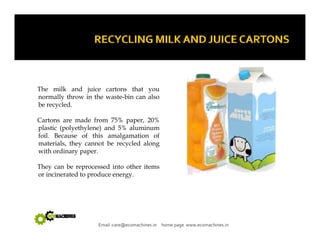
The milk and juice cartons that you 
normally throw in the waste-bin can also 
be recycled. 
Cartons are made from 75% paper, 20% 
plastic (polyethylene) and 5% aluminum 
foil. Because of this amalgamation of 
materials, they cannot be recycled along 
with ordinary paper. 
They can be reprocessed into other items 
or incinerated to produce energy. 
Email :care@ecomachines.in home page www.ecomachines.in
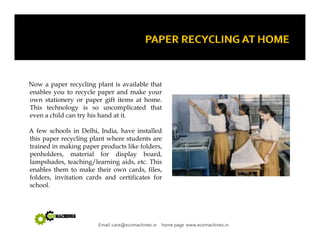
Now a paper recycling plant is available that 
enables you to recycle paper and make your 
own stationery or paper gift items at home. 
This technology is so uncomplicated that 
even a child can try his hand at it. 
A few schools in Delhi, India, have installed 
this paper recycling plant where students are 
trained in making paper products like folders, 
penholders, material for display board, 
lampshades, teaching/learning aids, etc. This 
enables them to make their own cards, files, 
folders, invitation cards and certificates for 
school. 
Email :care@ecomachines.in home page www.ecomachines.in
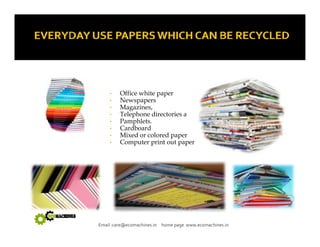
• Office white paper 
• Newspapers 
•• Magazines, 
• Telephone directories a 
• Pamphlets. 
• Cardboard 
• Mixed or colored paper 
• Computer print out paper 
Email :care@ecomachines.in home page www.ecomachines.in
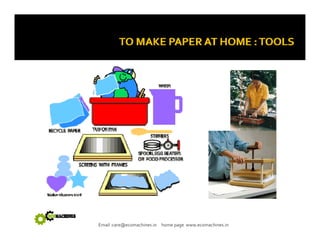
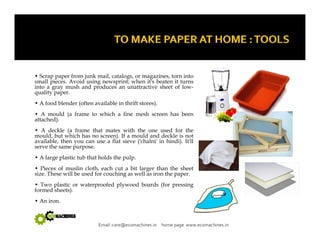
• Scrap paper from junk mail, catalogs, or magazines, torn into 
small pieces. Avoid using newsprint; when it's beaten it turns 
into a gray mush and produces an unattractive sheet of low-quality 
paper. 
• A food blender (often available in thrift stores). 
• A mould (a frame to which a fine mesh screen has been 
attached). 
• A deckle (a frame that mates with the one used for the 
mould, but which has no ) 
screen). If a mould and deckle is not 
l bl available, h then you can use a fl flat sieve ( ('h l chalni' in h d) hindi). ll 
It'll 
serve the same purpose. 
• A large plastic tub that holds the pulp. 
• Pieces of muslin cloth, each cut a bit larger than the sheet 
size. These will be used for couching as well as iron the paper. 
• Two plastic or waterproofed plywood boards (for pressing 
formed sheets). 
• An iron 
Email :care@ecomachines.in home page www.ecomachines.in 
iron.
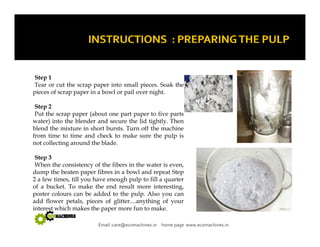
Step 1 
Tear or cut the scrap paper into small pieces. Soak the 
pieces of scrap paper in a bowl or pail over night. 
Step 2 
Put the scrap paper (about one part paper to five parts 
water) into the blender and secure the lid tightly. Then 
blend the mixture in short bursts. Turn off the machine 
from time to time and check to make sure the pulp is 
not collecting around the blade. 
Step 3 
When the consistency of the fibers in the water is even, 
dump the beaten paper fibres in a bowl and repeat Step 
2 a few times, till you have enough pulp to fill a quarter 
of a bucket. To make the end result more interesting, 
poster colours can be added to the pulp. Also you can 
add flower petals petals, pieces of glitter glitter....anything of your 
interest which makes the paper more fun to make. 
Email :care@ecomachines.in home page www.ecomachines.in
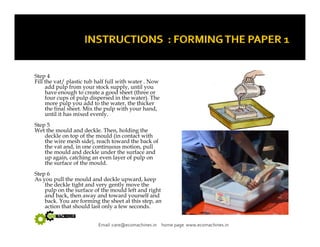
Step 4 
Fill the vat/ plastic tub half full with water . Now 
add pulp from your stock supply, until you 
have enough to create a good sheet (three or 
four cups of pulp dispersed in the water). The 
more pulp you add to the water, the thicker 
the final sheet. Mix the pulp with your hand, 
until it has mixed evenly. 
Step 5 
Wet the mould and deckle. Then, holding the 
deckle on p top of the mould ( 
in contact with 
h h d ) h d h b k f 
the wire mesh side), reach toward the back of 
the vat and, in one continuous motion, pull 
the mould and deckle under the surface and 
up again, catching an even layer of pulp on 
the surface of the mould. 
Step 6 
As you pull the mould and deckle upward, keep 
the deckle tight and very gently move the 
pulp on the surface of the mould left and right 
and back, then away and toward yourself and 
back You are forming the sheet at this step an 
back. step, action that should last only a few seconds. 
Email :care@ecomachines.in home page www.ecomachines.in
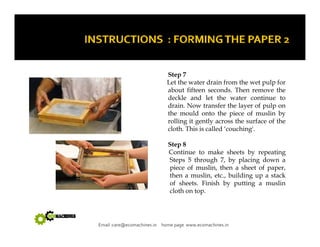
Step 7 
Let the water drain from the wet pulp for 
about fifteen seconds. Then remove the 
deckle and let the water continue to 
drain. Now transfer the layer of pulp on 
the mould onto the piece of muslin by 
rolling it gently across the surface of the 
cloth. This is called ‘couching'. 
Step 8 
Continue to make sheets by repeating 
Steps 5 through 7, by placing down a 
piece of muslin, then a sheet of paper, 
then a muslin, etc., building up a stack 
of sheets. Finish by putting a muslin 
cloth on top. 
Email :care@ecomachines.in home page www.ecomachines.in
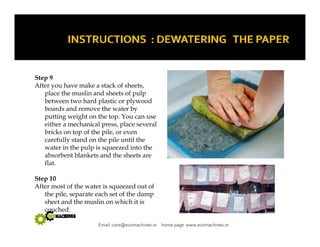
Step 9 
After you have make a stack of sheets, 
place the muslin and sheets of pulp 
between two hard plastic or plywood 
boards and remove the water by 
putting weight on the top. You can use 
either a mechanical press, place several 
bricks on top of the pile, or even 
carefully stand on the pile until the 
water in the pulp is squeezed into the 
absorbent blankets and the sheets are 
flat. 
Step 10 
After most of the water is squeezed out of 
the pile, separate each set of the damp 
sheet and the muslin on which it is 
Email :care@ecomachines.in home page www.ecomachines.in 
couched.
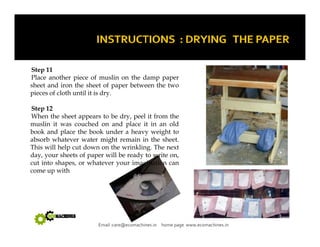
Step 11 
Place another piece of muslin on the damp paper 
sheet and iron the sheet of paper between the two 
pieces of cloth until it is dry. 
Step 12 
When the sheet appears to be dry, peel it from the 
muslin it was couched on and place it in an old 
book and place the book under a heavy weight to 
absorb whatever water might remain in the sheet. 
This will help cut down on the wrinkling. The next 
day, your sheets of paper will be ready to write on, 
cut into shapes, or whatever your imagination can 
come up with 
Email :care@ecomachines.in home page www.ecomachines.in

Paper making simplified

  • 1.
  • 2.
    Industry and businessesprovide almost half the amount of recovered paper in the form of cuttings/shavings and unsold newspapers/magazines. Households contribute over a third. Almost any household paper, including used newspapers, cardboard, packaging, stationery, direct mail, magazines, catalogues, greeting cards and wrapping paper, can be recycled. Recovered paper compares favorably with the production of wood-based pulp made by chemical or mechanical means in terms of environmental pollution and energy consumption consumption. Email :care@ecomachines.in home page www.ecomachines.in
  • 3.
    The milk andjuice cartons that you normally throw in the waste-bin can also be recycled. Cartons are made from 75% paper, 20% plastic (polyethylene) and 5% aluminum foil. Because of this amalgamation of materials, they cannot be recycled along with ordinary paper. They can be reprocessed into other items or incinerated to produce energy. Email :care@ecomachines.in home page www.ecomachines.in
  • 4.
    Now a paperrecycling plant is available that enables you to recycle paper and make your own stationery or paper gift items at home. This technology is so uncomplicated that even a child can try his hand at it. A few schools in Delhi, India, have installed this paper recycling plant where students are trained in making paper products like folders, penholders, material for display board, lampshades, teaching/learning aids, etc. This enables them to make their own cards, files, folders, invitation cards and certificates for school. Email :care@ecomachines.in home page www.ecomachines.in
  • 5.
    • Office whitepaper • Newspapers •• Magazines, • Telephone directories a • Pamphlets. • Cardboard • Mixed or colored paper • Computer print out paper Email :care@ecomachines.in home page www.ecomachines.in
  • 6.
    Email :care@ecomachines.in homepage www.ecomachines.in
  • 7.
    • Scrap paperfrom junk mail, catalogs, or magazines, torn into small pieces. Avoid using newsprint; when it's beaten it turns into a gray mush and produces an unattractive sheet of low-quality paper. • A food blender (often available in thrift stores). • A mould (a frame to which a fine mesh screen has been attached). • A deckle (a frame that mates with the one used for the mould, but which has no ) screen). If a mould and deckle is not l bl available, h then you can use a fl flat sieve ( ('h l chalni' in h d) hindi). ll It'll serve the same purpose. • A large plastic tub that holds the pulp. • Pieces of muslin cloth, each cut a bit larger than the sheet size. These will be used for couching as well as iron the paper. • Two plastic or waterproofed plywood boards (for pressing formed sheets). • An iron Email :care@ecomachines.in home page www.ecomachines.in iron.
  • 8.
    Step 1 Tearor cut the scrap paper into small pieces. Soak the pieces of scrap paper in a bowl or pail over night. Step 2 Put the scrap paper (about one part paper to five parts water) into the blender and secure the lid tightly. Then blend the mixture in short bursts. Turn off the machine from time to time and check to make sure the pulp is not collecting around the blade. Step 3 When the consistency of the fibers in the water is even, dump the beaten paper fibres in a bowl and repeat Step 2 a few times, till you have enough pulp to fill a quarter of a bucket. To make the end result more interesting, poster colours can be added to the pulp. Also you can add flower petals petals, pieces of glitter glitter....anything of your interest which makes the paper more fun to make. Email :care@ecomachines.in home page www.ecomachines.in
  • 9.
    Step 4 Fillthe vat/ plastic tub half full with water . Now add pulp from your stock supply, until you have enough to create a good sheet (three or four cups of pulp dispersed in the water). The more pulp you add to the water, the thicker the final sheet. Mix the pulp with your hand, until it has mixed evenly. Step 5 Wet the mould and deckle. Then, holding the deckle on p top of the mould ( in contact with h h d ) h d h b k f the wire mesh side), reach toward the back of the vat and, in one continuous motion, pull the mould and deckle under the surface and up again, catching an even layer of pulp on the surface of the mould. Step 6 As you pull the mould and deckle upward, keep the deckle tight and very gently move the pulp on the surface of the mould left and right and back, then away and toward yourself and back You are forming the sheet at this step an back. step, action that should last only a few seconds. Email :care@ecomachines.in home page www.ecomachines.in
  • 10.
    Step 7 Letthe water drain from the wet pulp for about fifteen seconds. Then remove the deckle and let the water continue to drain. Now transfer the layer of pulp on the mould onto the piece of muslin by rolling it gently across the surface of the cloth. This is called ‘couching'. Step 8 Continue to make sheets by repeating Steps 5 through 7, by placing down a piece of muslin, then a sheet of paper, then a muslin, etc., building up a stack of sheets. Finish by putting a muslin cloth on top. Email :care@ecomachines.in home page www.ecomachines.in
  • 11.
    Step 9 Afteryou have make a stack of sheets, place the muslin and sheets of pulp between two hard plastic or plywood boards and remove the water by putting weight on the top. You can use either a mechanical press, place several bricks on top of the pile, or even carefully stand on the pile until the water in the pulp is squeezed into the absorbent blankets and the sheets are flat. Step 10 After most of the water is squeezed out of the pile, separate each set of the damp sheet and the muslin on which it is Email :care@ecomachines.in home page www.ecomachines.in couched.
  • 12.
    Step 11 Placeanother piece of muslin on the damp paper sheet and iron the sheet of paper between the two pieces of cloth until it is dry. Step 12 When the sheet appears to be dry, peel it from the muslin it was couched on and place it in an old book and place the book under a heavy weight to absorb whatever water might remain in the sheet. This will help cut down on the wrinkling. The next day, your sheets of paper will be ready to write on, cut into shapes, or whatever your imagination can come up with Email :care@ecomachines.in home page www.ecomachines.in
  • 13.
    Email :care@ecomachines.in homepage www.ecomachines.in