How do we inspire...
  Writing for meaning and pleasure?


 Ideas from educators,
   working with children
    across the globe.


  Collated by Martin Waller
        with contributions from
      educators around the world
This is a crowd-sourced
     presentation...
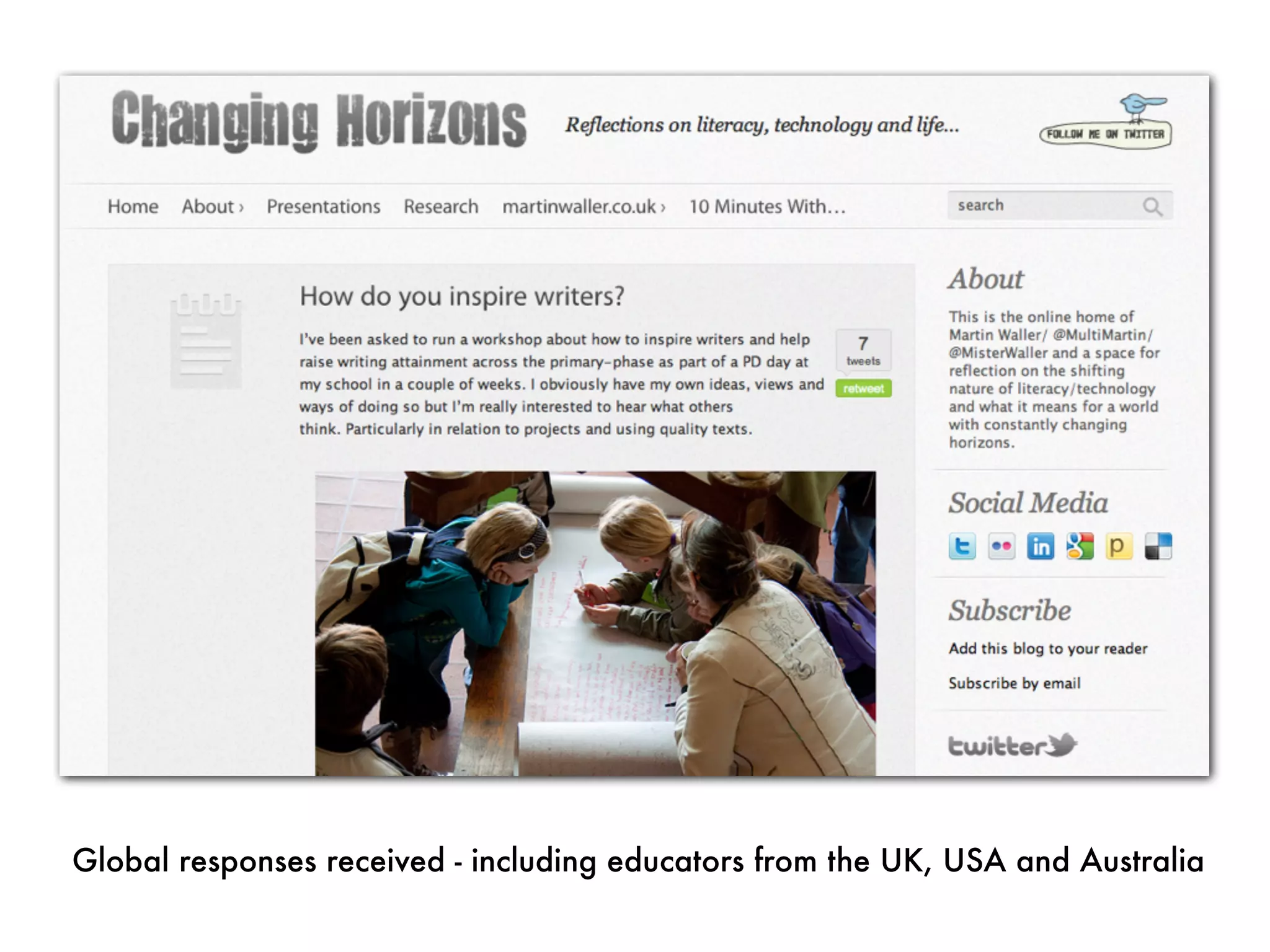
Global responses received - including educators from the UK, USA and Australia
Many thanks to...               Kevin Mc Laughlin                     Susie Arnott
                                 Primary School Teacher
            Bill Lord                                             Fiona Johnson
        Literacy Advisor        Mrs Davies                           Primary Teacher
                                Primary Teacher
D. Weston                                               James Mansell
                        Rachel Orr                         Primary Teacher
                   Primary Headteacher
                                         David Mitchell
                                          Primary Deputy
                                           Headteacher
                                                                Andrew Lambirth
                                                                 Professor of Education

                                              Bev Evans
                                              Primary Teacher              ‘Fibe’
                                                                    Primary Headteacher

                                          Marlise Witham
                                         Elementary School Teacher


                                                        HikingArtist.com
                                                  For illustrations used in this resource
The issue ‘of’ writing?
	

  Or issues ‘with’
  	 	 	 	 writing?


	 	 Literacy Policy
	 and Policy Literacy


The rocky road of teaching writing...
And there’s no magic
     formula...
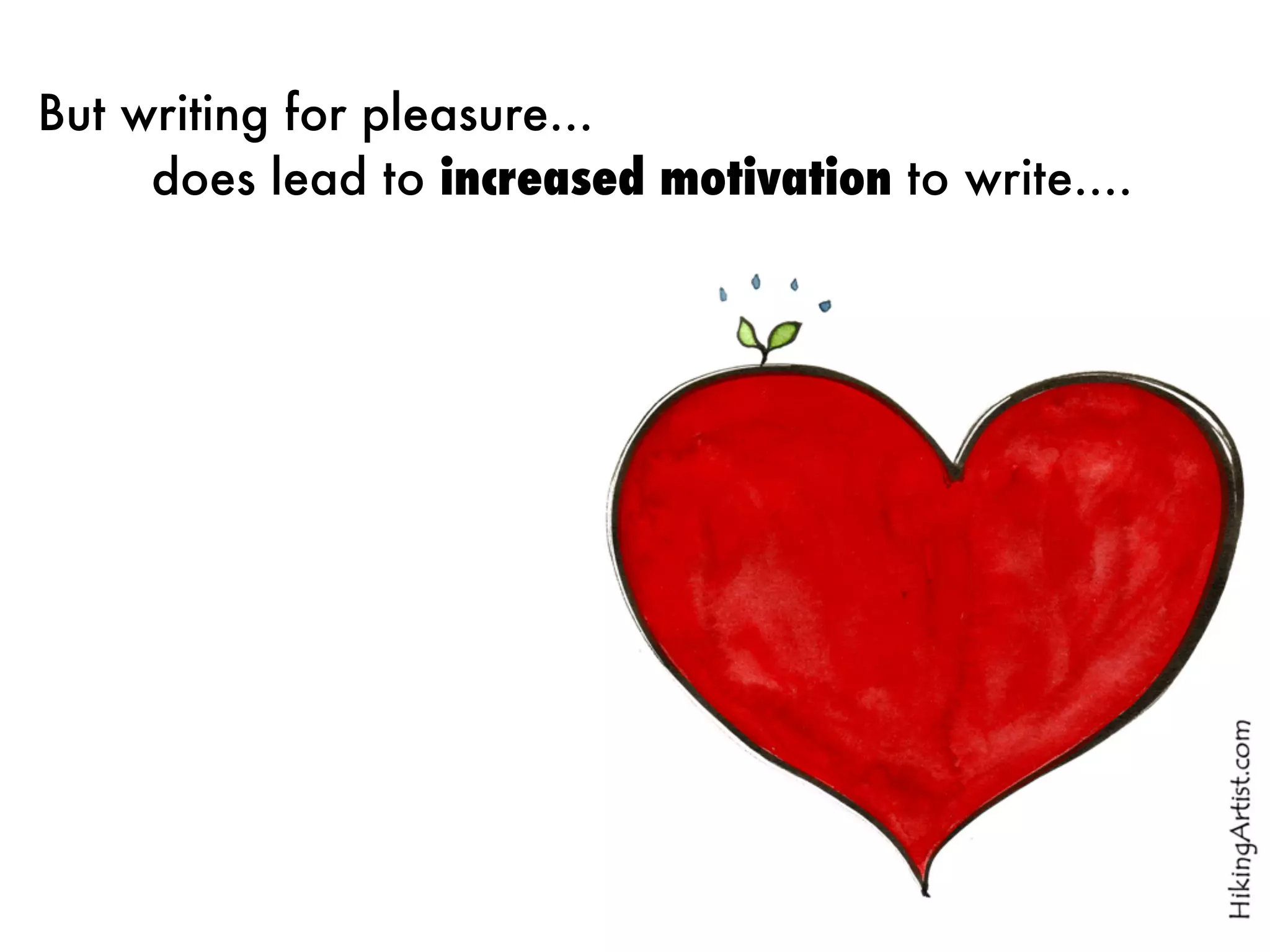
But writing for pleasure...
	 	 does lead to increased motivation to write....
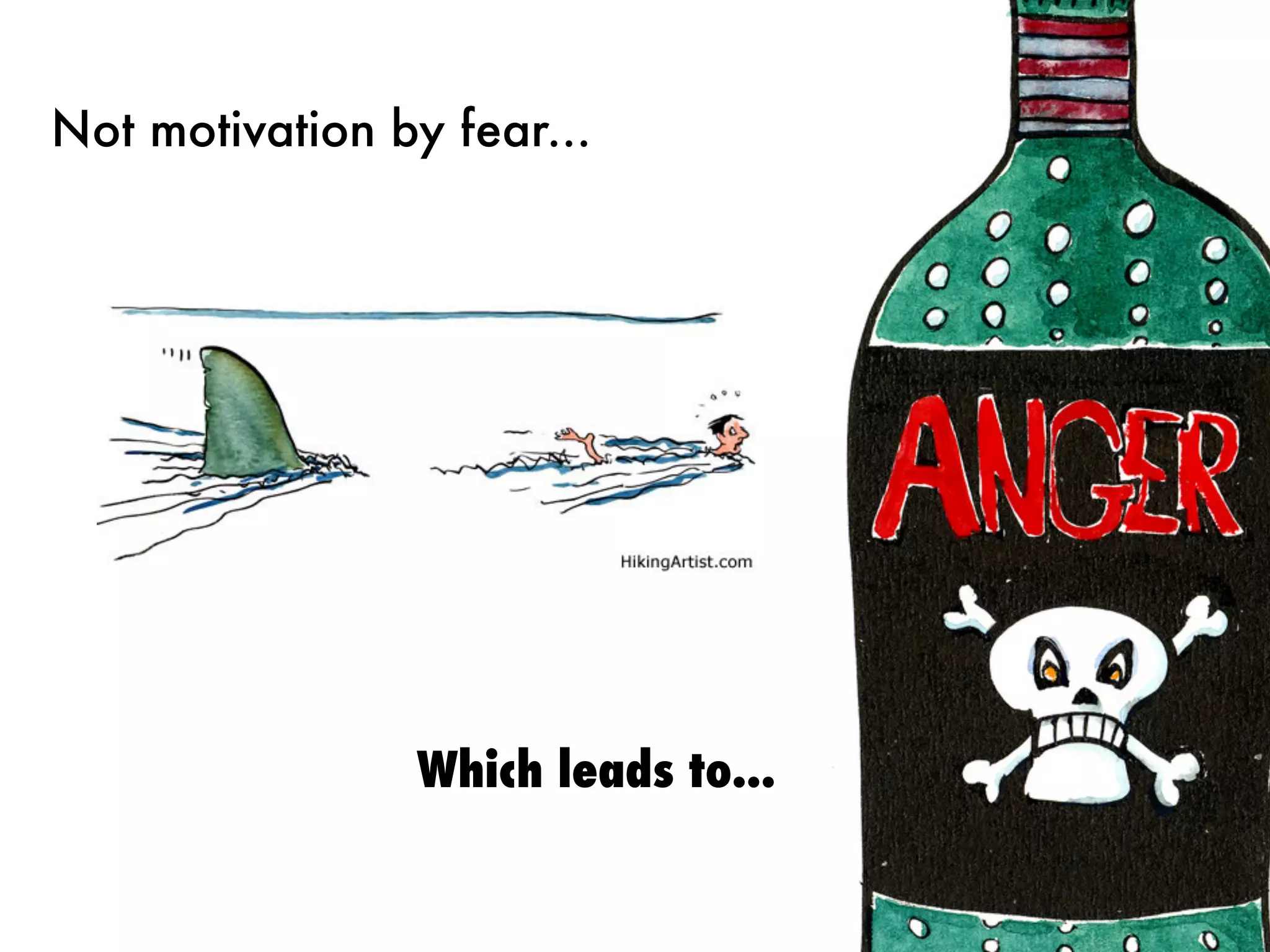
Not motivation by fear...


                Which leads to...
How do we develop writing for pleasure while
       raising writing achievement?
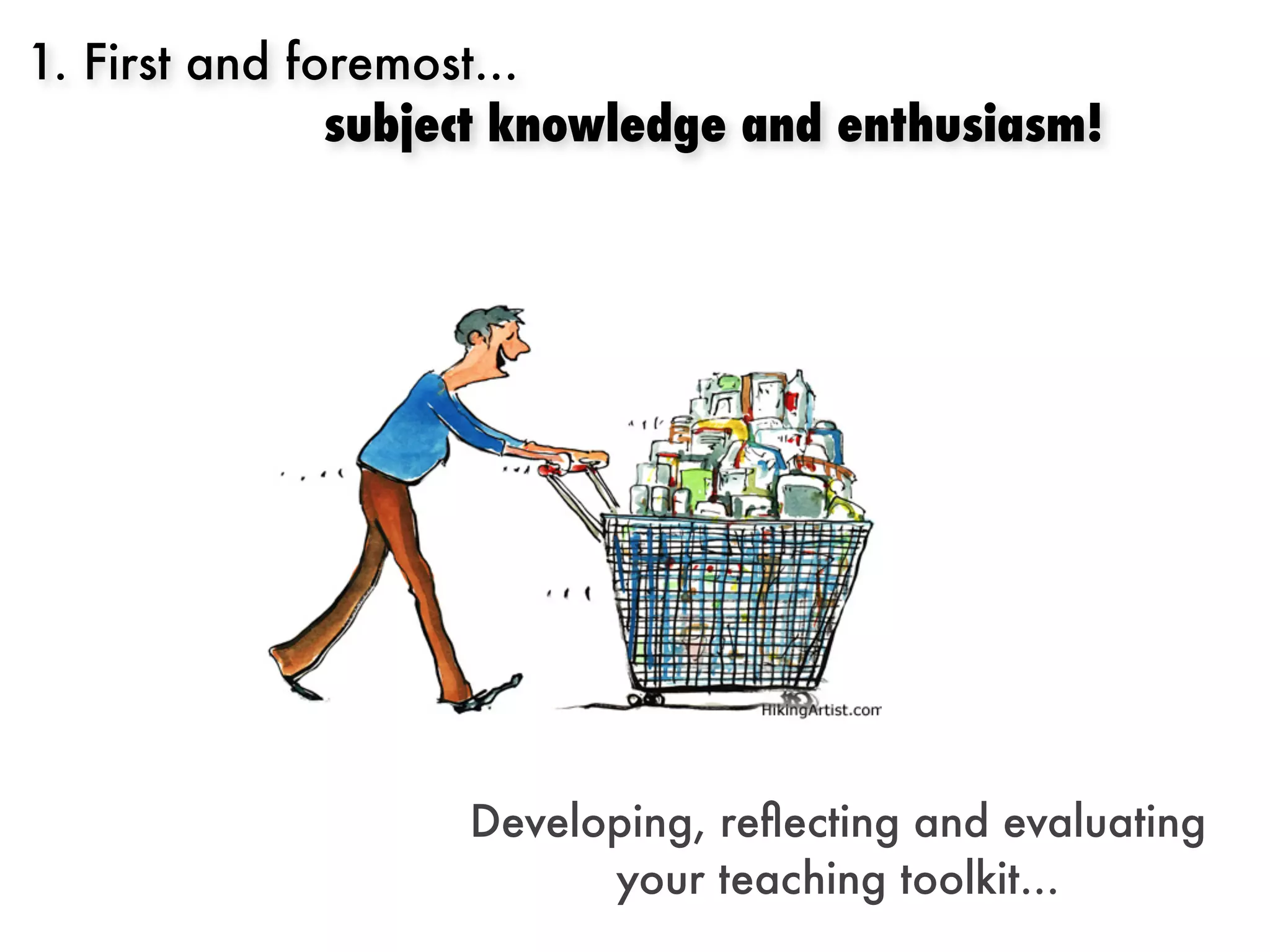
1. First and foremost...
               subject knowledge and enthusiasm!


                   Developing, reflecting and evaluating
                         your teaching toolkit...
2. Play with Language


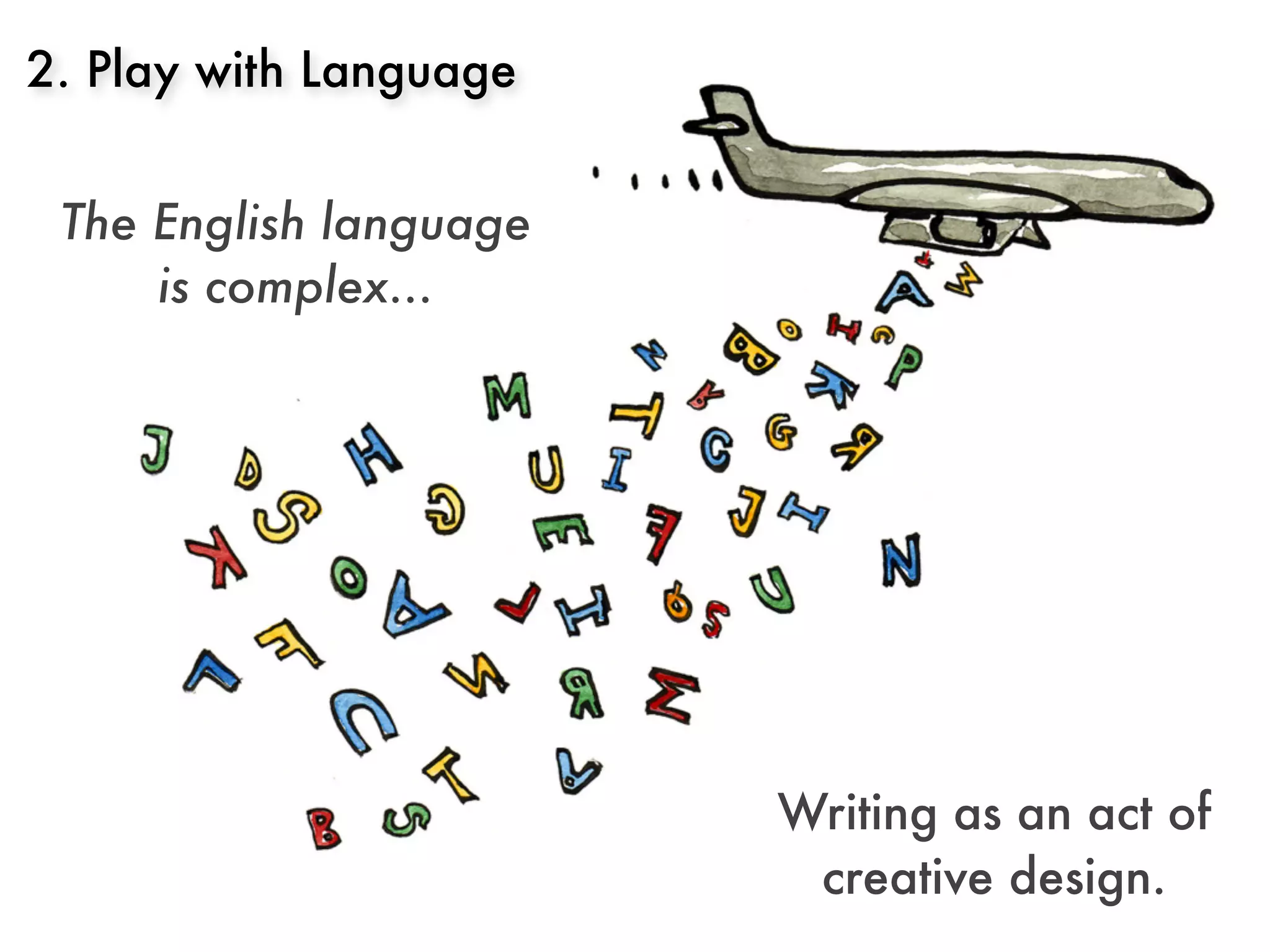
 The English language
     is complex...


                        Writing as an act of
                         creative design.
2. Play with Language


  “They need time too. Time to redraft and, yes, be
  allowed to make errors in transcription as they
  become absorbed in their compositions - knowing,
  depending on their age and experience, that
  further down the line they will need to proof read.
  Children become aware that there is a process to
  writing - it is rarely completed in one sitting.
  	 	
  - Andrew Lambirth (via blog)
3. Talk for writing...   (Rachel Orr via blog)


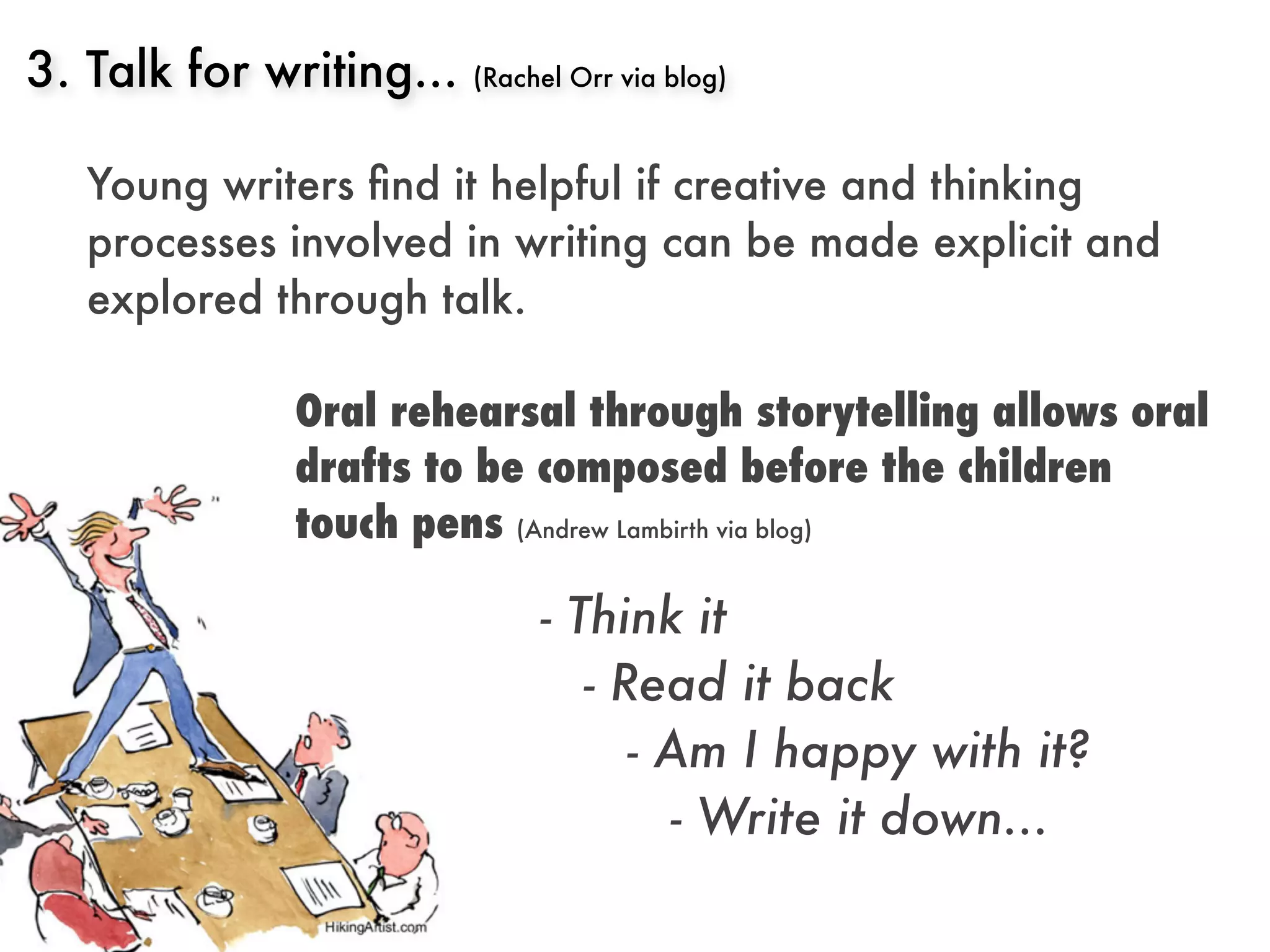
   Young writers find it helpful if creative and thinking
   processes involved in writing can be made explicit and
   explored through talk.

             Oral rehearsal through storytelling allows oral
             drafts to be composed before the children
             touch pens (Andrew Lambirth via blog)

                              - Think it
                                 - Read it back
                                    - Am I happy with it?
                                       - Write it down...
4. Allow for speaking, listening and drama...

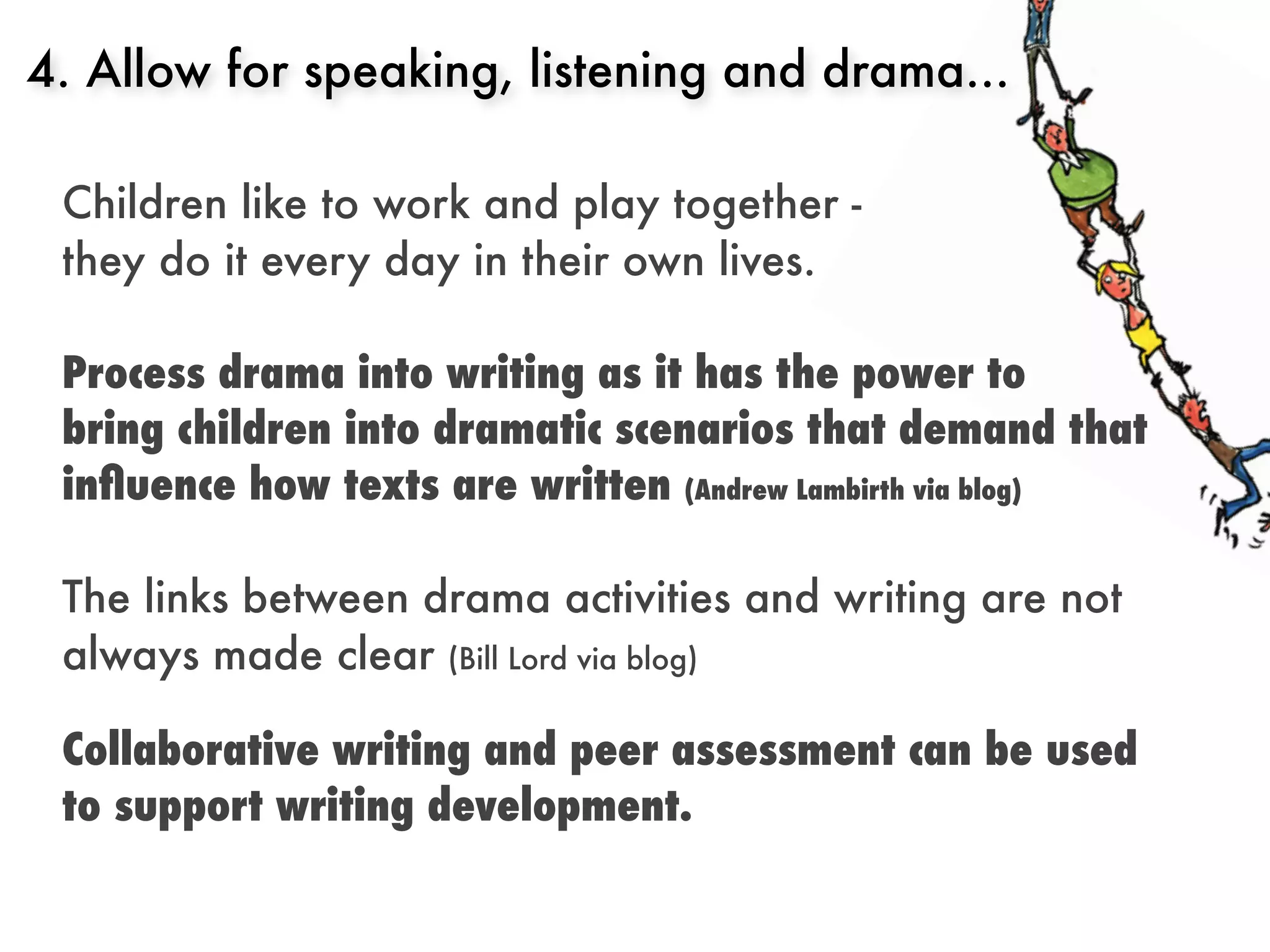
 Children like to work and play together -
 they do it every day in their own lives.

 Process drama into writing as it has the power to
 bring children into dramatic scenarios that demand that
 influence how texts are written (Andrew Lambirth via blog)

 The links between drama activities and writing are not
 always made clear (Bill Lord via blog)

 Collaborative writing and peer assessment can be used
 to support writing development.
5. Use quality texts...

 “Texts teach what readers’ learn” (Meek, 1987)

 ‘Recommended’ texts are not always best suited to a
 particular class or school.

 “Books must be enjoyed in their entirety not just as
 snippets” (Kevin Mc Laughlin via email)

 Select texts that children
 will enjoy and will want
 to engage with.
5. Use quality texts...


                            “Read to the children so that they
                            have examples of good stories.
                            Studying fragments of grammar such
                            as adverbial phrases is all very well
                            but not if children haven’t come to
                            enjoy stories as a whole in the first
                            place” - D Weston (via blog)


Image by HikingArtist.com
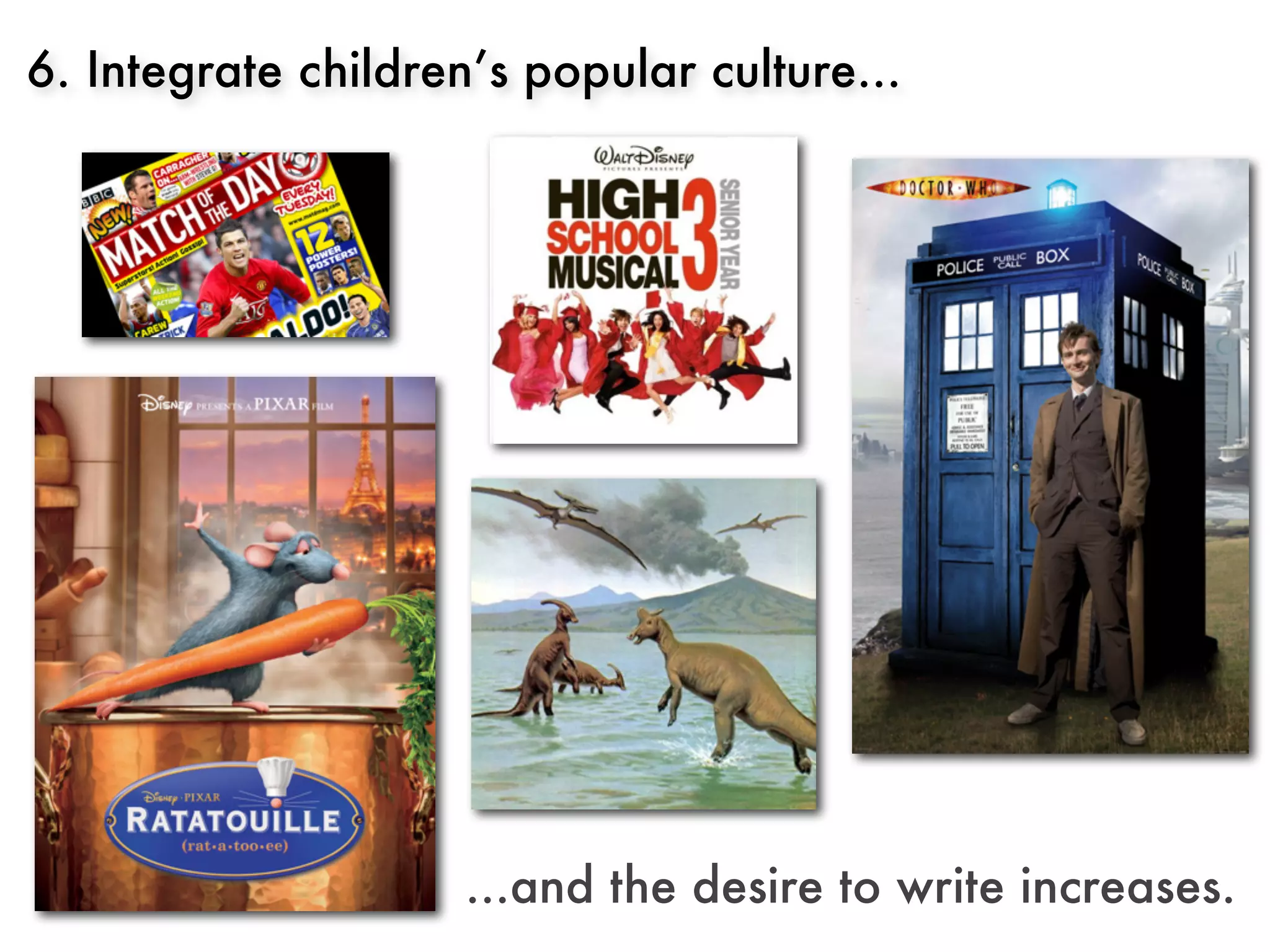
6. Integrate children’s popular culture...


                     ...and the desire to write increases.
6. Integrate children’s popular culture...              Focus on
                                                 Holy Trinity Rosehill
                                                  Primary School

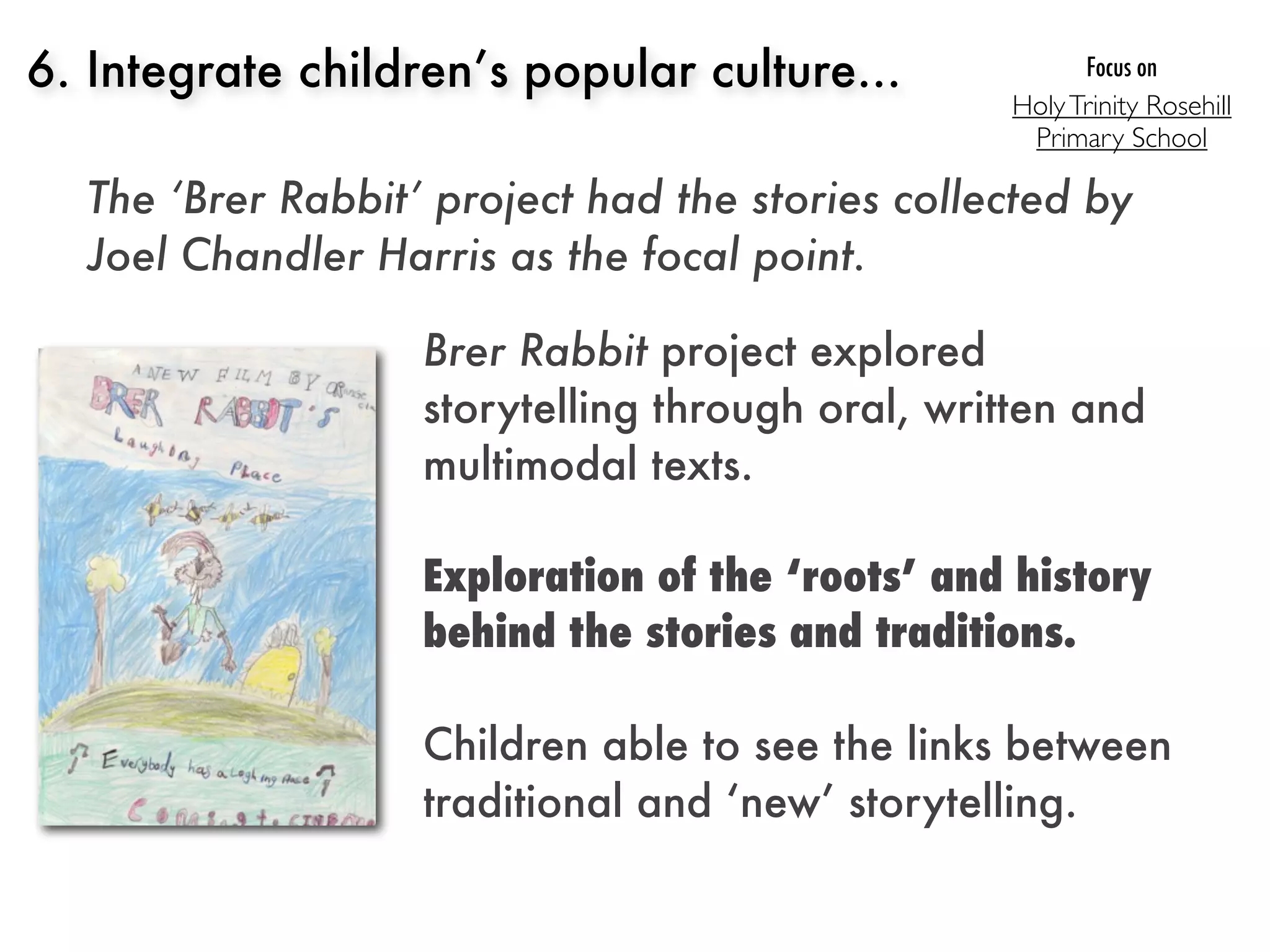
  The ‘Brer Rabbit’ project had the stories collected by
  Joel Chandler Harris as the focal point.

                   Brer Rabbit project explored
                   storytelling through oral, written and
                   multimodal texts.

                   Exploration of the ‘roots’ and history
                   behind the stories and traditions.

                   Children able to see the links between
                   traditional and ‘new’ storytelling.
6. Integrate children’s popular
culture...


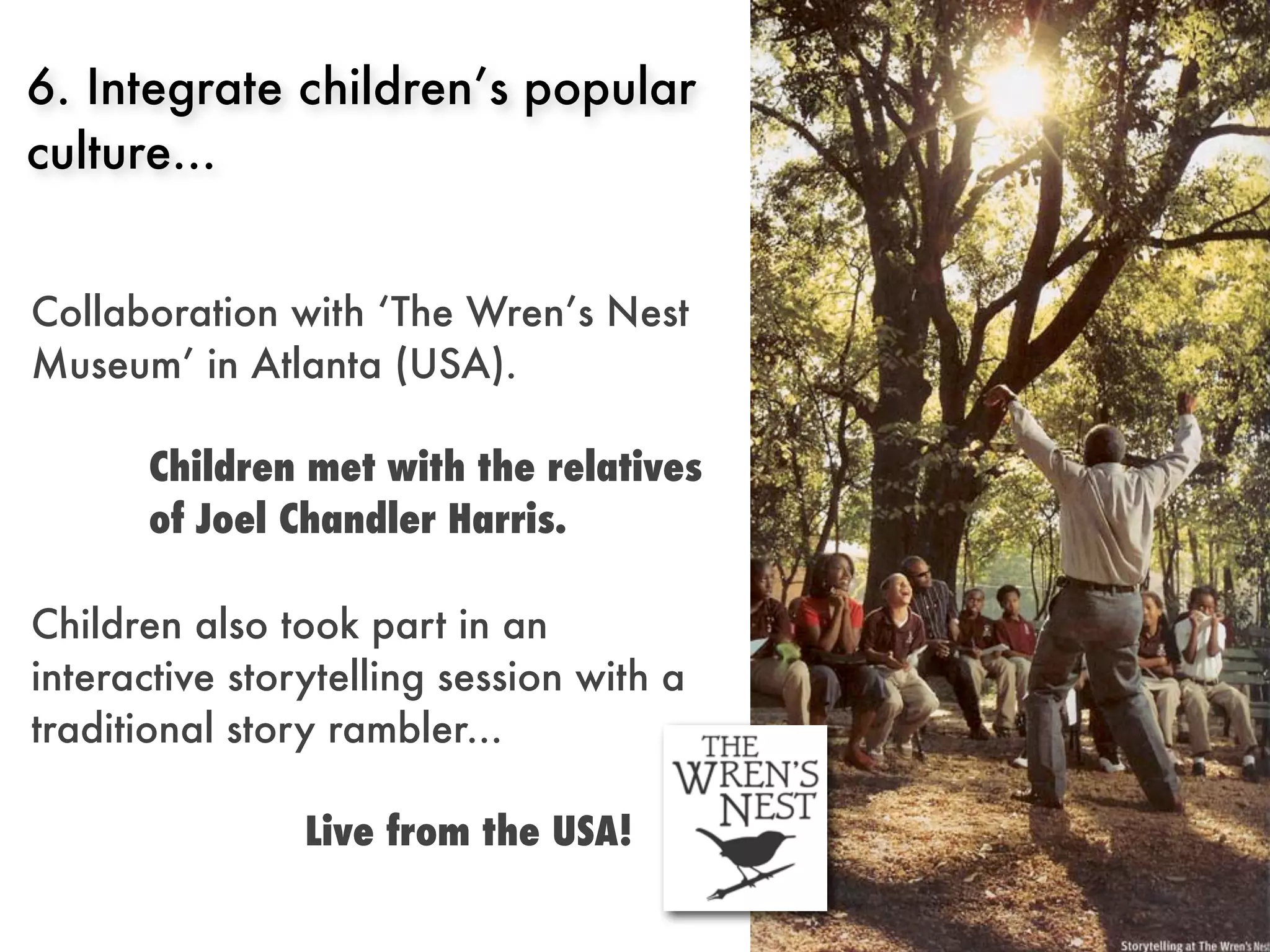
Collaboration with ‘The Wren’s Nest
Museum’ in Atlanta (USA).

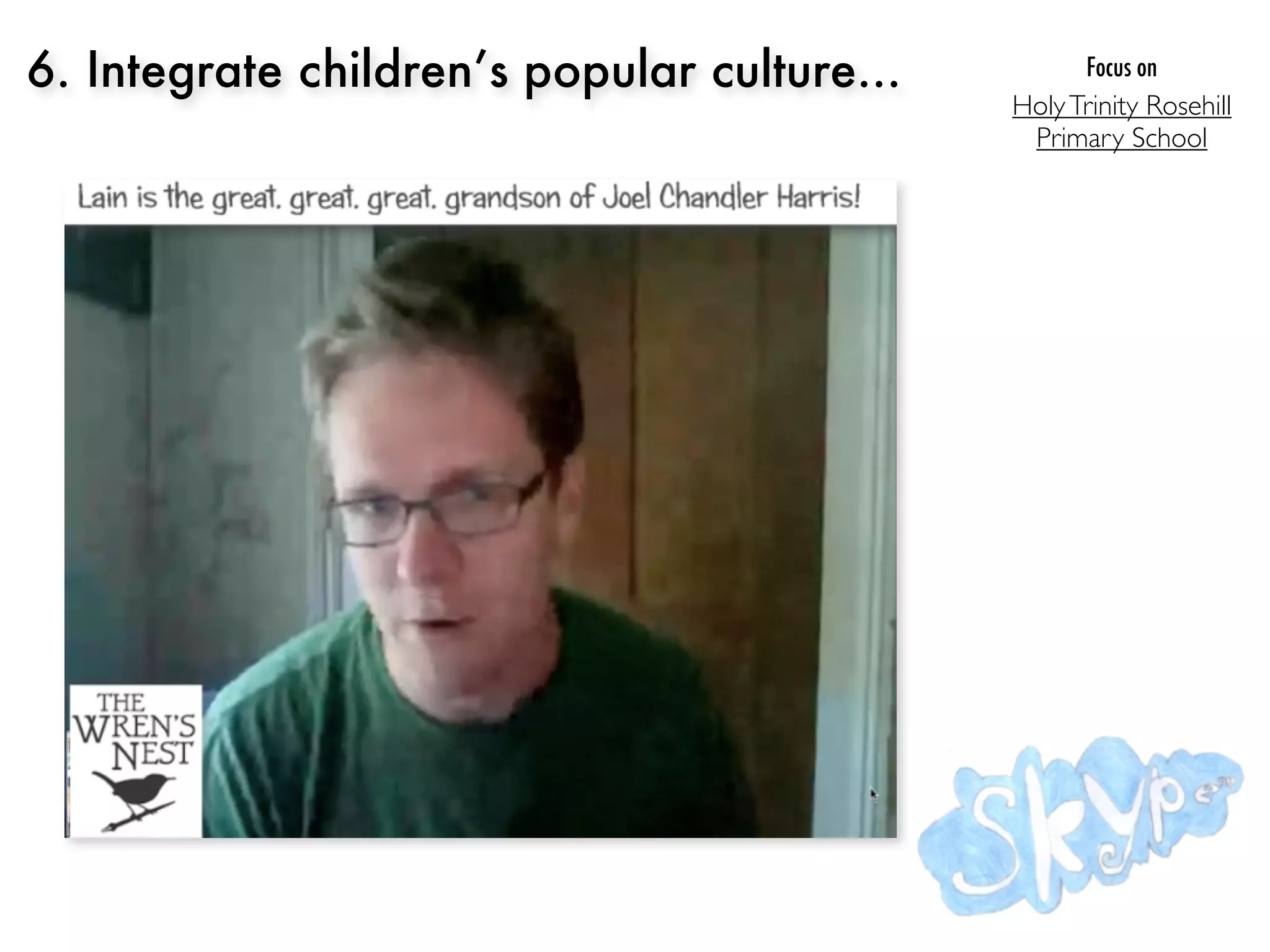
       Children met with the relatives
       of Joel Chandler Harris.

Children also took part in an
interactive storytelling session with a
traditional story rambler...

                Live from the USA!
6. Integrate children’s popular culture...          Focus on
                                             Holy Trinity Rosehill
                                              Primary School
7. Recognise and integrate digital technologies...

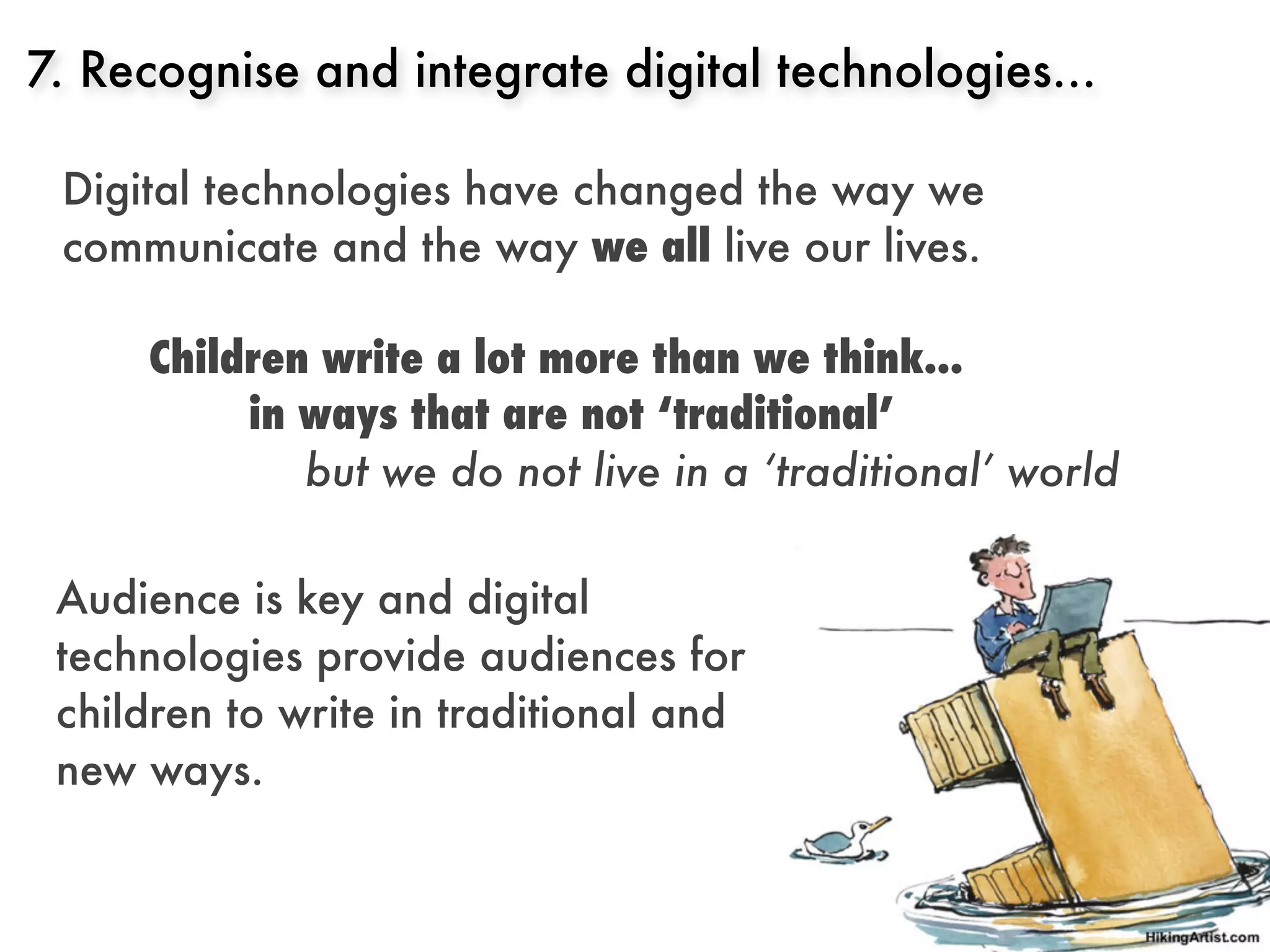
 Digital technologies have changed the way we
 communicate and the way we all live our lives.

     Children write a lot more than we think...
          in ways that are not ‘traditional’
             but we do not live in a ‘traditional’ world

 Audience is key and digital
 technologies provide audiences for
 children to write in traditional and
 new ways.
7. Recognise and integrate digital technologies...
                                                    Focus on
                                             Holy Trinity Rosehill
                                              Primary School


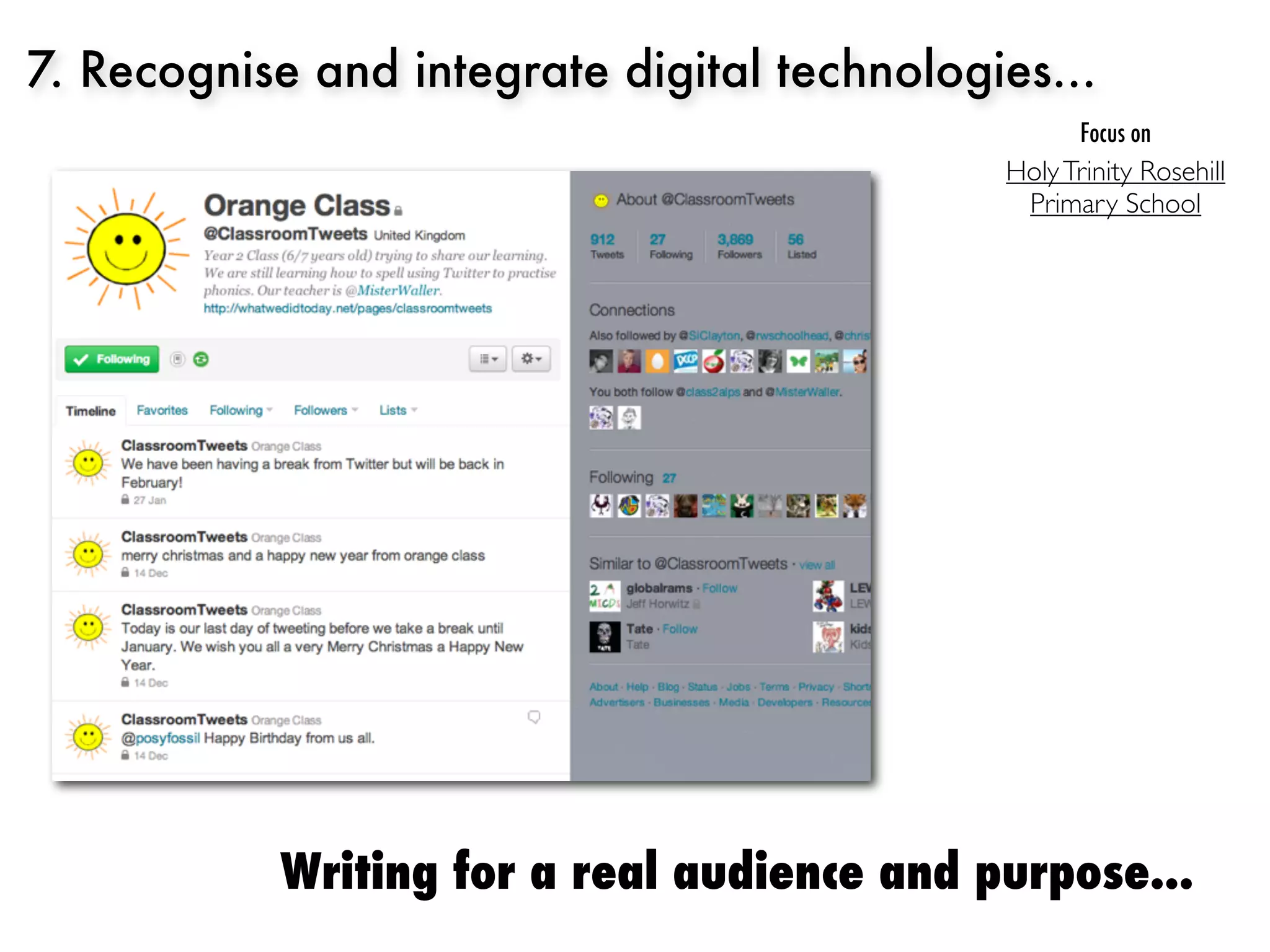
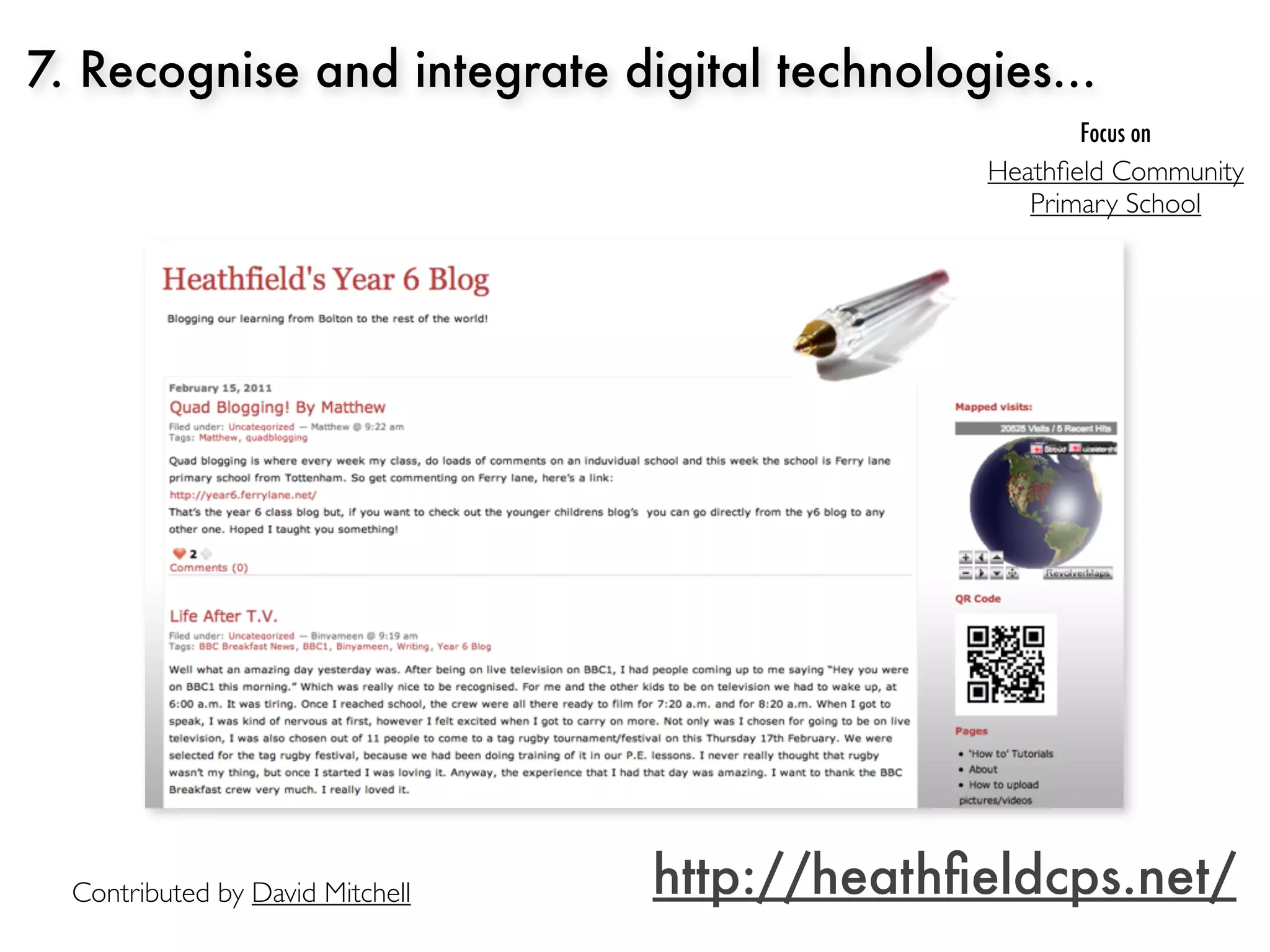
           Writing for a real audience and purpose...
7. Recognise and integrate digital technologies...
                                                      Focus on
                                                Heathfield Community
 A short term experiment of ‘blogging’ led         Primary School

 to a whole-school strategy for engaging writers.

 Boys engaged in the writing process. Blogging starts as
 early as Reception.

 Some children made two years progress in one
 academic year - 6.6 APS Progress per pupil.

 ‘SATS’ Level 5 scores have
 gone from 9% to 63%.

  Contributed by David Mitchell
7. Recognise and integrate digital technologies...
                                                     Focus on
                                               Heathfield Community
                                                  Primary School


  Contributed by David Mitchell   http://heathfieldcps.net/
8. Use meaningful contexts with children...

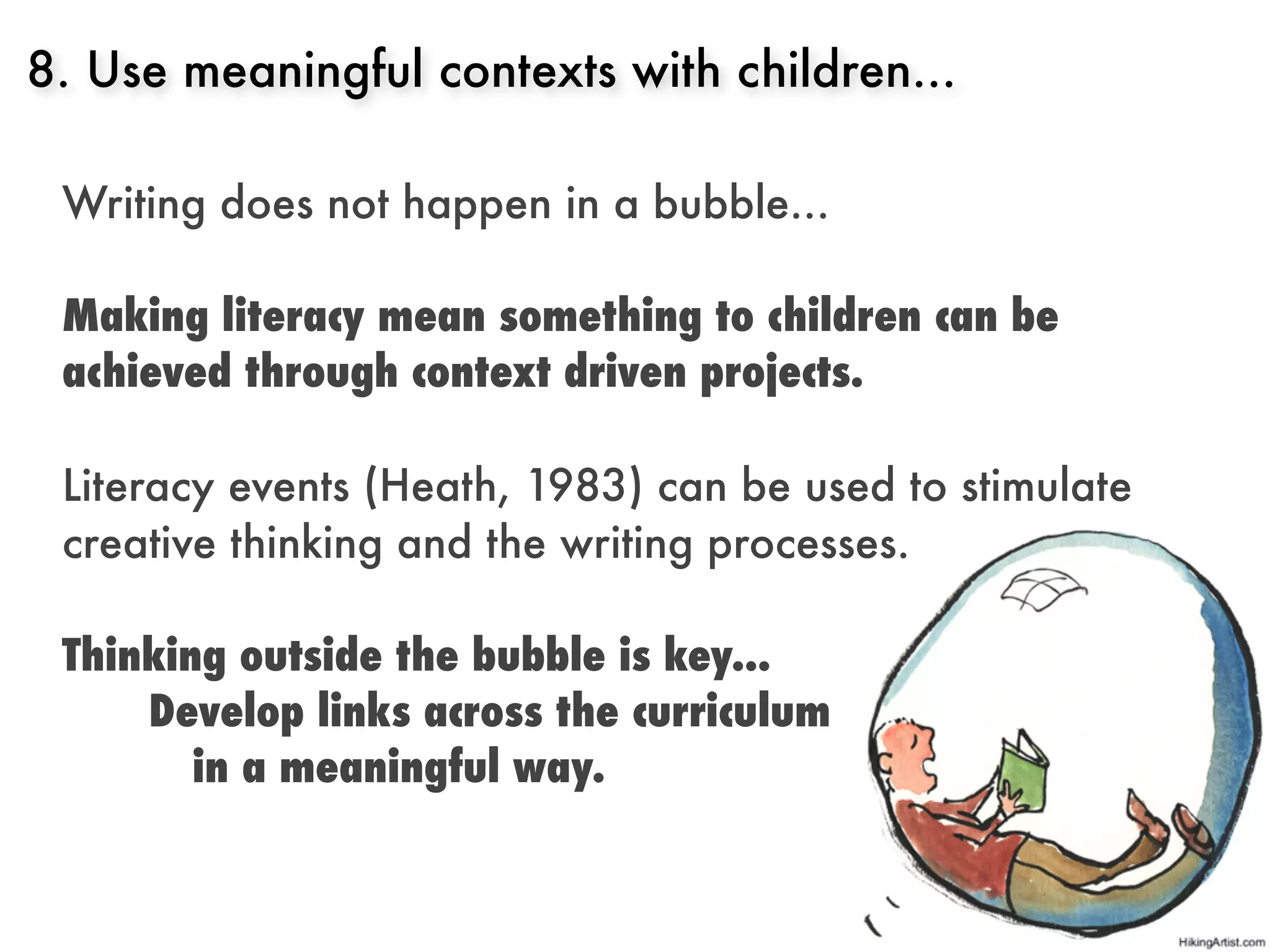
 Writing does not happen in a bubble...

 Making literacy mean something to children can be
 achieved through context driven projects.

 Literacy events (Heath, 1983) can be used to stimulate
 creative thinking and the writing processes.

 Thinking outside the bubble is key...
     Develop links across the curriculum
        in a meaningful way.
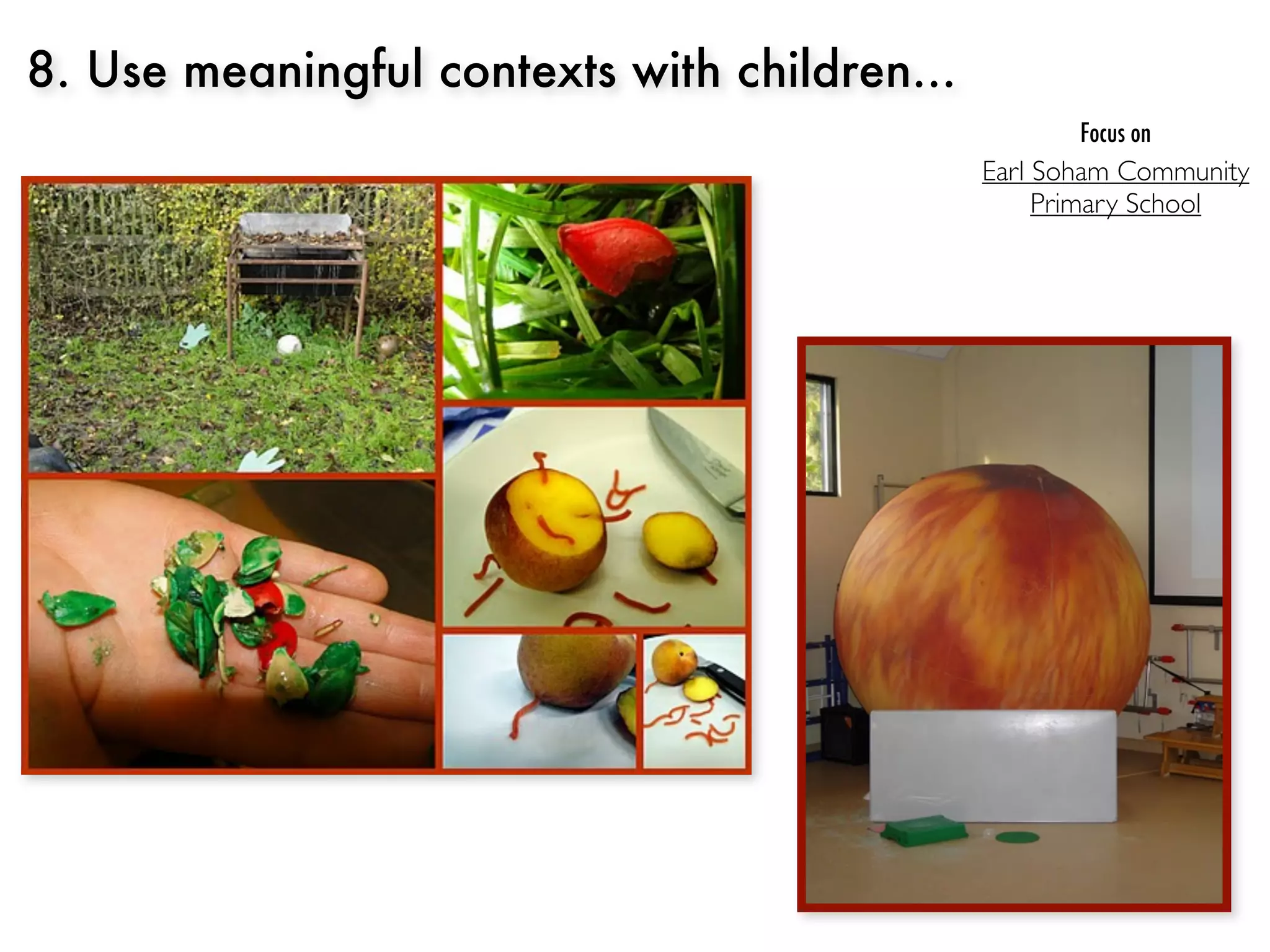
8. Use meaningful contexts with children...
                                                      Focus on
                                               Earl Soham Community
                                                    Primary School


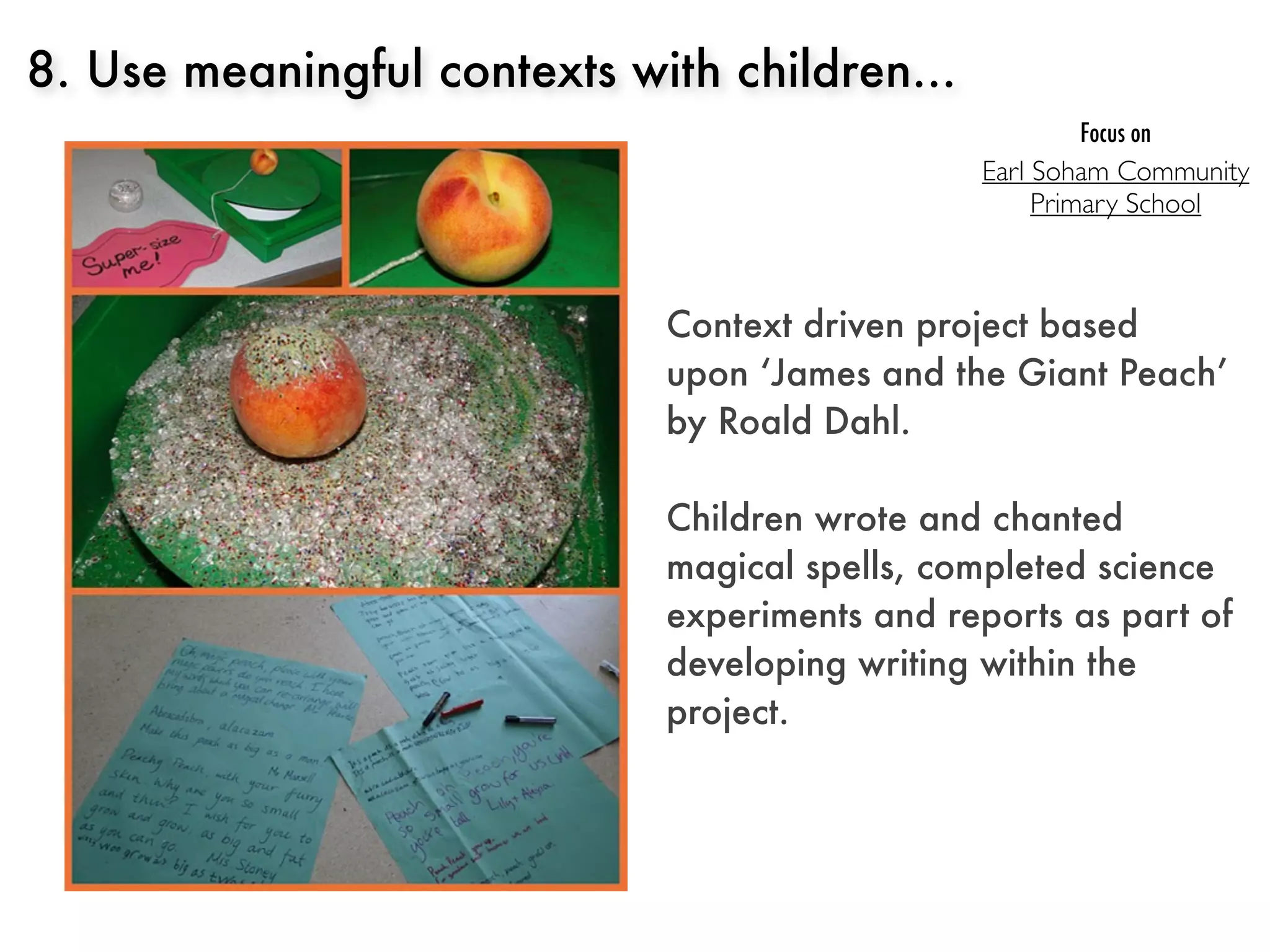
                             Context driven project based
                             upon ‘James and the Giant Peach’
                             by Roald Dahl.

                             Children wrote and chanted
                             magical spells, completed science
                             experiments and reports as part of
                             developing writing within the
                             project.
8. Use meaningful contexts with children...
                                                     Focus on
                                              Earl Soham Community
                                                   Primary School
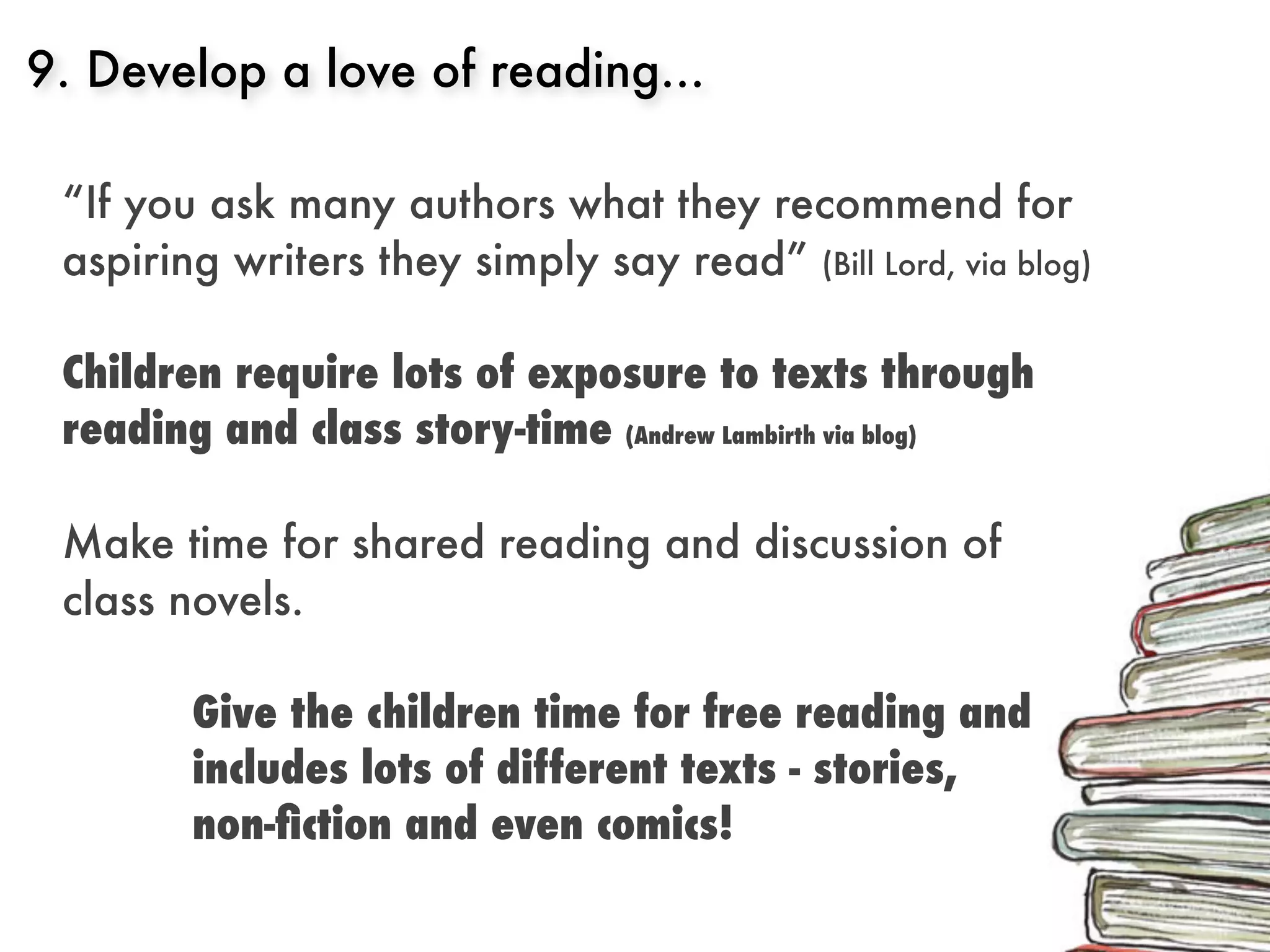
9. Develop a love of reading...

 “If you ask many authors what they recommend for
 aspiring writers they simply say read” (Bill Lord, via blog)

 Children require lots of exposure to texts through
 reading and class story-time (Andrew Lambirth via blog)

 Make time for shared reading and discussion of
 class novels.

        Give the children time for free reading and
        includes lots of different texts - stories,
        non-fiction and even comics!
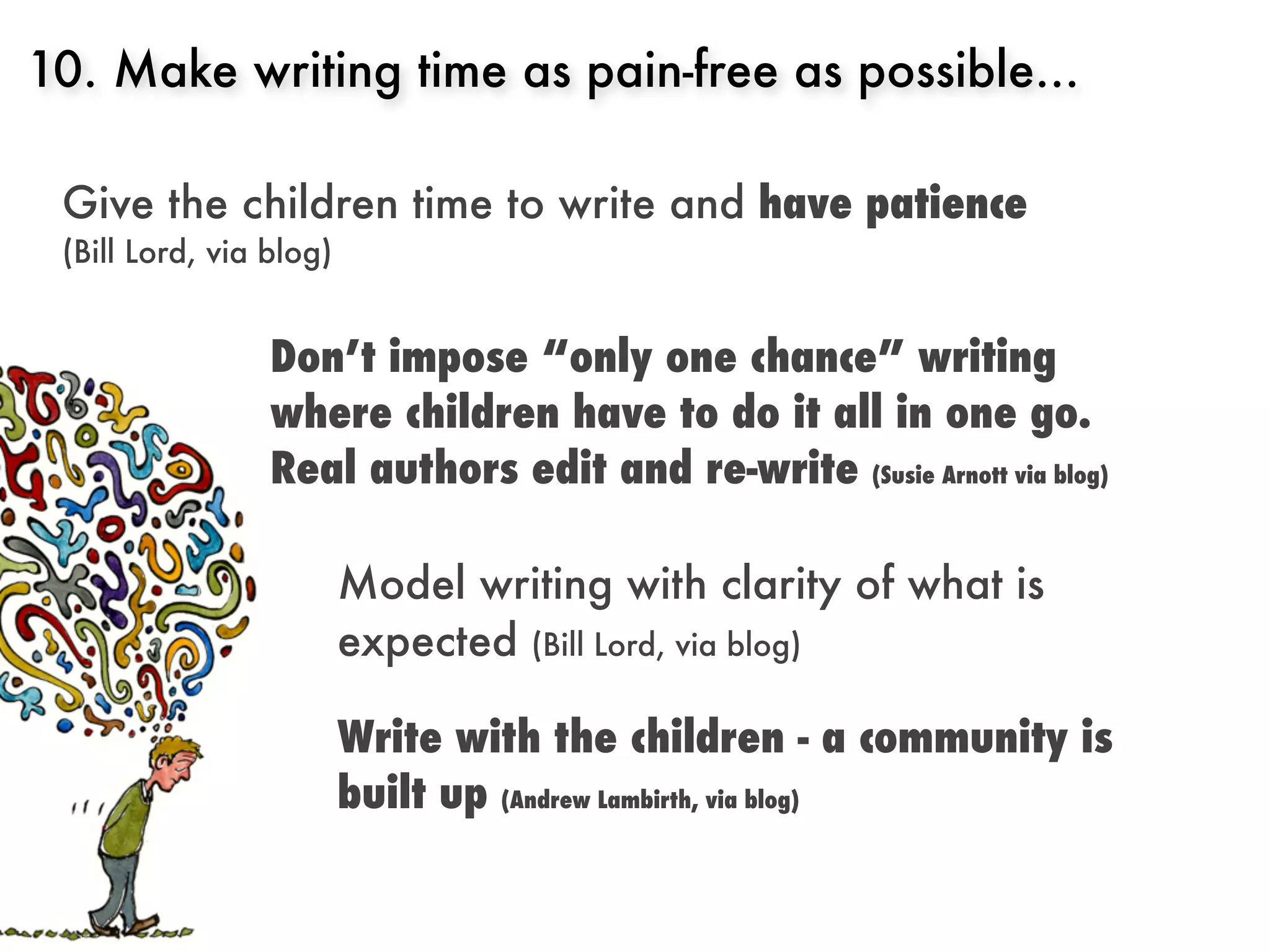
10. Make writing time as pain-free as possible...

 Give the children time to write and have patience
 (Bill Lord, via blog)


                 Don’t impose “only one chance” writing
                 where children have to do it all in one go.
                 Real authors edit and re-write (Susie Arnott via blog)

                         Model writing with clarity of what is
                         expected (Bill Lord, via blog)

                         Write with the children - a community is
                         built up (Andrew Lambirth, via blog)
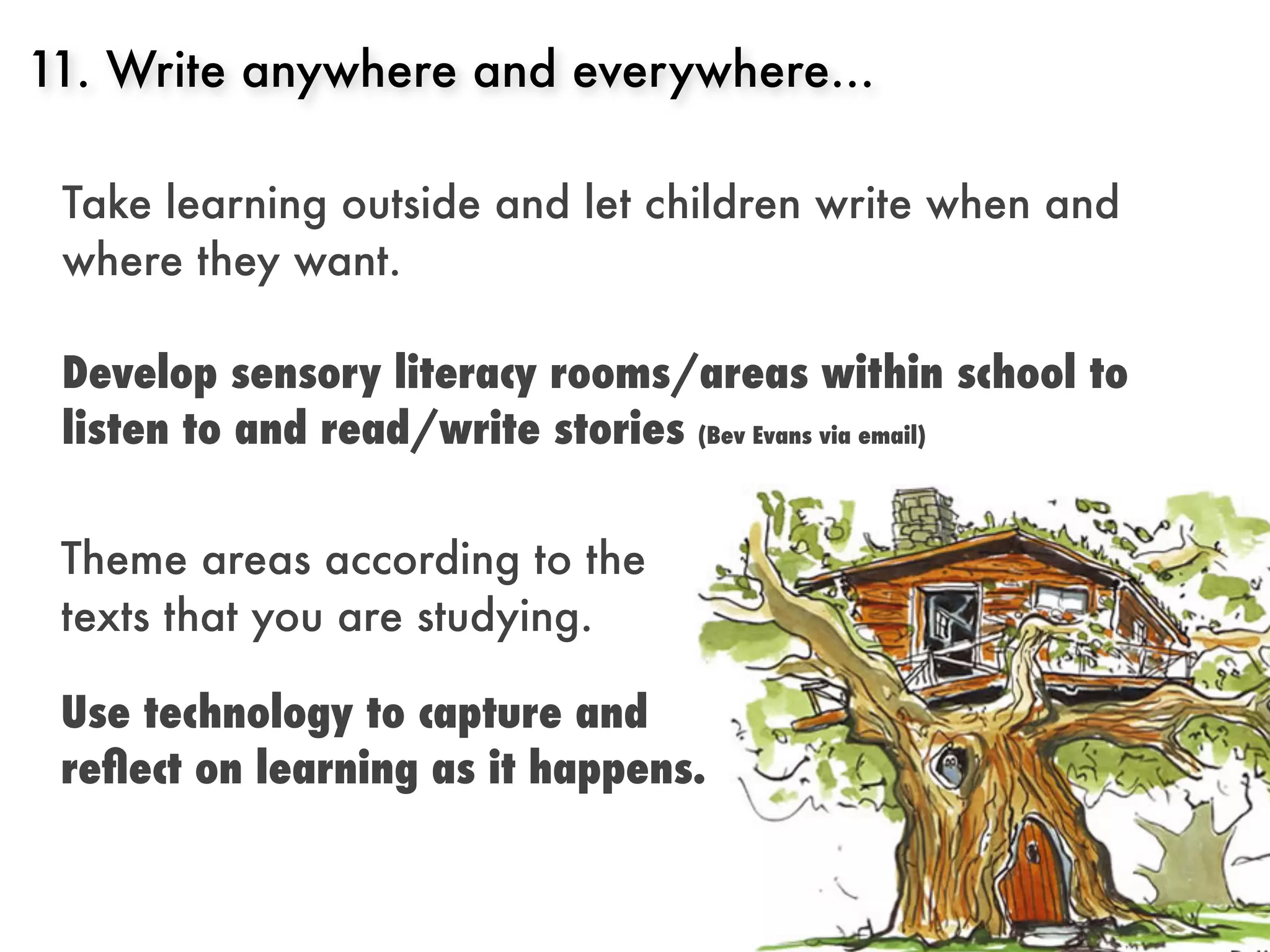
11. Write anywhere and everywhere...

 Take learning outside and let children write when and
 where they want.

 Develop sensory literacy rooms/areas within school to
 listen to and read/write stories (Bev Evans via email)


 Theme areas according to the
 texts that you are studying.

 Use technology to capture and
 reflect on learning as it happens.
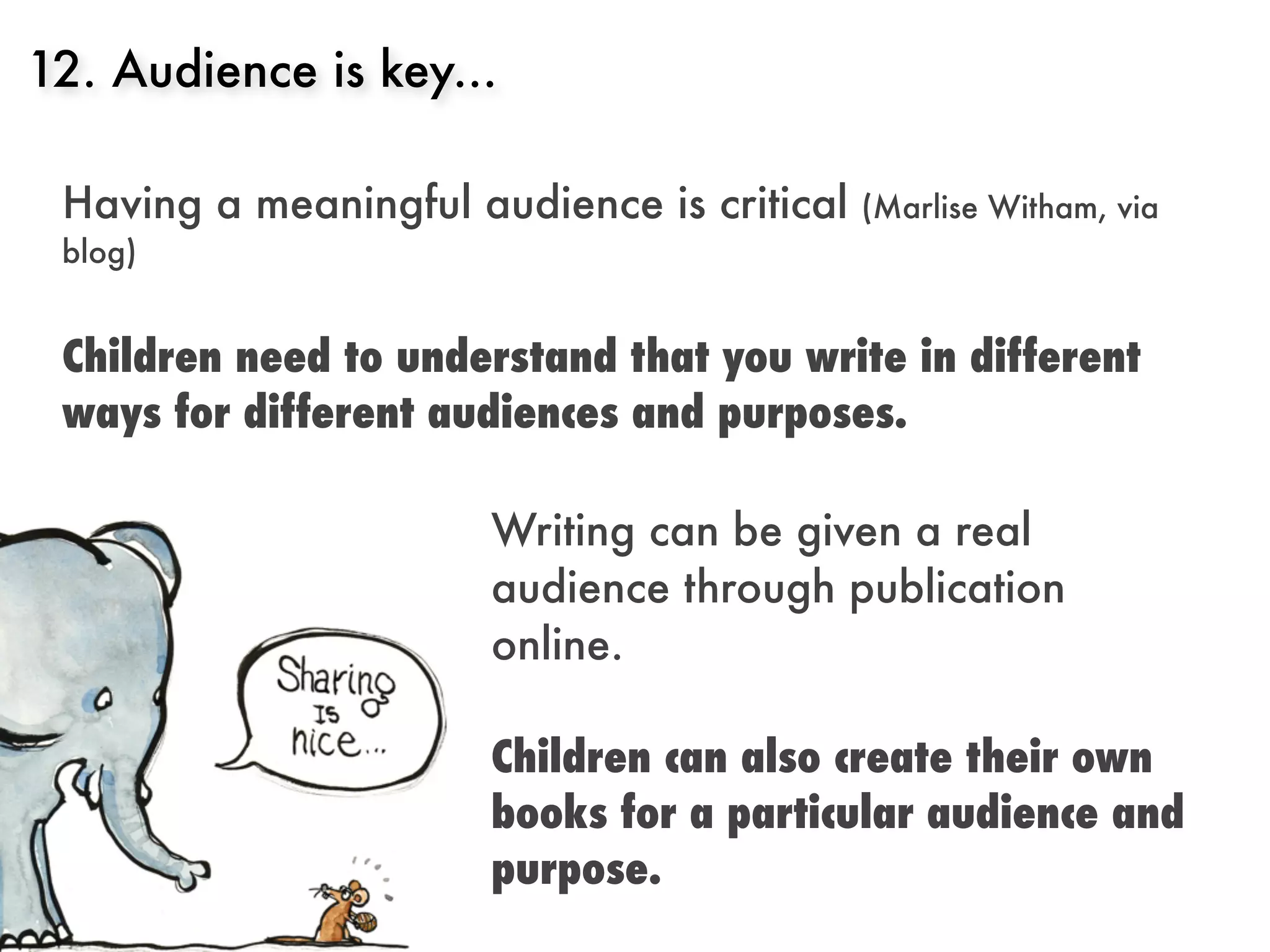
12. Audience is key...

 Having a meaningful audience is critical   (Marlise Witham, via
 blog)


 Children need to understand that you write in different
 ways for different audiences and purposes.

                      Writing can be given a real
                      audience through publication
                      online.

                      Children can also create their own
                      books for a particular audience and
                      purpose.
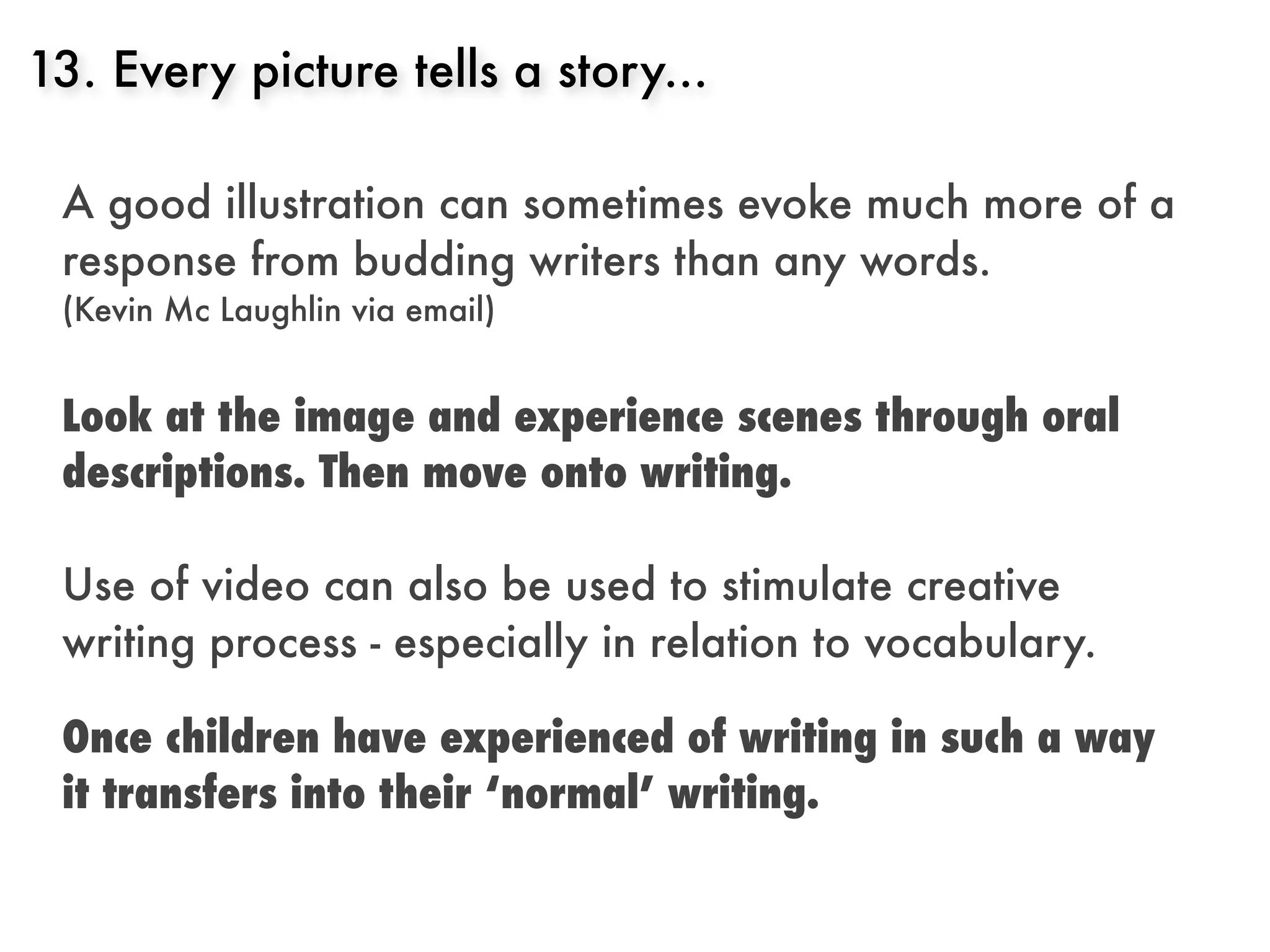
13. Every picture tells a story...

 A good illustration can sometimes evoke much more of a
 response from budding writers than any words.
 (Kevin Mc Laughlin via email)


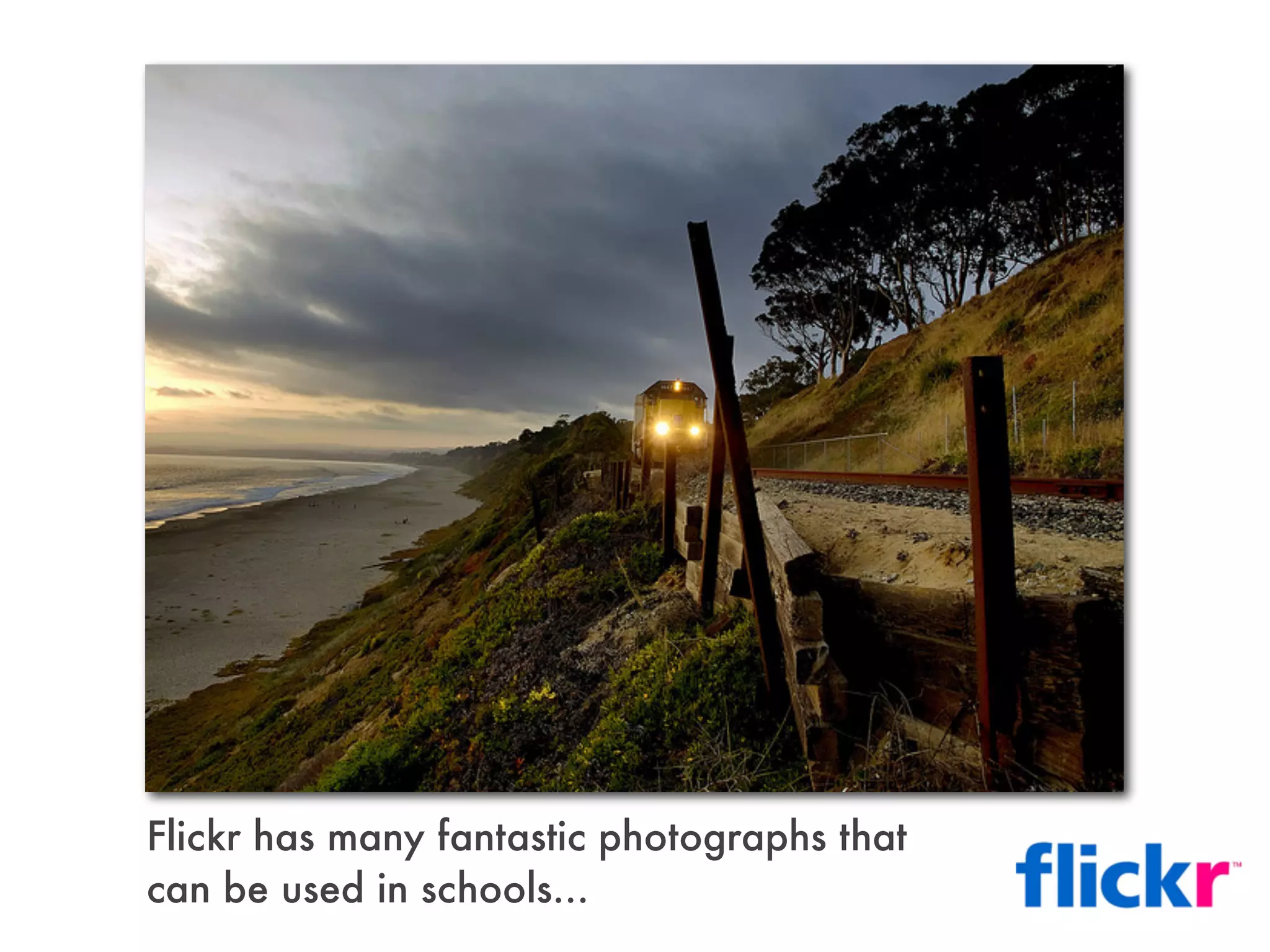
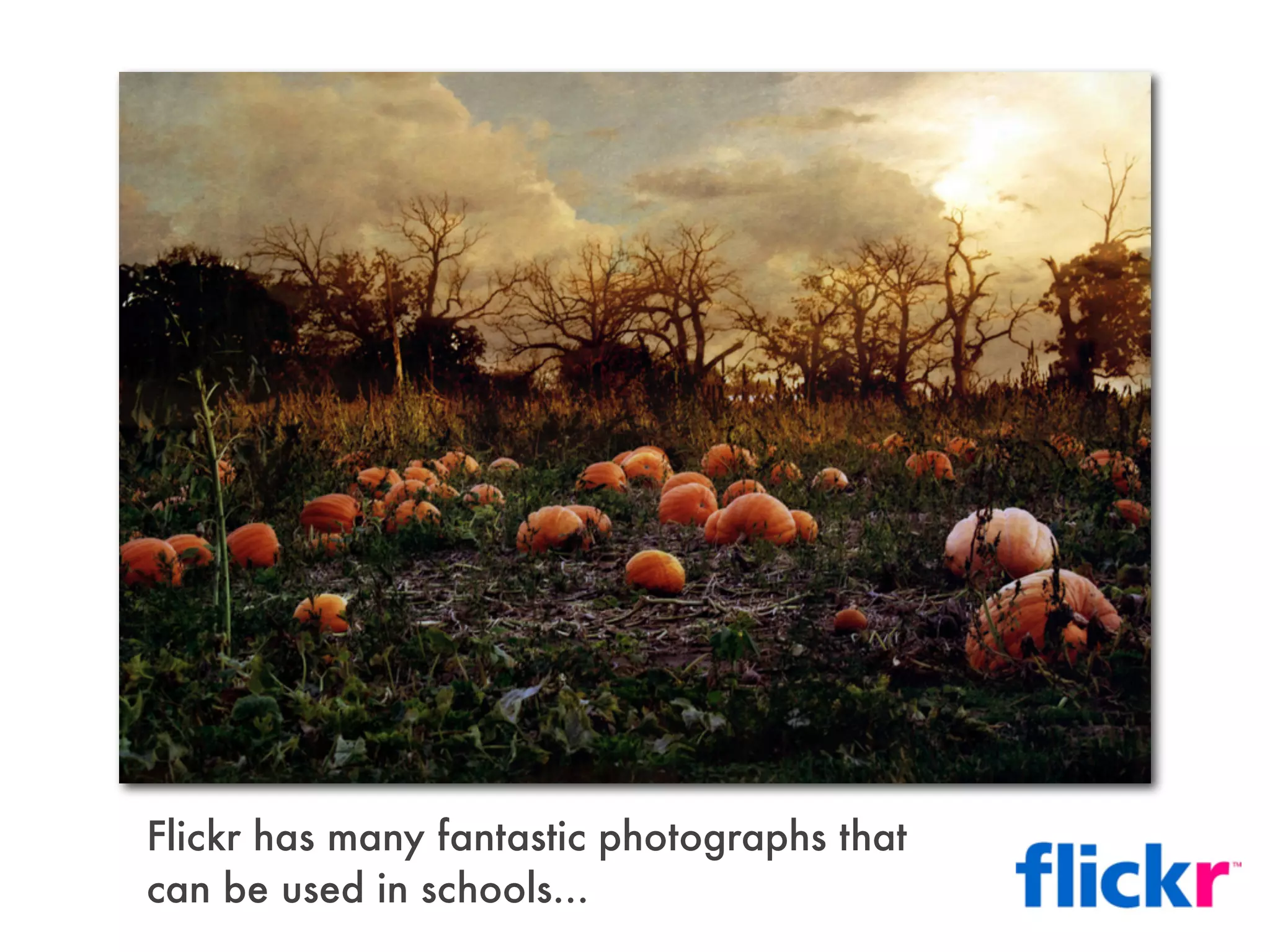
 Look at the image and experience scenes through oral
 descriptions. Then move onto writing.

 Use of video can also be used to stimulate creative
 writing process - especially in relation to vocabulary.

 Once children have experienced of writing in such a way
 it transfers into their ‘normal’ writing.
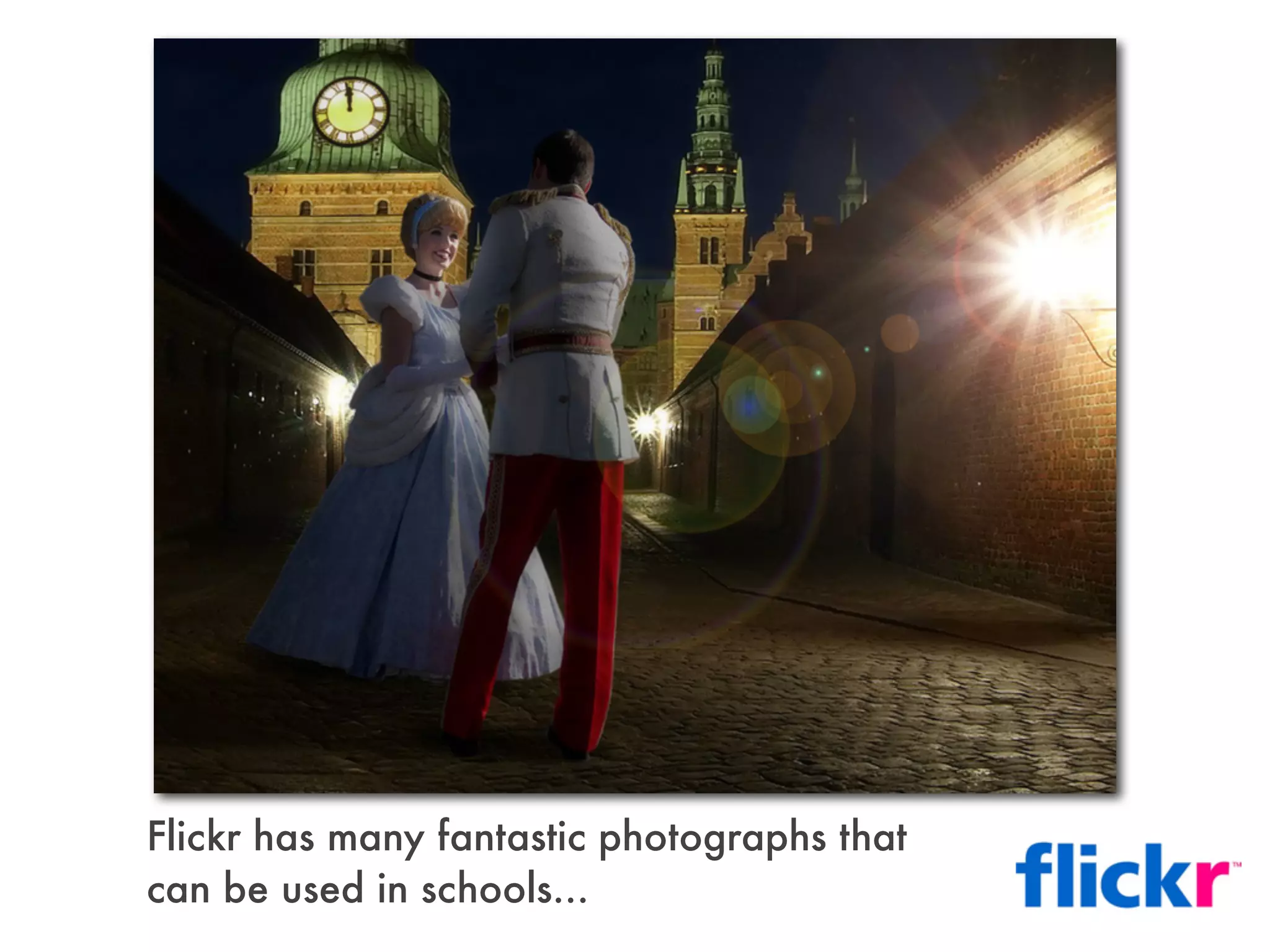
Flickr has many fantastic photographs that
can be used in schools...
Flickr has many fantastic photographs that
can be used in schools...
Flickr has many fantastic photographs that
can be used in schools...
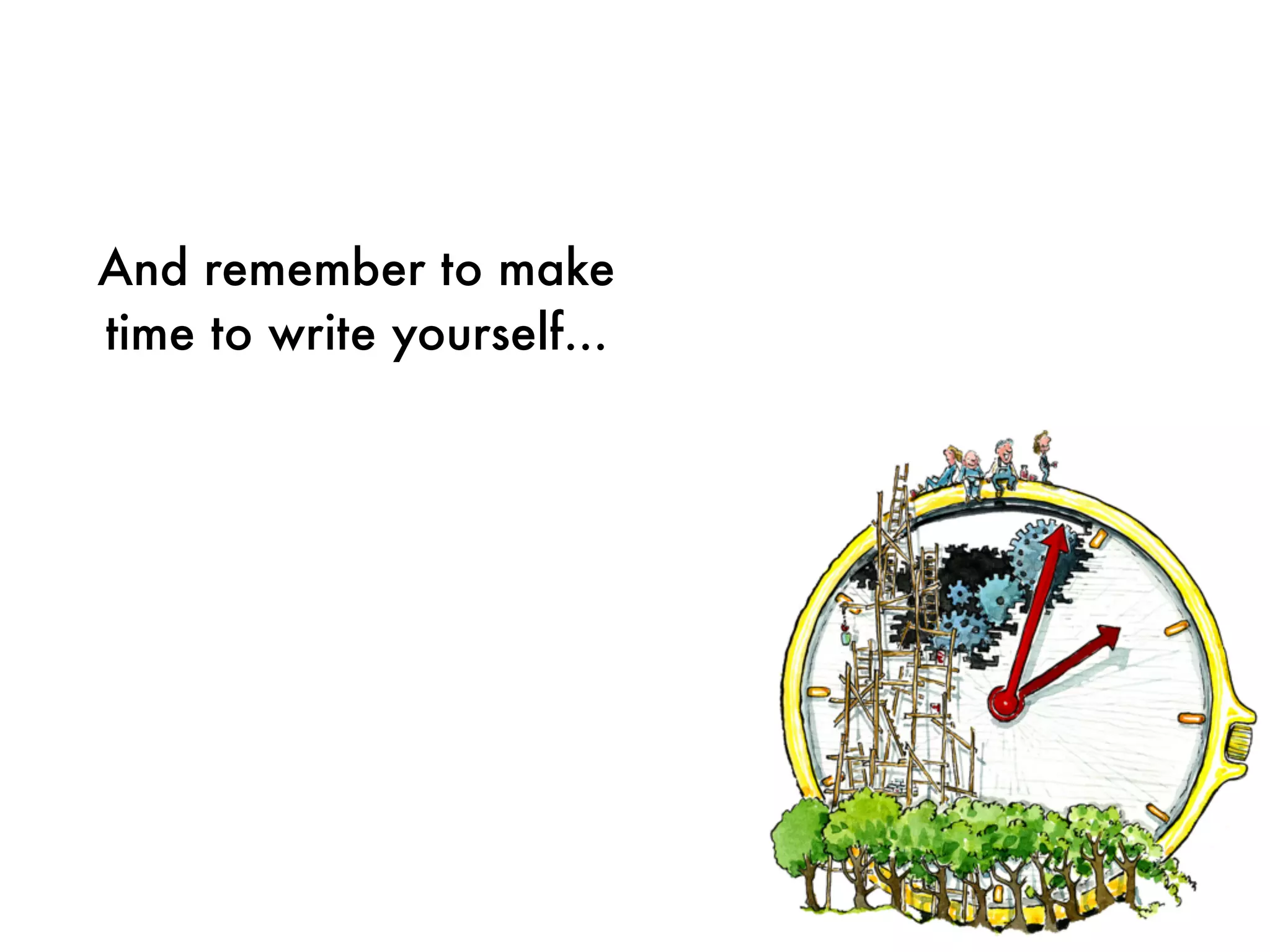
And remember to make
time to write yourself...
This crowd-sourced
 presentation is available             Other blogs of interest:
           online:
                                              Bill Lord’s Blog:
                                              www.lordlit.com
www.changinghorizons.net
                                           Andrew Lambirth’s Blog:
                             http://lambirthsprimaryeducationworld.blogspot.com

                                        Kevin Mc McLaughlin’s Blog
                                             www.ictsteps.com

                                               Bev Evan’s Blog
                                     http://technostories.wordpress.com

                                            David Mitchell’s Blog
                                     http://mrmitchell.heathfieldcps.net/

                                            Heathfield CPS Blogs:
                                       http://www.heathfieldcps.net/

How do you inspire writers?

  • 1.
    How do weinspire... Writing for meaning and pleasure? Ideas from educators, working with children across the globe. Collated by Martin Waller with contributions from educators around the world
  • 2.
    This is acrowd-sourced presentation...
  • 3.
    Global responses received- including educators from the UK, USA and Australia
  • 4.
    Many thanks to... Kevin Mc Laughlin Susie Arnott Primary School Teacher Bill Lord Fiona Johnson Literacy Advisor Mrs Davies Primary Teacher Primary Teacher D. Weston James Mansell Rachel Orr Primary Teacher Primary Headteacher David Mitchell Primary Deputy Headteacher Andrew Lambirth Professor of Education Bev Evans Primary Teacher ‘Fibe’ Primary Headteacher Marlise Witham Elementary School Teacher HikingArtist.com For illustrations used in this resource
  • 5.
    The issue ‘of’writing? Or issues ‘with’ writing? Literacy Policy and Policy Literacy The rocky road of teaching writing...
  • 6.
    And there’s nomagic formula...
  • 7.
    But writing forpleasure... does lead to increased motivation to write....
  • 8.
    Not motivation byfear... Which leads to...
  • 9.
    How do wedevelop writing for pleasure while raising writing achievement?
  • 10.
    1. First andforemost... subject knowledge and enthusiasm! Developing, reflecting and evaluating your teaching toolkit...
  • 11.
    2. Play withLanguage The English language is complex... Writing as an act of creative design.
  • 12.
    2. Play withLanguage “They need time too. Time to redraft and, yes, be allowed to make errors in transcription as they become absorbed in their compositions - knowing, depending on their age and experience, that further down the line they will need to proof read. Children become aware that there is a process to writing - it is rarely completed in one sitting. - Andrew Lambirth (via blog)
  • 13.
    3. Talk forwriting... (Rachel Orr via blog) Young writers find it helpful if creative and thinking processes involved in writing can be made explicit and explored through talk. Oral rehearsal through storytelling allows oral drafts to be composed before the children touch pens (Andrew Lambirth via blog) - Think it - Read it back - Am I happy with it? - Write it down...
  • 14.
    4. Allow forspeaking, listening and drama... Children like to work and play together - they do it every day in their own lives. Process drama into writing as it has the power to bring children into dramatic scenarios that demand that influence how texts are written (Andrew Lambirth via blog) The links between drama activities and writing are not always made clear (Bill Lord via blog) Collaborative writing and peer assessment can be used to support writing development.
  • 15.
    5. Use qualitytexts... “Texts teach what readers’ learn” (Meek, 1987) ‘Recommended’ texts are not always best suited to a particular class or school. “Books must be enjoyed in their entirety not just as snippets” (Kevin Mc Laughlin via email) Select texts that children will enjoy and will want to engage with.
  • 16.
    5. Use qualitytexts... “Read to the children so that they have examples of good stories. Studying fragments of grammar such as adverbial phrases is all very well but not if children haven’t come to enjoy stories as a whole in the first place” - D Weston (via blog) Image by HikingArtist.com
  • 17.
    6. Integrate children’spopular culture... ...and the desire to write increases.
  • 18.
    6. Integrate children’spopular culture... Focus on Holy Trinity Rosehill Primary School The ‘Brer Rabbit’ project had the stories collected by Joel Chandler Harris as the focal point. Brer Rabbit project explored storytelling through oral, written and multimodal texts. Exploration of the ‘roots’ and history behind the stories and traditions. Children able to see the links between traditional and ‘new’ storytelling.
  • 19.
    6. Integrate children’spopular culture... Collaboration with ‘The Wren’s Nest Museum’ in Atlanta (USA). Children met with the relatives of Joel Chandler Harris. Children also took part in an interactive storytelling session with a traditional story rambler... Live from the USA!
  • 20.
    6. Integrate children’spopular culture... Focus on Holy Trinity Rosehill Primary School
  • 21.
    7. Recognise andintegrate digital technologies... Digital technologies have changed the way we communicate and the way we all live our lives. Children write a lot more than we think... in ways that are not ‘traditional’ but we do not live in a ‘traditional’ world Audience is key and digital technologies provide audiences for children to write in traditional and new ways.
  • 22.
    7. Recognise andintegrate digital technologies... Focus on Holy Trinity Rosehill Primary School Writing for a real audience and purpose...
  • 23.
    7. Recognise andintegrate digital technologies... Focus on Heathfield Community A short term experiment of ‘blogging’ led Primary School to a whole-school strategy for engaging writers. Boys engaged in the writing process. Blogging starts as early as Reception. Some children made two years progress in one academic year - 6.6 APS Progress per pupil. ‘SATS’ Level 5 scores have gone from 9% to 63%. Contributed by David Mitchell
  • 24.
    7. Recognise andintegrate digital technologies... Focus on Heathfield Community Primary School Contributed by David Mitchell http://heathfieldcps.net/
  • 25.
    8. Use meaningfulcontexts with children... Writing does not happen in a bubble... Making literacy mean something to children can be achieved through context driven projects. Literacy events (Heath, 1983) can be used to stimulate creative thinking and the writing processes. Thinking outside the bubble is key... Develop links across the curriculum in a meaningful way.
  • 26.
    8. Use meaningfulcontexts with children... Focus on Earl Soham Community Primary School Context driven project based upon ‘James and the Giant Peach’ by Roald Dahl. Children wrote and chanted magical spells, completed science experiments and reports as part of developing writing within the project.
  • 27.
    8. Use meaningfulcontexts with children... Focus on Earl Soham Community Primary School
  • 28.
    9. Develop alove of reading... “If you ask many authors what they recommend for aspiring writers they simply say read” (Bill Lord, via blog) Children require lots of exposure to texts through reading and class story-time (Andrew Lambirth via blog) Make time for shared reading and discussion of class novels. Give the children time for free reading and includes lots of different texts - stories, non-fiction and even comics!
  • 29.
    10. Make writingtime as pain-free as possible... Give the children time to write and have patience (Bill Lord, via blog) Don’t impose “only one chance” writing where children have to do it all in one go. Real authors edit and re-write (Susie Arnott via blog) Model writing with clarity of what is expected (Bill Lord, via blog) Write with the children - a community is built up (Andrew Lambirth, via blog)
  • 30.
    11. Write anywhereand everywhere... Take learning outside and let children write when and where they want. Develop sensory literacy rooms/areas within school to listen to and read/write stories (Bev Evans via email) Theme areas according to the texts that you are studying. Use technology to capture and reflect on learning as it happens.
  • 31.
    12. Audience iskey... Having a meaningful audience is critical (Marlise Witham, via blog) Children need to understand that you write in different ways for different audiences and purposes. Writing can be given a real audience through publication online. Children can also create their own books for a particular audience and purpose.
  • 32.
    13. Every picturetells a story... A good illustration can sometimes evoke much more of a response from budding writers than any words. (Kevin Mc Laughlin via email) Look at the image and experience scenes through oral descriptions. Then move onto writing. Use of video can also be used to stimulate creative writing process - especially in relation to vocabulary. Once children have experienced of writing in such a way it transfers into their ‘normal’ writing.
  • 33.
    Flickr has manyfantastic photographs that can be used in schools...
  • 34.
    Flickr has manyfantastic photographs that can be used in schools...
  • 35.
    Flickr has manyfantastic photographs that can be used in schools...
  • 36.
    And remember tomake time to write yourself...
  • 37.
    This crowd-sourced presentationis available Other blogs of interest: online: Bill Lord’s Blog: www.lordlit.com www.changinghorizons.net Andrew Lambirth’s Blog: http://lambirthsprimaryeducationworld.blogspot.com Kevin Mc McLaughlin’s Blog www.ictsteps.com Bev Evan’s Blog http://technostories.wordpress.com David Mitchell’s Blog http://mrmitchell.heathfieldcps.net/ Heathfield CPS Blogs: http://www.heathfieldcps.net/