Windows Azure Platform
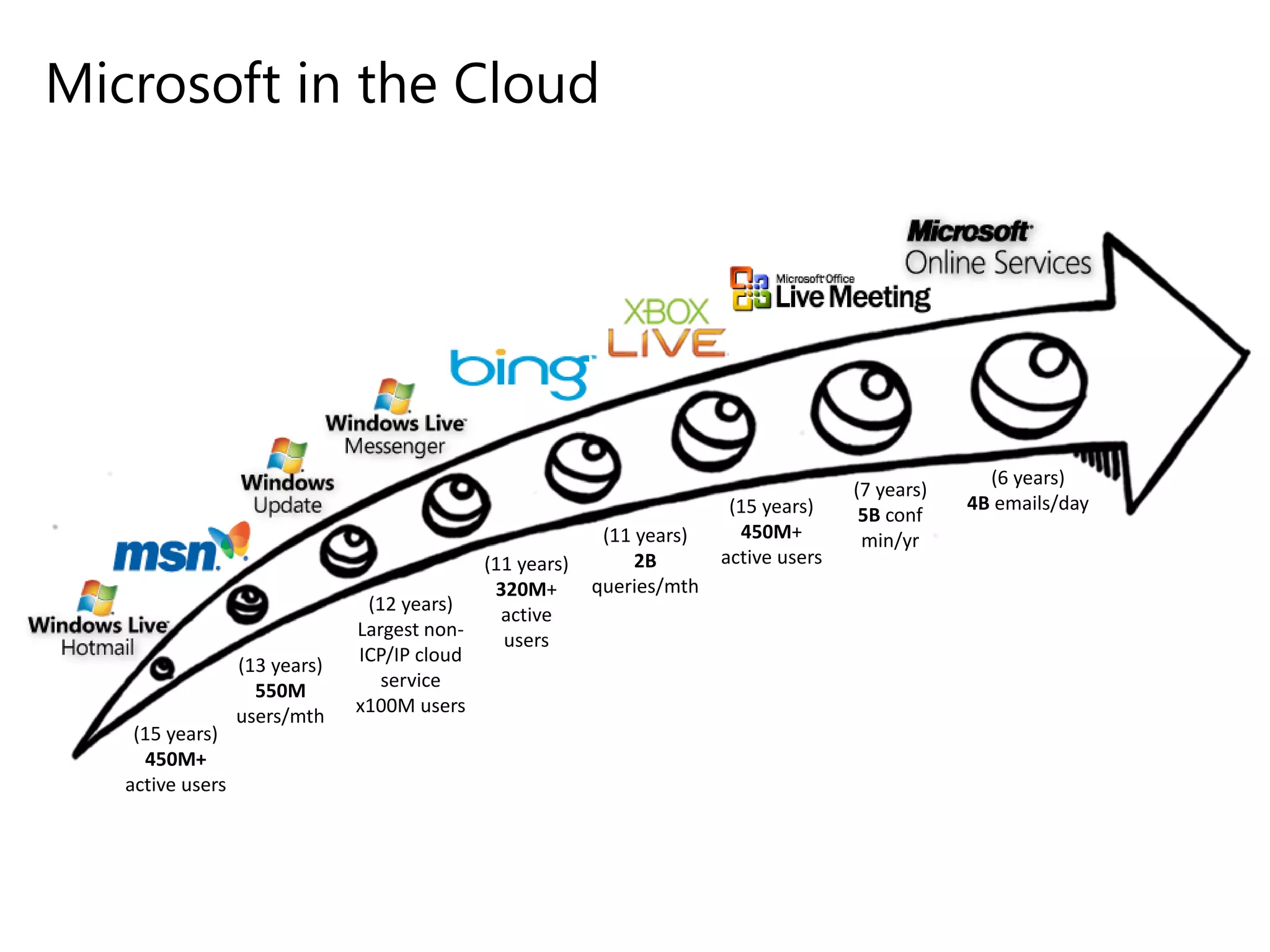
Microsoft in the Cloud
(15 years)
450M+
active users
(13 years)
550M
users/mth
(12 years)
Largest non-
ICP/IP cloud
service
x100M users
(11 years)
320M+
active
users
(11 years)
2B
queries/mth
(15 years)
450M+
active users
(7 years)
5B conf
min/yr
(6 years)
4B emails/day
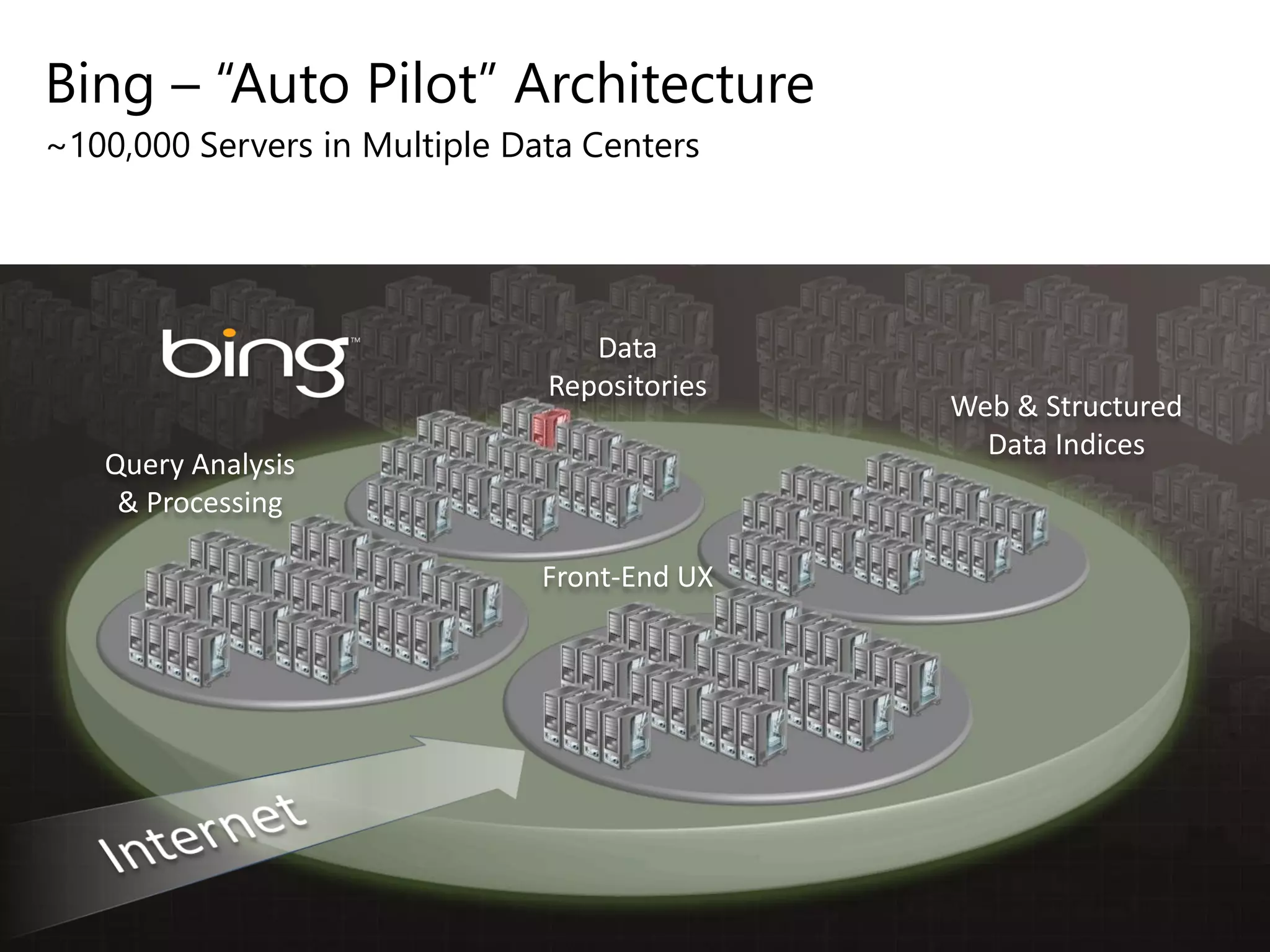
Bing – “Auto Pilot” Architecture
Web & Structured
Data Indices
~100,000 Servers in Multiple Data Centers
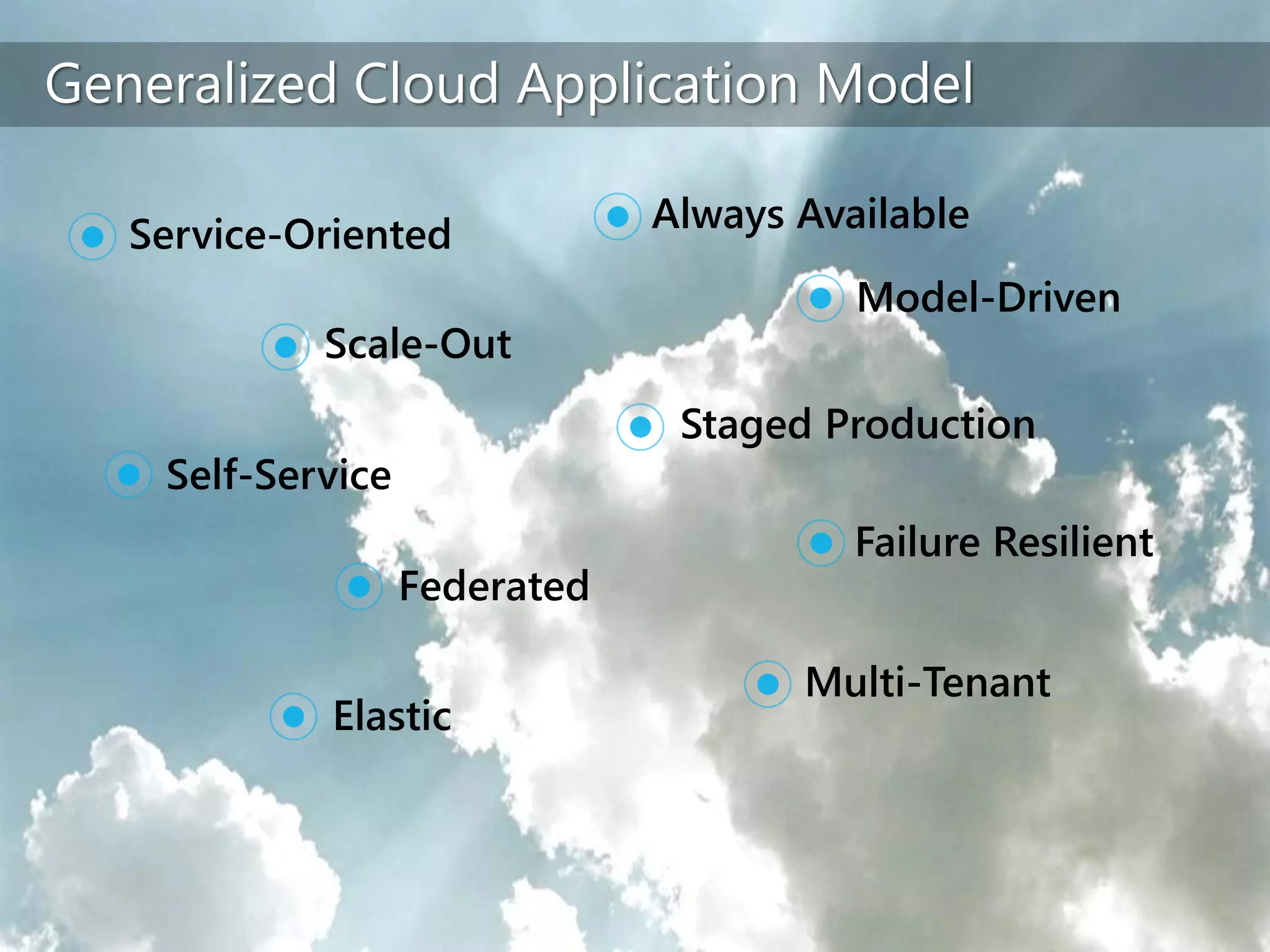
Generalized Cloud Application Model
Federated
Scale-Out
Elastic
Staged Production
Self-Service
Multi-Tenant
Model-Driven
Always Available
Failure Resilient
Service-Oriented
The Microsoft Cloud
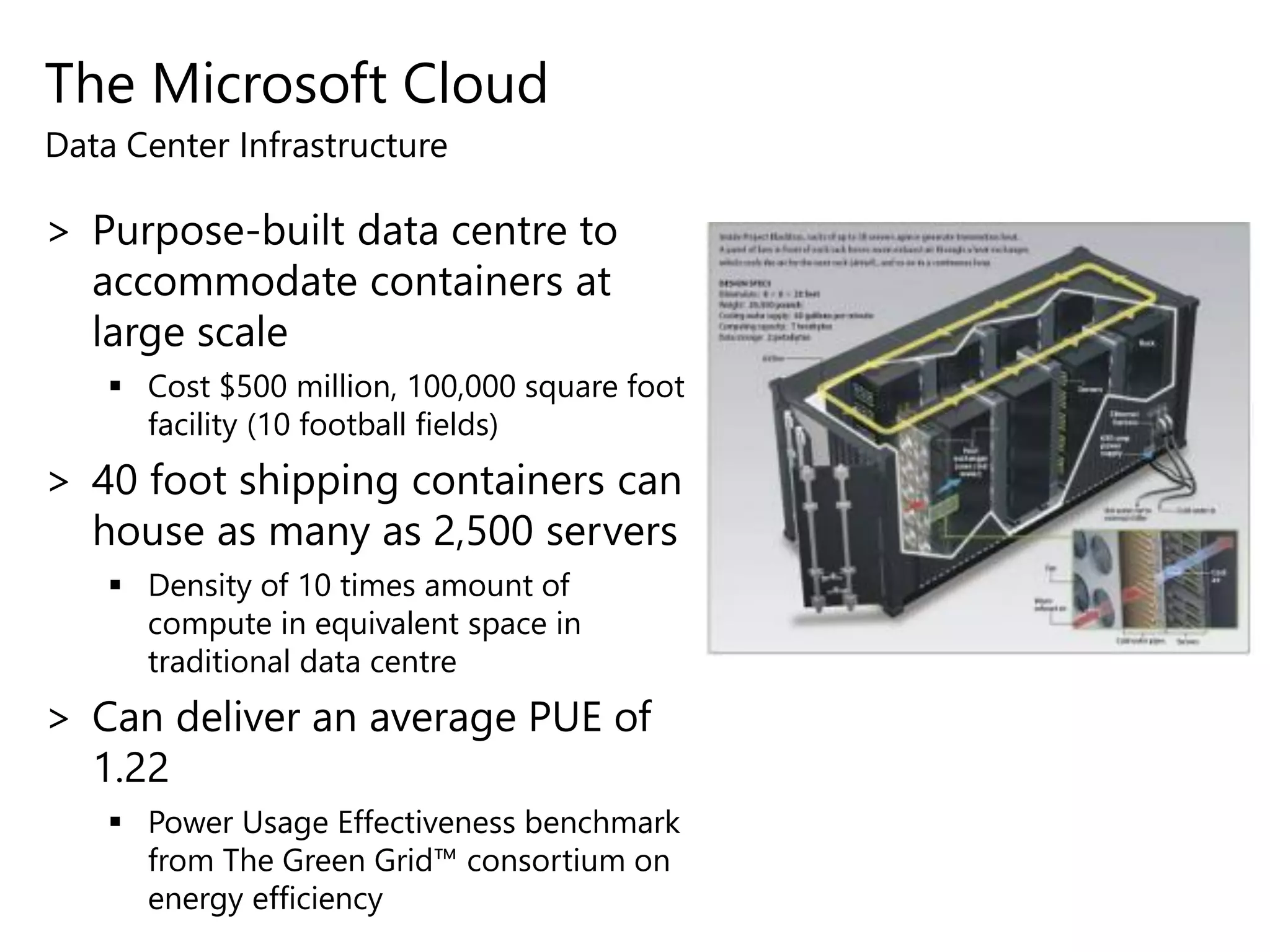
> Purpose-built data centre to
accommodate containers at
large scale
 Cost $500 million, 100,000 square foot
facility (10 football fields)
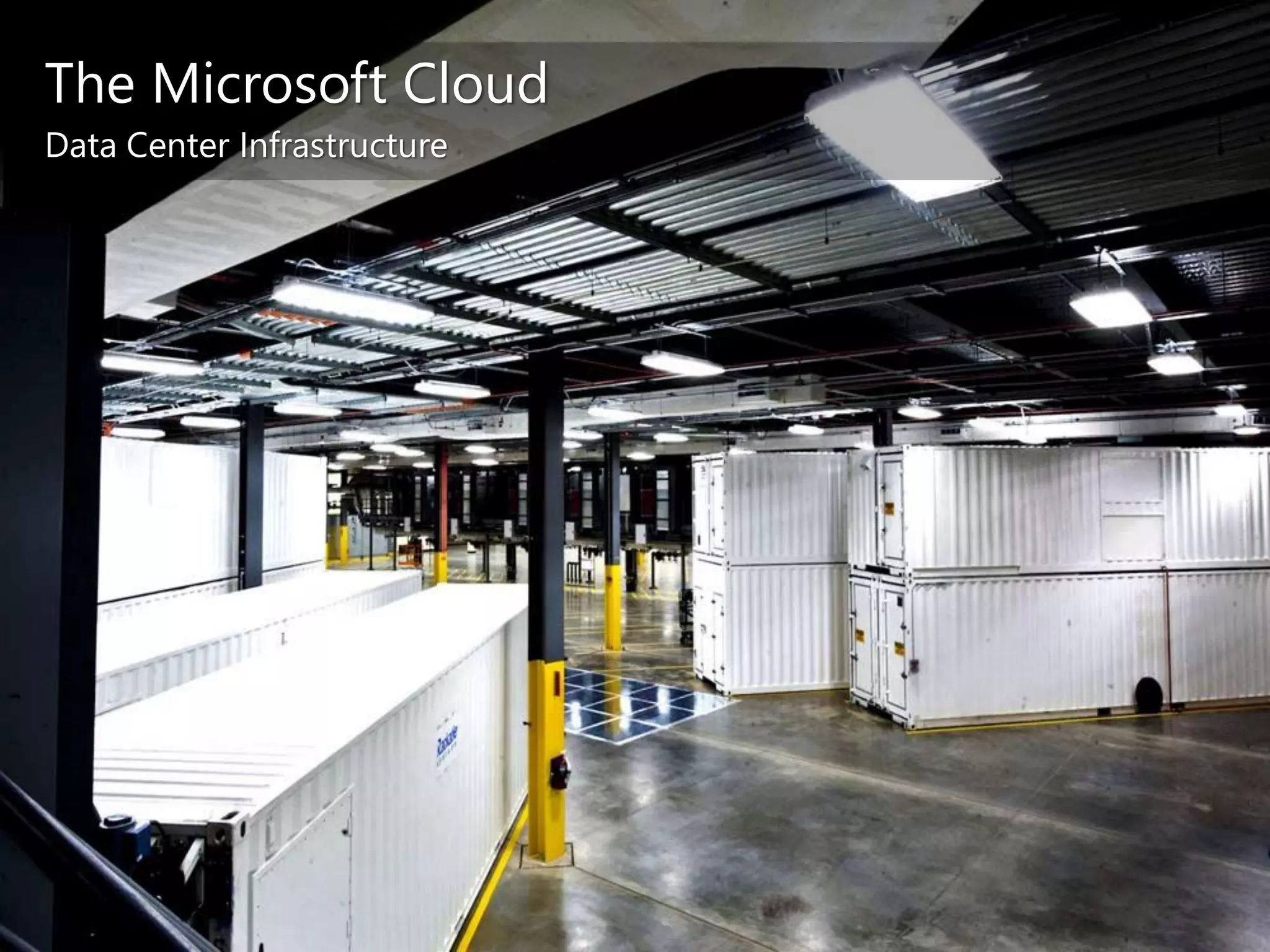
> 40 foot shipping containers can
house as many as 2,500 servers
 Density of 10 times amount of
compute in equivalent space in
traditional data centre
> Can deliver an average PUE of
1.22
 Power Usage Effectiveness benchmark
from The Green Grid™ consortium on
energy efficiency
Data Center Infrastructure
The Microsoft Cloud
Data Center Infrastructure
The Microsoft Cloud
Data Center Infrastructure
The Microsoft Cloud
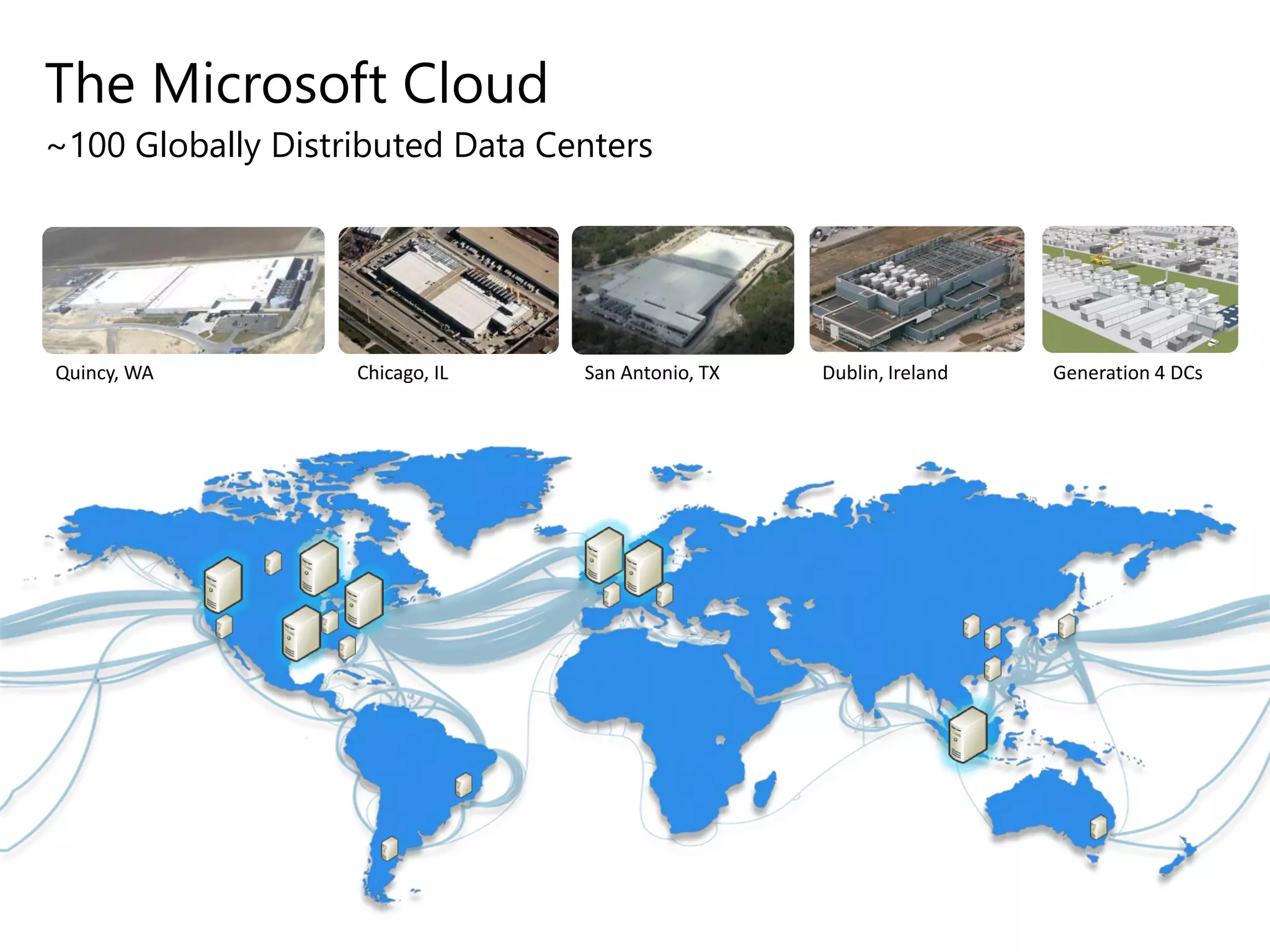
~100 Globally Distributed Data Centers
Quincy, WA Chicago, IL San Antonio, TX Dublin, Ireland Generation 4 DCs
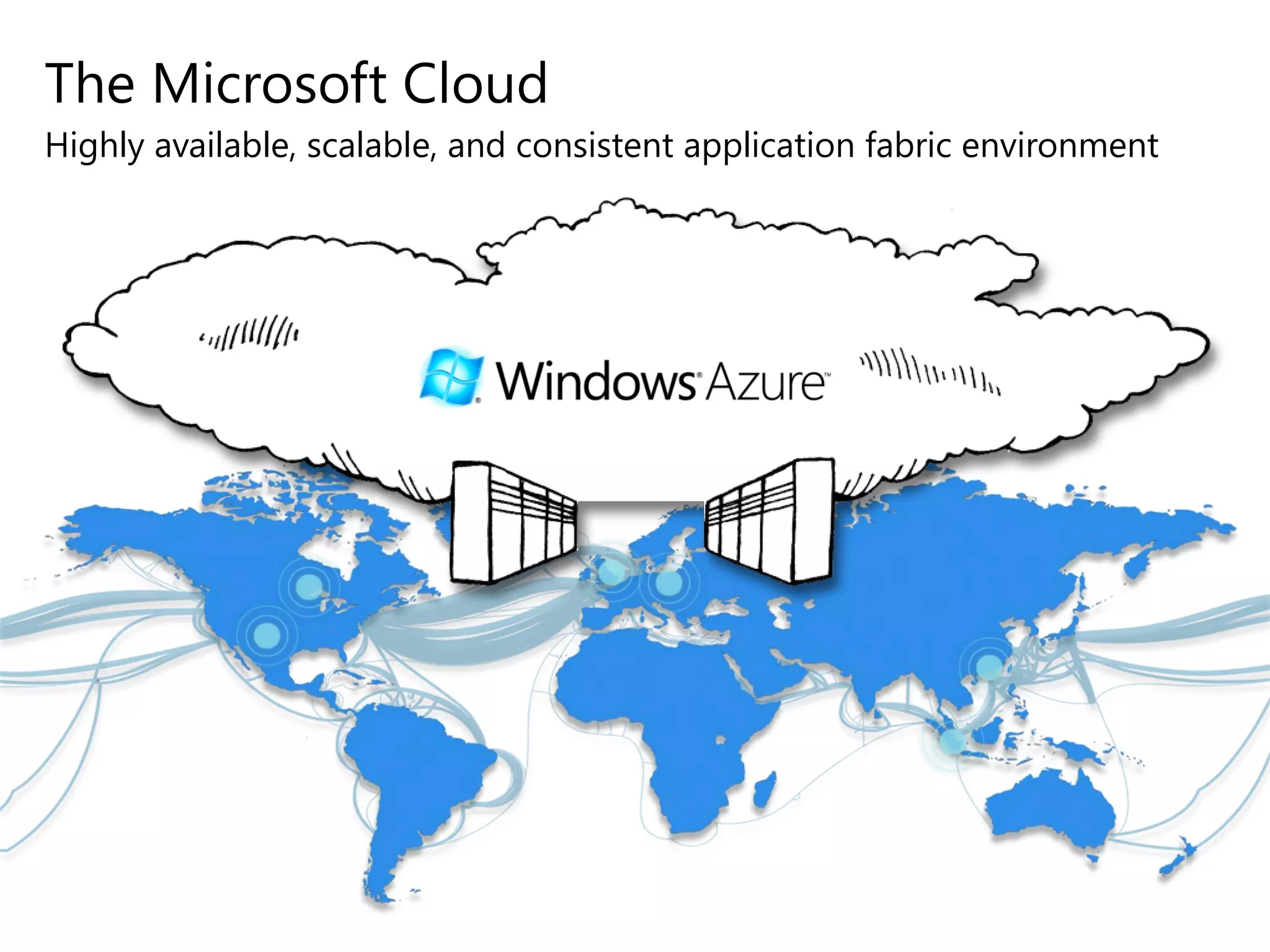
The Microsoft Cloud
Highly available, scalable, and consistent application fabric environment
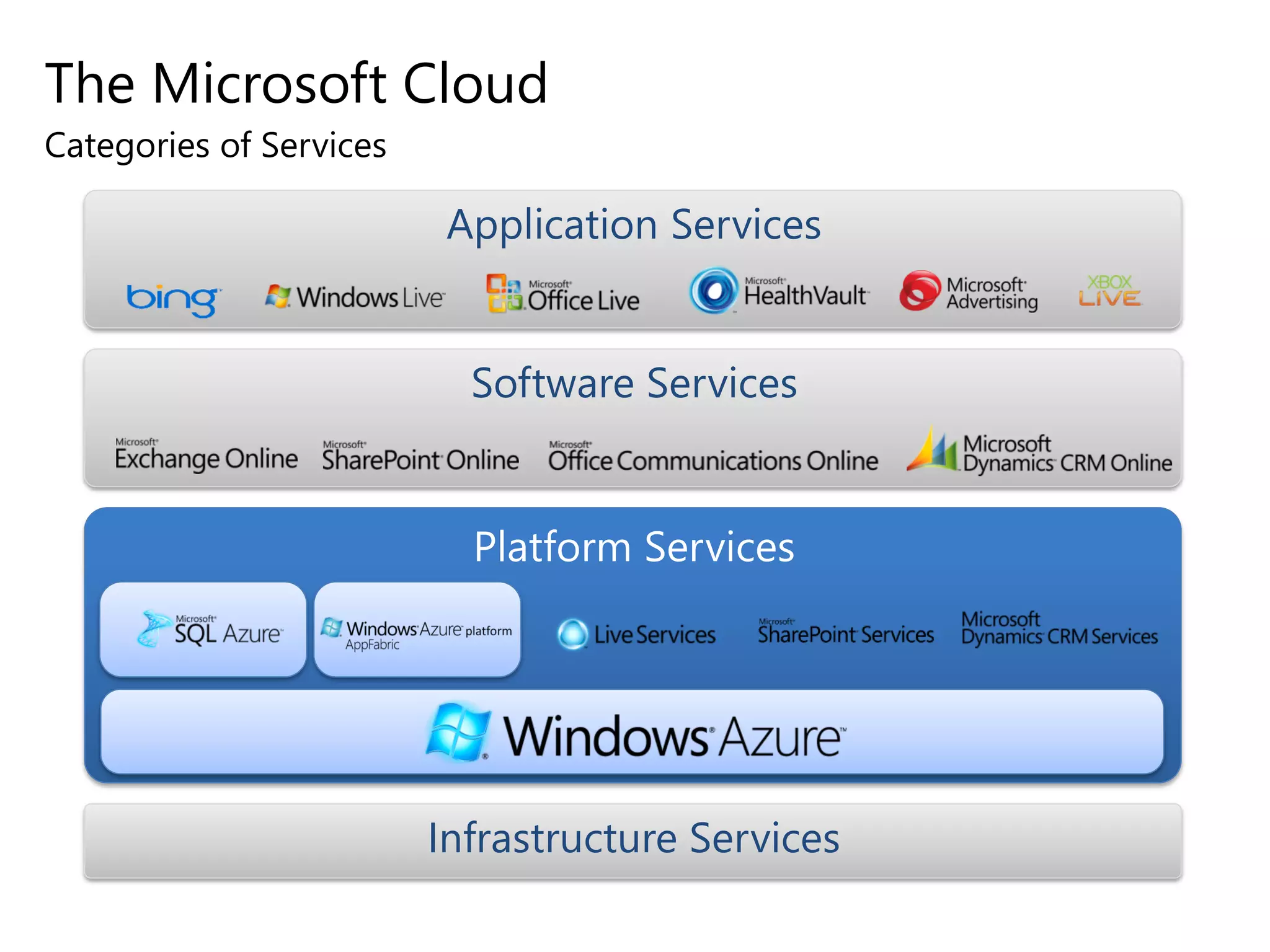
Platform Services
Software Services
Application Services
Infrastructure Services
The Microsoft Cloud
Categories of Services
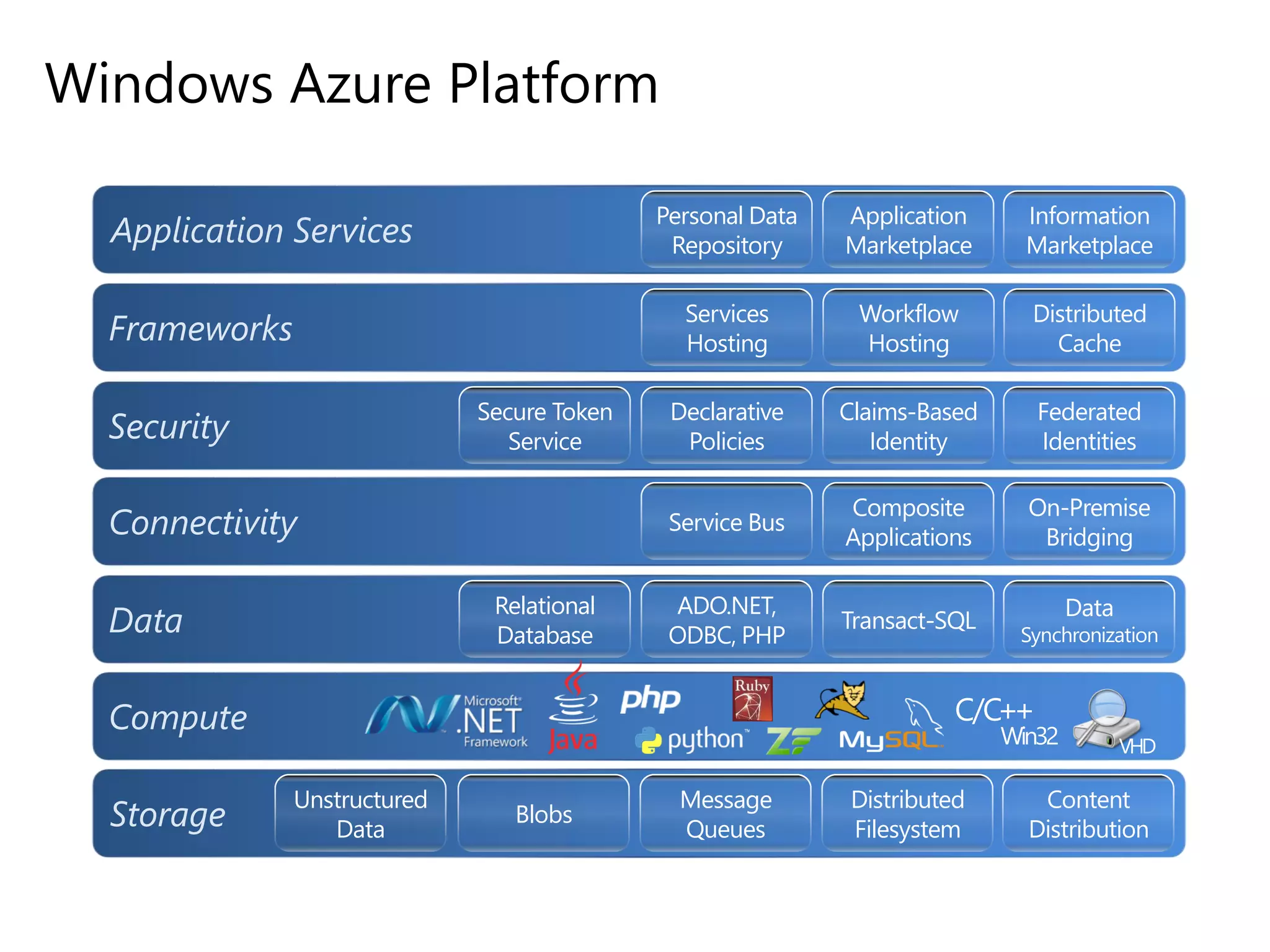
Storage
Unstructured
Data
Blobs
Message
Queues
Distributed
Filesystem
Content
Distribution
Data Transact-SQL
Data
Synchronization
Relational
Database
ADO.NET,
ODBC, PHP
Connectivity
Composite
Applications
On-Premise
Bridging
Service Bus
Security
Claims-Based
Identity
Federated
Identities
Secure Token
Service
Declarative
Policies
Application Services
Application
Marketplace
Information
Marketplace
Personal Data
Repository
Frameworks
Workflow
Hosting
Distributed
Cache
Services
Hosting
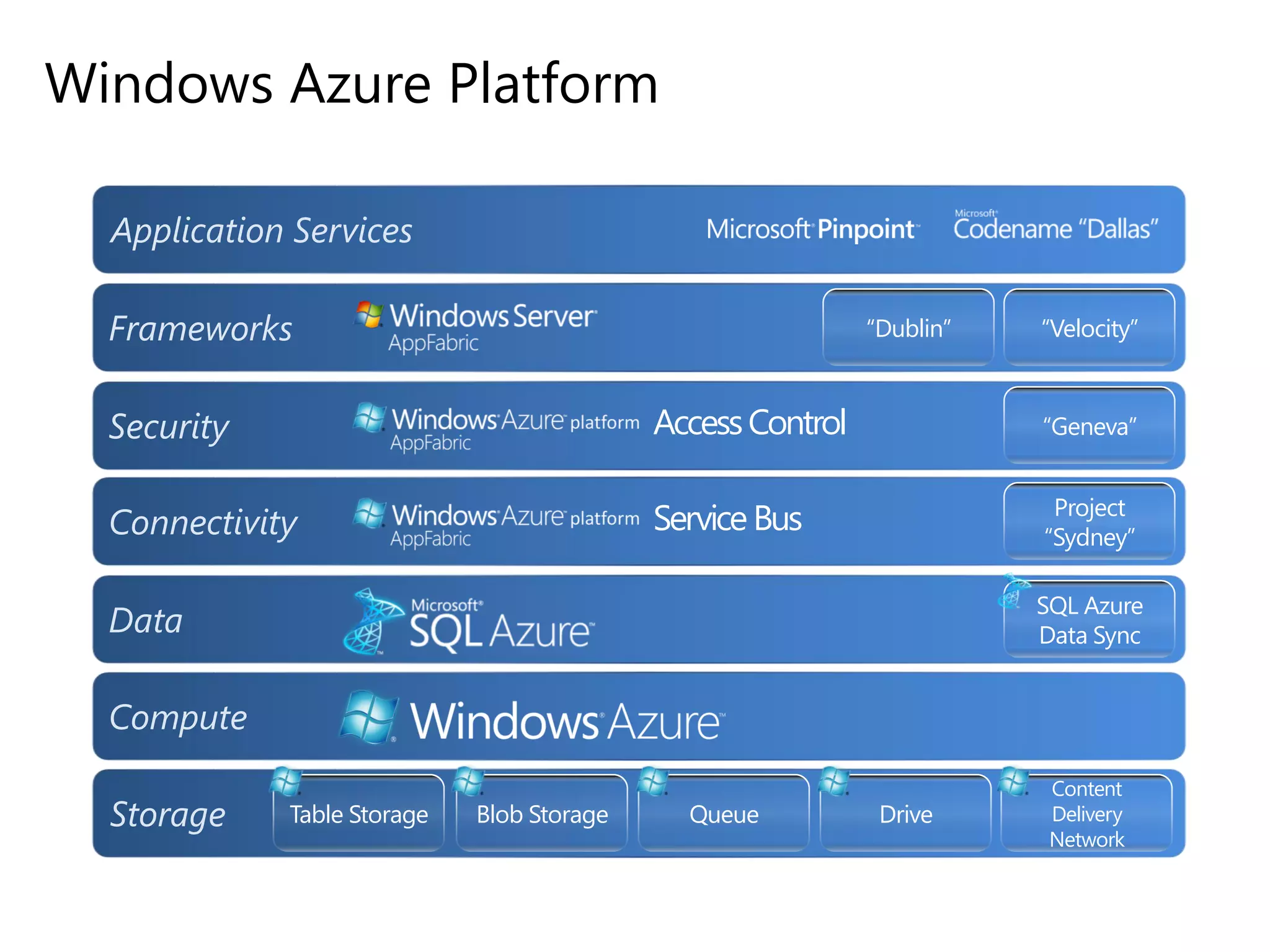
Windows Azure Platform
Compute C/C++
Win32 VHD
Compute
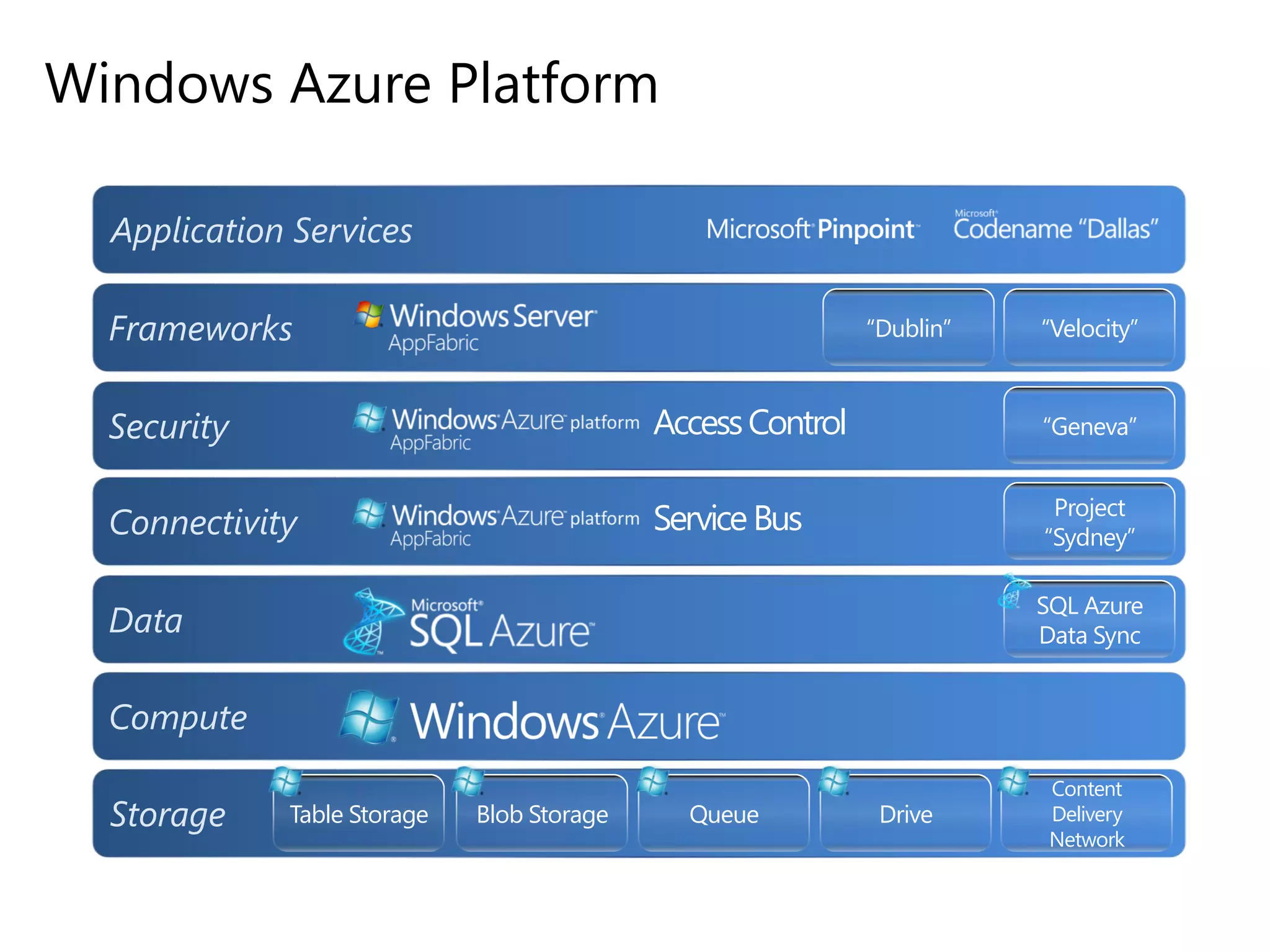
Storage
Data
SQL Azure
Data Sync
Connectivity
Project
“Sydney”
Security “Geneva”
Application Services
Frameworks “Dublin” “Velocity”
Windows Azure Platform
ServiceBus
AccessControl
Table Storage Blob Storage Queue Drive
Content
Delivery
Network
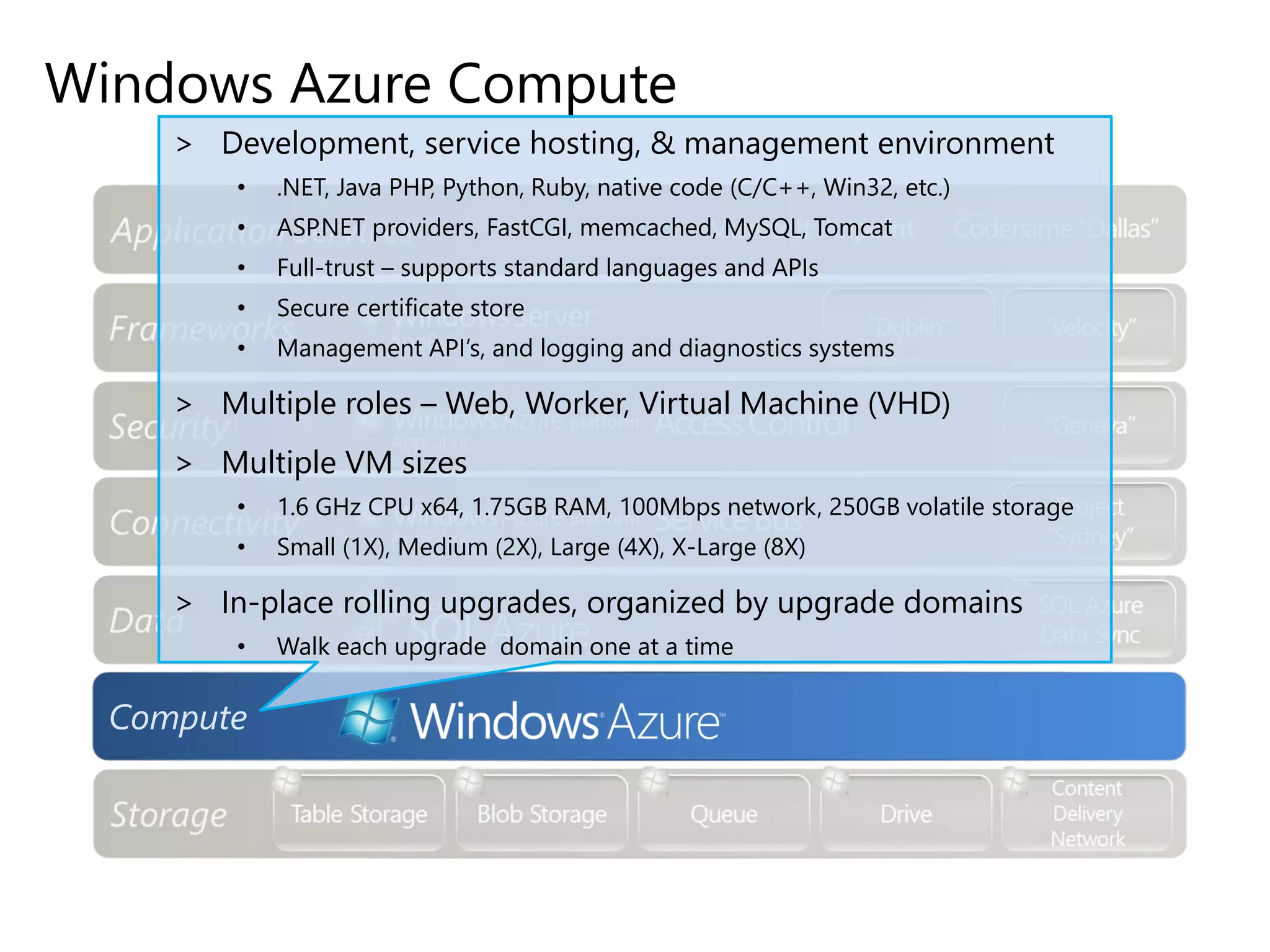
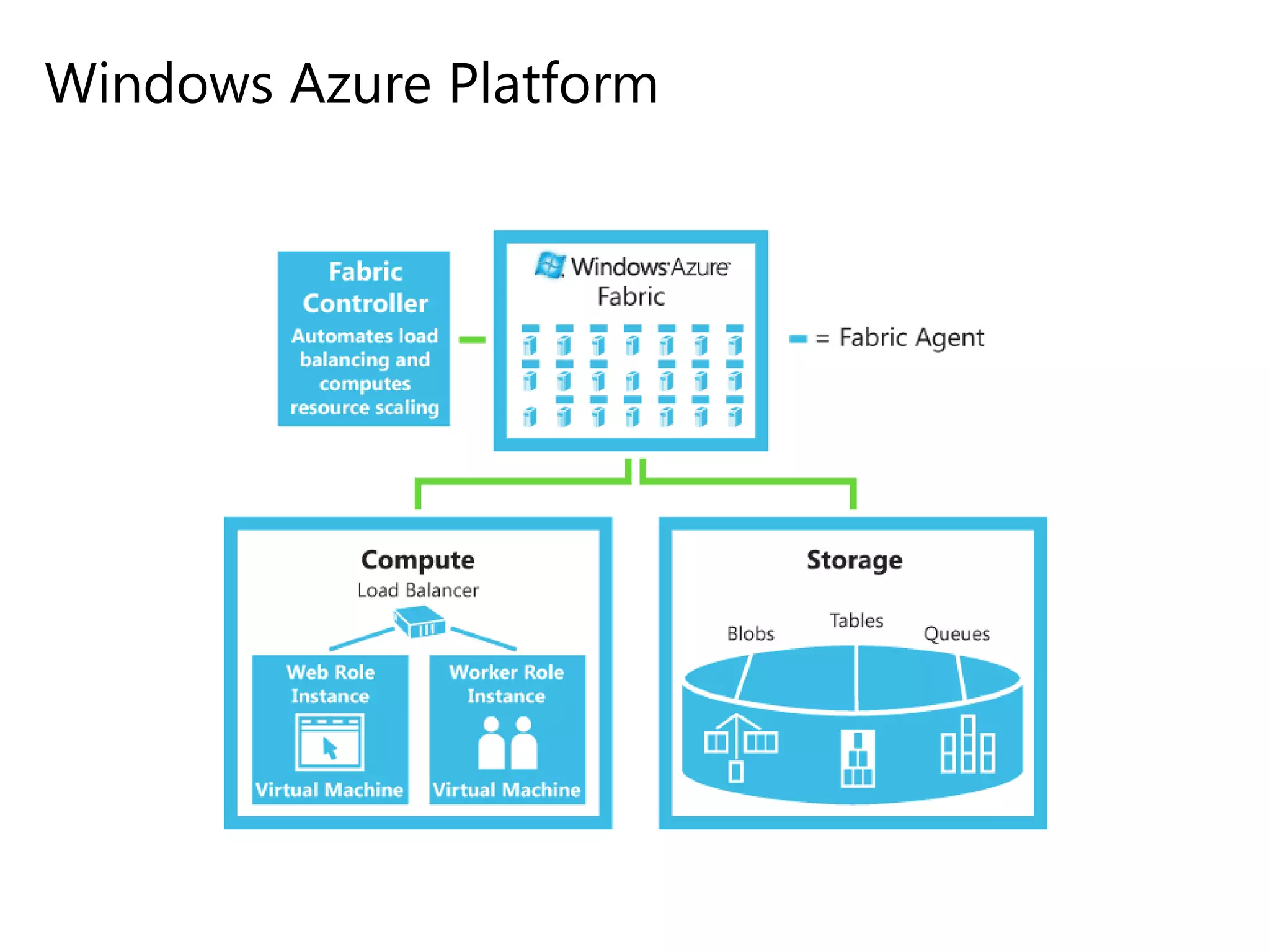
Windows Azure Compute
Compute
> Development, service hosting, & management environment
• .NET, Java PHP, Python, Ruby, native code (C/C++, Win32, etc.)
• ASP.NET providers, FastCGI, memcached, MySQL, Tomcat
• Full-trust – supports standard languages and APIs
• Secure certificate store
• Management API’s, and logging and diagnostics systems
> Multiple roles – Web, Worker, Virtual Machine (VHD)
> Multiple VM sizes
• 1.6 GHz CPU x64, 1.75GB RAM, 100Mbps network, 250GB volatile storage
• Small (1X), Medium (2X), Large (4X), X-Large (8X)
> In-place rolling upgrades, organized by upgrade domains
• Walk each upgrade domain one at a time
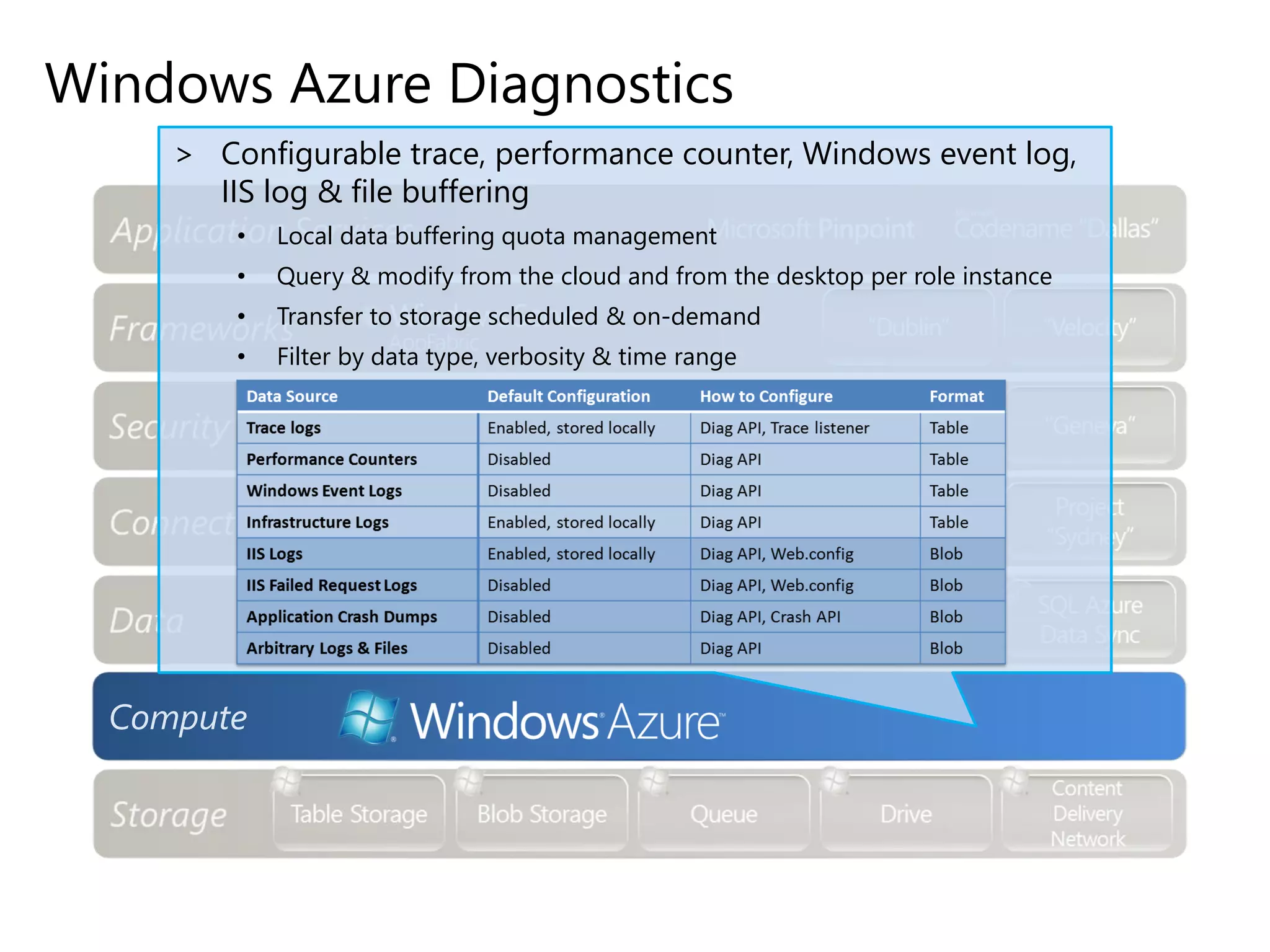
Windows Azure Diagnostics
Compute
> Configurable trace, performance counter, Windows event log,
IIS log & file buffering
• Local data buffering quota management
• Query & modify from the cloud and from the desktop per role instance
• Transfer to storage scheduled & on-demand
• Filter by data type, verbosity & time range
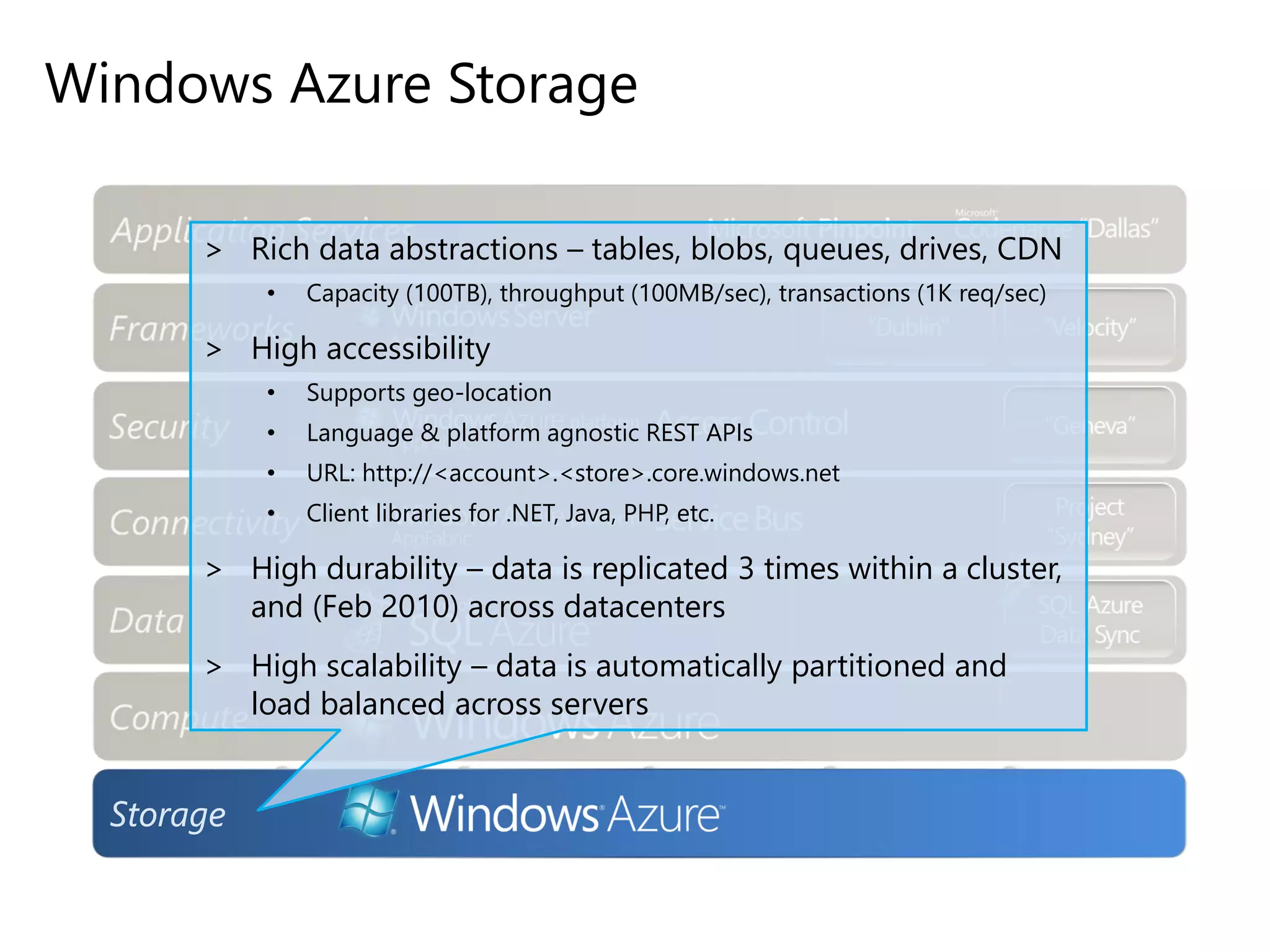
Windows Azure Storage
> Rich data abstractions – tables, blobs, queues, drives, CDN
• Capacity (100TB), throughput (100MB/sec), transactions (1K req/sec)
> High accessibility
• Supports geo-location
• Language & platform agnostic REST APIs
• URL: http://<account>.<store>.core.windows.net
• Client libraries for .NET, Java, PHP, etc.
> High durability – data is replicated 3 times within a cluster,
and (Feb 2010) across datacenters
> High scalability – data is automatically partitioned and
load balanced across servers
StorageStorage
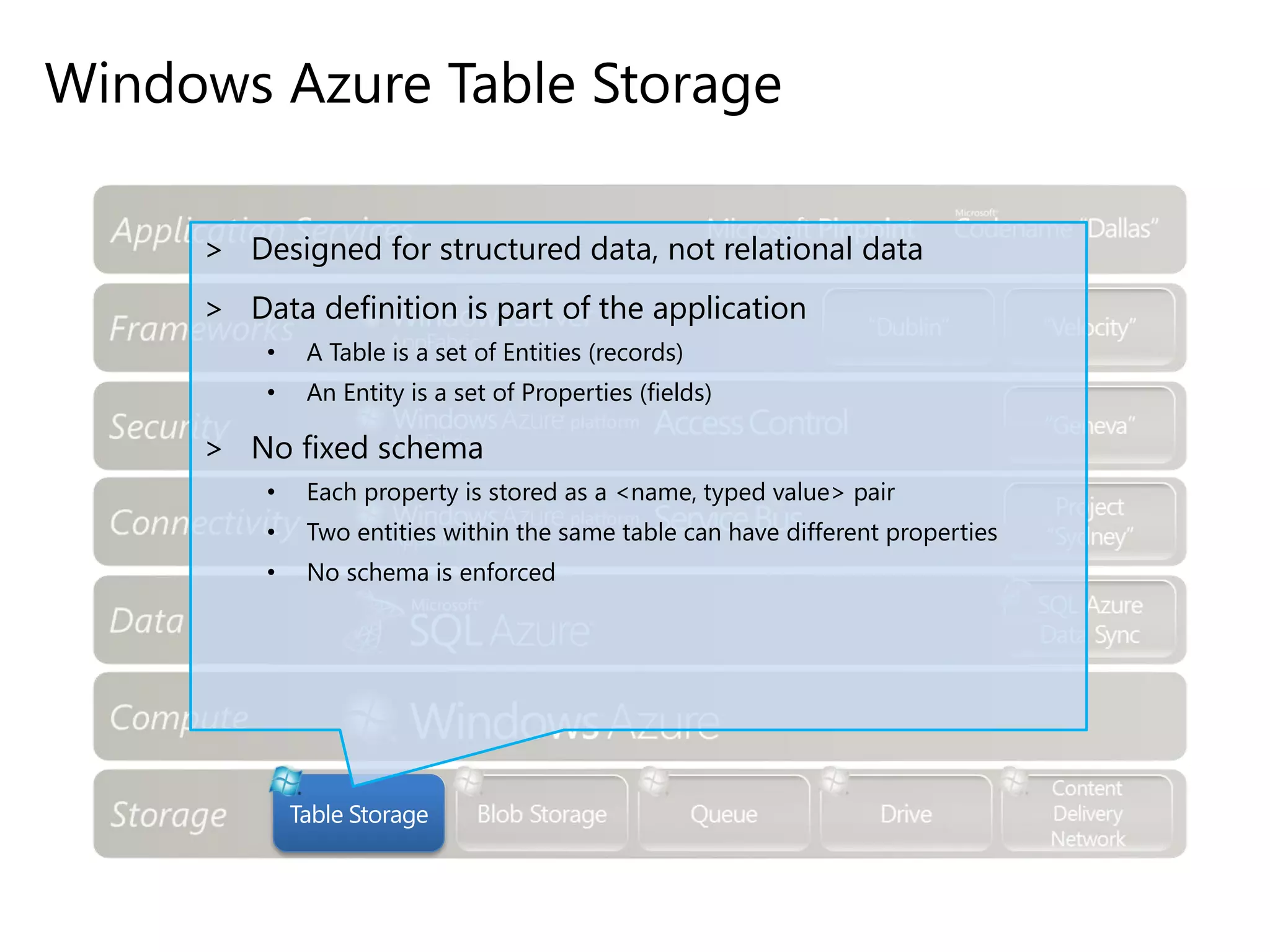
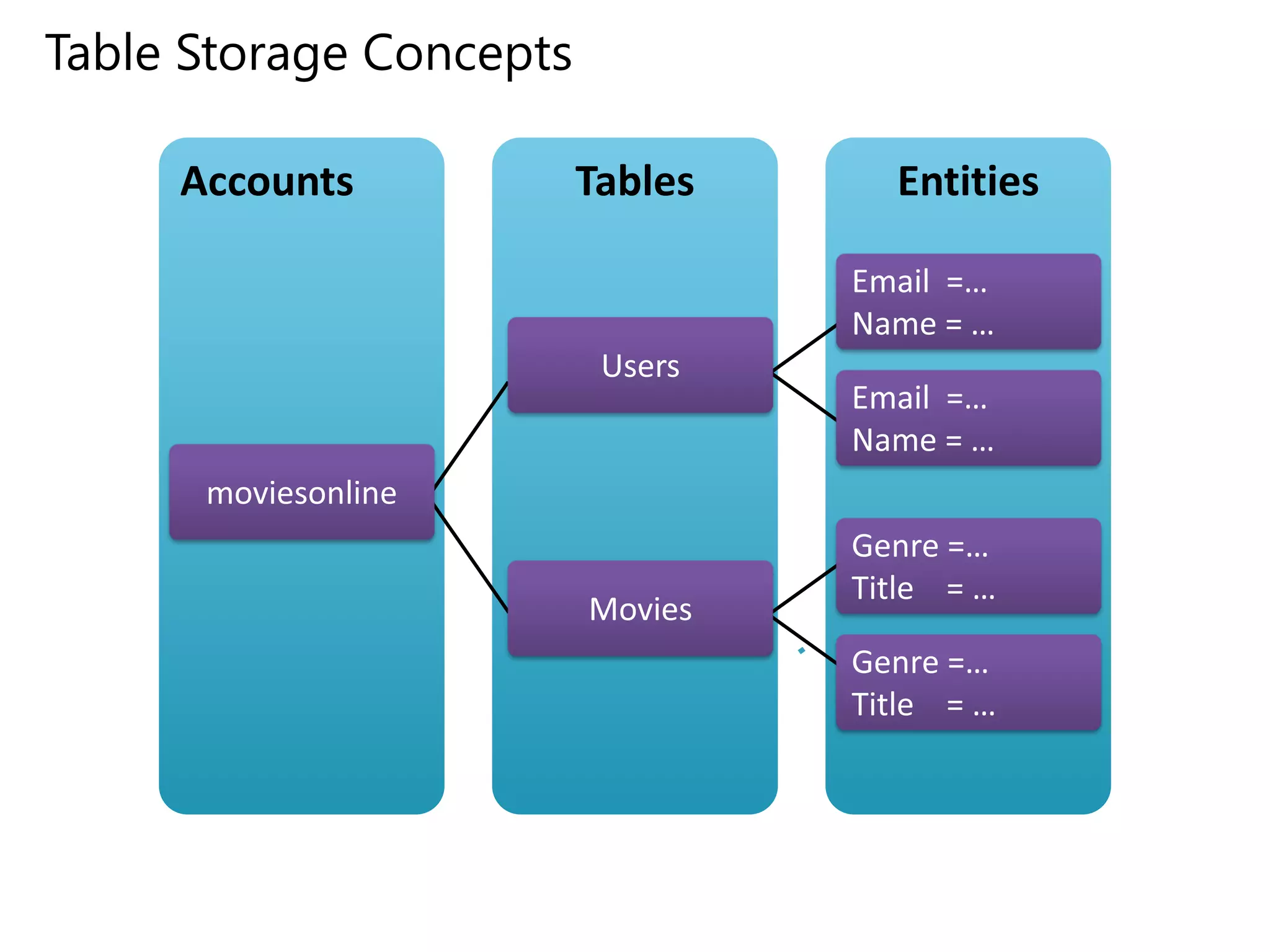
Windows Azure Table Storage
Table Storage
> Designed for structured data, not relational data
> Data definition is part of the application
• A Table is a set of Entities (records)
• An Entity is a set of Properties (fields)
> No fixed schema
• Each property is stored as a <name, typed value> pair
• Two entities within the same table can have different properties
• No schema is enforced
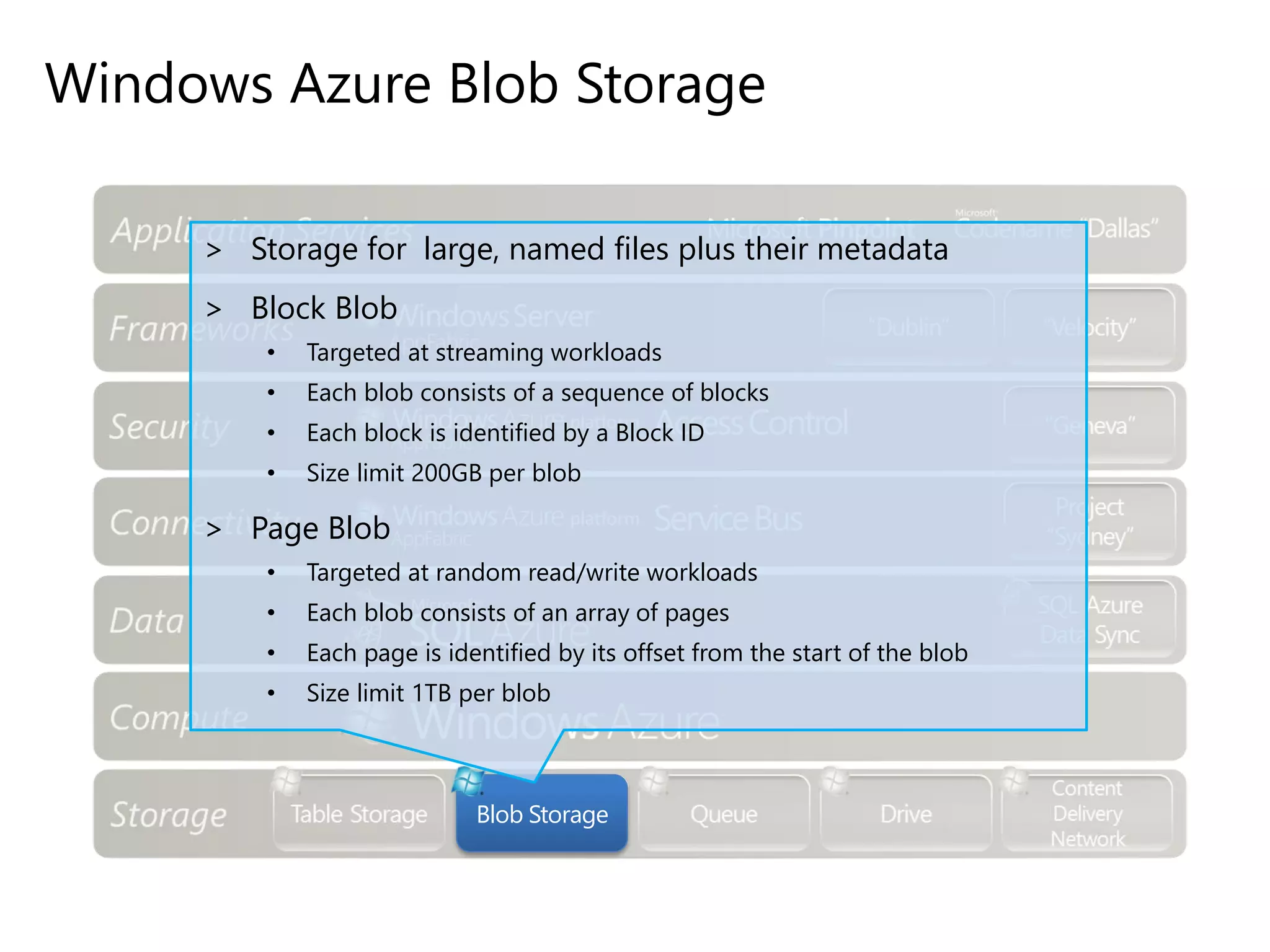
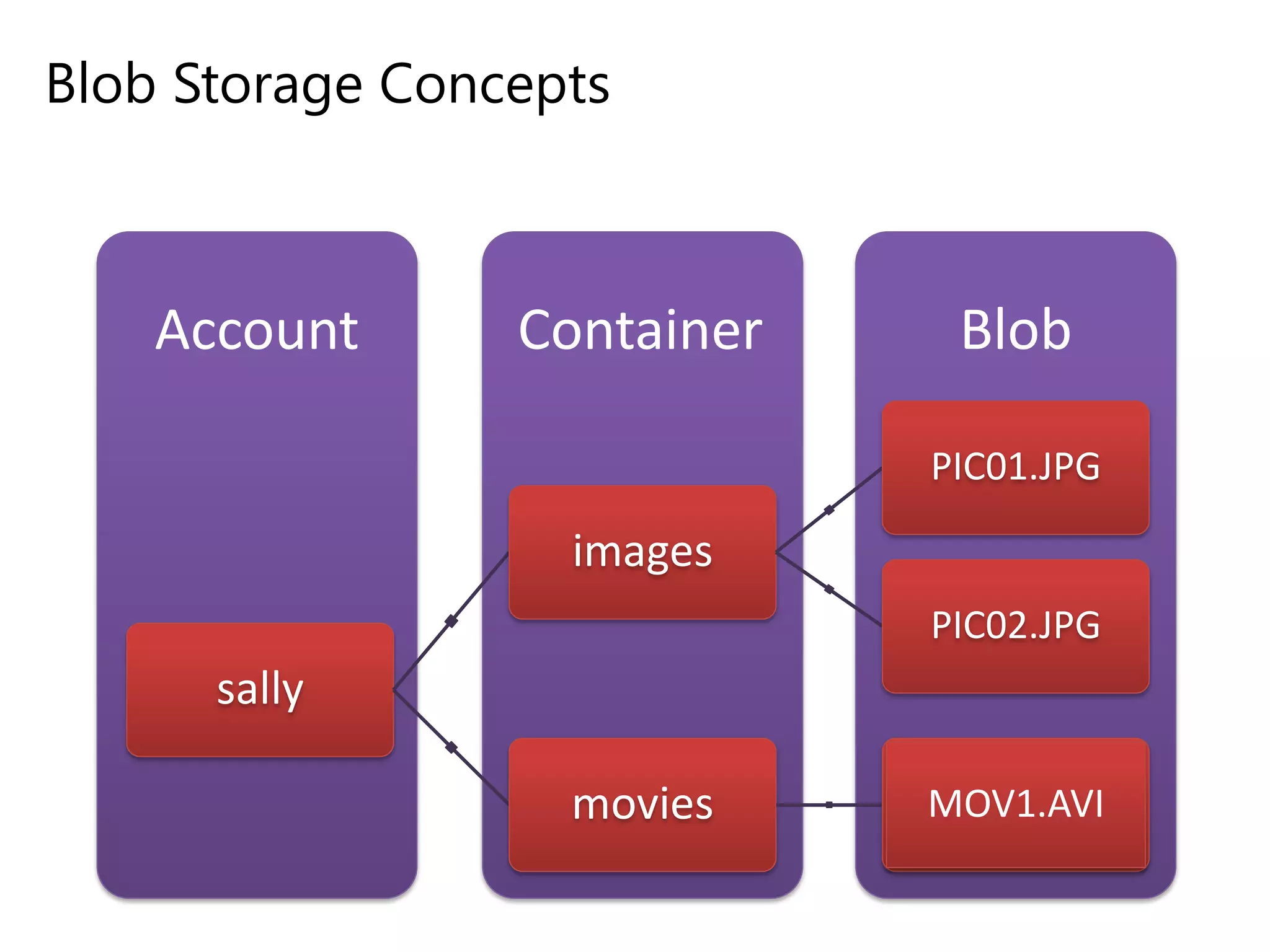
Windows Azure Blob Storage
Blob Storage
> Storage for large, named files plus their metadata
> Block Blob
• Targeted at streaming workloads
• Each blob consists of a sequence of blocks
• Each block is identified by a Block ID
• Size limit 200GB per blob
> Page Blob
• Targeted at random read/write workloads
• Each blob consists of an array of pages
• Each page is identified by its offset from the start of the blob
• Size limit 1TB per blob
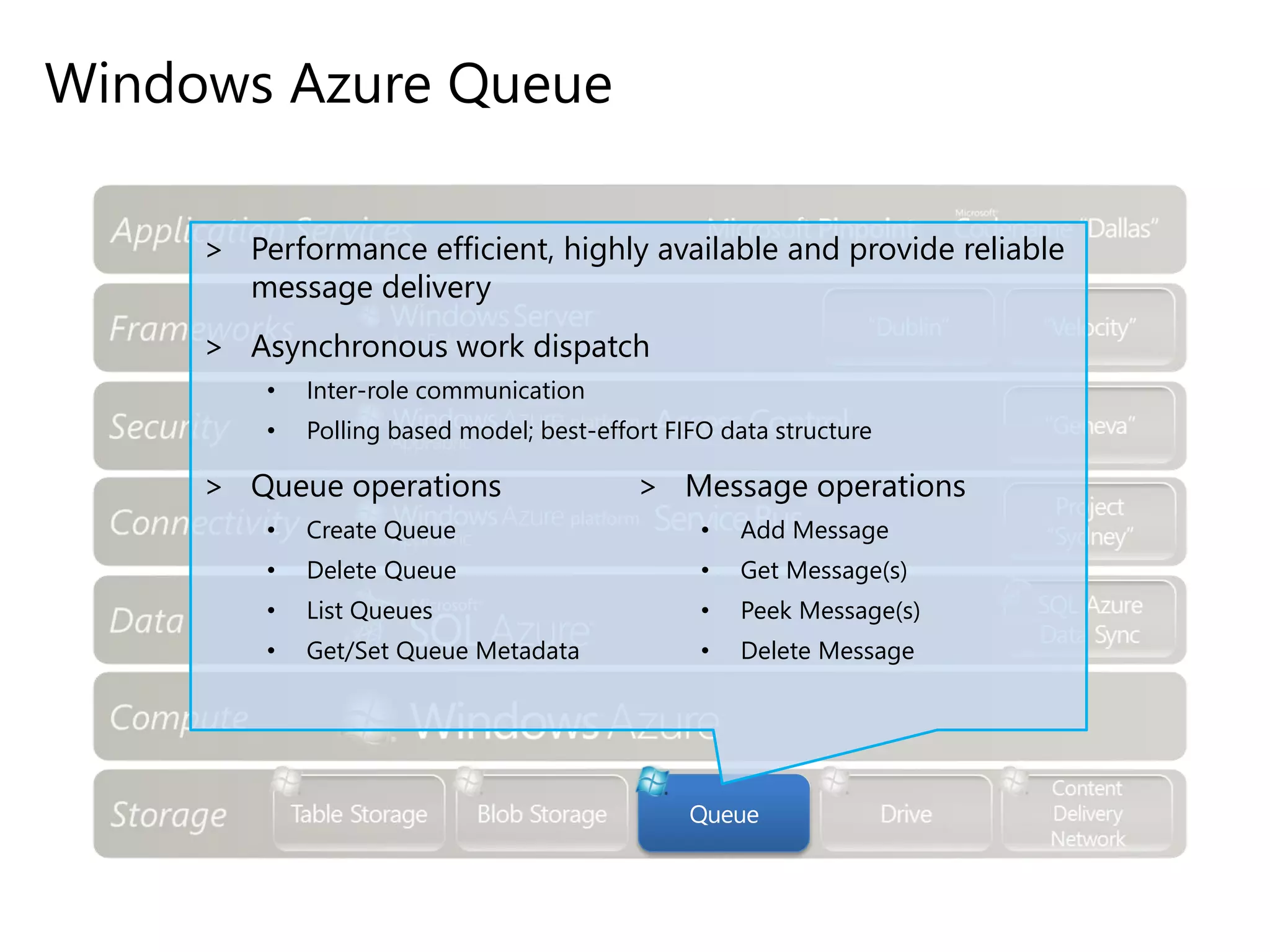
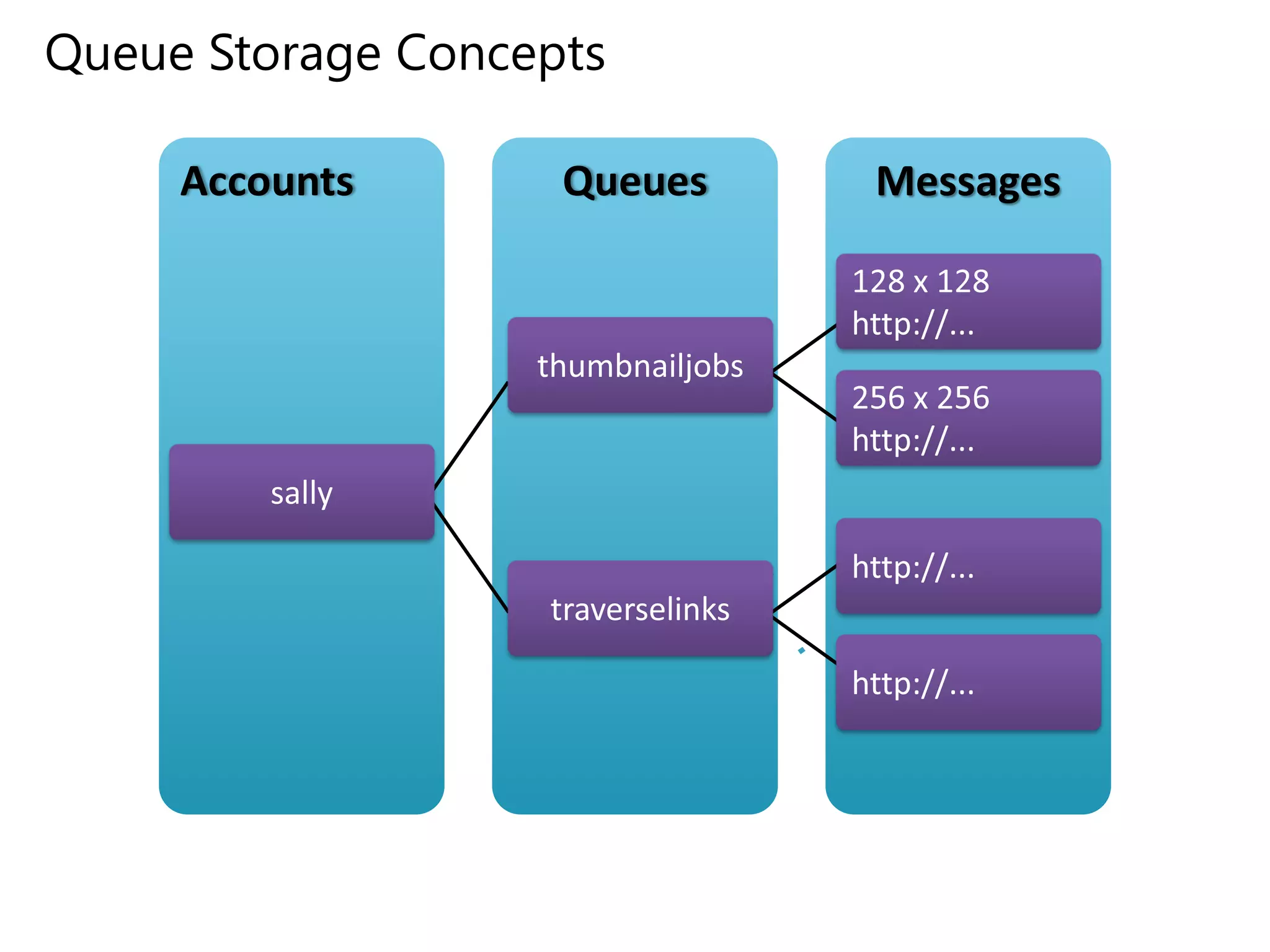
Windows Azure Queue
Queue
> Performance efficient, highly available and provide reliable
message delivery
> Asynchronous work dispatch
• Inter-role communication
• Polling based model; best-effort FIFO data structure
> Queue operations
• Create Queue
• Delete Queue
• List Queues
• Get/Set Queue Metadata
> Message operations
• Add Message
• Get Message(s)
• Peek Message(s)
• Delete Message
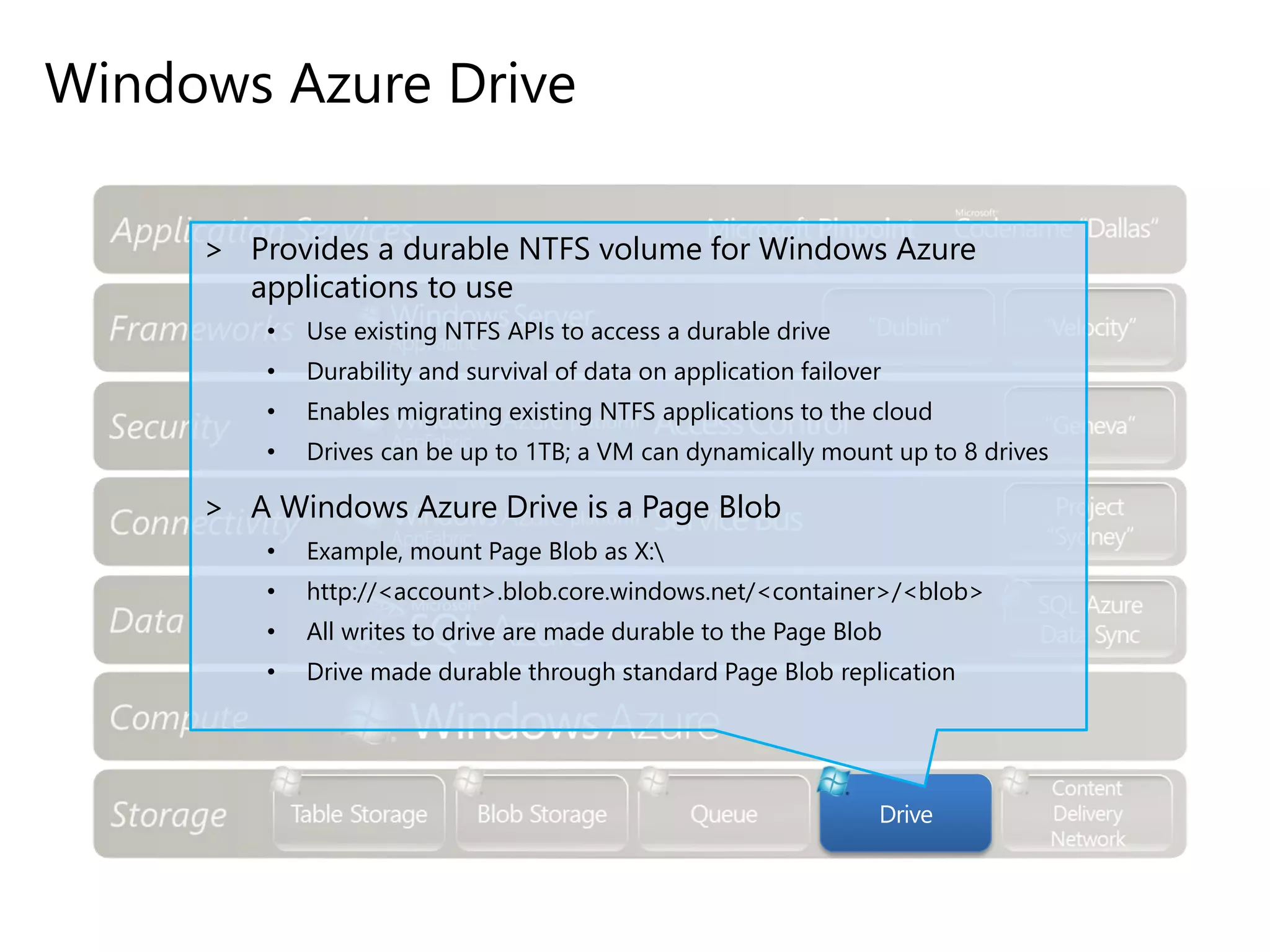
Windows Azure Drive
Drive
> Provides a durable NTFS volume for Windows Azure
applications to use
• Use existing NTFS APIs to access a durable drive
• Durability and survival of data on application failover
• Enables migrating existing NTFS applications to the cloud
• Drives can be up to 1TB; a VM can dynamically mount up to 8 drives
> A Windows Azure Drive is a Page Blob
• Example, mount Page Blob as X:
• http://<account>.blob.core.windows.net/<container>/<blob>
• All writes to drive are made durable to the Page Blob
• Drive made durable through standard Page Blob replication
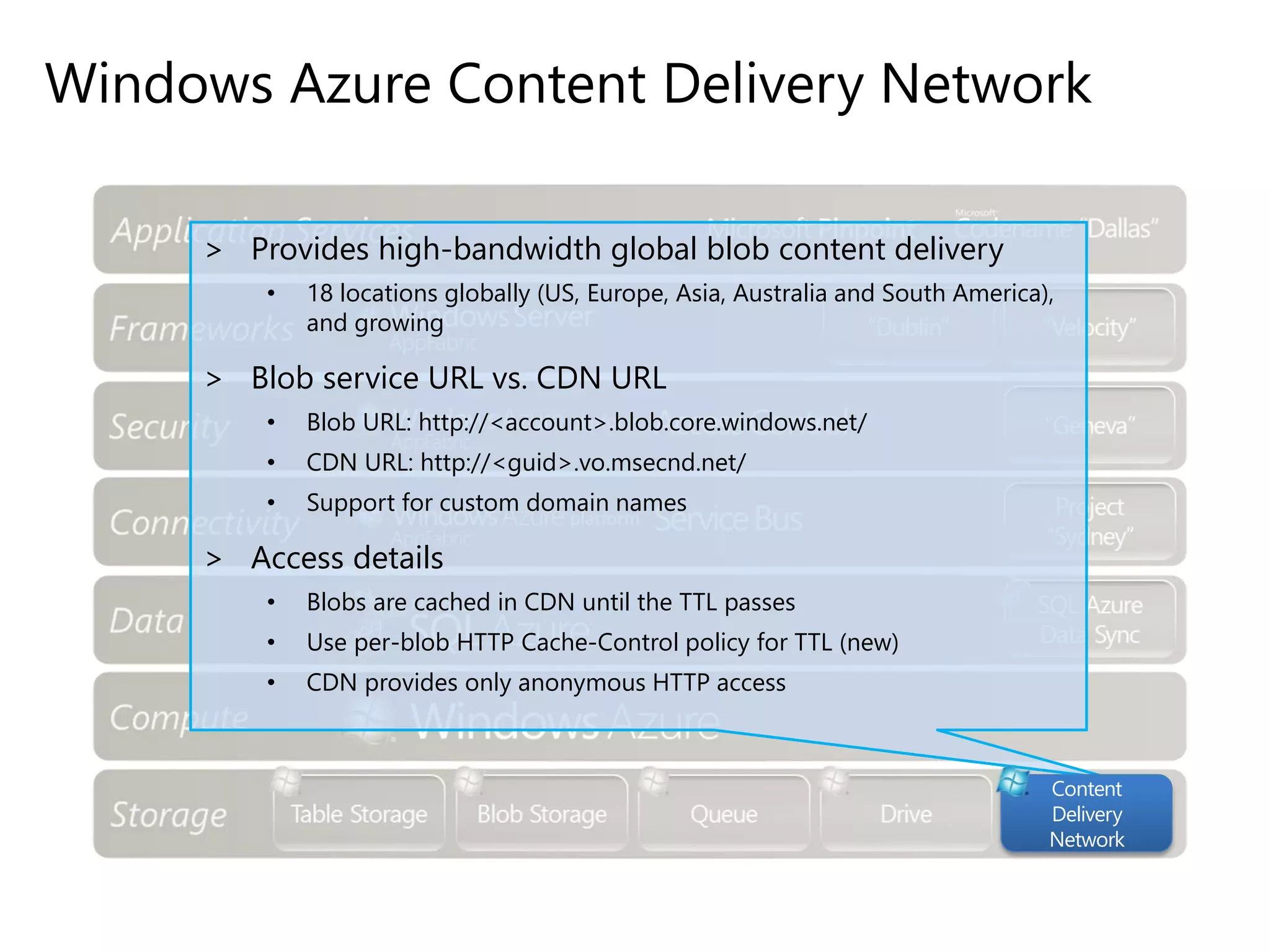
Windows Azure Content Delivery Network
> Provides high-bandwidth global blob content delivery
• 18 locations globally (US, Europe, Asia, Australia and South America),
and growing
> Blob service URL vs. CDN URL
• Blob URL: http://<account>.blob.core.windows.net/
• CDN URL: http://<guid>.vo.msecnd.net/
• Support for custom domain names
> Access details
• Blobs are cached in CDN until the TTL passes
• Use per-blob HTTP Cache-Control policy for TTL (new)
• CDN provides only anonymous HTTP access
Content
Delivery
Network
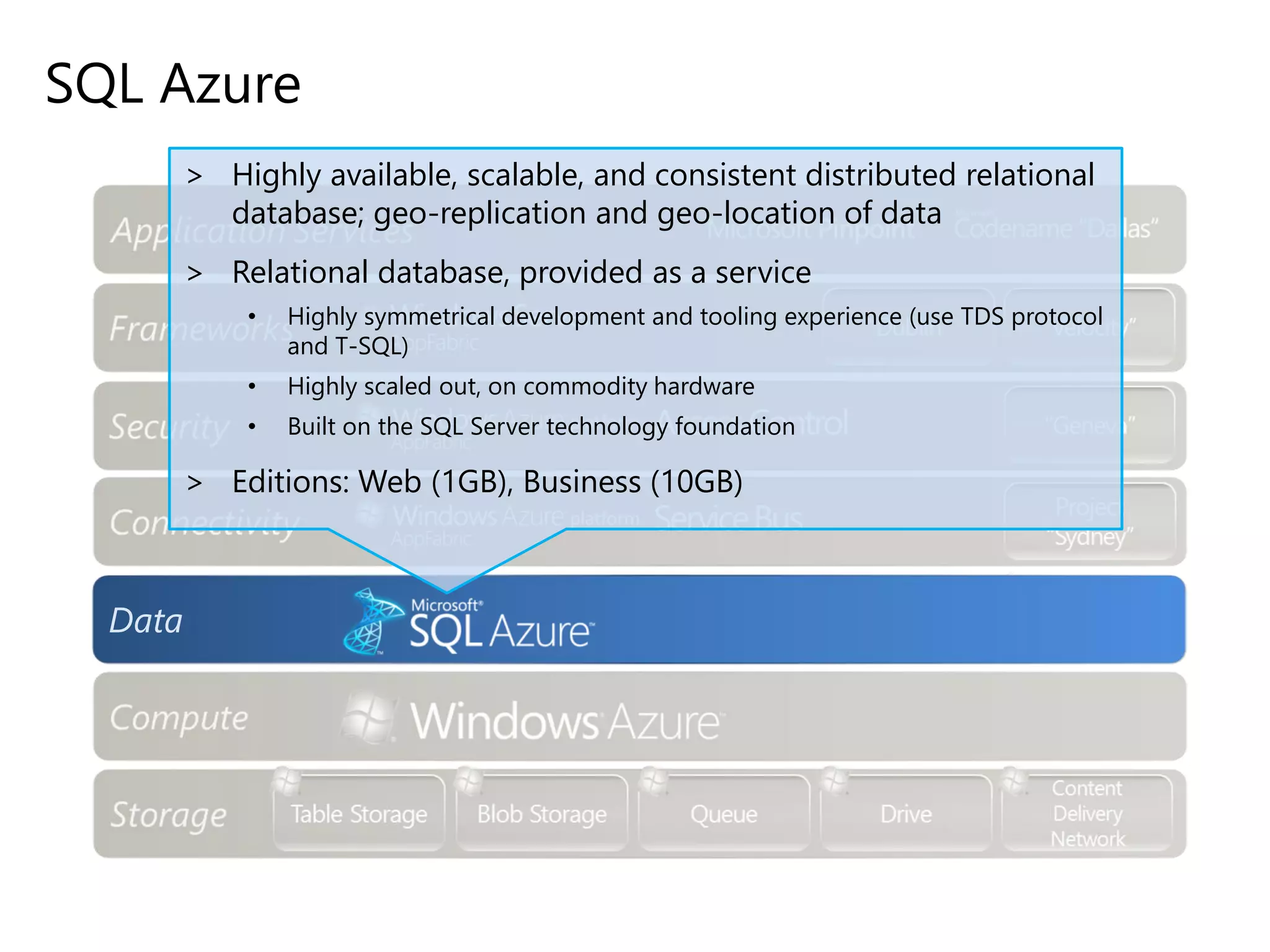
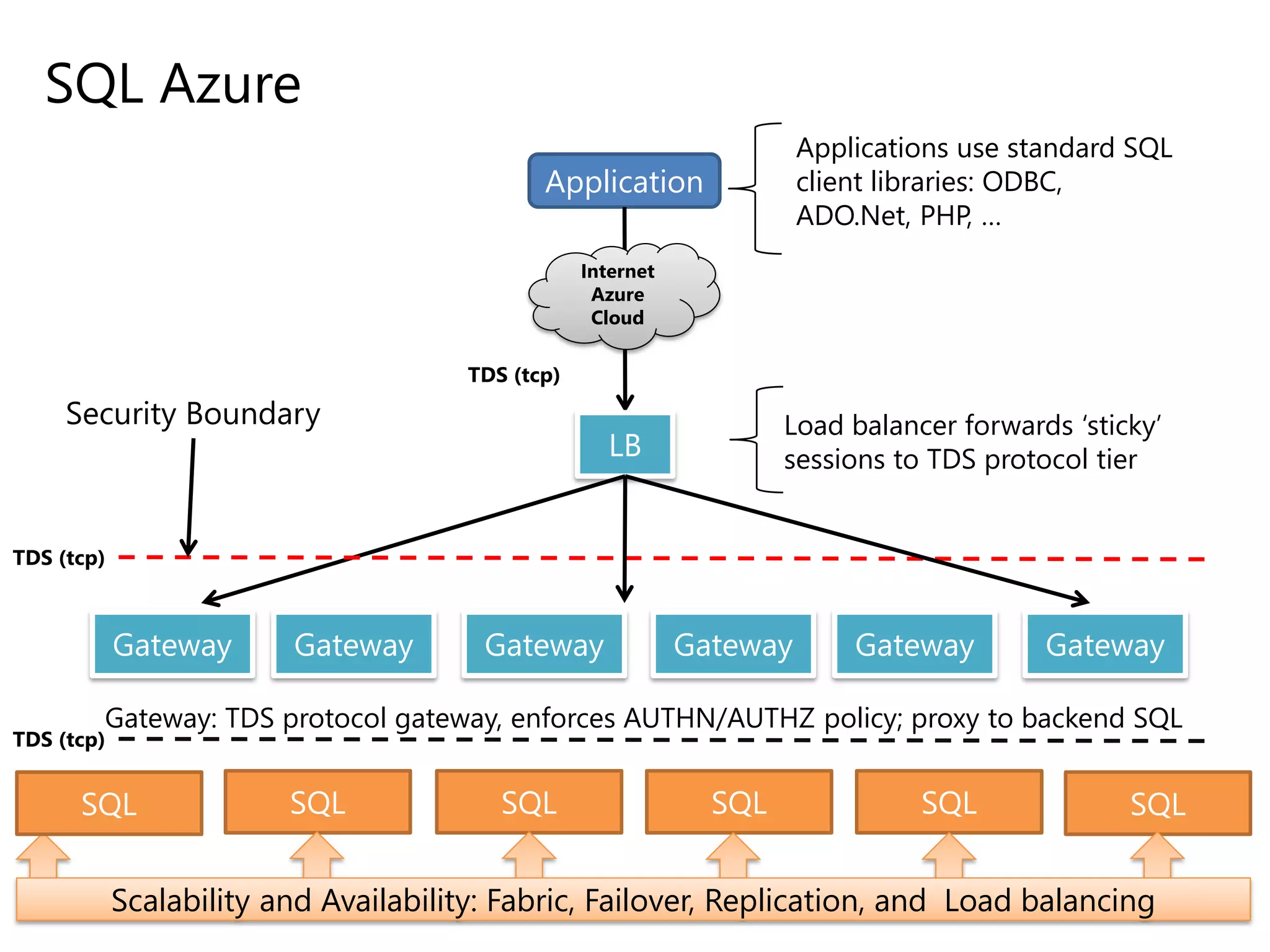
SQL Azure
Data
> Highly available, scalable, and consistent distributed relational
database; geo-replication and geo-location of data
> Relational database, provided as a service
• Highly symmetrical development and tooling experience (use TDS protocol
and T-SQL)
• Highly scaled out, on commodity hardware
• Built on the SQL Server technology foundation
> Editions: Web (1GB), Business (10GB)
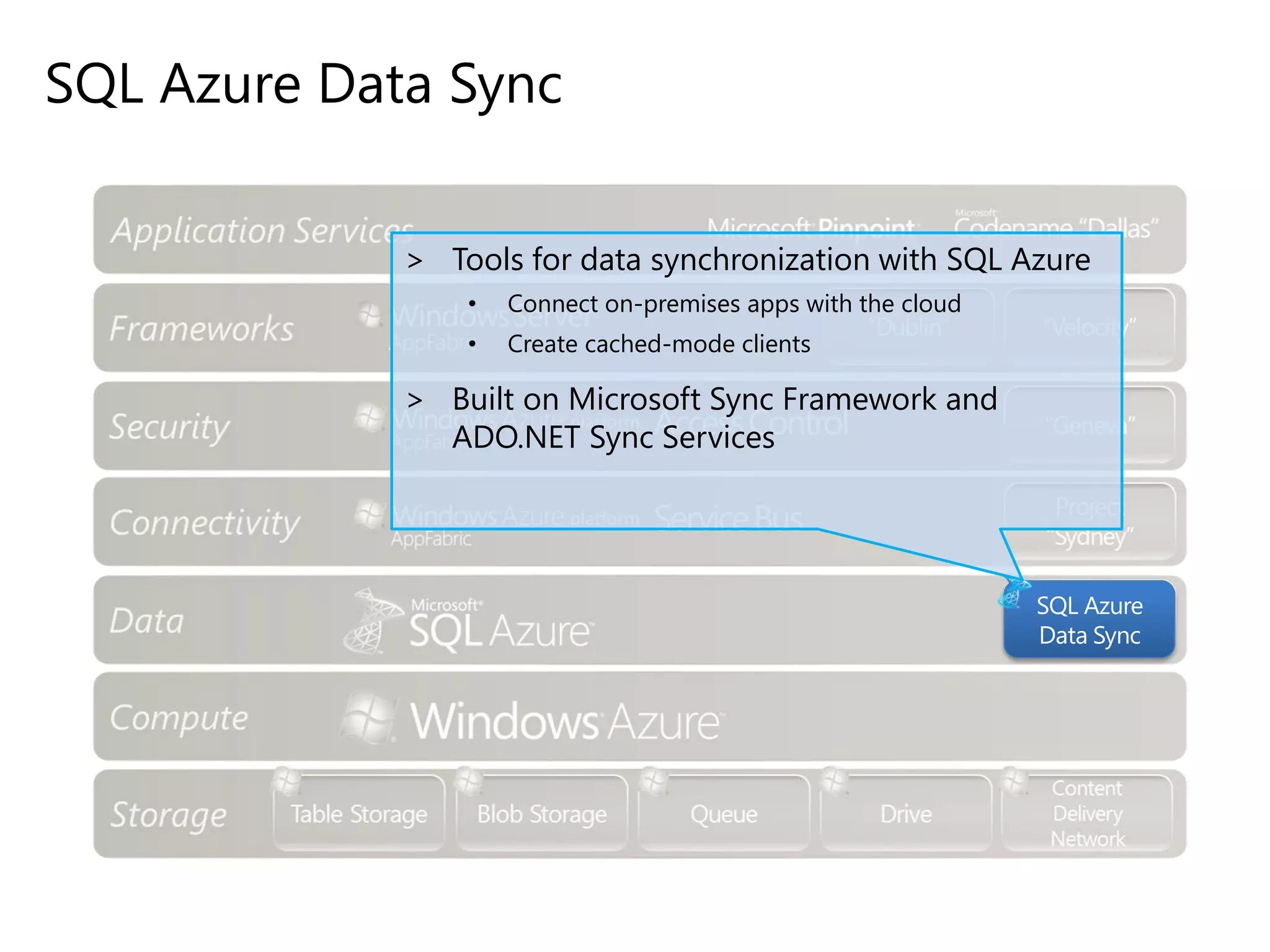
SQL Azure Data Sync
SQL Azure
Data Sync
> Tools for data synchronization with SQL Azure
• Connect on-premises apps with the cloud
• Create cached-mode clients
> Built on Microsoft Sync Framework and
ADO.NET Sync Services
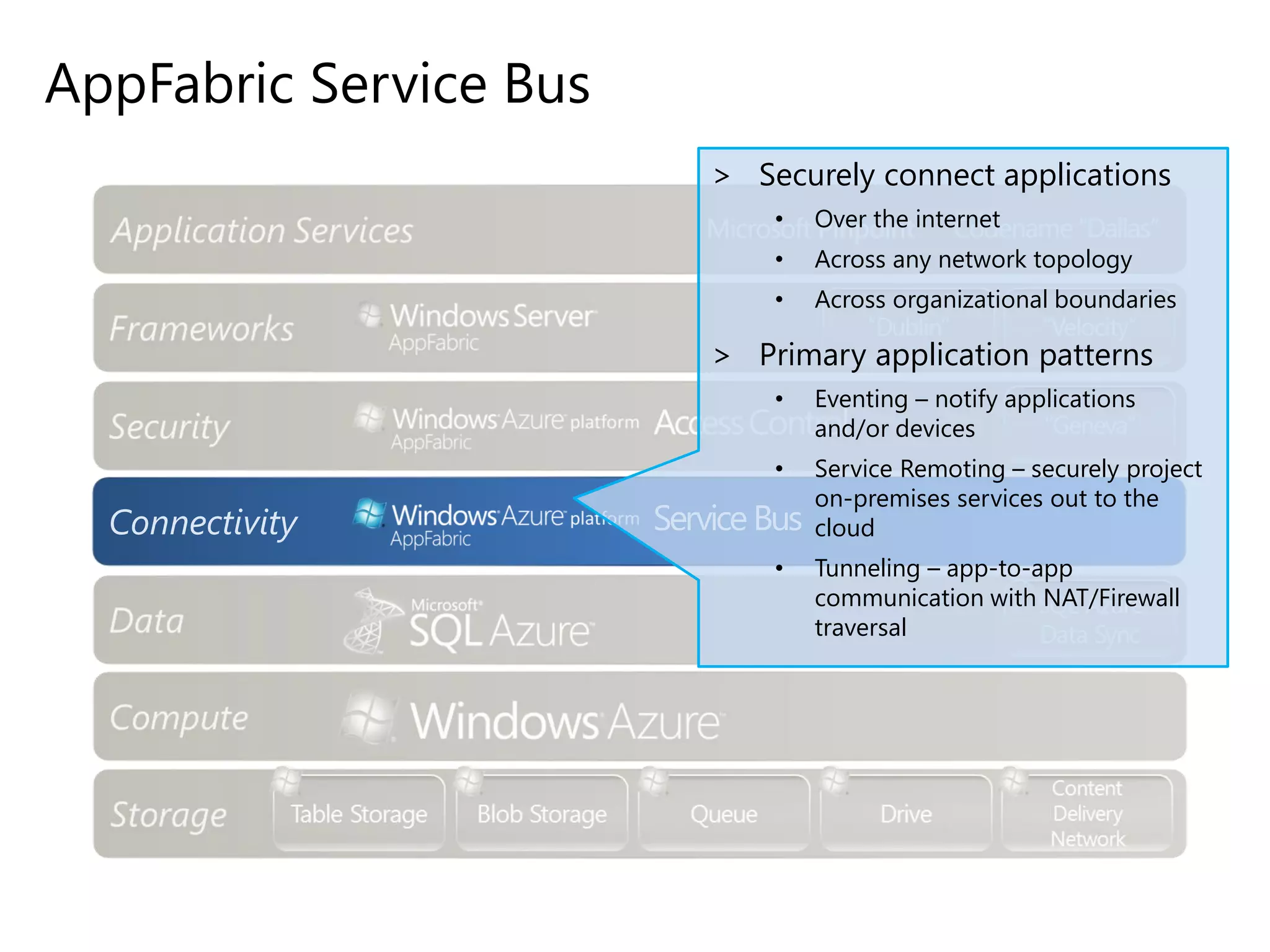
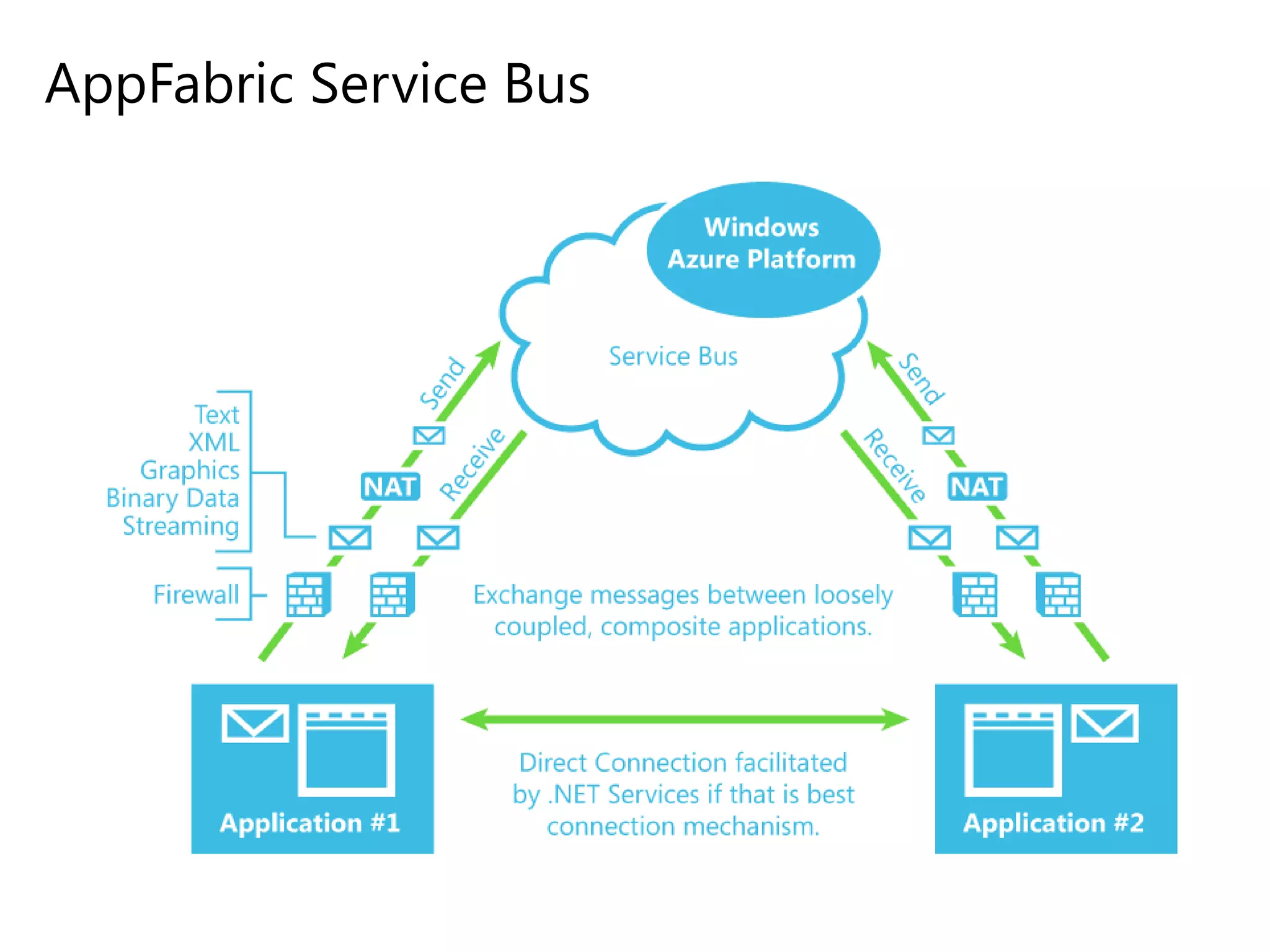
AppFabric Service Bus
Connectivity ServiceBus
> Securely connect applications
• Over the internet
• Across any network topology
• Across organizational boundaries
> Primary application patterns
• Eventing – notify applications
and/or devices
• Service Remoting – securely project
on-premises services out to the
cloud
• Tunneling – app-to-app
communication with NAT/Firewall
traversal
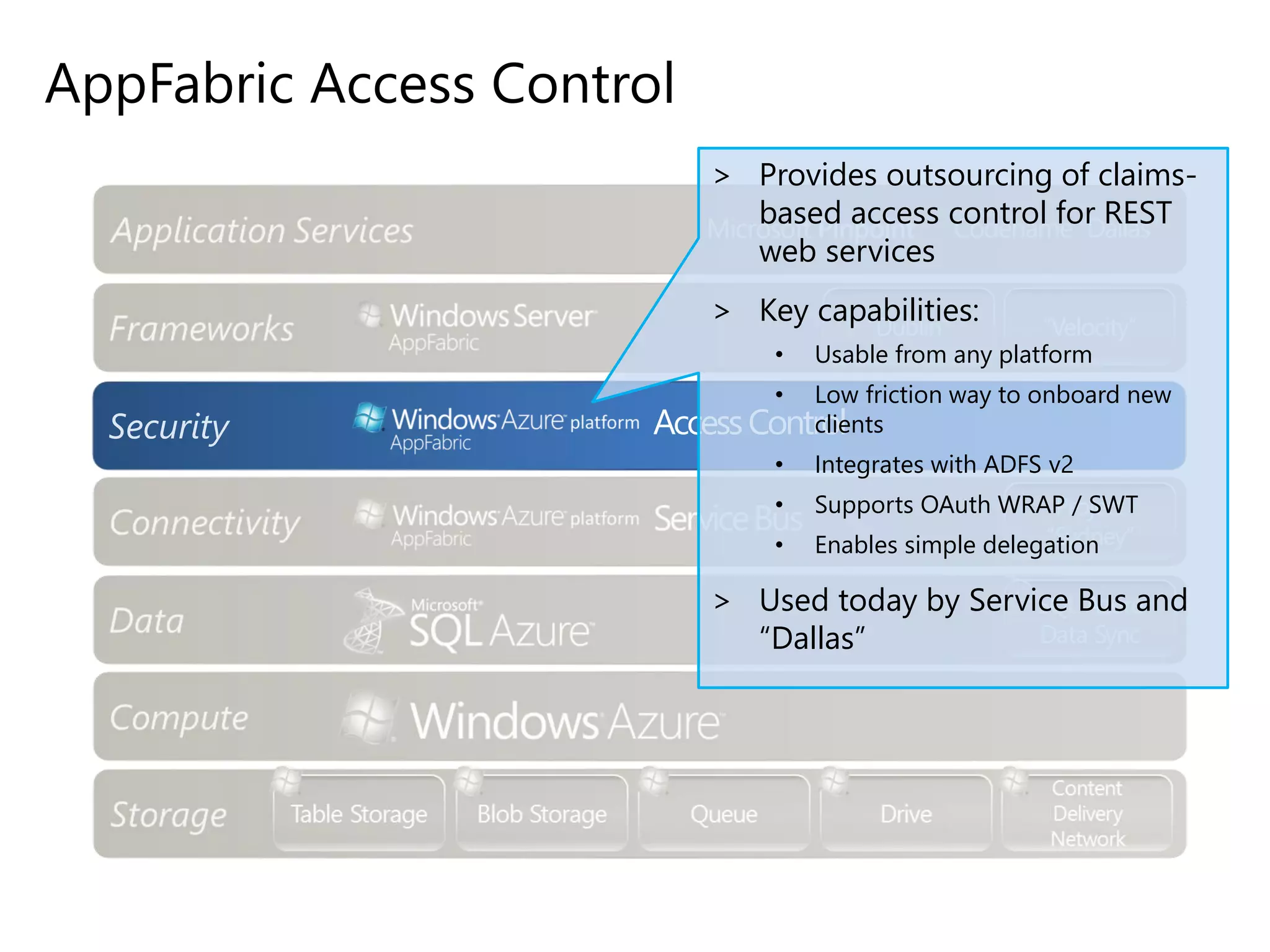
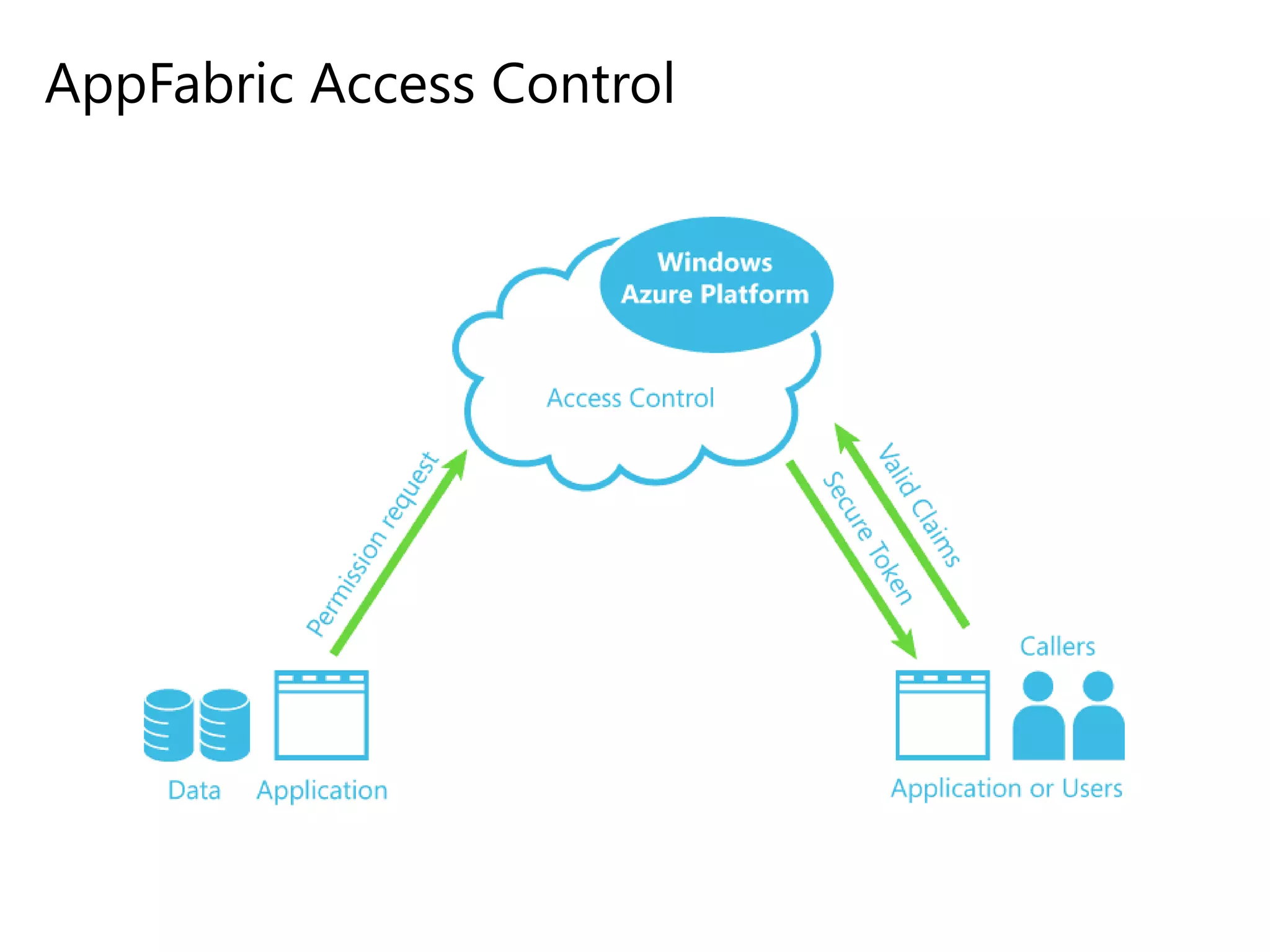
AppFabric Access Control
Security AccessControl
> Provides outsourcing of claims-
based access control for REST
web services
> Key capabilities:
• Usable from any platform
• Low friction way to onboard new
clients
• Integrates with ADFS v2
• Supports OAuth WRAP / SWT
• Enables simple delegation
> Used today by Service Bus and
“Dallas”
“Geneva”
“Geneva”
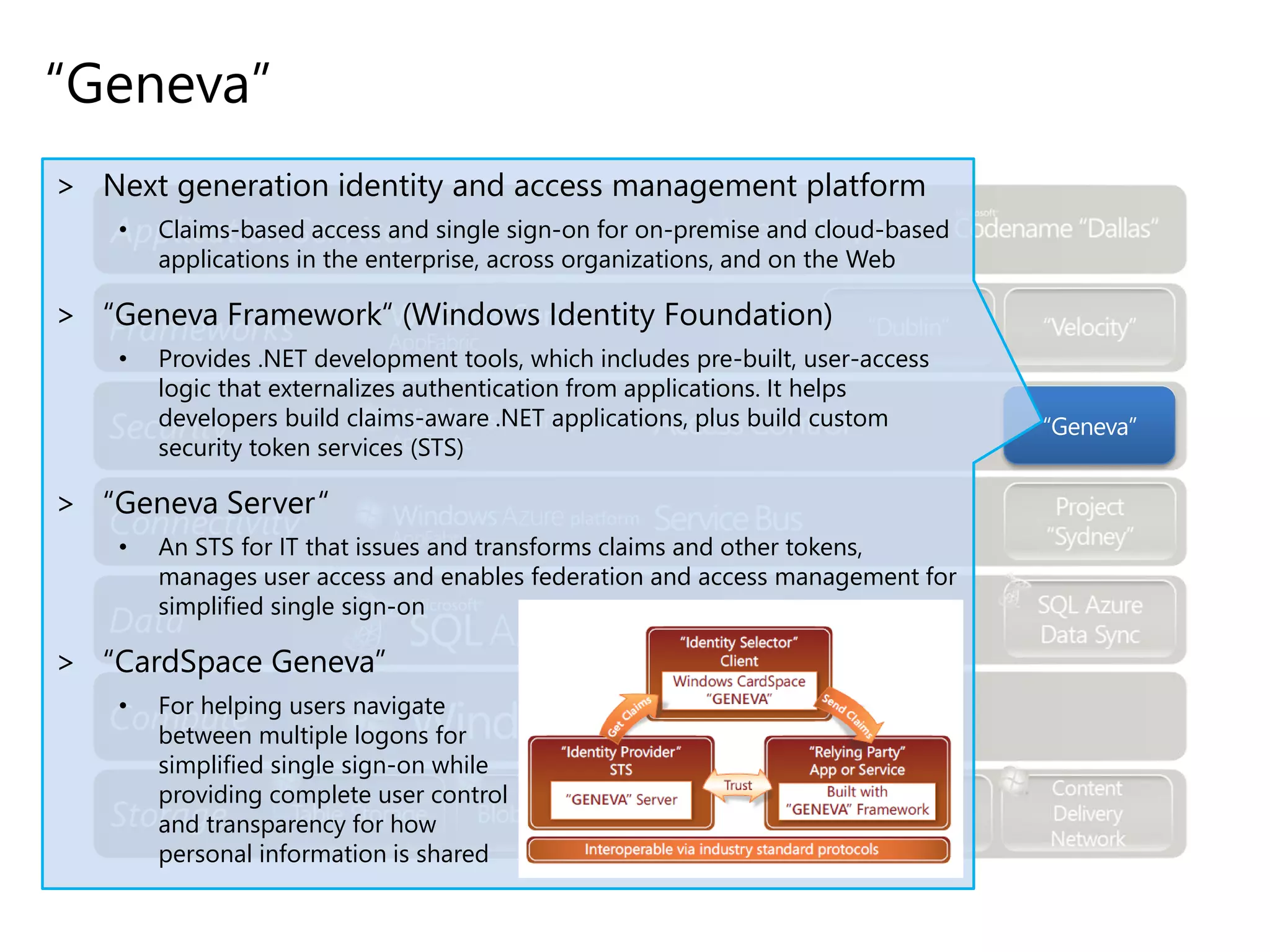
> Next generation identity and access management platform
• Claims-based access and single sign-on for on-premise and cloud-based
applications in the enterprise, across organizations, and on the Web
> “Geneva Framework“ (Windows Identity Foundation)
• Provides .NET development tools, which includes pre-built, user-access
logic that externalizes authentication from applications. It helps
developers build claims-aware .NET applications, plus build custom
security token services (STS)
> “Geneva Server“
• An STS for IT that issues and transforms claims and other tokens,
manages user access and enables federation and access management for
simplified single sign-on
> “CardSpace Geneva”
• For helping users navigate
between multiple logons for
simplified single sign-on while
providing complete user control
and transparency for how
personal information is shared
“Velocity”
“Velocity”
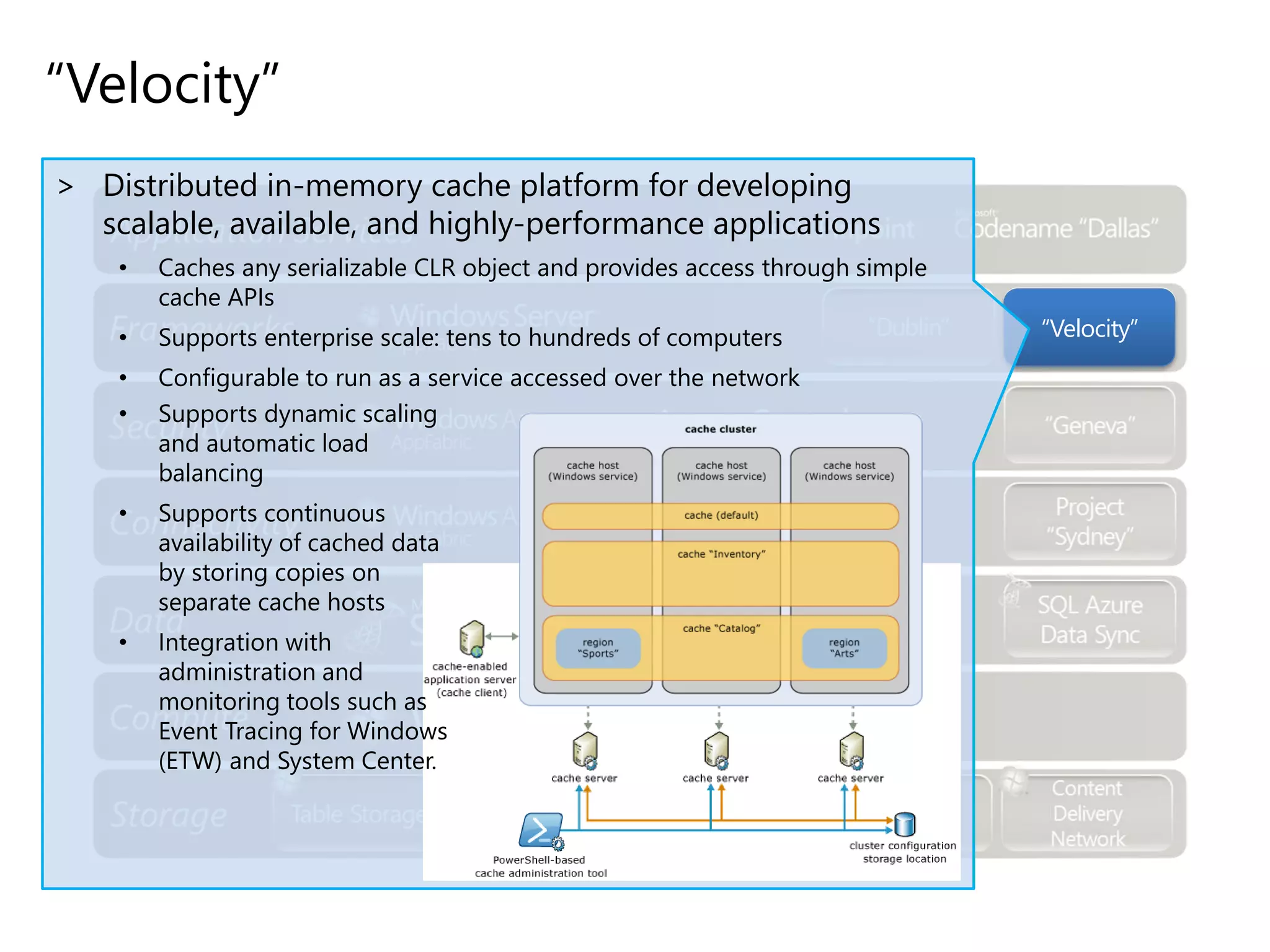
> Distributed in-memory cache platform for developing
scalable, available, and highly-performance applications
• Caches any serializable CLR object and provides access through simple
cache APIs
• Supports enterprise scale: tens to hundreds of computers
• Configurable to run as a service accessed over the network
• Supports dynamic scaling
and automatic load
balancing
• Supports continuous
availability of cached data
by storing copies on
separate cache hosts
• Integration with
administration and
monitoring tools such as
Event Tracing for Windows
(ETW) and System Center.
“Dublin”
“Dublin”
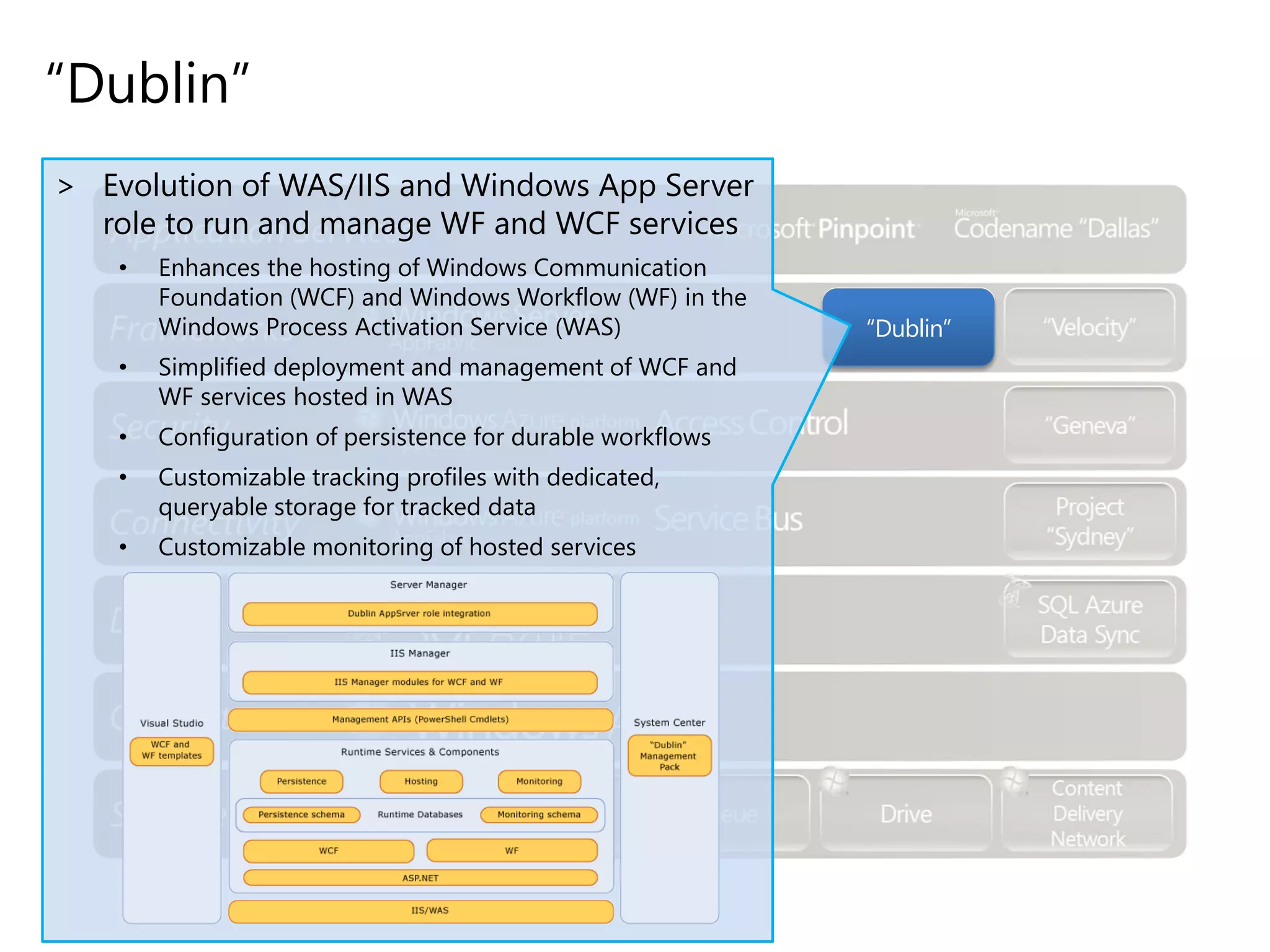
> Evolution of WAS/IIS and Windows App Server
role to run and manage WF and WCF services
• Enhances the hosting of Windows Communication
Foundation (WCF) and Windows Workflow (WF) in the
Windows Process Activation Service (WAS)
• Simplified deployment and management of WCF and
WF services hosted in WAS
• Configuration of persistence for durable workflows
• Customizable tracking profiles with dedicated,
queryable storage for tracked data
• Customizable monitoring of hosted services
“Dallas”
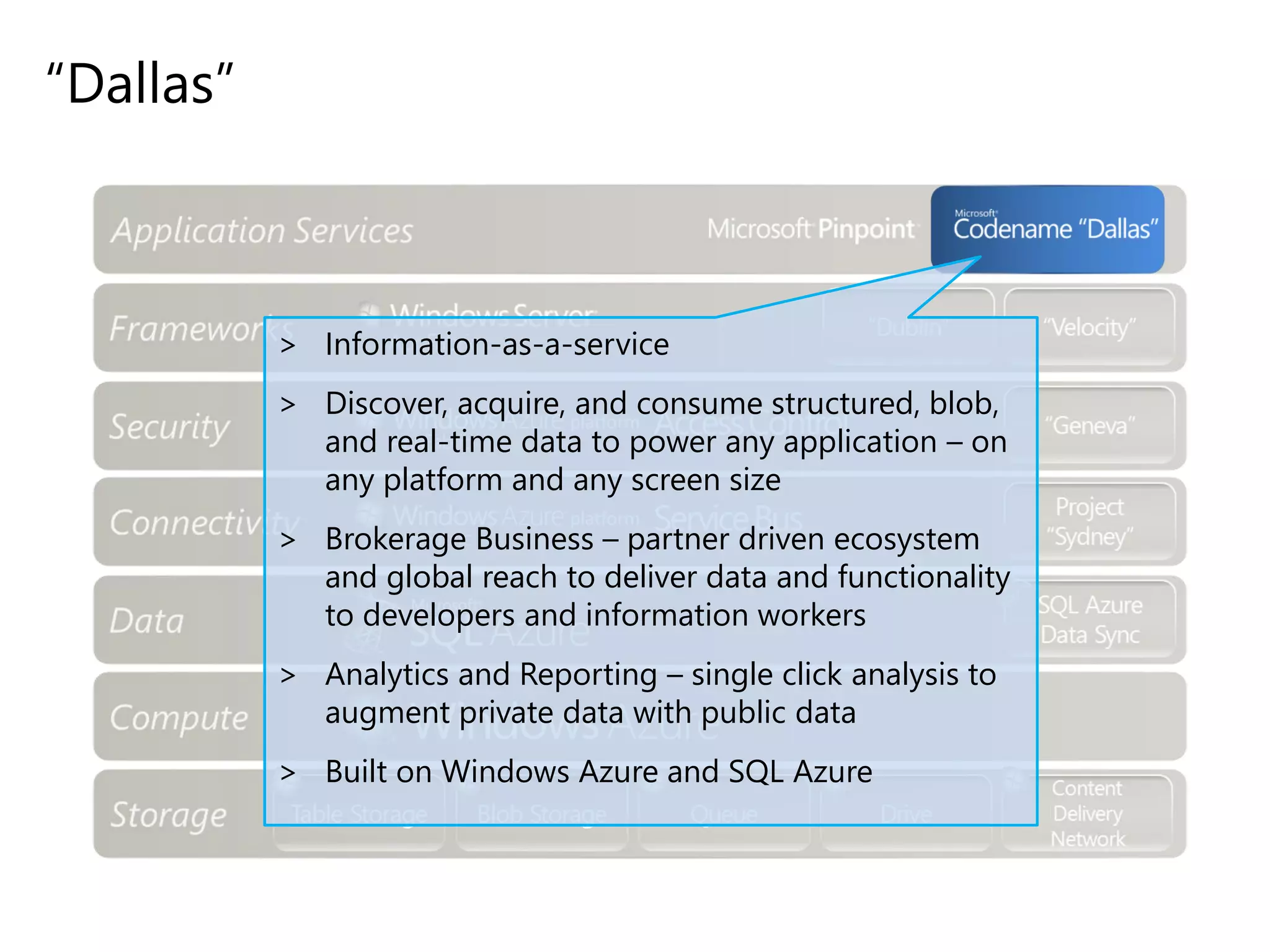
> Information-as-a-service
> Discover, acquire, and consume structured, blob,
and real-time data to power any application – on
any platform and any screen size
> Brokerage Business – partner driven ecosystem
and global reach to deliver data and functionality
to developers and information workers
> Analytics and Reporting – single click analysis to
augment private data with public data
> Built on Windows Azure and SQL Azure
Compute
Storage
Data
SQL Azure
Data Sync
Connectivity
Project
“Sydney”
Security “Geneva”
Application Services
Frameworks “Dublin” “Velocity”
Windows Azure Platform
ServiceBus
AccessControl
Table Storage Blob Storage Queue Drive
Content
Delivery
Network
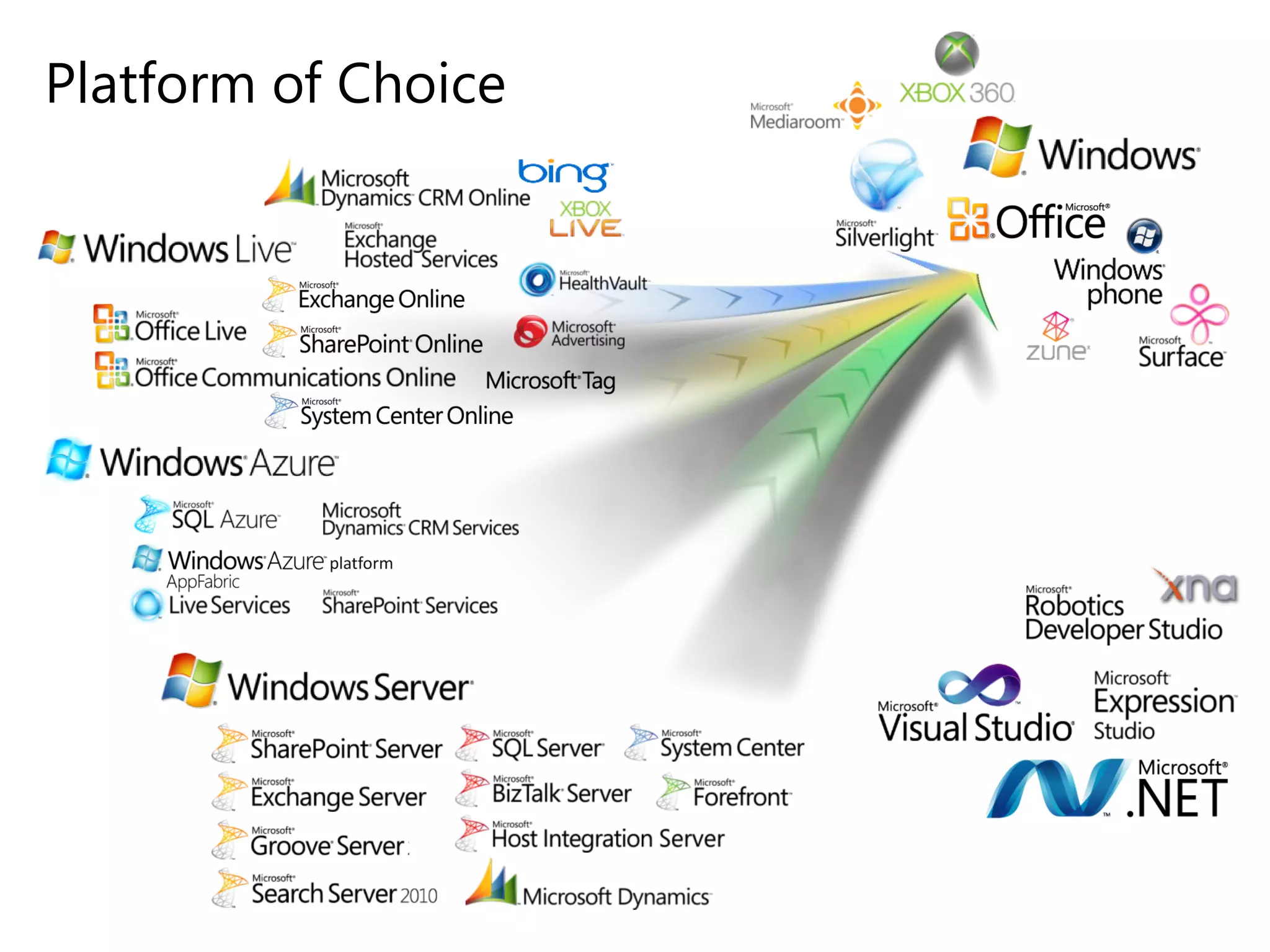
Platform of Choice
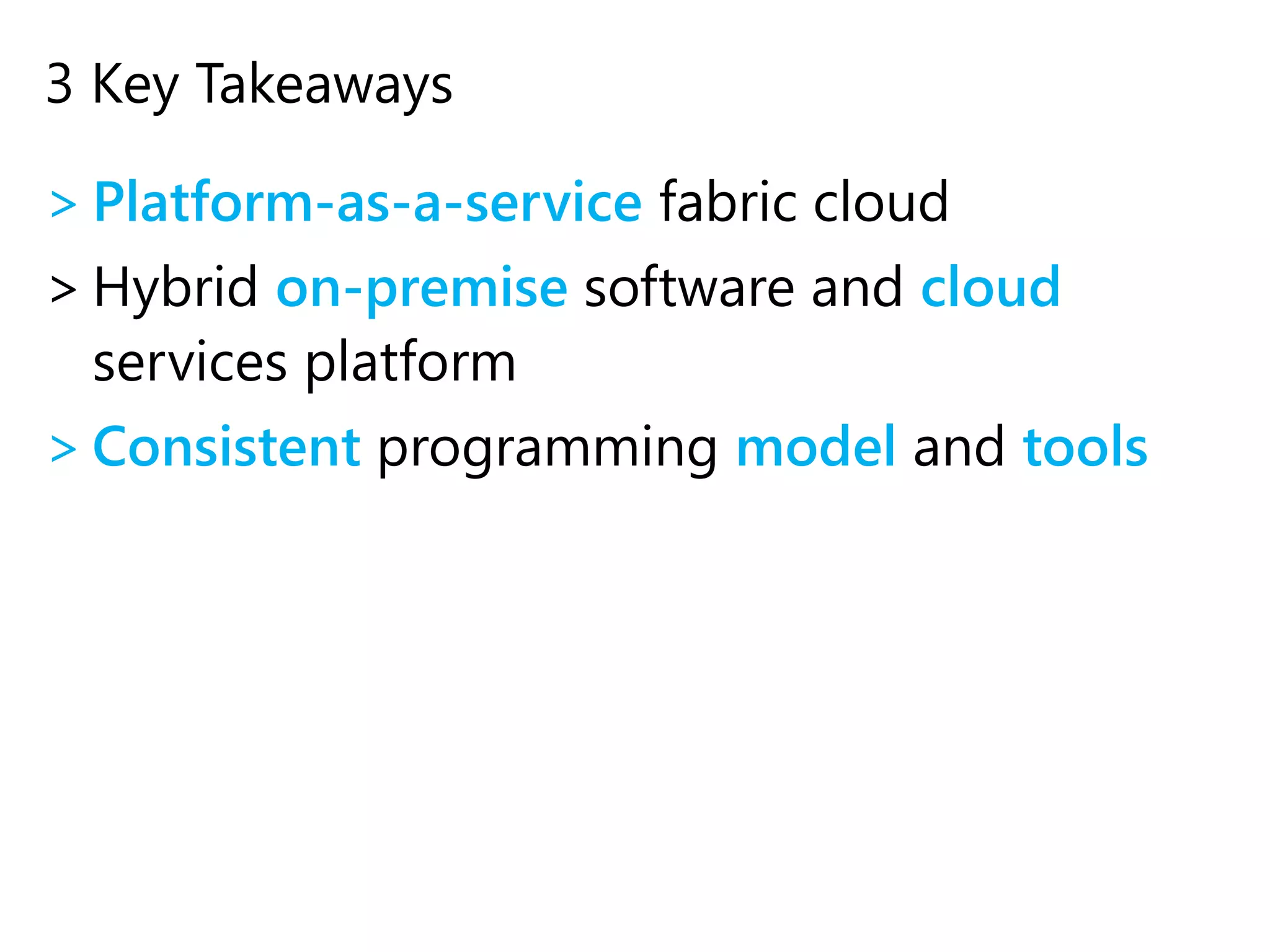
3 Key Takeaways
> Platform-as-a-service fabric cloud
> Hybrid on-premise software and cloud
services platform
> Consistent programming model and tools
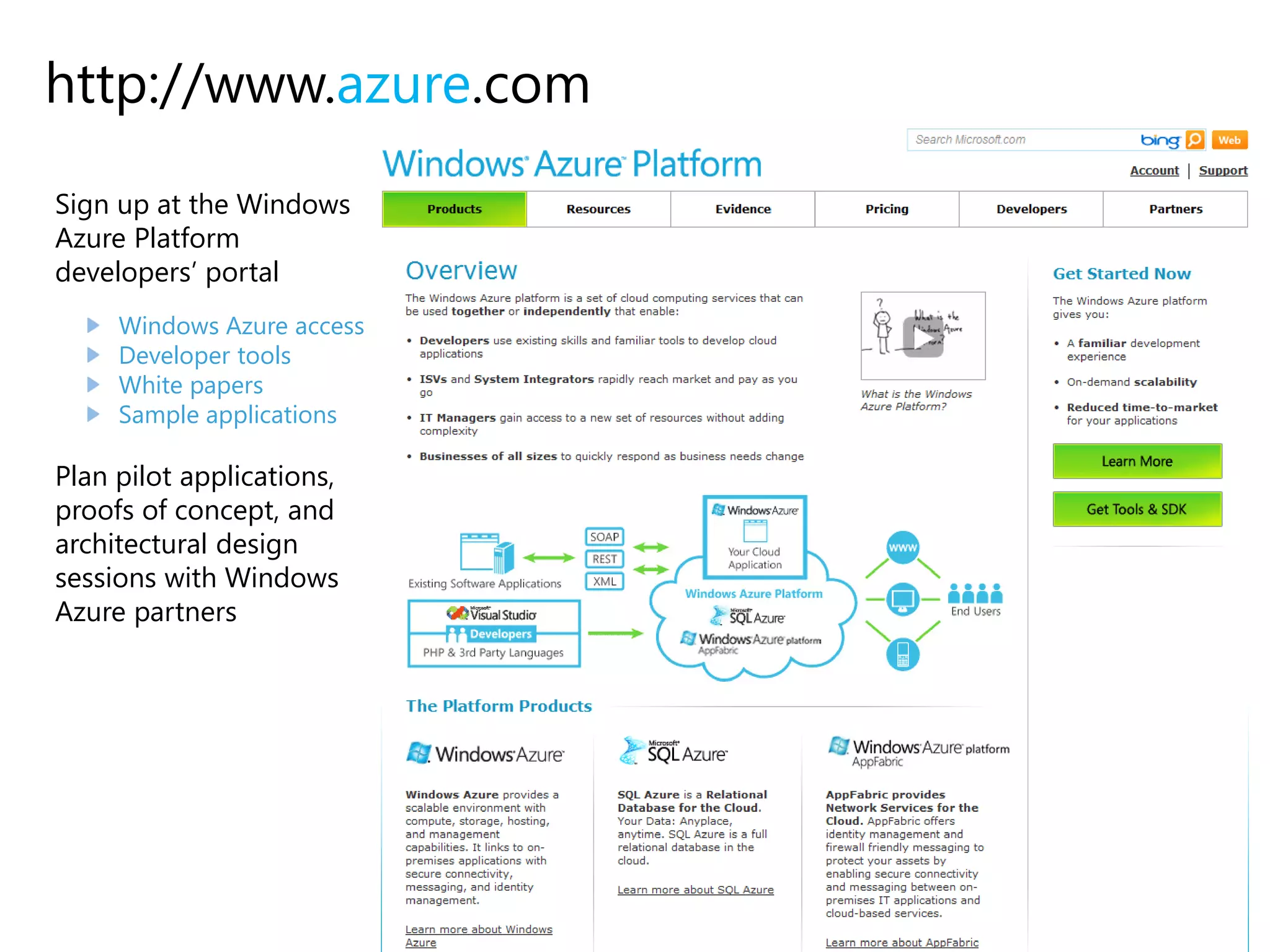
Sign up at the Windows
Azure Platform
developers’ portal
Windows Azure access
Developer tools
White papers
Sample applications
Plan pilot applications,
proofs of concept, and
architectural design
sessions with Windows
Azure partners
http://www.azure.com
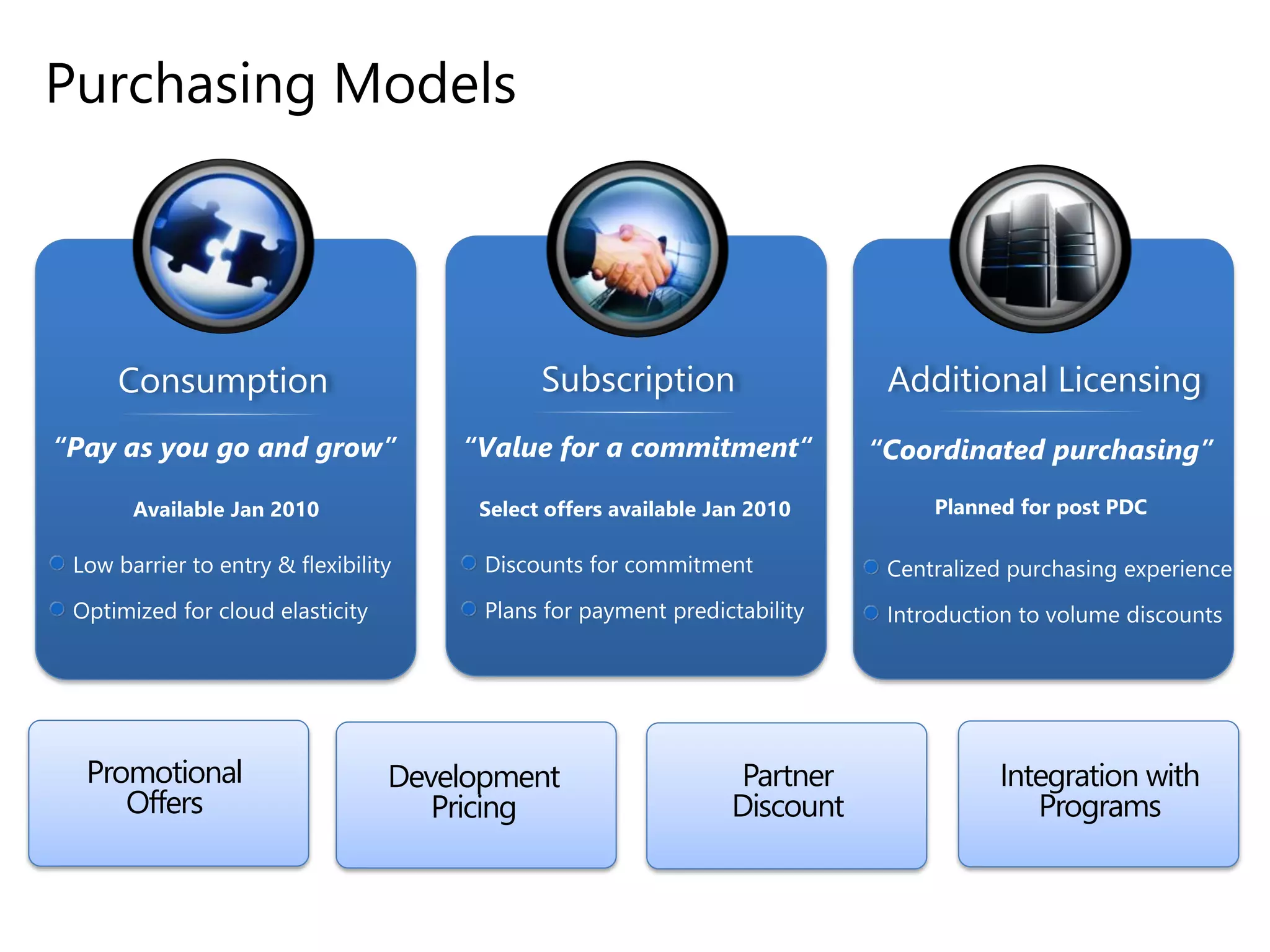
Purchasing Models
Promotional
Offers
Partner
Discount
Development
Pricing
Integration with
Programs
Windows Azure Platform
AppFabric Service Bus
AppFabric Access Control
SQL Azure
Application
Internet
Azure
Cloud
LB
TDS (tcp)
TDS (tcp)
TDS (tcp)
Applications use standard SQL
client libraries: ODBC,
ADO.Net, PHP, …
Load balancer forwards ‘sticky’
sessions to TDS protocol tier
Security Boundary
SQL SQL SQL SQL SQLSQL
Gateway Gateway Gateway Gateway Gateway Gateway
Scalability and Availability: Fabric, Failover, Replication, and Load balancing
Gateway: TDS protocol gateway, enforces AUTHN/AUTHZ policy; proxy to backend SQL
Table Storage Concepts
EntitiesTablesAccounts
Queue Storage Concepts
MessagesQueuesAccounts
Blob Storage Concepts
BlobContainerAccount
sally
images
PIC01.JPG
PIC02.JPG
movies MOV1.AVI
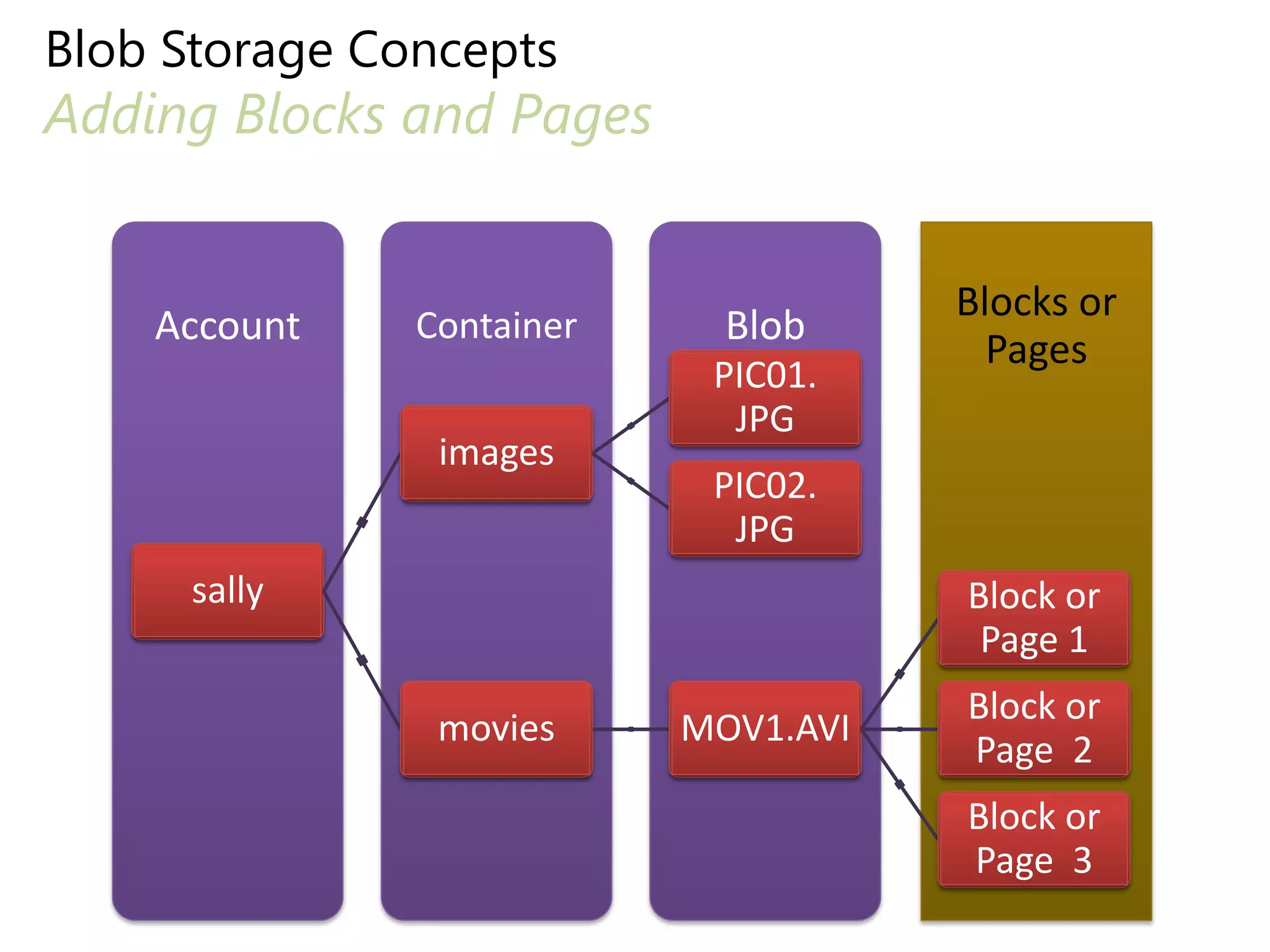
Blob Storage Concepts
Blocks or
Pages
BlobContainerAccount
sally
images
PIC01.
JPG
PIC02.
JPG
movies MOV1.AVI
Block or
Page 1
Block or
Page 2
Block or
Page 3

Microsoft azure platforms

  • 1.
  • 2.
    Microsoft in theCloud (15 years) 450M+ active users (13 years) 550M users/mth (12 years) Largest non- ICP/IP cloud service x100M users (11 years) 320M+ active users (11 years) 2B queries/mth (15 years) 450M+ active users (7 years) 5B conf min/yr (6 years) 4B emails/day
  • 3.
    Bing – “AutoPilot” Architecture Web & Structured Data Indices ~100,000 Servers in Multiple Data Centers
  • 4.
    Generalized Cloud ApplicationModel Federated Scale-Out Elastic Staged Production Self-Service Multi-Tenant Model-Driven Always Available Failure Resilient Service-Oriented
  • 5.
    The Microsoft Cloud >Purpose-built data centre to accommodate containers at large scale  Cost $500 million, 100,000 square foot facility (10 football fields) > 40 foot shipping containers can house as many as 2,500 servers  Density of 10 times amount of compute in equivalent space in traditional data centre > Can deliver an average PUE of 1.22  Power Usage Effectiveness benchmark from The Green Grid™ consortium on energy efficiency Data Center Infrastructure
  • 6.
    The Microsoft Cloud DataCenter Infrastructure
  • 7.
    The Microsoft Cloud DataCenter Infrastructure
  • 8.
    The Microsoft Cloud ~100Globally Distributed Data Centers Quincy, WA Chicago, IL San Antonio, TX Dublin, Ireland Generation 4 DCs
  • 9.
    The Microsoft Cloud Highlyavailable, scalable, and consistent application fabric environment
  • 10.
    Platform Services Software Services ApplicationServices Infrastructure Services The Microsoft Cloud Categories of Services
  • 11.
    Storage Unstructured Data Blobs Message Queues Distributed Filesystem Content Distribution Data Transact-SQL Data Synchronization Relational Database ADO.NET, ODBC, PHP Connectivity Composite Applications On-Premise Bridging ServiceBus Security Claims-Based Identity Federated Identities Secure Token Service Declarative Policies Application Services Application Marketplace Information Marketplace Personal Data Repository Frameworks Workflow Hosting Distributed Cache Services Hosting Windows Azure Platform Compute C/C++ Win32 VHD
  • 12.
    Compute Storage Data SQL Azure Data Sync Connectivity Project “Sydney” Security“Geneva” Application Services Frameworks “Dublin” “Velocity” Windows Azure Platform ServiceBus AccessControl Table Storage Blob Storage Queue Drive Content Delivery Network
  • 13.
    Windows Azure Compute Compute >Development, service hosting, & management environment • .NET, Java PHP, Python, Ruby, native code (C/C++, Win32, etc.) • ASP.NET providers, FastCGI, memcached, MySQL, Tomcat • Full-trust – supports standard languages and APIs • Secure certificate store • Management API’s, and logging and diagnostics systems > Multiple roles – Web, Worker, Virtual Machine (VHD) > Multiple VM sizes • 1.6 GHz CPU x64, 1.75GB RAM, 100Mbps network, 250GB volatile storage • Small (1X), Medium (2X), Large (4X), X-Large (8X) > In-place rolling upgrades, organized by upgrade domains • Walk each upgrade domain one at a time
  • 14.
    Windows Azure Diagnostics Compute >Configurable trace, performance counter, Windows event log, IIS log & file buffering • Local data buffering quota management • Query & modify from the cloud and from the desktop per role instance • Transfer to storage scheduled & on-demand • Filter by data type, verbosity & time range
  • 15.
    Windows Azure Storage >Rich data abstractions – tables, blobs, queues, drives, CDN • Capacity (100TB), throughput (100MB/sec), transactions (1K req/sec) > High accessibility • Supports geo-location • Language & platform agnostic REST APIs • URL: http://<account>.<store>.core.windows.net • Client libraries for .NET, Java, PHP, etc. > High durability – data is replicated 3 times within a cluster, and (Feb 2010) across datacenters > High scalability – data is automatically partitioned and load balanced across servers StorageStorage
  • 16.
    Windows Azure TableStorage Table Storage > Designed for structured data, not relational data > Data definition is part of the application • A Table is a set of Entities (records) • An Entity is a set of Properties (fields) > No fixed schema • Each property is stored as a <name, typed value> pair • Two entities within the same table can have different properties • No schema is enforced
  • 17.
    Windows Azure BlobStorage Blob Storage > Storage for large, named files plus their metadata > Block Blob • Targeted at streaming workloads • Each blob consists of a sequence of blocks • Each block is identified by a Block ID • Size limit 200GB per blob > Page Blob • Targeted at random read/write workloads • Each blob consists of an array of pages • Each page is identified by its offset from the start of the blob • Size limit 1TB per blob
  • 18.
    Windows Azure Queue Queue >Performance efficient, highly available and provide reliable message delivery > Asynchronous work dispatch • Inter-role communication • Polling based model; best-effort FIFO data structure > Queue operations • Create Queue • Delete Queue • List Queues • Get/Set Queue Metadata > Message operations • Add Message • Get Message(s) • Peek Message(s) • Delete Message
  • 19.
    Windows Azure Drive Drive >Provides a durable NTFS volume for Windows Azure applications to use • Use existing NTFS APIs to access a durable drive • Durability and survival of data on application failover • Enables migrating existing NTFS applications to the cloud • Drives can be up to 1TB; a VM can dynamically mount up to 8 drives > A Windows Azure Drive is a Page Blob • Example, mount Page Blob as X: • http://<account>.blob.core.windows.net/<container>/<blob> • All writes to drive are made durable to the Page Blob • Drive made durable through standard Page Blob replication
  • 20.
    Windows Azure ContentDelivery Network > Provides high-bandwidth global blob content delivery • 18 locations globally (US, Europe, Asia, Australia and South America), and growing > Blob service URL vs. CDN URL • Blob URL: http://<account>.blob.core.windows.net/ • CDN URL: http://<guid>.vo.msecnd.net/ • Support for custom domain names > Access details • Blobs are cached in CDN until the TTL passes • Use per-blob HTTP Cache-Control policy for TTL (new) • CDN provides only anonymous HTTP access Content Delivery Network
  • 21.
    SQL Azure Data > Highlyavailable, scalable, and consistent distributed relational database; geo-replication and geo-location of data > Relational database, provided as a service • Highly symmetrical development and tooling experience (use TDS protocol and T-SQL) • Highly scaled out, on commodity hardware • Built on the SQL Server technology foundation > Editions: Web (1GB), Business (10GB)
  • 22.
    SQL Azure DataSync SQL Azure Data Sync > Tools for data synchronization with SQL Azure • Connect on-premises apps with the cloud • Create cached-mode clients > Built on Microsoft Sync Framework and ADO.NET Sync Services
  • 23.
    AppFabric Service Bus ConnectivityServiceBus > Securely connect applications • Over the internet • Across any network topology • Across organizational boundaries > Primary application patterns • Eventing – notify applications and/or devices • Service Remoting – securely project on-premises services out to the cloud • Tunneling – app-to-app communication with NAT/Firewall traversal
  • 24.
    AppFabric Access Control SecurityAccessControl > Provides outsourcing of claims- based access control for REST web services > Key capabilities: • Usable from any platform • Low friction way to onboard new clients • Integrates with ADFS v2 • Supports OAuth WRAP / SWT • Enables simple delegation > Used today by Service Bus and “Dallas”
  • 25.
    “Geneva” “Geneva” > Next generationidentity and access management platform • Claims-based access and single sign-on for on-premise and cloud-based applications in the enterprise, across organizations, and on the Web > “Geneva Framework“ (Windows Identity Foundation) • Provides .NET development tools, which includes pre-built, user-access logic that externalizes authentication from applications. It helps developers build claims-aware .NET applications, plus build custom security token services (STS) > “Geneva Server“ • An STS for IT that issues and transforms claims and other tokens, manages user access and enables federation and access management for simplified single sign-on > “CardSpace Geneva” • For helping users navigate between multiple logons for simplified single sign-on while providing complete user control and transparency for how personal information is shared
  • 26.
    “Velocity” “Velocity” > Distributed in-memorycache platform for developing scalable, available, and highly-performance applications • Caches any serializable CLR object and provides access through simple cache APIs • Supports enterprise scale: tens to hundreds of computers • Configurable to run as a service accessed over the network • Supports dynamic scaling and automatic load balancing • Supports continuous availability of cached data by storing copies on separate cache hosts • Integration with administration and monitoring tools such as Event Tracing for Windows (ETW) and System Center.
  • 27.
    “Dublin” “Dublin” > Evolution ofWAS/IIS and Windows App Server role to run and manage WF and WCF services • Enhances the hosting of Windows Communication Foundation (WCF) and Windows Workflow (WF) in the Windows Process Activation Service (WAS) • Simplified deployment and management of WCF and WF services hosted in WAS • Configuration of persistence for durable workflows • Customizable tracking profiles with dedicated, queryable storage for tracked data • Customizable monitoring of hosted services
  • 28.
    “Dallas” > Information-as-a-service > Discover,acquire, and consume structured, blob, and real-time data to power any application – on any platform and any screen size > Brokerage Business – partner driven ecosystem and global reach to deliver data and functionality to developers and information workers > Analytics and Reporting – single click analysis to augment private data with public data > Built on Windows Azure and SQL Azure
  • 29.
    Compute Storage Data SQL Azure Data Sync Connectivity Project “Sydney” Security“Geneva” Application Services Frameworks “Dublin” “Velocity” Windows Azure Platform ServiceBus AccessControl Table Storage Blob Storage Queue Drive Content Delivery Network
  • 30.
  • 31.
    3 Key Takeaways >Platform-as-a-service fabric cloud > Hybrid on-premise software and cloud services platform > Consistent programming model and tools
  • 32.
    Sign up atthe Windows Azure Platform developers’ portal Windows Azure access Developer tools White papers Sample applications Plan pilot applications, proofs of concept, and architectural design sessions with Windows Azure partners http://www.azure.com
  • 33.
  • 34.
  • 35.
  • 36.
  • 37.
    SQL Azure Application Internet Azure Cloud LB TDS (tcp) TDS(tcp) TDS (tcp) Applications use standard SQL client libraries: ODBC, ADO.Net, PHP, … Load balancer forwards ‘sticky’ sessions to TDS protocol tier Security Boundary SQL SQL SQL SQL SQLSQL Gateway Gateway Gateway Gateway Gateway Gateway Scalability and Availability: Fabric, Failover, Replication, and Load balancing Gateway: TDS protocol gateway, enforces AUTHN/AUTHZ policy; proxy to backend SQL
  • 38.
  • 39.
  • 40.
  • 41.
    Blob Storage Concepts Blocksor Pages BlobContainerAccount sally images PIC01. JPG PIC02. JPG movies MOV1.AVI Block or Page 1 Block or Page 2 Block or Page 3