Software as a service (SaaS)Brief description, pros and cons
SaaS model – short historyIntroduction of this model is dated to year 1999, when it was called „service based software“Phrase „Software as a service“ was introduced few years later in publication „Strategic Backgrounder: Software as a Service“Sometimes, we can encounter phrase „Service on demand“, which is referring to the same subject as SaaSNowadays, we‘re surrounded by software provided in this way
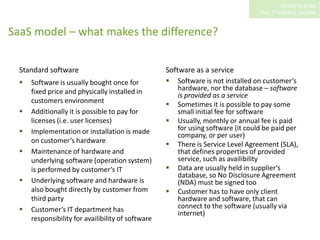
SaaS model – what makes the difference?Standard softwareSoftware is usually bought once for fixed price and physically installed in customers environmentAdditionally it is possible to pay for licenses (i.e. user licenses)Implementation or installation is made on customer‘s hardwareMaintenance of hardware and underlying software (operation system)  is performed by customer‘s ITUnderlying software and hardware is also bought directly by customer from third partyCustomer‘s IT department has responsibility for availibility of softwareSoftware as a serviceSoftware is not installed on customer‘s hardware, nor the database – software is provided as a serviceSometimes it is possible to pay some small initial fee for softwareUsually, monthly or annual fee is paid for using software (it could be paid per company, or per user)There is Service Level Agreement (SLA), that defines properties of provided service, such as availibilityData are usually held in supplier‘s database, so No Disclosure Agreement (NDA) must be signed tooCustomer has to have only client hardware and software, that can connect to the software (usually via internet)
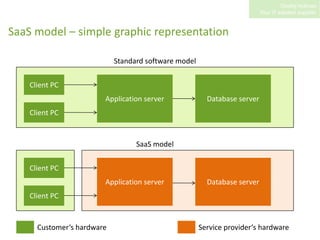
SaaS model – simple graphic representationStandard software modelClient PCApplication serverDatabase serverClient PCSaaS modelClient PCApplication serverDatabase serverClient PCCustomer‘s hardwareService provider‘s hardware
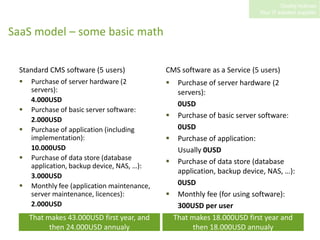
SaaS model – some basic mathStandard CMS software (5 users)Purchase of server hardware (2 servers):4.000USDPurchase of basic server software:2.000USDPurchase of application (including implementation):10.000USDPurchase of data store (database application, backup device, NAS, …):3.000USDMonthly fee (application maintenance, server maintenance, licences):	2.000USDCMS software as a Service (5 users)Purchase of server hardware (2 servers):0USDPurchase of basic server software:0USDPurchase of application:	Usually 0USDPurchase of data store (database application, backup device, NAS, …):0USDMonthly fee (for using software):300USD per userThat makes 43.000USD first year, and then 24.000USD annualyThat makes 18.000USD first year and then 18.000USD annualy
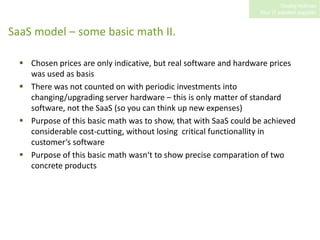
SaaS model – some basic math II. Chosen prices are only indicative, but real software and hardware prices was used as basisThere was not counted on with periodic investments into changing/upgrading server hardware – this is only matter of standard software, not the SaaS (so you can think up new expenses)Purpose of this basic math was to show, that with SaaS could be achieved considerable cost-cutting, without losing  critical functionallity in customer‘s softwarePurpose of this basic math wasn‘t to show precise comparation of two concrete products
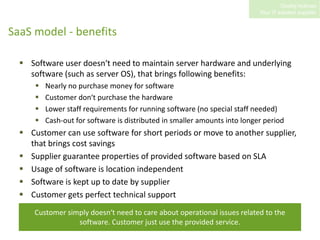
SaaS model - benefitsSoftware user doesn‘t need to maintain server hardware and underlying software (such as server OS), that brings following benefits:Nearly no purchase money for software Customer don‘t purchase the hardwareLower staff requirements for running software (no special staff needed)Cash-out for software is distributed in smaller amounts into longer periodCustomer can use software for short periods or move to another supplier, that brings cost savingsSupplier guarantee properties of provided software based on SLAUsage of software is location independentSoftware is kept up to date by supplierCustomer gets perfect technical supportCustomer simply doesn‘t need to care about operational issues related to the software. Customer just use the provided service.
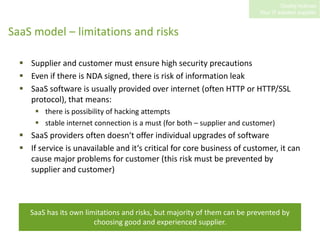
SaaS model – limitations and risksSupplier and customer must ensure high security precautionsEven if there is NDA signed, there is risk of information leakSaaS software is usually provided over internet (often HTTP or HTTP/SSL protocol), that means:there is possibility of hacking attemptsstable internet connection is a must (for both – supplier and customer)SaaS providers often doesn‘t offer individual upgrades of softwareIf service is unavailable and it‘s critical for core business of customer, it can cause major problems for customer (this risk must be prevented by supplier and customer)SaaS has its own limitations and risks, but majority of them can be prevented by choosing good and experienced supplier.
SaaS model – Service Level AgreementMost people has seen Service Level Agreement (SLA)for example if you decide to buy web-hosting, you look at parameters such as available disk space, connectivity and availibilityIt is contract between supplier and customer, that specifies properties of delivered service and penalties, if the properties are not fulfilledUsually we encouter this basic attributes of SLA:Availibility of softwareDisk or database spaceNumber of usersPaid plugins or addons
SaaS model – final wordTypical examples of SaaS are:Google AppsCargopassESKER on Demand applicationsMint.comand many many more…SaaS is perspective, relatively new method of providing software to end-users, which I personally could only recommend.
Software as a Service

Software as a Service

  • 1.
    Software as aservice (SaaS)Brief description, pros and cons
  • 2.
    SaaS model –short historyIntroduction of this model is dated to year 1999, when it was called „service based software“Phrase „Software as a service“ was introduced few years later in publication „Strategic Backgrounder: Software as a Service“Sometimes, we can encounter phrase „Service on demand“, which is referring to the same subject as SaaSNowadays, we‘re surrounded by software provided in this way
  • 3.
    SaaS model –what makes the difference?Standard softwareSoftware is usually bought once for fixed price and physically installed in customers environmentAdditionally it is possible to pay for licenses (i.e. user licenses)Implementation or installation is made on customer‘s hardwareMaintenance of hardware and underlying software (operation system) is performed by customer‘s ITUnderlying software and hardware is also bought directly by customer from third partyCustomer‘s IT department has responsibility for availibility of softwareSoftware as a serviceSoftware is not installed on customer‘s hardware, nor the database – software is provided as a serviceSometimes it is possible to pay some small initial fee for softwareUsually, monthly or annual fee is paid for using software (it could be paid per company, or per user)There is Service Level Agreement (SLA), that defines properties of provided service, such as availibilityData are usually held in supplier‘s database, so No Disclosure Agreement (NDA) must be signed tooCustomer has to have only client hardware and software, that can connect to the software (usually via internet)
  • 4.
    SaaS model –simple graphic representationStandard software modelClient PCApplication serverDatabase serverClient PCSaaS modelClient PCApplication serverDatabase serverClient PCCustomer‘s hardwareService provider‘s hardware
  • 5.
    SaaS model –some basic mathStandard CMS software (5 users)Purchase of server hardware (2 servers):4.000USDPurchase of basic server software:2.000USDPurchase of application (including implementation):10.000USDPurchase of data store (database application, backup device, NAS, …):3.000USDMonthly fee (application maintenance, server maintenance, licences): 2.000USDCMS software as a Service (5 users)Purchase of server hardware (2 servers):0USDPurchase of basic server software:0USDPurchase of application: Usually 0USDPurchase of data store (database application, backup device, NAS, …):0USDMonthly fee (for using software):300USD per userThat makes 43.000USD first year, and then 24.000USD annualyThat makes 18.000USD first year and then 18.000USD annualy
  • 6.
    SaaS model –some basic math II. Chosen prices are only indicative, but real software and hardware prices was used as basisThere was not counted on with periodic investments into changing/upgrading server hardware – this is only matter of standard software, not the SaaS (so you can think up new expenses)Purpose of this basic math was to show, that with SaaS could be achieved considerable cost-cutting, without losing critical functionallity in customer‘s softwarePurpose of this basic math wasn‘t to show precise comparation of two concrete products
  • 7.
    SaaS model -benefitsSoftware user doesn‘t need to maintain server hardware and underlying software (such as server OS), that brings following benefits:Nearly no purchase money for software Customer don‘t purchase the hardwareLower staff requirements for running software (no special staff needed)Cash-out for software is distributed in smaller amounts into longer periodCustomer can use software for short periods or move to another supplier, that brings cost savingsSupplier guarantee properties of provided software based on SLAUsage of software is location independentSoftware is kept up to date by supplierCustomer gets perfect technical supportCustomer simply doesn‘t need to care about operational issues related to the software. Customer just use the provided service.
  • 8.
    SaaS model –limitations and risksSupplier and customer must ensure high security precautionsEven if there is NDA signed, there is risk of information leakSaaS software is usually provided over internet (often HTTP or HTTP/SSL protocol), that means:there is possibility of hacking attemptsstable internet connection is a must (for both – supplier and customer)SaaS providers often doesn‘t offer individual upgrades of softwareIf service is unavailable and it‘s critical for core business of customer, it can cause major problems for customer (this risk must be prevented by supplier and customer)SaaS has its own limitations and risks, but majority of them can be prevented by choosing good and experienced supplier.
  • 9.
    SaaS model –Service Level AgreementMost people has seen Service Level Agreement (SLA)for example if you decide to buy web-hosting, you look at parameters such as available disk space, connectivity and availibilityIt is contract between supplier and customer, that specifies properties of delivered service and penalties, if the properties are not fulfilledUsually we encouter this basic attributes of SLA:Availibility of softwareDisk or database spaceNumber of usersPaid plugins or addons
  • 10.
    SaaS model –final wordTypical examples of SaaS are:Google AppsCargopassESKER on Demand applicationsMint.comand many many more…SaaS is perspective, relatively new method of providing software to end-users, which I personally could only recommend.