Are “Digital Natives” Dropping
Print Newspapers?
A National Survey of College Newspaper
Advisers
H. Iris Chyi, Ph.D.
Assistant Professor
School of Journalism
College of Communication
The University of Texas at Austin
Paper presented at the 13th International Symposium on
Online Journalism, Austin, Texas, April 20-21, 2012
What everyone knows
• No. 1: Young adults are less likely to
read a print newspaper compared with
other age groups.
• No. 2: Younger people are more likely to
spend time online compared with other
age groups.
Widely accepted assumption
• Young people are dropping print
newspapers in favor of online news
sources.
• Nine out of ten journalists believed young
adults prefer online news to print news
(Kaufhold, 2010).
Industry response
• Newspapers have shifted substantial
amount of dwindling resources from
print to online.
• The Web is newspapers’ No. 1 priority for
attracting young readers (Graybeal, 2011).
In reality
• Young people are not using technologies
to get news at higher rates than do older
people (Pew Research Center, 2010).
Previous research
• Most people find the print newspaper
more useful, satisfying, likeable,
enjoyable than its online counterpart
(Chyi & Chang, 2009; De Waal et al., 2005; Online Publishers
Association, 2004; Chyi & Lasorsa, 1999, 2002; Chyi & Lee,
2012).
• Are so-called “digital natives” an
exception?
Purpose of this study
• To re-examine the assumptions about
young people’s news-seeking habits and
their attitude toward print and online
newspapers.
College newspapers
• Most college papers publish in online
and print formats.
• Both formats are offered for free.
• Their target readers are college students
ages 18-22, all with Internet access.
• College papers publish content most
relevant to campus life.
Method
• A list of college newspaper advisers was
obtained from College Media
Association
• A Web-based survey of U.S. college
newspapers
• May 6-June 6, 2011
• Completion rate: 41%
198 college newspapers
• Serving student population of
• <5,000: 32%
• 5,000 to 9,999: 17%
• 10,000 to 19,999:22%
• 20,000: 29%
• Staff
• 1.9 full-time and 1.6 part-time non-student
staff members
• 46 student staff members
Annual income
• The average annual income =$206,785
• Advertising (47%)
• Student fees (31%)
• Academic funds (18%)
• Other (5%)
Multiplatform publishing
• Print edition: 98%
• Web edition: 97%
• Videos (75%)
• Slideshows (64%)
• Audio (54%)
• Mobile app: 21%
Print vs. Web readership
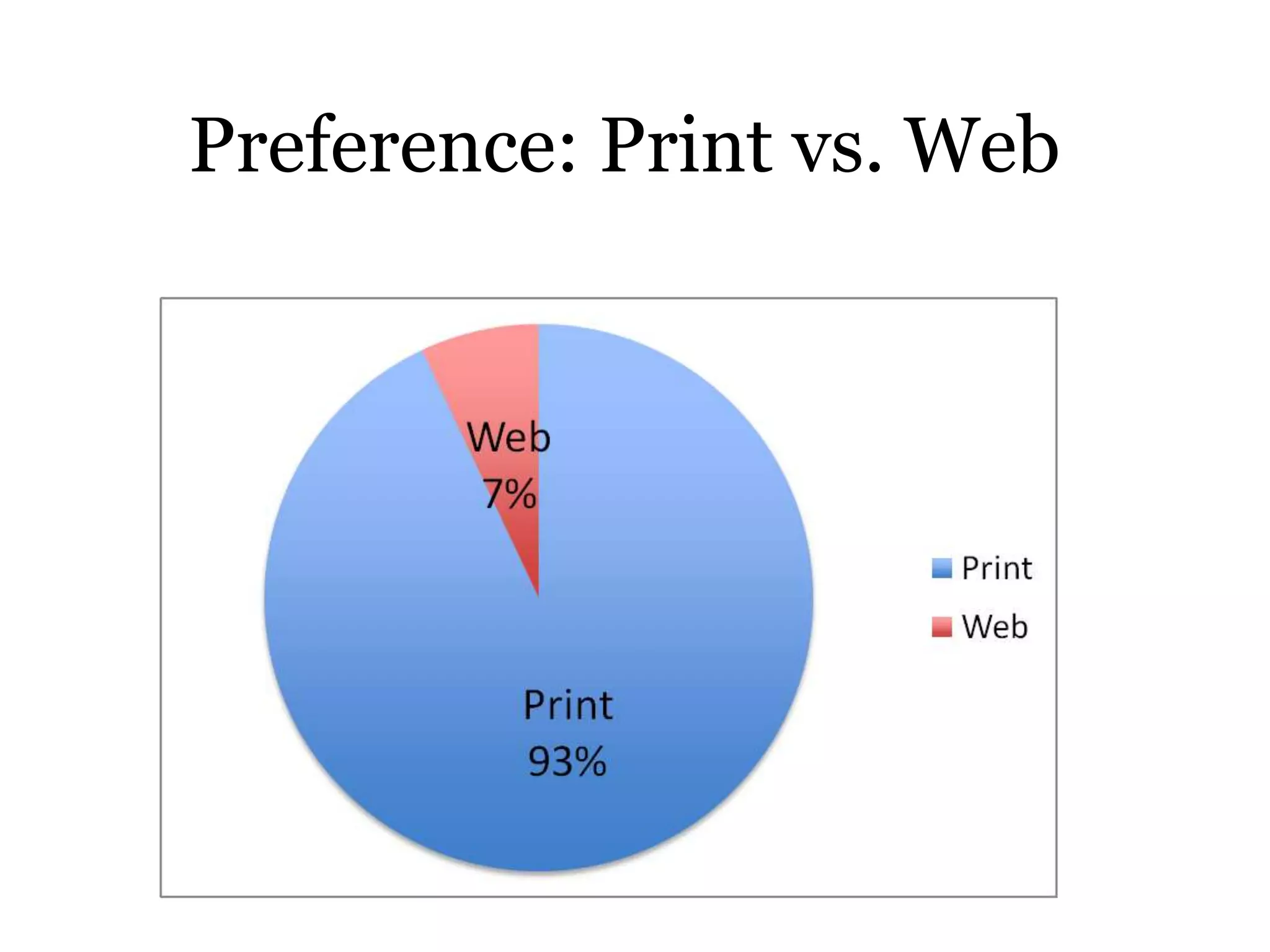
Preference: Print vs. Web
Advertising revenue:
Print vs. Web
Changes in print circulation
during past 3 years
• Increases: 11%
• Stable: 58%
• Declines: 26%
Changes in print ad revenue
during past 3 years
• Increases: 25%
• Stable: 30%
• Declines: 42%
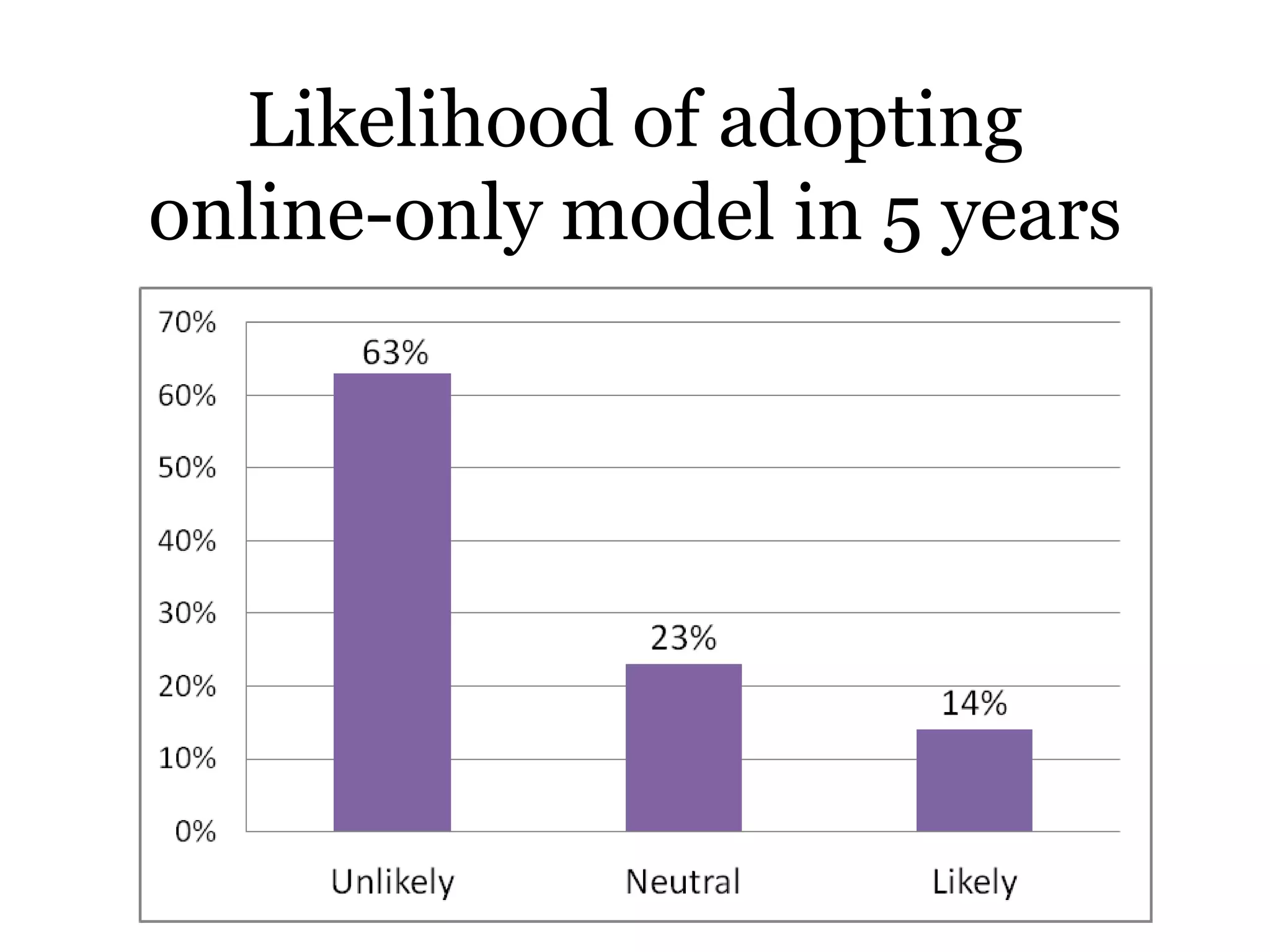
Likelihood of adopting
online-only model in 5 years
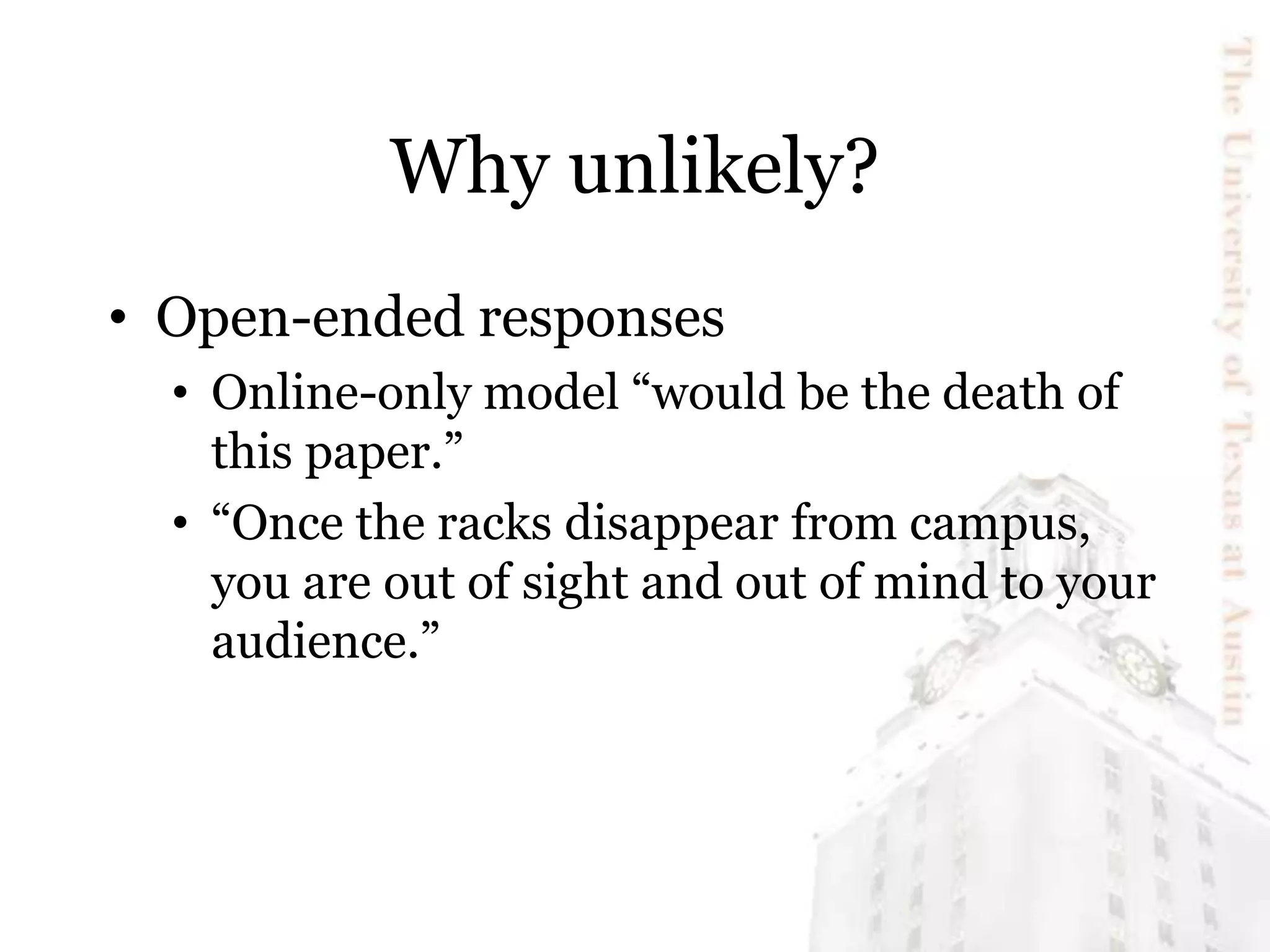
Why unlikely?
• Open-ended responses
• Online-only model “would be the death of
this paper.”
• “Once the racks disappear from campus,
you are out of sight and out of mind to your
audience.”
Conclusion
• Digital natives are not dropping print
newspapers in favor of their online
counterparts as most think they would
or have.
• The print edition can be the most
popular format among digital natives
when it is readily accessible, free, and
relevant.
Implication
• The real problem has little to do with
the “print format” per se and cannot be
solved with technology alone.

Chyi

  • 1.
    Are “Digital Natives”Dropping Print Newspapers? A National Survey of College Newspaper Advisers H. Iris Chyi, Ph.D. Assistant Professor School of Journalism College of Communication The University of Texas at Austin Paper presented at the 13th International Symposium on Online Journalism, Austin, Texas, April 20-21, 2012
  • 2.
    What everyone knows •No. 1: Young adults are less likely to read a print newspaper compared with other age groups. • No. 2: Younger people are more likely to spend time online compared with other age groups.
  • 3.
    Widely accepted assumption •Young people are dropping print newspapers in favor of online news sources. • Nine out of ten journalists believed young adults prefer online news to print news (Kaufhold, 2010).
  • 4.
    Industry response • Newspapershave shifted substantial amount of dwindling resources from print to online. • The Web is newspapers’ No. 1 priority for attracting young readers (Graybeal, 2011).
  • 5.
    In reality • Youngpeople are not using technologies to get news at higher rates than do older people (Pew Research Center, 2010).
  • 6.
    Previous research • Mostpeople find the print newspaper more useful, satisfying, likeable, enjoyable than its online counterpart (Chyi & Chang, 2009; De Waal et al., 2005; Online Publishers Association, 2004; Chyi & Lasorsa, 1999, 2002; Chyi & Lee, 2012). • Are so-called “digital natives” an exception?
  • 7.
    Purpose of thisstudy • To re-examine the assumptions about young people’s news-seeking habits and their attitude toward print and online newspapers.
  • 8.
    College newspapers • Mostcollege papers publish in online and print formats. • Both formats are offered for free. • Their target readers are college students ages 18-22, all with Internet access. • College papers publish content most relevant to campus life.
  • 9.
    Method • A listof college newspaper advisers was obtained from College Media Association • A Web-based survey of U.S. college newspapers • May 6-June 6, 2011 • Completion rate: 41%
  • 10.
    198 college newspapers •Serving student population of • <5,000: 32% • 5,000 to 9,999: 17% • 10,000 to 19,999:22% • 20,000: 29% • Staff • 1.9 full-time and 1.6 part-time non-student staff members • 46 student staff members
  • 11.
    Annual income • Theaverage annual income =$206,785 • Advertising (47%) • Student fees (31%) • Academic funds (18%) • Other (5%)
  • 12.
    Multiplatform publishing • Printedition: 98% • Web edition: 97% • Videos (75%) • Slideshows (64%) • Audio (54%) • Mobile app: 21%
  • 13.
    Print vs. Webreadership
  • 14.
  • 15.
  • 16.
    Changes in printcirculation during past 3 years • Increases: 11% • Stable: 58% • Declines: 26%
  • 17.
    Changes in printad revenue during past 3 years • Increases: 25% • Stable: 30% • Declines: 42%
  • 18.
  • 19.
    Why unlikely? • Open-endedresponses • Online-only model “would be the death of this paper.” • “Once the racks disappear from campus, you are out of sight and out of mind to your audience.”
  • 20.
    Conclusion • Digital nativesare not dropping print newspapers in favor of their online counterparts as most think they would or have. • The print edition can be the most popular format among digital natives when it is readily accessible, free, and relevant.
  • 21.
    Implication • The realproblem has little to do with the “print format” per se and cannot be solved with technology alone.

Editor's Notes

  • #8 Do they really prefer online news?