1
PESC : Fall 2010 Data
Summit
Patrick Perry
Vice Chancellor of Technology,
Research, & Information
Systems, CCCCO
2
Ten Years Ago…
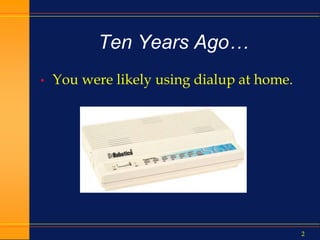
• You were likely using dialup at home.
3
Ten Years Ago
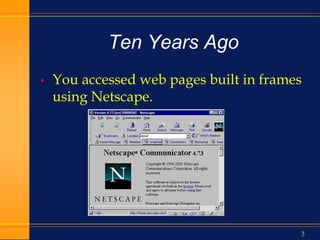
• You accessed web pages built in frames
using Netscape.
4
Ten Years Ago
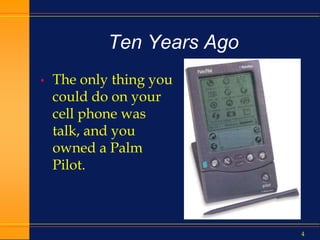
• The only thing you
could do on your
cell phone was
talk, and you
owned a Palm
Pilot.
5
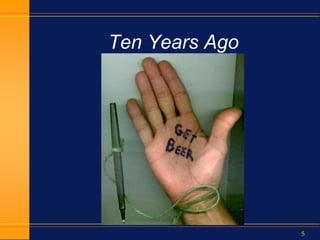
Ten Years Ago
6
Ten Years Ago
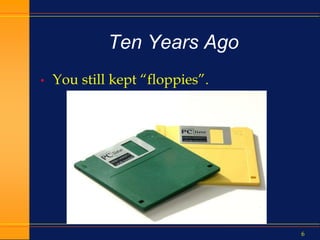
• You still kept “floppies”.
7
Ten Years Ago
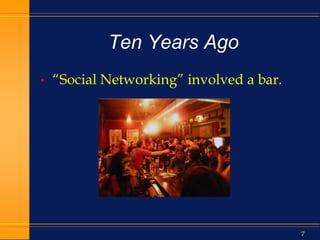
• “Social Networking” involved a bar.
8
Ten Years Ago…
• Distance Education occurred on
cablevision.
• Video was captured and streamed over
your VCR.
• Your campus’ or corporate “T-1”
connection seemed like a huge pipe.
• “Year” fields had only 2 characters.
9
The Internet
• Number of hosts:
• 1999: 50 million
• 2009: 700 million
10
Internet Users
• Number of Users:
• 1999: 360 million
• 2009: 1.7 billion
• Today, 25% of the citizens of our planet
are users of the internet.
11
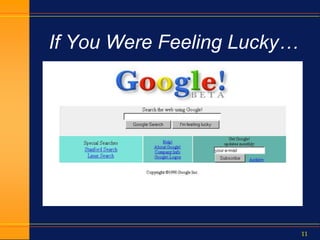
If You Were Feeling Lucky…
12
Google
• Market Share, 1998: Zero.
• Today: Of the 137 billion searches
performed in the US, 63.5% of them
were “Googled”.
• Of all the growth in search volume, 90%
was captured by Google, most from
increasing the number of searches, not
the number of people searching.
13
E-business: then
• Your main competition was your
neighbor.
• Your main market was your neighbors.
• Your static website channeled your
customers to your phone number.
14
E-business: now
• Your main competition can be anyone
on the planet.
• Your main market is everyone on the
planet.
• Your inefficiencies are discretely
outsourced.
15
Pre 2001
• Web 1.0
• 50k bandwidth
• One-way content, static pages
• Overhyped and overvalued companies: the
bubble
• Lasting legacy: dark fiber (Moore’s
Law) and pervasive governmental
deficits
16
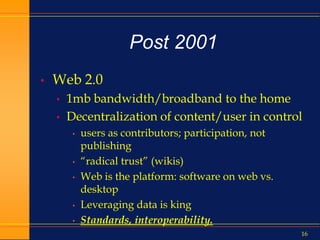
Post 2001
• Web 2.0
• 1mb bandwidth/broadband to the home
• Decentralization of content/user in control
• users as contributors; participation, not
publishing
• “radical trust” (wikis)
• Web is the platform: software on web vs.
desktop
• Leveraging data is king
• Standards, interoperability.
17
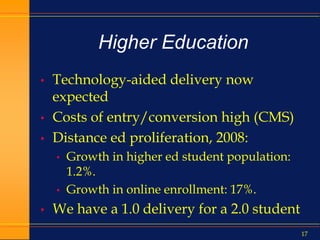
Higher Education
• Technology-aided delivery now
expected
• Costs of entry/conversion high (CMS)
• Distance ed proliferation, 2008:
• Growth in higher ed student population:
1.2%.
• Growth in online enrollment: 17%.
• We have a 1.0 delivery for a 2.0 student
18
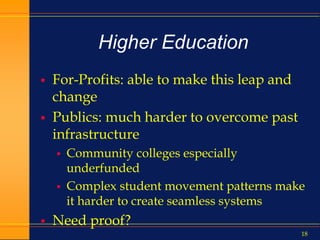
Higher Education
 For-Profits: able to make this leap and
change
 Publics: much harder to overcome past
infrastructure
 Community colleges especially
underfunded
 Complex student movement patterns make
it harder to create seamless systems
 Need proof?
19
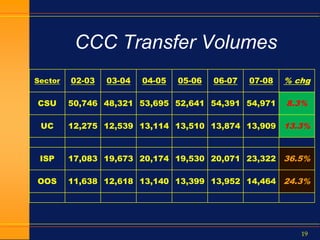
CCC Transfer Volumes
Sector 02-03 03-04 04-05 05-06 06-07 07-08 % chg
CSU 50,746 48,321 53,695 52,641 54,391 54,971 8.3%
UC 12,275 12,539 13,114 13,510 13,874 13,909 13.3%
ISP 17,083 19,673 20,174 19,530 20,071 23,322 36.5%
OOS 11,638 12,618 13,140 13,399 13,952 14,464 24.3%
20
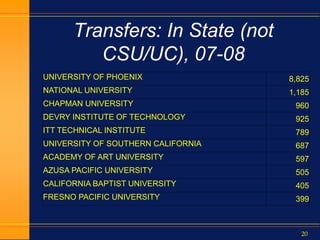
Transfers: In State (not
CSU/UC), 07-08
UNIVERSITY OF PHOENIX 8,825
NATIONAL UNIVERSITY 1,185
CHAPMAN UNIVERSITY 960
DEVRY INSTITUTE OF TECHNOLOGY 925
ITT TECHNICAL INSTITUTE 789
UNIVERSITY OF SOUTHERN CALIFORNIA 687
ACADEMY OF ART UNIVERSITY 597
AZUSA PACIFIC UNIVERSITY 505
CALIFORNIA BAPTIST UNIVERSITY 405
FRESNO PACIFIC UNIVERSITY 399
21
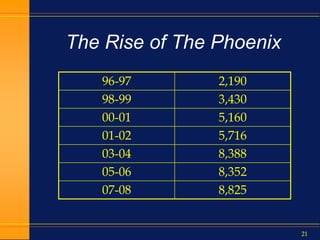
The Rise of The Phoenix
96-97 2,190
98-99 3,430
00-01 5,160
01-02 5,716
03-04 8,388
05-06 8,352
07-08 8,825
22
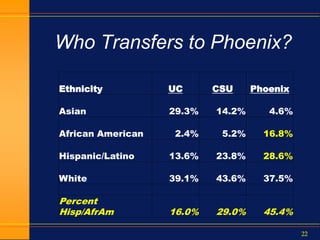
Who Transfers to Phoenix?
Ethnicity UC CSU Phoenix
Asian 29.3% 14.2% 4.6%
African American 2.4% 5.2% 16.8%
Hispanic/Latino 13.6% 23.8% 28.6%
White 39.1% 43.6% 37.5%
Percent
Hisp/AfrAm 16.0% 29.0% 45.4%
23
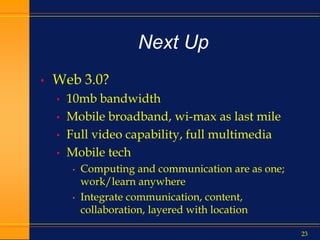
Next Up
• Web 3.0?
• 10mb bandwidth
• Mobile broadband, wi-max as last mile
• Full video capability, full multimedia
• Mobile tech
• Computing and communication are as one;
work/learn anywhere
• Integrate communication, content,
collaboration, layered with location
24
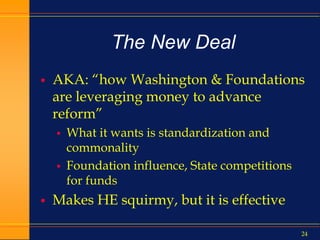
The New Deal
 AKA: “how Washington & Foundations
are leveraging money to advance
reform”
 What it wants is standardization and
commonality
 Foundation influence, State competitions
for funds
 Makes HE squirmy, but it is effective
25
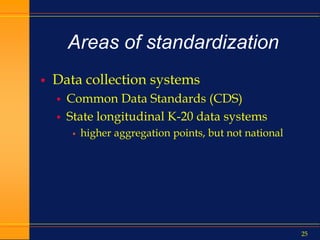
Areas of standardization
 Data collection systems
 Common Data Standards (CDS)
 State longitudinal K-20 data systems
 higher aggregation points, but not national
26
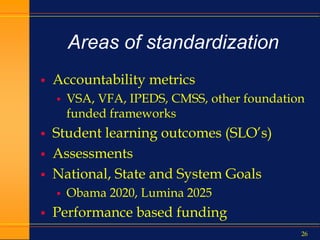
Areas of standardization
 Accountability metrics
 VSA, VFA, IPEDS, CMSS, other foundation
funded frameworks
 Student learning outcomes (SLO’s)
 Assessments
 National, State and System Goals
 Obama 2020, Lumina 2025
 Performance based funding
27
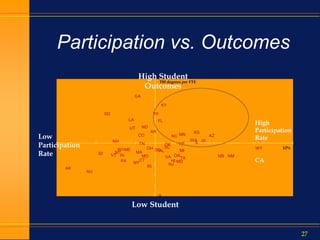
Participation vs. Outcomes
AL
AK
AZ
AR
CO
CT
DE
FL
GA
HI
ID
IL
IN
IA
KS
KY
LA
ME
MD
MA MI
MN
MSMO
MT
NE
NV
NH
NJ
NM
NY
NC
ND
OH
OK
OR
PA
RI
SC
SD
TN
TX
UT
VT VA
WA
WV
WI
WY
High Student
Outcomes
Low Student
Outcomes
550 degrees per FTE
0
Low
Participation
Rate
0%
High
Participation
Rate
CA
12%
28
The Golden Quadrant
 Has a variety of fee levels
 Has a variety of funding levels
 Has a variety of fin aid levels
29
Properties of High
Outcome/High Partic. States
• Strong Statewide Articulation/Transfer
Agreements
• Common Core Curriculum
• Common Course Numbering
• AA transfer guarantee or Statewide
General Ed guarantee
• CTE pathways
30
Properties of High
Outcome/High Partic. States
• Strong online student academic
planners and support
• Common assessment tools
• Statewide Transfer scholarships
• In other words…the systems that make
it easy for the *student*.
31
Technology
 Is the glue of standardization
 We (systems, vendors) are building
very good suites of applications/SOA
 Applications, e-xscripts, e-portfolios, CMS,
ERP, student services support
 Tech drives from the back seat
 CB 21 phenomenon: how a data element is
driving change in the CCC
32
Applause to Us
 Standards have been the logical
evolution in the IT world
 Education has not embraced
standardization with open arms
 There are limits and “initiative fatigue”
 What we are doing provides hope that
goals can be accomplished in this
environment
33
Thank You
 For everything you are doing.
 You are truly a major part of the
solution.
 Have a great conference and keep up
the good work.

Perry.ppt.101110

  • 1.
    1 PESC : Fall2010 Data Summit Patrick Perry Vice Chancellor of Technology, Research, & Information Systems, CCCCO
  • 2.
    2 Ten Years Ago… •You were likely using dialup at home.
  • 3.
    3 Ten Years Ago •You accessed web pages built in frames using Netscape.
  • 4.
    4 Ten Years Ago •The only thing you could do on your cell phone was talk, and you owned a Palm Pilot.
  • 5.
  • 6.
    6 Ten Years Ago •You still kept “floppies”.
  • 7.
    7 Ten Years Ago •“Social Networking” involved a bar.
  • 8.
    8 Ten Years Ago… •Distance Education occurred on cablevision. • Video was captured and streamed over your VCR. • Your campus’ or corporate “T-1” connection seemed like a huge pipe. • “Year” fields had only 2 characters.
  • 9.
    9 The Internet • Numberof hosts: • 1999: 50 million • 2009: 700 million
  • 10.
    10 Internet Users • Numberof Users: • 1999: 360 million • 2009: 1.7 billion • Today, 25% of the citizens of our planet are users of the internet.
  • 11.
    11 If You WereFeeling Lucky…
  • 12.
    12 Google • Market Share,1998: Zero. • Today: Of the 137 billion searches performed in the US, 63.5% of them were “Googled”. • Of all the growth in search volume, 90% was captured by Google, most from increasing the number of searches, not the number of people searching.
  • 13.
    13 E-business: then • Yourmain competition was your neighbor. • Your main market was your neighbors. • Your static website channeled your customers to your phone number.
  • 14.
    14 E-business: now • Yourmain competition can be anyone on the planet. • Your main market is everyone on the planet. • Your inefficiencies are discretely outsourced.
  • 15.
    15 Pre 2001 • Web1.0 • 50k bandwidth • One-way content, static pages • Overhyped and overvalued companies: the bubble • Lasting legacy: dark fiber (Moore’s Law) and pervasive governmental deficits
  • 16.
    16 Post 2001 • Web2.0 • 1mb bandwidth/broadband to the home • Decentralization of content/user in control • users as contributors; participation, not publishing • “radical trust” (wikis) • Web is the platform: software on web vs. desktop • Leveraging data is king • Standards, interoperability.
  • 17.
    17 Higher Education • Technology-aideddelivery now expected • Costs of entry/conversion high (CMS) • Distance ed proliferation, 2008: • Growth in higher ed student population: 1.2%. • Growth in online enrollment: 17%. • We have a 1.0 delivery for a 2.0 student
  • 18.
    18 Higher Education  For-Profits:able to make this leap and change  Publics: much harder to overcome past infrastructure  Community colleges especially underfunded  Complex student movement patterns make it harder to create seamless systems  Need proof?
  • 19.
    19 CCC Transfer Volumes Sector02-03 03-04 04-05 05-06 06-07 07-08 % chg CSU 50,746 48,321 53,695 52,641 54,391 54,971 8.3% UC 12,275 12,539 13,114 13,510 13,874 13,909 13.3% ISP 17,083 19,673 20,174 19,530 20,071 23,322 36.5% OOS 11,638 12,618 13,140 13,399 13,952 14,464 24.3%
  • 20.
    20 Transfers: In State(not CSU/UC), 07-08 UNIVERSITY OF PHOENIX 8,825 NATIONAL UNIVERSITY 1,185 CHAPMAN UNIVERSITY 960 DEVRY INSTITUTE OF TECHNOLOGY 925 ITT TECHNICAL INSTITUTE 789 UNIVERSITY OF SOUTHERN CALIFORNIA 687 ACADEMY OF ART UNIVERSITY 597 AZUSA PACIFIC UNIVERSITY 505 CALIFORNIA BAPTIST UNIVERSITY 405 FRESNO PACIFIC UNIVERSITY 399
  • 21.
    21 The Rise ofThe Phoenix 96-97 2,190 98-99 3,430 00-01 5,160 01-02 5,716 03-04 8,388 05-06 8,352 07-08 8,825
  • 22.
    22 Who Transfers toPhoenix? Ethnicity UC CSU Phoenix Asian 29.3% 14.2% 4.6% African American 2.4% 5.2% 16.8% Hispanic/Latino 13.6% 23.8% 28.6% White 39.1% 43.6% 37.5% Percent Hisp/AfrAm 16.0% 29.0% 45.4%
  • 23.
    23 Next Up • Web3.0? • 10mb bandwidth • Mobile broadband, wi-max as last mile • Full video capability, full multimedia • Mobile tech • Computing and communication are as one; work/learn anywhere • Integrate communication, content, collaboration, layered with location
  • 24.
    24 The New Deal AKA: “how Washington & Foundations are leveraging money to advance reform”  What it wants is standardization and commonality  Foundation influence, State competitions for funds  Makes HE squirmy, but it is effective
  • 25.
    25 Areas of standardization Data collection systems  Common Data Standards (CDS)  State longitudinal K-20 data systems  higher aggregation points, but not national
  • 26.
    26 Areas of standardization Accountability metrics  VSA, VFA, IPEDS, CMSS, other foundation funded frameworks  Student learning outcomes (SLO’s)  Assessments  National, State and System Goals  Obama 2020, Lumina 2025  Performance based funding
  • 27.
    27 Participation vs. Outcomes AL AK AZ AR CO CT DE FL GA HI ID IL IN IA KS KY LA ME MD MAMI MN MSMO MT NE NV NH NJ NM NY NC ND OH OK OR PA RI SC SD TN TX UT VT VA WA WV WI WY High Student Outcomes Low Student Outcomes 550 degrees per FTE 0 Low Participation Rate 0% High Participation Rate CA 12%
  • 28.
    28 The Golden Quadrant Has a variety of fee levels  Has a variety of funding levels  Has a variety of fin aid levels
  • 29.
    29 Properties of High Outcome/HighPartic. States • Strong Statewide Articulation/Transfer Agreements • Common Core Curriculum • Common Course Numbering • AA transfer guarantee or Statewide General Ed guarantee • CTE pathways
  • 30.
    30 Properties of High Outcome/HighPartic. States • Strong online student academic planners and support • Common assessment tools • Statewide Transfer scholarships • In other words…the systems that make it easy for the *student*.
  • 31.
    31 Technology  Is theglue of standardization  We (systems, vendors) are building very good suites of applications/SOA  Applications, e-xscripts, e-portfolios, CMS, ERP, student services support  Tech drives from the back seat  CB 21 phenomenon: how a data element is driving change in the CCC
  • 32.
    32 Applause to Us Standards have been the logical evolution in the IT world  Education has not embraced standardization with open arms  There are limits and “initiative fatigue”  What we are doing provides hope that goals can be accomplished in this environment
  • 33.
    33 Thank You  Foreverything you are doing.  You are truly a major part of the solution.  Have a great conference and keep up the good work.