Pervasive/Ubiquitous Computing
Presented by Kamran Ashraf
13-NTU-4009
What is Ubiquitous Computing?
The term ubiquitous implies that technology is
everywhere and we use it all the time.
▫ Using computing technologies will be as natural as
using other non-computing technologies (e.g.,
pen, paper, and cups)
▫ Computing services will be available anytime and
anywhere.
Vision
“The most profound technologies are those that
disappear. They weave themselves into the fabric
of everyday life until they are indistinguishable
from it ” – Mark Weiser
Think: writing, central heating, electric
lighting, …
Why is it Important?
Ubiquitous computing is changing our daily
activities in a variety of ways. When it comes to
using today's digital tools users tend to
• communicate in different ways
• be more active
• have more control
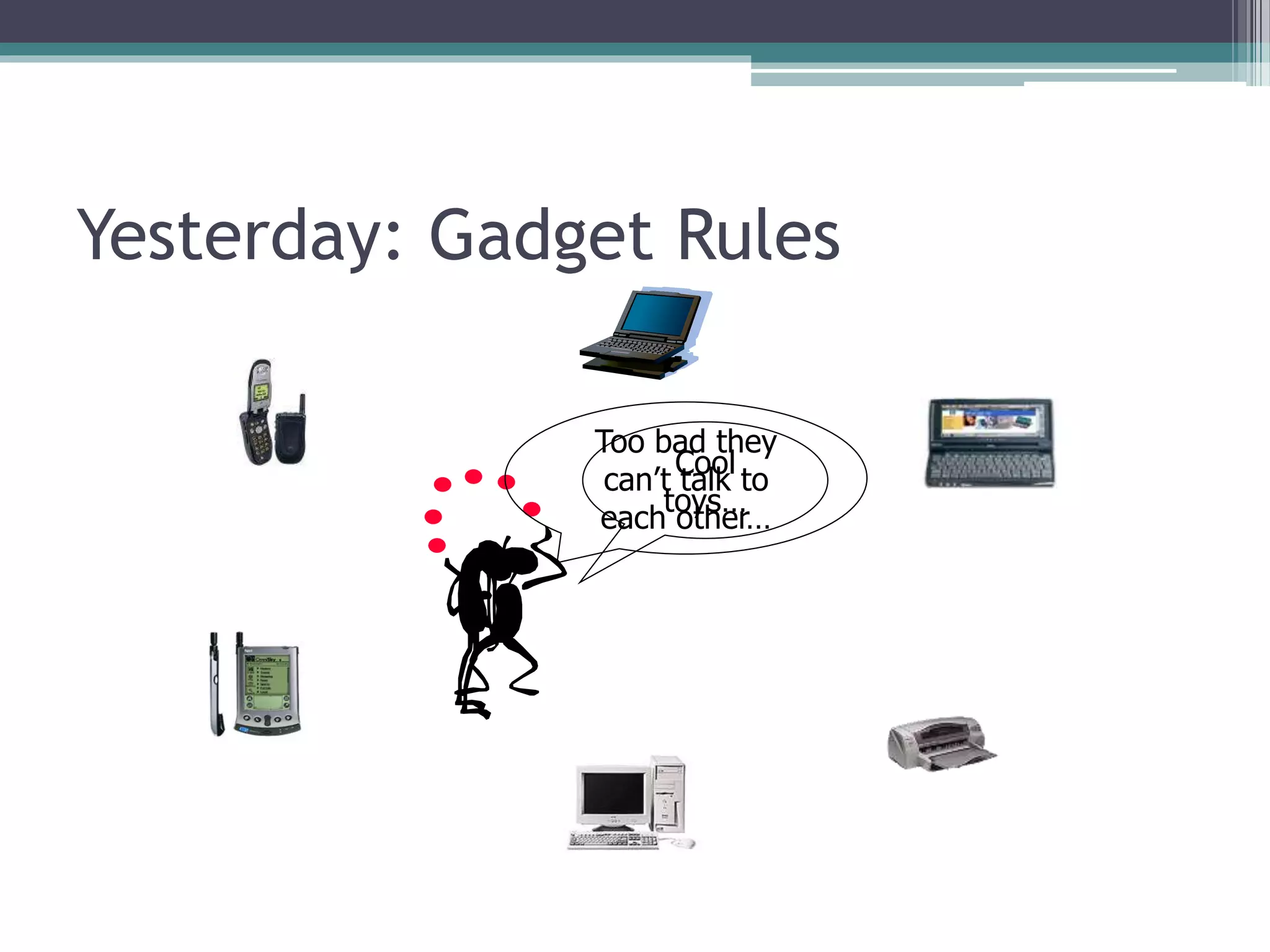
Yesterday: Gadget Rules
Cool
toys…
Too bad they
can’t talk to
each other…
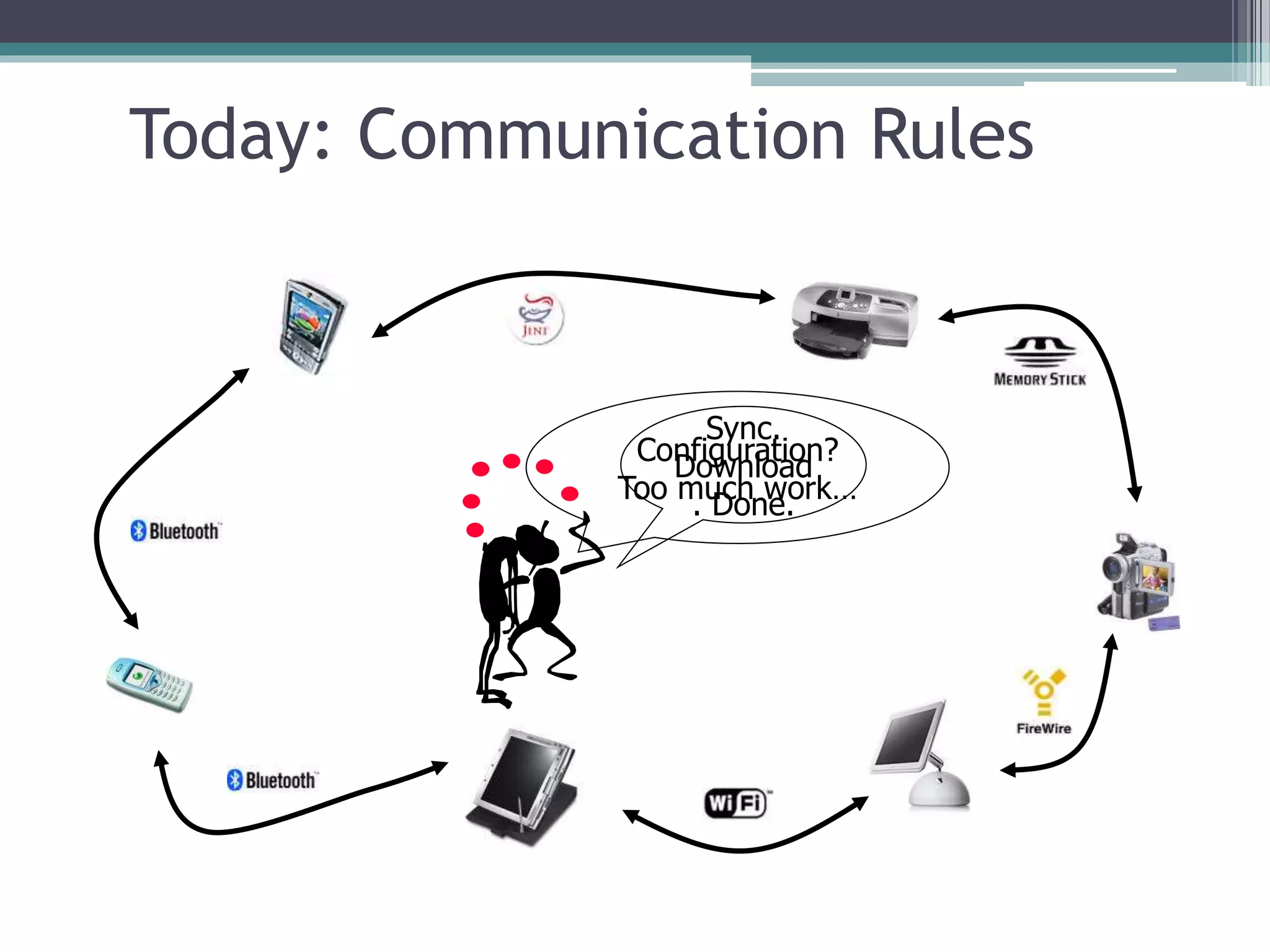
Today: Communication Rules
Sync.
Download
. Done.
Configuration?
Too much work…
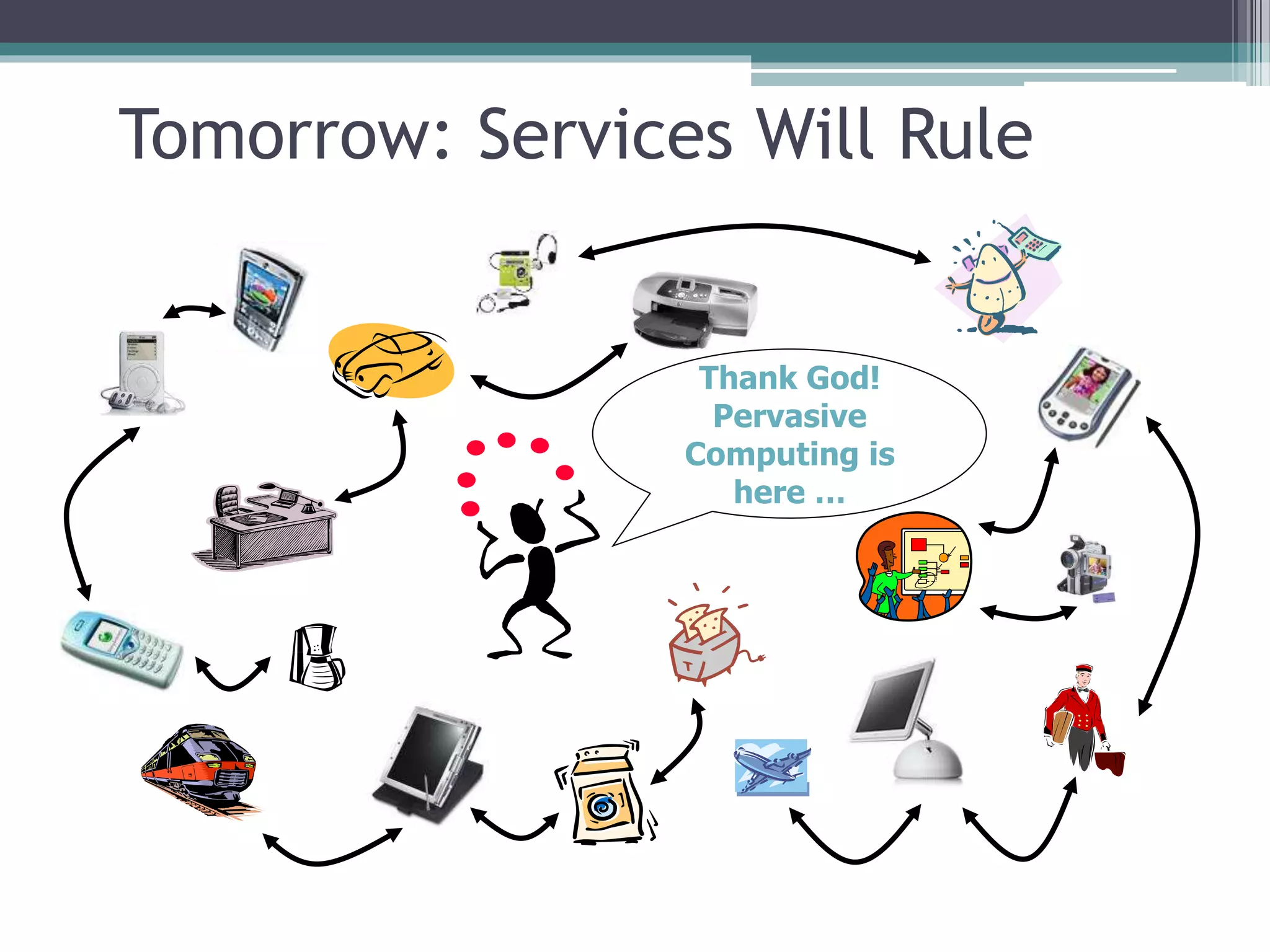
Tomorrow: Services Will Rule
Thank God!
Pervasive
Computing is
here …
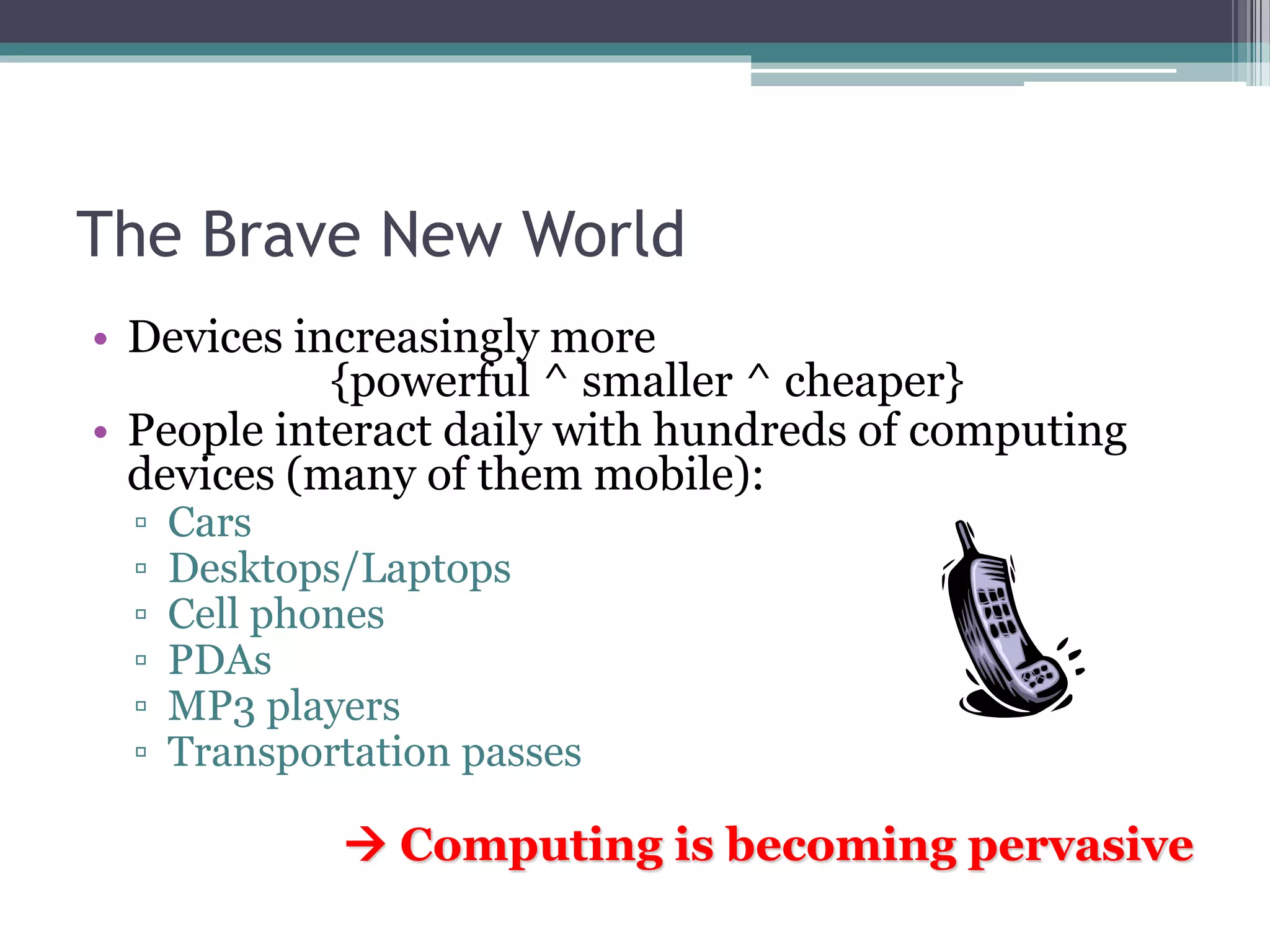
The Brave New World
• Devices increasingly more
{powerful ^ smaller ^ cheaper}
• People interact daily with hundreds of computing
devices (many of them mobile):
▫ Cars
▫ Desktops/Laptops
▫ Cell phones
▫ PDAs
▫ MP3 players
▫ Transportation passes
 Computing is becoming pervasive
Securing Data & Services
• Security is critical because in many pervasive
applications, we interact with agents that are not
in our “home” or “office” environment.
• Much of the work in security for distributed
systems is not directly applicable to pervasive
environments
• Need to worry about privacy!
Future challenges
Ubiquitous computing presents challenges across
computer science:
1. In systems design and engineering,
2. In systems modelling
3. In user interface design
Value in Teaching and Learning?
To take full advantage of the potential inherent in ubiquitous
computing, teaching must be reconceived from instructing to
conducting learning. Teaching and learning must no longer be thought
of as bound by the school building or the school day.
1. First, ubiquitous access to the Internet and telecommunication
technologies changes classrooms into places with access to many
resources and rich connections to the world.
2. Second, ubiquitous access to a variety of digital devices and
multimedia tools makes it possible to create, analyze and
communicate knowledge using a rich variety of media forms.
3. Third, ubiquitous access to digital tools that automate lower level
skills allows students to concentrate on higher level thinking, and
lessens the skill levels needed to explore a range of complex topics.
Research Paper: Smart Classroom, Enhancing Collaborative
Learning Using Pervasive Computing Technology
• Smart Classroom facilitates collaborative learning among college
students.
• In a Smart Classroom, each student has a situation-aware PDA
• Students' PDAs dynamically form mobile ad hoc networks for group
meetings.
• Each PDA monitors its situation and uses situation to trigger
communication activity among the students and the instructor for
group discussion and automatic distribution of presentation
materials.
• Middleware can effectively address the situation-awareness and ad
hoc group communication for pervasive computing by providing
development and runtime support to the application software.
• Link: http://dpse.eas.asu.edu/papers/SmartClassroom.pdf
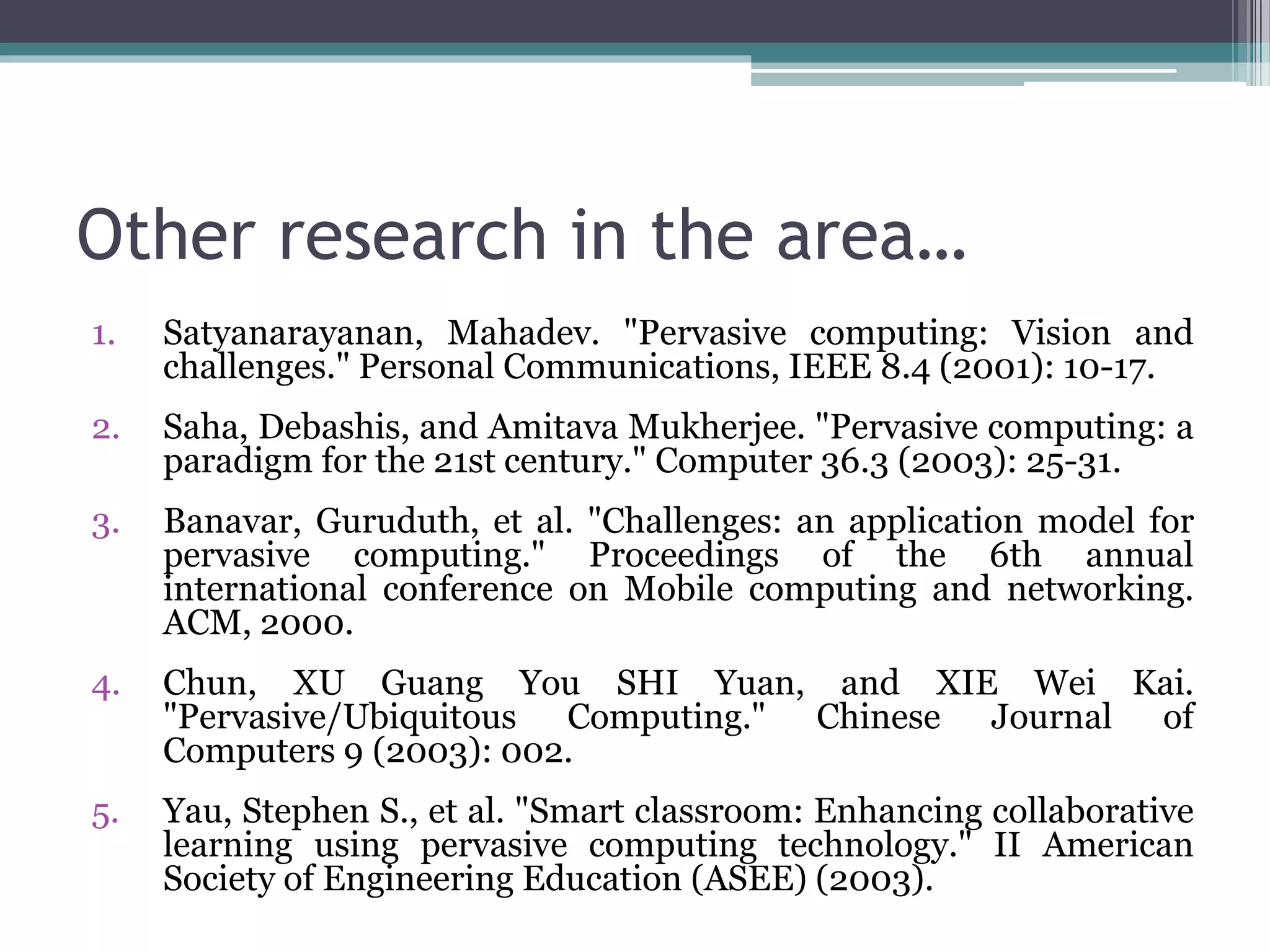
Other research in the area…
1. Satyanarayanan, Mahadev. "Pervasive computing: Vision and
challenges." Personal Communications, IEEE 8.4 (2001): 10-17.
2. Saha, Debashis, and Amitava Mukherjee. "Pervasive computing: a
paradigm for the 21st century." Computer 36.3 (2003): 25-31.
3. Banavar, Guruduth, et al. "Challenges: an application model for
pervasive computing." Proceedings of the 6th annual
international conference on Mobile computing and networking.
ACM, 2000.
4. Chun, XU Guang You SHI Yuan, and XIE Wei Kai.
"Pervasive/Ubiquitous Computing." Chinese Journal of
Computers 9 (2003): 002.
5. Yau, Stephen S., et al. "Smart classroom: Enhancing collaborative
learning using pervasive computing technology." II American
Society of Engineering Education (ASEE) (2003).
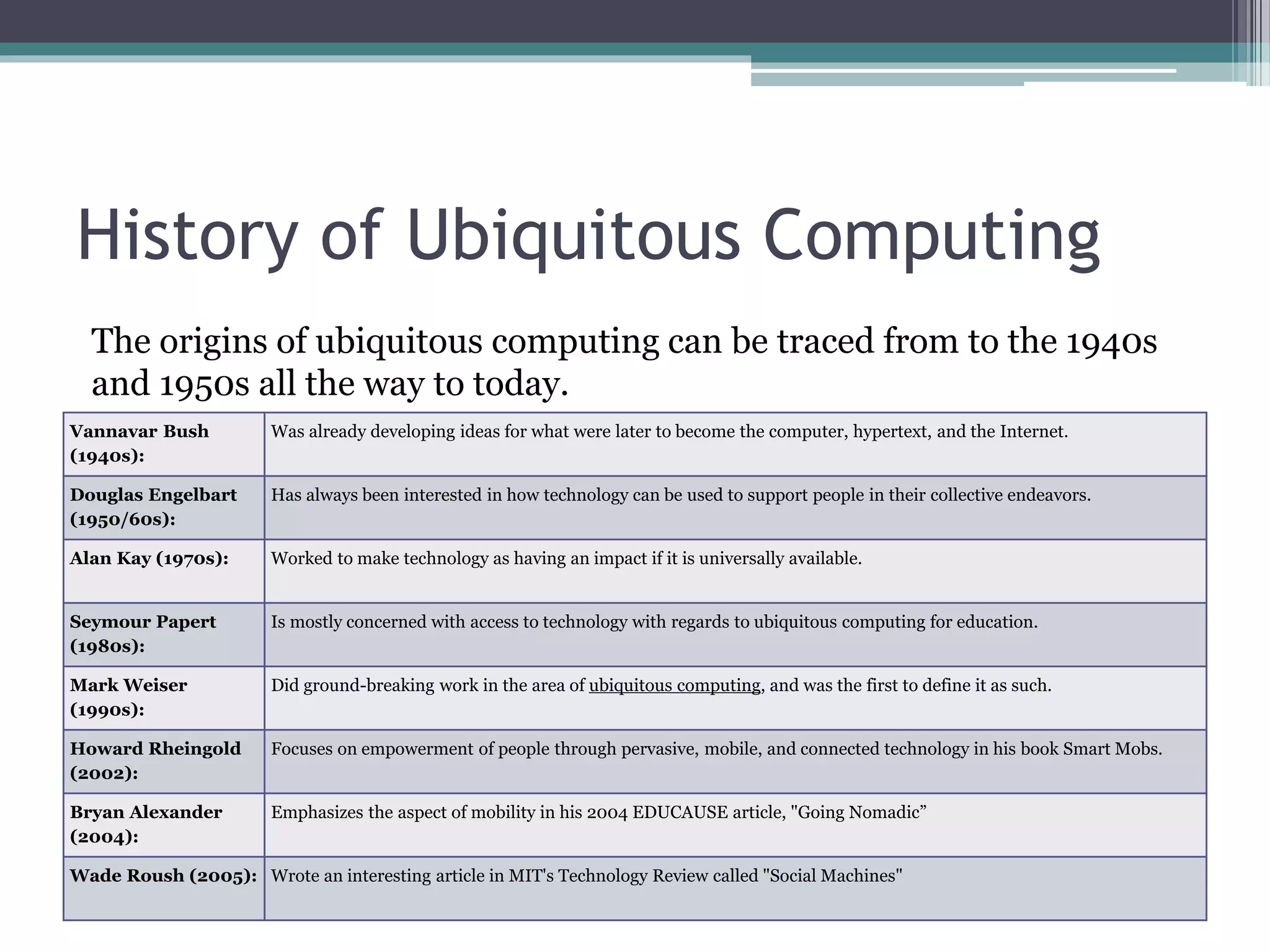
History of Ubiquitous Computing
The origins of ubiquitous computing can be traced from to the 1940s
and 1950s all the way to today.
Vannavar Bush
(1940s):
Was already developing ideas for what were later to become the computer, hypertext, and the Internet.
Douglas Engelbart
(1950/60s):
Has always been interested in how technology can be used to support people in their collective endeavors.
Alan Kay (1970s): Worked to make technology as having an impact if it is universally available.
Seymour Papert
(1980s):
Is mostly concerned with access to technology with regards to ubiquitous computing for education.
Mark Weiser
(1990s):
Did ground-breaking work in the area of ubiquitous computing, and was the first to define it as such.
Howard Rheingold
(2002):
Focuses on empowerment of people through pervasive, mobile, and connected technology in his book Smart Mobs.
Bryan Alexander
(2004):
Emphasizes the aspect of mobility in his 2004 EDUCAUSE article, "Going Nomadic”
Wade Roush (2005): Wrote an interesting article in MIT's Technology Review called "Social Machines"
Thanks…

Ubiquitous Computing

  • 1.
  • 2.
    What is UbiquitousComputing? The term ubiquitous implies that technology is everywhere and we use it all the time. ▫ Using computing technologies will be as natural as using other non-computing technologies (e.g., pen, paper, and cups) ▫ Computing services will be available anytime and anywhere.
  • 3.
    Vision “The most profoundtechnologies are those that disappear. They weave themselves into the fabric of everyday life until they are indistinguishable from it ” – Mark Weiser Think: writing, central heating, electric lighting, …
  • 4.
    Why is itImportant? Ubiquitous computing is changing our daily activities in a variety of ways. When it comes to using today's digital tools users tend to • communicate in different ways • be more active • have more control
  • 5.
    Yesterday: Gadget Rules Cool toys… Toobad they can’t talk to each other…
  • 6.
    Today: Communication Rules Sync. Download .Done. Configuration? Too much work…
  • 7.
    Tomorrow: Services WillRule Thank God! Pervasive Computing is here …
  • 8.
    The Brave NewWorld • Devices increasingly more {powerful ^ smaller ^ cheaper} • People interact daily with hundreds of computing devices (many of them mobile): ▫ Cars ▫ Desktops/Laptops ▫ Cell phones ▫ PDAs ▫ MP3 players ▫ Transportation passes  Computing is becoming pervasive
  • 9.
    Securing Data &Services • Security is critical because in many pervasive applications, we interact with agents that are not in our “home” or “office” environment. • Much of the work in security for distributed systems is not directly applicable to pervasive environments • Need to worry about privacy!
  • 10.
    Future challenges Ubiquitous computingpresents challenges across computer science: 1. In systems design and engineering, 2. In systems modelling 3. In user interface design
  • 11.
    Value in Teachingand Learning? To take full advantage of the potential inherent in ubiquitous computing, teaching must be reconceived from instructing to conducting learning. Teaching and learning must no longer be thought of as bound by the school building or the school day. 1. First, ubiquitous access to the Internet and telecommunication technologies changes classrooms into places with access to many resources and rich connections to the world. 2. Second, ubiquitous access to a variety of digital devices and multimedia tools makes it possible to create, analyze and communicate knowledge using a rich variety of media forms. 3. Third, ubiquitous access to digital tools that automate lower level skills allows students to concentrate on higher level thinking, and lessens the skill levels needed to explore a range of complex topics.
  • 12.
    Research Paper: SmartClassroom, Enhancing Collaborative Learning Using Pervasive Computing Technology • Smart Classroom facilitates collaborative learning among college students. • In a Smart Classroom, each student has a situation-aware PDA • Students' PDAs dynamically form mobile ad hoc networks for group meetings. • Each PDA monitors its situation and uses situation to trigger communication activity among the students and the instructor for group discussion and automatic distribution of presentation materials. • Middleware can effectively address the situation-awareness and ad hoc group communication for pervasive computing by providing development and runtime support to the application software. • Link: http://dpse.eas.asu.edu/papers/SmartClassroom.pdf
  • 13.
    Other research inthe area… 1. Satyanarayanan, Mahadev. "Pervasive computing: Vision and challenges." Personal Communications, IEEE 8.4 (2001): 10-17. 2. Saha, Debashis, and Amitava Mukherjee. "Pervasive computing: a paradigm for the 21st century." Computer 36.3 (2003): 25-31. 3. Banavar, Guruduth, et al. "Challenges: an application model for pervasive computing." Proceedings of the 6th annual international conference on Mobile computing and networking. ACM, 2000. 4. Chun, XU Guang You SHI Yuan, and XIE Wei Kai. "Pervasive/Ubiquitous Computing." Chinese Journal of Computers 9 (2003): 002. 5. Yau, Stephen S., et al. "Smart classroom: Enhancing collaborative learning using pervasive computing technology." II American Society of Engineering Education (ASEE) (2003).
  • 14.
    History of UbiquitousComputing The origins of ubiquitous computing can be traced from to the 1940s and 1950s all the way to today. Vannavar Bush (1940s): Was already developing ideas for what were later to become the computer, hypertext, and the Internet. Douglas Engelbart (1950/60s): Has always been interested in how technology can be used to support people in their collective endeavors. Alan Kay (1970s): Worked to make technology as having an impact if it is universally available. Seymour Papert (1980s): Is mostly concerned with access to technology with regards to ubiquitous computing for education. Mark Weiser (1990s): Did ground-breaking work in the area of ubiquitous computing, and was the first to define it as such. Howard Rheingold (2002): Focuses on empowerment of people through pervasive, mobile, and connected technology in his book Smart Mobs. Bryan Alexander (2004): Emphasizes the aspect of mobility in his 2004 EDUCAUSE article, "Going Nomadic” Wade Roush (2005): Wrote an interesting article in MIT's Technology Review called "Social Machines"
  • 15.