Lessons Learned from the application of
     Outcome Mapping to an IDRC EcoHealth
   project: a double-acting participatory process.
Outcome Mapping Reflection of the Ecosystem Approaches to the Better Management
of Zoonotic Emerging Infectious Diseases in the Southeast Asia Region (EcoZD) project


            The 1st Pan Asia-Africa Monitoring & Evaluation Forum,
                            Bangkok, Thailand 2012

          Tohtubtiang, K., Assé, R., Wisartsakul, W., and Gilbert , J.
Introduction
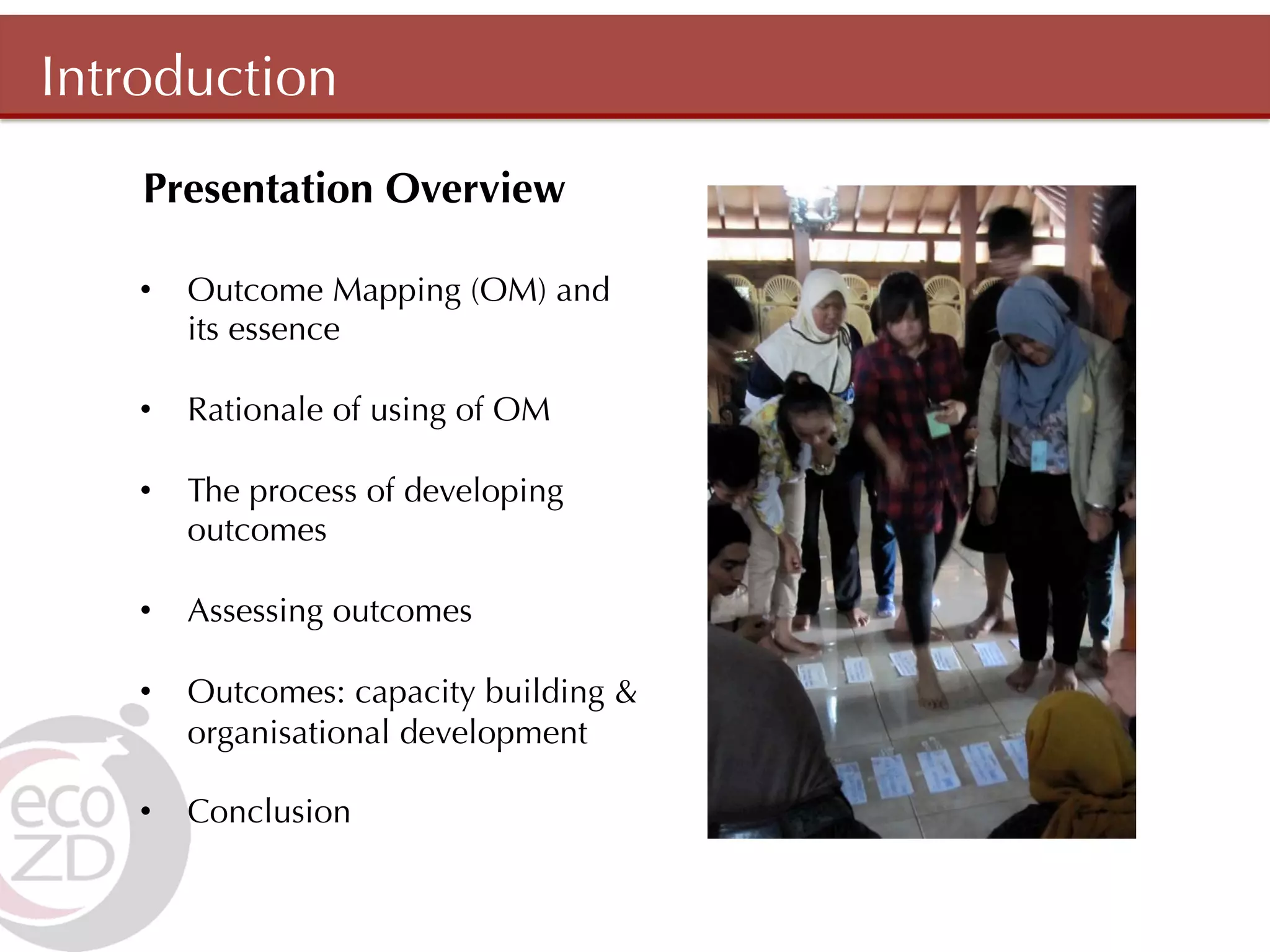
    Presentation Overview

    •  Outcome Mapping (OM) and
       its essence

    •  Rationale of using of OM

    •  The process of developing
       outcomes

    •  Assessing outcomes

    •  Outcomes: capacity building &
       organisational development

    •  Conclusion
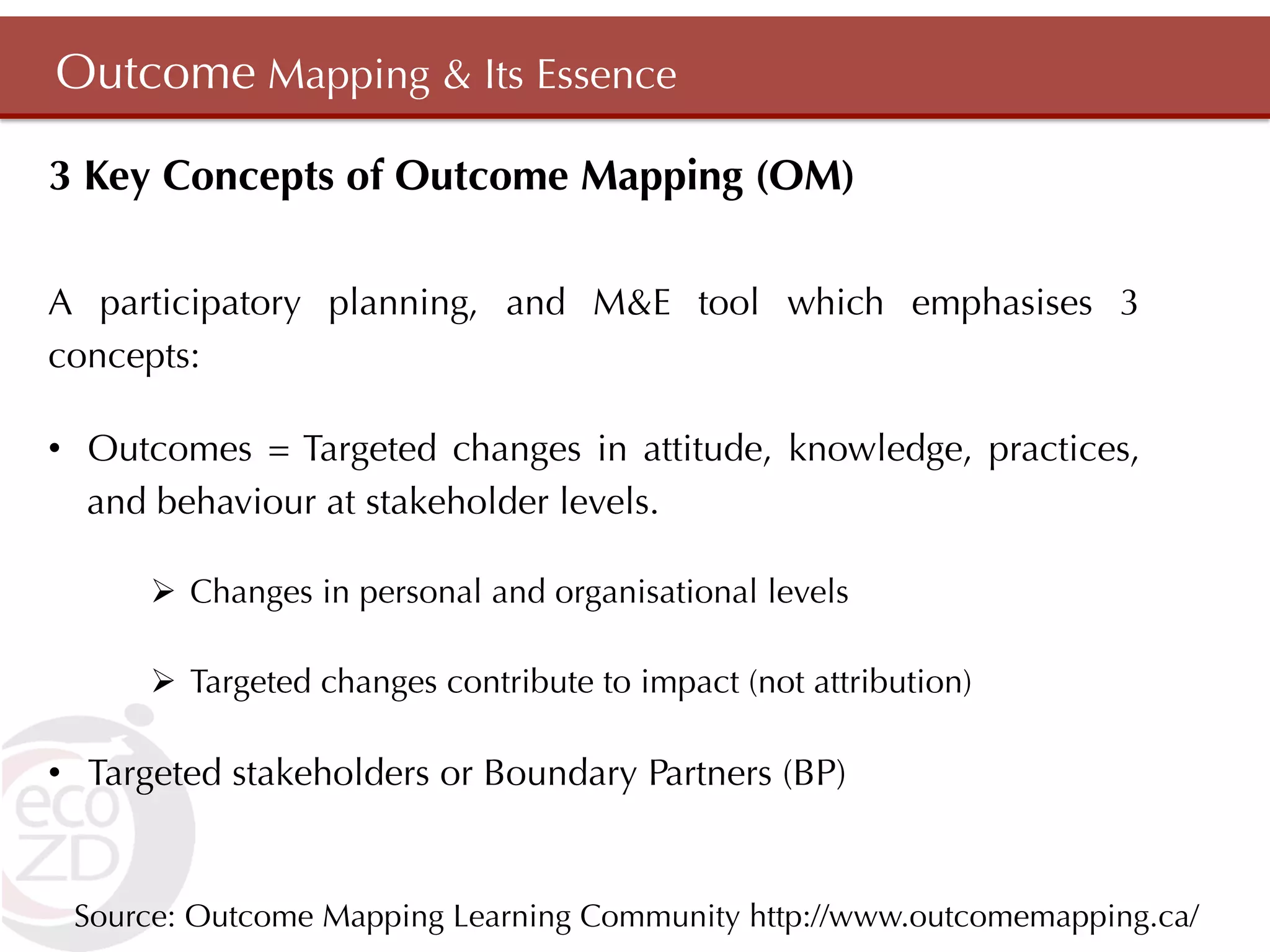
Outcome Mapping & Its Essence

3 Key Concepts of Outcome Mapping (OM)

A participatory planning, and M&E tool which emphasises 3
concepts:

•  Outcomes = Targeted changes in attitude, knowledge, practices,
   and behaviour at stakeholder levels.

      Ø  Changes in personal and organisational levels

      Ø  Targeted changes contribute to impact (not attribution)

•  Targeted stakeholders or Boundary Partners (BP)


 Source: Outcome Mapping Learning Community http://www.outcomemapping.ca/
Outcome Mapping & Its Essence

3 Key Concepts of Outcome Mapping (OM)
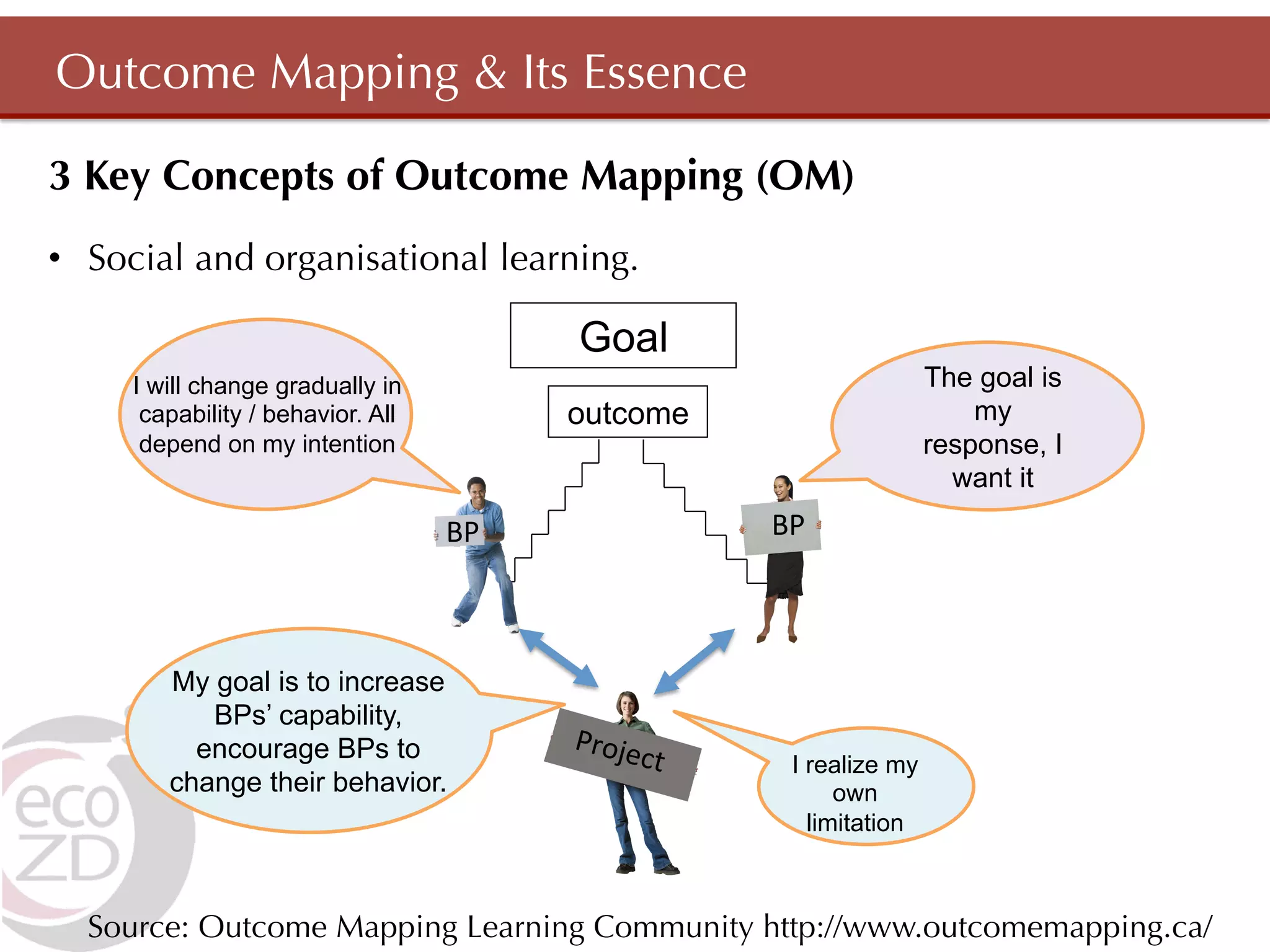
•  Social and organisational learning.

                                            Goal
     I will change gradually in                                           The goal is
      capability / behavior. All            outcome                           my
      depend on my intention	
                                            response, I
                                                                            want it	
                                   BP	
                   BP	


        My goal is to increase
           BPs’ capability,
                                            Proje
          encourage BPs to                       ct	
        I realize my
        change their behavior.	
                                  own
                                                               limitation 	


  Source: Outcome Mapping Learning Community http://www.outcomemapping.ca/
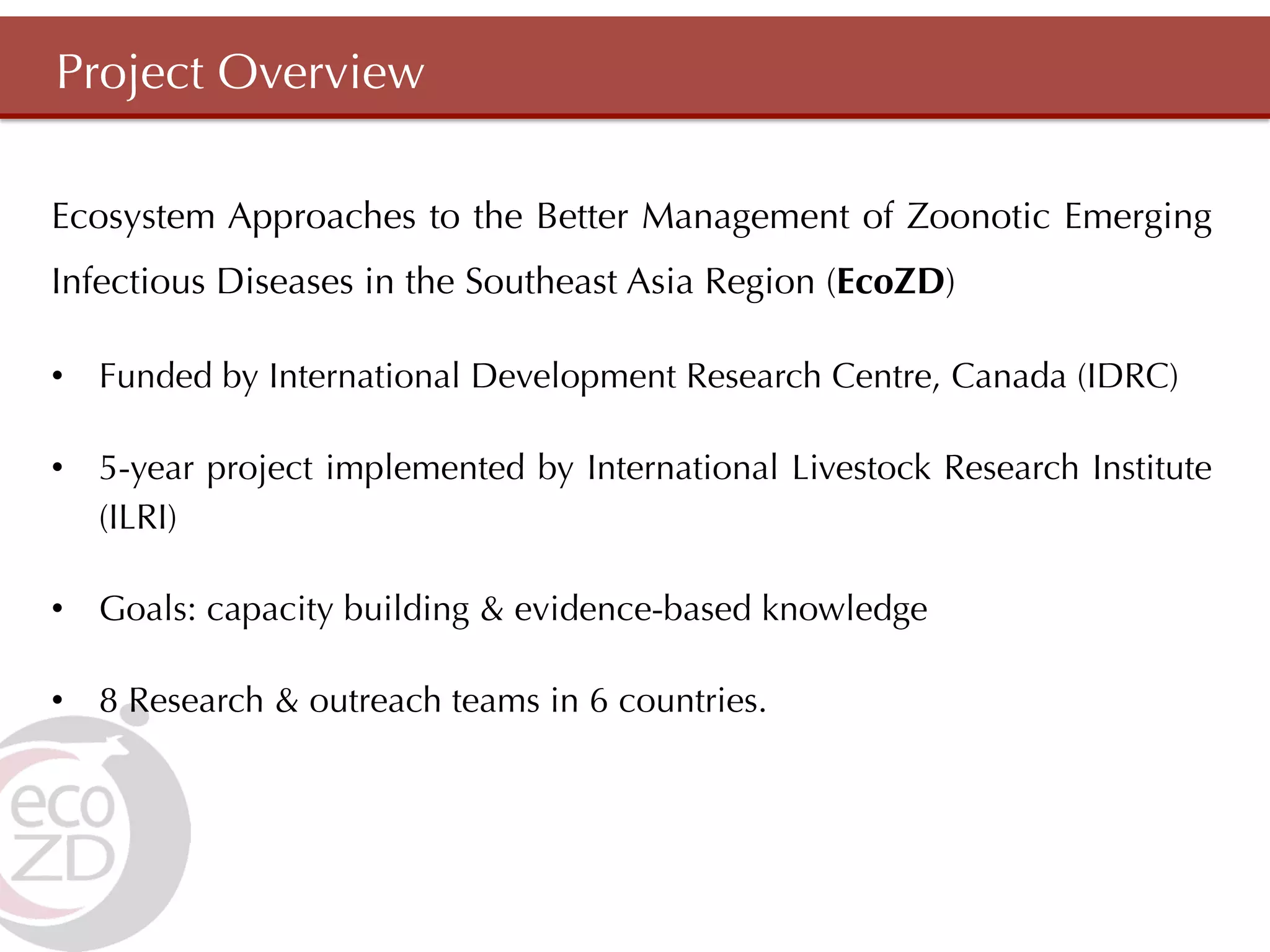
Project Overview

Ecosystem Approaches to the Better Management of Zoonotic Emerging
Infectious Diseases in the Southeast Asia Region (EcoZD)

•  Funded by International Development Research Centre, Canada (IDRC)

•  5-year project implemented by International Livestock Research Institute
   (ILRI)

•  Goals: capacity building & evidence-based knowledge

•  8 Research & outreach teams in 6 countries.
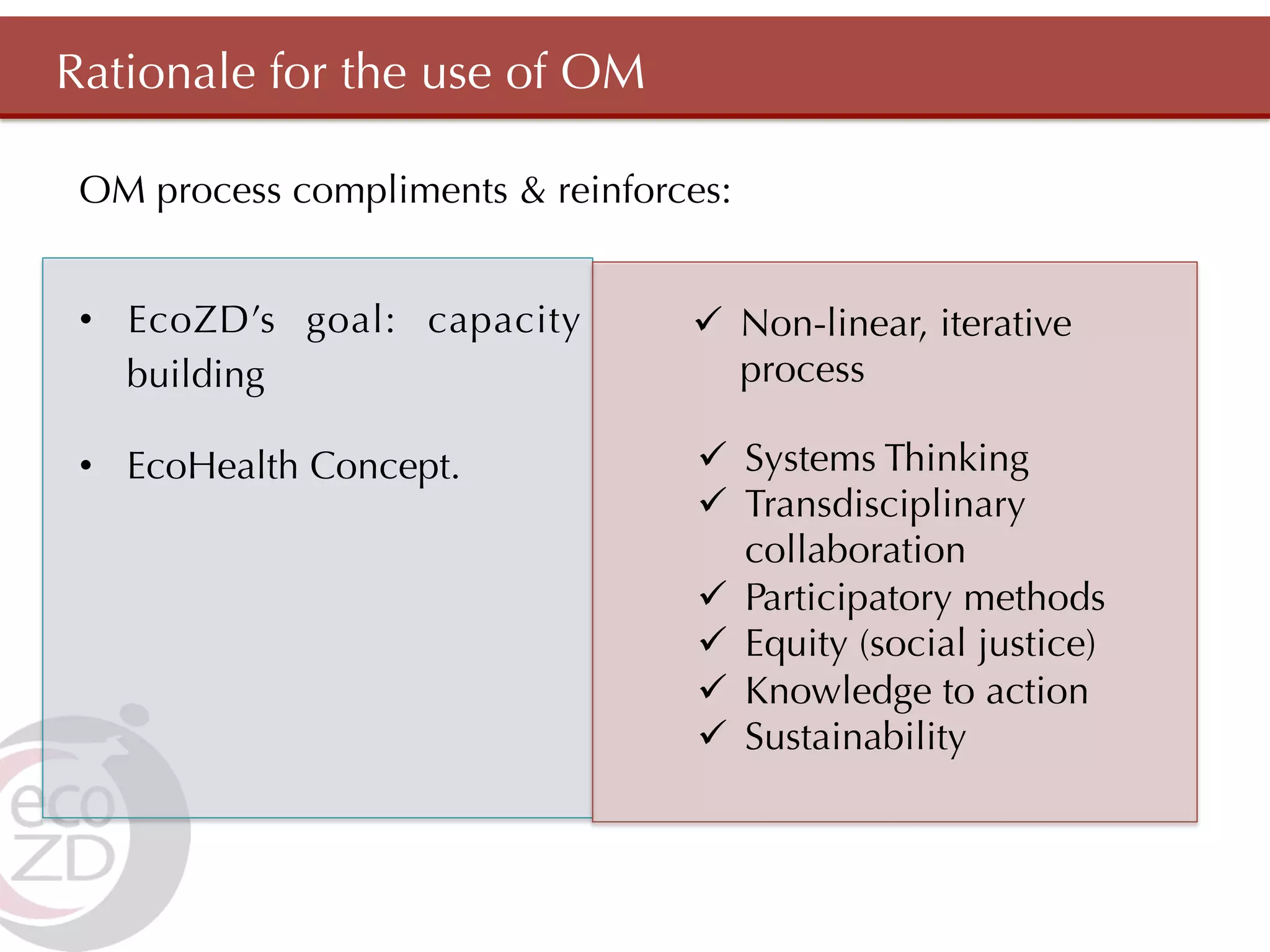
Rationale for the use of OM

 OM process compliments & reinforces:


 •  EcoZD’s goal: capacity        ü  Non-linear, iterative
    building                          process

 •  EcoHealth Concept.             ü  Systems Thinking
                                   ü  Transdisciplinary
                                       collaboration
                                   ü  Participatory methods
                                   ü  Equity (social justice)
                                   ü  Knowledge to action
                                   ü  Sustainability
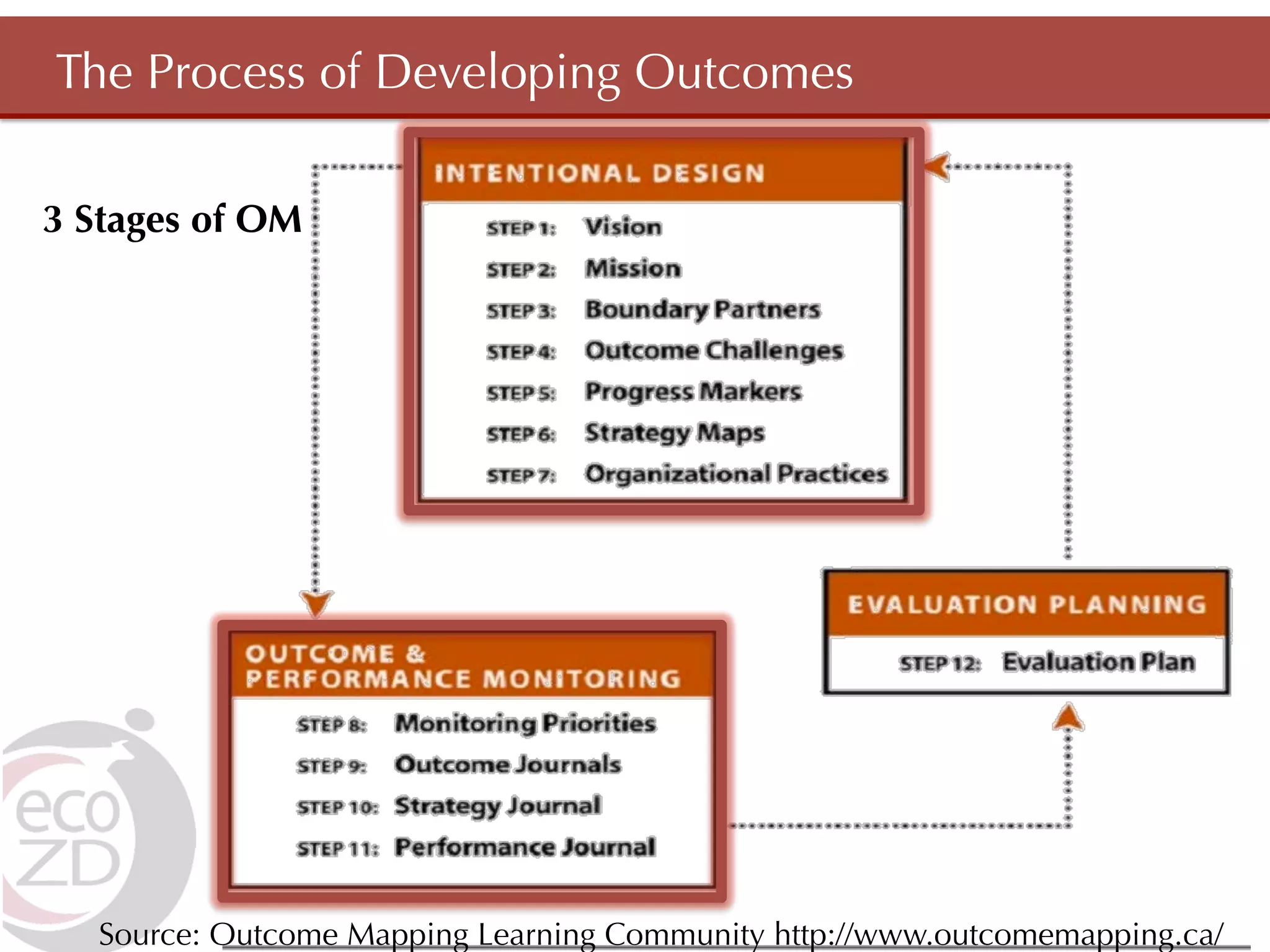
The Process of Developing Outcomes

3 Stages of OM


   Source: Outcome Mapping Learning Community http://www.outcomemapping.ca/
The Process of Developing Outcomes
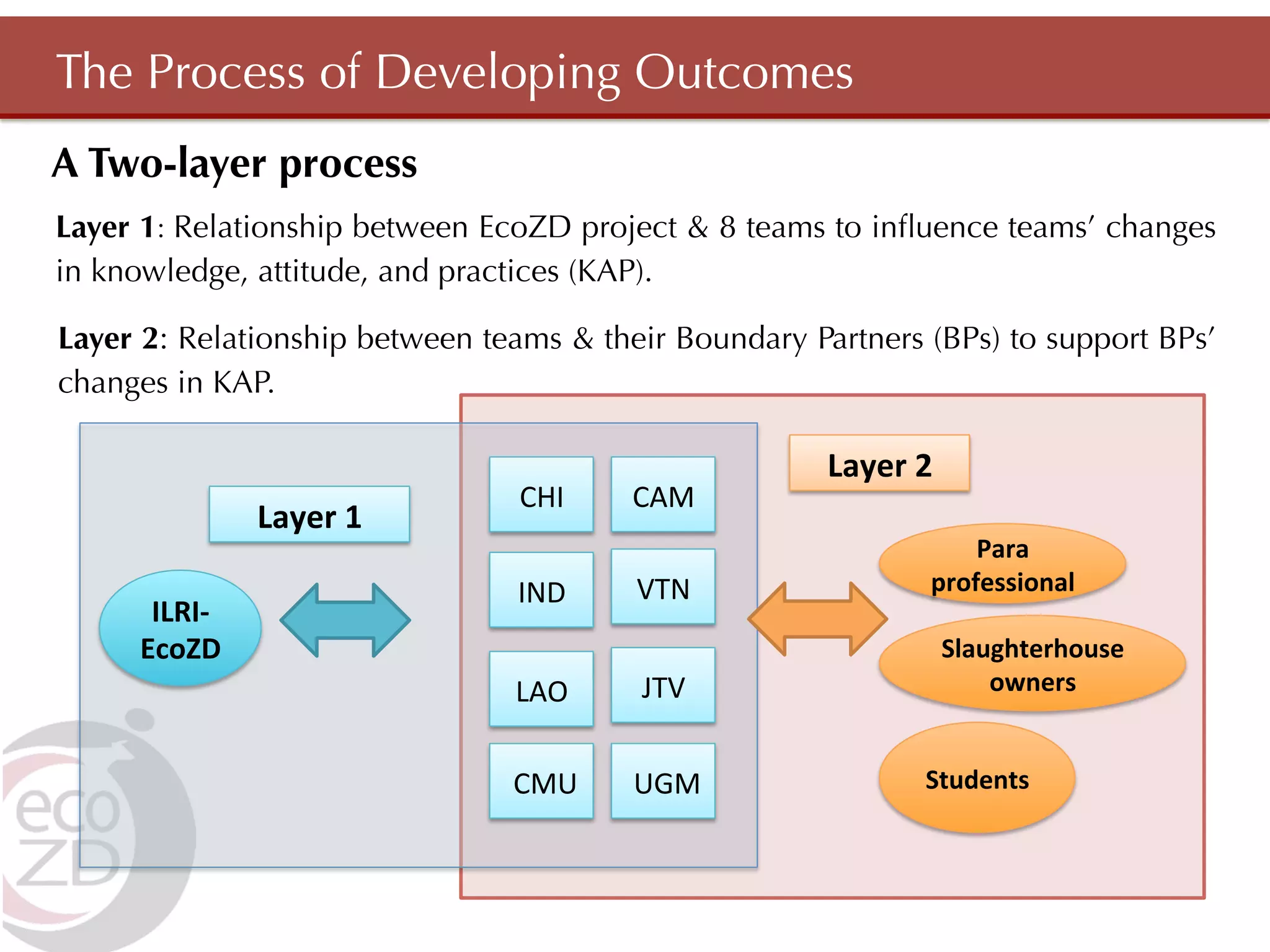
A Two-layer process
Layer 1: Relationship between EcoZD project & 8 teams to influence teams’ changes
in knowledge, attitude, and practices (KAP).

Layer 2: Relationship between teams & their Boundary Partners (BPs) to support BPs’
changes in KAP.

                                                                  Layer	
  2	
  	
  
                                       CHI	
        CAM	
  
                 Layer	
  1	
  	
  
                                                                                     Para	
  
                                       IND	
         VTN	
                       professional	
  
      ILRI-­‐
     EcoZD	
                                                                      Slaughterhouse	
  
                                       LAO	
          JTV	
                           owners	


  CMU	
     	
  UGM	
                   Students	
  
The Process of Developing Outcomes

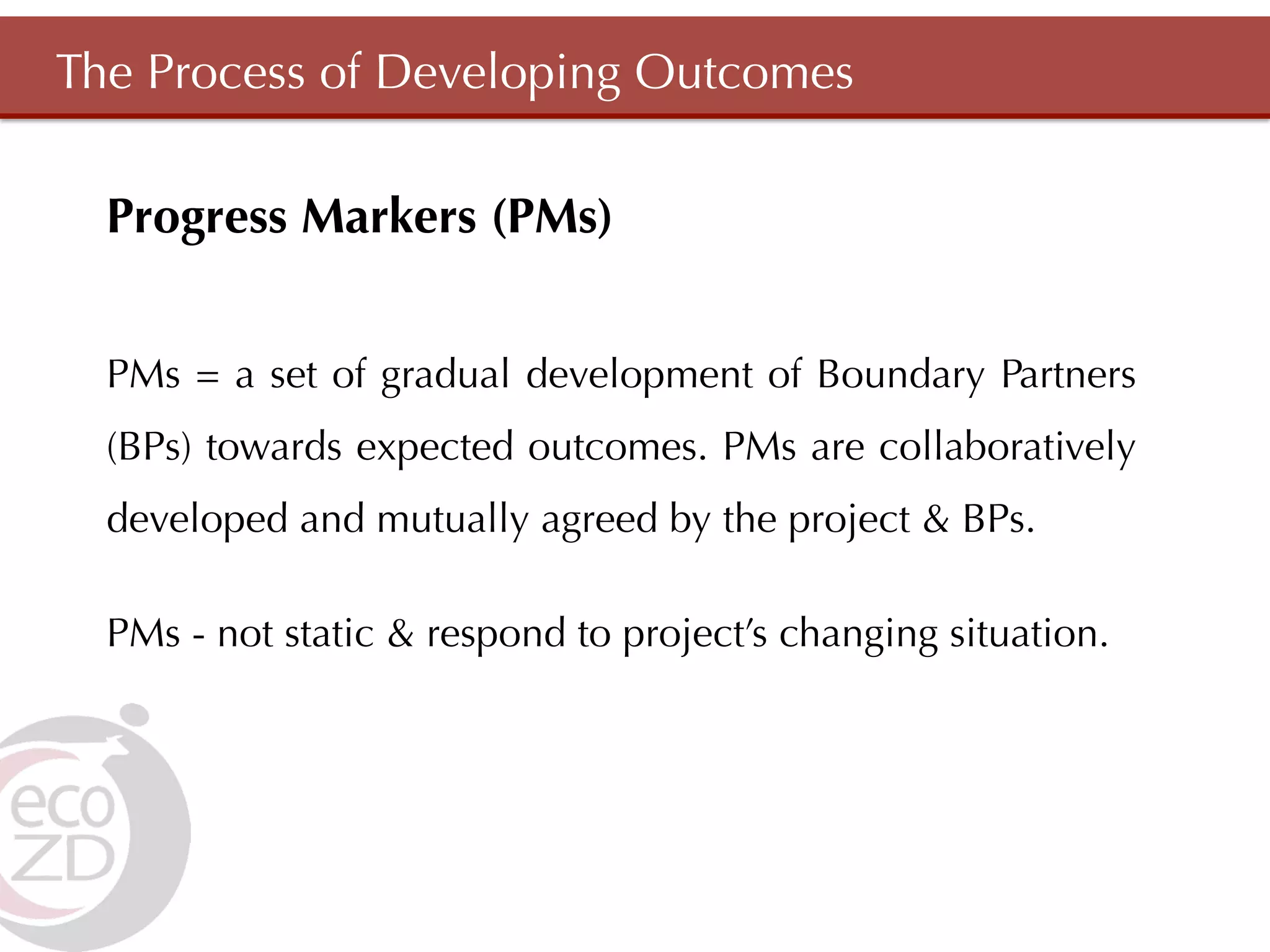
  Progress Markers (PMs)


  PMs = a set of gradual development of Boundary Partners
  (BPs) towards expected outcomes. PMs are collaboratively
  developed and mutually agreed by the project & BPs.

  PMs - not static & respond to project’s changing situation.
The Process of Developing Outcomes

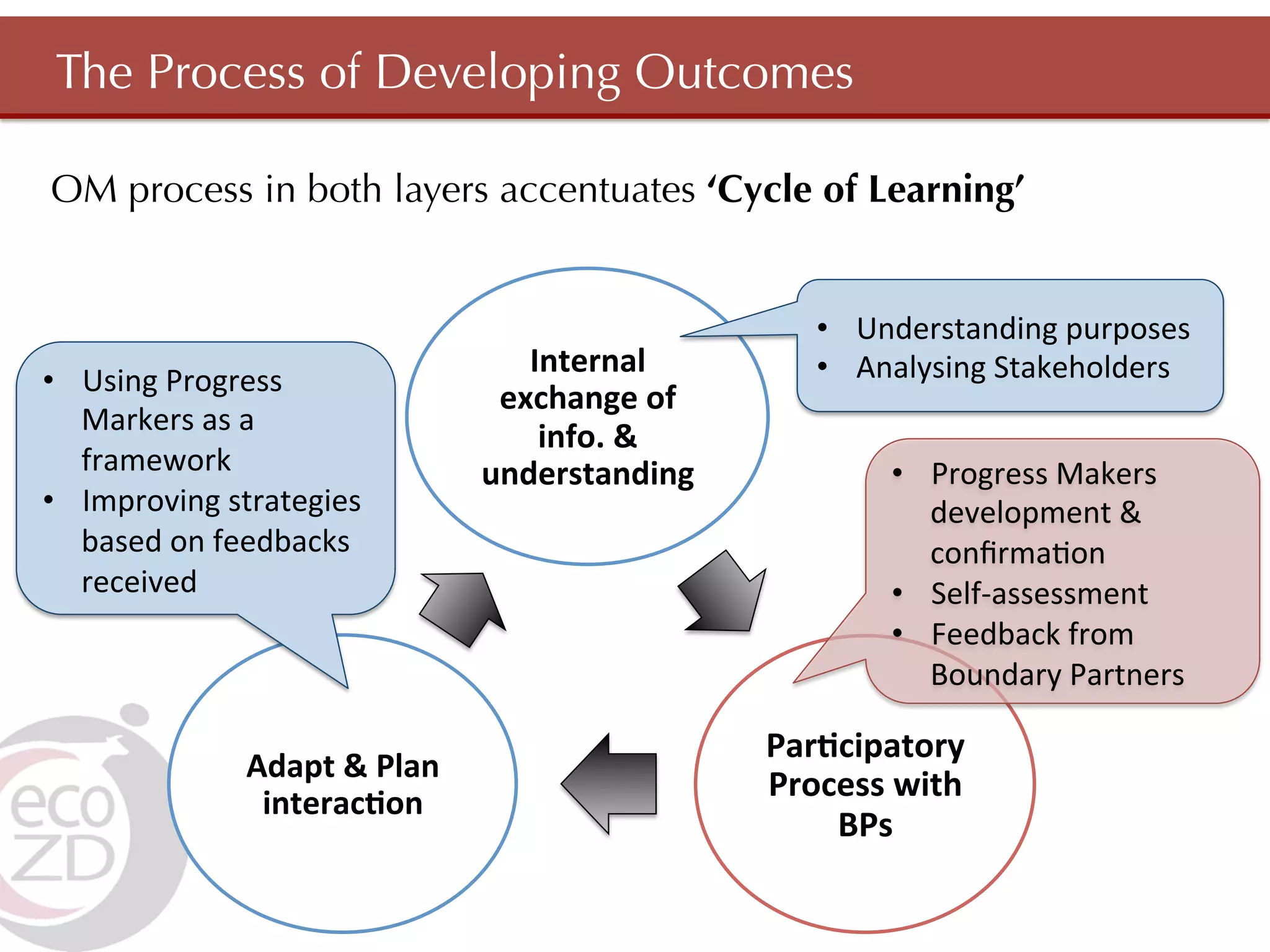
OM process in both layers accentuates ‘Cycle of Learning’


                                                                         •  Understanding	
  purposes	
  
                                               Internal	
                •  Analysing	
  Stakeholders	
  
•  Using	
  Progress	
  
                                             exchange	
  of	
  
   Markers	
  as	
  a	
  
                                                info.	
  &	
  	
  
   framework	
                              understanding	
                     •  Progress	
  Makers	
  
•  Improving	
  strategies	
                                                       development	
  &	
  
   based	
  on	
  feedbacks	
                                                      confirmaIon	
  
   received	
  	
                                                               •  Self-­‐assessment	
  
                                                                                •  Feedback	
  from	
  
                                                                                   Boundary	
  Partners	
  

                                                                     ParBcipatory	
  
                   Adapt	
  &	
  Plan	
  
                    interacBon	
  
                                                                     Process	
  with	
  
                                                                         BPs	
  
Assessing Outcomes
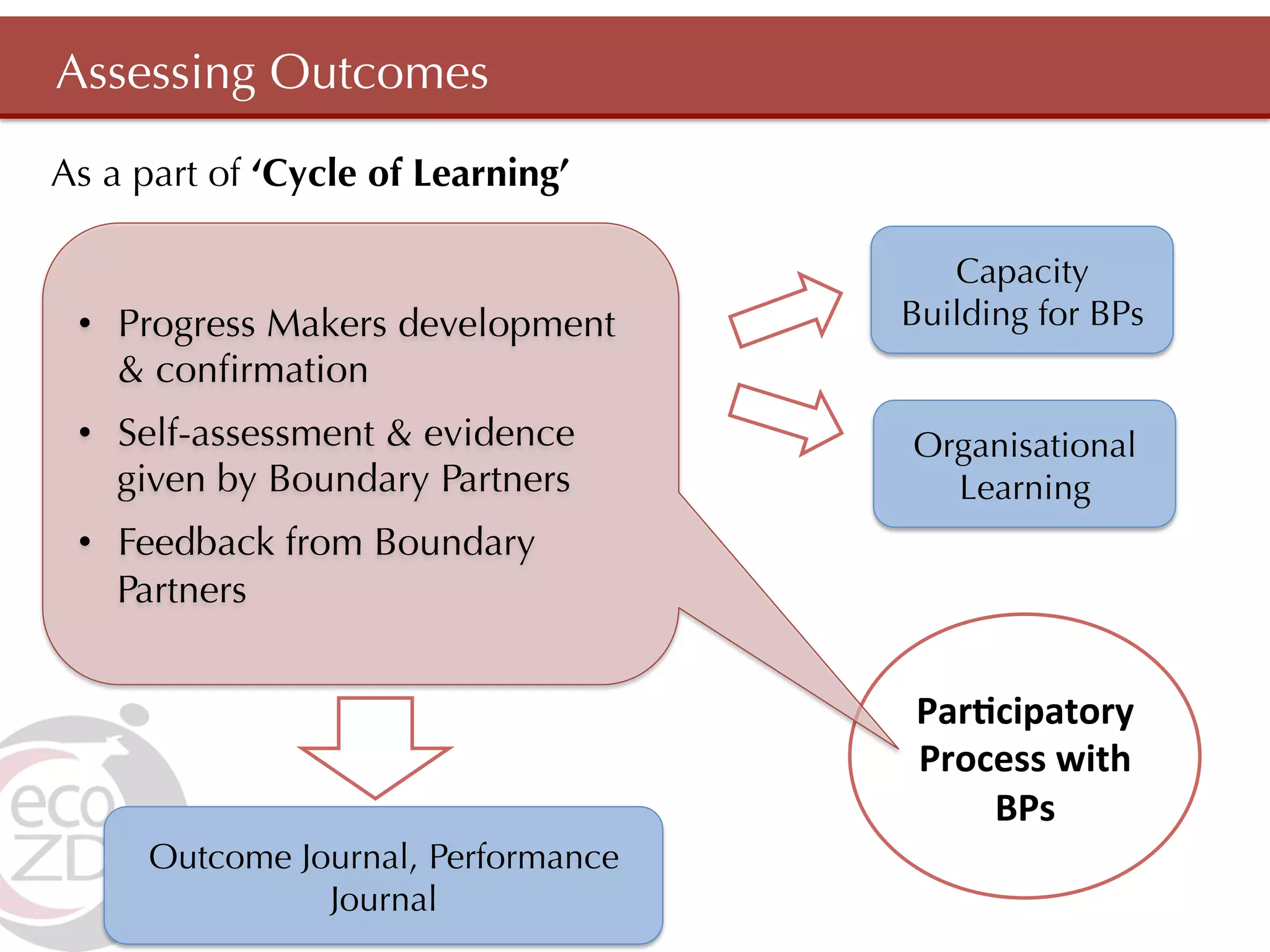
As a part of ‘Cycle of Learning’

                                        Capacity
 •  Progress Makers development      Building for BPs
    & confirmation
 •  Self-assessment & evidence       Organisational
    given by Boundary Partners         Learning
 •  Feedback from Boundary
    Partners


                                     ParBcipatory	
  
                                     Process	
  with	
  
                                         BPs	
  
      Outcome Journal, Performance
                Journal
Assessing Outcomes

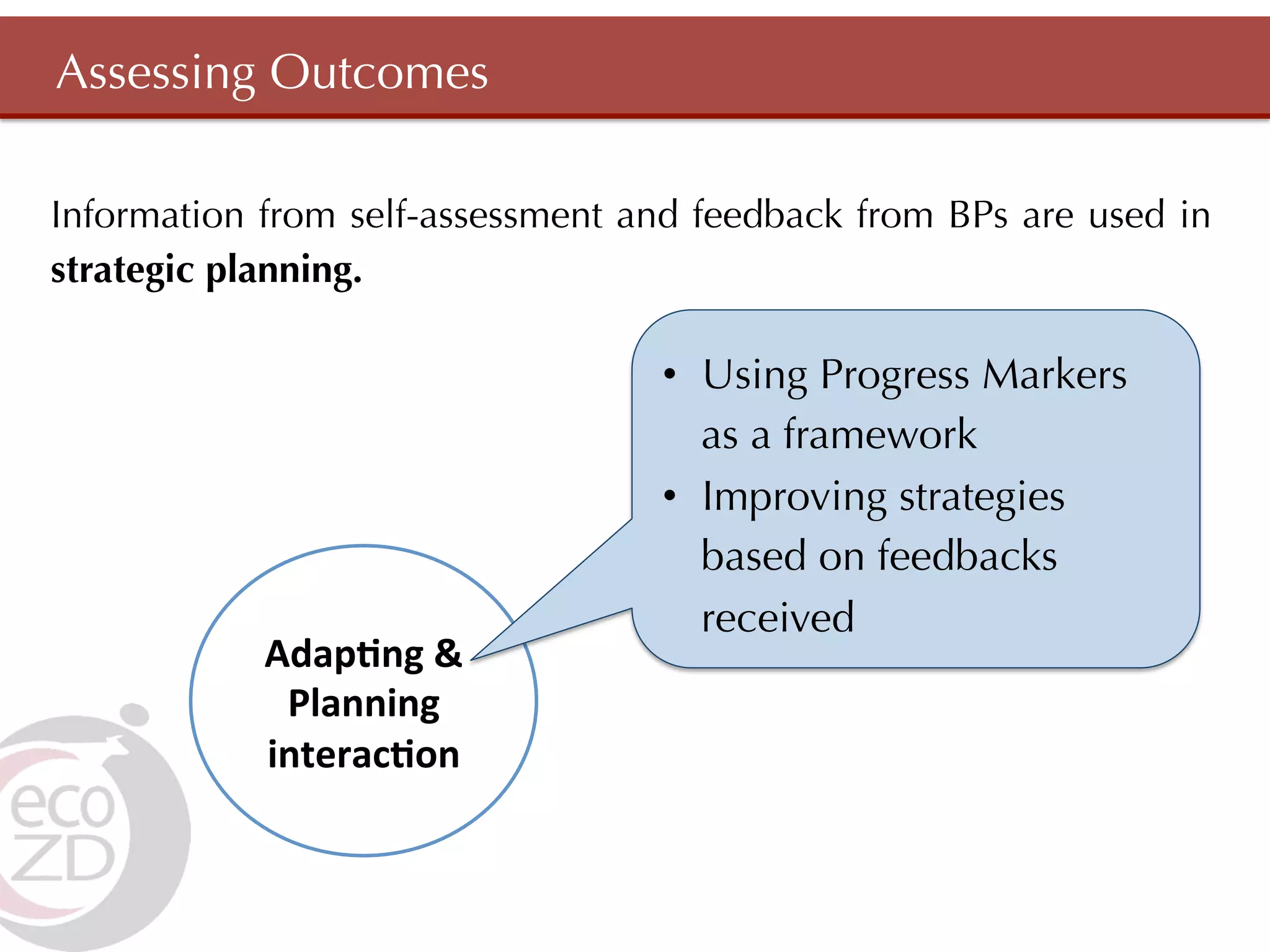
Information from self-assessment and feedback from BPs are used in
strategic planning.

                                  •  Using Progress Markers
                                     as a framework
                                  •  Improving strategies
                                     based on feedbacks
                                     received
            AdapBng	
  &	
  
             Planning	
  
            interacBon	
  
Assessing Outcomes

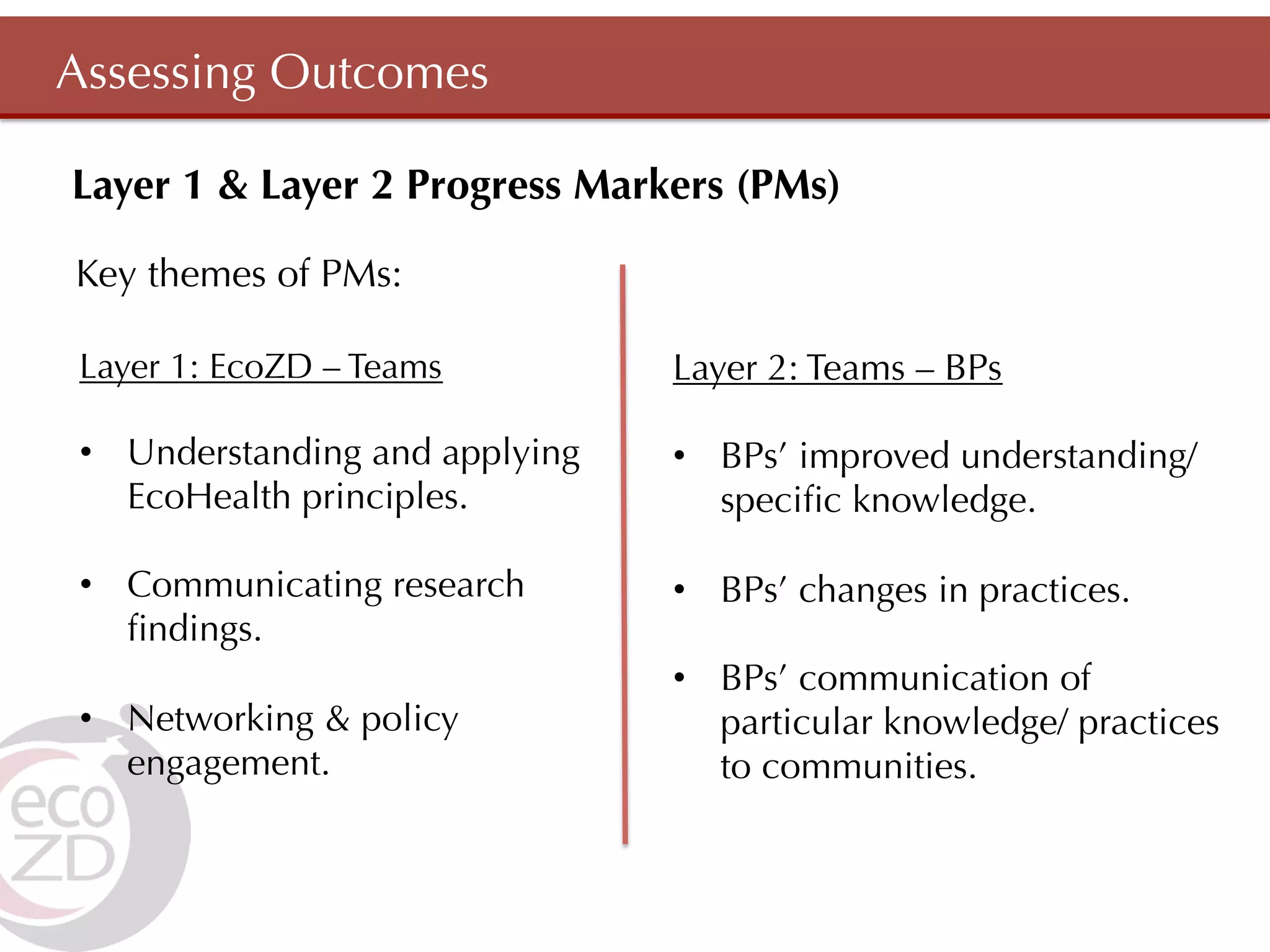
Layer 1 & Layer 2 Progress Markers (PMs)

Key themes of PMs:

Layer 1: EcoZD – Teams          Layer 2: Teams – BPs

•  Understanding and applying   •  BPs’ improved understanding/
   EcoHealth principles.           specific knowledge.

•  Communicating research       •  BPs’ changes in practices.
   findings.
                                •  BPs’ communication of
•  Networking & policy             particular knowledge/ practices
   engagement.                     to communities.
Assessing Outcomes

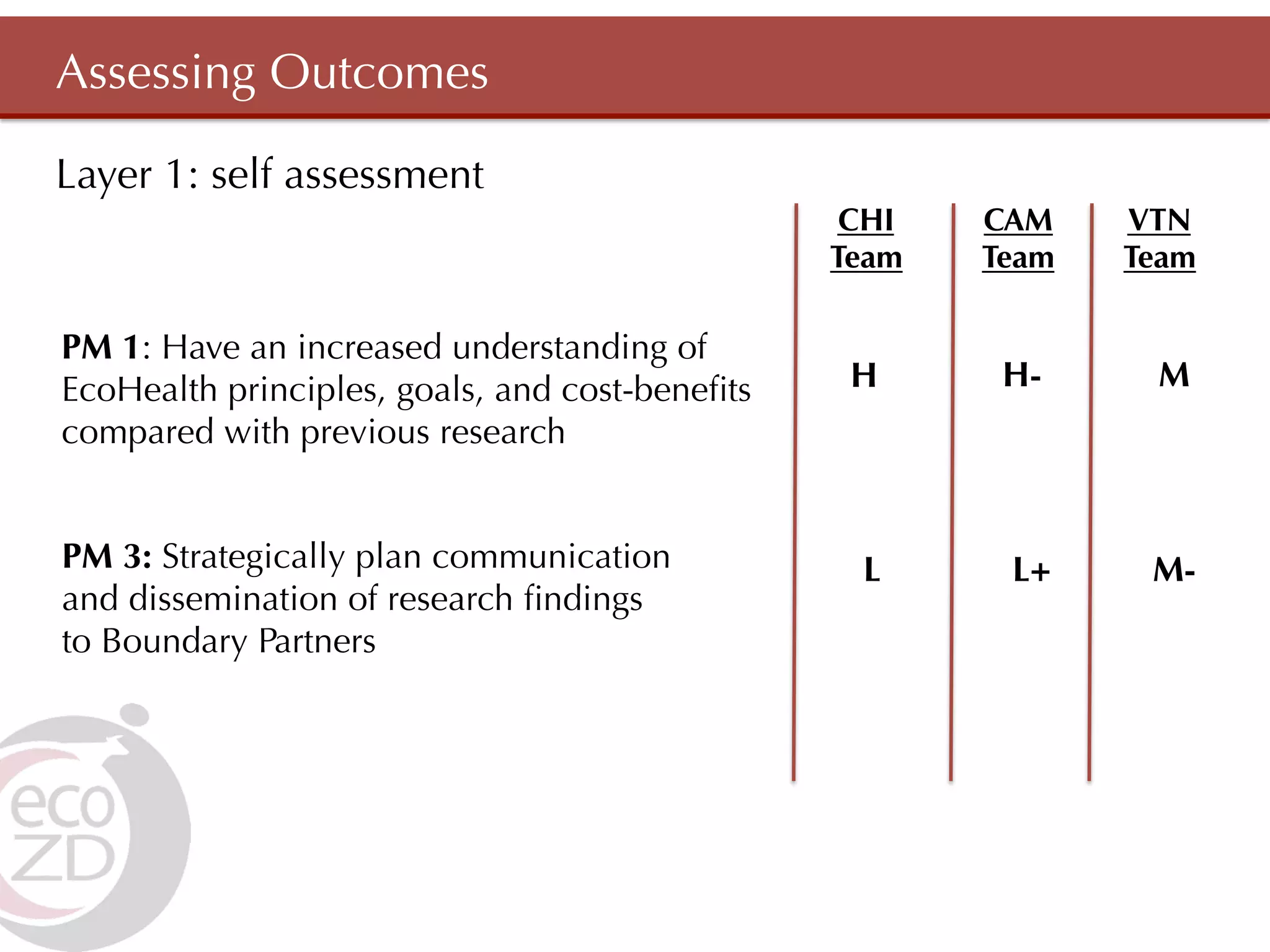
Layer 1: self assessment
                                                 CHI   CAM    VTN
                                                Team   Team   Team

PM 1: Have an increased understanding of
EcoHealth principles, goals, and cost-benefits    H      H-     M
compared with previous research


PM 3: Strategically plan communication           L      L+     M-
and dissemination of research findings
to Boundary Partners
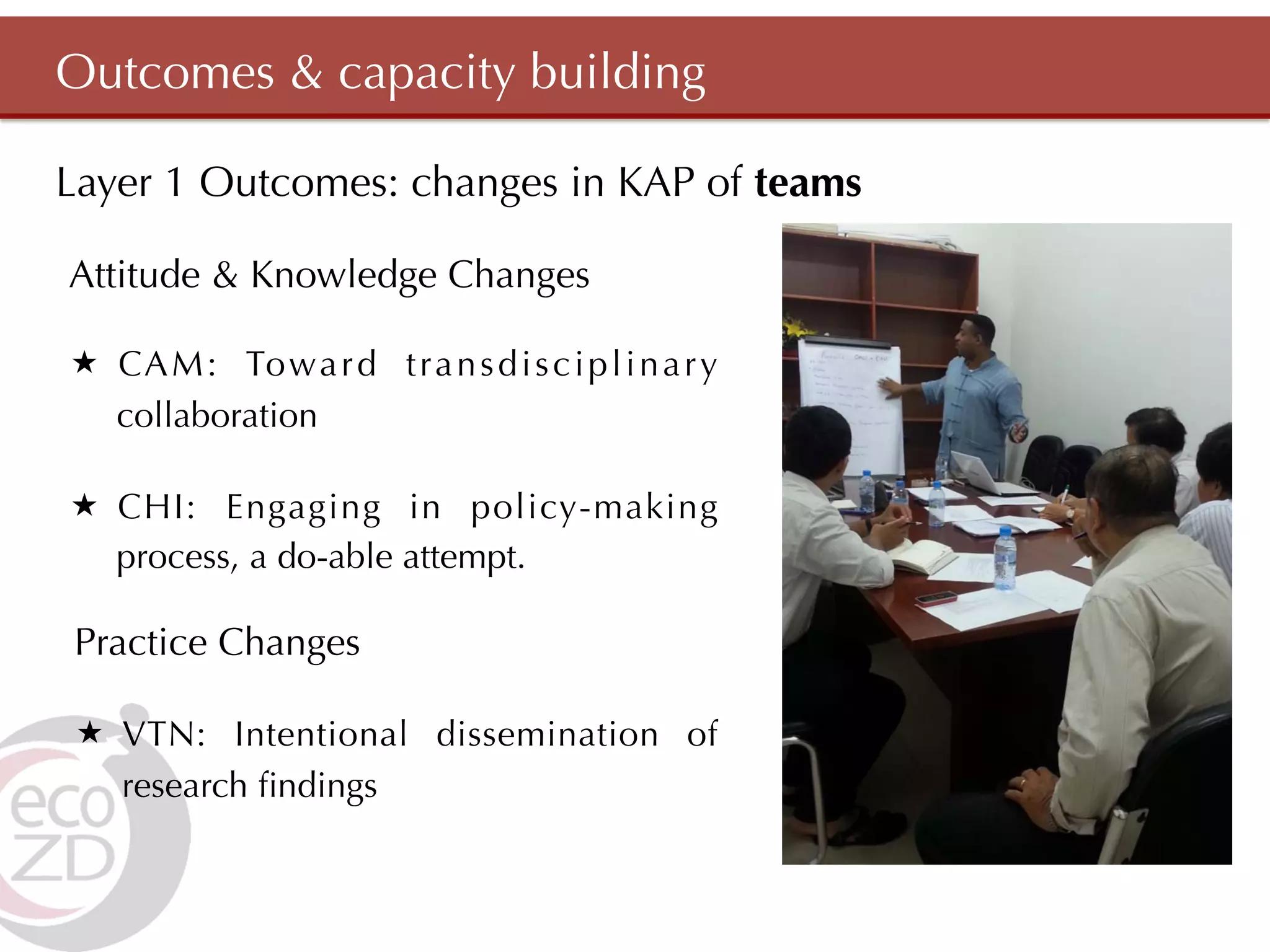
Outcomes & capacity building

Layer 1 Outcomes: changes in KAP of teams

Attitude & Knowledge Changes

«  CA M : Towa r d t ra n s d i s c i p l i n a r y
    collaboration

«  CHI: Engaging in policy-making
    process, a do-able attempt.

Practice Changes

«  VTN: Intentional dissemination of
    research findings
Outcomes & capacity building
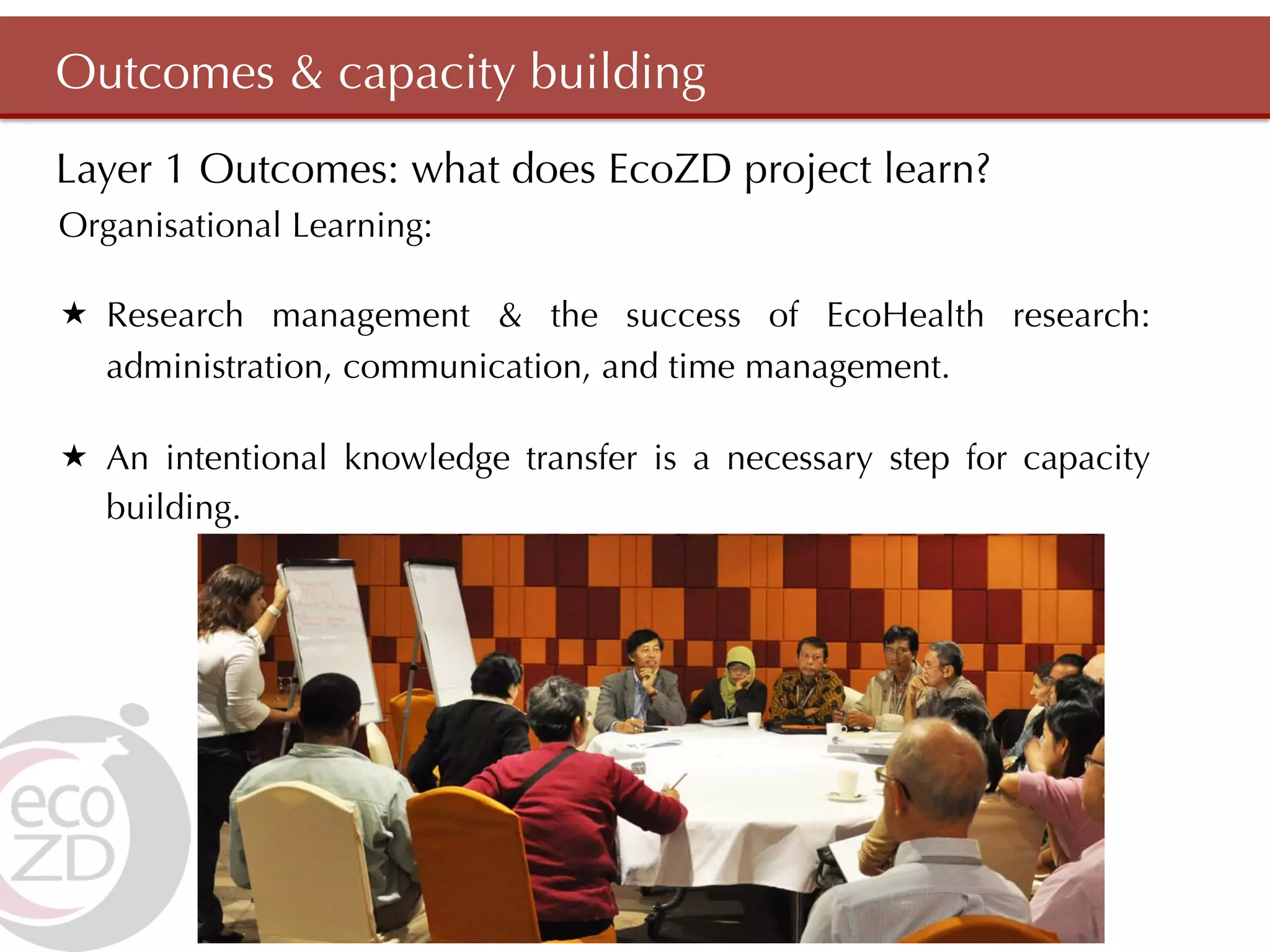
Layer 1 Outcomes: what does EcoZD project learn?
Organisational Learning:

«  Research management & the success of EcoHealth research:
    administration, communication, and time management.

«  An intentional knowledge transfer is a necessary step for capacity
    building.
Outcomes & capacity building

Layer 2 Outcomes: changes in KAP of BPs

Attitude & Knowledge Changes

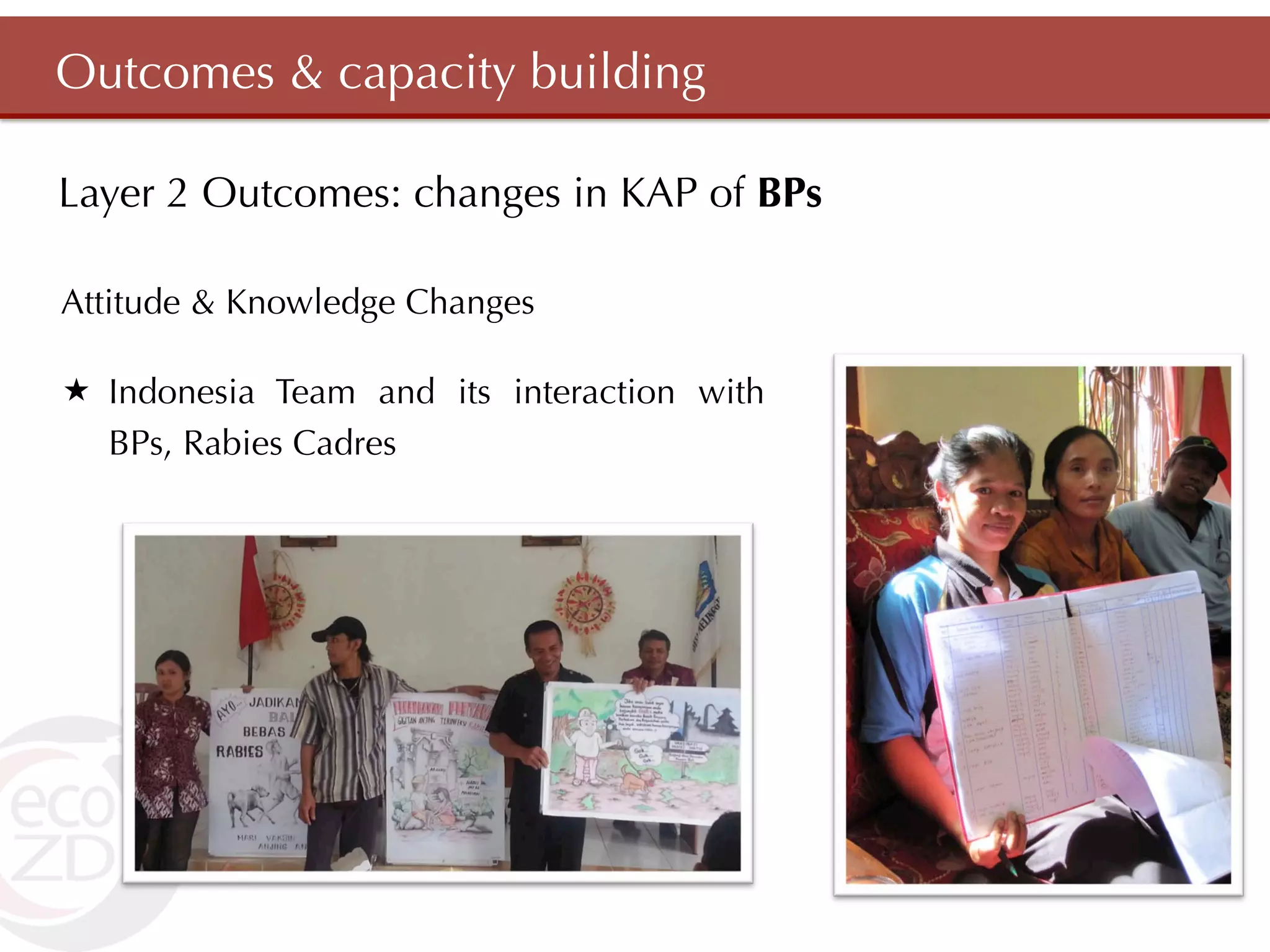
«  Indonesia Team and its interaction with
    BPs, Rabies Cadres
Outcomes & capacity building

Layer 2 Outcomes: changes in KAP of BPs
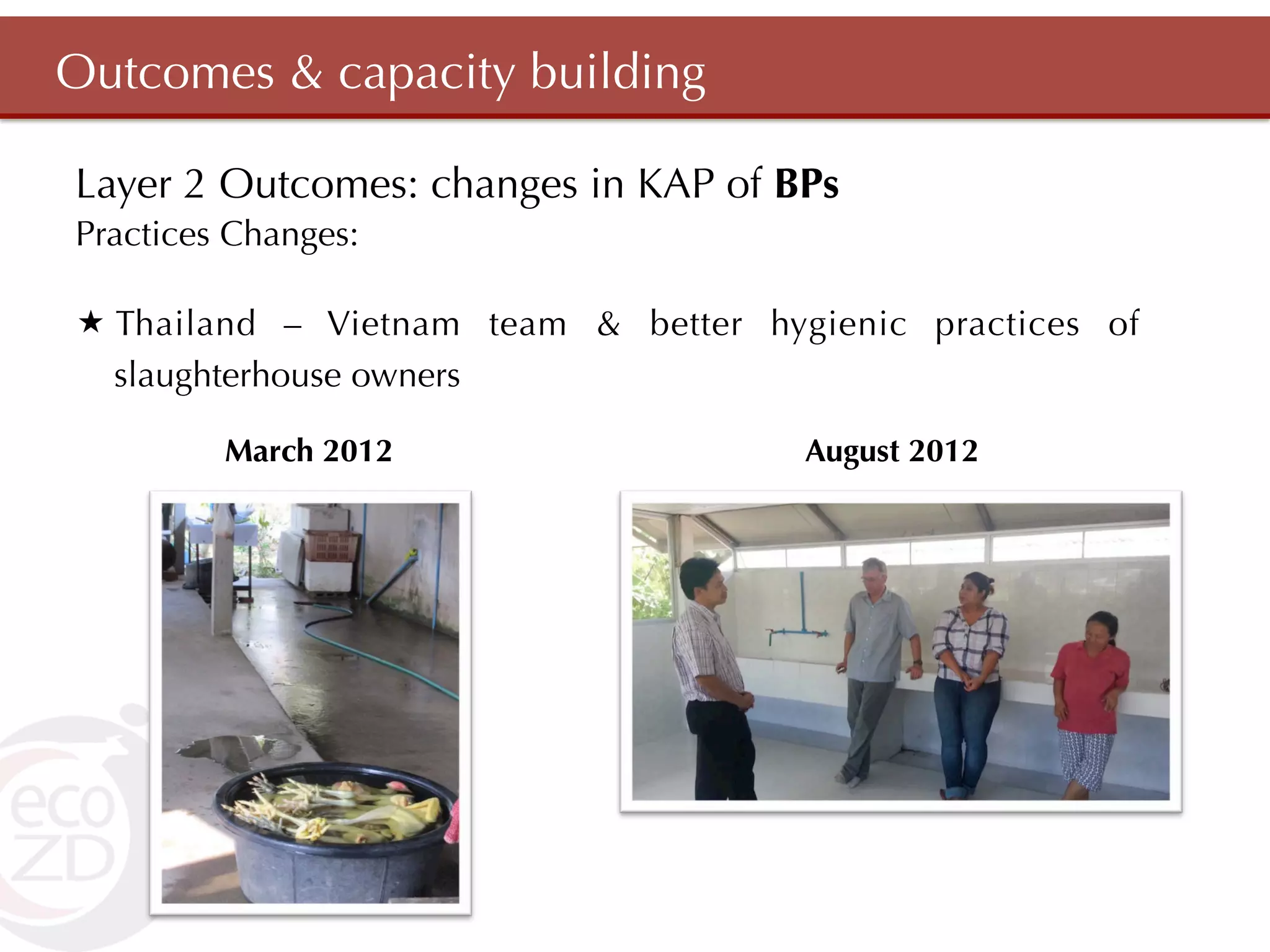
Practices Changes:

«  Thailand – Vietnam team & better hygienic practices of
    slaughterhouse owners

         March 2012                    August 2012
Outcomes & capacity building
Layer 2 Outcomes

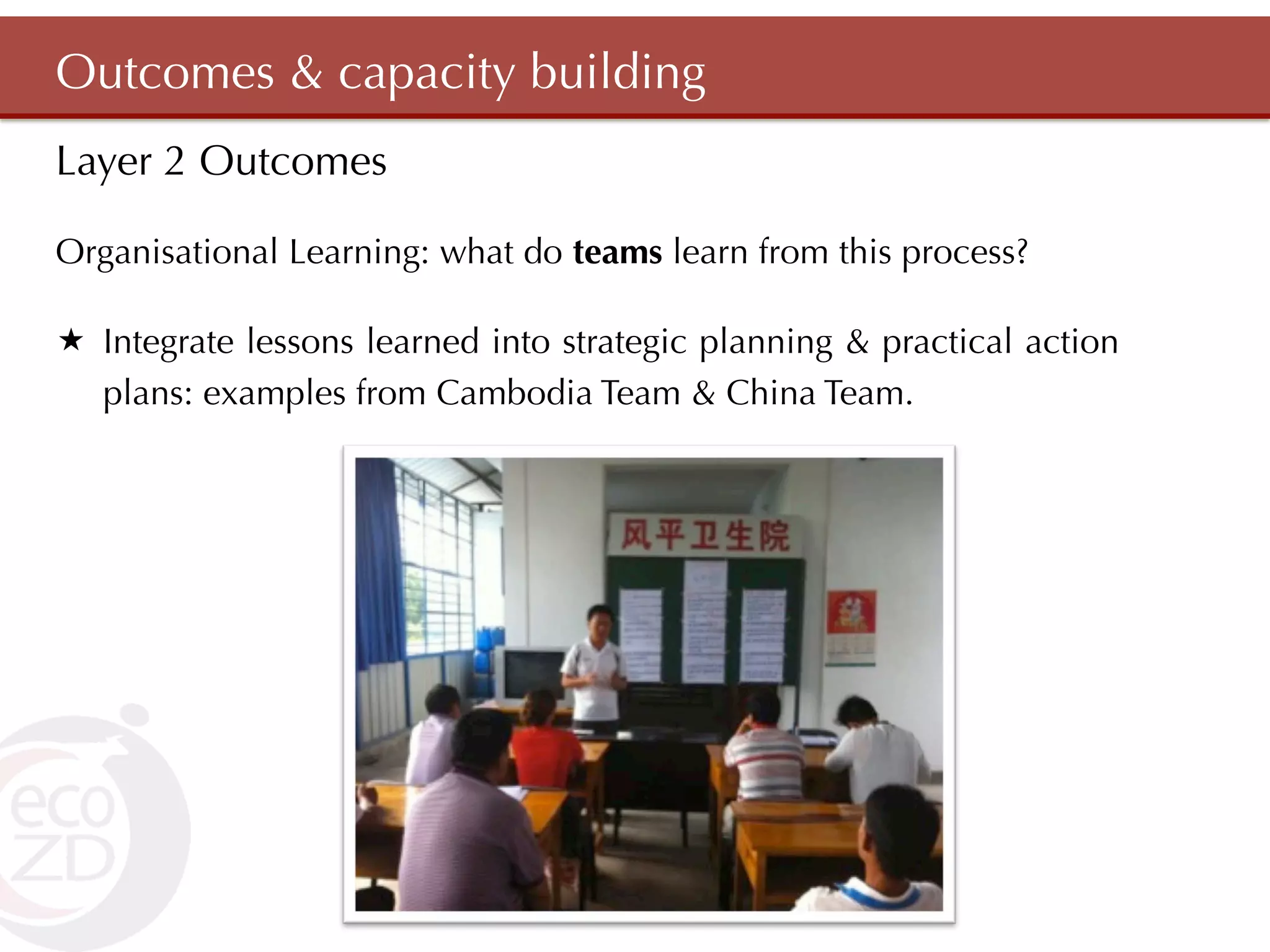
Organisational Learning: what do teams learn from this process?

«  Integrate lessons learned into strategic planning & practical action
    plans: examples from Cambodia Team & China Team.
Conclusion


«  OM is used as a framework for the process of developing
    outcomes and also a formative reflection which contributes
    to project management.

«  Challenges faced by implementation of this process: 1)
    subjectivity of the tool, 2) seen as a seperate part of the
    project, 3) resources, especially time & skills of personnel in
    the teams.
Reference

•    Charron, D.F. (2012) (ed) EcoHealth Research in Practice: Innovative
     Applications of an EcoSystem Approach to Health, Ottawa, International
     Development Research Centre

•    Jones, H., Jones, N., Shaxson, L., and Walker, D. (2012) ‘Knowledge,
     Policy, and Power in International Development: a Practical Guide’,
     Bristol: The Policy Press.

•    Patton, M. (2010) Developmental evaluation: Applying complexity
     concepts to enhance innovation and use, New York, NY: Guildford
     Publications

•    Outcome Mapping Learning Community, www.outcomemapping.ca
EcoZD Project

For more information about the EcoZD project, please
                       visit:
                          
                www.ilri.org/ecozd
       www.ilriasia.wordpress.com/tag/ecozd

                     Or contact:
                 Korapin Tohtubtiang
                 tkorapin@gmail.com

Lessons Learned from the application of Outcome Mapping to an IDRC EcoHealth project: A double-acting participatory process

  • 1.
    Lessons Learned fromthe application of Outcome Mapping to an IDRC EcoHealth project: a double-acting participatory process. Outcome Mapping Reflection of the Ecosystem Approaches to the Better Management of Zoonotic Emerging Infectious Diseases in the Southeast Asia Region (EcoZD) project The 1st Pan Asia-Africa Monitoring & Evaluation Forum, Bangkok, Thailand 2012 Tohtubtiang, K., Assé, R., Wisartsakul, W., and Gilbert , J.
  • 2.
    Introduction Presentation Overview •  Outcome Mapping (OM) and its essence •  Rationale of using of OM •  The process of developing outcomes •  Assessing outcomes •  Outcomes: capacity building & organisational development •  Conclusion
  • 3.
    Outcome Mapping &Its Essence 3 Key Concepts of Outcome Mapping (OM) A participatory planning, and M&E tool which emphasises 3 concepts: •  Outcomes = Targeted changes in attitude, knowledge, practices, and behaviour at stakeholder levels. Ø  Changes in personal and organisational levels Ø  Targeted changes contribute to impact (not attribution) •  Targeted stakeholders or Boundary Partners (BP) Source: Outcome Mapping Learning Community http://www.outcomemapping.ca/
  • 4.
    Outcome Mapping &Its Essence 3 Key Concepts of Outcome Mapping (OM) •  Social and organisational learning. Goal I will change gradually in The goal is capability / behavior. All outcome my depend on my intention response, I want it BP   BP   My goal is to increase BPs’ capability, Proje encourage BPs to ct   I realize my change their behavior. own limitation Source: Outcome Mapping Learning Community http://www.outcomemapping.ca/
  • 5.
    Project Overview Ecosystem Approachesto the Better Management of Zoonotic Emerging Infectious Diseases in the Southeast Asia Region (EcoZD) •  Funded by International Development Research Centre, Canada (IDRC) •  5-year project implemented by International Livestock Research Institute (ILRI) •  Goals: capacity building & evidence-based knowledge •  8 Research & outreach teams in 6 countries.
  • 6.
    Rationale for theuse of OM OM process compliments & reinforces: •  EcoZD’s goal: capacity ü  Non-linear, iterative building process •  EcoHealth Concept. ü  Systems Thinking ü  Transdisciplinary collaboration ü  Participatory methods ü  Equity (social justice) ü  Knowledge to action ü  Sustainability
  • 7.
    The Process ofDeveloping Outcomes 3 Stages of OM Source: Outcome Mapping Learning Community http://www.outcomemapping.ca/
  • 8.
    The Process ofDeveloping Outcomes A Two-layer process Layer 1: Relationship between EcoZD project & 8 teams to influence teams’ changes in knowledge, attitude, and practices (KAP). Layer 2: Relationship between teams & their Boundary Partners (BPs) to support BPs’ changes in KAP. Layer  2     CHI   CAM   Layer  1     Para   IND   VTN   professional   ILRI-­‐ EcoZD   Slaughterhouse   LAO   JTV   owners      CMU    UGM   Students  
  • 9.
    The Process ofDeveloping Outcomes Progress Markers (PMs) PMs = a set of gradual development of Boundary Partners (BPs) towards expected outcomes. PMs are collaboratively developed and mutually agreed by the project & BPs. PMs - not static & respond to project’s changing situation.
  • 10.
    The Process ofDeveloping Outcomes OM process in both layers accentuates ‘Cycle of Learning’ •  Understanding  purposes   Internal   •  Analysing  Stakeholders   •  Using  Progress   exchange  of   Markers  as  a   info.  &     framework   understanding   •  Progress  Makers   •  Improving  strategies   development  &   based  on  feedbacks   confirmaIon   received     •  Self-­‐assessment   •  Feedback  from   Boundary  Partners   ParBcipatory   Adapt  &  Plan   interacBon   Process  with   BPs  
  • 11.
    Assessing Outcomes As apart of ‘Cycle of Learning’ Capacity •  Progress Makers development Building for BPs & confirmation •  Self-assessment & evidence Organisational given by Boundary Partners Learning •  Feedback from Boundary Partners ParBcipatory   Process  with   BPs   Outcome Journal, Performance Journal
  • 12.
    Assessing Outcomes Information fromself-assessment and feedback from BPs are used in strategic planning. •  Using Progress Markers as a framework •  Improving strategies based on feedbacks received AdapBng  &   Planning   interacBon  
  • 13.
    Assessing Outcomes Layer 1& Layer 2 Progress Markers (PMs) Key themes of PMs: Layer 1: EcoZD – Teams Layer 2: Teams – BPs •  Understanding and applying •  BPs’ improved understanding/ EcoHealth principles. specific knowledge. •  Communicating research •  BPs’ changes in practices. findings. •  BPs’ communication of •  Networking & policy particular knowledge/ practices engagement. to communities.
  • 14.
    Assessing Outcomes Layer 1:self assessment CHI CAM VTN Team Team Team PM 1: Have an increased understanding of EcoHealth principles, goals, and cost-benefits H H- M compared with previous research PM 3: Strategically plan communication L L+ M- and dissemination of research findings to Boundary Partners
  • 15.
    Outcomes & capacitybuilding Layer 1 Outcomes: changes in KAP of teams Attitude & Knowledge Changes «  CA M : Towa r d t ra n s d i s c i p l i n a r y collaboration «  CHI: Engaging in policy-making process, a do-able attempt. Practice Changes «  VTN: Intentional dissemination of research findings
  • 16.
    Outcomes & capacitybuilding Layer 1 Outcomes: what does EcoZD project learn? Organisational Learning: «  Research management & the success of EcoHealth research: administration, communication, and time management. «  An intentional knowledge transfer is a necessary step for capacity building.
  • 17.
    Outcomes & capacitybuilding Layer 2 Outcomes: changes in KAP of BPs Attitude & Knowledge Changes «  Indonesia Team and its interaction with BPs, Rabies Cadres
  • 18.
    Outcomes & capacitybuilding Layer 2 Outcomes: changes in KAP of BPs Practices Changes: «  Thailand – Vietnam team & better hygienic practices of slaughterhouse owners March 2012 August 2012
  • 19.
    Outcomes & capacitybuilding Layer 2 Outcomes Organisational Learning: what do teams learn from this process? «  Integrate lessons learned into strategic planning & practical action plans: examples from Cambodia Team & China Team.
  • 20.
    Conclusion «  OM isused as a framework for the process of developing outcomes and also a formative reflection which contributes to project management. «  Challenges faced by implementation of this process: 1) subjectivity of the tool, 2) seen as a seperate part of the project, 3) resources, especially time & skills of personnel in the teams.
  • 21.
    Reference •  Charron, D.F. (2012) (ed) EcoHealth Research in Practice: Innovative Applications of an EcoSystem Approach to Health, Ottawa, International Development Research Centre •  Jones, H., Jones, N., Shaxson, L., and Walker, D. (2012) ‘Knowledge, Policy, and Power in International Development: a Practical Guide’, Bristol: The Policy Press. •  Patton, M. (2010) Developmental evaluation: Applying complexity concepts to enhance innovation and use, New York, NY: Guildford Publications •  Outcome Mapping Learning Community, www.outcomemapping.ca
  • 22.
    EcoZD Project For moreinformation about the EcoZD project, please visit: www.ilri.org/ecozd www.ilriasia.wordpress.com/tag/ecozd Or contact: Korapin Tohtubtiang tkorapin@gmail.com