© Enterprise Knowledge, LLC
Cracking the Code on Taxonomy
Design and Implementation
Taxonomy Design Business Value, Best Practices, and
Lessons Learned
Zach Wahl
Founder and Principal
© Enterprise Knowledge, LLC
Agenda
• Defining the Business Taxonomy
– Importance of the Business Taxonomy
– The Business Taxonomy in Practice
• Taxonomy Design Methodology
• Taxonomy Design Best Practices
1
© Enterprise Knowledge, LLC
DEFINING THE BUSINESS TAXONOMY
© Enterprise Knowledge, LLC
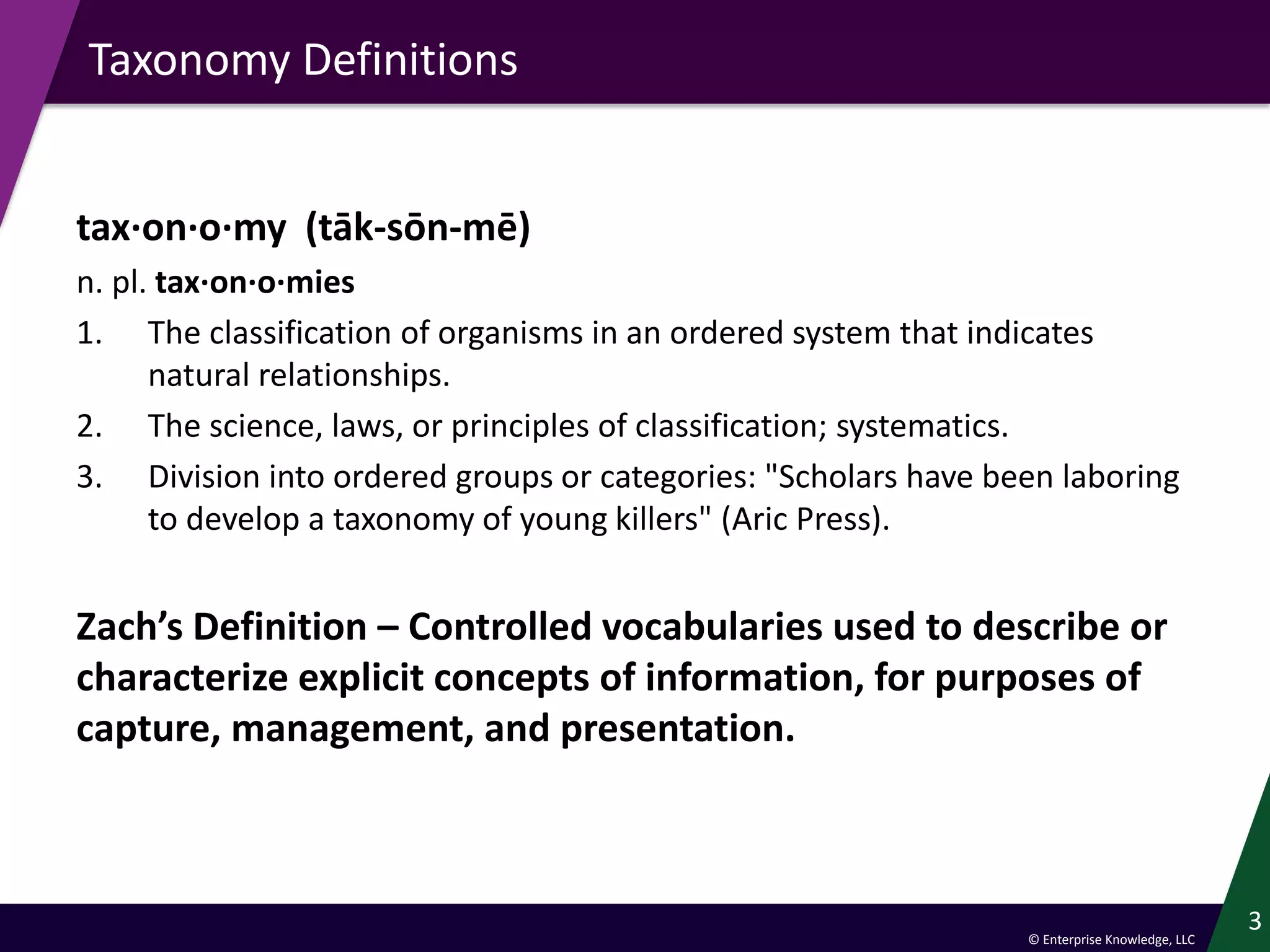
Taxonomy Definitions
tax·on·o·my (tāk-sōn-mē)
n. pl. tax·on·o·mies
1. The classification of organisms in an ordered system that indicates
natural relationships.
2. The science, laws, or principles of classification; systematics.
3. Division into ordered groups or categories: "Scholars have been laboring
to develop a taxonomy of young killers" (Aric Press).
Zach’s Definition – Controlled vocabularies used to describe or
characterize explicit concepts of information, for purposes of
capture, management, and presentation.
3
© Enterprise Knowledge, LLC
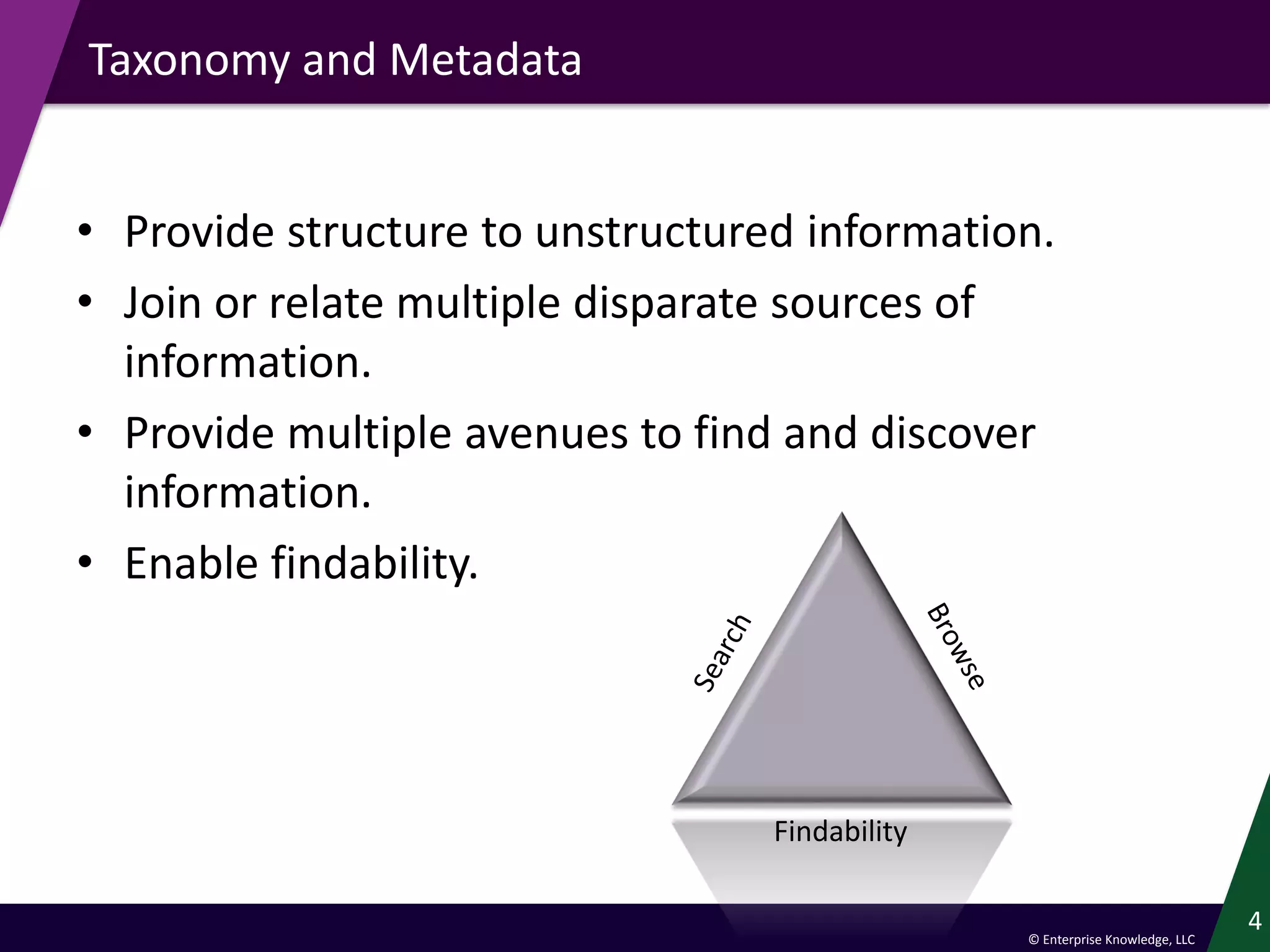
Taxonomy and Metadata
• Provide structure to unstructured information.
• Join or relate multiple disparate sources of
information.
• Provide multiple avenues to find and discover
information.
• Enable findability.
4
Findability
© Enterprise Knowledge, LLC
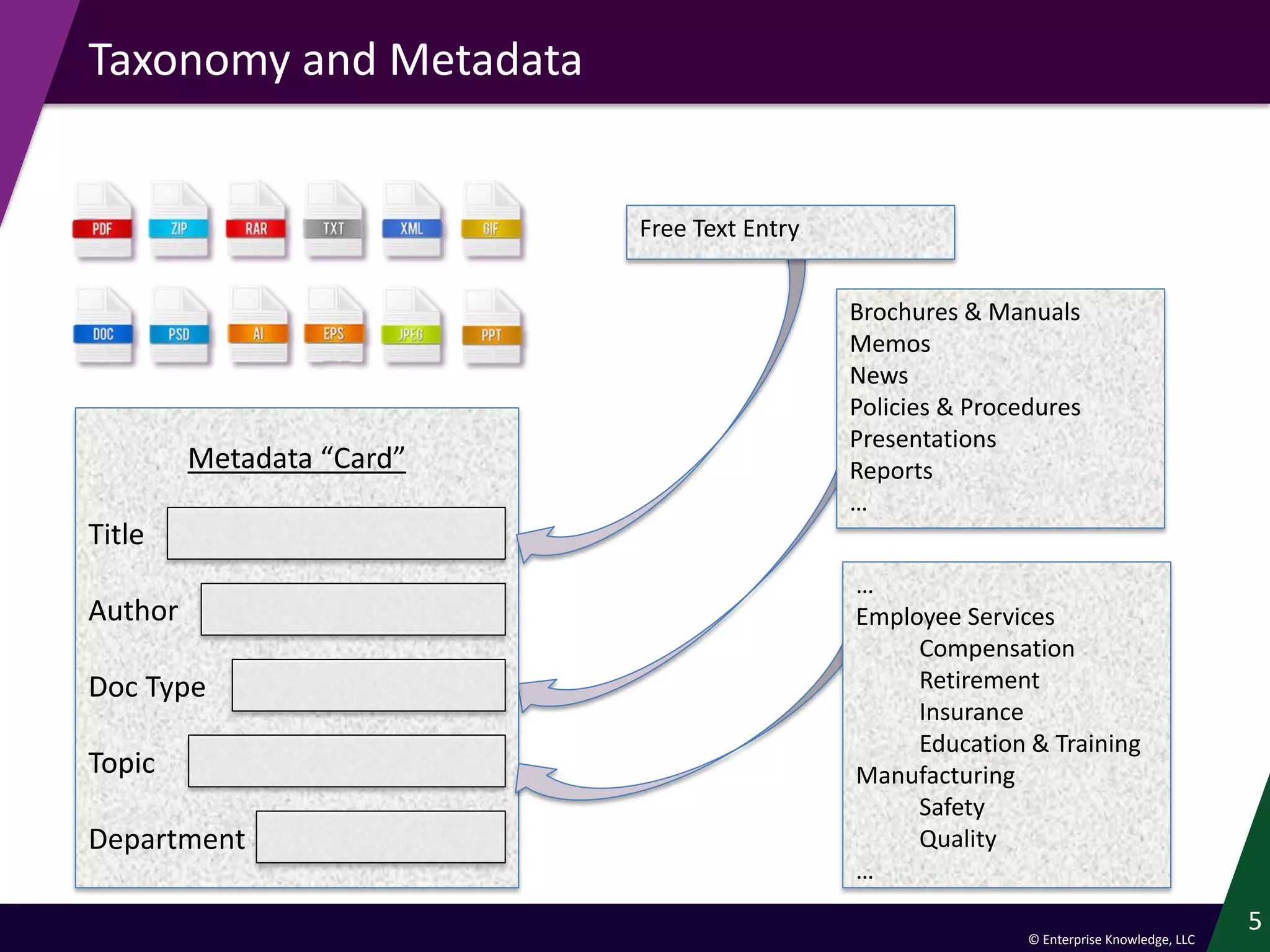
5
Taxonomy and Metadata
Metadata “Card”
Title
Author
Doc Type
Topic
Department
Brochures & Manuals
Memos
News
Policies & Procedures
Presentations
Reports
…
…
Employee Services
Compensation
Retirement
Insurance
Education & Training
Manufacturing
Safety
Quality
…
Free Text Entry
© Enterprise Knowledge, LLC
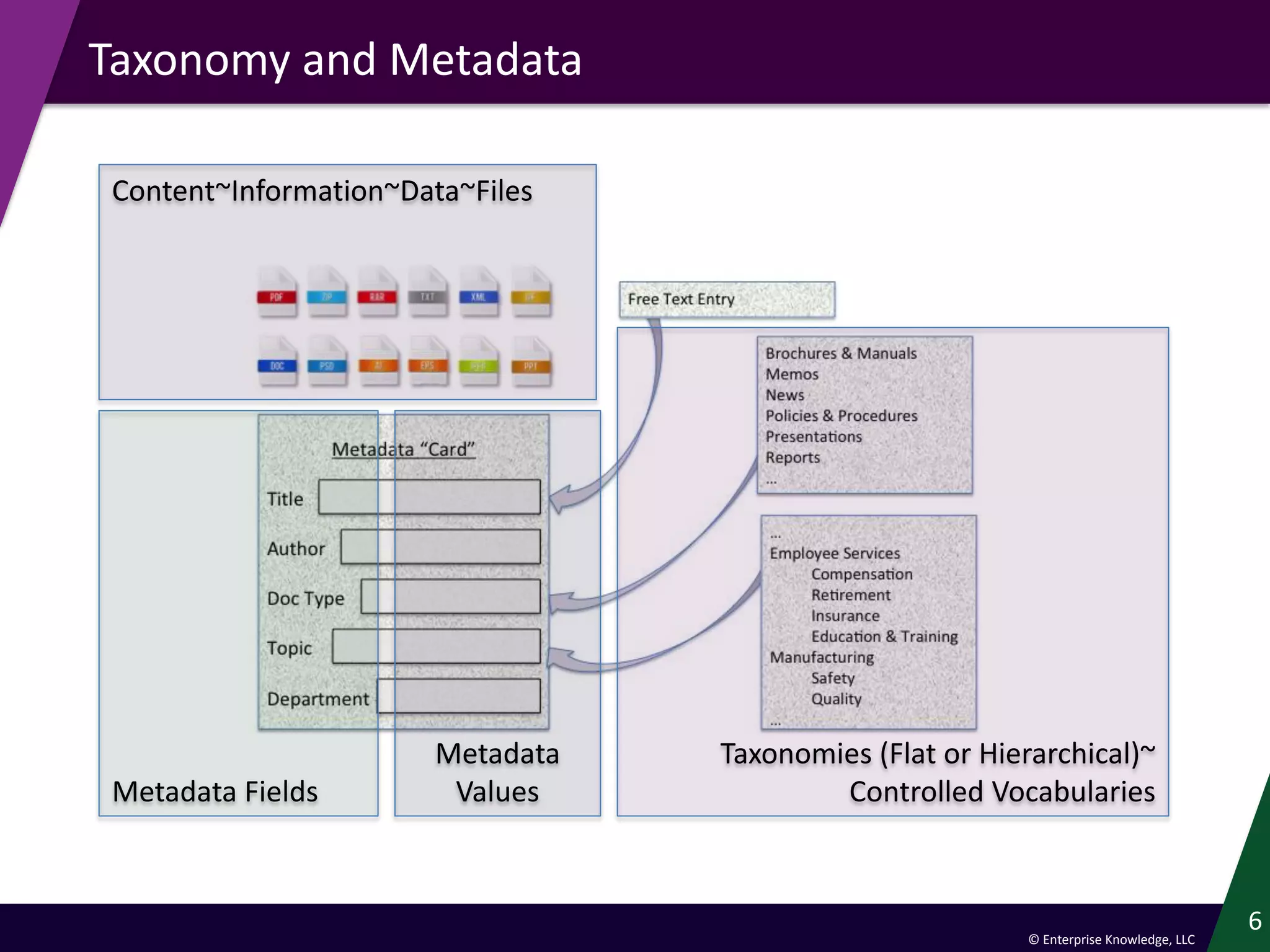
6
Taxonomy and Metadata
Content~Information~Data~Files
Metadata Fields
Metadata
Values
Taxonomies (Flat or Hierarchical)~
Controlled Vocabularies
© Enterprise Knowledge, LLC
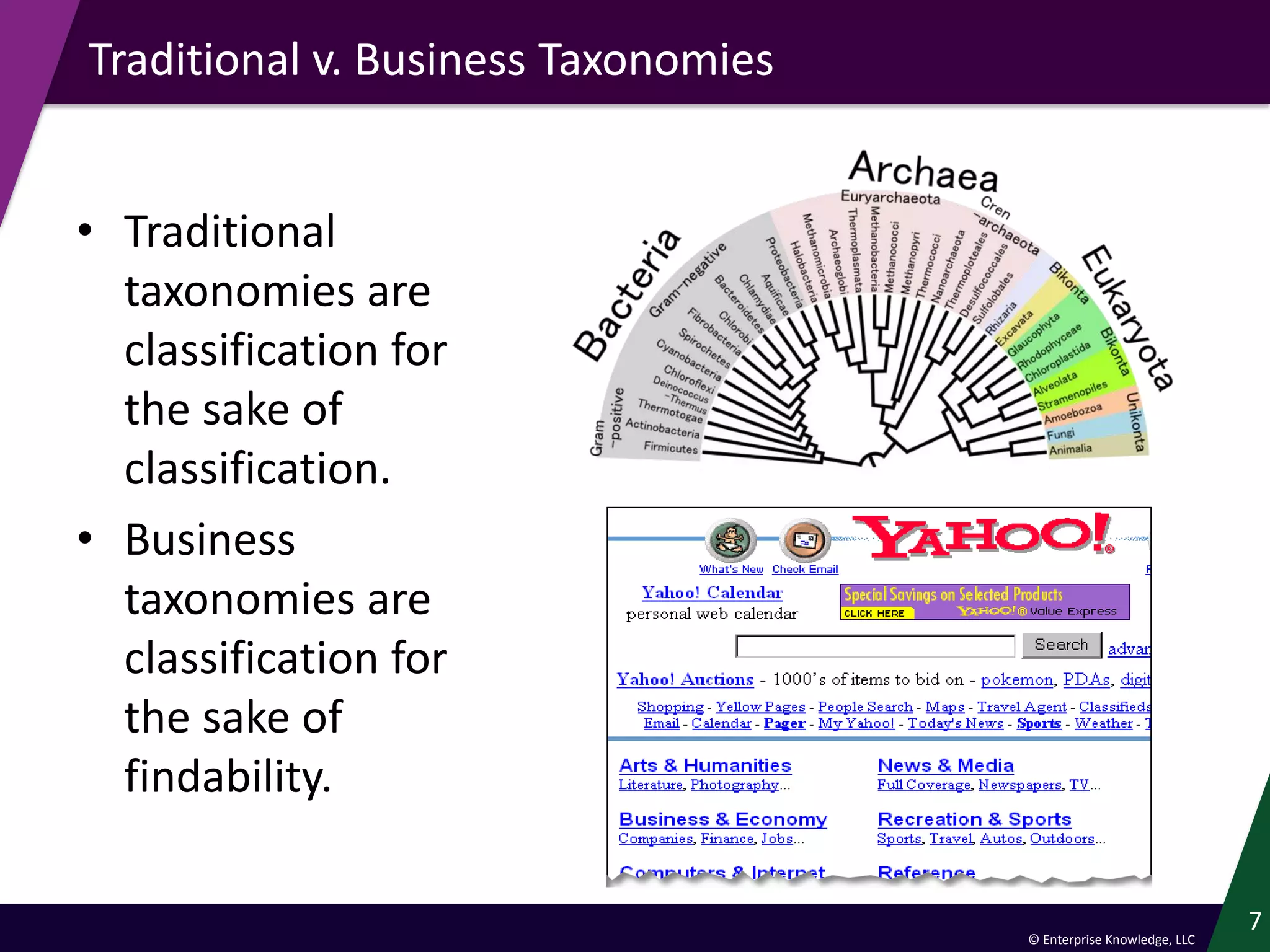
Traditional v. Business Taxonomies
• Traditional
taxonomies are
classification for
the sake of
classification.
• Business
taxonomies are
classification for
the sake of
findability.
7
© Enterprise Knowledge, LLC
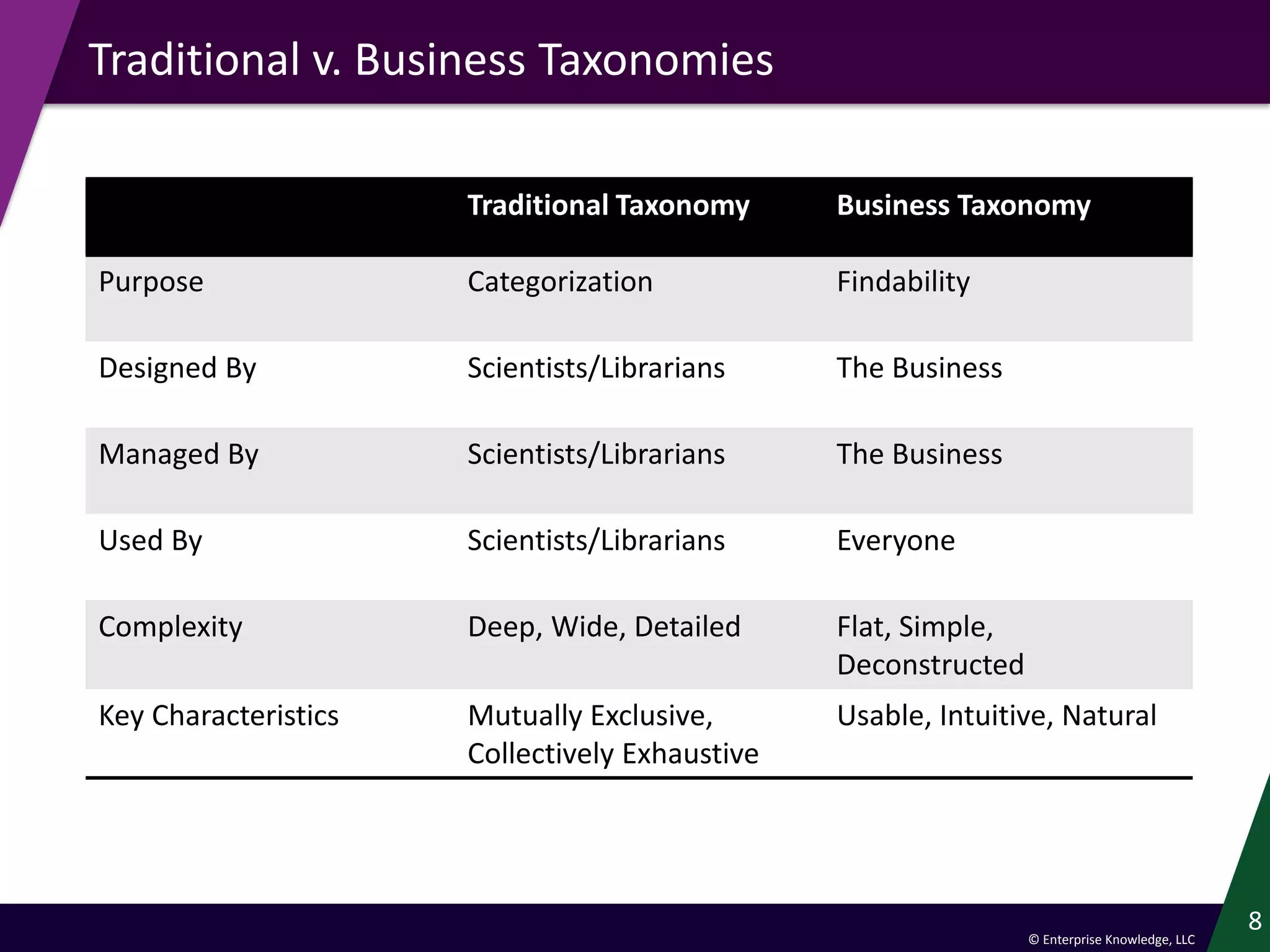
8
Traditional v. Business Taxonomies
Traditional Taxonomy Business Taxonomy
Purpose Categorization Findability
Designed By Scientists/Librarians The Business
Managed By Scientists/Librarians The Business
Used By Scientists/Librarians Everyone
Complexity Deep, Wide, Detailed Flat, Simple,
Deconstructed
Key Characteristics Mutually Exclusive,
Collectively Exhaustive
Usable, Intuitive, Natural
© Enterprise Knowledge, LLC
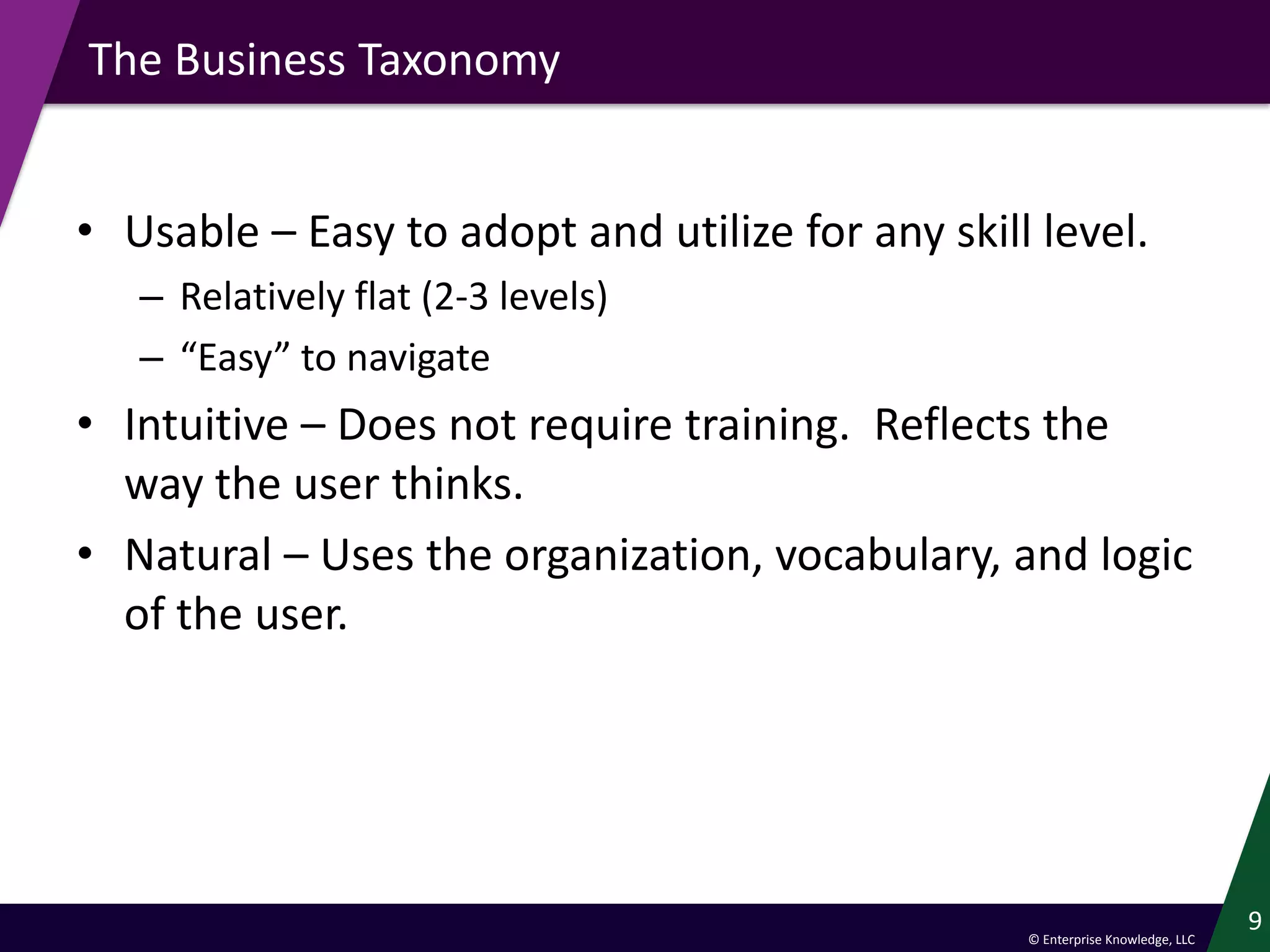
The Business Taxonomy
• Usable – Easy to adopt and utilize for any skill level.
– Relatively flat (2-3 levels)
– “Easy” to navigate
• Intuitive – Does not require training. Reflects the
way the user thinks.
• Natural – Uses the organization, vocabulary, and logic
of the user.
9
© Enterprise Knowledge, LLC
IMPORTANCE OF THE BUSINESS
TAXONOMY
© Enterprise Knowledge, LLC
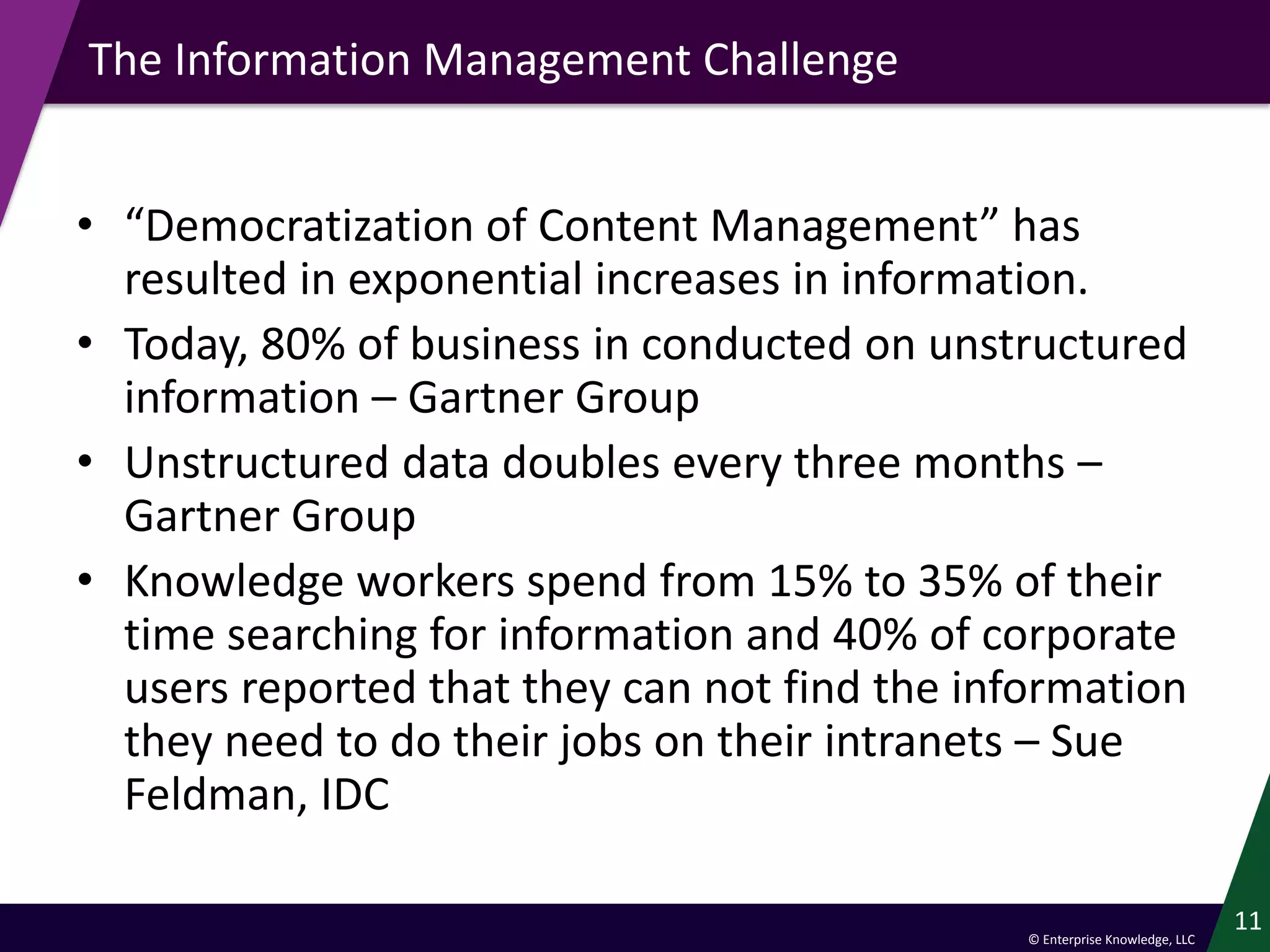
The Information Management Challenge
• “Democratization of Content Management” has
resulted in exponential increases in information.
• Today, 80% of business in conducted on unstructured
information – Gartner Group
• Unstructured data doubles every three months –
Gartner Group
• Knowledge workers spend from 15% to 35% of their
time searching for information and 40% of corporate
users reported that they can not find the information
they need to do their jobs on their intranets – Sue
Feldman, IDC
11
© Enterprise Knowledge, LLC
THE BUSINESS TAXONOMY IN PRACTICE
© Enterprise Knowledge, LLC
13
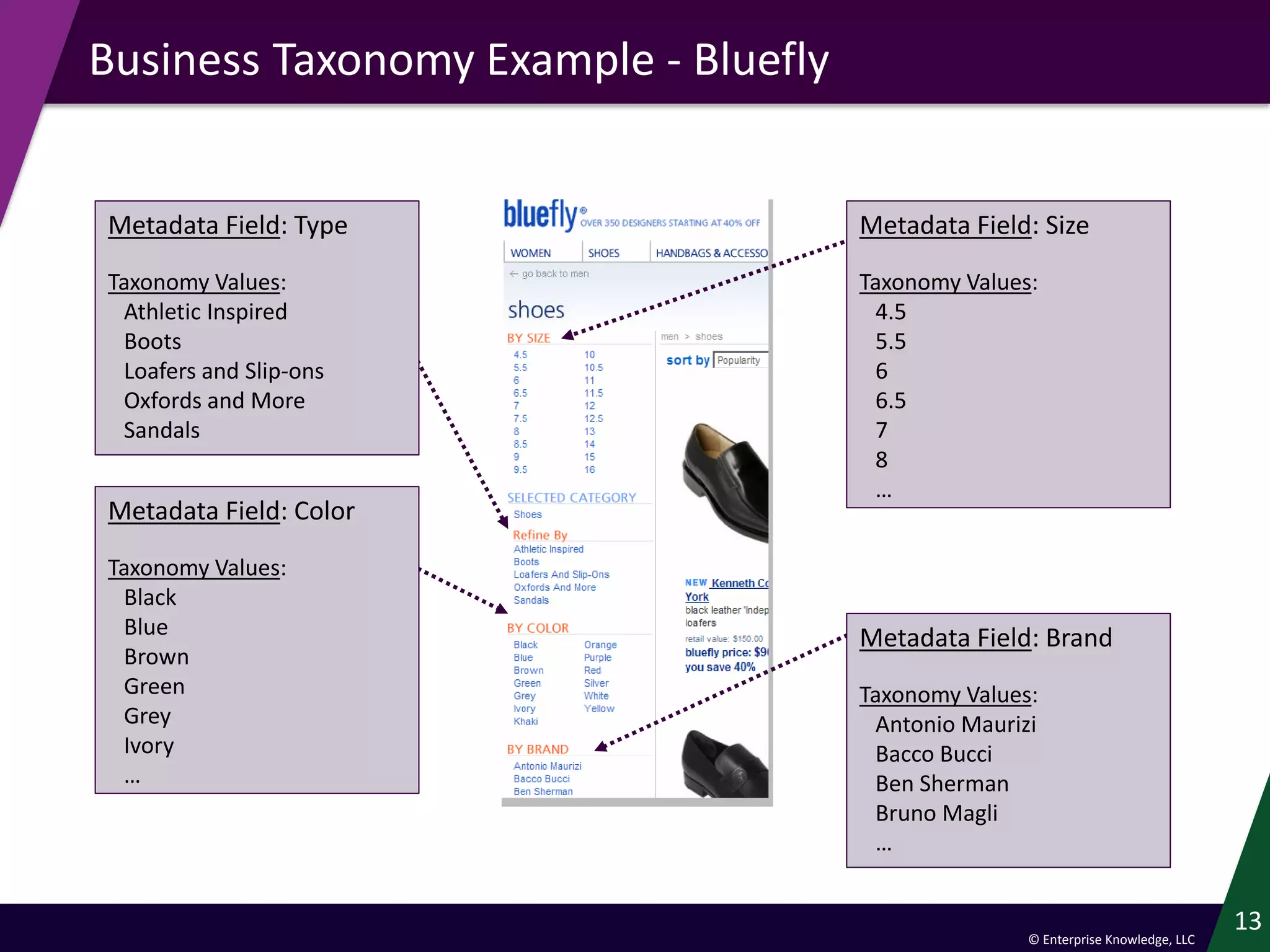
Business Taxonomy Example - Bluefly
Metadata Field: Size
Taxonomy Values:
4.5
5.5
6
6.5
7
8
…
Metadata Field: Color
Taxonomy Values:
Black
Blue
Brown
Green
Grey
Ivory
…
Metadata Field: Type
Taxonomy Values:
Athletic Inspired
Boots
Loafers and Slip-ons
Oxfords and More
Sandals
Metadata Field: Brand
Taxonomy Values:
Antonio Maurizi
Bacco Bucci
Ben Sherman
Bruno Magli
…
© Enterprise Knowledge, LLC
Your
Organization
Here
14
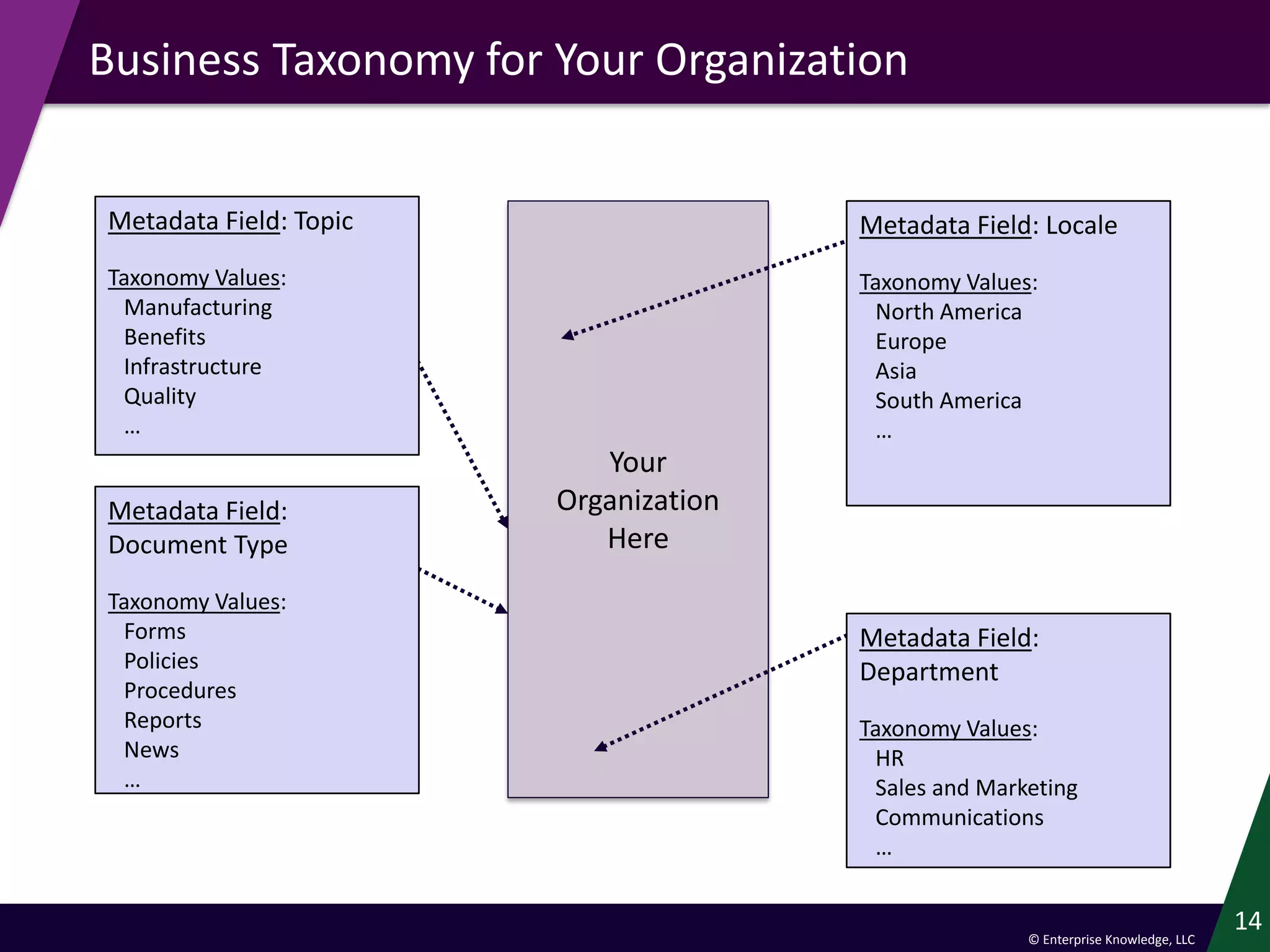
Business Taxonomy for Your Organization
Metadata Field: Topic
Taxonomy Values:
Manufacturing
Benefits
Infrastructure
Quality
…
Metadata Field:
Document Type
Taxonomy Values:
Forms
Policies
Procedures
Reports
News
…
Metadata Field: Locale
Taxonomy Values:
North America
Europe
Asia
South America
…
Metadata Field:
Department
Taxonomy Values:
HR
Sales and Marketing
Communications
…
© Enterprise Knowledge, LLC
15
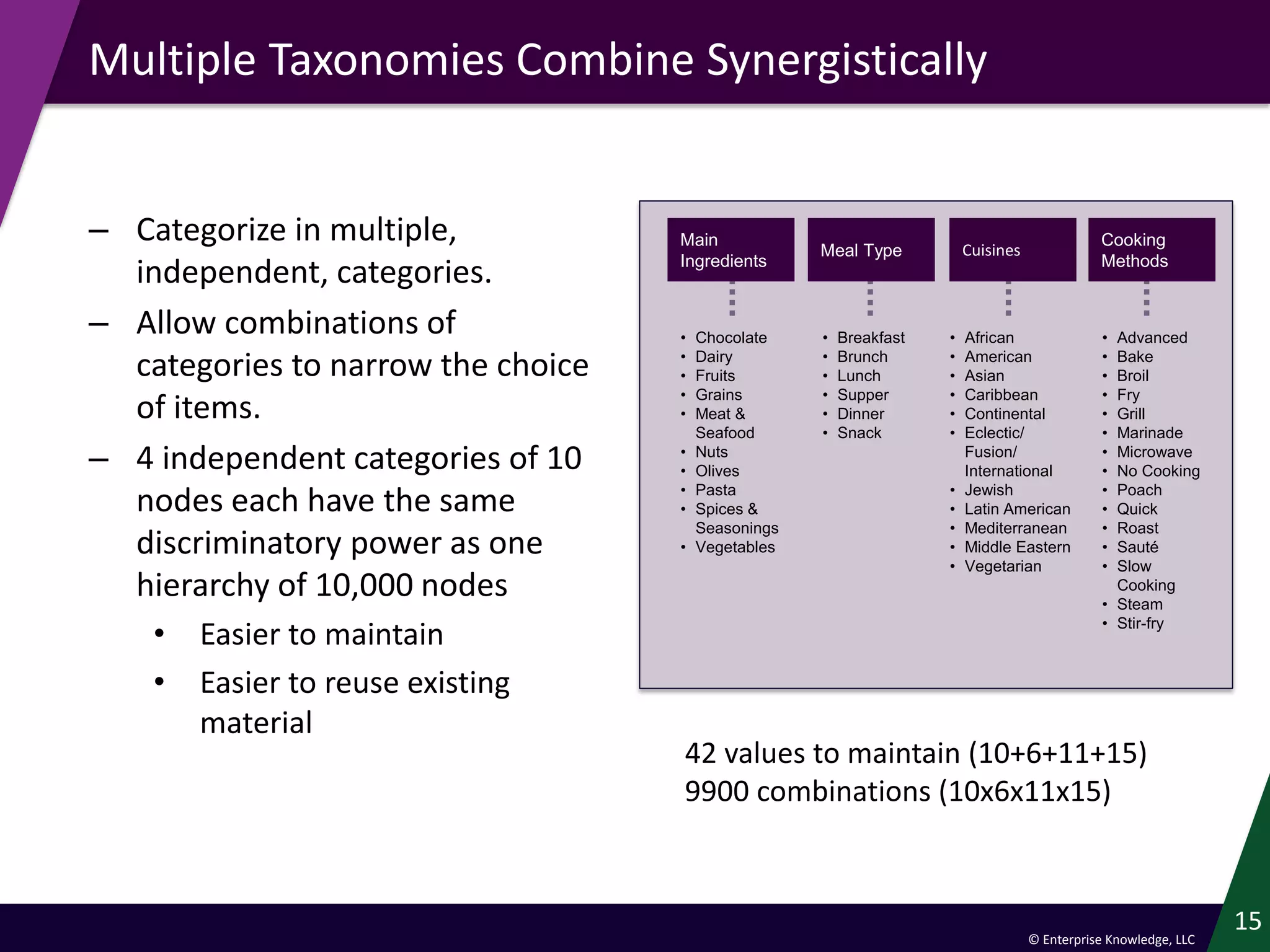
Multiple Taxonomies Combine Synergistically
– Categorize in multiple,
independent, categories.
– Allow combinations of
categories to narrow the choice
of items.
– 4 independent categories of 10
nodes each have the same
discriminatory power as one
hierarchy of 10,000 nodes
• Easier to maintain
• Easier to reuse existing
material
42 values to maintain (10+6+11+15)
9900 combinations (10x6x11x15)
Main
Ingredients
Cooking
Methods
Meal Type Cuisines
• Chocolate
• Dairy
• Fruits
• Grains
• Meat &
Seafood
• Nuts
• Olives
• Pasta
• Spices &
Seasonings
• Vegetables
• Breakfast
• Brunch
• Lunch
• Supper
• Dinner
• Snack
• African
• American
• Asian
• Caribbean
• Continental
• Eclectic/
Fusion/
International
• Jewish
• Latin American
• Mediterranean
• Middle Eastern
• Vegetarian
• Advanced
• Bake
• Broil
• Fry
• Grill
• Marinade
• Microwave
• No Cooking
• Poach
• Quick
• Roast
• Sauté
• Slow
Cooking
• Steam
• Stir-fry
© Enterprise Knowledge, LLC
16
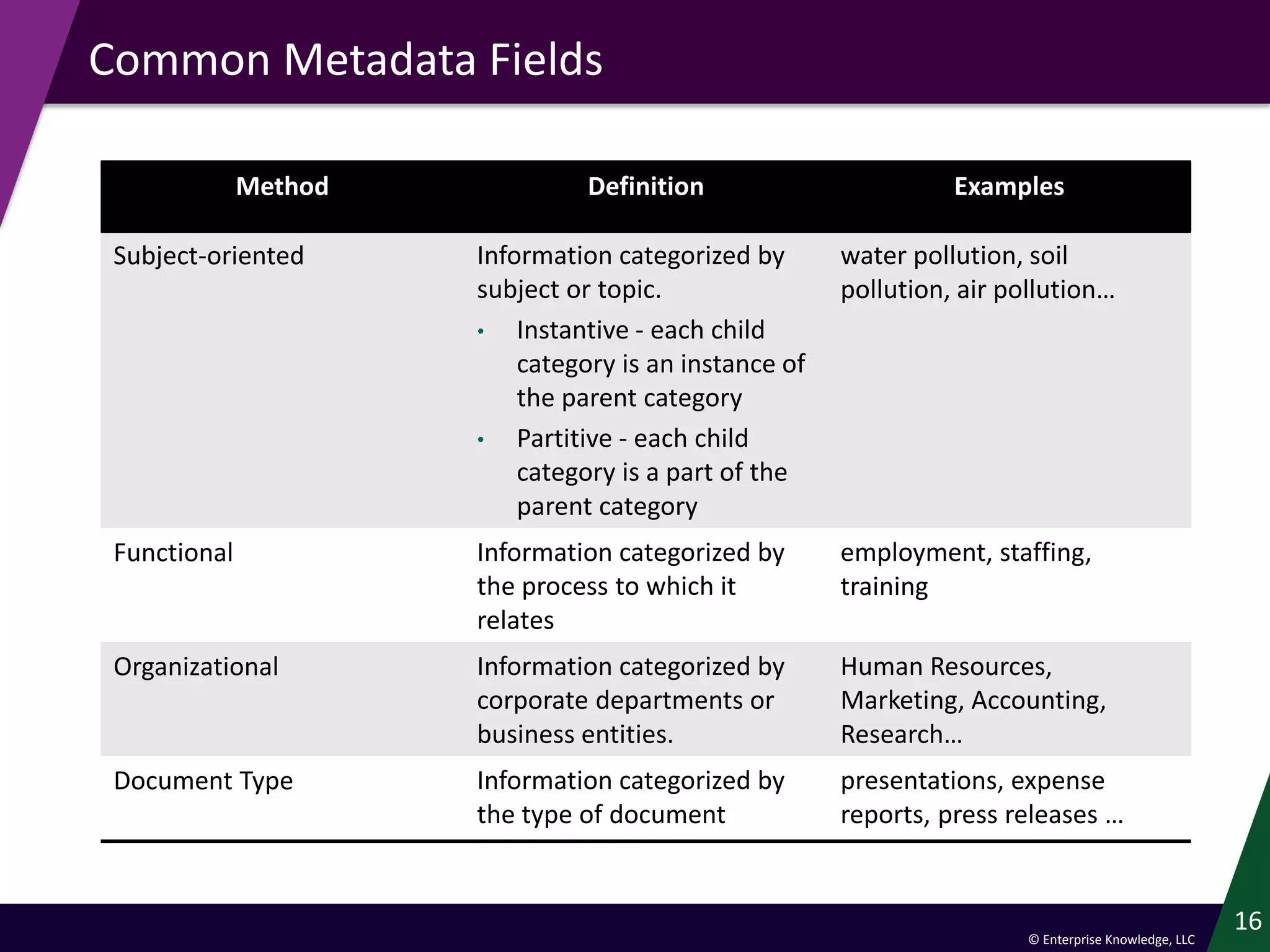
Common Metadata Fields
Method Definition Examples
Subject-oriented Information categorized by
subject or topic.
• Instantive - each child
category is an instance of
the parent category
• Partitive - each child
category is a part of the
parent category
water pollution, soil
pollution, air pollution…
Functional Information categorized by
the process to which it
relates
employment, staffing,
training
Organizational Information categorized by
corporate departments or
business entities.
Human Resources,
Marketing, Accounting,
Research…
Document Type Information categorized by
the type of document
presentations, expense
reports, press releases …
© Enterprise Knowledge, LLC
TAXONOMY DESIGN METHODOLOGY
© Enterprise Knowledge, LLC
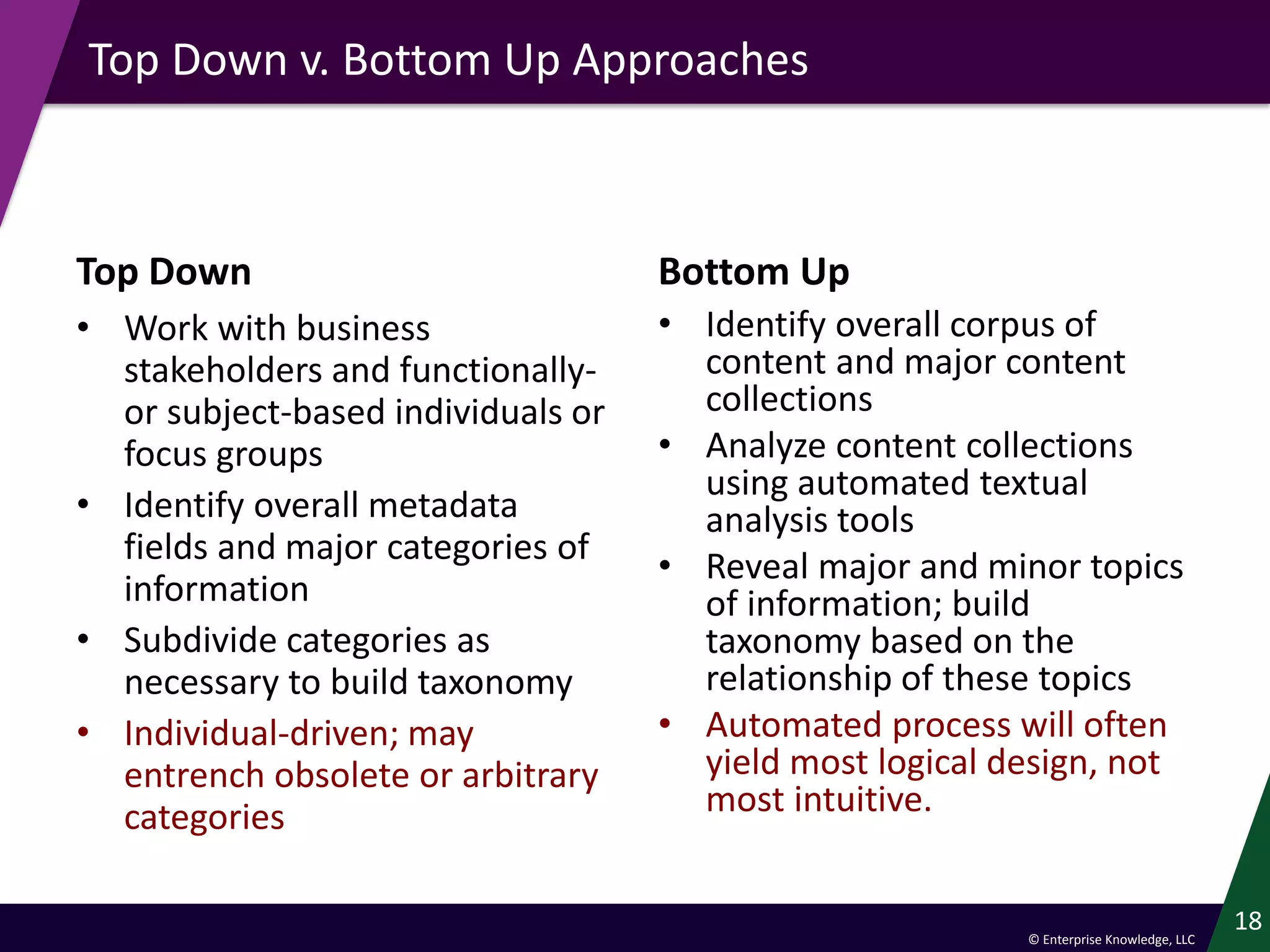
Top Down
• Work with business
stakeholders and functionally-
or subject-based individuals or
focus groups
• Identify overall metadata
fields and major categories of
information
• Subdivide categories as
necessary to build taxonomy
• Individual-driven; may
entrench obsolete or arbitrary
categories
Bottom Up
• Identify overall corpus of
content and major content
collections
• Analyze content collections
using automated textual
analysis tools
• Reveal major and minor topics
of information; build
taxonomy based on the
relationship of these topics
• Automated process will often
yield most logical design, not
most intuitive.
18
Top Down v. Bottom Up Approaches
© Enterprise Knowledge, LLC
19
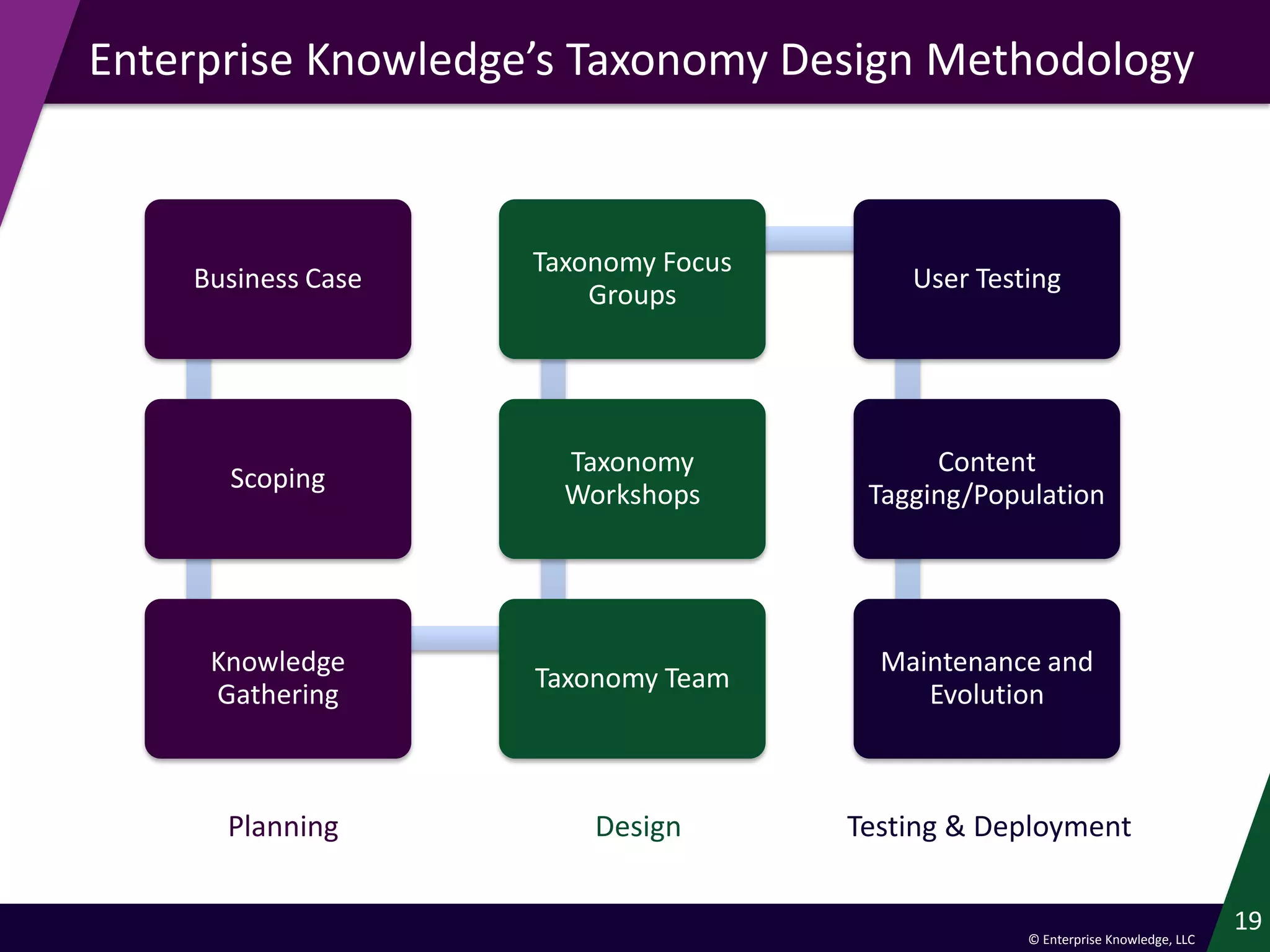
Enterprise Knowledge’s Taxonomy Design Methodology
Business Case
Scoping
Knowledge
Gathering
Taxonomy Team
Taxonomy
Workshops
Taxonomy Focus
Groups
User Testing
Content
Tagging/Population
Maintenance and
Evolution
Planning Design Testing & Deployment
© Enterprise Knowledge, LLC
20
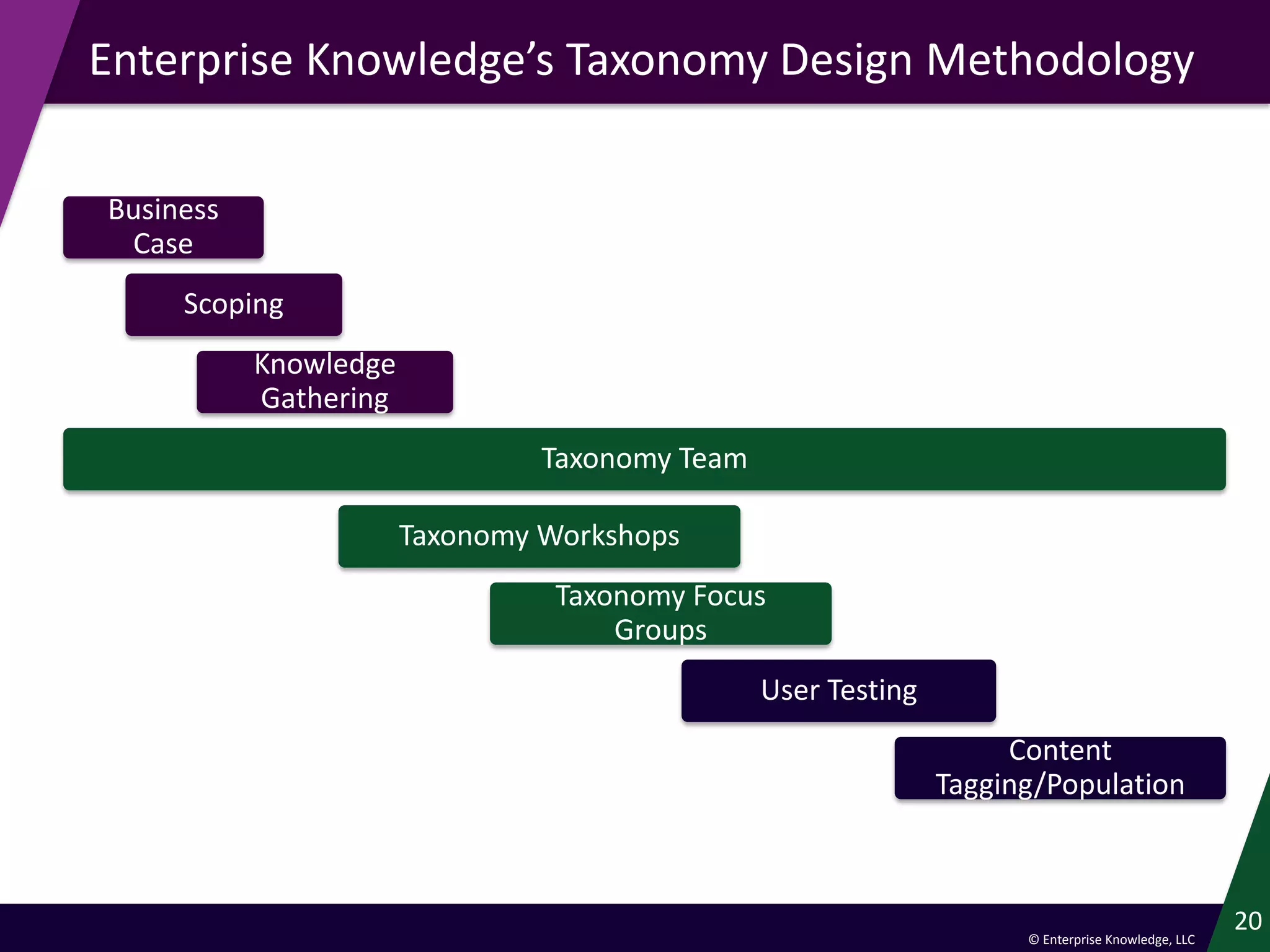
Enterprise Knowledge’s Taxonomy Design Methodology
Business
Case
Scoping
Knowledge
Gathering
Taxonomy Team
Taxonomy Workshops
Taxonomy Focus
Groups
User Testing
Content
Tagging/Population
© Enterprise Knowledge, LLC
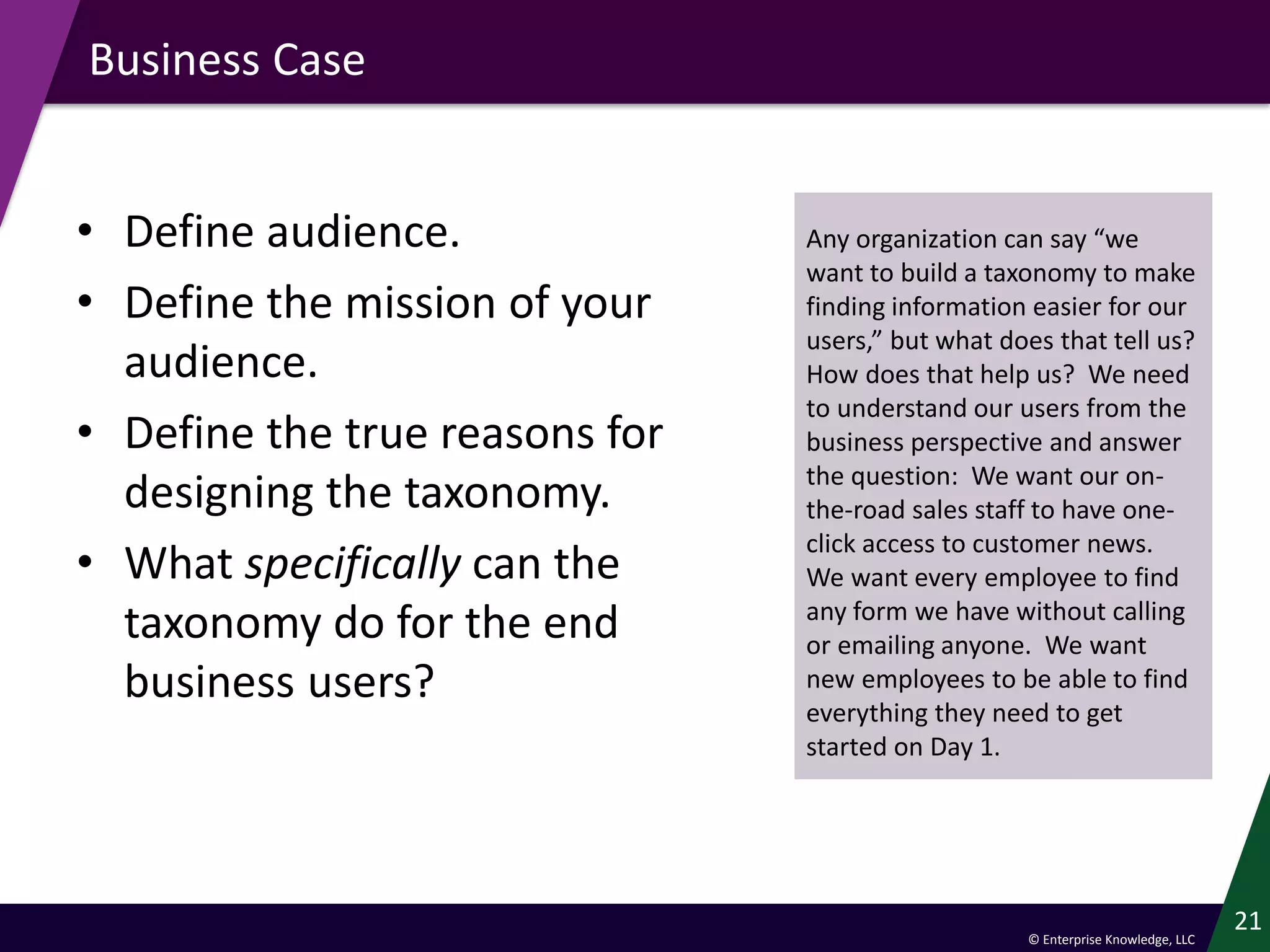
Business Case
• Define audience.
• Define the mission of your
audience.
• Define the true reasons for
designing the taxonomy.
• What specifically can the
taxonomy do for the end
business users?
21
Any organization can say “we
want to build a taxonomy to make
finding information easier for our
users,” but what does that tell us?
How does that help us? We need
to understand our users from the
business perspective and answer
the question: We want our on-
the-road sales staff to have one-
click access to customer news.
We want every employee to find
any form we have without calling
or emailing anyone. We want
new employees to be able to find
everything they need to get
started on Day 1.
© Enterprise Knowledge, LLC
Scoping
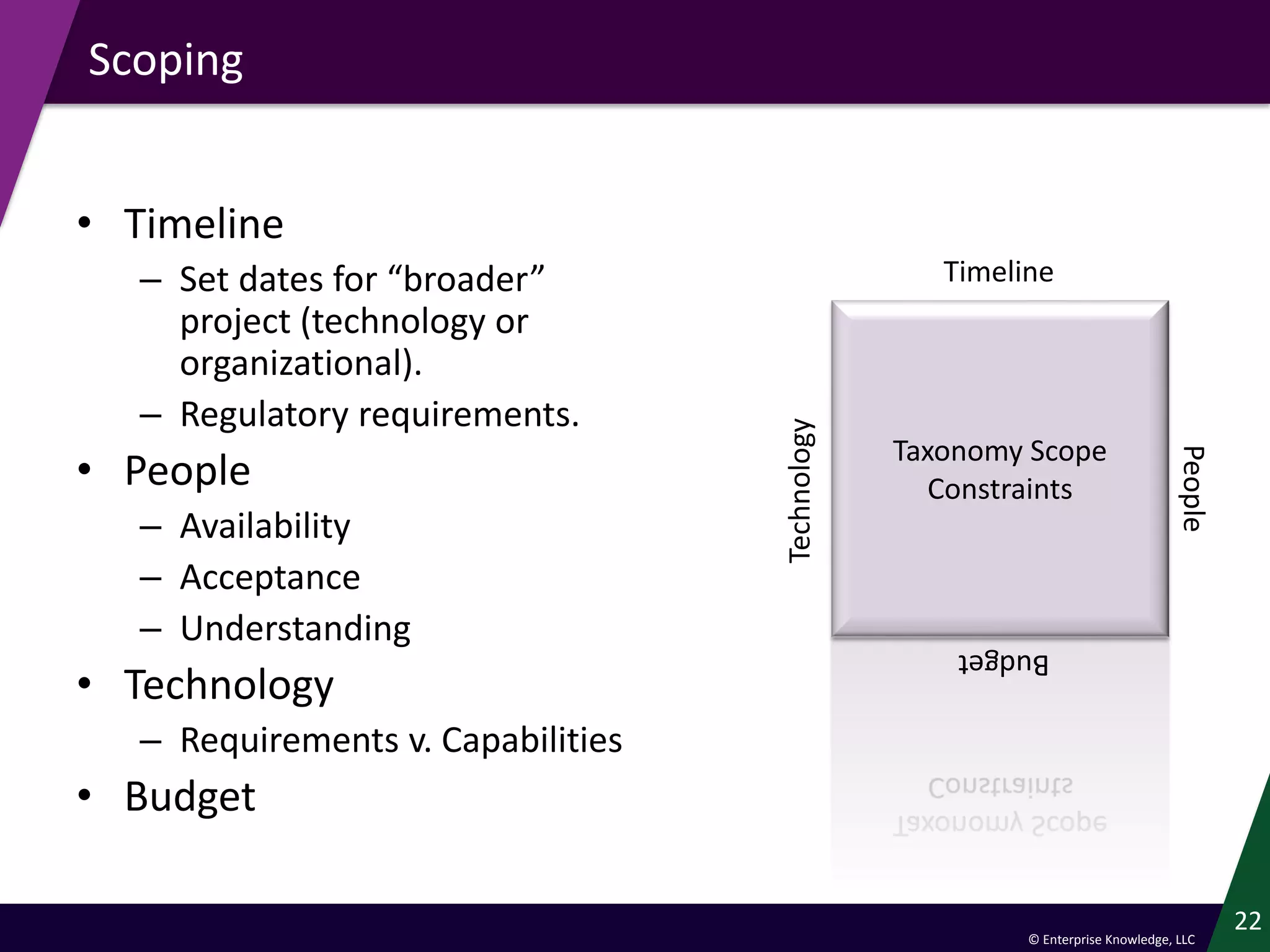
• Timeline
– Set dates for “broader”
project (technology or
organizational).
– Regulatory requirements.
• People
– Availability
– Acceptance
– Understanding
• Technology
– Requirements v. Capabilities
• Budget
22
Taxonomy Scope
Constraints
Timeline
Technology
People
Budget
© Enterprise Knowledge, LLC
Knowledge Gathering
• Communication, Education, and Marketing:
– Set user expectations
– Translate “pain points” to solutions in real time
– Create “buzz” around the project
– Market the results, not the definitions
• Identify taxonomy and content starting points
– Key stakeholders and early adopters
– Existing taxonomies and information systems
– Critical “must find” content
23
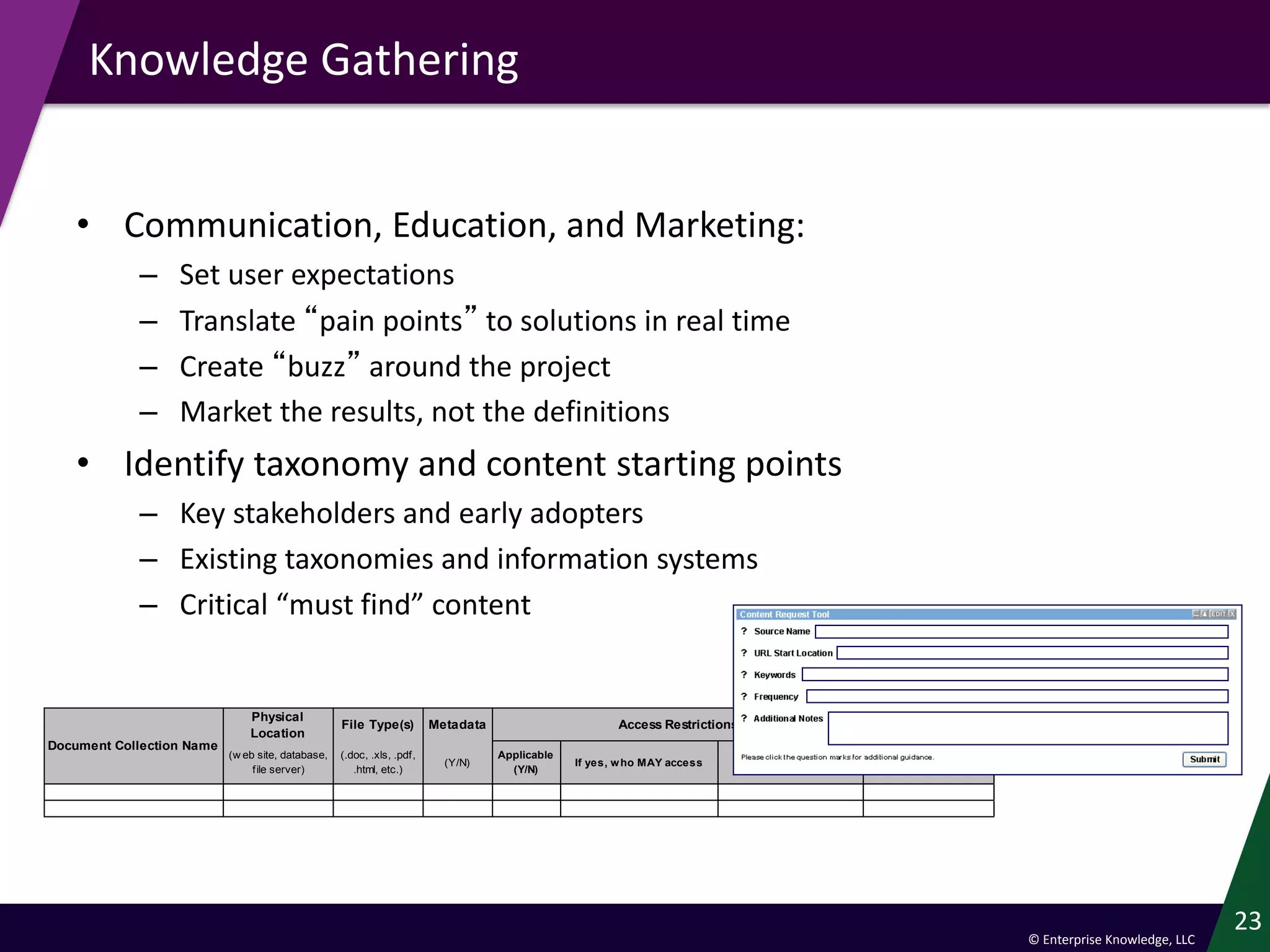
Physical
Location
File Type(s) Metadata Users
(w eb site, database,
file server)
(.doc, .xls, .pdf,
.html, etc.)
(Y/N)
Applicable
(Y/N)
If yes, who MAY access Justification
Access Restrictions
Document Collection Name
© Enterprise Knowledge, LLC
Taxonomy Team
• Convene wide-spectrum team (12-18 people) to represent their
components of the organization. Strive for diversity in:
– Function
– Hierarchy (to a degree)
– Tenure
– Geography
• Strive to identify individuals who “get it,” but also yield influence in
their respective domains.
• Participation should become an official and measurable job activity,
supported by management.
24
© Enterprise Knowledge, LLC
Taxonomy Team
• The Taxonomy Team will ensure the taxonomy is a
true business taxonomy.
– Participate in initial workshops to identify metadata fields
and top-down taxonomy design.
– Identify and enlist additional representatives for follow-on
workshops, focus groups, and testing.
– Support the content migration (and tagging) process.
• The Taxonomy Team will continue to meet
throughout the length of the effort, and ideally
beyond.
25
© Enterprise Knowledge, LLC
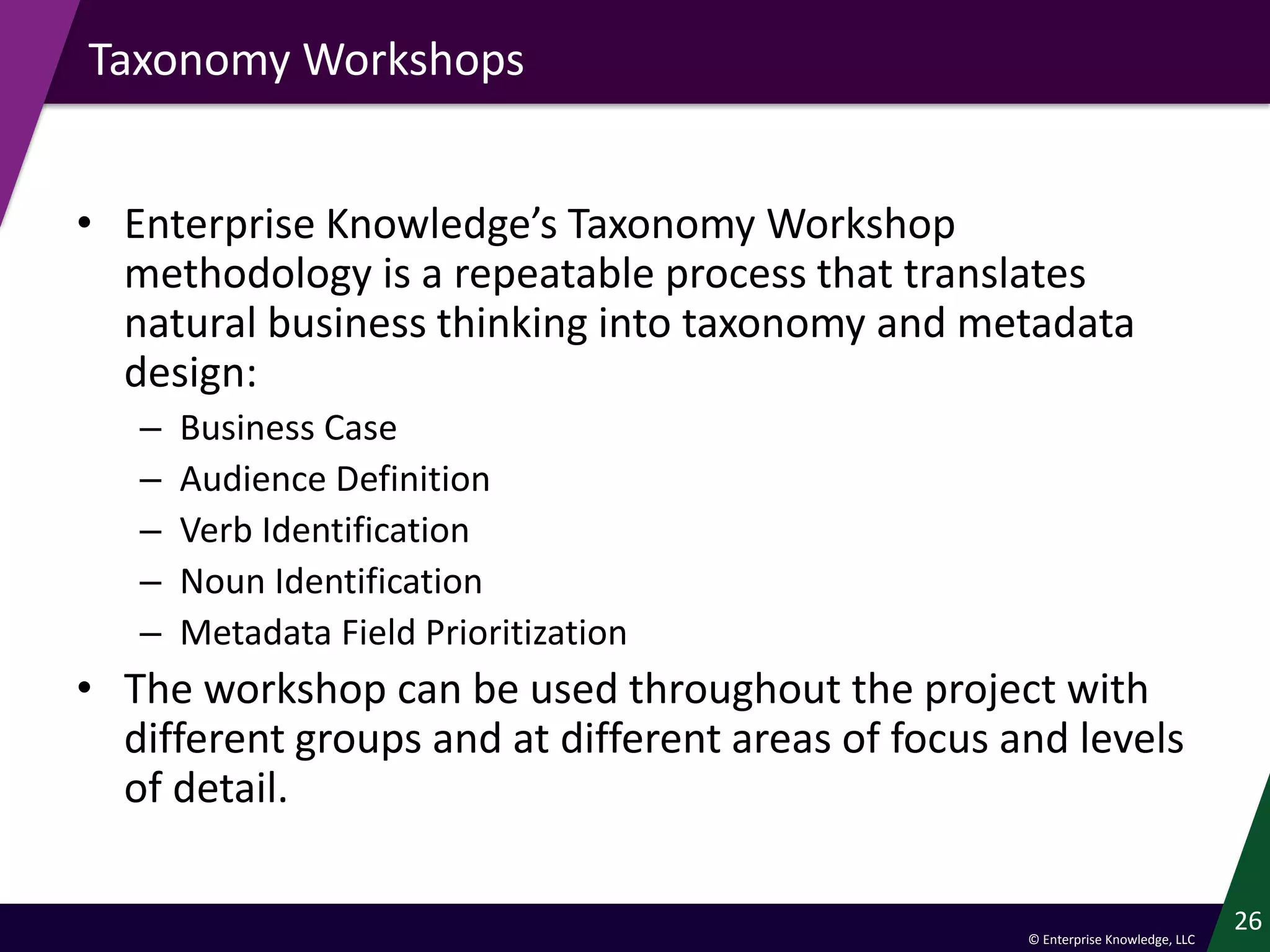
Taxonomy Workshops
• Enterprise Knowledge’s Taxonomy Workshop
methodology is a repeatable process that translates
natural business thinking into taxonomy and metadata
design:
– Business Case
– Audience Definition
– Verb Identification
– Noun Identification
– Metadata Field Prioritization
• The workshop can be used throughout the project with
different groups and at different areas of focus and levels
of detail.
26
© Enterprise Knowledge, LLC
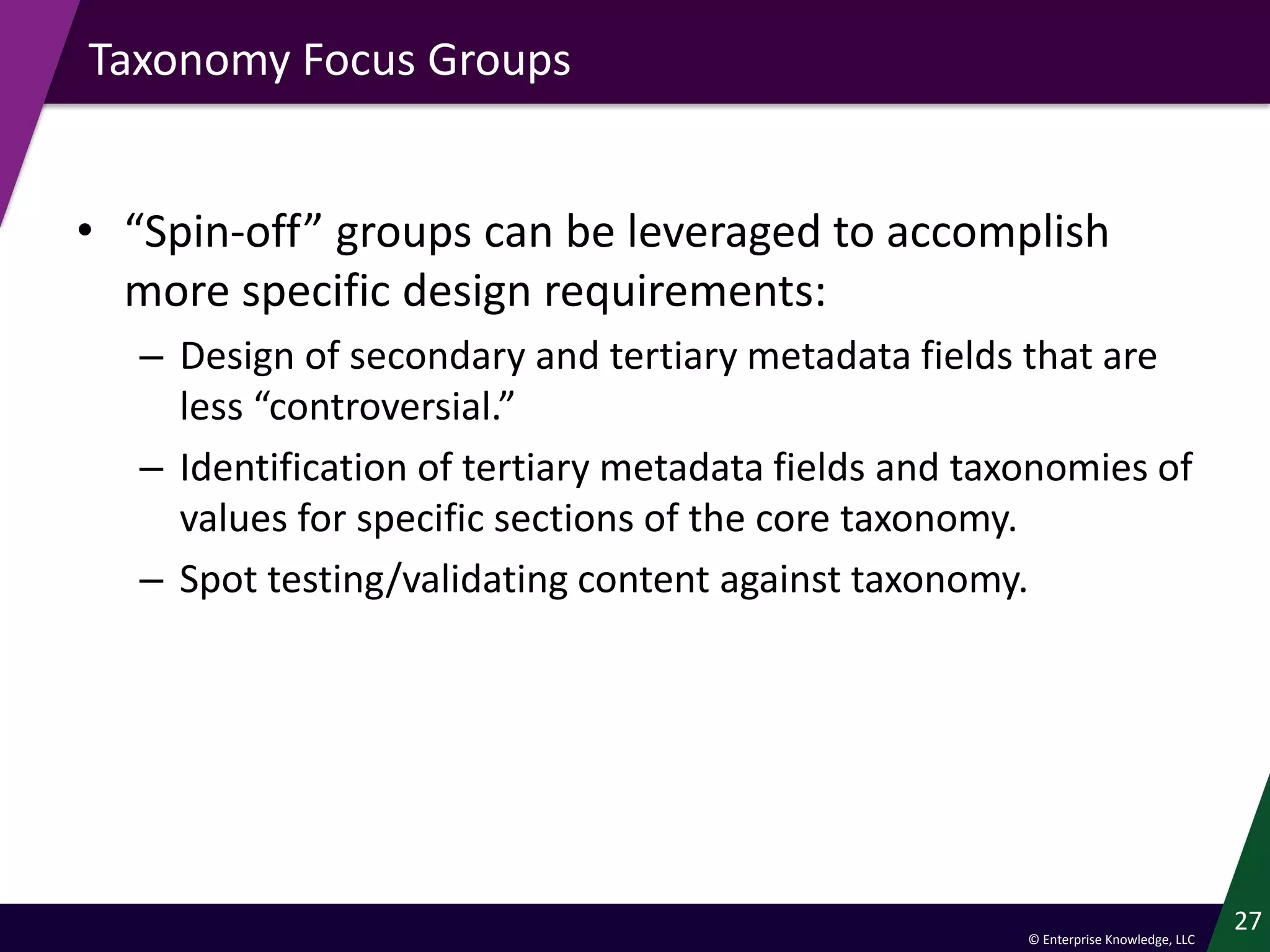
Taxonomy Focus Groups
• “Spin-off” groups can be leveraged to accomplish
more specific design requirements:
– Design of secondary and tertiary metadata fields that are
less “controversial.”
– Identification of tertiary metadata fields and taxonomies of
values for specific sections of the core taxonomy.
– Spot testing/validating content against taxonomy.
27
© Enterprise Knowledge, LLC
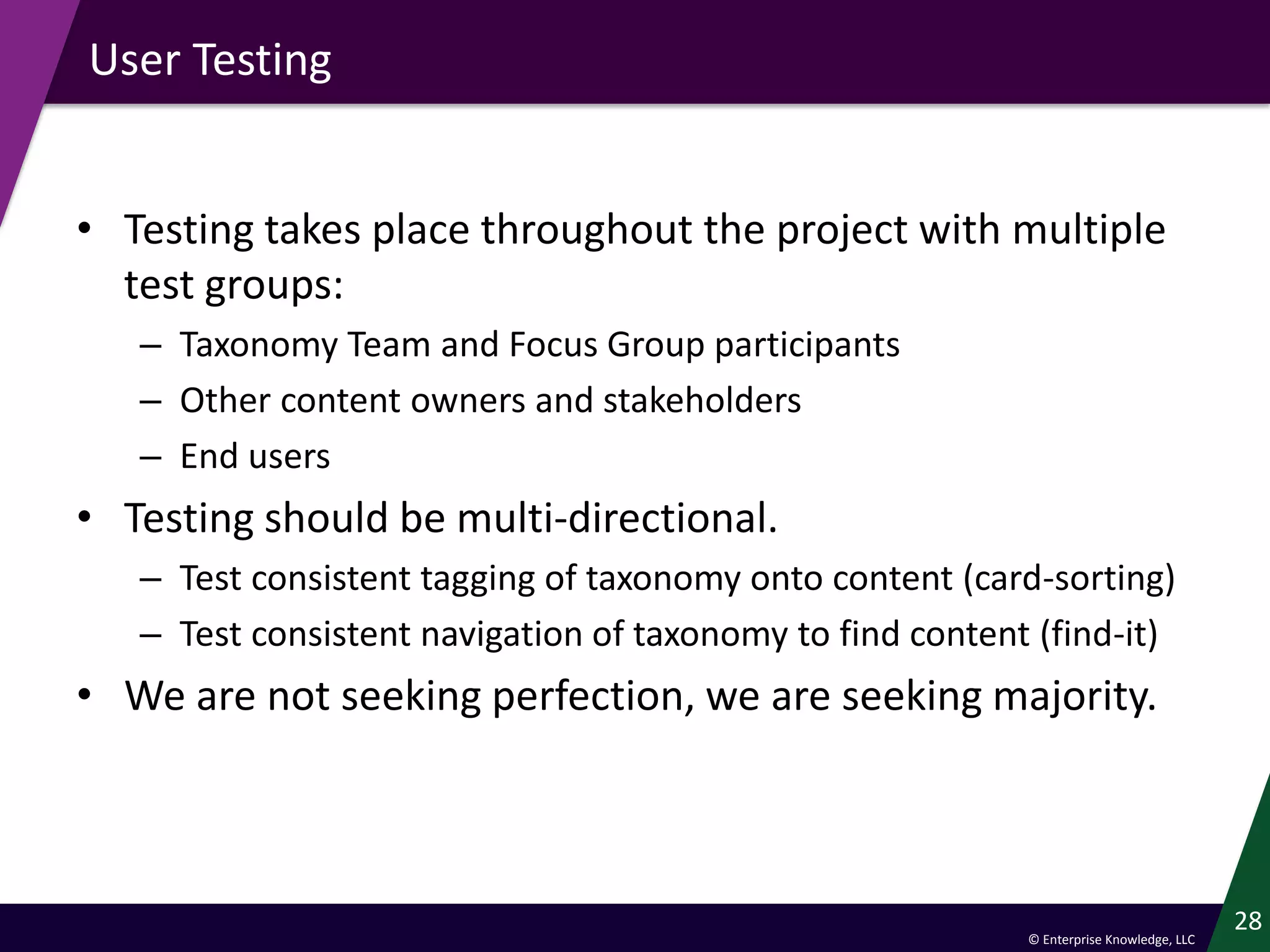
User Testing
• Testing takes place throughout the project with multiple
test groups:
– Taxonomy Team and Focus Group participants
– Other content owners and stakeholders
– End users
• Testing should be multi-directional.
– Test consistent tagging of taxonomy onto content (card-sorting)
– Test consistent navigation of taxonomy to find content (find-it)
• We are not seeking perfection, we are seeking majority.
28
© Enterprise Knowledge, LLC
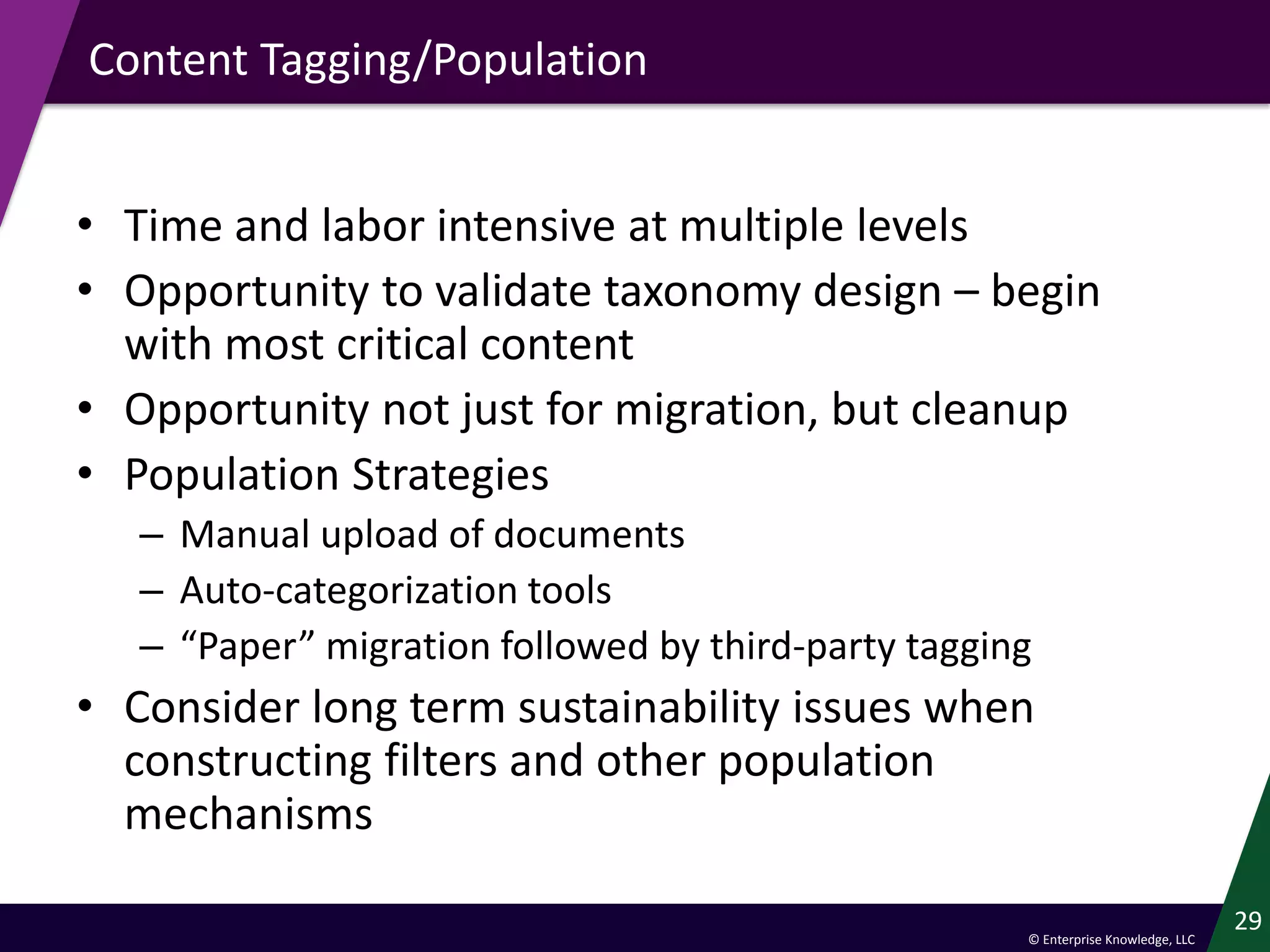
Content Tagging/Population
• Time and labor intensive at multiple levels
• Opportunity to validate taxonomy design – begin
with most critical content
• Opportunity not just for migration, but cleanup
• Population Strategies
– Manual upload of documents
– Auto-categorization tools
– “Paper” migration followed by third-party tagging
• Consider long term sustainability issues when
constructing filters and other population
mechanisms
29
© Enterprise Knowledge, LLC
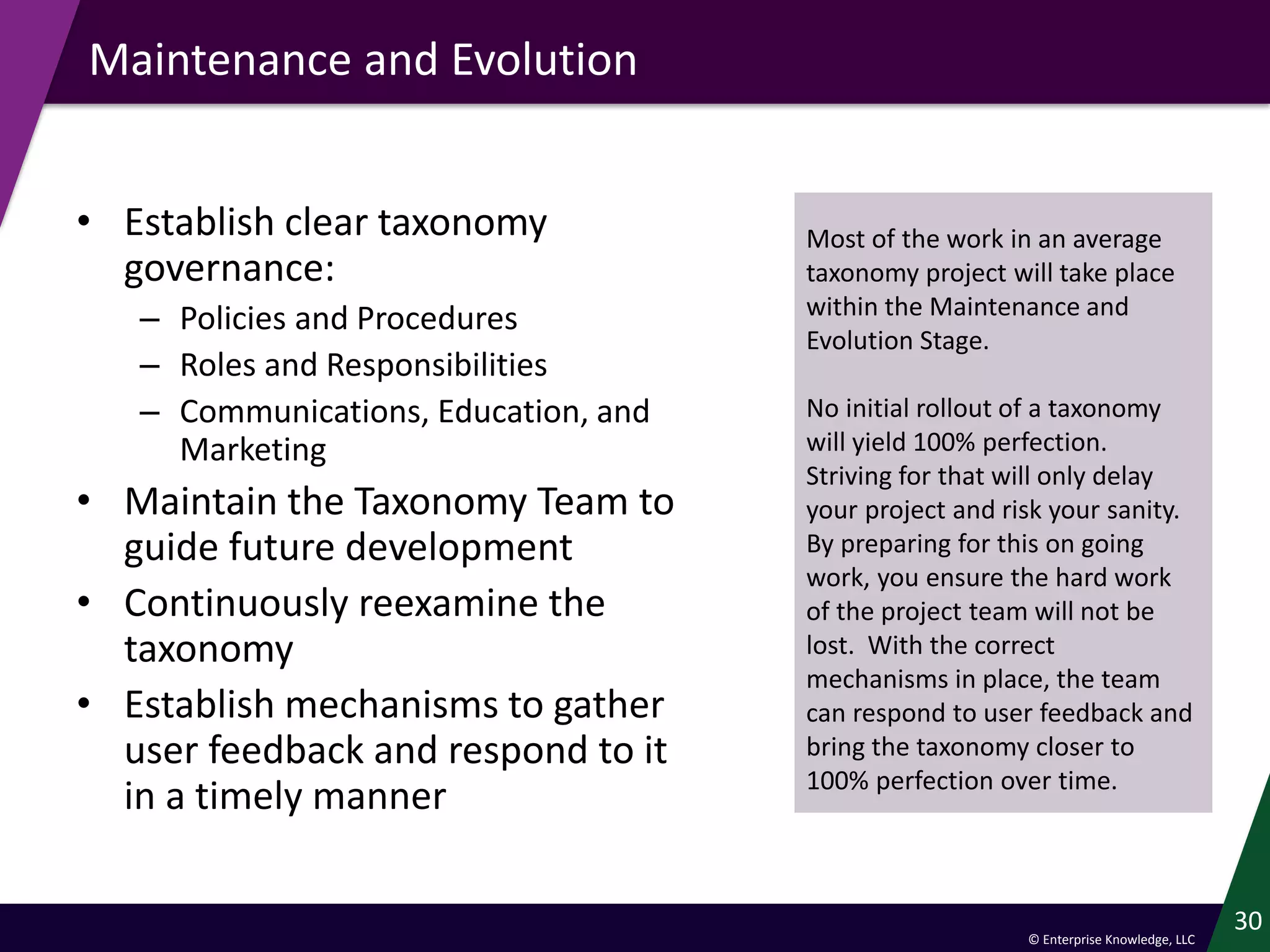
Maintenance and Evolution
• Establish clear taxonomy
governance:
– Policies and Procedures
– Roles and Responsibilities
– Communications, Education, and
Marketing
• Maintain the Taxonomy Team to
guide future development
• Continuously reexamine the
taxonomy
• Establish mechanisms to gather
user feedback and respond to it
in a timely manner
30
Most of the work in an average
taxonomy project will take place
within the Maintenance and
Evolution Stage.
No initial rollout of a taxonomy
will yield 100% perfection.
Striving for that will only delay
your project and risk your sanity.
By preparing for this on going
work, you ensure the hard work
of the project team will not be
lost. With the correct
mechanisms in place, the team
can respond to user feedback and
bring the taxonomy closer to
100% perfection over time.
© Enterprise Knowledge, LLC
TAXONOMY DESIGN BEST PRACTICES
© Enterprise Knowledge, LLC
Define Taxonomy Project Objectives Early
• Define a simple business case to help control scope
and communicate with end users and stakeholders.
• Develop a timeline and listing of phases to detail
when specific milestones will be met.
• Limit initial scope to ensure success.
32
© Enterprise Knowledge, LLC
Employ Quality Measurements and Analytics
• Use both active and passive analytics:
– Surveys
• Satisfaction
• Time Saved
• Anecdotal Evidence
– Search terms
– Size of hit lists
– Dead ends
• Consistency Testing
• Time Tests
33
© Enterprise Knowledge, LLC
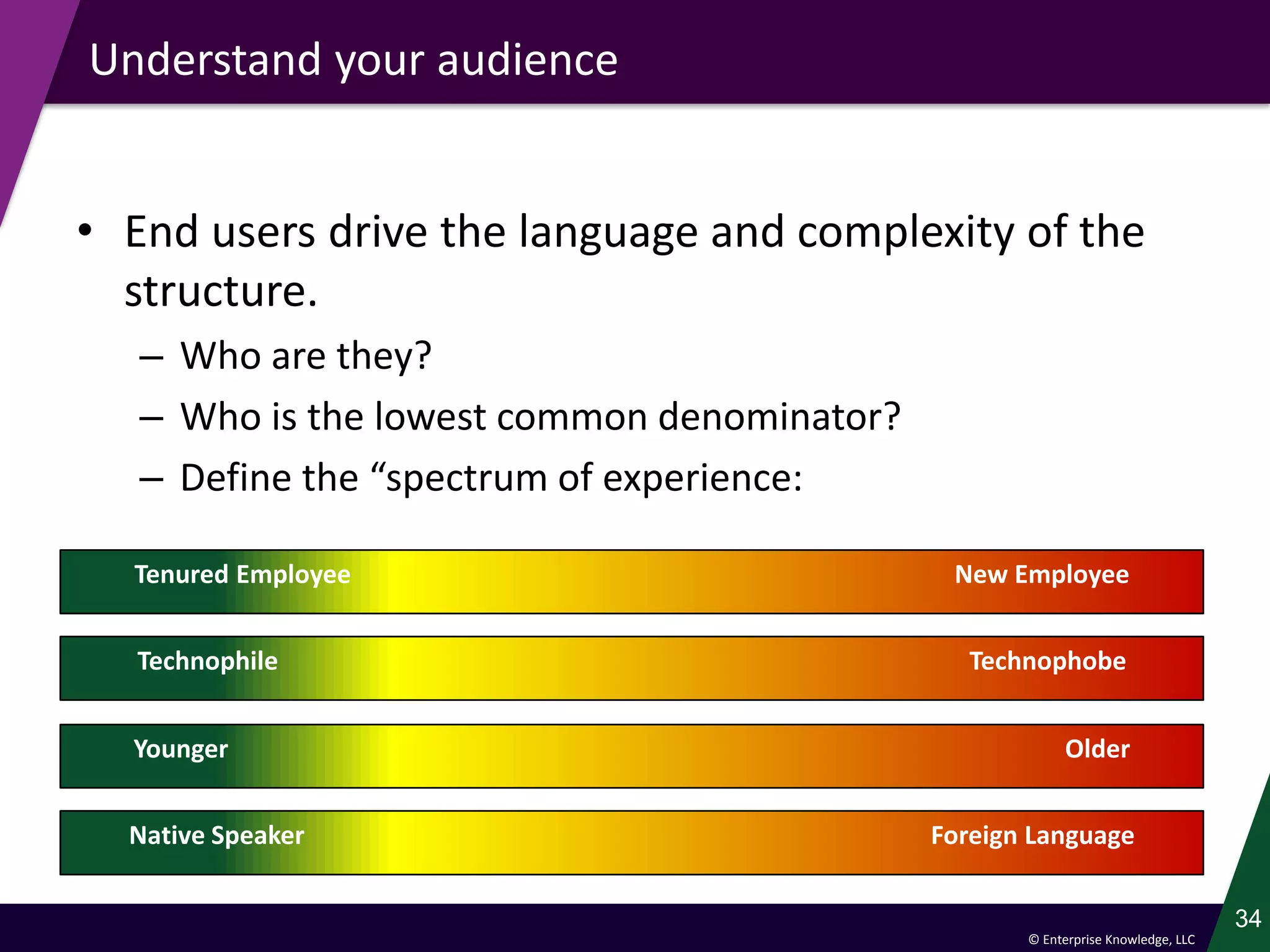
Understand your audience
• End users drive the language and complexity of the
structure.
– Who are they?
– Who is the lowest common denominator?
– Define the “spectrum of experience:
34
Tenured Employee New Employee
Technophile Technophobe
Younger Older
Native Speaker Foreign Language
© Enterprise Knowledge, LLC
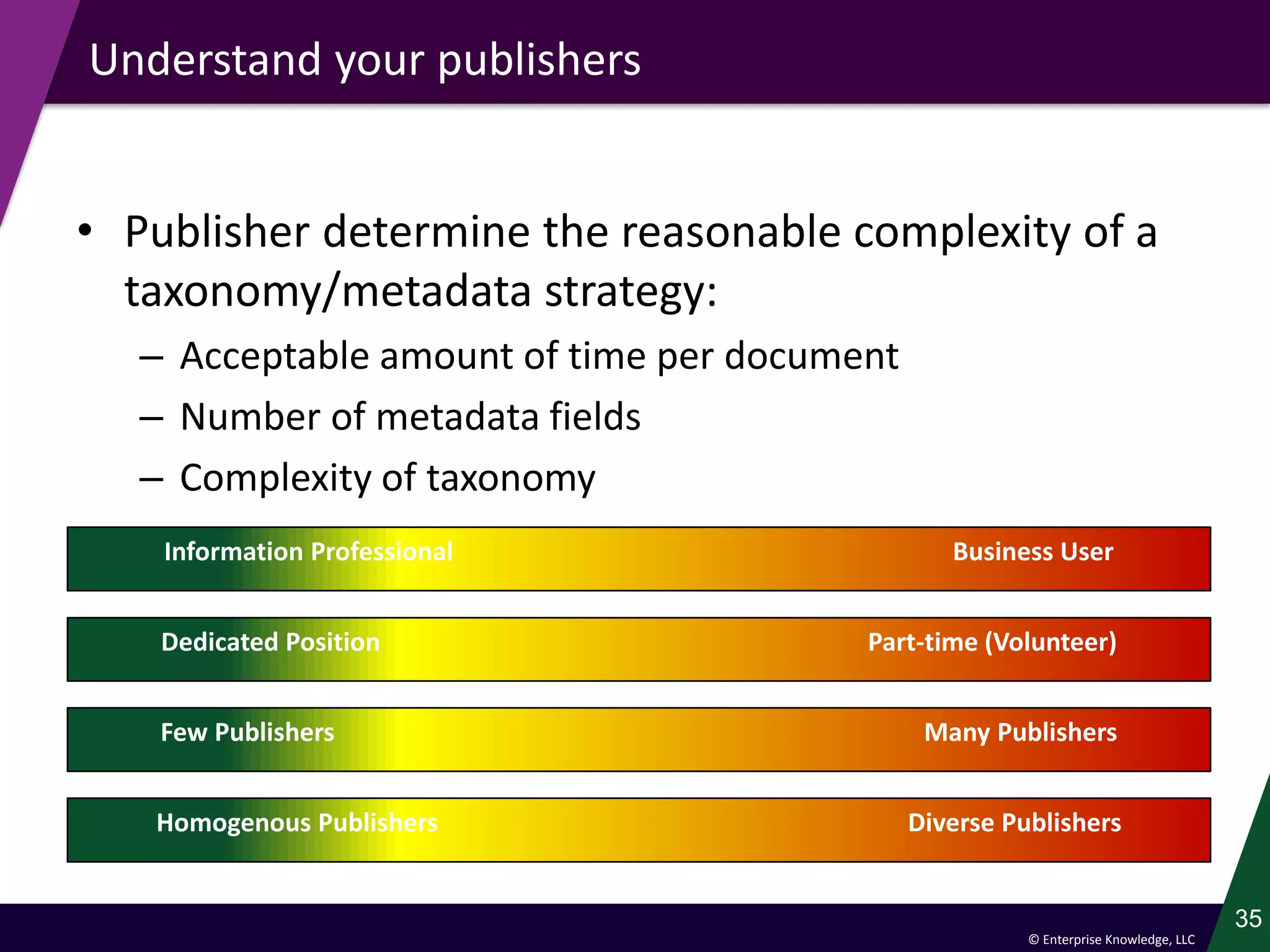
Understand your publishers
35
Information Professional Business User
Dedicated Position Part-time (Volunteer)
Few Publishers Many Publishers
Homogenous Publishers Diverse Publishers
• Publisher determine the reasonable complexity of a
taxonomy/metadata strategy:
– Acceptable amount of time per document
– Number of metadata fields
– Complexity of taxonomy
© Enterprise Knowledge, LLC
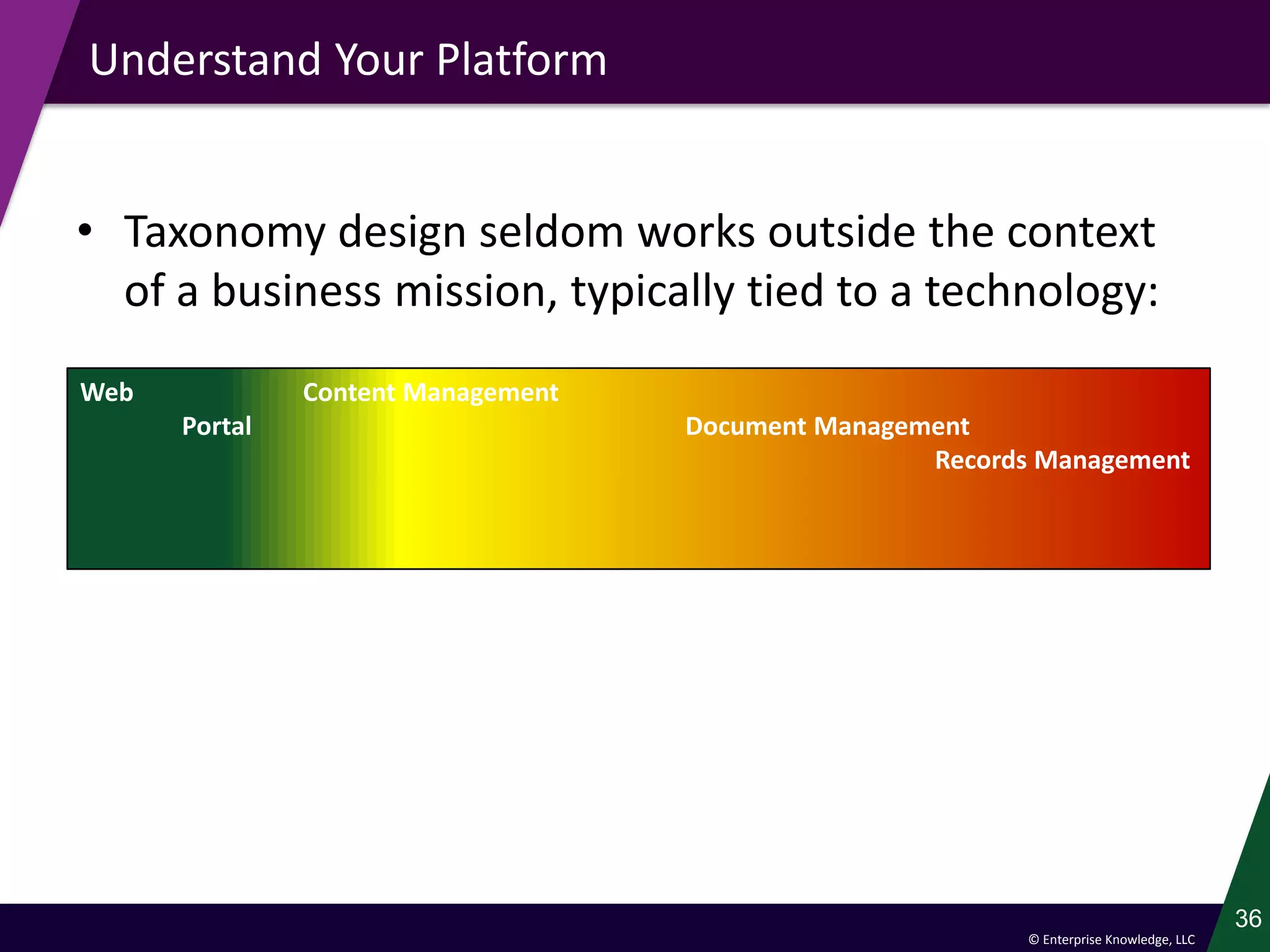
Understand Your Platform
• Taxonomy design seldom works outside the context
of a business mission, typically tied to a technology:
36
Web Content Management
Portal Document Management
Records Management
Looser Tighter
Less Complex More Complex
© Enterprise Knowledge, LLC
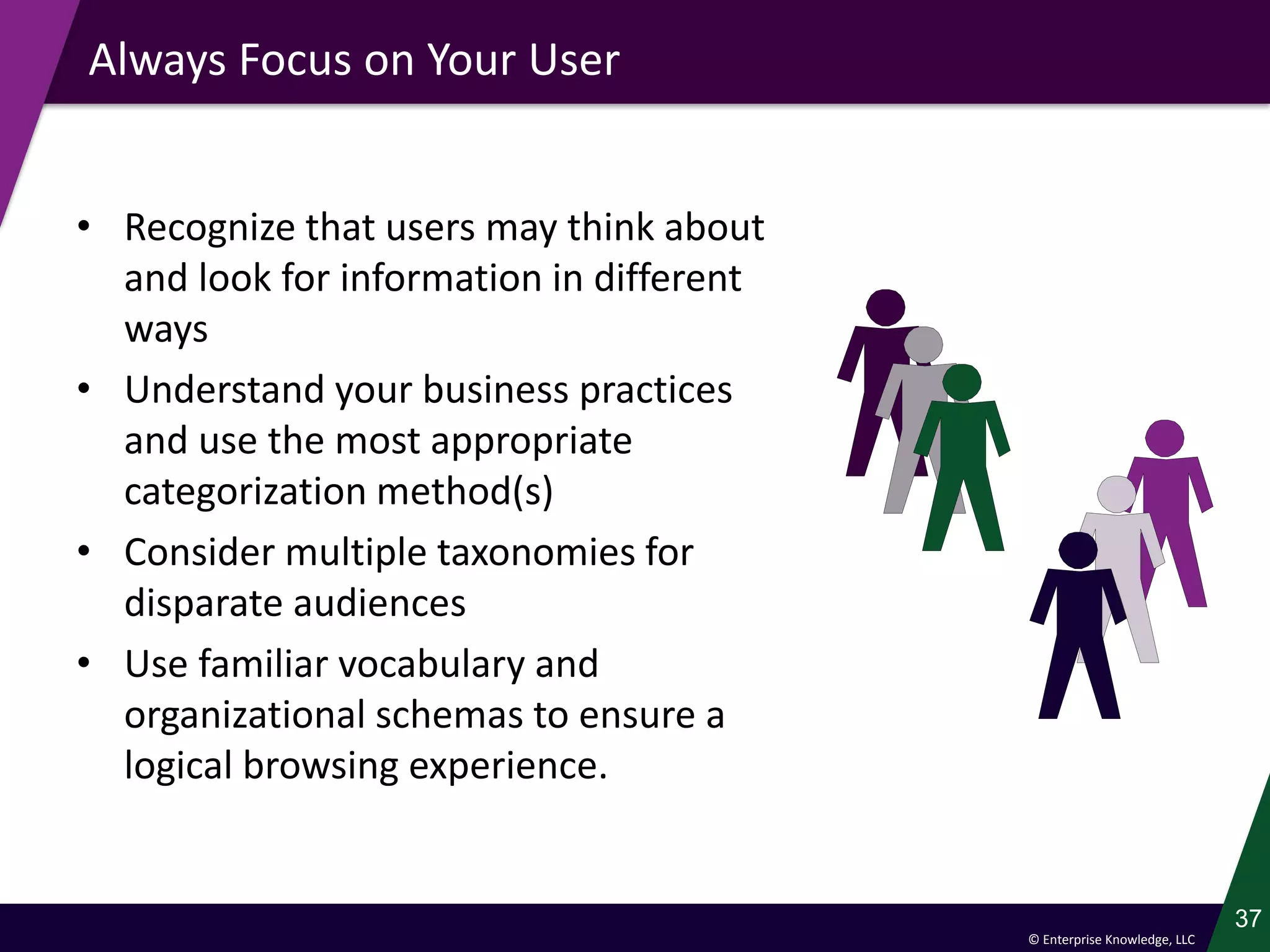
Always Focus on Your User
• Recognize that users may think about
and look for information in different
ways
• Understand your business practices
and use the most appropriate
categorization method(s)
• Consider multiple taxonomies for
disparate audiences
• Use familiar vocabulary and
organizational schemas to ensure a
logical browsing experience.
37
© Enterprise Knowledge, LLC
Make a Long-term Investment
• Taxonomy development is an iterative and on-going effort
– Respond to change: validate and modify regularly
– Invest in dedicated, long-term resources
• Initial effort must have foresight
– Establish a solid foundation
– Allow extensibility to accommodate new information
– Plan for iterative development
• Consider auto-categorization/auto-taxonomization
technologies
– But recognize that human intervention and oversight is critical
• Establish maintenance and governance processes
– Conduct regular (quarterly) taxonomy and content categorization
reviews
38
© Enterprise Knowledge, LLC
Thank you.
Zach Wahl
Enterprise Knowledge, LLC
www.enterprise-knowledge.com
571.403.1109
zwahl@enterprise-knowledge.com
@ZacharyWahl, @EKConsulting

Enterprise Knowledge - Taxonomy Design Best Practices and Methodology

  • 1.
    © Enterprise Knowledge,LLC Cracking the Code on Taxonomy Design and Implementation Taxonomy Design Business Value, Best Practices, and Lessons Learned Zach Wahl Founder and Principal
  • 2.
    © Enterprise Knowledge,LLC Agenda • Defining the Business Taxonomy – Importance of the Business Taxonomy – The Business Taxonomy in Practice • Taxonomy Design Methodology • Taxonomy Design Best Practices 1
  • 3.
    © Enterprise Knowledge,LLC DEFINING THE BUSINESS TAXONOMY
  • 4.
    © Enterprise Knowledge,LLC Taxonomy Definitions tax·on·o·my (tāk-sōn-mē) n. pl. tax·on·o·mies 1. The classification of organisms in an ordered system that indicates natural relationships. 2. The science, laws, or principles of classification; systematics. 3. Division into ordered groups or categories: "Scholars have been laboring to develop a taxonomy of young killers" (Aric Press). Zach’s Definition – Controlled vocabularies used to describe or characterize explicit concepts of information, for purposes of capture, management, and presentation. 3
  • 5.
    © Enterprise Knowledge,LLC Taxonomy and Metadata • Provide structure to unstructured information. • Join or relate multiple disparate sources of information. • Provide multiple avenues to find and discover information. • Enable findability. 4 Findability
  • 6.
    © Enterprise Knowledge,LLC 5 Taxonomy and Metadata Metadata “Card” Title Author Doc Type Topic Department Brochures & Manuals Memos News Policies & Procedures Presentations Reports … … Employee Services Compensation Retirement Insurance Education & Training Manufacturing Safety Quality … Free Text Entry
  • 7.
    © Enterprise Knowledge,LLC 6 Taxonomy and Metadata Content~Information~Data~Files Metadata Fields Metadata Values Taxonomies (Flat or Hierarchical)~ Controlled Vocabularies
  • 8.
    © Enterprise Knowledge,LLC Traditional v. Business Taxonomies • Traditional taxonomies are classification for the sake of classification. • Business taxonomies are classification for the sake of findability. 7
  • 9.
    © Enterprise Knowledge,LLC 8 Traditional v. Business Taxonomies Traditional Taxonomy Business Taxonomy Purpose Categorization Findability Designed By Scientists/Librarians The Business Managed By Scientists/Librarians The Business Used By Scientists/Librarians Everyone Complexity Deep, Wide, Detailed Flat, Simple, Deconstructed Key Characteristics Mutually Exclusive, Collectively Exhaustive Usable, Intuitive, Natural
  • 10.
    © Enterprise Knowledge,LLC The Business Taxonomy • Usable – Easy to adopt and utilize for any skill level. – Relatively flat (2-3 levels) – “Easy” to navigate • Intuitive – Does not require training. Reflects the way the user thinks. • Natural – Uses the organization, vocabulary, and logic of the user. 9
  • 11.
    © Enterprise Knowledge,LLC IMPORTANCE OF THE BUSINESS TAXONOMY
  • 12.
    © Enterprise Knowledge,LLC The Information Management Challenge • “Democratization of Content Management” has resulted in exponential increases in information. • Today, 80% of business in conducted on unstructured information – Gartner Group • Unstructured data doubles every three months – Gartner Group • Knowledge workers spend from 15% to 35% of their time searching for information and 40% of corporate users reported that they can not find the information they need to do their jobs on their intranets – Sue Feldman, IDC 11
  • 13.
    © Enterprise Knowledge,LLC THE BUSINESS TAXONOMY IN PRACTICE
  • 14.
    © Enterprise Knowledge,LLC 13 Business Taxonomy Example - Bluefly Metadata Field: Size Taxonomy Values: 4.5 5.5 6 6.5 7 8 … Metadata Field: Color Taxonomy Values: Black Blue Brown Green Grey Ivory … Metadata Field: Type Taxonomy Values: Athletic Inspired Boots Loafers and Slip-ons Oxfords and More Sandals Metadata Field: Brand Taxonomy Values: Antonio Maurizi Bacco Bucci Ben Sherman Bruno Magli …
  • 15.
    © Enterprise Knowledge,LLC Your Organization Here 14 Business Taxonomy for Your Organization Metadata Field: Topic Taxonomy Values: Manufacturing Benefits Infrastructure Quality … Metadata Field: Document Type Taxonomy Values: Forms Policies Procedures Reports News … Metadata Field: Locale Taxonomy Values: North America Europe Asia South America … Metadata Field: Department Taxonomy Values: HR Sales and Marketing Communications …
  • 16.
    © Enterprise Knowledge,LLC 15 Multiple Taxonomies Combine Synergistically – Categorize in multiple, independent, categories. – Allow combinations of categories to narrow the choice of items. – 4 independent categories of 10 nodes each have the same discriminatory power as one hierarchy of 10,000 nodes • Easier to maintain • Easier to reuse existing material 42 values to maintain (10+6+11+15) 9900 combinations (10x6x11x15) Main Ingredients Cooking Methods Meal Type Cuisines • Chocolate • Dairy • Fruits • Grains • Meat & Seafood • Nuts • Olives • Pasta • Spices & Seasonings • Vegetables • Breakfast • Brunch • Lunch • Supper • Dinner • Snack • African • American • Asian • Caribbean • Continental • Eclectic/ Fusion/ International • Jewish • Latin American • Mediterranean • Middle Eastern • Vegetarian • Advanced • Bake • Broil • Fry • Grill • Marinade • Microwave • No Cooking • Poach • Quick • Roast • Sauté • Slow Cooking • Steam • Stir-fry
  • 17.
    © Enterprise Knowledge,LLC 16 Common Metadata Fields Method Definition Examples Subject-oriented Information categorized by subject or topic. • Instantive - each child category is an instance of the parent category • Partitive - each child category is a part of the parent category water pollution, soil pollution, air pollution… Functional Information categorized by the process to which it relates employment, staffing, training Organizational Information categorized by corporate departments or business entities. Human Resources, Marketing, Accounting, Research… Document Type Information categorized by the type of document presentations, expense reports, press releases …
  • 18.
    © Enterprise Knowledge,LLC TAXONOMY DESIGN METHODOLOGY
  • 19.
    © Enterprise Knowledge,LLC Top Down • Work with business stakeholders and functionally- or subject-based individuals or focus groups • Identify overall metadata fields and major categories of information • Subdivide categories as necessary to build taxonomy • Individual-driven; may entrench obsolete or arbitrary categories Bottom Up • Identify overall corpus of content and major content collections • Analyze content collections using automated textual analysis tools • Reveal major and minor topics of information; build taxonomy based on the relationship of these topics • Automated process will often yield most logical design, not most intuitive. 18 Top Down v. Bottom Up Approaches
  • 20.
    © Enterprise Knowledge,LLC 19 Enterprise Knowledge’s Taxonomy Design Methodology Business Case Scoping Knowledge Gathering Taxonomy Team Taxonomy Workshops Taxonomy Focus Groups User Testing Content Tagging/Population Maintenance and Evolution Planning Design Testing & Deployment
  • 21.
    © Enterprise Knowledge,LLC 20 Enterprise Knowledge’s Taxonomy Design Methodology Business Case Scoping Knowledge Gathering Taxonomy Team Taxonomy Workshops Taxonomy Focus Groups User Testing Content Tagging/Population
  • 22.
    © Enterprise Knowledge,LLC Business Case • Define audience. • Define the mission of your audience. • Define the true reasons for designing the taxonomy. • What specifically can the taxonomy do for the end business users? 21 Any organization can say “we want to build a taxonomy to make finding information easier for our users,” but what does that tell us? How does that help us? We need to understand our users from the business perspective and answer the question: We want our on- the-road sales staff to have one- click access to customer news. We want every employee to find any form we have without calling or emailing anyone. We want new employees to be able to find everything they need to get started on Day 1.
  • 23.
    © Enterprise Knowledge,LLC Scoping • Timeline – Set dates for “broader” project (technology or organizational). – Regulatory requirements. • People – Availability – Acceptance – Understanding • Technology – Requirements v. Capabilities • Budget 22 Taxonomy Scope Constraints Timeline Technology People Budget
  • 24.
    © Enterprise Knowledge,LLC Knowledge Gathering • Communication, Education, and Marketing: – Set user expectations – Translate “pain points” to solutions in real time – Create “buzz” around the project – Market the results, not the definitions • Identify taxonomy and content starting points – Key stakeholders and early adopters – Existing taxonomies and information systems – Critical “must find” content 23 Physical Location File Type(s) Metadata Users (w eb site, database, file server) (.doc, .xls, .pdf, .html, etc.) (Y/N) Applicable (Y/N) If yes, who MAY access Justification Access Restrictions Document Collection Name
  • 25.
    © Enterprise Knowledge,LLC Taxonomy Team • Convene wide-spectrum team (12-18 people) to represent their components of the organization. Strive for diversity in: – Function – Hierarchy (to a degree) – Tenure – Geography • Strive to identify individuals who “get it,” but also yield influence in their respective domains. • Participation should become an official and measurable job activity, supported by management. 24
  • 26.
    © Enterprise Knowledge,LLC Taxonomy Team • The Taxonomy Team will ensure the taxonomy is a true business taxonomy. – Participate in initial workshops to identify metadata fields and top-down taxonomy design. – Identify and enlist additional representatives for follow-on workshops, focus groups, and testing. – Support the content migration (and tagging) process. • The Taxonomy Team will continue to meet throughout the length of the effort, and ideally beyond. 25
  • 27.
    © Enterprise Knowledge,LLC Taxonomy Workshops • Enterprise Knowledge’s Taxonomy Workshop methodology is a repeatable process that translates natural business thinking into taxonomy and metadata design: – Business Case – Audience Definition – Verb Identification – Noun Identification – Metadata Field Prioritization • The workshop can be used throughout the project with different groups and at different areas of focus and levels of detail. 26
  • 28.
    © Enterprise Knowledge,LLC Taxonomy Focus Groups • “Spin-off” groups can be leveraged to accomplish more specific design requirements: – Design of secondary and tertiary metadata fields that are less “controversial.” – Identification of tertiary metadata fields and taxonomies of values for specific sections of the core taxonomy. – Spot testing/validating content against taxonomy. 27
  • 29.
    © Enterprise Knowledge,LLC User Testing • Testing takes place throughout the project with multiple test groups: – Taxonomy Team and Focus Group participants – Other content owners and stakeholders – End users • Testing should be multi-directional. – Test consistent tagging of taxonomy onto content (card-sorting) – Test consistent navigation of taxonomy to find content (find-it) • We are not seeking perfection, we are seeking majority. 28
  • 30.
    © Enterprise Knowledge,LLC Content Tagging/Population • Time and labor intensive at multiple levels • Opportunity to validate taxonomy design – begin with most critical content • Opportunity not just for migration, but cleanup • Population Strategies – Manual upload of documents – Auto-categorization tools – “Paper” migration followed by third-party tagging • Consider long term sustainability issues when constructing filters and other population mechanisms 29
  • 31.
    © Enterprise Knowledge,LLC Maintenance and Evolution • Establish clear taxonomy governance: – Policies and Procedures – Roles and Responsibilities – Communications, Education, and Marketing • Maintain the Taxonomy Team to guide future development • Continuously reexamine the taxonomy • Establish mechanisms to gather user feedback and respond to it in a timely manner 30 Most of the work in an average taxonomy project will take place within the Maintenance and Evolution Stage. No initial rollout of a taxonomy will yield 100% perfection. Striving for that will only delay your project and risk your sanity. By preparing for this on going work, you ensure the hard work of the project team will not be lost. With the correct mechanisms in place, the team can respond to user feedback and bring the taxonomy closer to 100% perfection over time.
  • 32.
    © Enterprise Knowledge,LLC TAXONOMY DESIGN BEST PRACTICES
  • 33.
    © Enterprise Knowledge,LLC Define Taxonomy Project Objectives Early • Define a simple business case to help control scope and communicate with end users and stakeholders. • Develop a timeline and listing of phases to detail when specific milestones will be met. • Limit initial scope to ensure success. 32
  • 34.
    © Enterprise Knowledge,LLC Employ Quality Measurements and Analytics • Use both active and passive analytics: – Surveys • Satisfaction • Time Saved • Anecdotal Evidence – Search terms – Size of hit lists – Dead ends • Consistency Testing • Time Tests 33
  • 35.
    © Enterprise Knowledge,LLC Understand your audience • End users drive the language and complexity of the structure. – Who are they? – Who is the lowest common denominator? – Define the “spectrum of experience: 34 Tenured Employee New Employee Technophile Technophobe Younger Older Native Speaker Foreign Language
  • 36.
    © Enterprise Knowledge,LLC Understand your publishers 35 Information Professional Business User Dedicated Position Part-time (Volunteer) Few Publishers Many Publishers Homogenous Publishers Diverse Publishers • Publisher determine the reasonable complexity of a taxonomy/metadata strategy: – Acceptable amount of time per document – Number of metadata fields – Complexity of taxonomy
  • 37.
    © Enterprise Knowledge,LLC Understand Your Platform • Taxonomy design seldom works outside the context of a business mission, typically tied to a technology: 36 Web Content Management Portal Document Management Records Management Looser Tighter Less Complex More Complex
  • 38.
    © Enterprise Knowledge,LLC Always Focus on Your User • Recognize that users may think about and look for information in different ways • Understand your business practices and use the most appropriate categorization method(s) • Consider multiple taxonomies for disparate audiences • Use familiar vocabulary and organizational schemas to ensure a logical browsing experience. 37
  • 39.
    © Enterprise Knowledge,LLC Make a Long-term Investment • Taxonomy development is an iterative and on-going effort – Respond to change: validate and modify regularly – Invest in dedicated, long-term resources • Initial effort must have foresight – Establish a solid foundation – Allow extensibility to accommodate new information – Plan for iterative development • Consider auto-categorization/auto-taxonomization technologies – But recognize that human intervention and oversight is critical • Establish maintenance and governance processes – Conduct regular (quarterly) taxonomy and content categorization reviews 38
  • 40.
    © Enterprise Knowledge,LLC Thank you. Zach Wahl Enterprise Knowledge, LLC www.enterprise-knowledge.com 571.403.1109 zwahl@enterprise-knowledge.com @ZacharyWahl, @EKConsulting