Tempo and
Dynamics
Tempo
The speed or a pace of a piece.
Listen to different tempos. Tap to the steady
beat.
Chopin, Piano Concerto no. 2, 2nd Movement
http://www.youtube.com/watch?v=Q_dSI0gVb
p0
Haydn, Symphony No. 98, Finale
http://www.youtube.com/watch?v=QtIfVLHLe
aQ
Tempo Measurement
Tempo is measured in beats per minute
(BPM)
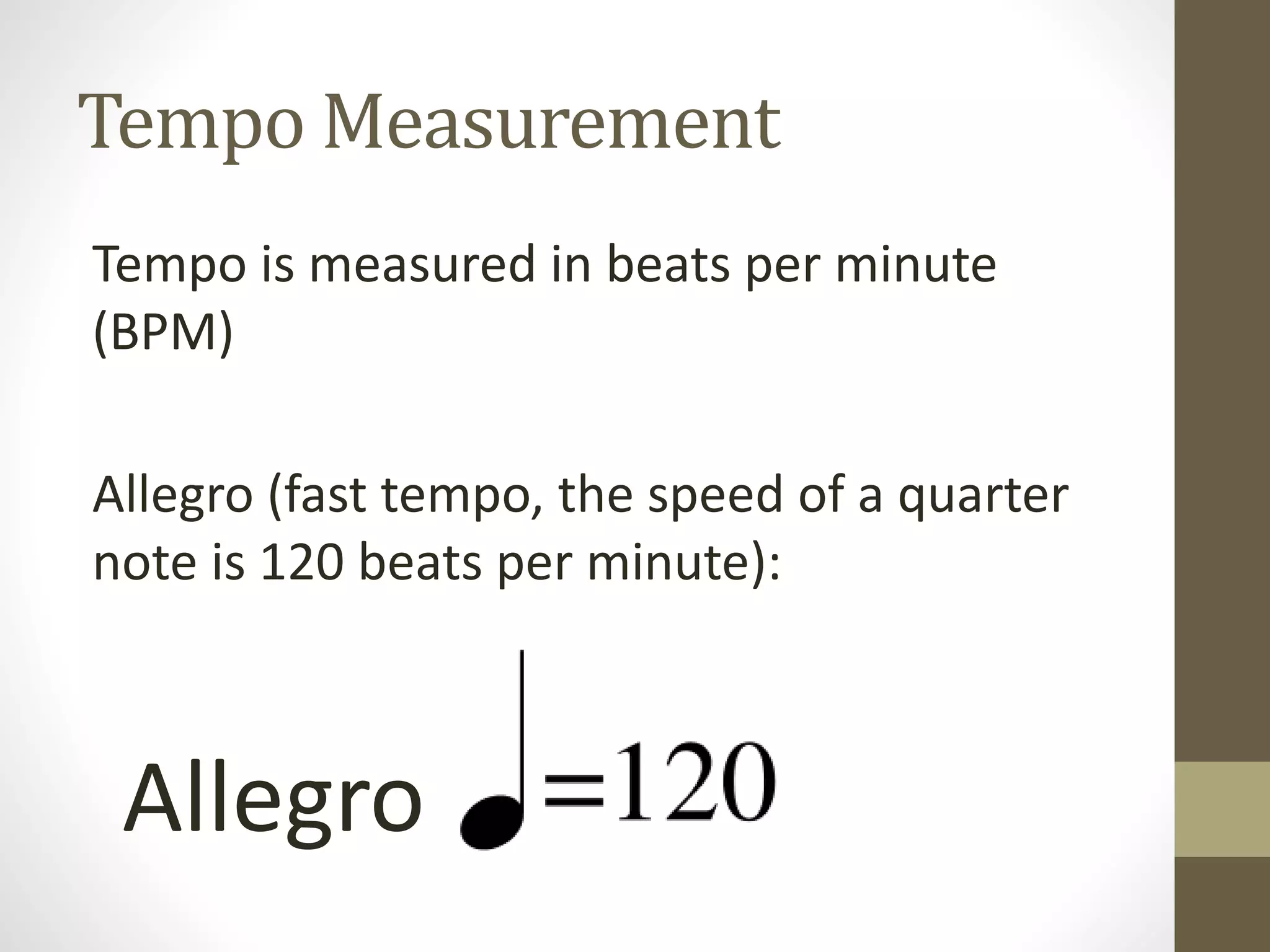
Allegro (fast tempo, the speed of a quarter
note is 120 beats per minute):
Allegro
Metronome
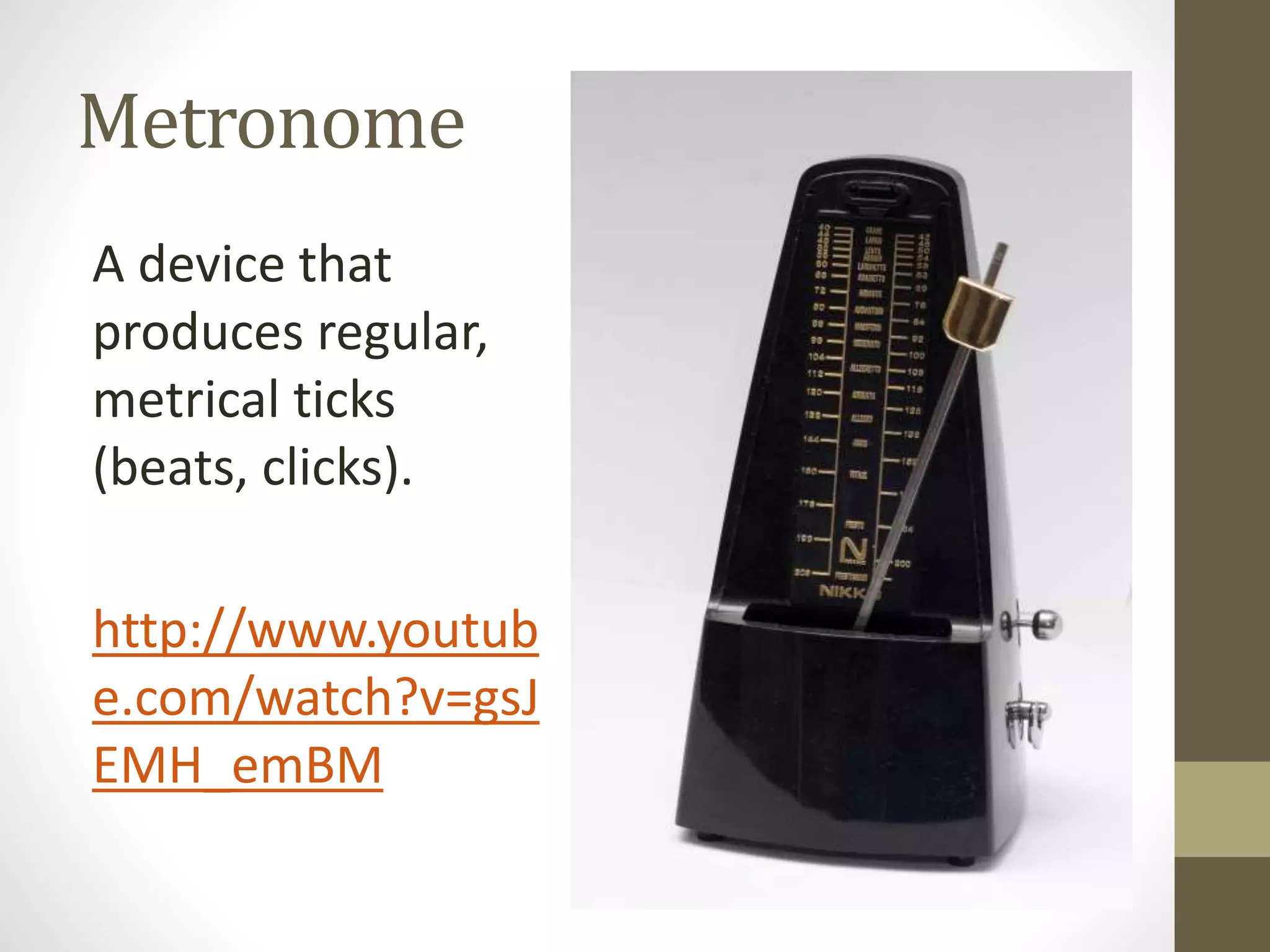
A device that
produces regular,
metrical ticks
(beats, clicks).
http://www.youtub
e.com/watch?v=gsJ
EMH_emBM
Tempo Markings
• Tempo markings are mostly in Italian.
• They are placed in the beginning of a piece.
Open the following score and look for the following Italian
tempo markings: Largo, Allegro, Vivace, Allegro.
Then, listen to the composition and try to determine what these
markings mean.
A. Corelli, Concerto Grosso in C Minor, op. 6 no. 3
http://erato.uvt.nl/files/imglnks/usimg/1/1a/IMSLP254974-
PMLP28008-Corelli_-
_Concerto_grosso_No3_in_CM_for_2_Solo-Violins__Solo-
Cello__Strings_and_Piano__Schering__score.pdf
http://content.thespco.org/music/compositions/concerto-
grosso-in-c-minot-arcangelo-corelli/
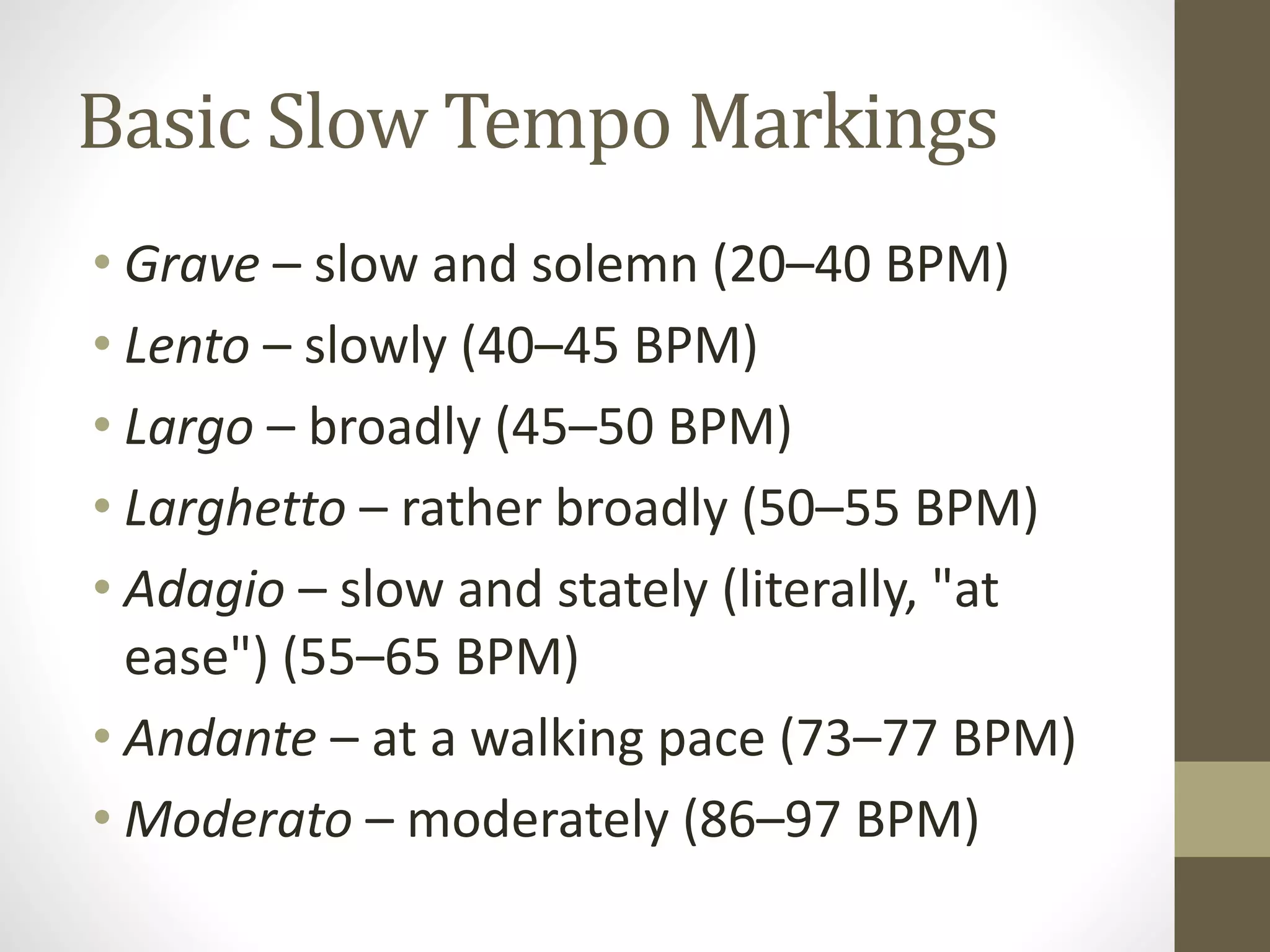
Basic Slow Tempo Markings
• Grave – slow and solemn (20–40 BPM)
• Lento – slowly (40–45 BPM)
• Largo – broadly (45–50 BPM)
• Larghetto – rather broadly (50–55 BPM)
• Adagio – slow and stately (literally, "at
ease") (55–65 BPM)
• Andante – at a walking pace (73–77 BPM)
• Moderato – moderately (86–97 BPM)
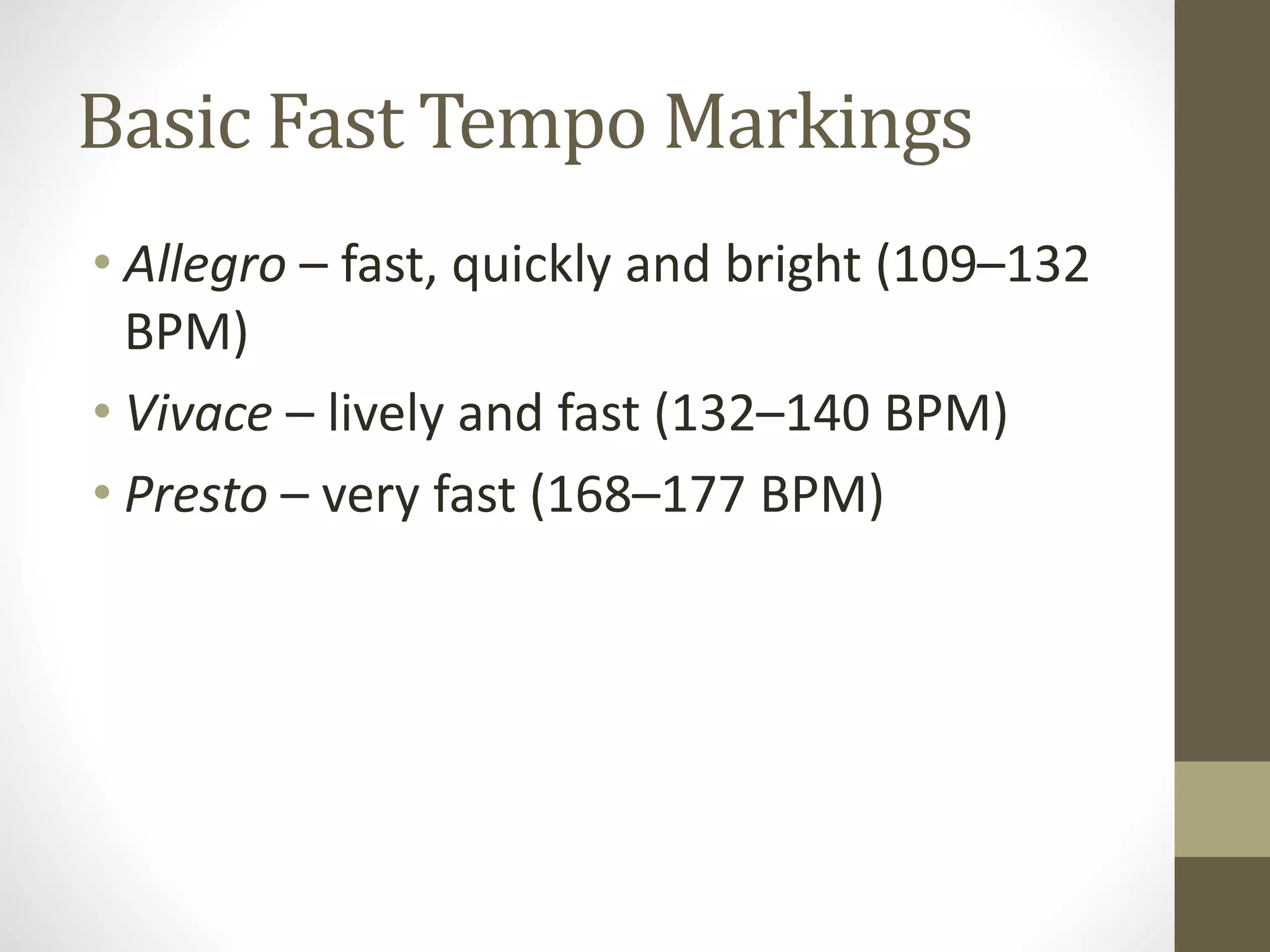
Basic Fast Tempo Markings
• Allegro – fast, quickly and bright (109–132
BPM)
• Vivace – lively and fast (132–140 BPM)
• Presto – very fast (168–177 BPM)
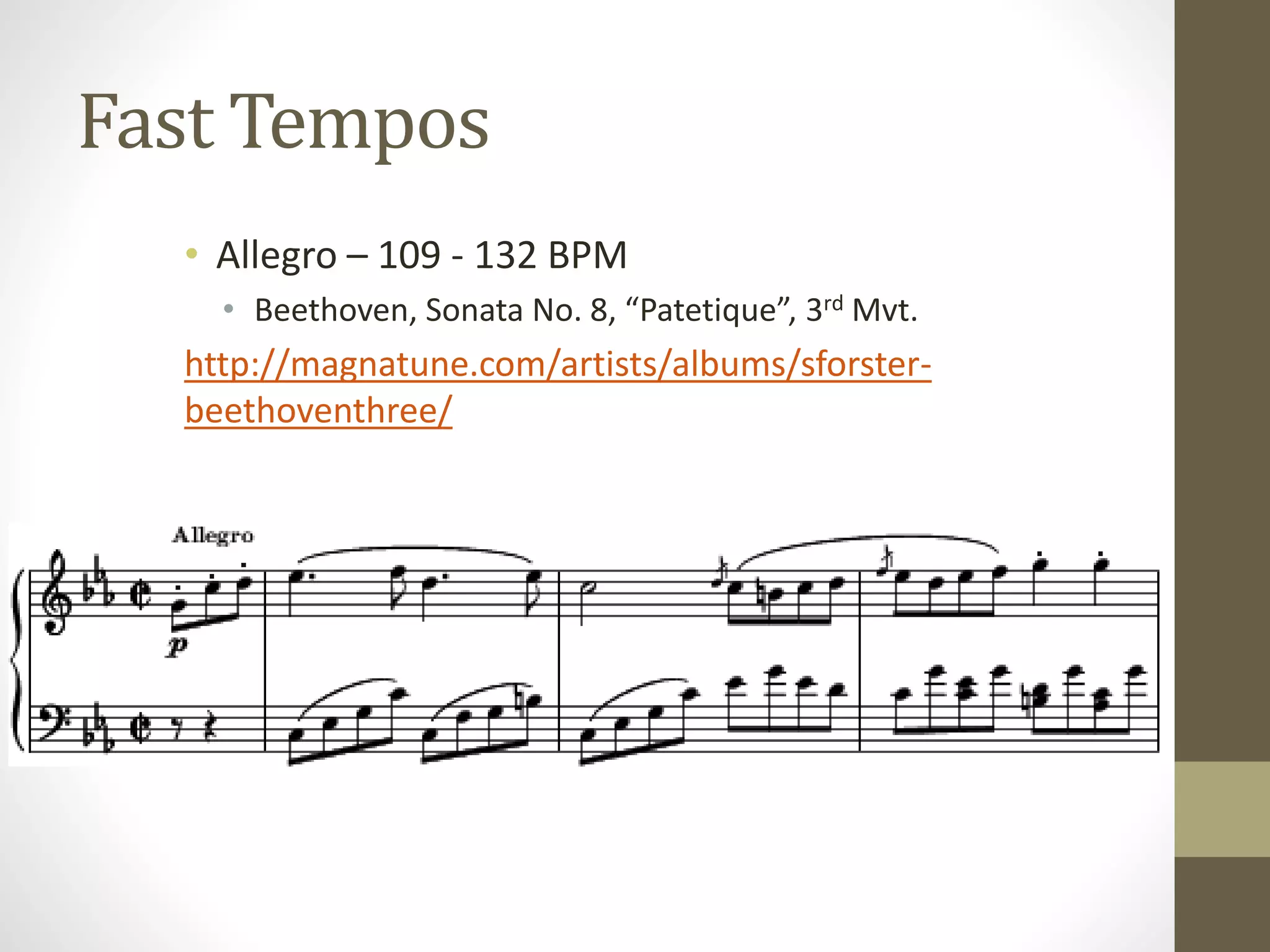
Fast Tempos
• Allegro – 109 - 132 BPM
• Beethoven, Sonata No. 8, “Patetique”, 3rd Mvt.
http://magnatune.com/artists/albums/sforster-
beethoventhree/
Fast Tempos
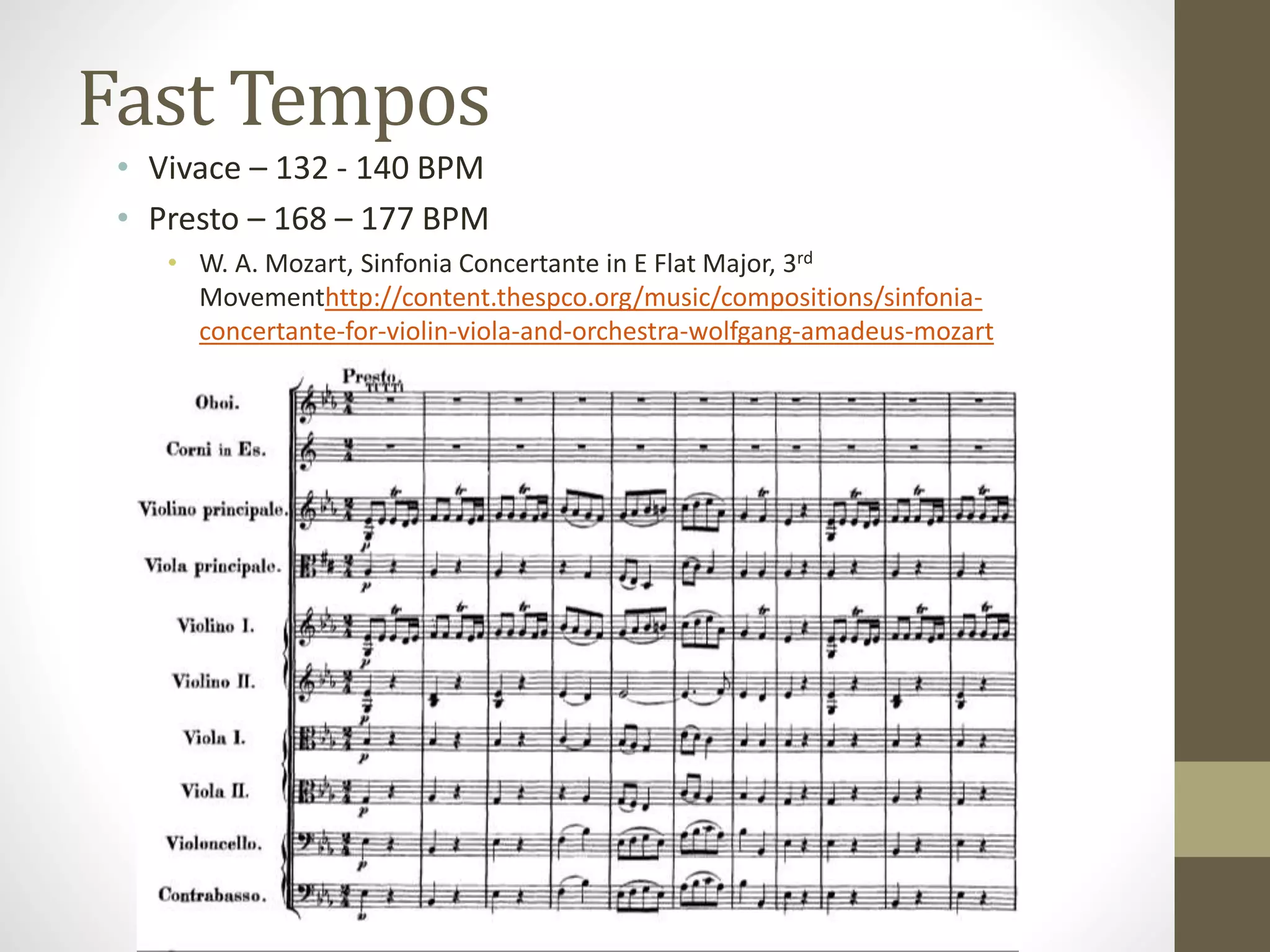
• Vivace – 132 - 140 BPM
• Presto – 168 – 177 BPM
• W. A. Mozart, Sinfonia Concertante in E Flat Major, 3rd
Movementhttp://content.thespco.org/music/compositions/sinfonia-
concertante-for-violin-viola-and-orchestra-wolfgang-amadeus-mozart
Slow Tempos
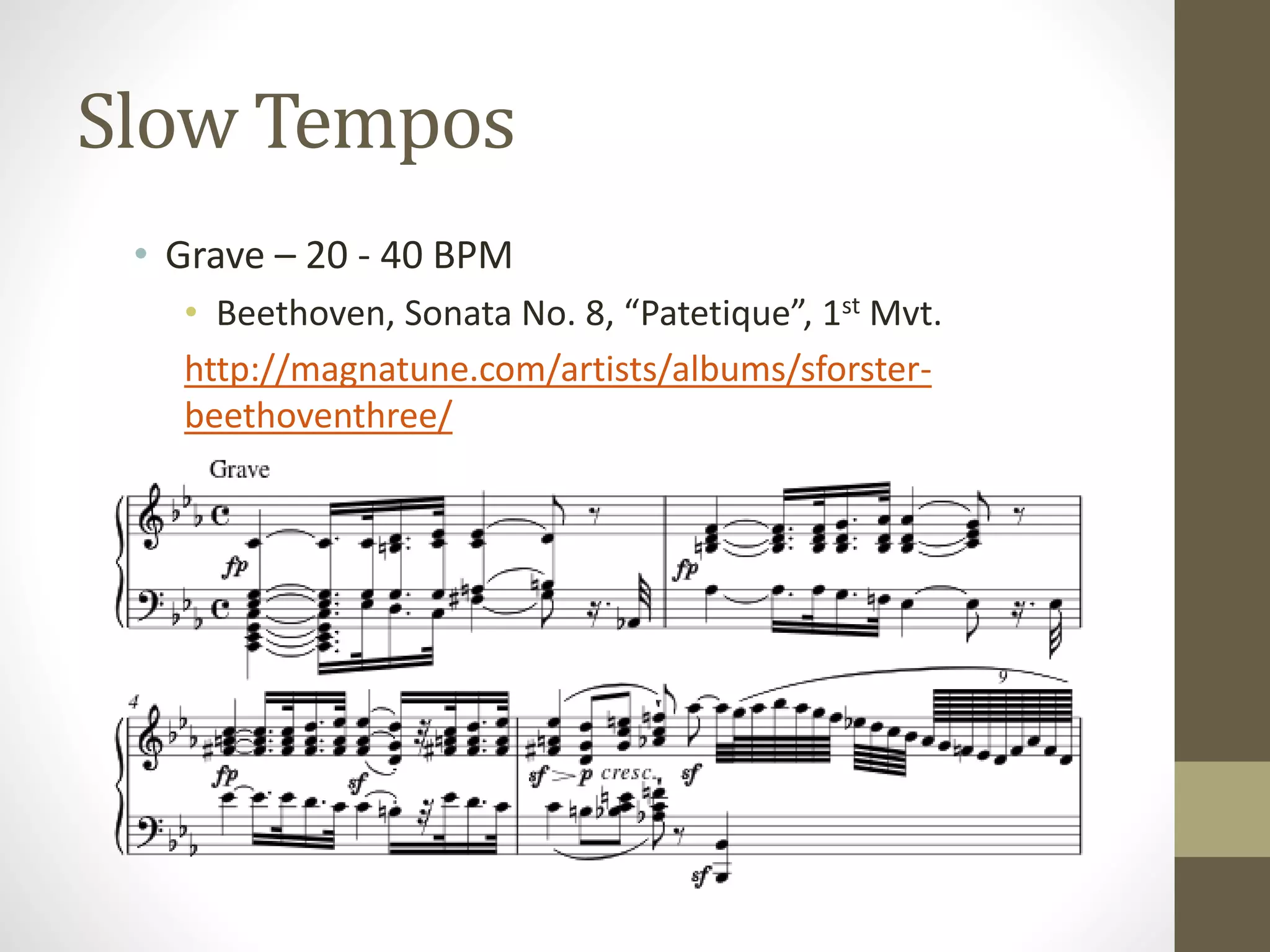
• Grave – 20 - 40 BPM
• Beethoven, Sonata No. 8, “Patetique”, 1st Mvt.
http://magnatune.com/artists/albums/sforster-
beethoventhree/
Slow Tempos
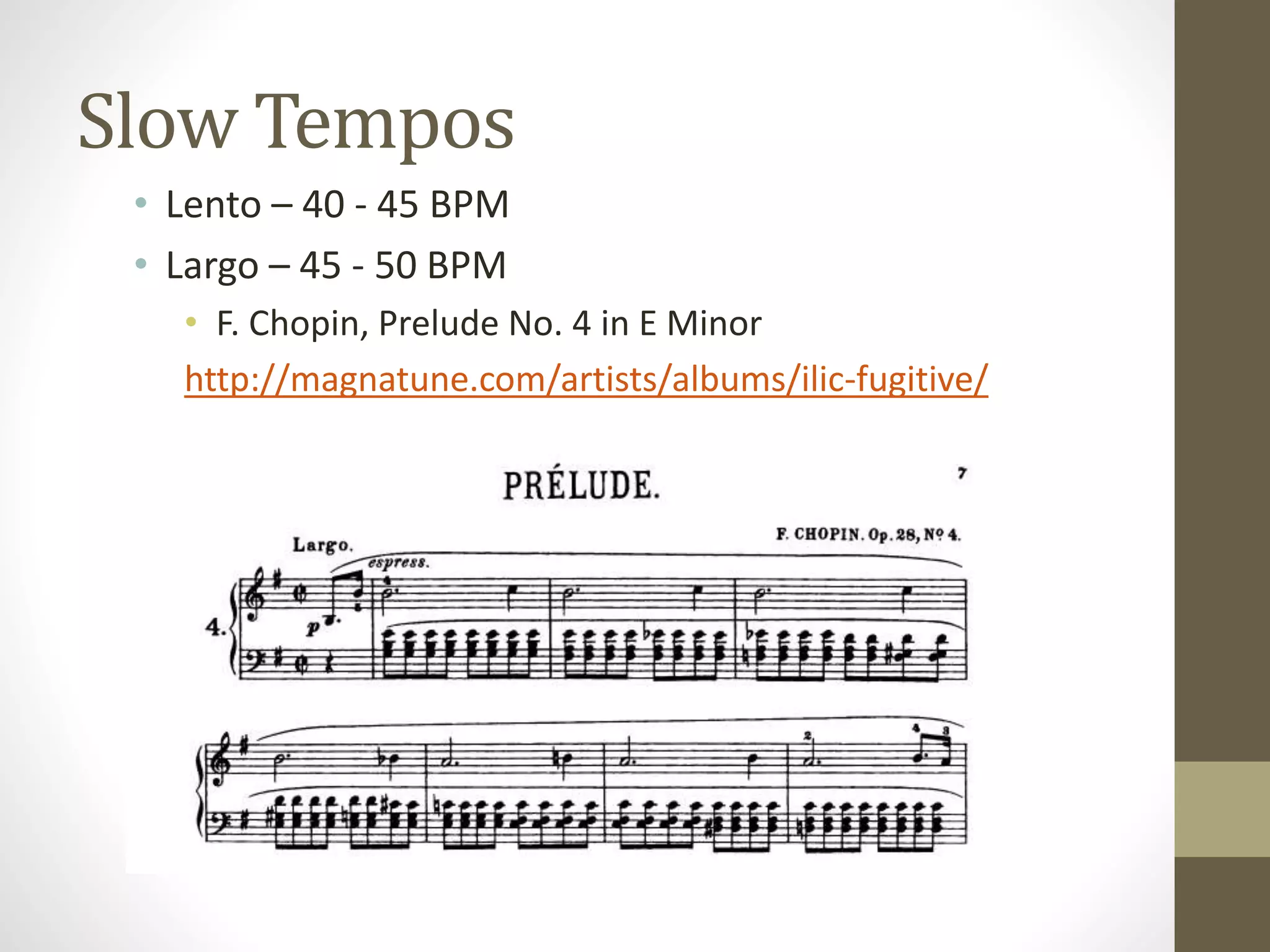
• Lento – 40 - 45 BPM
• Largo – 45 - 50 BPM
• F. Chopin, Prelude No. 4 in E Minor
http://magnatune.com/artists/albums/ilic-fugitive/
Slow Tempos
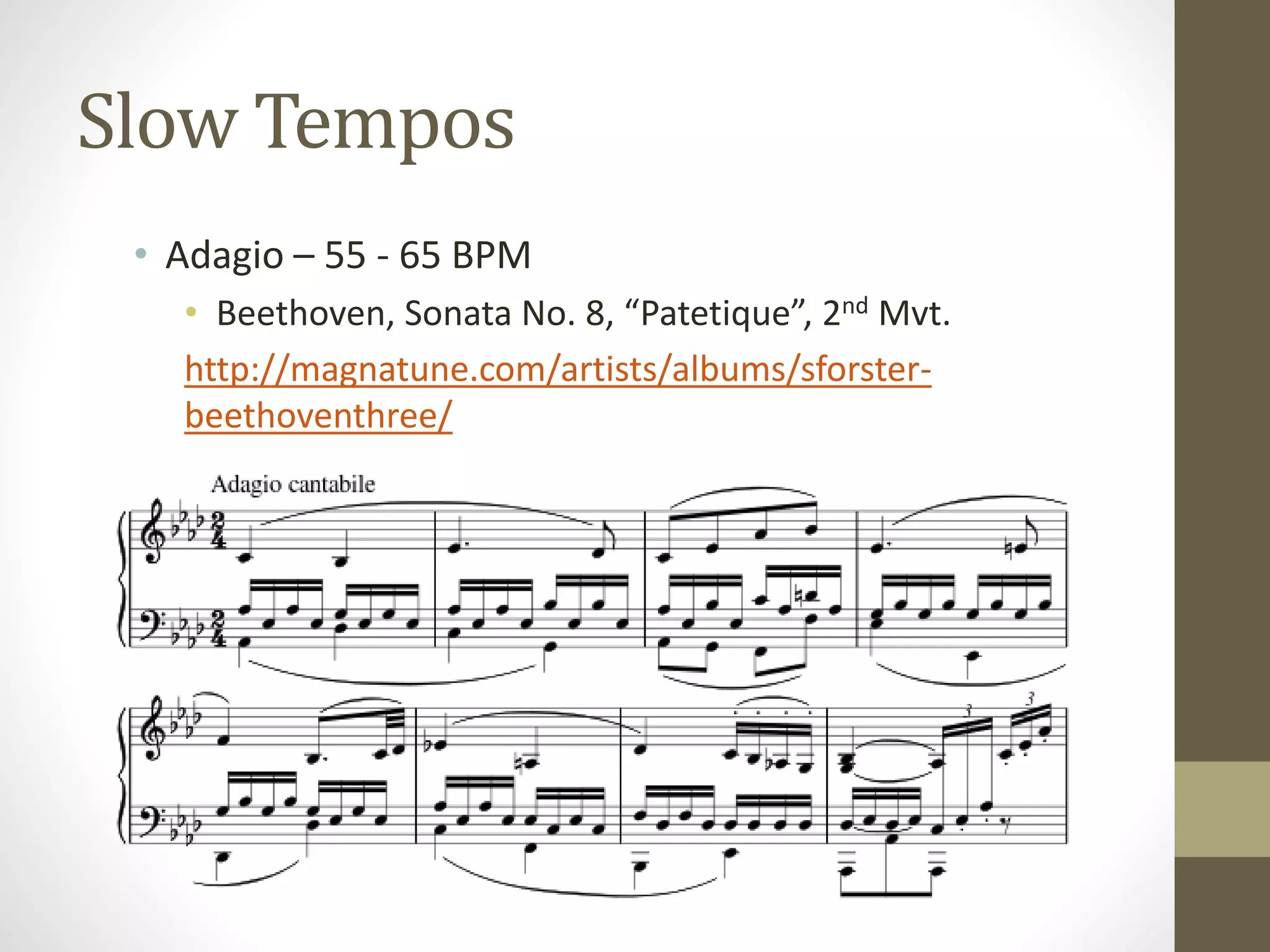
• Adagio – 55 - 65 BPM
• Beethoven, Sonata No. 8, “Patetique”, 2nd Mvt.
http://magnatune.com/artists/albums/sforster-
beethoventhree/
Slow Tempos
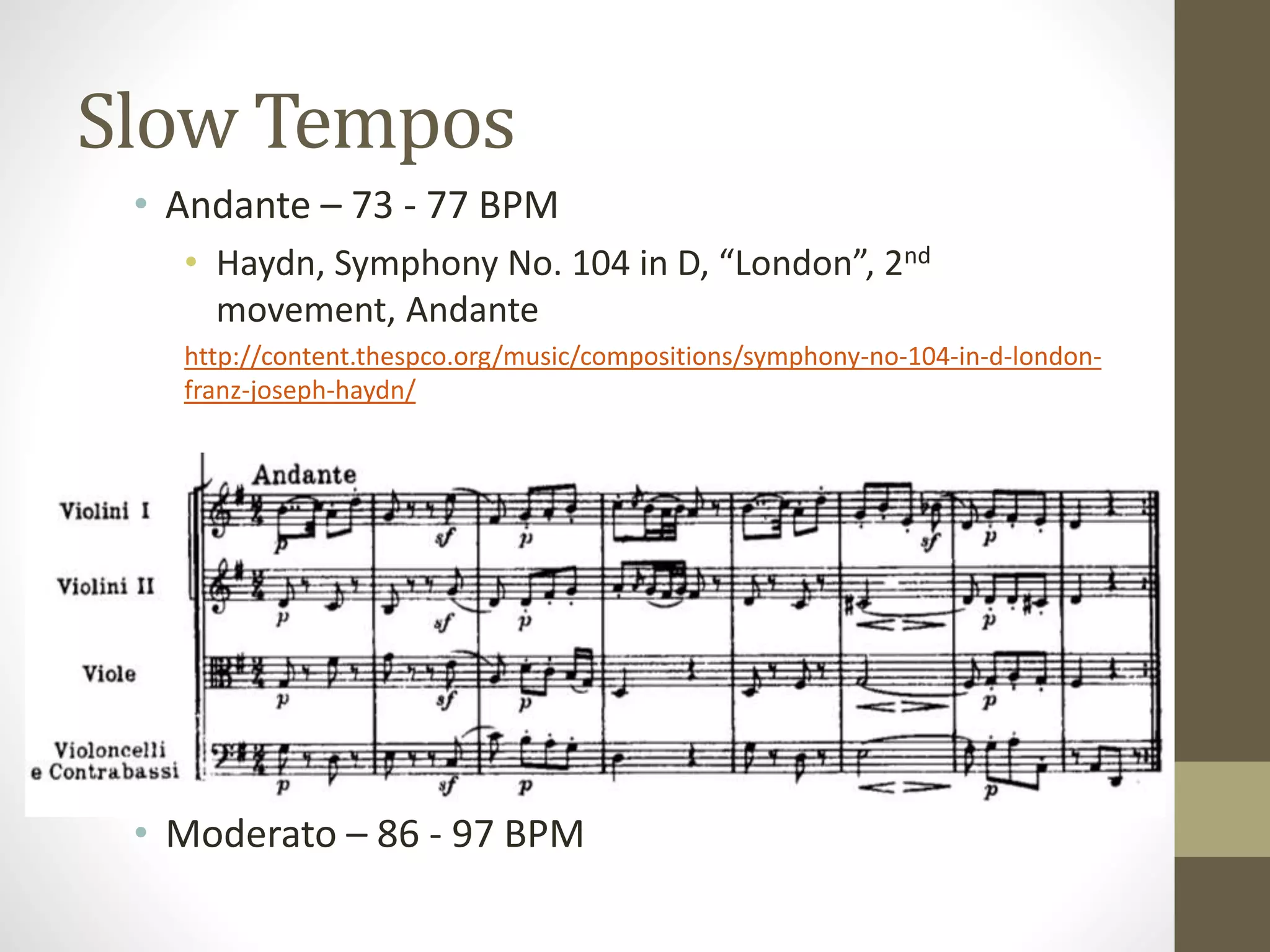
• Andante – 73 - 77 BPM
• Haydn, Symphony No. 104 in D, “London”, 2nd
movement, Andante
http://content.thespco.org/music/compositions/symphony-no-104-in-d-london-
franz-joseph-haydn/
• Moderato – 86 - 97 BPM
Terms for Tempo Changes
• Accelerando – speeding up (abbreviation:
accel.)
• Ritenuto or Rallentando – gradual slowing
down
• Rubato – free adjustment of tempo for
expressive purposes.
• F. Chopin, Waltz No. 12 in E Major
http://magnatune.com/artists/albums/jjohnson-chopin/
• G. Gershwin, “Rhapsody in Blue”
http://content.thespco.org/music/compositions/rhapsody-in-blue-
for-piano-and-jazz-band-george-gershwin/
Tempo Changes
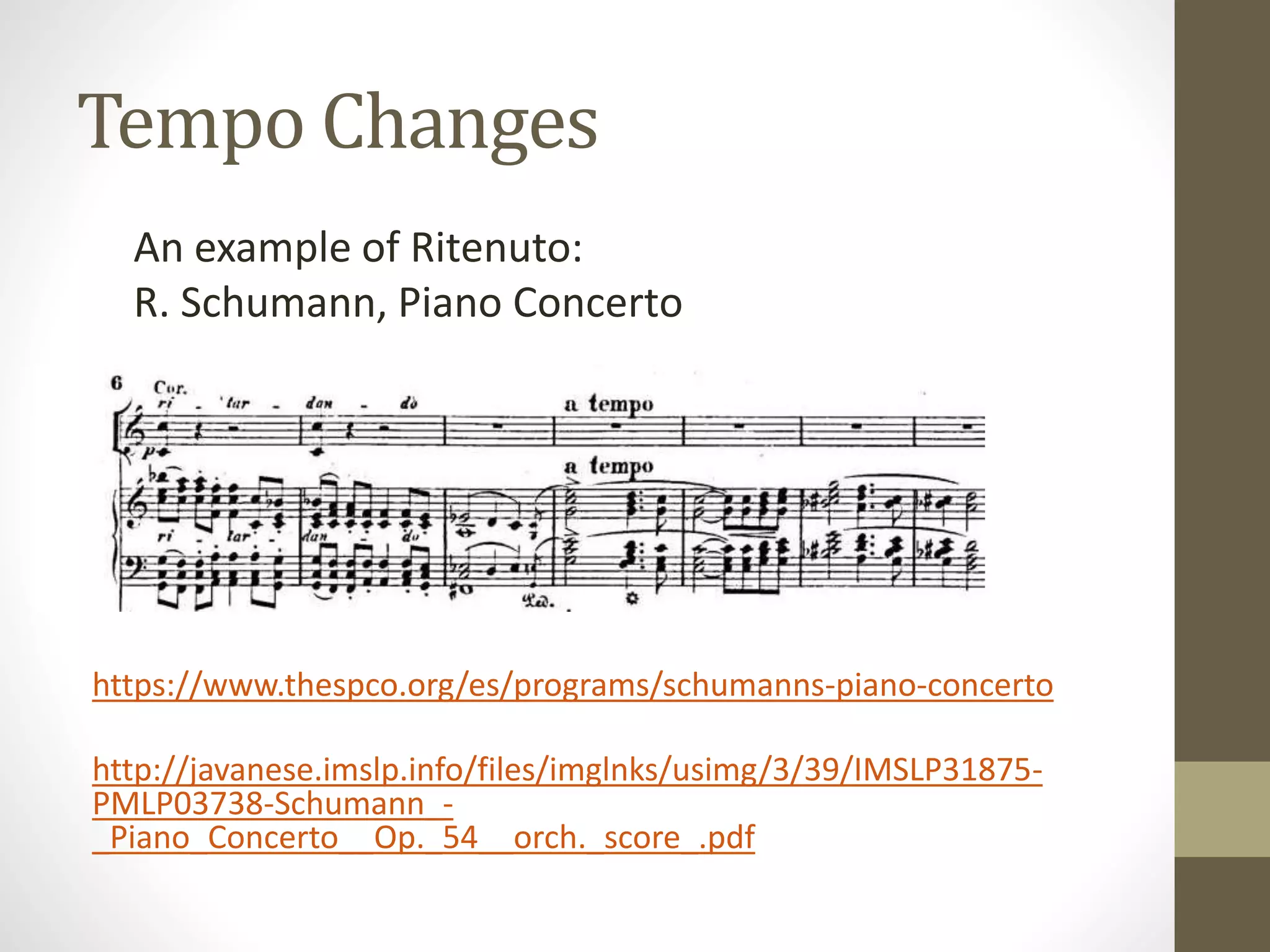
An example of Ritenuto:
R. Schumann, Piano Concerto
https://www.thespco.org/es/programs/schumanns-piano-concerto
http://javanese.imslp.info/files/imglnks/usimg/3/39/IMSLP31875-
PMLP03738-Schumann_-
_Piano_Concerto__Op._54__orch._score_.pdf
Dynamics
• p or piano, meaning "soft”
• f or forte, meaning "loud.”
More subtle degrees of loudness or softness are indicated by:
• mp, standing for mezzo-piano, meaning "moderately soft",
and
• mf, standing for mezzo-forte, meaning "moderately loud”.
Beyond f and p, there are also
• pp, standing for "pianissimo" and meaning "very soft", and
• ff, standing for "fortissimo" and meaning "very loud".[5]
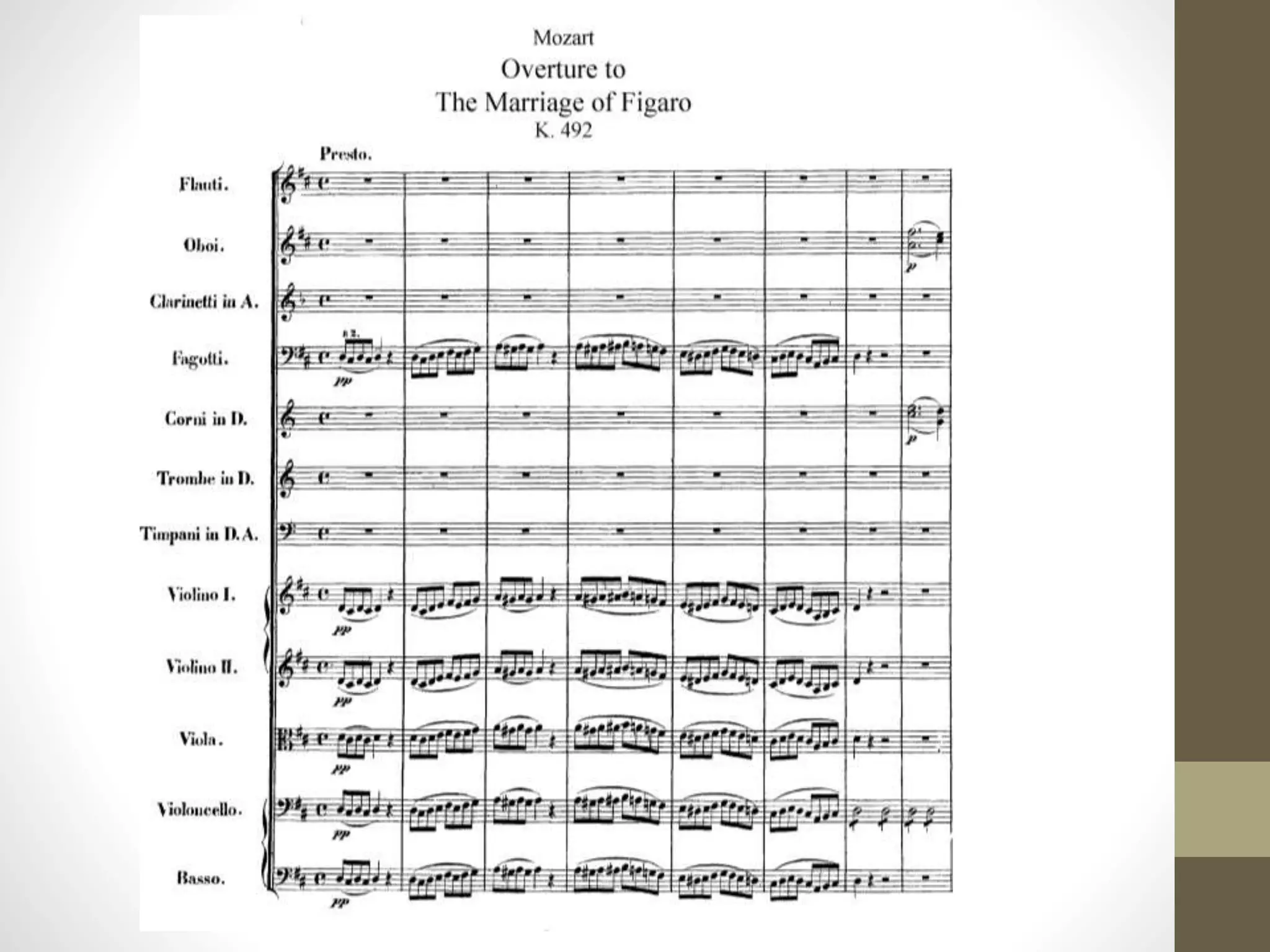
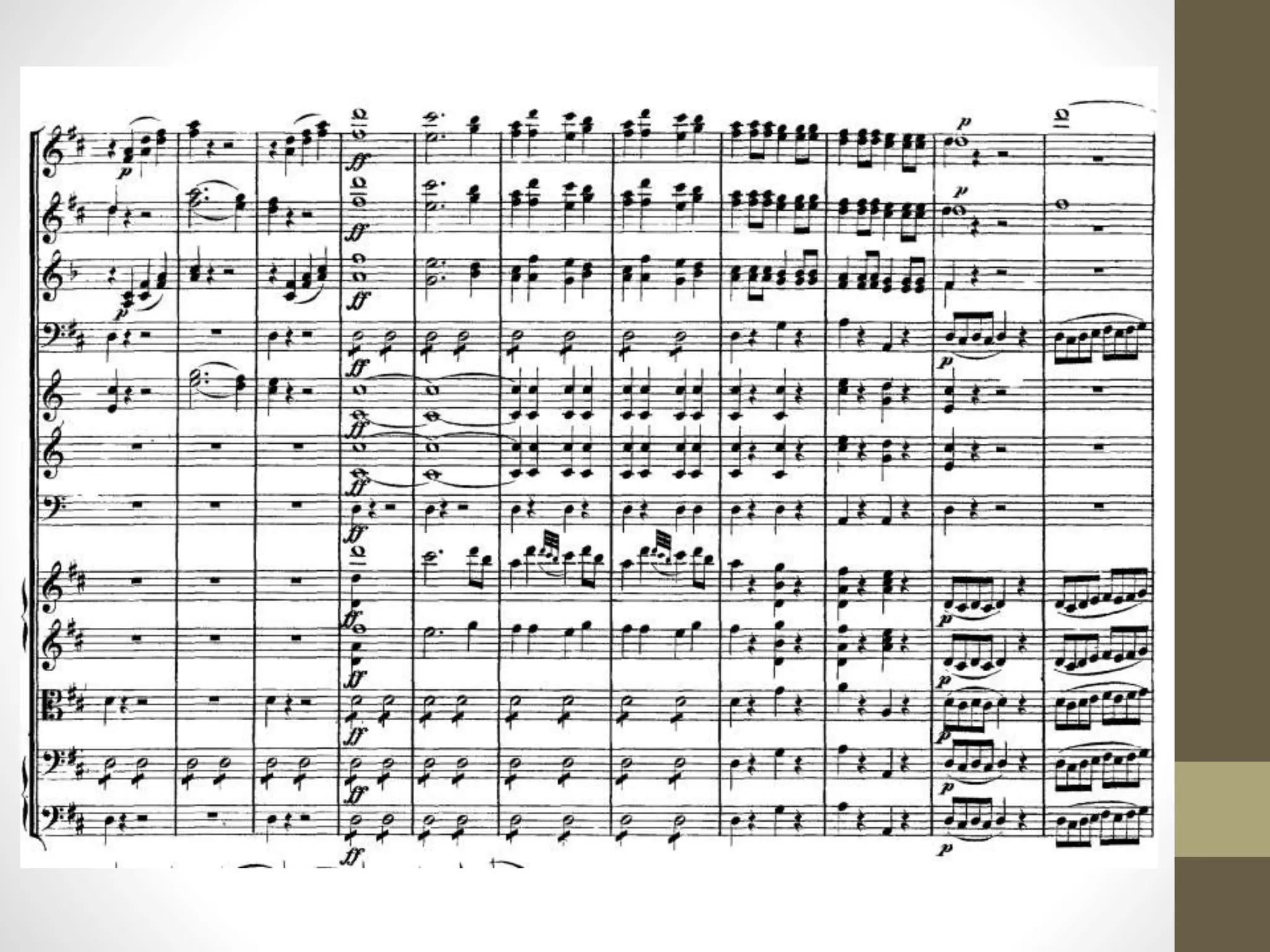
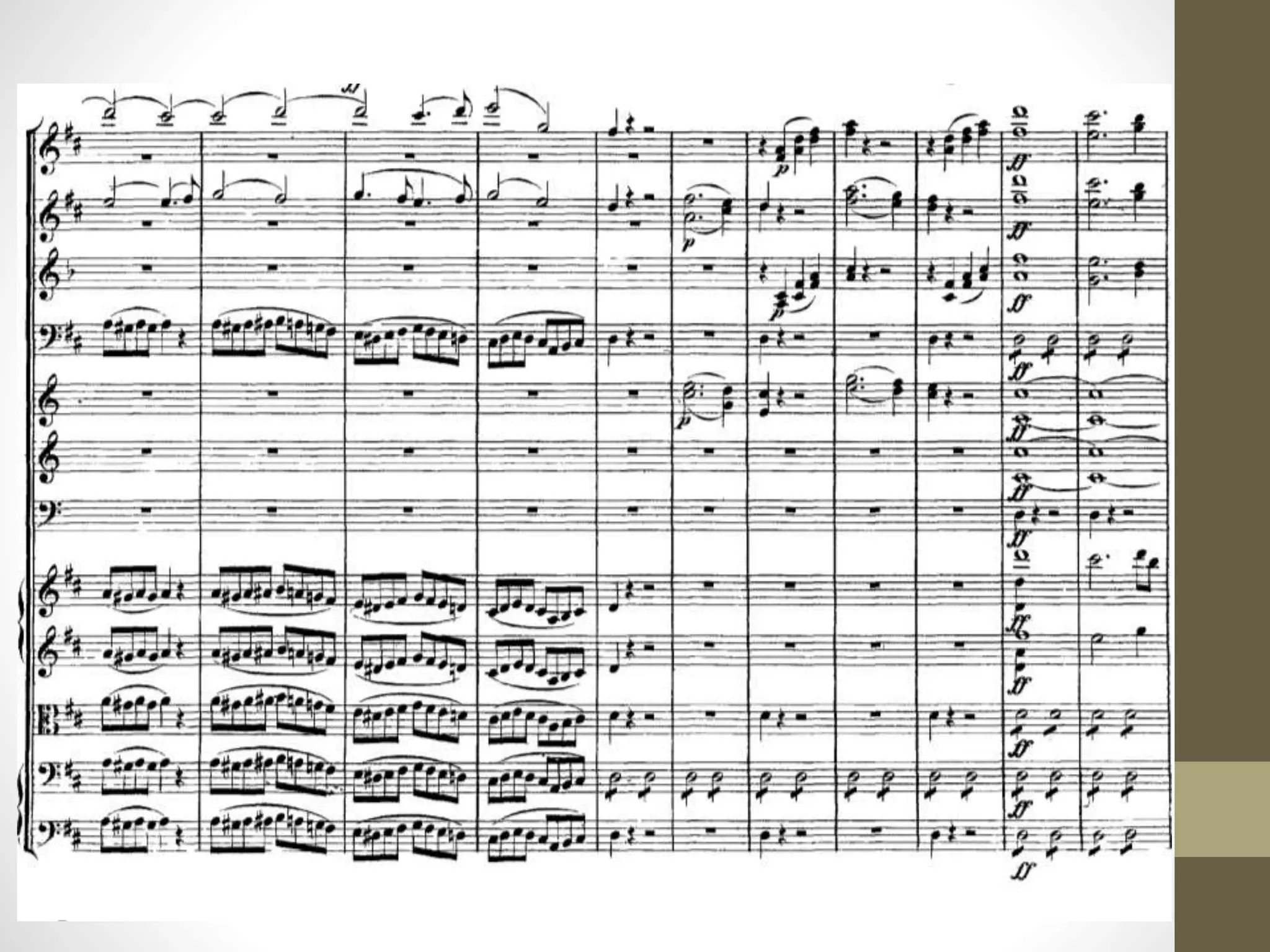
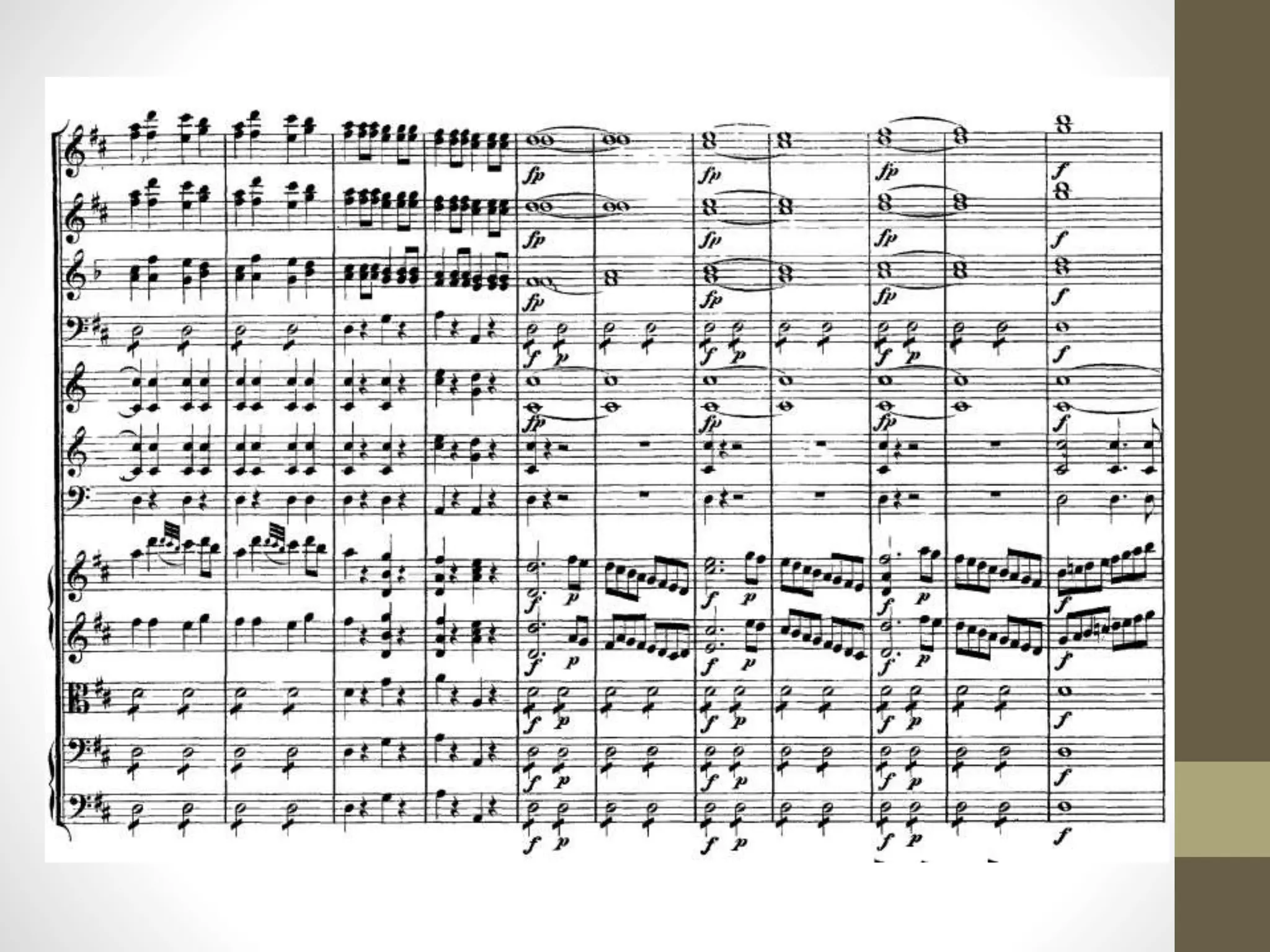
Listen for the dynamic changes in W.
A. Mozart’s, Overture to “The
Marriage of Figaro”.
Look for the dynamic markings in the
score before you start listening: pp, p,
ff, p (next four pages).
http://content.thespco.org/music/compositions/overture-to-the-
marriage-of-figaro-wolfgang-amadeus-mozart/
http://conquest.imslp.info/files/imglnks/usimg/8/8e/IMSLP01198-
The_Marriage_of_Figaro_Overture.pdf
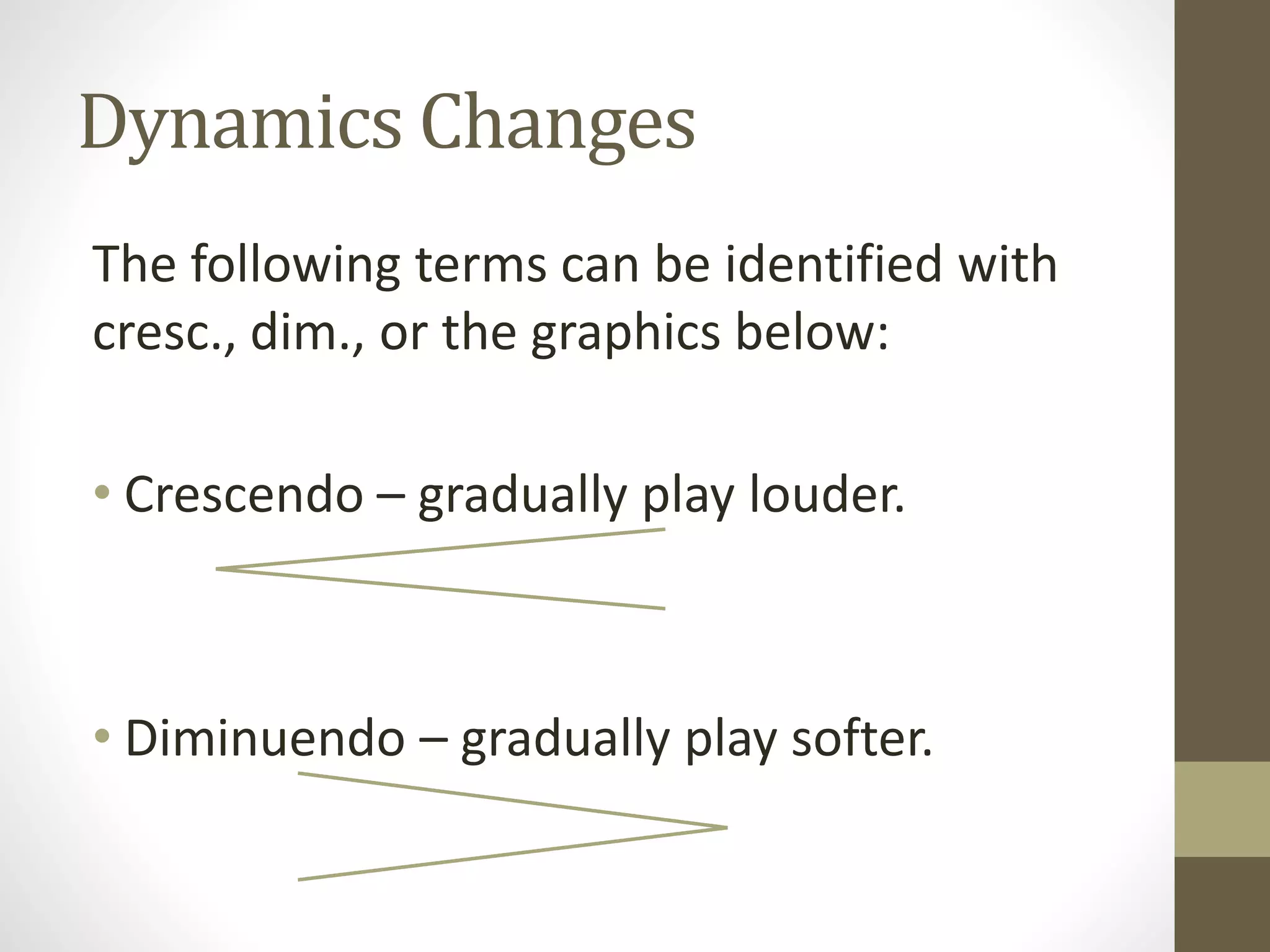
Dynamics Changes
The following terms can be identified with
cresc., dim., or the graphics below:
• Crescendo – gradually play louder.
• Diminuendo – gradually play softer.
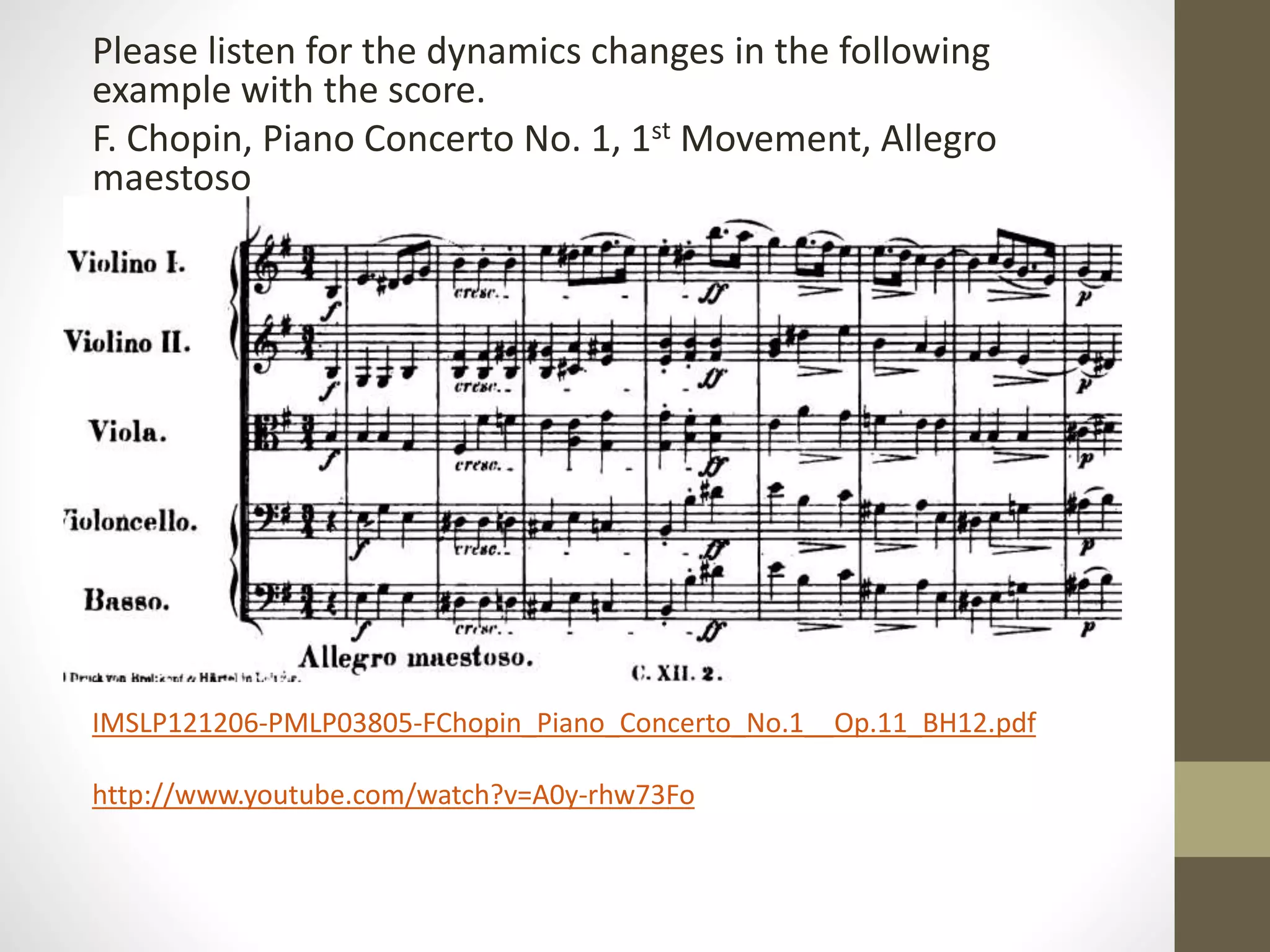
Please listen for the dynamics changes in the following
example with the score.
F. Chopin, Piano Concerto No. 1, 1st Movement, Allegro
maestoso
http://javanese.imslp.info/files/imglnks/usimg/3/37/
IMSLP121206-PMLP03805-FChopin_Piano_Concerto_No.1__Op.11_BH12.pdf
http://www.youtube.com/watch?v=A0y-rhw73Fo
Beethoven, Symphony 1, 3rd Movement, Menuetto
http://content.thespco.org/music/compositions/symphony-no-1-
ludwig-van-beethoven/
Required Readings
• http://en.wikipedia.org/wiki/Tempo
• http://en.wikipedia.org/wiki/Music_dynamics

Tempo and Dynamics

  • 1.
  • 2.
    Tempo The speed ora pace of a piece. Listen to different tempos. Tap to the steady beat. Chopin, Piano Concerto no. 2, 2nd Movement http://www.youtube.com/watch?v=Q_dSI0gVb p0 Haydn, Symphony No. 98, Finale http://www.youtube.com/watch?v=QtIfVLHLe aQ
  • 3.
    Tempo Measurement Tempo ismeasured in beats per minute (BPM) Allegro (fast tempo, the speed of a quarter note is 120 beats per minute): Allegro
  • 4.
    Metronome A device that producesregular, metrical ticks (beats, clicks). http://www.youtub e.com/watch?v=gsJ EMH_emBM
  • 5.
    Tempo Markings • Tempomarkings are mostly in Italian. • They are placed in the beginning of a piece. Open the following score and look for the following Italian tempo markings: Largo, Allegro, Vivace, Allegro. Then, listen to the composition and try to determine what these markings mean. A. Corelli, Concerto Grosso in C Minor, op. 6 no. 3 http://erato.uvt.nl/files/imglnks/usimg/1/1a/IMSLP254974- PMLP28008-Corelli_- _Concerto_grosso_No3_in_CM_for_2_Solo-Violins__Solo- Cello__Strings_and_Piano__Schering__score.pdf http://content.thespco.org/music/compositions/concerto- grosso-in-c-minot-arcangelo-corelli/
  • 6.
    Basic Slow TempoMarkings • Grave – slow and solemn (20–40 BPM) • Lento – slowly (40–45 BPM) • Largo – broadly (45–50 BPM) • Larghetto – rather broadly (50–55 BPM) • Adagio – slow and stately (literally, "at ease") (55–65 BPM) • Andante – at a walking pace (73–77 BPM) • Moderato – moderately (86–97 BPM)
  • 7.
    Basic Fast TempoMarkings • Allegro – fast, quickly and bright (109–132 BPM) • Vivace – lively and fast (132–140 BPM) • Presto – very fast (168–177 BPM)
  • 8.
    Fast Tempos • Allegro– 109 - 132 BPM • Beethoven, Sonata No. 8, “Patetique”, 3rd Mvt. http://magnatune.com/artists/albums/sforster- beethoventhree/
  • 9.
    Fast Tempos • Vivace– 132 - 140 BPM • Presto – 168 – 177 BPM • W. A. Mozart, Sinfonia Concertante in E Flat Major, 3rd Movementhttp://content.thespco.org/music/compositions/sinfonia- concertante-for-violin-viola-and-orchestra-wolfgang-amadeus-mozart
  • 10.
    Slow Tempos • Grave– 20 - 40 BPM • Beethoven, Sonata No. 8, “Patetique”, 1st Mvt. http://magnatune.com/artists/albums/sforster- beethoventhree/
  • 11.
    Slow Tempos • Lento– 40 - 45 BPM • Largo – 45 - 50 BPM • F. Chopin, Prelude No. 4 in E Minor http://magnatune.com/artists/albums/ilic-fugitive/
  • 12.
    Slow Tempos • Adagio– 55 - 65 BPM • Beethoven, Sonata No. 8, “Patetique”, 2nd Mvt. http://magnatune.com/artists/albums/sforster- beethoventhree/
  • 13.
    Slow Tempos • Andante– 73 - 77 BPM • Haydn, Symphony No. 104 in D, “London”, 2nd movement, Andante http://content.thespco.org/music/compositions/symphony-no-104-in-d-london- franz-joseph-haydn/ • Moderato – 86 - 97 BPM
  • 14.
    Terms for TempoChanges • Accelerando – speeding up (abbreviation: accel.) • Ritenuto or Rallentando – gradual slowing down • Rubato – free adjustment of tempo for expressive purposes. • F. Chopin, Waltz No. 12 in E Major http://magnatune.com/artists/albums/jjohnson-chopin/ • G. Gershwin, “Rhapsody in Blue” http://content.thespco.org/music/compositions/rhapsody-in-blue- for-piano-and-jazz-band-george-gershwin/
  • 15.
    Tempo Changes An exampleof Ritenuto: R. Schumann, Piano Concerto https://www.thespco.org/es/programs/schumanns-piano-concerto http://javanese.imslp.info/files/imglnks/usimg/3/39/IMSLP31875- PMLP03738-Schumann_- _Piano_Concerto__Op._54__orch._score_.pdf
  • 16.
    Dynamics • p orpiano, meaning "soft” • f or forte, meaning "loud.” More subtle degrees of loudness or softness are indicated by: • mp, standing for mezzo-piano, meaning "moderately soft", and • mf, standing for mezzo-forte, meaning "moderately loud”. Beyond f and p, there are also • pp, standing for "pianissimo" and meaning "very soft", and • ff, standing for "fortissimo" and meaning "very loud".[5]
  • 17.
    Listen for thedynamic changes in W. A. Mozart’s, Overture to “The Marriage of Figaro”. Look for the dynamic markings in the score before you start listening: pp, p, ff, p (next four pages). http://content.thespco.org/music/compositions/overture-to-the- marriage-of-figaro-wolfgang-amadeus-mozart/ http://conquest.imslp.info/files/imglnks/usimg/8/8e/IMSLP01198- The_Marriage_of_Figaro_Overture.pdf
  • 22.
    Dynamics Changes The followingterms can be identified with cresc., dim., or the graphics below: • Crescendo – gradually play louder. • Diminuendo – gradually play softer.
  • 23.
    Please listen forthe dynamics changes in the following example with the score. F. Chopin, Piano Concerto No. 1, 1st Movement, Allegro maestoso http://javanese.imslp.info/files/imglnks/usimg/3/37/ IMSLP121206-PMLP03805-FChopin_Piano_Concerto_No.1__Op.11_BH12.pdf http://www.youtube.com/watch?v=A0y-rhw73Fo
  • 24.
    Beethoven, Symphony 1,3rd Movement, Menuetto http://content.thespco.org/music/compositions/symphony-no-1- ludwig-van-beethoven/
  • 25.
    Required Readings • http://en.wikipedia.org/wiki/Tempo •http://en.wikipedia.org/wiki/Music_dynamics

Editor's Notes

  • #5 Metronome Nikko. Authored by: Vincent Quach. Located at: https://en.wikipedia.org/wiki/File:Metronome_Nikko.jpg. License: CC BY-SA