Basic Elements of
Music
Rhythm and Meter
Steady Beat
Steady beat – the pulse of music.
Tap to the steady beat in the following excerpts.
http://magnatune.com/artists/albums/lara-bach/
http://magnatune.com/artists/albums/streicher-klaviertrios/
You will notice that some notes are equal to the steady beat,
some are longer, and some are shorter.
Durations of Notes
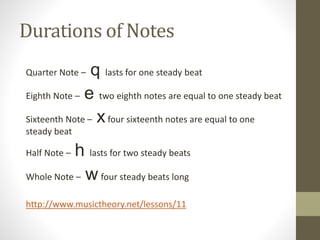
Quarter Note – q lasts for one steady beat
Eighth Note – e two eighth notes are equal to one steady beat
Sixteenth Note – xfour sixteenth notes are equal to one
steady beat
Half Note – h lasts for two steady beats
Whole Note – w four steady beats long
http://www.musictheory.net/lessons/11
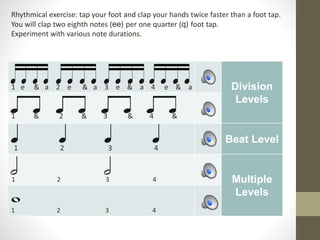
Division
Levels
Beat Level
Multiple
Levels
Rhythmical exercise: tap your foot and clap your hands twice faster than a foot tap.
You will clap two eighth notes (ee) per one quarter (q) foot tap.
Experiment with various note durations.
1 2 3 4
1 & 2 & 3 & 4 &
1 e & a 2 e & a 3 e & a 4 e & a
1 2 3 4
1 2 3 4
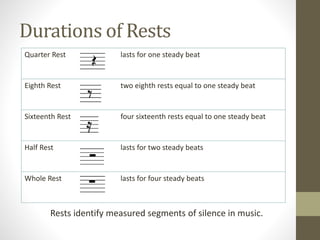
Quarter Rest lasts for one steady beat
Eighth Rest two eighth rests equal to one steady beat
Sixteenth Rest four sixteenth rests equal to one steady beat
Half Rest lasts for two steady beats
Whole Rest lasts for four steady beats
Durations of Rests
Rests identify measured segments of silence in music.
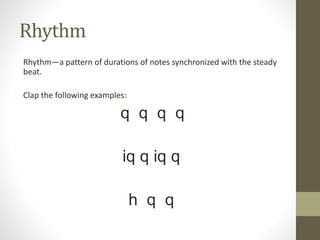
Rhythm
Rhythm—a pattern of durations of notes synchronized with the steady
beat.
Clap the following examples:
q q q q
iq q iq q
h q q
Meter
Arrangement of rhythms in a repetitive pattern of strong and
weak beats.
Meters can be classified by counting the number of beats from
one strong beat to the next.
Simple Meters
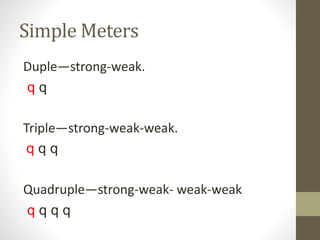
Duple—strong-weak.
q q
Triple—strong-weak-weak.
q q q
Quadruple—strong-weak- weak-weak
q q q q
Measure
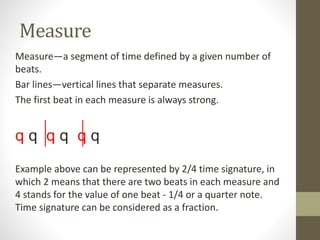
Measure—a segment of time defined by a given number of
beats.
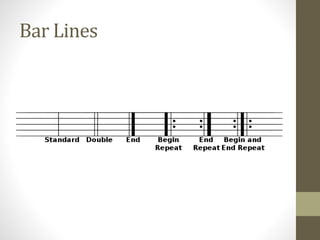
Bar lines—vertical lines that separate measures.
The first beat in each measure is always strong.
q q q q q q
Example above can be represented by 2/4 time signature, in
which 2 means that there are two beats in each measure and
4 stands for the value of one beat - 1/4 or a quarter note.
Time signature can be considered as a fraction.
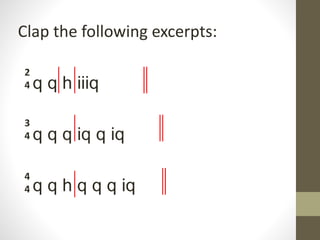
Clap the following excerpts:
q q h iiiq
q q q iq q iq
q q h q q q iq
2
4
3
4
4
4
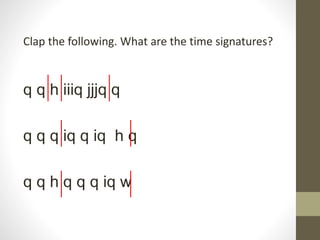
Clap the following. What are the time signatures?
q q h iiiq jjjq q
q q q iq q iq h q
q q h q q q iq w
Bar Lines
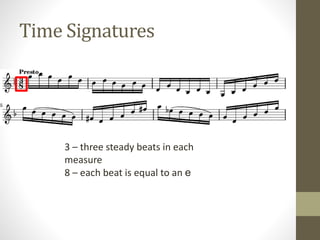
Time Signatures
3 – three steady beats in each
measure
8 – each beat is equal to an e
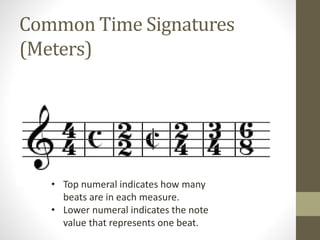
Common Time Signatures
(Meters)
• Top numeral indicates how many
beats are in each measure.
• Lower numeral indicates the note
value that represents one beat.
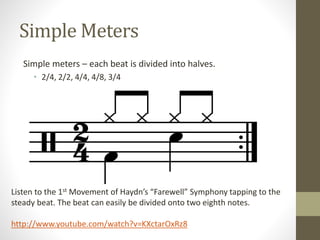
Simple Meters
Simple meters – each beat is divided into halves.
• 2/4, 2/2, 4/4, 4/8, 3/4
Listen to the 1st Movement of Haydn’s “Farewell” Symphony tapping to the
steady beat. The beat can easily be divided onto two eighth notes.
http://www.youtube.com/watch?v=KXctarOxRz8
Compound Meters
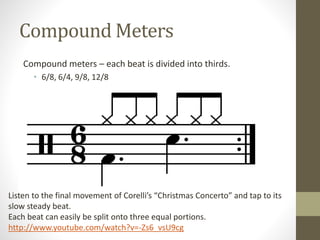
Compound meters – each beat is divided into thirds.
• 6/8, 6/4, 9/8, 12/8
Listen to the final movement of Corelli’s “Christmas Concerto” and tap to its
slow steady beat.
Each beat can easily be split onto three equal portions.
http://www.youtube.com/watch?v=-Zs6_vsU9cg
Conducting
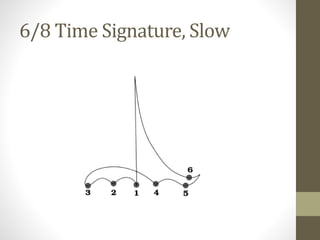
Conductors use hand patterns to communicate meters (time
signatures).
This helps musicians to follow and play together.
http://www.youtube.com/watch?v=79Pk-33R2HM
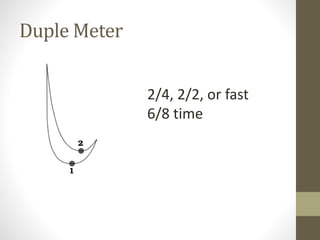
Duple Meter
2/4, 2/2, or fast
6/8 time
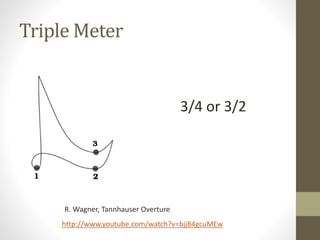
Triple Meter
3/4 or 3/2
http://www.youtube.com/watch?v=bjj84gcuMEw
R. Wagner, Tannhauser Overture
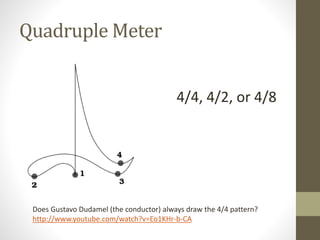
Quadruple Meter
4/4, 4/2, or 4/8
Does Gustavo Dudamel (the conductor) always draw the 4/4 pattern?
http://www.youtube.com/watch?v=Eo1KHr-b-CA
6/8 Time Signature, Slow
Syncopation
A disruption of the regular flow of rhythm, a replacement of
stresses to where they would not occur.
Please study the following.
https://www.teoria.com/reference/s/syncopation.php?l=S
Listening Activity
Listen to and conduct to the samples on this page.
http://www.gmajormusictheory.org/Listening/meters/meters.ht
ml
Required Readings
• http://en.wikipedia.org/wiki/Time_signature
• http://www.musictheory.net/lessons - read Note
Duration and Measures and Time Signature in the
Basics area
• http://www.musictheory.net/lessons/15

Rhythm and Meter

  • 1.
  • 2.
    Steady Beat Steady beat– the pulse of music. Tap to the steady beat in the following excerpts. http://magnatune.com/artists/albums/lara-bach/ http://magnatune.com/artists/albums/streicher-klaviertrios/ You will notice that some notes are equal to the steady beat, some are longer, and some are shorter.
  • 3.
    Durations of Notes QuarterNote – q lasts for one steady beat Eighth Note – e two eighth notes are equal to one steady beat Sixteenth Note – xfour sixteenth notes are equal to one steady beat Half Note – h lasts for two steady beats Whole Note – w four steady beats long http://www.musictheory.net/lessons/11
  • 4.
    Division Levels Beat Level Multiple Levels Rhythmical exercise:tap your foot and clap your hands twice faster than a foot tap. You will clap two eighth notes (ee) per one quarter (q) foot tap. Experiment with various note durations. 1 2 3 4 1 & 2 & 3 & 4 & 1 e & a 2 e & a 3 e & a 4 e & a 1 2 3 4 1 2 3 4
  • 5.
    Quarter Rest lastsfor one steady beat Eighth Rest two eighth rests equal to one steady beat Sixteenth Rest four sixteenth rests equal to one steady beat Half Rest lasts for two steady beats Whole Rest lasts for four steady beats Durations of Rests Rests identify measured segments of silence in music.
  • 6.
    Rhythm Rhythm—a pattern ofdurations of notes synchronized with the steady beat. Clap the following examples: q q q q iq q iq q h q q
  • 7.
    Meter Arrangement of rhythmsin a repetitive pattern of strong and weak beats. Meters can be classified by counting the number of beats from one strong beat to the next.
  • 8.
    Simple Meters Duple—strong-weak. q q Triple—strong-weak-weak. qq q Quadruple—strong-weak- weak-weak q q q q
  • 9.
    Measure Measure—a segment oftime defined by a given number of beats. Bar lines—vertical lines that separate measures. The first beat in each measure is always strong. q q q q q q Example above can be represented by 2/4 time signature, in which 2 means that there are two beats in each measure and 4 stands for the value of one beat - 1/4 or a quarter note. Time signature can be considered as a fraction.
  • 10.
    Clap the followingexcerpts: q q h iiiq q q q iq q iq q q h q q q iq 2 4 3 4 4 4
  • 11.
    Clap the following.What are the time signatures? q q h iiiq jjjq q q q q iq q iq h q q q h q q q iq w
  • 12.
  • 13.
    Time Signatures 3 –three steady beats in each measure 8 – each beat is equal to an e
  • 14.
    Common Time Signatures (Meters) •Top numeral indicates how many beats are in each measure. • Lower numeral indicates the note value that represents one beat.
  • 15.
    Simple Meters Simple meters– each beat is divided into halves. • 2/4, 2/2, 4/4, 4/8, 3/4 Listen to the 1st Movement of Haydn’s “Farewell” Symphony tapping to the steady beat. The beat can easily be divided onto two eighth notes. http://www.youtube.com/watch?v=KXctarOxRz8
  • 16.
    Compound Meters Compound meters– each beat is divided into thirds. • 6/8, 6/4, 9/8, 12/8 Listen to the final movement of Corelli’s “Christmas Concerto” and tap to its slow steady beat. Each beat can easily be split onto three equal portions. http://www.youtube.com/watch?v=-Zs6_vsU9cg
  • 17.
    Conducting Conductors use handpatterns to communicate meters (time signatures). This helps musicians to follow and play together. http://www.youtube.com/watch?v=79Pk-33R2HM
  • 18.
    Duple Meter 2/4, 2/2,or fast 6/8 time
  • 19.
    Triple Meter 3/4 or3/2 http://www.youtube.com/watch?v=bjj84gcuMEw R. Wagner, Tannhauser Overture
  • 20.
    Quadruple Meter 4/4, 4/2,or 4/8 Does Gustavo Dudamel (the conductor) always draw the 4/4 pattern? http://www.youtube.com/watch?v=Eo1KHr-b-CA
  • 21.
  • 22.
    Syncopation A disruption ofthe regular flow of rhythm, a replacement of stresses to where they would not occur. Please study the following. https://www.teoria.com/reference/s/syncopation.php?l=S
  • 23.
    Listening Activity Listen toand conduct to the samples on this page. http://www.gmajormusictheory.org/Listening/meters/meters.ht ml
  • 24.
    Required Readings • http://en.wikipedia.org/wiki/Time_signature •http://www.musictheory.net/lessons - read Note Duration and Measures and Time Signature in the Basics area • http://www.musictheory.net/lessons/15

Editor's Notes

  • #13 Barlines. Authored by: Mets501. Located at: https://commons.wikimedia.org/wiki/File:Barlines.svg. License: CC BY-SA
  • #14 Presto. Authored by: Wikipedia. Located at: https://he.wikipedia.org/wiki/%D7%A2%D7%96%D7%A8%D7%94:%D7%AA%D7%95%D7%95%D7%99%D7%9D. License: CC BY-SA
  • #15 Common time signatures. Authored by: Anonymous Located at: https://en.wikipedia.org/wiki/File:Common_time_signatures.gif. License: Public Domain
  • #16 Simple duple drum pattern. Authored by: Anonymous. Located at: https://en.wikipedia.org/wiki/File:Simple_duple_drum_pattern.png. License: Public Domain
  • #17 Compound duple drum pattern. Authored by: Hyacinth. Located at: https://commons.wikimedia.org/wiki/File:Compound_duple_drum_pattern.png. License: Public Domain
  • #19 Conducting 2/4 Time. Authored by: Hankwang. Located at: https://en.wikipedia.org/wiki/File:Conducting-24time.svg. License: CC BY-SA
  • #20 Conducting 3/4 Time. Authored by: Hankwang. Located at: https://en.wikipedia.org/wiki/File:Conducting-34time.svg. License: CC BY-SA
  • #21 Conducting 4/4 Time. Authored by: Hankwang. Located at: https://en.wikipedia.org/wiki/File:Conducting-44time.svg. License: CC BY-SA
  • #22 Conducting 6/8 Time. Authored by: Hankwang. Located at: https://en.wikipedia.org/wiki/File:Conducting-68time.svg. License: CC BY-SA