Basic concepts 1
Physical chemistry
for Textile
6. Thermodynamics
L10: State of system, First law
Basic concepts 2
System and Surrounding
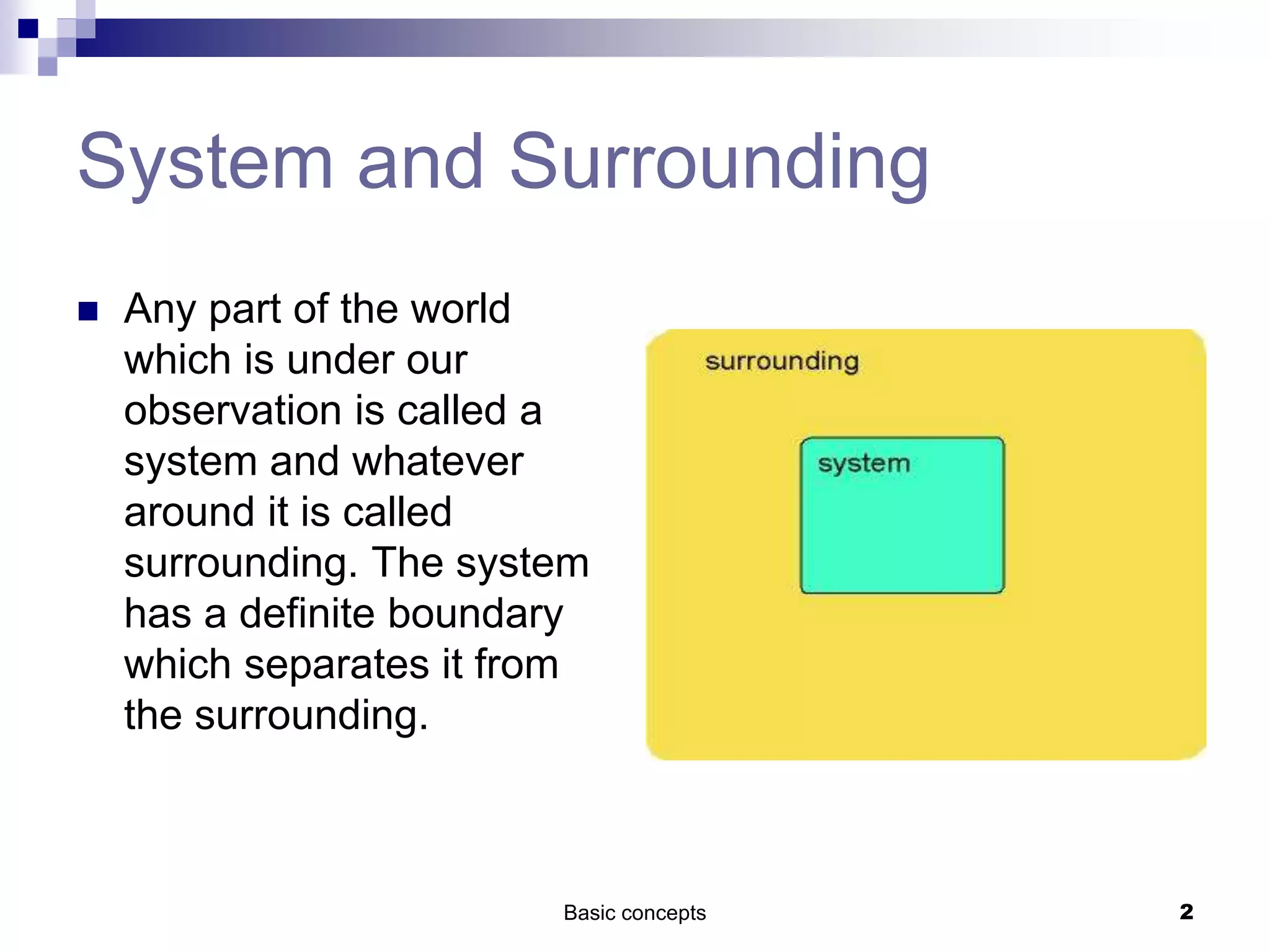
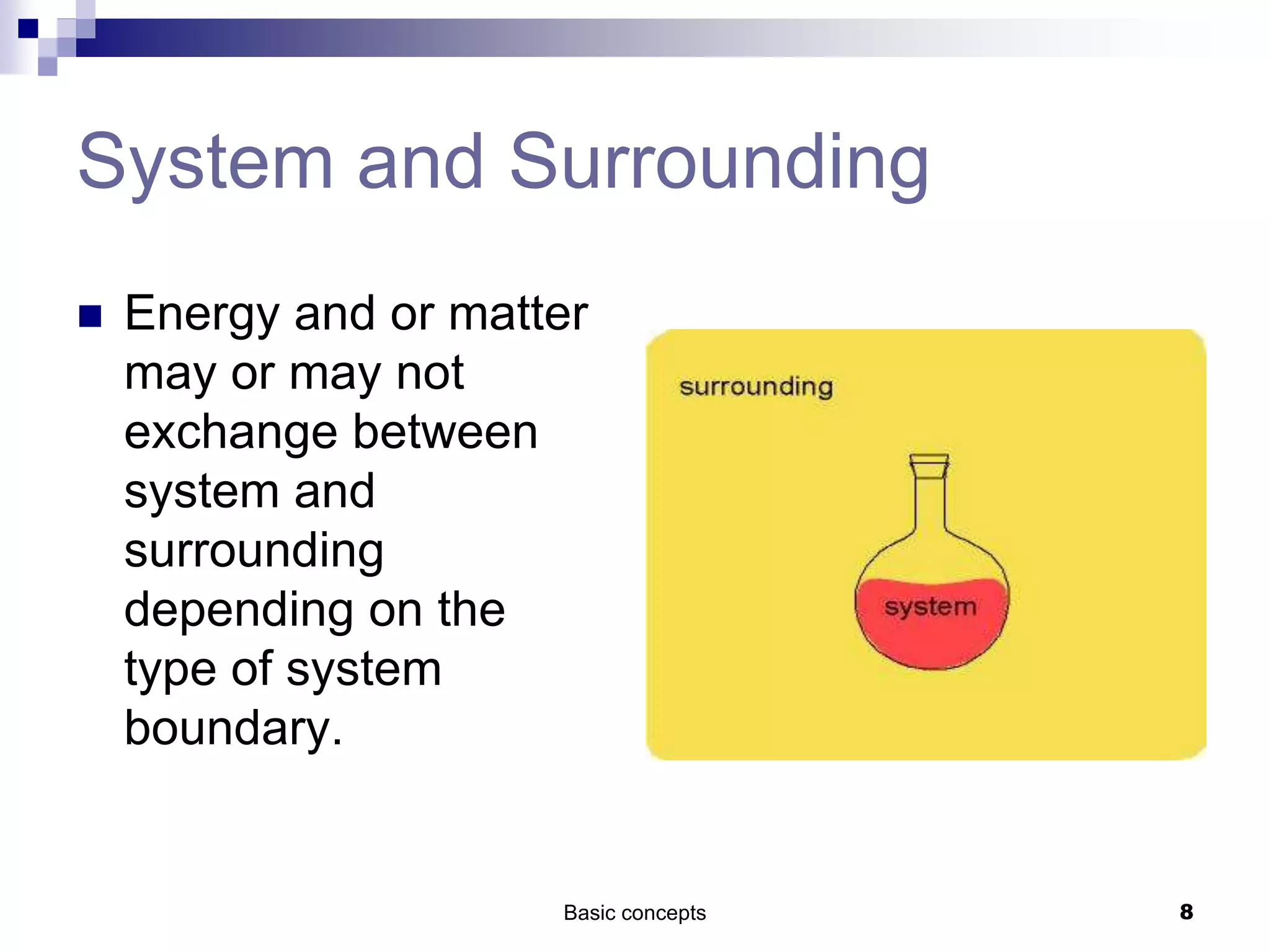
 Any part of the world
which is under our
observation is called a
system and whatever
around it is called
surrounding. The system
has a definite boundary
which separates it from
the surrounding.
System and Surrounding
 A bird is a system
which is separated
from its surrounding
by its skin and
fethers.
 It exchanges both
energy and matter
with its environment.
Basic concepts 3
System and Surrounding
 If earth is
considered as a
system,
everything around
its surrounding.
 It exchanges
energy with the
environment but
not matter.
Basic concepts 4
System and Surrounding
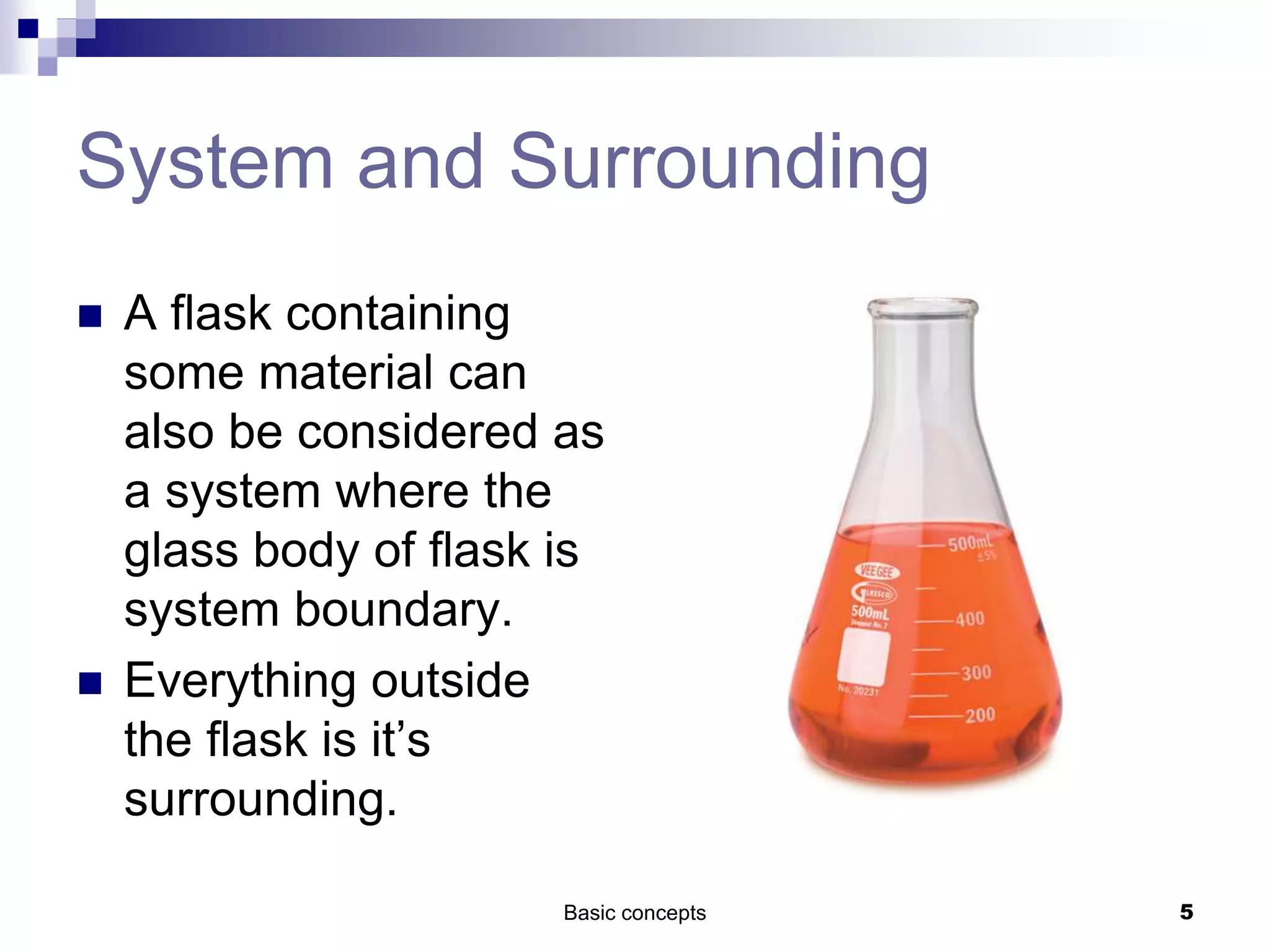
 A flask containing
some material can
also be considered as
a system where the
glass body of flask is
system boundary.
 Everything outside
the flask is it’s
surrounding.
Basic concepts 5
System and Surrounding
 Sometimes the
system may not have
a definite boundary.
For example: a cube
of dry ice. The dry ice
diffuses into the air
without melting at a
temperature of -78.5
°C.
Basic concepts 6
System and Surrounding
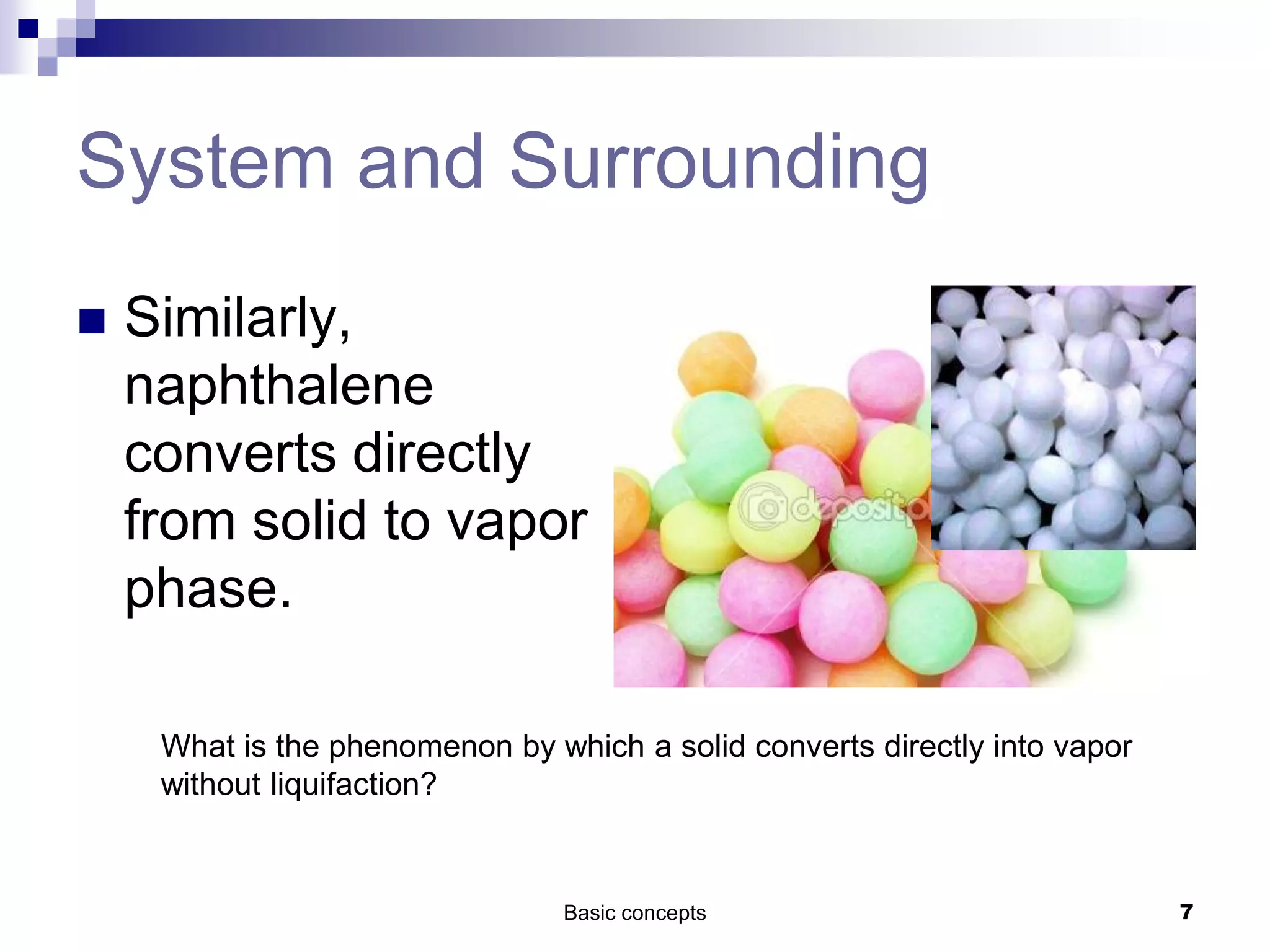
 Similarly,
naphthalene
converts directly
from solid to vapor
phase.
Basic concepts 7
What is the phenomenon by which a solid converts directly into vapor
without liquifaction?
Basic concepts 8
System and Surrounding
 Energy and or matter
may or may not
exchange between
system and
surrounding
depending on the
type of system
boundary.
Definitions of System
 Depending on the
properties of system
boundary the systems
may be divided in
three different kinds.
Open system
Closed system
Isolated system
Basic concepts 9
Basic concepts 10
Open system
 Open system is the
system in which both
energy and matter
can move across the
boundary of system.
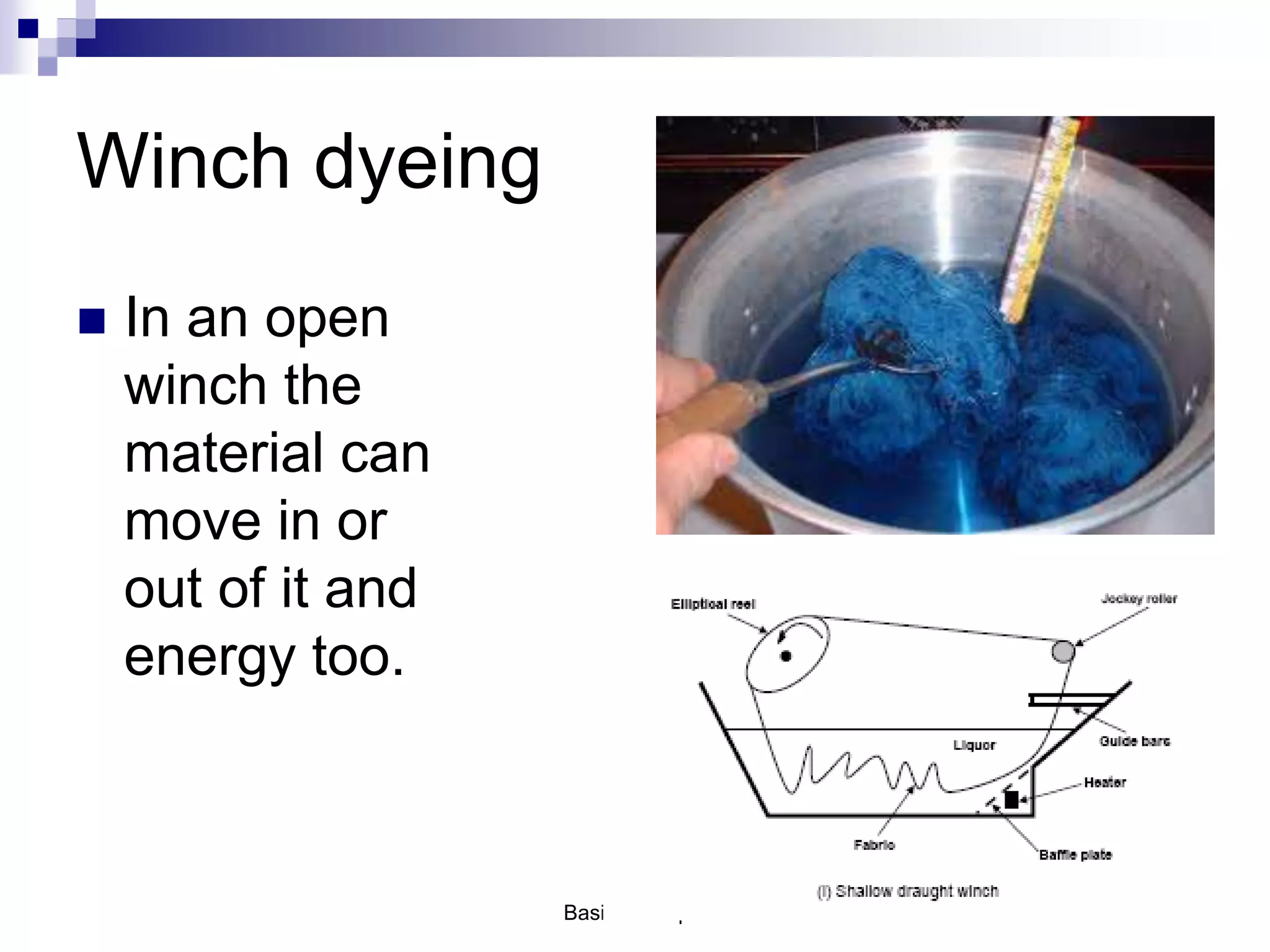
Winch dyeing
 In an open
winch the
material can
move in or
out of it and
energy too.
Basic concepts 11
Basic concepts 12
Closed system
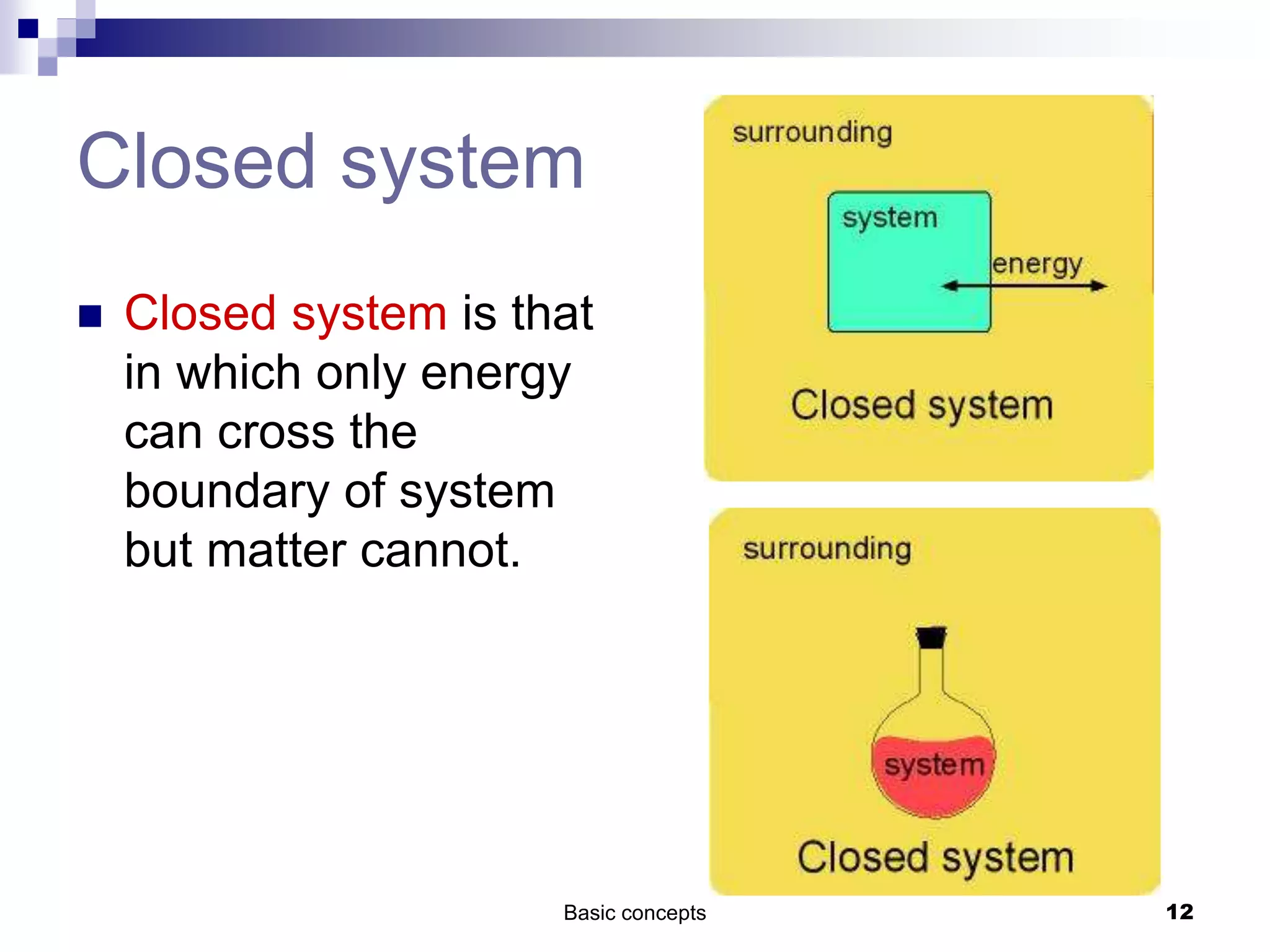
 Closed system is that
in which only energy
can cross the
boundary of system
but matter cannot.
Closed system
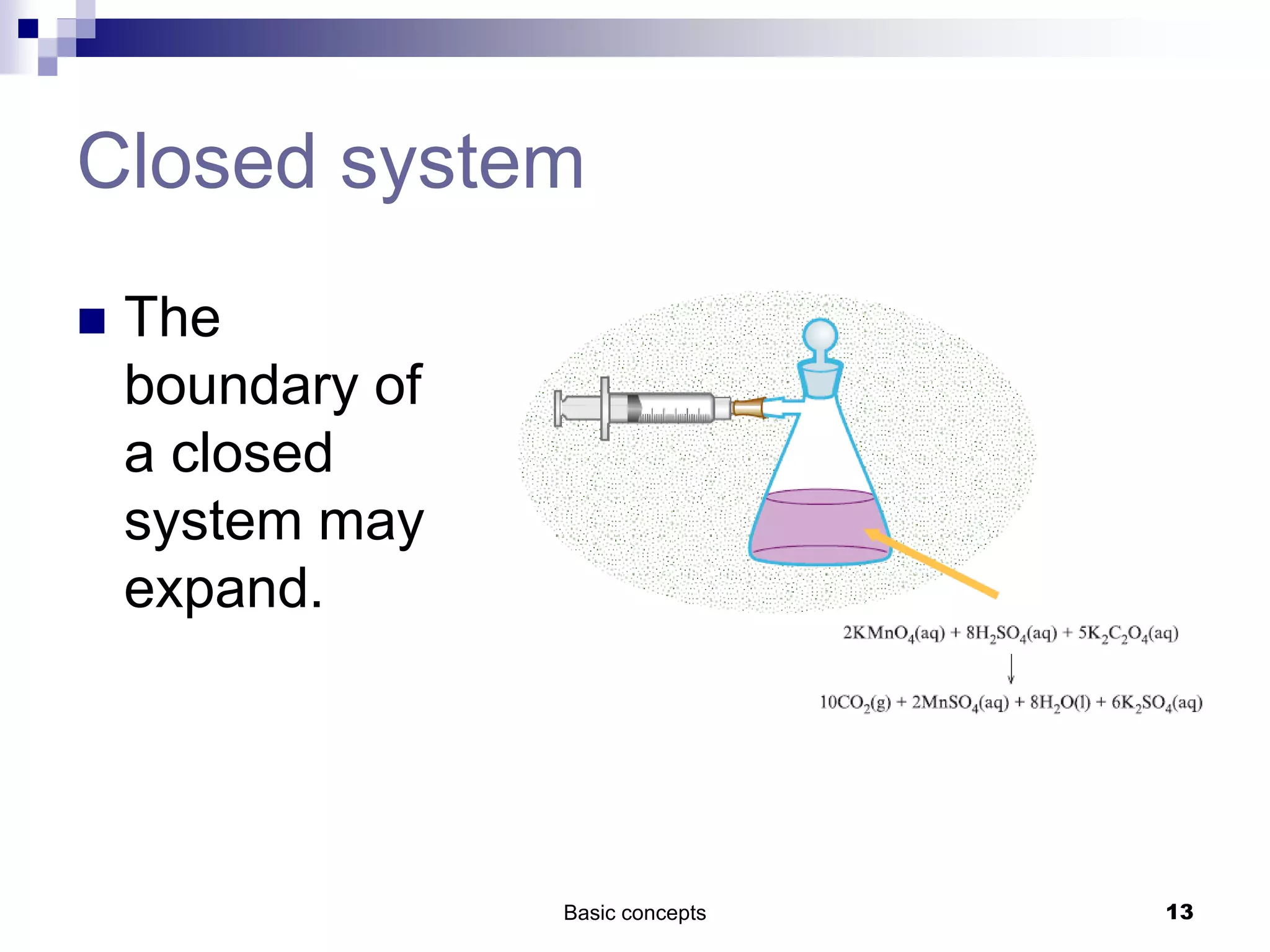
 The
boundary of
a closed
system may
expand.
Basic concepts 13
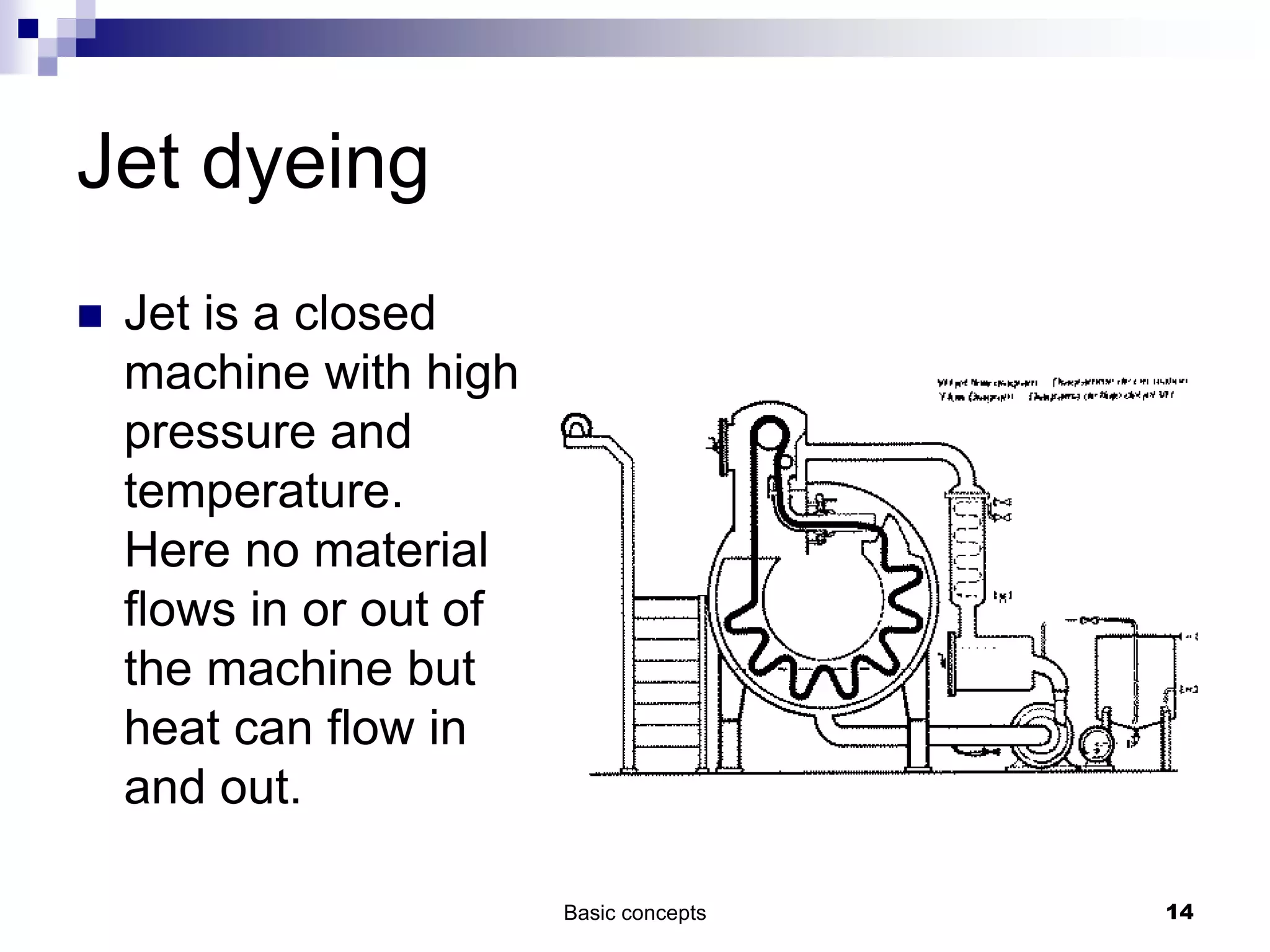
Jet dyeing
Basic concepts 14
 Jet is a closed
machine with high
pressure and
temperature.
Here no material
flows in or out of
the machine but
heat can flow in
and out.
Basic concepts 15
Isolated
system
 Isolated system the
system in which
neither matter nor
energy can cross the
system boundary.
Basic concepts 16
Comparison of systems
Basic concepts 17
State of a system
 State of a system is the condition of
the system defined by certain set of
properties. For instance the volume,
pressure and temperature of a
system defines a certain state of
that system. If for example the
pressure on a system is reduced,
the volume will increase and the
system is said to be in a new state.
 Similarly if the temperature of the
system is increased the volume will
increase and the state of system will
change.
 When the set of properties defining
the state of a system are known, the
system is said to be in a definite
state.
Basic concepts 18
Properties of state of system
 The properties which
determine the state of a
system are called state
properties.
 State properties such as
temperature, pressure and
volume have major
significance. However there
are other state properties also
such as it’s composition.
 If the pressure, temperature ,
volume or other state
properties of a system are
known then the system is said
to be in a definite state.
Properties of state of system
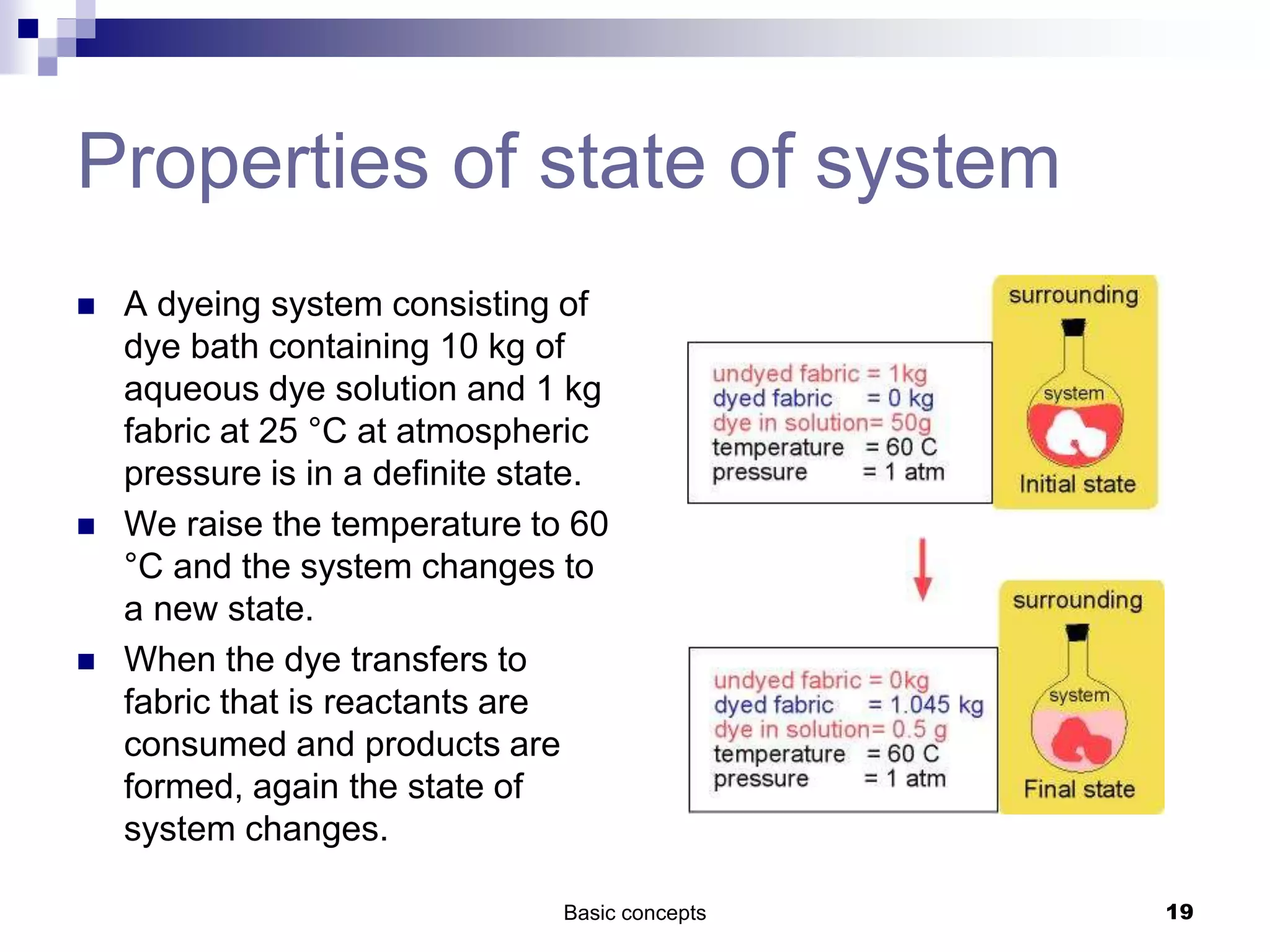
 A dyeing system consisting of
dye bath containing 10 kg of
aqueous dye solution and 1 kg
fabric at 25 °C at atmospheric
pressure is in a definite state.
 We raise the temperature to 60
°C and the system changes to
a new state.
 When the dye transfers to
fabric that is reactants are
consumed and products are
formed, again the state of
system changes.
Basic concepts 19
Law of conservation of energy
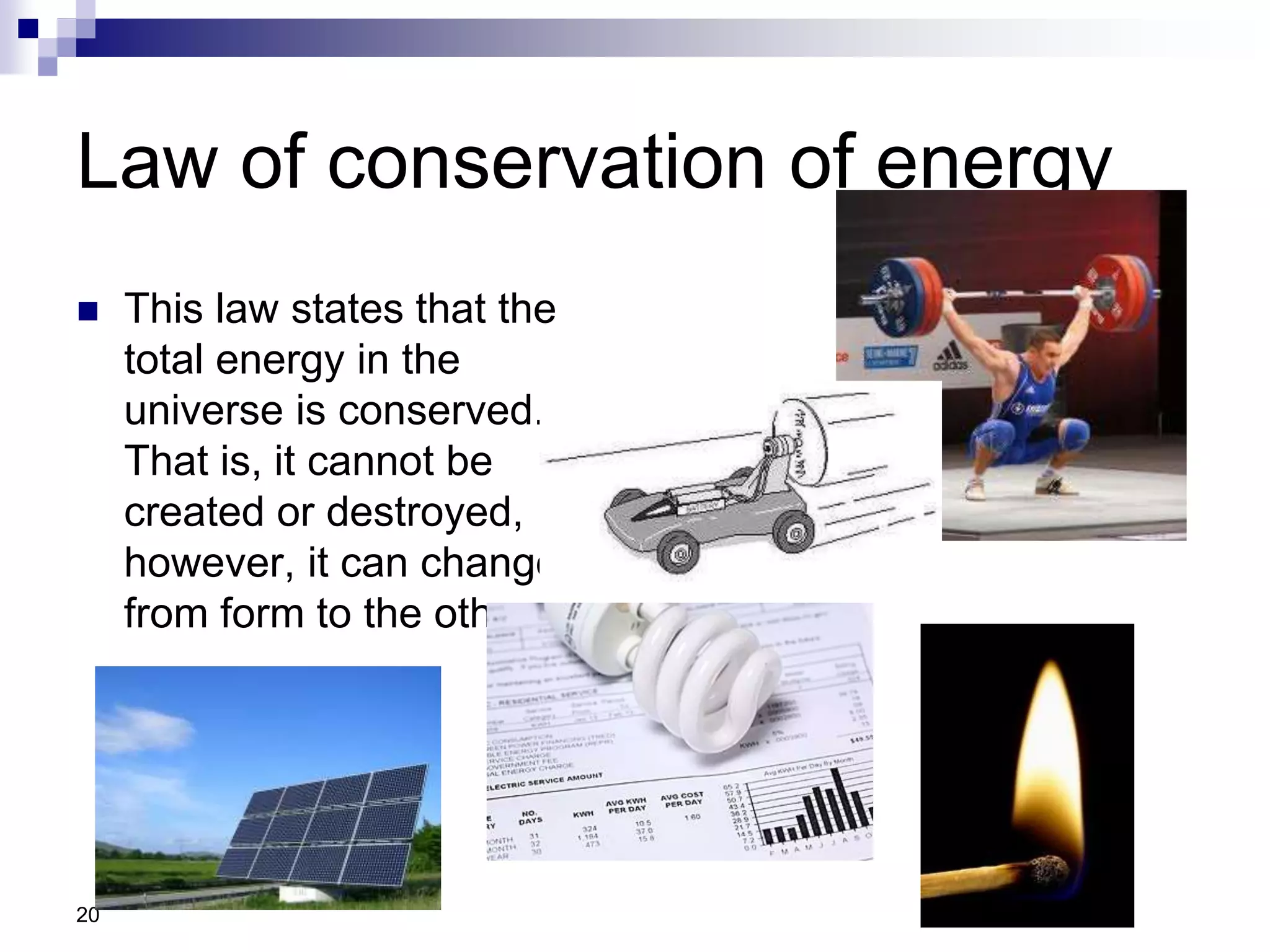
 This law states that the
total energy in the
universe is conserved.
That is, it cannot be
created or destroyed,
however, it can change
from form to the other.
20
Internal energy
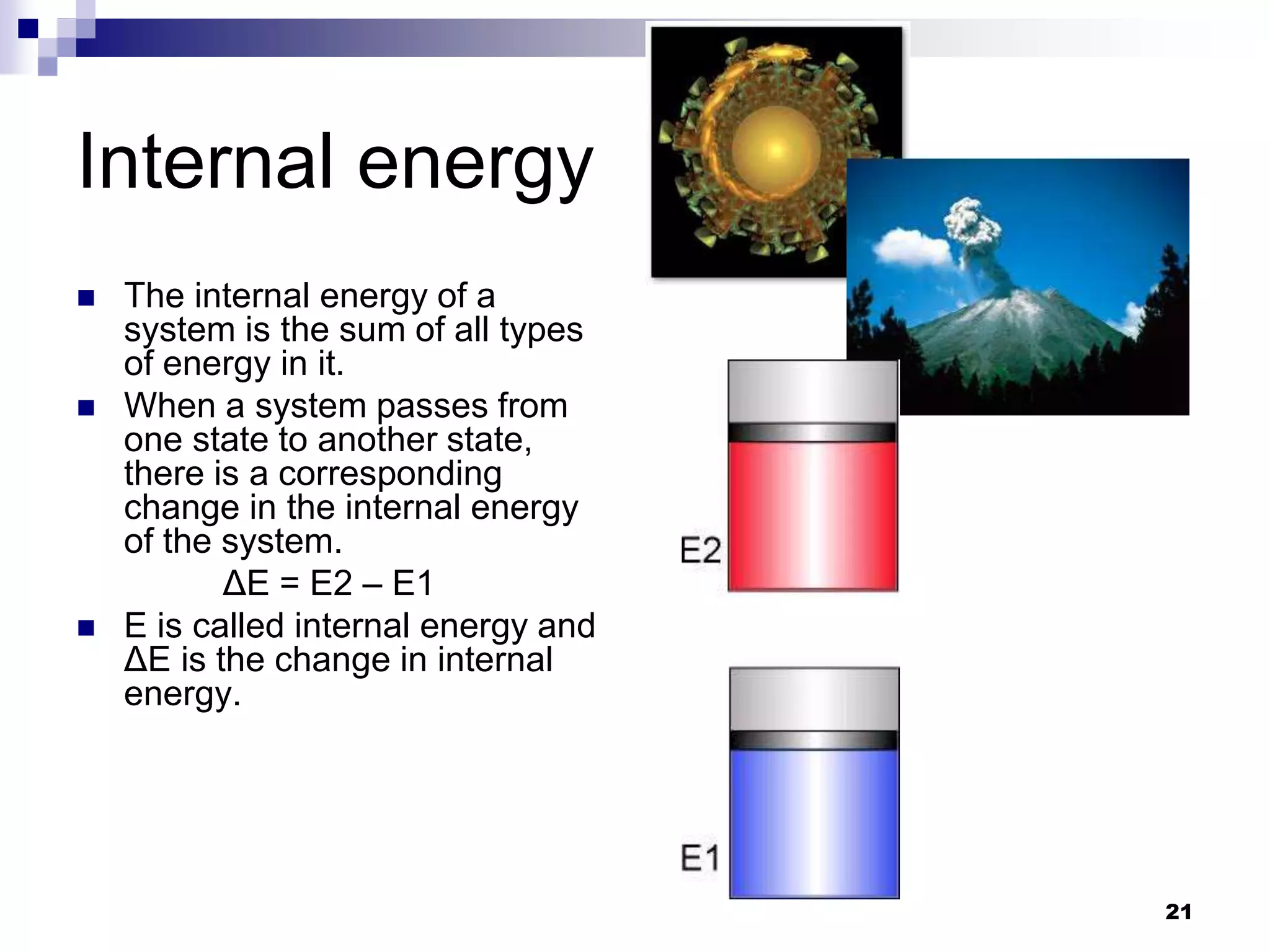
 The internal energy of a
system is the sum of all types
of energy in it.
 When a system passes from
one state to another state,
there is a corresponding
change in the internal energy
of the system.
ΔE = E2 – E1
 E is called internal energy and
ΔE is the change in internal
energy.
21
Internal energy
 A system containing calcium oxide (CaO) and water
(H2O) has some internal energy in the form of chemical
energy at the beginning of reaction. As the reaction
proceeds and reactants change into Ca(OH)2, a large
amount of heat energy is evolved. As a result the
internal energy of the system reduces. The change in
energy can be calculated simply by subtracting the initial
state from final state.
22
CaO + H2O = Ca(OH)2 + heat
Internal energy – state function
 State functions are those properties of a
system which depend only on the state of
the system and not on the path they follow
to reach the final state.
 Since internal energy is a state function,
hence depends only on the state of the
system. Therefore any change in the
internal energy depends only on the initial
and final states of the system and is
represented by:
ΔE = E2 – E1
23
Internal energy – state function
 For instance, we consider the
following example:
If we have two identical
containers having equal
amounts of water in them.
 We heat one of the containers
to raise it’s temperature through
1˚C and simply stir the water in
other container so that it’s
temperature rises through 1˚C.
 At the end, the change in both
systems is exactly same and
independent of the fact how the
change was brought up.
24
Internal energy
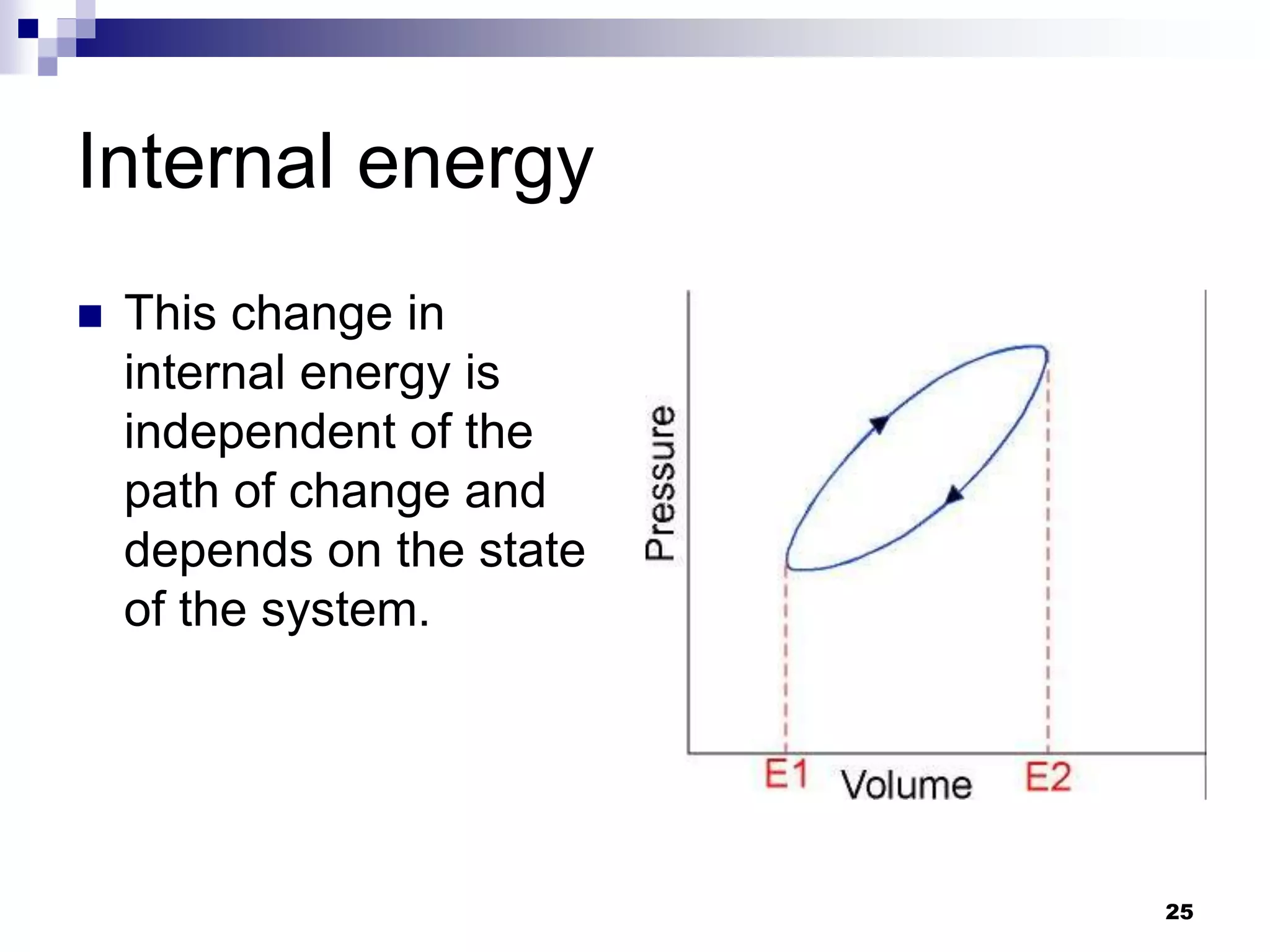
 This change in
internal energy is
independent of the
path of change and
depends on the state
of the system.
25
Internal energy
 Therefore the internal energy of a system
depends on the state of the system and
not on the path or the way how it was
brought about, that is:
ΔE = E2 – E1
 The properties of a system which depend
on the state of the system and not on the
path are called state functions.
26
Path dependence - Work
 Those properties of a system which
vary with the path taken to change the
state of system are path functions.
 The work, for example, vary with the
path taken to reach the final state
27
Change of state
 When a
system
passes from
one state to
the other
state, it may
lose or gain
energy as
heat or
work.
CaO + H2O = Ca(OH)2 + (-ΔH)
In the above instance the
heat content of product is
less than the reactants.
NaNO2 + H2O = Na++NO-
2 +
(+ΔH)
In this example the heat
content of product is less
than the reactants.28
Change of state
 Consider a gas confined in
a cylinder with a movable
piston. Now some heat is
transferred from
surrounding to the system.
This absorption of heat
energy may trigger two
processes:
 1. It may increase the
internal energy of the
system.
 2. Some of the heat
absorbed may be
consumed in doing P
ΔV work against
external pressure.
q = ΔE + w
29
Change of state
 A dyeing bath is heated
from room temperature to
100ºC. What changes will
occur in the final state if it
is an open system?
 What if the temperature
of dyeing bath is raised to
30ºC only?
q = ΔE + w
30
Change of state
 In chemical reactions
if some gaseous
product is formed or
gaseous reactants
change to liquid
product work is done
by the system or on
the system.
HCl + Zn = ZnCl2 +
H2
HCl + H2O =
H3O++Cl-
31
Change of state
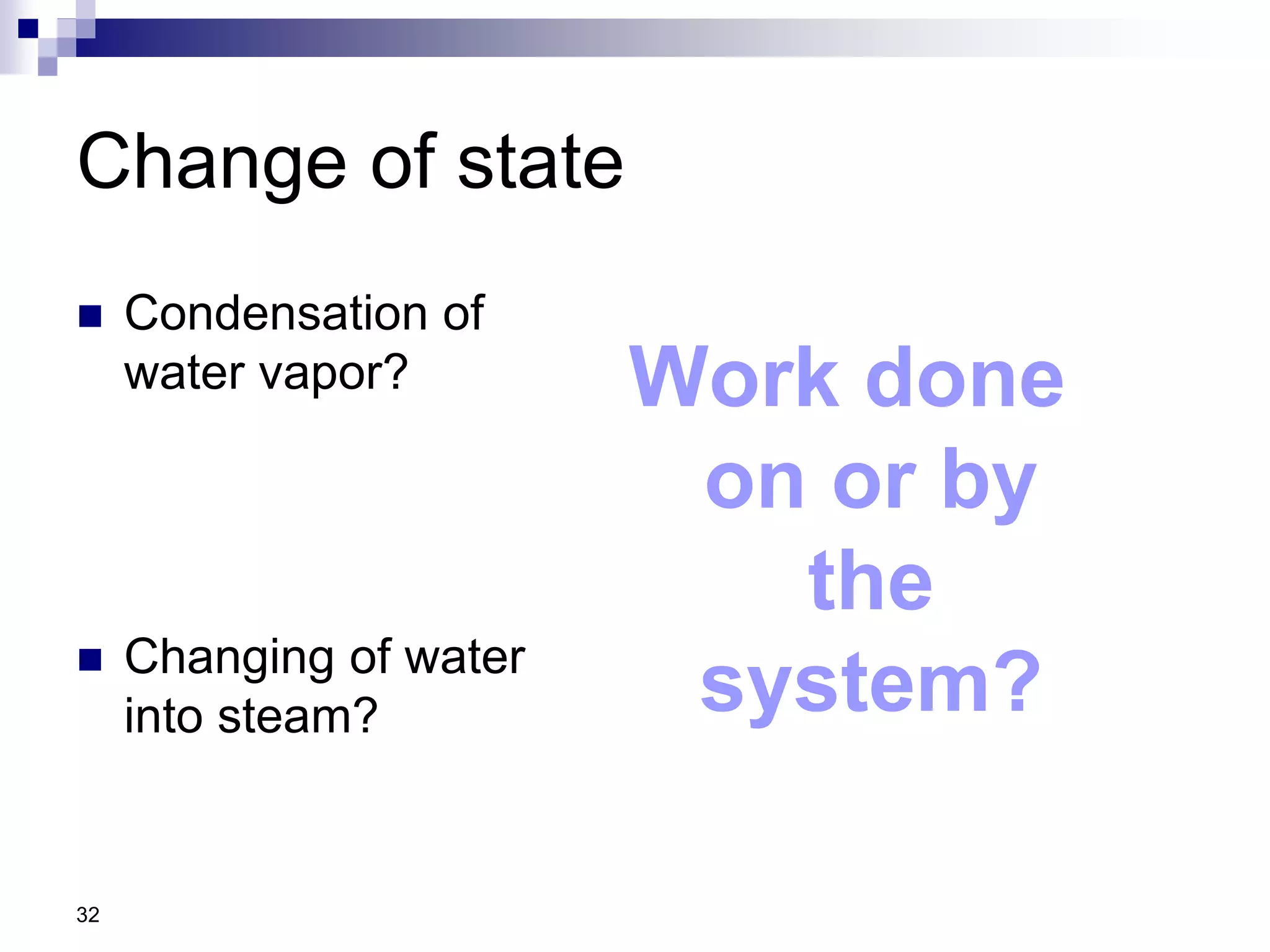
 Condensation of
water vapor?
 Changing of water
into steam?
Work done
on or by
the
system?
32
Relationship between internal energy, heat
and work
 The change in internal energy is given by
the equation:
q = ΔE + w
ΔE = q – w
Or = q – P ΔV
 There are certain conditions under which
heat and work terms become definite:
 Constant pressure and
 Constant volume
33
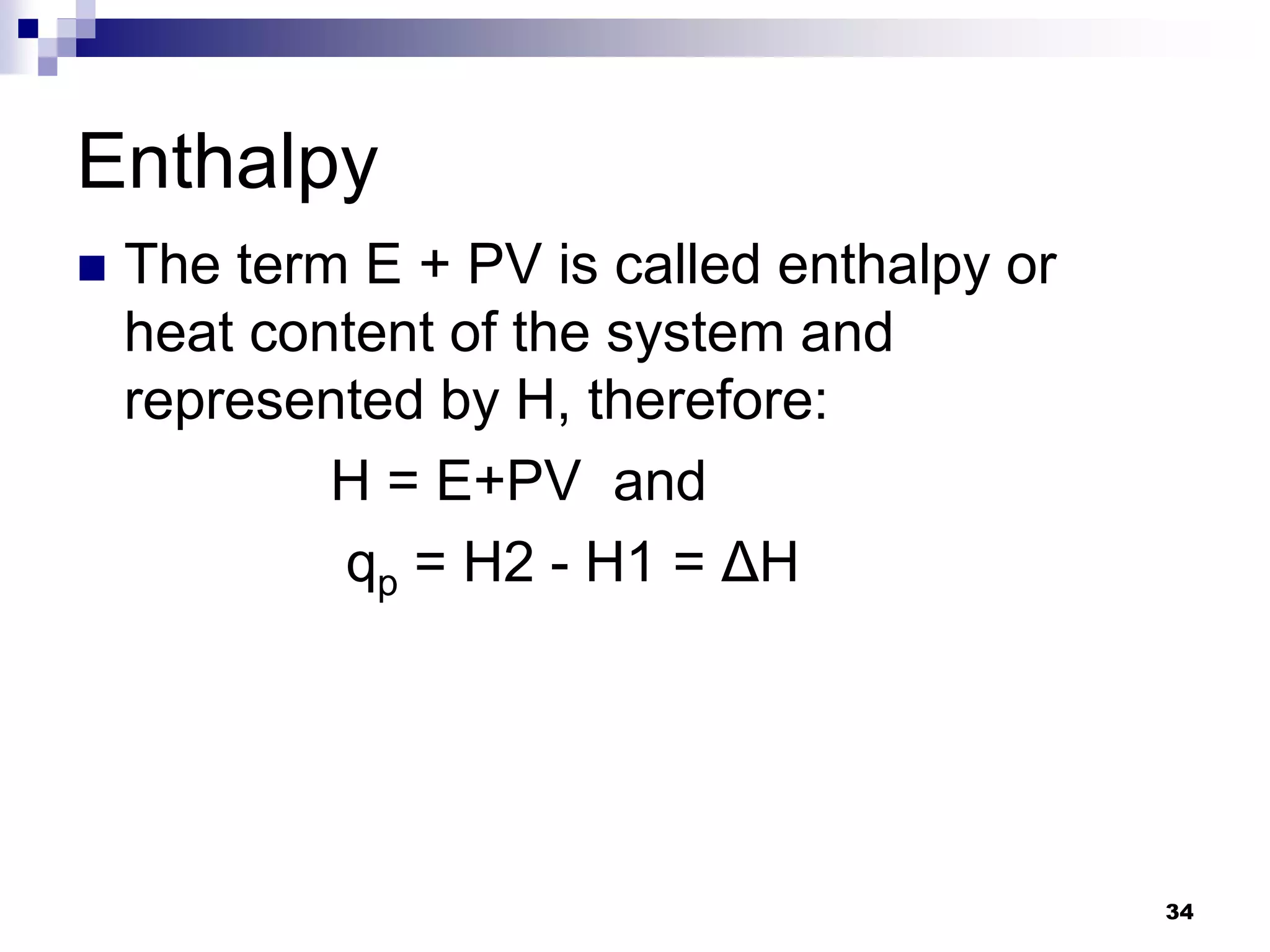
Enthalpy
 The term E + PV is called enthalpy or
heat content of the system and
represented by H, therefore:
H = E+PV and
qp = H2 - H1 = ΔH
34
The First law
 The first law of thermodynamics is
simply the statement of law of
conservation of energy, that is: The
energy cannot be created or
destroyed.
35
Specific heat
 If a system consists of 1g of a
substance and a definite
amount of heat is transferred to
it so that it’s temperature rises
by 1°C, the amount of heat thus
transferred is called it’s specific
heat.
The specific heat or specific
heat capacity of a substance is
the amount of heat required to
raise the temperature of 1 gram
of a substance by 1°C.
36
Heat capacity
Heat capacity of a system
is defined as the amount
of heat required to raise
the temperature of the
system by 1˚.
 The heat capacity of a
system is given by the
following equation:
C = specific heat x mass (g)
37
Heat capacity
 For e.g. if the temperature of
1000 kg of water is to be
raised by 1°C, the amount of
heat absorbed will be:
C = specific heat x mass (g)
= 1 cal/g °C x 1000 Kg x 1000
= 1000,000 cal/°C
= 1000 kcal/°C
38
Molar heat capacity
 If the system consists of 1
mole of a substance it is
called molar heat
capacity.
The molar heat capacity
is the amount of heat
required to raise the
temperature of 1 mole of
a substance through 1°.
39
Molar heat capacity
Find the mole of each of
following.
 Oxygen = ?
 Carbon dioxide = ?
 Methanol = ?
 Mole of ethanol = ?
 Mole of glycerine = ?
 Water = ?
 Copper = ?
 Iron = ?
Calculate the
molar heat
capacity of
each of these
from specific
heat data.
40
Heat capacity
 Since the heat capacity C may vary with
temperature, it is written in the form:
C = q/dT
 Here q is an infinitesimally small amount of
heat absorbed by the system when the
temperature is raised by dT degrees.
 Since q is an indefinite quantity unless
certain conditions are defined, hence, it is
normally defined at constant pressure or
constant volume.
41
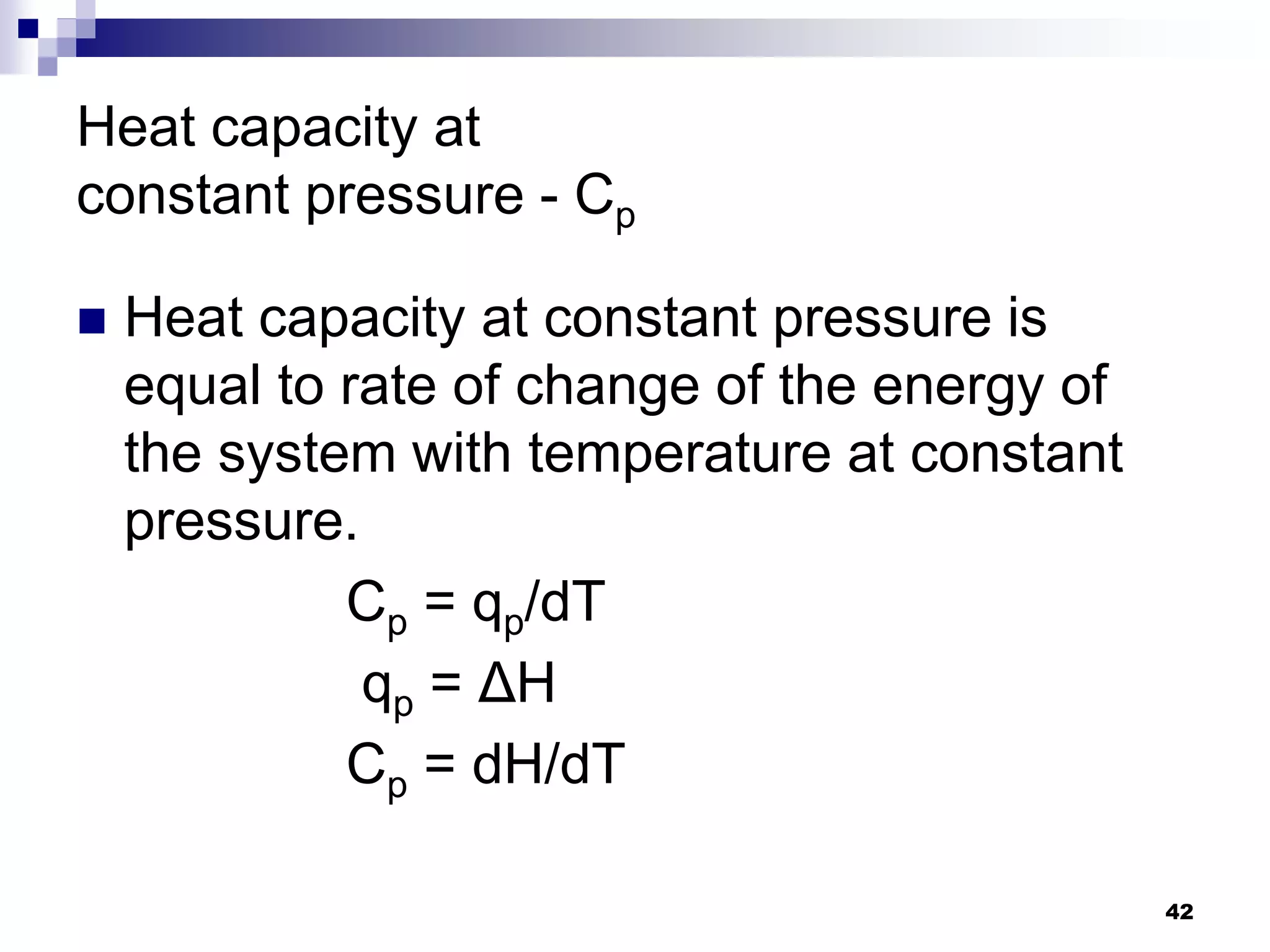
Heat capacity at
constant pressure - Cp
 Heat capacity at constant pressure is
equal to rate of change of the energy of
the system with temperature at constant
pressure.
Cp = qp/dT
qp = ΔH
Cp = dH/dT
42
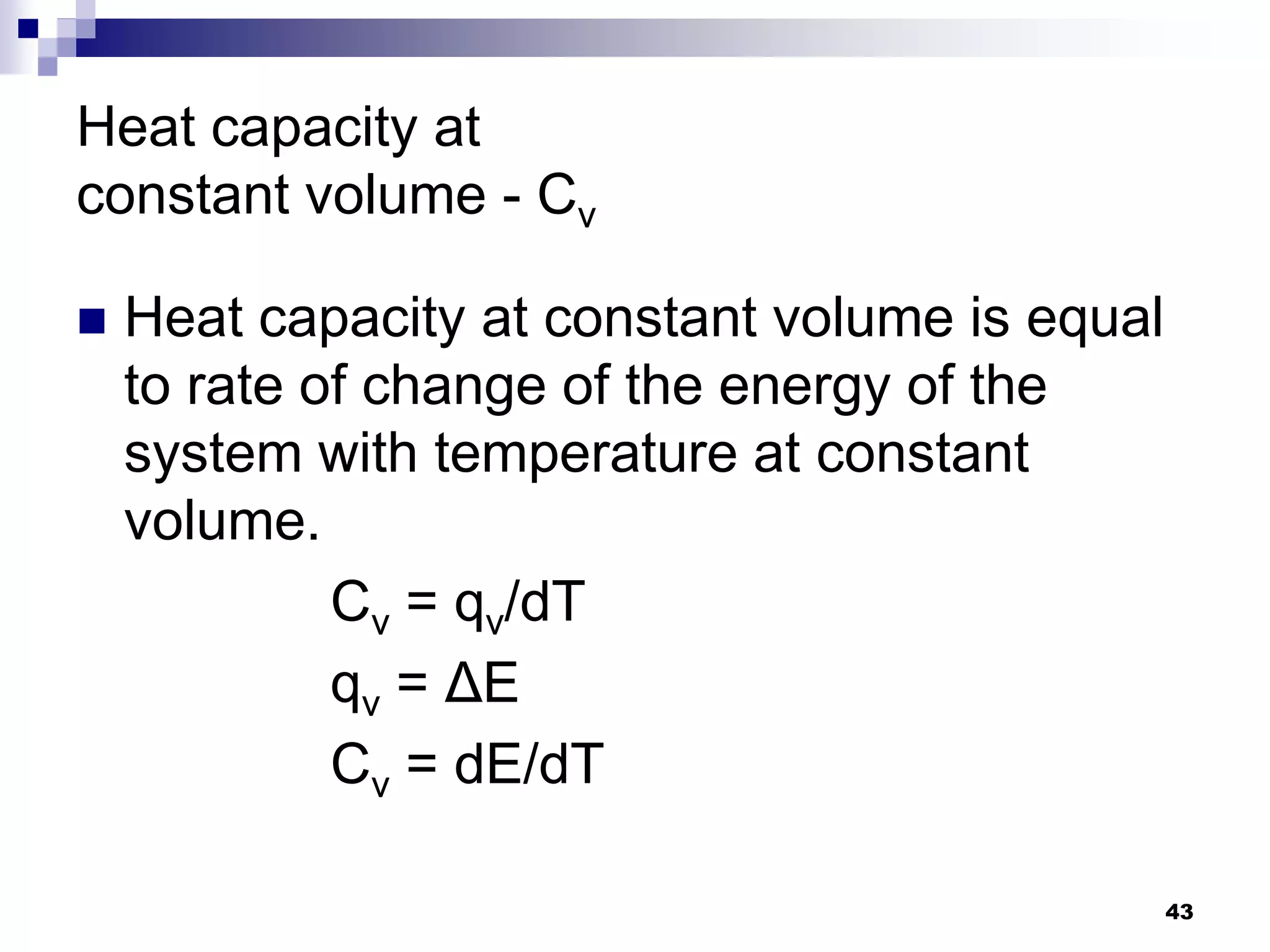
Heat capacity at
constant volume - Cv
 Heat capacity at constant volume is equal
to rate of change of the energy of the
system with temperature at constant
volume.
Cv = qv/dT
qv = ΔE
Cv = dE/dT
43
Difference of Cv and Cp
 In case of Cp, some of the
energy absorbed will be
consumed in doing work
against the surrounding and
rest of it will raise the internal
energy.
 However in case of Cv, no
work is done by the system.
 Hence for a similar system the
energy required in case of Cp
will be greater than in Cv.
44
Importance of thermal data
 We can calculate the
amount of heat
required to gain the
required temperature
of system of definite
properties.
 We can calculate the
cost of heating.
How the heat of
dyeing can be
calculated?
How the energy
cost of dyeing
can be
calculated?
45
Importance of thermal data
 Different materials
have different specific
heat capacity. Hence
two materials having
different specific heat
capacities on
absorbing the same
amount under the
same condition
achieve different
temperatures.
 Observe
temperatures of
different objects
placed in sunlight.
46
Wood
Iron body of a car
Water
A plastic bottle
Wool
Cotton
polyester
Importance of thermal data
 If cotton and polyester
fabrics are placed
under sun under the
same conditions, why
the temperature of
polyester rises above
that of cotton.
Why it happens
so?
 This is one of the
reasons why
wearing pure
polyester in hot
weather is
uncomfortable
while cotton is
more comfortable.
47
Problem 1
 Determine the heat capacity of 100 kg
of water in kJ/kg-K. The specific heat
of water is 1 cal/g. The conversion
factor to convert cal to Joule is 4.184.
 What difference in Cp and Cv for the
above system do you expect.
48
Problem 2
 If a piece of wood and that of iron of
same mass are put in environment
under the same condition, iron will
gain higher temperature than wood.
What is the reason of this
phenomenon.
49
Problem 3
 How many calories are required to
heat each of the following from 15 to
65 ˚C:
550 gram of water
1 kg of Polyester
1 kg of Nylon
1 kg of cotton
50
Which system?
 A classroom?  Open
 Closed
 isolated
Basic concepts 51
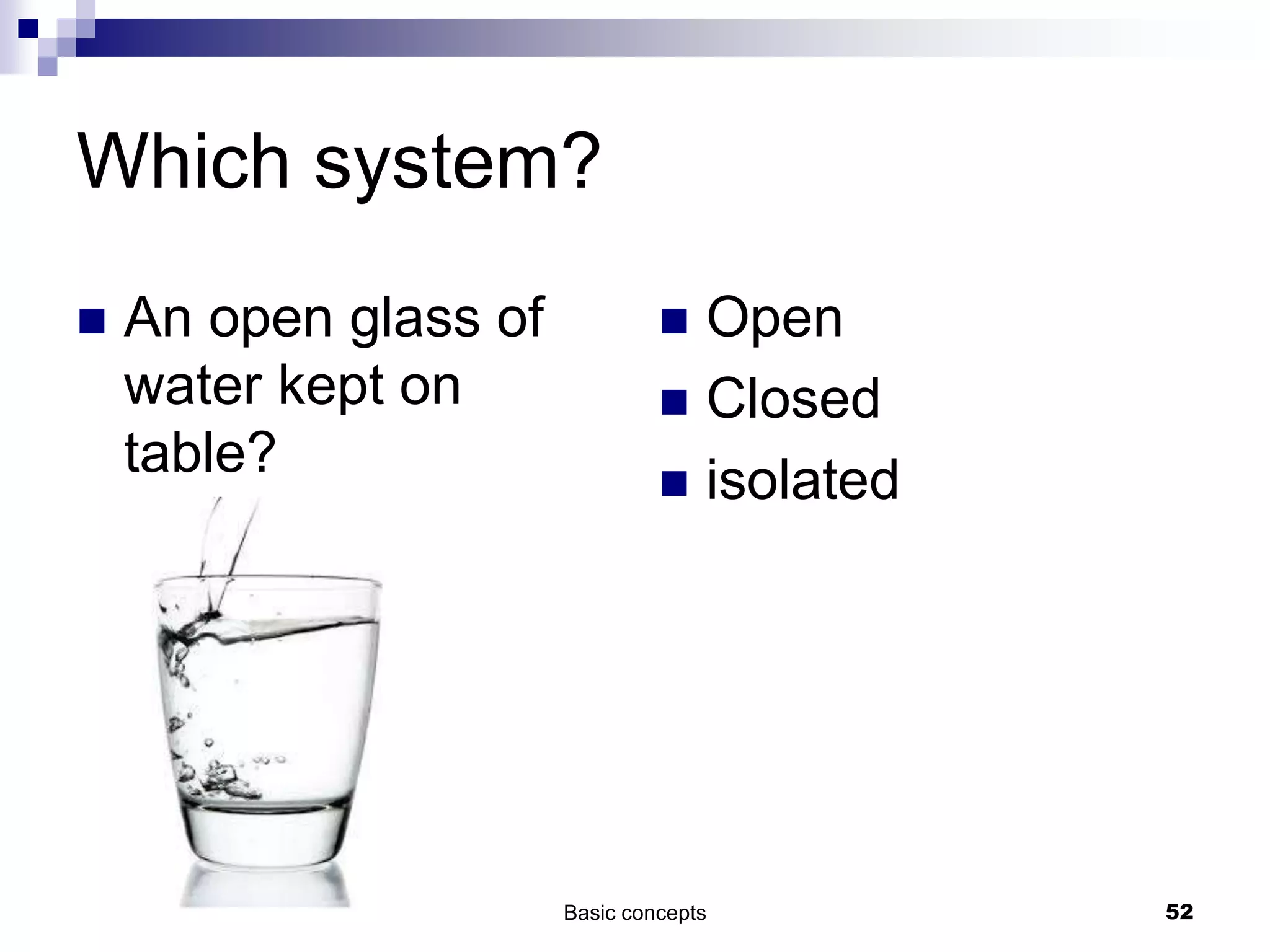
Which system?
 An open glass of
water kept on
table?
 Open
 Closed
 isolated
Basic concepts 52
Which system?
 A pressure cooker
with food inside?
 Open
 Closed
 isolated
Basic concepts 53
Which system?
 A water distillation
unit?
 Open
 Closed
 isolated
Basic concepts 54
Which system?
 The earth with its
atmosphere?
 Open
 Closed
 isolated
Basic concepts 55
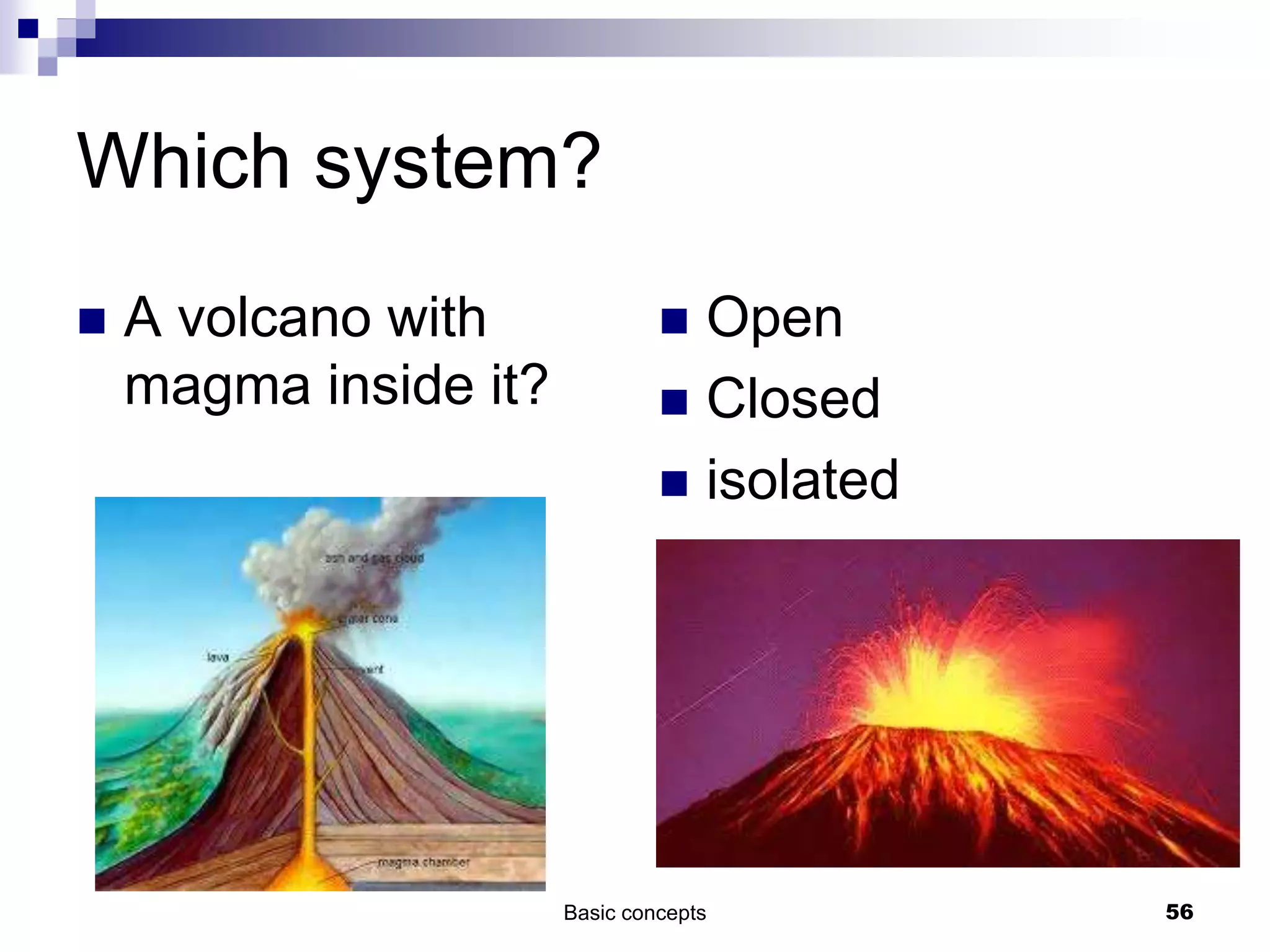
Which system?
 A volcano with
magma inside it?
 Open
 Closed
 isolated
Basic concepts 56
Which system?
 A pod of peas?  Open
 Closed
 isolated
Basic concepts 57
Which system?
 A tomato?  Open
 Closed
 isolated
Basic concepts 58
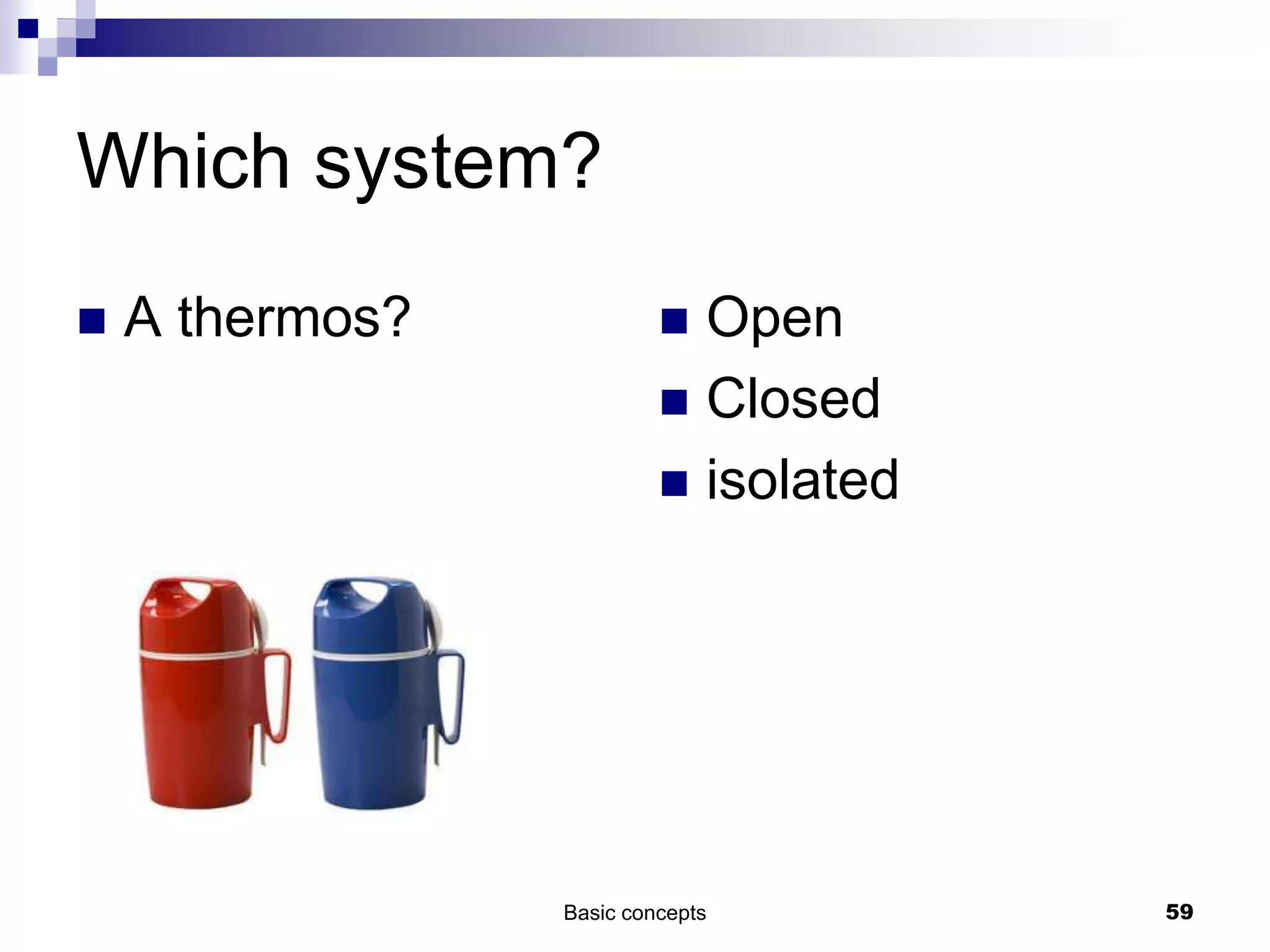
Which system?
 A thermos?  Open
 Closed
 isolated
Basic concepts 59

Thermodynamics Lecture

  • 1.
    Basic concepts 1 Physicalchemistry for Textile 6. Thermodynamics L10: State of system, First law
  • 2.
    Basic concepts 2 Systemand Surrounding  Any part of the world which is under our observation is called a system and whatever around it is called surrounding. The system has a definite boundary which separates it from the surrounding.
  • 3.
    System and Surrounding A bird is a system which is separated from its surrounding by its skin and fethers.  It exchanges both energy and matter with its environment. Basic concepts 3
  • 4.
    System and Surrounding If earth is considered as a system, everything around its surrounding.  It exchanges energy with the environment but not matter. Basic concepts 4
  • 5.
    System and Surrounding A flask containing some material can also be considered as a system where the glass body of flask is system boundary.  Everything outside the flask is it’s surrounding. Basic concepts 5
  • 6.
    System and Surrounding Sometimes the system may not have a definite boundary. For example: a cube of dry ice. The dry ice diffuses into the air without melting at a temperature of -78.5 °C. Basic concepts 6
  • 7.
    System and Surrounding Similarly, naphthalene converts directly from solid to vapor phase. Basic concepts 7 What is the phenomenon by which a solid converts directly into vapor without liquifaction?
  • 8.
    Basic concepts 8 Systemand Surrounding  Energy and or matter may or may not exchange between system and surrounding depending on the type of system boundary.
  • 9.
    Definitions of System Depending on the properties of system boundary the systems may be divided in three different kinds. Open system Closed system Isolated system Basic concepts 9
  • 10.
    Basic concepts 10 Opensystem  Open system is the system in which both energy and matter can move across the boundary of system.
  • 11.
    Winch dyeing  Inan open winch the material can move in or out of it and energy too. Basic concepts 11
  • 12.
    Basic concepts 12 Closedsystem  Closed system is that in which only energy can cross the boundary of system but matter cannot.
  • 13.
    Closed system  The boundaryof a closed system may expand. Basic concepts 13
  • 14.
    Jet dyeing Basic concepts14  Jet is a closed machine with high pressure and temperature. Here no material flows in or out of the machine but heat can flow in and out.
  • 15.
    Basic concepts 15 Isolated system Isolated system the system in which neither matter nor energy can cross the system boundary.
  • 16.
  • 17.
    Basic concepts 17 Stateof a system  State of a system is the condition of the system defined by certain set of properties. For instance the volume, pressure and temperature of a system defines a certain state of that system. If for example the pressure on a system is reduced, the volume will increase and the system is said to be in a new state.  Similarly if the temperature of the system is increased the volume will increase and the state of system will change.  When the set of properties defining the state of a system are known, the system is said to be in a definite state.
  • 18.
    Basic concepts 18 Propertiesof state of system  The properties which determine the state of a system are called state properties.  State properties such as temperature, pressure and volume have major significance. However there are other state properties also such as it’s composition.  If the pressure, temperature , volume or other state properties of a system are known then the system is said to be in a definite state.
  • 19.
    Properties of stateof system  A dyeing system consisting of dye bath containing 10 kg of aqueous dye solution and 1 kg fabric at 25 °C at atmospheric pressure is in a definite state.  We raise the temperature to 60 °C and the system changes to a new state.  When the dye transfers to fabric that is reactants are consumed and products are formed, again the state of system changes. Basic concepts 19
  • 20.
    Law of conservationof energy  This law states that the total energy in the universe is conserved. That is, it cannot be created or destroyed, however, it can change from form to the other. 20
  • 21.
    Internal energy  Theinternal energy of a system is the sum of all types of energy in it.  When a system passes from one state to another state, there is a corresponding change in the internal energy of the system. ΔE = E2 – E1  E is called internal energy and ΔE is the change in internal energy. 21
  • 22.
    Internal energy  Asystem containing calcium oxide (CaO) and water (H2O) has some internal energy in the form of chemical energy at the beginning of reaction. As the reaction proceeds and reactants change into Ca(OH)2, a large amount of heat energy is evolved. As a result the internal energy of the system reduces. The change in energy can be calculated simply by subtracting the initial state from final state. 22 CaO + H2O = Ca(OH)2 + heat
  • 23.
    Internal energy –state function  State functions are those properties of a system which depend only on the state of the system and not on the path they follow to reach the final state.  Since internal energy is a state function, hence depends only on the state of the system. Therefore any change in the internal energy depends only on the initial and final states of the system and is represented by: ΔE = E2 – E1 23
  • 24.
    Internal energy –state function  For instance, we consider the following example: If we have two identical containers having equal amounts of water in them.  We heat one of the containers to raise it’s temperature through 1˚C and simply stir the water in other container so that it’s temperature rises through 1˚C.  At the end, the change in both systems is exactly same and independent of the fact how the change was brought up. 24
  • 25.
    Internal energy  Thischange in internal energy is independent of the path of change and depends on the state of the system. 25
  • 26.
    Internal energy  Thereforethe internal energy of a system depends on the state of the system and not on the path or the way how it was brought about, that is: ΔE = E2 – E1  The properties of a system which depend on the state of the system and not on the path are called state functions. 26
  • 27.
    Path dependence -Work  Those properties of a system which vary with the path taken to change the state of system are path functions.  The work, for example, vary with the path taken to reach the final state 27
  • 28.
    Change of state When a system passes from one state to the other state, it may lose or gain energy as heat or work. CaO + H2O = Ca(OH)2 + (-ΔH) In the above instance the heat content of product is less than the reactants. NaNO2 + H2O = Na++NO- 2 + (+ΔH) In this example the heat content of product is less than the reactants.28
  • 29.
    Change of state Consider a gas confined in a cylinder with a movable piston. Now some heat is transferred from surrounding to the system. This absorption of heat energy may trigger two processes:  1. It may increase the internal energy of the system.  2. Some of the heat absorbed may be consumed in doing P ΔV work against external pressure. q = ΔE + w 29
  • 30.
    Change of state A dyeing bath is heated from room temperature to 100ºC. What changes will occur in the final state if it is an open system?  What if the temperature of dyeing bath is raised to 30ºC only? q = ΔE + w 30
  • 31.
    Change of state In chemical reactions if some gaseous product is formed or gaseous reactants change to liquid product work is done by the system or on the system. HCl + Zn = ZnCl2 + H2 HCl + H2O = H3O++Cl- 31
  • 32.
    Change of state Condensation of water vapor?  Changing of water into steam? Work done on or by the system? 32
  • 33.
    Relationship between internalenergy, heat and work  The change in internal energy is given by the equation: q = ΔE + w ΔE = q – w Or = q – P ΔV  There are certain conditions under which heat and work terms become definite:  Constant pressure and  Constant volume 33
  • 34.
    Enthalpy  The termE + PV is called enthalpy or heat content of the system and represented by H, therefore: H = E+PV and qp = H2 - H1 = ΔH 34
  • 35.
    The First law The first law of thermodynamics is simply the statement of law of conservation of energy, that is: The energy cannot be created or destroyed. 35
  • 36.
    Specific heat  Ifa system consists of 1g of a substance and a definite amount of heat is transferred to it so that it’s temperature rises by 1°C, the amount of heat thus transferred is called it’s specific heat. The specific heat or specific heat capacity of a substance is the amount of heat required to raise the temperature of 1 gram of a substance by 1°C. 36
  • 37.
    Heat capacity Heat capacityof a system is defined as the amount of heat required to raise the temperature of the system by 1˚.  The heat capacity of a system is given by the following equation: C = specific heat x mass (g) 37
  • 38.
    Heat capacity  Fore.g. if the temperature of 1000 kg of water is to be raised by 1°C, the amount of heat absorbed will be: C = specific heat x mass (g) = 1 cal/g °C x 1000 Kg x 1000 = 1000,000 cal/°C = 1000 kcal/°C 38
  • 39.
    Molar heat capacity If the system consists of 1 mole of a substance it is called molar heat capacity. The molar heat capacity is the amount of heat required to raise the temperature of 1 mole of a substance through 1°. 39
  • 40.
    Molar heat capacity Findthe mole of each of following.  Oxygen = ?  Carbon dioxide = ?  Methanol = ?  Mole of ethanol = ?  Mole of glycerine = ?  Water = ?  Copper = ?  Iron = ? Calculate the molar heat capacity of each of these from specific heat data. 40
  • 41.
    Heat capacity  Sincethe heat capacity C may vary with temperature, it is written in the form: C = q/dT  Here q is an infinitesimally small amount of heat absorbed by the system when the temperature is raised by dT degrees.  Since q is an indefinite quantity unless certain conditions are defined, hence, it is normally defined at constant pressure or constant volume. 41
  • 42.
    Heat capacity at constantpressure - Cp  Heat capacity at constant pressure is equal to rate of change of the energy of the system with temperature at constant pressure. Cp = qp/dT qp = ΔH Cp = dH/dT 42
  • 43.
    Heat capacity at constantvolume - Cv  Heat capacity at constant volume is equal to rate of change of the energy of the system with temperature at constant volume. Cv = qv/dT qv = ΔE Cv = dE/dT 43
  • 44.
    Difference of Cvand Cp  In case of Cp, some of the energy absorbed will be consumed in doing work against the surrounding and rest of it will raise the internal energy.  However in case of Cv, no work is done by the system.  Hence for a similar system the energy required in case of Cp will be greater than in Cv. 44
  • 45.
    Importance of thermaldata  We can calculate the amount of heat required to gain the required temperature of system of definite properties.  We can calculate the cost of heating. How the heat of dyeing can be calculated? How the energy cost of dyeing can be calculated? 45
  • 46.
    Importance of thermaldata  Different materials have different specific heat capacity. Hence two materials having different specific heat capacities on absorbing the same amount under the same condition achieve different temperatures.  Observe temperatures of different objects placed in sunlight. 46 Wood Iron body of a car Water A plastic bottle Wool Cotton polyester
  • 47.
    Importance of thermaldata  If cotton and polyester fabrics are placed under sun under the same conditions, why the temperature of polyester rises above that of cotton. Why it happens so?  This is one of the reasons why wearing pure polyester in hot weather is uncomfortable while cotton is more comfortable. 47
  • 48.
    Problem 1  Determinethe heat capacity of 100 kg of water in kJ/kg-K. The specific heat of water is 1 cal/g. The conversion factor to convert cal to Joule is 4.184.  What difference in Cp and Cv for the above system do you expect. 48
  • 49.
    Problem 2  Ifa piece of wood and that of iron of same mass are put in environment under the same condition, iron will gain higher temperature than wood. What is the reason of this phenomenon. 49
  • 50.
    Problem 3  Howmany calories are required to heat each of the following from 15 to 65 ˚C: 550 gram of water 1 kg of Polyester 1 kg of Nylon 1 kg of cotton 50
  • 51.
    Which system?  Aclassroom?  Open  Closed  isolated Basic concepts 51
  • 52.
    Which system?  Anopen glass of water kept on table?  Open  Closed  isolated Basic concepts 52
  • 53.
    Which system?  Apressure cooker with food inside?  Open  Closed  isolated Basic concepts 53
  • 54.
    Which system?  Awater distillation unit?  Open  Closed  isolated Basic concepts 54
  • 55.
    Which system?  Theearth with its atmosphere?  Open  Closed  isolated Basic concepts 55
  • 56.
    Which system?  Avolcano with magma inside it?  Open  Closed  isolated Basic concepts 56
  • 57.
    Which system?  Apod of peas?  Open  Closed  isolated Basic concepts 57
  • 58.
    Which system?  Atomato?  Open  Closed  isolated Basic concepts 58
  • 59.
    Which system?  Athermos?  Open  Closed  isolated Basic concepts 59

Editor's Notes