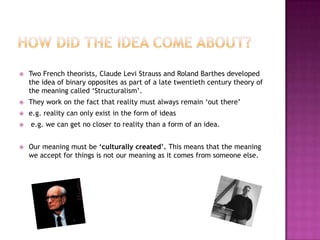
   Two French theorists, Claude Levi Strauss and Roland Barthes developed
    the idea of binary opposites as part of a late twentieth century theory of
    the meaning called ‘Structuralism’.
   They work on the fact that reality must always remain ‘out there’
   e.g. reality can only exist in the form of ideas
   e.g. we can get no closer to reality than a form of an idea.


   Our meaning must be ‘culturally created’. This means that the meaning
    we accept for things is not our meaning as it comes from someone else.
    The theorists when even further into the theory. They both realised that
     meaning can never reside entirely within a thing in itself but only from a
     complex appreciation of a things opposite- what they called its Binary
     Opposite.


    They also said that words and images act as no more than symbols for
     ideas and make meaning because of the difference between opposing
     ideas.


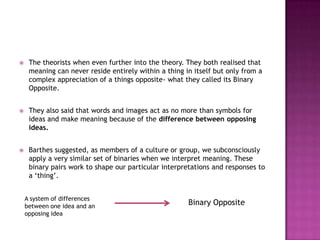
    Barthes suggested, as members of a culture or group, we subconsciously
     apply a very similar set of binaries when we interpret meaning. These
     binary pairs work to shape our particular interpretations and responses to
     a ‘thing’.


    A system of differences
    between one idea and an
                                                       Binary Opposite
    opposing idea
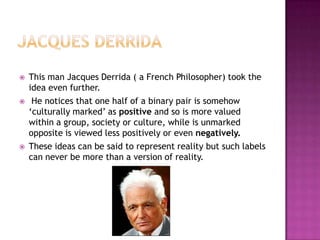
   This man Jacques Derrida ( a French Philosopher) took the
    idea even further.
    He notices that one half of a binary pair is somehow
    ‘culturally marked’ as positive and so is more valued
    within a group, society or culture, while is unmarked
    opposite is viewed less positively or even negatively.
   These ideas can be said to represent reality but such labels
    can never be more than a version of reality.
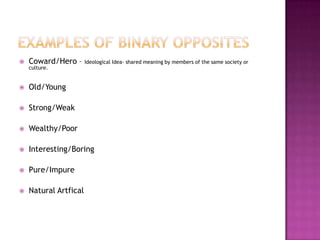
   Coward/Hero – Ideological Idea- shared meaning by members of the same society or
    culture.


   Old/Young

   Strong/Weak

   Wealthy/Poor

   Interesting/Boring

   Pure/Impure

   Natural Artfical
From putting together this presentation, it has
  allowed me to research into Binary
  Opposition. This has helped me to
  understand the topic more as this is
  something that I wasn’t sure on previously.
  Furthermore this presentation has also
  refreshed what I did already know. From
  creating this I will now be able to use this to
  help me revise this topic.

Presentation on binary opposition

  • 2.
    Two French theorists, Claude Levi Strauss and Roland Barthes developed the idea of binary opposites as part of a late twentieth century theory of the meaning called ‘Structuralism’.  They work on the fact that reality must always remain ‘out there’  e.g. reality can only exist in the form of ideas  e.g. we can get no closer to reality than a form of an idea.  Our meaning must be ‘culturally created’. This means that the meaning we accept for things is not our meaning as it comes from someone else.
  • 3.
    The theorists when even further into the theory. They both realised that meaning can never reside entirely within a thing in itself but only from a complex appreciation of a things opposite- what they called its Binary Opposite.  They also said that words and images act as no more than symbols for ideas and make meaning because of the difference between opposing ideas.  Barthes suggested, as members of a culture or group, we subconsciously apply a very similar set of binaries when we interpret meaning. These binary pairs work to shape our particular interpretations and responses to a ‘thing’. A system of differences between one idea and an Binary Opposite opposing idea
  • 4.
    This man Jacques Derrida ( a French Philosopher) took the idea even further.  He notices that one half of a binary pair is somehow ‘culturally marked’ as positive and so is more valued within a group, society or culture, while is unmarked opposite is viewed less positively or even negatively.  These ideas can be said to represent reality but such labels can never be more than a version of reality.
  • 5.
    Coward/Hero – Ideological Idea- shared meaning by members of the same society or culture.  Old/Young  Strong/Weak  Wealthy/Poor  Interesting/Boring  Pure/Impure  Natural Artfical
  • 6.
    From putting togetherthis presentation, it has allowed me to research into Binary Opposition. This has helped me to understand the topic more as this is something that I wasn’t sure on previously. Furthermore this presentation has also refreshed what I did already know. From creating this I will now be able to use this to help me revise this topic.