Mirroring
Characters
 We wanted to show the contrast in characters, mainly
through their class and family lives
 We decided that we will show morning and evening routines
of the two families as this gives a good insight to their
everyday lives
 The two families will cross paths through going on a walk,
and this is where Jack starts taking notice of Paige never
having any toys with her, despite neither himself or his sister
Elizabeth knowing the family
 We enter the mind-set of a 5 year old boy who relies on his
favourite teddy to go everywhere with him, he can’t
understand why Paige never brings anything out with her
 Later on he realises its because she doesn’t have toys like
he does
What we wanted to contrast
Claude Lévi-Strauss theory
links to this
 Claude Lévi-Strauss was born on the 28th November
1908 and died on the 30th October 2009.
 He was a French anthropologist whose work was key in
the development of the theory of structuralism and
structural anthropology, He has been called the "father of
modern anthropology".
 Strauss believed that the way we understood certain
words depended not so much on any meaning they
themselves directly contain but by our understanding the
different of the word and its opposite.
His theory of binary Oppositions link
to what we want to do
 A binary opposition (also binary system) is a pair of
related terms or concepts that are opposite in
meaning. Binary opposition is the system by which,
in language and thought, two theoretical opposites
are strictly defined and set off against one another.
 Claude Levi Strauss studied hundreds of myths and
legends worldwide, and came to the conclusion that
we as humans make sense of the world, people
and events by seeing and using binary opposites.
 Our Character Jack recognises binary opposites in
the form of differences of possession despite his
innocence
Subordinate Groups
Binary Oppositions and Subordinate
Groups, like Dyer, is a way of
understanding how representation are
deliberately placed in binary
opposition to ensure the dominant
culture is maintained and the minority
representations is seen as
subordinate and marginalized.
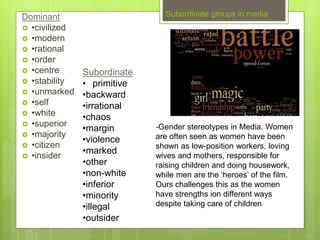
Subordinate groups in mediaDominant
 •civilized
 •modern
 •rational
 •order
 •centre
 •stability
 •unmarked
 •self
 •white
 •superior
 •majority
 •citizen
 •insider
Subordinate
• primitive
•backward
•irrational
•chaos
•margin
•violence
•marked
•other
•non-white
•inferior
•minority
•illegal
•outsider
-Gender stereotypes in Media. Women
are often seen as women have been
shown as low-position workers, loving
wives and mothers, responsible for
raising children and doing housework,
while men are the ‘heroes’ of the film.
Ours challenges this as the women
have strengths ion different ways
despite taking care of children
Binary Opposites in Media
 Binary opposites are
usually the basis of our
understanding of a story
as it is a conventional
narrative an enables a
equilibrium.
 Within the media field,
Binary oppositions are
frequently used in the
plots of films, especially
in the horror genre.
 Our understanding of the
word “villain” depends on
the difference between
that word and the
opposing word “hero”.
Examples
• Good vs Evil
• Peace vs War
• Male vs Female
• Protagonist vs Antagonist
• First world vs Third world
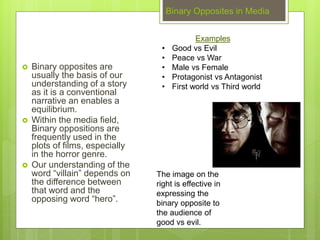
The image on the
right is effective in
expressing the
binary opposite to
the audience of
good vs evil.

Mirroring characters

  • 1.
  • 2.
     We wantedto show the contrast in characters, mainly through their class and family lives  We decided that we will show morning and evening routines of the two families as this gives a good insight to their everyday lives  The two families will cross paths through going on a walk, and this is where Jack starts taking notice of Paige never having any toys with her, despite neither himself or his sister Elizabeth knowing the family  We enter the mind-set of a 5 year old boy who relies on his favourite teddy to go everywhere with him, he can’t understand why Paige never brings anything out with her  Later on he realises its because she doesn’t have toys like he does What we wanted to contrast
  • 3.
    Claude Lévi-Strauss theory linksto this  Claude Lévi-Strauss was born on the 28th November 1908 and died on the 30th October 2009.  He was a French anthropologist whose work was key in the development of the theory of structuralism and structural anthropology, He has been called the "father of modern anthropology".  Strauss believed that the way we understood certain words depended not so much on any meaning they themselves directly contain but by our understanding the different of the word and its opposite.
  • 4.
    His theory ofbinary Oppositions link to what we want to do  A binary opposition (also binary system) is a pair of related terms or concepts that are opposite in meaning. Binary opposition is the system by which, in language and thought, two theoretical opposites are strictly defined and set off against one another.  Claude Levi Strauss studied hundreds of myths and legends worldwide, and came to the conclusion that we as humans make sense of the world, people and events by seeing and using binary opposites.  Our Character Jack recognises binary opposites in the form of differences of possession despite his innocence
  • 5.
    Subordinate Groups Binary Oppositionsand Subordinate Groups, like Dyer, is a way of understanding how representation are deliberately placed in binary opposition to ensure the dominant culture is maintained and the minority representations is seen as subordinate and marginalized.
  • 6.
    Subordinate groups inmediaDominant  •civilized  •modern  •rational  •order  •centre  •stability  •unmarked  •self  •white  •superior  •majority  •citizen  •insider Subordinate • primitive •backward •irrational •chaos •margin •violence •marked •other •non-white •inferior •minority •illegal •outsider -Gender stereotypes in Media. Women are often seen as women have been shown as low-position workers, loving wives and mothers, responsible for raising children and doing housework, while men are the ‘heroes’ of the film. Ours challenges this as the women have strengths ion different ways despite taking care of children
  • 7.
    Binary Opposites inMedia  Binary opposites are usually the basis of our understanding of a story as it is a conventional narrative an enables a equilibrium.  Within the media field, Binary oppositions are frequently used in the plots of films, especially in the horror genre.  Our understanding of the word “villain” depends on the difference between that word and the opposing word “hero”. Examples • Good vs Evil • Peace vs War • Male vs Female • Protagonist vs Antagonist • First world vs Third world The image on the right is effective in expressing the binary opposite to the audience of good vs evil.