Levi-Strauss Theory
Luke Catchpole, Tom Jenkins
Binary Opposition
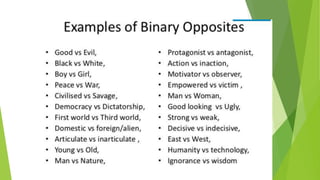
 Levi- Strauss claimed that humans make sense of the world by seeing and
using binary opposites.
 He found out that narratives are arranged around the conflict of binary
opposites.
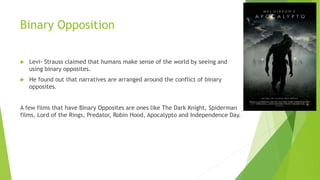
A few films that have Binary Opposites are ones like The Dark Knight, Spiderman
films, Lord of the Rings, Predator, Robin Hood, Apocalypto and Independence Day.
Opposites
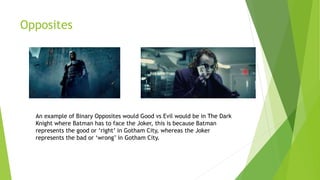
An example of Binary Opposites would Good vs Evil would be in The Dark
Knight where Batman has to face the Joker, this is because Batman
represents the good or ‘right’ in Gotham City, whereas the Joker
represents the bad or ‘wrong’ in Gotham City.
Summary
 Levi-Strauss basically said that this theory is the conflict between opposites,
whether this be good vs evil, right vs wrong etc etc. He also argued that
behind this theory also was that not everything was as it seemed and that
everything that humans interpret has a deeper meaning and we should not
look past this – almost as a polar opposite to the Occams Razor Theory. (The
simplest answer is usually the right one.)
 His more philosophical approach to media texts and theory also was one of
the fundamental breakthroughs towards the subject as it left more and more
theories to be created because different theorists were attempting to solve
the deeper meanings within texts and theories and basically allowed a more
open view upon this area as it was shown not to be as simple as it once
appeared.
Revolution
 He and Roland Barthes came together and discovered that the way we understand certain
words does not depend so much on the meaning that they directly contain, but much more by
our understanding of the difference between the word and its ‘opposite’ or, as they called it
‘binary opposite’.
 They realised that words simply act as symbols for society’s ideas and that the meaning of
words was a relationship rather than a fixed thing just a relationship between opposing ideas.
 This was a more philosophical insight into media texts as they it looks deeper into meaning of
things instead of taking the simplest answer or meaning to be the best suited.
 This type of theory revolutionised the way theorists looked at texts because it changed the
whole perception of a text as it left people asking whether there was a ‘deeper meaning’
 It also meant that media theories and texts as a whole became more philosophical and hence
through the years gained more and more ‘theorists’ to study the concept of it.

Levi Strauss Theory

  • 1.
  • 2.
    Binary Opposition  Levi-Strauss claimed that humans make sense of the world by seeing and using binary opposites.  He found out that narratives are arranged around the conflict of binary opposites. A few films that have Binary Opposites are ones like The Dark Knight, Spiderman films, Lord of the Rings, Predator, Robin Hood, Apocalypto and Independence Day.
  • 3.
    Opposites An example ofBinary Opposites would Good vs Evil would be in The Dark Knight where Batman has to face the Joker, this is because Batman represents the good or ‘right’ in Gotham City, whereas the Joker represents the bad or ‘wrong’ in Gotham City.
  • 5.
    Summary  Levi-Strauss basicallysaid that this theory is the conflict between opposites, whether this be good vs evil, right vs wrong etc etc. He also argued that behind this theory also was that not everything was as it seemed and that everything that humans interpret has a deeper meaning and we should not look past this – almost as a polar opposite to the Occams Razor Theory. (The simplest answer is usually the right one.)  His more philosophical approach to media texts and theory also was one of the fundamental breakthroughs towards the subject as it left more and more theories to be created because different theorists were attempting to solve the deeper meanings within texts and theories and basically allowed a more open view upon this area as it was shown not to be as simple as it once appeared.
  • 6.
    Revolution  He andRoland Barthes came together and discovered that the way we understand certain words does not depend so much on the meaning that they directly contain, but much more by our understanding of the difference between the word and its ‘opposite’ or, as they called it ‘binary opposite’.  They realised that words simply act as symbols for society’s ideas and that the meaning of words was a relationship rather than a fixed thing just a relationship between opposing ideas.  This was a more philosophical insight into media texts as they it looks deeper into meaning of things instead of taking the simplest answer or meaning to be the best suited.  This type of theory revolutionised the way theorists looked at texts because it changed the whole perception of a text as it left people asking whether there was a ‘deeper meaning’  It also meant that media theories and texts as a whole became more philosophical and hence through the years gained more and more ‘theorists’ to study the concept of it.