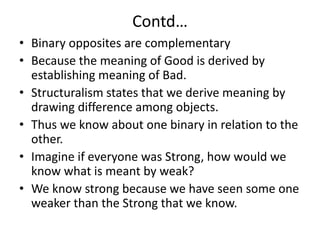
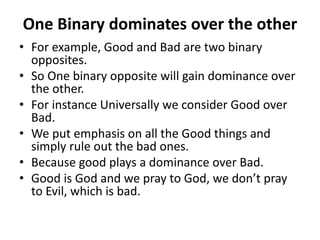
Claude Levi Strauss, a key figure in structural anthropology, introduced the concept of binary opposites, which are contrasting concepts that form the basic structure of narratives. Drawing from Ferdinand de Saussure's theory of structuralism, he argued that these opposites are intrinsic to both language and culture, influencing how meanings are derived through social narratives and interactions. Binary opposites like good/evil and strong/weak reflect complementary relationships, where the meaning of one is established in relation to the other, often leading to one having dominance over the other.


![Conclusion
• To put it simply binary opposites are basically
[Adjectives] qualities, like Strong/weak,
white/black, tall/short, more/less, etc.
• However there are some other [noun] and
[verb] binary opposites, such as Laugh/Cry,
Stop/Move, Asleep/Awake, Boy/Girl,
Man/Woman, etc.](https://image.slidesharecdn.com/claudelevistraussbinaryopposites-200809063918/85/Claude-levi-strauss-binary-opposites-9-320.jpg)


![Claude levi strauss[1]](https://cdn.slidesharecdn.com/ss_thumbnails/claudelevistrauss1-110301060830-phpapp01-thumbnail.jpg?width=640&height=640&fit=bounds)


