Coursework for CNMT
European Master of Reseach on Information and
Communication Technologies
Spring semester 2010-2011
Barcelona
POLICY ADOPTED BY IETF
YATISH BATHLA,OSCAR
2Communication-Network Management Technologies
INTRODUCTION
 IETF Stands for Internet Engineering Task Force
 contribute to the engineering and evolution of
Internet technologies
 forum for the betterment of future protocols,
standards and products
 basic technical standards for Internet protocols
are set and maintained
 standardize all the protocol layers in between,
from IP itself up to general applications like email
and HTTP.
3Communication-Network Management Technologies
INTRODUCTION
 does not standardize specialized application layer
protocols
 does not standardize transmission hardware
 Goal: to make the Internet work better
 Area: Eight Areas together comprise to form IETF
Engineering Steering Group (IESG)
 WG: there are about 115 different WGs under
these Eight Areas
4Communication-Network Management Technologies
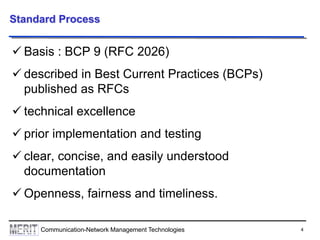
Standard Process
 Basis : BCP 9 (RFC 2026)
 described in Best Current Practices (BCPs)
published as RFCs
 technical excellence
 prior implementation and testing
 clear, concise, and easily understood
documentation
 Openness, fairness and timeliness.
5Communication-Network Management Technologies
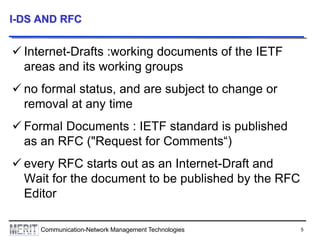
I-DS AND RFC
 Internet-Drafts :working documents of the IETF
areas and its working groups
 no formal status, and are subject to change or
removal at any time
 Formal Documents : IETF standard is published
as an RFC ("Request for Comments“)
 every RFC starts out as an Internet-Draft and
Wait for the document to be published by the RFC
Editor
6Communication-Network Management Technologies
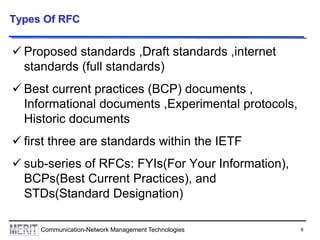
Types Of RFC
 Proposed standards ,Draft standards ,internet
standards (full standards)
 Best current practices (BCP) documents ,
Informational documents ,Experimental protocols,
Historic documents
 first three are standards within the IETF
 sub-series of RFCs: FYIs(For Your Information),
BCPs(Best Current Practices), and
STDs(Standard Designation)
7Communication-Network Management Technologies
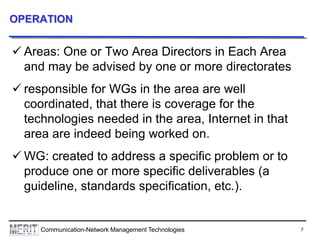
OPERATION
 Areas: One or Two Area Directors in Each Area
and may be advised by one or more directorates
 responsible for WGs in the area are well
coordinated, that there is coverage for the
technologies needed in the area, Internet in that
area are indeed being worked on.
 WG: created to address a specific problem or to
produce one or more specific deliverables (a
guideline, standards specification, etc.).
8Communication-Network Management Technologies
CLASSIFICATION OF AREAS
 Applications Area (app)
 General Area (gen)
 Internet Area (int)
 Operations and Management Area (ops)
 Real-time Applications and Infrastructure Area
 Routing Area (rtg)
 Security Area (sec)
 Transport Area (tsv)
9Communication-Network Management Technologies
Applications Area
 first cluster contains application protocols which
develop application like email, HTTP, FTP
 second cluster contains protocols which are used
for Internet infrastructure like IDNA and EPP
 The third cluster contains "building block"
protocols which are designed for applications
(e.g., LDAP, MIME types, URI schemes, URNs).
 working groups: web foundations and security,
calendaring, internationalization, virtual worlds,
personal address books etc.
10Communication-Network Management Technologies
General Area
 focused on supporting, updating and maintaining
the IETF standards development process
 General AD, the IETF Chair manages the General
Area Review Team (Gen-ART) and other IETF-
wide directorates.
11Communication-Network Management Technologies
Internet Area
 Area include IP layer (both IPv4 and IPv6),
implications of IPv4 address depletion, co-
existence between the IP versions, DNS, DHCP,
host and router configuration, mobility,
multihoming, identifier-locator separation, VPNs
and pseudowires along with related MPLS issues,
and various link layer technologies.
 responsible for specifying how IP will run over
new link layer protocols
12Communication-Network Management Technologies
Operations and Management Area
 logically divided into two separate functions:
Network Management and Operations.
 Network Management function covers Internet
management ,AAA , to identify potential or actual
management issues regarding IETF protocols
and the related protocols
 Operations function is largely responsible for
soliciting operator feedback and input regarding
IETF work. intersects most often with the Routing,
Internet and Security areas
13Communication-Network Management Technologies
Real-time Applications and Infrastructure Area
 develops protocols and architectures for delay-
sensitive interpersonal communications
 Work in the RAI Area serves an industry whose
applications and services include voice and video
over IP, instant messaging, and presence
 These applications and services are "real-time" in
the sense described in RFC 3550
 The infrastructure applications needed to support
real-time interpersonal communication are also
part of the RAI Area
14Communication-Network Management Technologies
Real-time Applications and Infrastructure Area
• Authority-to-Citizen Alert
•Audio/Video Transport Core Maintenance
•Audio/Video Transport Extensions
•Basic Level of Interoperability for SIP Services
•ControLling mUltiple streams for tElepresence
•Internet Wideband Audio Codec
•Call Control UUI Service for SIP
•Dispatch
•Data for Reachability of Inter/tra-NetworK SIP
•Emergency Context Resolution with Internet Technologies
•Telephone Number Mapping
•Geographic Location/Privacy
• •Multiparty Multimedia Session Control
15Communication-Network Management Technologies
Real-time Applications and Infrastructure Area
• Peer-to-Peer Session Initiation Protocol
• Audio/Video Transport Payloads
• Sip ALerting for User Devices
• SIP for Instant Messaging and Presence Leveraging Extensions
• SIP Common Log Format
• Session Initiation Protocol Core
• Siprec - SIP Recording
• SIP Overload Control
• Speech Services Control
• Session PEERing for Multimedia INTerconnect
• looSely-couPLed sIp deviCES
• Verification Involving PSTN Reachability
16Communication-Network Management Technologies
Routing Area
 ensuring continuous operation of the Internet
routing system by maintaining the scalability and
stability characteristics of the existing routing
protocols, as well as developing new protocols,
extensions, and bug fixes in a timely manner.
 works on Generalized MPLS used in the control
plane of optical networks as well as security
aspects of the routing system.
 developed a routing protocol (RPL) for use in low-
powered and lossy networks
17Communication-Network Management Technologies
Routing Area
 Forwarding methods (such as destination-based
unicast and multicast forwarding, MPLS, and
pseudowire) and signalling protocols (OSPF, IS-
IS, BGP, RSVP-TE, L1-, L2-, and L3-VPNs)
 Interaction with the Internet Area concentrates
mainly on IP Forwarding and Multicast
 With the Operations & Management Area the
focus is on MIB development.
 With the Security area the focus is on routing
protocol security.
18Communication-Network Management Technologies
Routing Area
• Bidirectional Forwarding Detection
• Common Control and Measurement Plane
• Forwarding and Control Element Separation
• Inter-Domain Routing
• IS-IS for IP Internets
• Keying and Authentication for Routing Protocols
• Layer 2 Virtual Private Networks
• Layer 3 Virtual Private Networks
• Mobile Ad-hoc Networks
• Multiprotocol Label Switching
• Open Shortest Path First IGP
• Path Computation Element
19Communication-Network Management Technologies
Security Area
 home for working groups focused on security
protocols
 security services: integrity, authentication, non-
repudiation, confidentiality, and access control.
 focuses upon practical application of Security
Area protocols and technologies to the protocols
of other Areas
20Communication-Network Management Technologies
Security Area
• Application Bridging for Federated Access Beyond web
• DNS-based Authentication of Named Entities
• Domain Keys Identified Mail
• EAP Method Update
• Handover Keying
• IP Security Maintenance and Extensions
• Integrated Security Model for SNMP
• Common Authentication Technology Next Generation
• Kerberos
• Long-Term Archive and Notary Services
• Multicast Security
• Network Endpoint Assessment
21Communication-Network Management Technologies
Transport Area
 covers a range of technical topics related to data
transport in the Internet.
 end-to-end data transport to support Internet
applications and services that exchange
potentially large volumes of traffic at potentially
high bandwidths.
 detect and react to congestion in the Internet,
such as the congestion control algorithms in
Internet transport control protocols such as TCP,
SCTP, and DCCP
22Communication-Network Management Technologies
Transport Area
 transport work includes congestion signaling and
reporting, forward error correction, multicast, QoS
and reservation signaling, storage protocols for
the Internet, peer-to-peer streaming, performance
metrics for Internet paths, experimentation with
congestion control schemes , multipath
extensions , congestion control and extensions to
the IETF protocols for multimedia transport.
 intersects most frequently with Internet area, the
applications area, the RAI area, the security area
and several IRTF research groups.
23Communication-Network Management Technologies
Transport Area
• Application-Layer Traffic Optimization
• Behavior Engineering for Hindrance Avoidance
• Congestion Exposure
• Datagram Congestion Control Protocol
• Decoupled Application Data Enroute
• FEC Framework
• IP Performance Metrics
• Low Extra Delay Background Transport
• Multipath TCP
• Network File System Version 4
• Congestion and Pre-Congestion Notification
• Peer to Peer Streaming Protocol
Coursework for CNMT
European Master of Reseach on Information and
Communication Technologies
Spring semester 2010-2011
Barcelona
THANK YOU

Internet Engineering Task Force

  • 1.
    Coursework for CNMT EuropeanMaster of Reseach on Information and Communication Technologies Spring semester 2010-2011 Barcelona POLICY ADOPTED BY IETF YATISH BATHLA,OSCAR
  • 2.
    2Communication-Network Management Technologies INTRODUCTION IETF Stands for Internet Engineering Task Force  contribute to the engineering and evolution of Internet technologies  forum for the betterment of future protocols, standards and products  basic technical standards for Internet protocols are set and maintained  standardize all the protocol layers in between, from IP itself up to general applications like email and HTTP.
  • 3.
    3Communication-Network Management Technologies INTRODUCTION does not standardize specialized application layer protocols  does not standardize transmission hardware  Goal: to make the Internet work better  Area: Eight Areas together comprise to form IETF Engineering Steering Group (IESG)  WG: there are about 115 different WGs under these Eight Areas
  • 4.
    4Communication-Network Management Technologies StandardProcess  Basis : BCP 9 (RFC 2026)  described in Best Current Practices (BCPs) published as RFCs  technical excellence  prior implementation and testing  clear, concise, and easily understood documentation  Openness, fairness and timeliness.
  • 5.
    5Communication-Network Management Technologies I-DSAND RFC  Internet-Drafts :working documents of the IETF areas and its working groups  no formal status, and are subject to change or removal at any time  Formal Documents : IETF standard is published as an RFC ("Request for Comments“)  every RFC starts out as an Internet-Draft and Wait for the document to be published by the RFC Editor
  • 6.
    6Communication-Network Management Technologies TypesOf RFC  Proposed standards ,Draft standards ,internet standards (full standards)  Best current practices (BCP) documents , Informational documents ,Experimental protocols, Historic documents  first three are standards within the IETF  sub-series of RFCs: FYIs(For Your Information), BCPs(Best Current Practices), and STDs(Standard Designation)
  • 7.
    7Communication-Network Management Technologies OPERATION Areas: One or Two Area Directors in Each Area and may be advised by one or more directorates  responsible for WGs in the area are well coordinated, that there is coverage for the technologies needed in the area, Internet in that area are indeed being worked on.  WG: created to address a specific problem or to produce one or more specific deliverables (a guideline, standards specification, etc.).
  • 8.
    8Communication-Network Management Technologies CLASSIFICATIONOF AREAS  Applications Area (app)  General Area (gen)  Internet Area (int)  Operations and Management Area (ops)  Real-time Applications and Infrastructure Area  Routing Area (rtg)  Security Area (sec)  Transport Area (tsv)
  • 9.
    9Communication-Network Management Technologies ApplicationsArea  first cluster contains application protocols which develop application like email, HTTP, FTP  second cluster contains protocols which are used for Internet infrastructure like IDNA and EPP  The third cluster contains "building block" protocols which are designed for applications (e.g., LDAP, MIME types, URI schemes, URNs).  working groups: web foundations and security, calendaring, internationalization, virtual worlds, personal address books etc.
  • 10.
    10Communication-Network Management Technologies GeneralArea  focused on supporting, updating and maintaining the IETF standards development process  General AD, the IETF Chair manages the General Area Review Team (Gen-ART) and other IETF- wide directorates.
  • 11.
    11Communication-Network Management Technologies InternetArea  Area include IP layer (both IPv4 and IPv6), implications of IPv4 address depletion, co- existence between the IP versions, DNS, DHCP, host and router configuration, mobility, multihoming, identifier-locator separation, VPNs and pseudowires along with related MPLS issues, and various link layer technologies.  responsible for specifying how IP will run over new link layer protocols
  • 12.
    12Communication-Network Management Technologies Operationsand Management Area  logically divided into two separate functions: Network Management and Operations.  Network Management function covers Internet management ,AAA , to identify potential or actual management issues regarding IETF protocols and the related protocols  Operations function is largely responsible for soliciting operator feedback and input regarding IETF work. intersects most often with the Routing, Internet and Security areas
  • 13.
    13Communication-Network Management Technologies Real-timeApplications and Infrastructure Area  develops protocols and architectures for delay- sensitive interpersonal communications  Work in the RAI Area serves an industry whose applications and services include voice and video over IP, instant messaging, and presence  These applications and services are "real-time" in the sense described in RFC 3550  The infrastructure applications needed to support real-time interpersonal communication are also part of the RAI Area
  • 14.
    14Communication-Network Management Technologies Real-timeApplications and Infrastructure Area • Authority-to-Citizen Alert •Audio/Video Transport Core Maintenance •Audio/Video Transport Extensions •Basic Level of Interoperability for SIP Services •ControLling mUltiple streams for tElepresence •Internet Wideband Audio Codec •Call Control UUI Service for SIP •Dispatch •Data for Reachability of Inter/tra-NetworK SIP •Emergency Context Resolution with Internet Technologies •Telephone Number Mapping •Geographic Location/Privacy • •Multiparty Multimedia Session Control
  • 15.
    15Communication-Network Management Technologies Real-timeApplications and Infrastructure Area • Peer-to-Peer Session Initiation Protocol • Audio/Video Transport Payloads • Sip ALerting for User Devices • SIP for Instant Messaging and Presence Leveraging Extensions • SIP Common Log Format • Session Initiation Protocol Core • Siprec - SIP Recording • SIP Overload Control • Speech Services Control • Session PEERing for Multimedia INTerconnect • looSely-couPLed sIp deviCES • Verification Involving PSTN Reachability
  • 16.
    16Communication-Network Management Technologies RoutingArea  ensuring continuous operation of the Internet routing system by maintaining the scalability and stability characteristics of the existing routing protocols, as well as developing new protocols, extensions, and bug fixes in a timely manner.  works on Generalized MPLS used in the control plane of optical networks as well as security aspects of the routing system.  developed a routing protocol (RPL) for use in low- powered and lossy networks
  • 17.
    17Communication-Network Management Technologies RoutingArea  Forwarding methods (such as destination-based unicast and multicast forwarding, MPLS, and pseudowire) and signalling protocols (OSPF, IS- IS, BGP, RSVP-TE, L1-, L2-, and L3-VPNs)  Interaction with the Internet Area concentrates mainly on IP Forwarding and Multicast  With the Operations & Management Area the focus is on MIB development.  With the Security area the focus is on routing protocol security.
  • 18.
    18Communication-Network Management Technologies RoutingArea • Bidirectional Forwarding Detection • Common Control and Measurement Plane • Forwarding and Control Element Separation • Inter-Domain Routing • IS-IS for IP Internets • Keying and Authentication for Routing Protocols • Layer 2 Virtual Private Networks • Layer 3 Virtual Private Networks • Mobile Ad-hoc Networks • Multiprotocol Label Switching • Open Shortest Path First IGP • Path Computation Element
  • 19.
    19Communication-Network Management Technologies SecurityArea  home for working groups focused on security protocols  security services: integrity, authentication, non- repudiation, confidentiality, and access control.  focuses upon practical application of Security Area protocols and technologies to the protocols of other Areas
  • 20.
    20Communication-Network Management Technologies SecurityArea • Application Bridging for Federated Access Beyond web • DNS-based Authentication of Named Entities • Domain Keys Identified Mail • EAP Method Update • Handover Keying • IP Security Maintenance and Extensions • Integrated Security Model for SNMP • Common Authentication Technology Next Generation • Kerberos • Long-Term Archive and Notary Services • Multicast Security • Network Endpoint Assessment
  • 21.
    21Communication-Network Management Technologies TransportArea  covers a range of technical topics related to data transport in the Internet.  end-to-end data transport to support Internet applications and services that exchange potentially large volumes of traffic at potentially high bandwidths.  detect and react to congestion in the Internet, such as the congestion control algorithms in Internet transport control protocols such as TCP, SCTP, and DCCP
  • 22.
    22Communication-Network Management Technologies TransportArea  transport work includes congestion signaling and reporting, forward error correction, multicast, QoS and reservation signaling, storage protocols for the Internet, peer-to-peer streaming, performance metrics for Internet paths, experimentation with congestion control schemes , multipath extensions , congestion control and extensions to the IETF protocols for multimedia transport.  intersects most frequently with Internet area, the applications area, the RAI area, the security area and several IRTF research groups.
  • 23.
    23Communication-Network Management Technologies TransportArea • Application-Layer Traffic Optimization • Behavior Engineering for Hindrance Avoidance • Congestion Exposure • Datagram Congestion Control Protocol • Decoupled Application Data Enroute • FEC Framework • IP Performance Metrics • Low Extra Delay Background Transport • Multipath TCP • Network File System Version 4 • Congestion and Pre-Congestion Notification • Peer to Peer Streaming Protocol
  • 24.
    Coursework for CNMT EuropeanMaster of Reseach on Information and Communication Technologies Spring semester 2010-2011 Barcelona THANK YOU