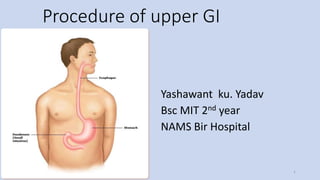
Procedure of upper GI
Yashawant ku. Yadav
Bsc MIT 2nd year
NAMS Bir Hospital
1
Contents
• Introduction
• Anatomy of upper GI
• Indications of barium swallow & Meal and it’s Contraindications
• Contrast medium
• Equipment
• Patient Preparation
• Technique
• Filming
• Aftercare
• References
2
Introduction
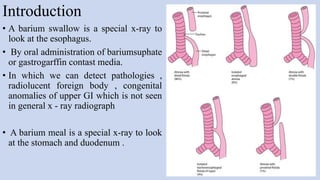
• A barium swallow is a special x-ray to
look at the esophagus.
• By oral administration of bariumsuphate
or gastrogarffin contast media.
• In which we can detect pathologies ,
radiolucent foreign body , congenital
anomalies of upper GI which is not seen
in general x - ray radiograph
• A barium meal is a special x-ray to look
at the stomach and duodenum .
3
Anatomy of upper GI (glance)
Organ involve in upper GI
a. Mouth
b. Pharynx
c. Esophagus
d. Stomach
e. duodenum
4
Wall of GI / layers
Gi is formed by 4 layers
1. Mucus layer (innermost) have 3 layer
2. Submucus
3.Muscular
4. Fibrous layer or serous
5
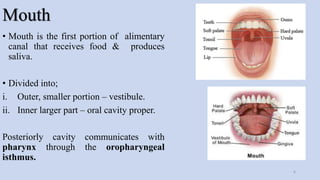
Mouth
• Mouth is the first portion of alimentary
canal that receives food & produces
saliva.
• Divided into;
i. Outer, smaller portion – vestibule.
ii. Inner larger part – oral cavity proper.
Posteriorly cavity communicates with
pharynx through the oropharyngeal
isthmus.
6
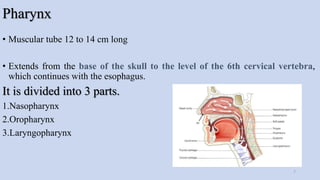
Pharynx
• Muscular tube 12 to 14 cm long
• Extends from the base of the skull to the level of the 6th cervical vertebra,
which continues with the esophagus.
It is divided into 3 parts.
1.Nasopharynx
2.Oropharynx
3.Laryngopharynx
7
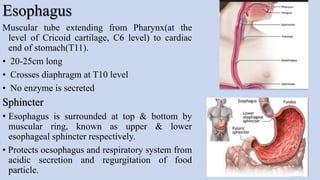
Esophagus
Muscular tube extending from Pharynx(at the
level of Cricoid cartilage, C6 level) to cardiac
end of stomach(T11).
• 20-25cm long
• Crosses diaphragm at T10 level
• No enzyme is secreted
Sphincter
• Esophagus is surrounded at top & bottom by
muscular ring, known as upper & lower
esophageal sphincter respectively.
• Protects oesophagus and respiratory system from
acidic secretion and regurgitation of food
particle. 8
Contd..
Normal constrictions of esophagus :-
a. At upper esophageal sphincter.
b. At the level where it is crossed by arch of aorta.
c. At the level where it is crossed by left main bronchus.
d. At the level where it pierces the diaphragm.
9
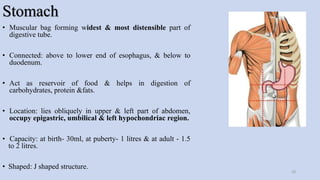
Stomach
• Muscular bag forming widest & most distensible part of
digestive tube.
• Connected: above to lower end of esophagus, & below to
duodenum.
• Act as reservoir of food & helps in digestion of
carbohydrates, protein &fats.
• Location: lies obliquely in upper & left part of abdomen,
occupy epigastric, umbilical & left hypochondriac region.
• Capacity: at birth- 30ml, at puberty- 1 litres & at adult - 1.5
to 2 litres.
• Shaped: J shaped structure.
10
Contd…
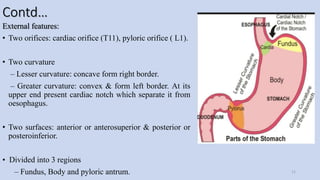
External features:
• Two orifices: cardiac orifice (T11), pyloric orifice ( L1).
• Two curvature
– Lesser curvature: concave form right border.
– Greater curvature: convex & form left border. At its
upper end present cardiac notch which separate it from
oesophagus.
• Two surfaces: anterior or anterosuperior & posterior or
posteroinferior.
• Divided into 3 regions
– Fundus, Body and pyloric antrum. 11
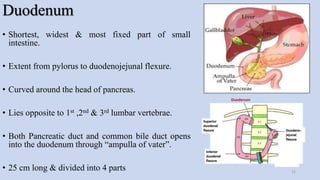
Duodenum
• Shortest, widest & most fixed part of small
intestine.
• Extent from pylorus to duodenojejunal flexure.
• Curved around the head of pancreas.
• Lies opposite to 1st ,2nd & 3rd lumbar vertebrae.
• Both Pancreatic duct and common bile duct opens
into the duodenum through “ampulla of vater”.
• 25 cm long & divided into 4 parts 12
Indications B/S
Dysphasia
Congenital abnormalities of esophagus such as TOF, Atresia, Duplex esophagus
etc.
Pathological investigation of esophagus (intra/extra esophageal benign/malignant growth)
Retrosternal pain, heart burn, regurgitation and odynophagia
Hiatus hernia
Motility disorder such as achalasia, diffuse esophageal spasm etc.
Stricture/diverticula formation
Esophageal varices and Left atrial enlargement
Assessment of abnormality of pharyngoesophageal junction including zenker’s
diverticulum and cricoid web .
13
Contraindication's of B/S
Recently operated patient
For suspected perforation, Barium is contraindicated.
For TOF or if there is possibility of aspiration, Gastrograffin is
contraindicated.
14
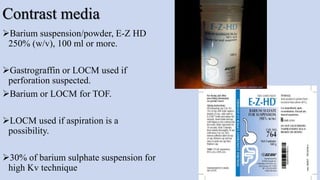
Contrast media
Barium suspension/powder, E-Z HD
250% (w/v), 100 ml or more.
Gastrograffin or LOCM used if
perforation suspected.
Barium or LOCM for TOF.
LOCM used if aspiration is a
possibility.
30% of barium sulphate suspension for
high Kv technique 15
Equipment
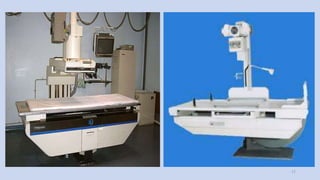
High power/ frequency x-ray generator.
Fluoroscopy unit with IITV system.
Tilting type of x-ray table.
Rapid serial radiography (at least 6 frame per second) or video
recording, required for assessment of laryngopharynx and upper
esophagus during deglutition.
Radiation protection devices
Emergency recovery equipment .
16
17
Patients preparation
Because the esophagus is empty most of the time, patients need no preparation for
an esophagram unless an upper GI series is to follow.
None in general, but nil orally 6 hours prior to the procedure in case of distal
esophagus and done in conjunction with Barium Meal.
Ensure that no contraindication to the contrast agent used.
Procedure should be explained to patient before undergoing the procedure.
Preliminary film taken if perforation suspected.
18
Technique
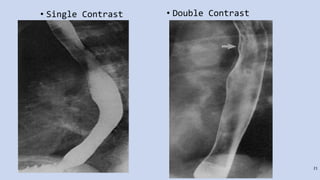
Single contrast study
Only positive contrast medium used.
In diagnosis of gross pathology
Not suitable for visualization of mucosal pattern.
Double contrast study
Both positive and negative contrast media used
Small structural anatomy and minute mucosal pattern visualized.
19
Contd..
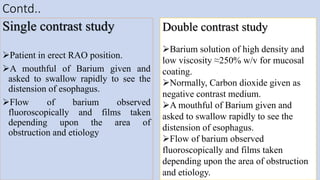
Single contrast study
Patient in erect RAO position.
A mouthful of Barium given and
asked to swallow rapidly to see the
distension of esophagus.
Flow of barium observed
fluoroscopically and films taken
depending upon the area of
obstruction and etiology
20
Double contrast study
Barium solution of high density and
low viscosity ≈250% w/v for mucosal
coating.
Normally, Carbon dioxide given as
negative contrast medium.
A mouthful of Barium given and
asked to swallow rapidly to see the
distension of esophagus.
Flow of barium observed
fluoroscopically and films taken
depending upon the area of obstruction
and etiology.
21
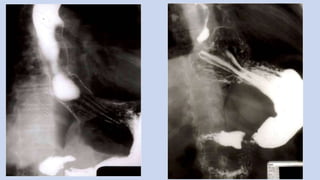
• Single Contrast • Double Contrast
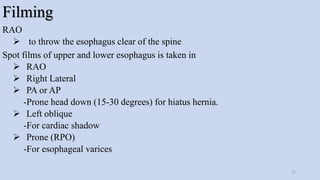
Filming
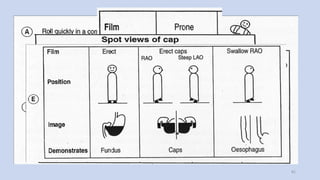
RAO
 to throw the esophagus clear of the spine
Spot films of upper and lower esophagus is taken in
 RAO
 Right Lateral
 PA or AP
-Prone head down (15-30 degrees) for hiatus hernia.
 Left oblique
-For cardiac shadow
 Prone (RPO)
-For esophageal varices
22
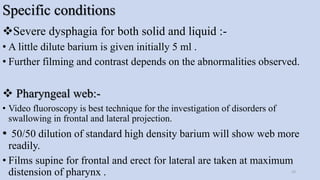
Specific conditions
Severe dysphagia for both solid and liquid :-
• A little dilute barium is given initially 5 ml .
• Further filming and contrast depends on the abnormalities observed.
 Pharyngeal web:-
• Video fluoroscopy is best technique for the investigation of disorders of
swallowing in frontal and lateral projection.
• 50/50 dilution of standard high density barium will show web more
readily.
• Films supine for frontal and erect for lateral are taken at maximum
distension of pharynx . 23
Foreign body
• To detect the level of obstruction in case of radio lucent FB in the oesophagus . A
marsh mallow coated with barium is swallowed whole .
• Marsh mallow hindered at the level of obstruction , (cotton soak can be used but
marsh mallow dissolved spontaneously .
In carcinoma:-
• High viscosity , normal density liquid barium is given
24
Motility Disorder
• A minimum 5 mouthful of contrast should be given to the study of motility
disorders .
• Out of 5 , 2 mouthful of contrast should be abnormal for positive diagnosis .
• For motility disorder a prone swallow is essential to assess oesophageal
contraction in the absence of gravity.
• Disorder are either of peristalsis or sphincter abnormalities . Lower and upper
O/S.
 Achalasia:-
• Esophagus should be cleaned thoroughly so that secondary achalasia due to
Carcinoma esophagus may not missed .
• Barium 80%w/v is used and patient in erect position.
• To differentiate achalasia from other condition show abnormal peristalsis . 25
Contd..
• Mecholyl test is done .on administration of mecholyl there will be
hyperperistalsis pain and streaks of contrast entering the stomach
conforming the diagnosis of achalasia ,( Amyl Nitrate is alternative)
Trachea oesophageal fistula:-
1. Congenital & Acquired
• Ideally contrast is non ionic (water soluble )
• When barium is used then it should be fluid like and Pt. should be lying
lateral .
• Pt. should keep in prone if fistula is not identifiable in lateral .
26
Contd..
• If fistula is seen the procedure should be stopped , barium aspiration may result in
inflammation and granuloma formation in the lungs .
• To demonstrate the TOF in infants , a Ryle’s tube is introduce to the level of mid
esophagus and contrast is injected while withdrawing the tube slowly.
• Bothe lateral and prone views to be assessed.
 Hiatus hernia :-
• High abdominal pressure is required to demonstrate hiatus hernia
• Pt. has to strain
• Pt. ask to lie down straighten the leg and then raise them up.
• Manual compression of abdomen
• Pt. stands upright ask him to bend downward with lag straight .
• Stomach should be well distended otherwise hiatus hernia is not may not
demonstrate .
27
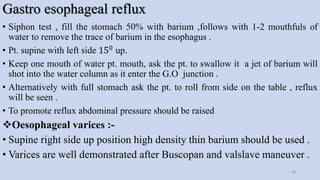
Gastro esophageal reflux
• Siphon test , fill the stomach 50% with barium ,follows with 1-2 mouthfuls of
water to remove the trace of barium in the esophagus .
• Pt. supine with left side 150 up.
• Keep one mouth of water pt. mouth, ask the pt. to swallow it a jet of barium will
shot into the water column as it enter the G.O junction .
• Alternatively with full stomach ask the pt. to roll from side on the table , reflux
will be seen .
• To promote reflux abdominal pressure should be raised
Oesophageal varices :-
• Supine right side up position high density thin barium should be used .
• Varices are well demonstrated after Buscopan and valslave maneuver .
28
Modifications
Primarily, to demonstrate TOF in infant, a nasogastric tube is introduced to the
level of the mid-esophagus from where contrast medium injected.
Also performed to demonstrate the lesion of lower esophagus, Reflux
esophagitis, Esophageal atresia, intubated patient etc
 Contrast medium is syringed in, to distend the esophagus, pressuring it through
any small fistula.
 Radiographs should be taken in the lateral projection during simultaneous
injection of c/m and withdrawal of the tube.
 Pull-back technique is not supposed to be necessary in the majority of children
(some authors).
29
Aftercare/Complications
 Aftercare
 Advised to drink plenty fluid.
 Informed about the white stool color for few days.
Complications
Leakage of barium from an unsuspected perforation
Aspiration
30
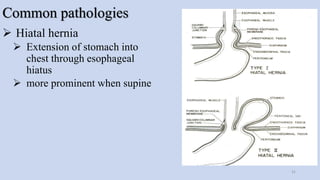
Common pathologies
 Hiatal hernia
 Extension of stomach into
chest through esophageal
hiatus
 more prominent when supine
31
32
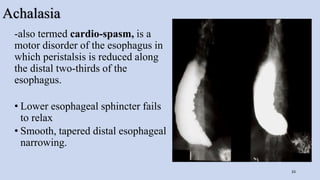
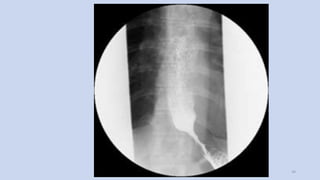
Achalasia
-also termed cardio-spasm, is a
motor disorder of the esophagus in
which peristalsis is reduced along
the distal two-thirds of the
esophagus.
• Lower esophageal sphincter fails
to relax
• Smooth, tapered distal esophageal
narrowing.
33
34
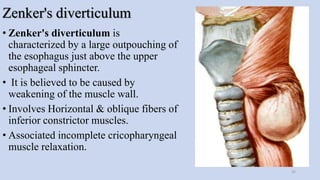
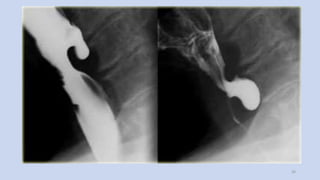
Zenker's diverticulum
• Zenker's diverticulum is
characterized by a large outpouching of
the esophagus just above the upper
esophageal sphincter.
• It is believed to be caused by
weakening of the muscle wall.
• Involves Horizontal & oblique fibers of
inferior constrictor muscles.
• Associated incomplete cricopharyngeal
muscle relaxation.
35
36
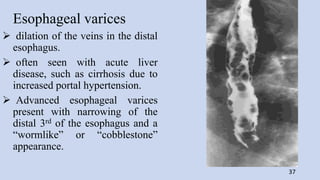
Esophageal varices
 dilation of the veins in the distal
esophagus.
 often seen with acute liver
disease, such as cirrhosis due to
increased portal hypertension.
 Advanced esophageal varices
present with narrowing of the
distal 3rd of the esophagus and a
“wormlike” or “cobblestone”
appearance.
37
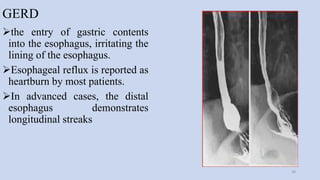
GERD
the entry of gastric contents
into the esophagus, irritating the
lining of the esophagus.
Esophageal reflux is reported as
heartburn by most patients.
In advanced cases, the distal
esophagus demonstrates
longitudinal streaks
38
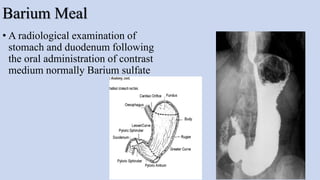
Barium Meal
• A radiological examination of
stomach and duodenum following
the oral administration of contrast
medium normally Barium sulfate
39
Indications
• Dyspepsia
• Vomiting
• Weight loss
• Epigastric pain
• Hematemesis
• Abdominal masses
• Tuberculosis of GI tract
• Suspected perforation
• Failed upper GI endoscopy
• ULCERATION AND CARCINOMA
40
Contraindications
• Recently operated patient .
• Complete large bowel obstruction.
• History/suspicion of aspiration .
• Fistulous communication with any organ other than parts of GIT .
• Recent biopsy of GIT , as barium granuloma formed at biopsy site.
41
Patient preparation
• Nil orally up to 6 hours prior to the procedure
• Ensure that no contraindication to the contrast agent used.
• Procedure should be explained to patient before undergoing the
examination.
• Smoking should not be allowed in the examination day.
• diabetic Patients should be scheduled at morning.
42
Technique
1. Single-contrast + graded compression (SCGC)
2. Double-contrast (DC)
3. Biphasic method: Combined DC + SCGC.
43
Single contrast + Graded compression
• The stomach is filled and distended with dilute barium or a water-
soluble contrast agent (SC).
• The stomach is compressed either manually or by positioning to allow
for adequate x-ray penetration in the evaluation of each anatomical
segment (GC).
• Single contrast with graded compression (SCGC) technique assesses
thickness of the gastric folds and evaluation of gastric emptying.
• Large luminal defects can be detected.
• The anterior gastric wall is evaluated on the prone films, an area which
may not be well demonstrated on a routine double-contrast examination
. 44
Indications of SCGC technique:
• Children:
• Usually not necessary to demonstrate mucosal pattern
• Very ill adults:
• When not possible to move in different positions
• To demonstrate gross pathology only.
45
Double-contrast study:-
• Combines the principles of
• distension,
• mucosal coating and
• proper projection
• A small amount of high-density barium suspension is used to coat the
mucosal surface and air or CO2 gas to distend the lumen.
• Both barium and air are used for contrast.
• Images are obtained as the patient rolls in various positions to coat the
gastric mucosa with contrast.
46
Contd..
• Double-contrast technique provides exquisite detail of the mucosal
surface of the stomach.
• Lesions on the dependent surface of the stomach (the posterior wall in
the supine patient) are best seen using double-contrast technique
• Popularized by the Japanese to diagnose early gastric carcinoma.
47
Biphasic-Contrast Exam
• Combines the best features of the DC and the SCGC techniques in
one diagnostic procedure.
• Performed with a single barium suspension that can provide
excellent mucosal coating during gaseous distention in the DC
phase of the study and also sufficient transparency to permit “see
through” of the contrast agent during the SCGC phase.
Why biphasic?
48
Contd..
•DC technique
• gives excellent definition of the lesser and greater curvatures and the
posterior wall of the stomach;
• however, satisfactory DC images of the anterior wall of the distal
stomach and duodenum are very hard to obtain.
•SCGC:
• anterior wall of these structures could be demonstrated in face by
filling the stomach and duodenum with a low-density barium
suspension and applying graded compression to permit the examiner
to “see through” these viscera
•Combination: takes advantages of both
49
Contd…
• For biphasic study bubbly barium is developed.
• A medium-density barium suspension which can be administered
simultaneously with a gas-producing agent in the form of a cold,
carbonated drink (“bubbly barium”)
50
Contrast Media
• High density, low viscosity barium sulphate for DC study.
• 250% w/v
• ~135ml
• Low density barium (100%w/v) for single contrast study.
• Medium density bubbly barium for biphasic study.
• Effervescent:
• Used for double contrast study.
• Carbex granules or tablets
• Composed of sodium bicarbonate, citrate and an antifoaming agent
(simethicone).
• When swallowed with a small amount of water, the granules or tablets release
300–500 ml of carbon dioxide which distends the stomach
51
Contd..
• Water-soluble contrast should be used when
• perforation or
• post-operative anastomotic failure is suspected.
Pharmacological agents:
• To relax the stomach and delay gastric emptying
• Buscopan 20mg i.v. or
• Glucagon 0.1 to 0.2mg i.v
• Metoclopramide 20 mg oral/ i.v
52
Patient preparation:-
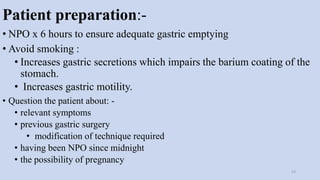
• NPO x 6 hours to ensure adequate gastric emptying
• Avoid smoking :
• Increases gastric secretions which impairs the barium coating of the
stomach.
• Increases gastric motility.
• Question the patient about: -
• relevant symptoms
• previous gastric surgery
• modification of technique required
• having been NPO since midnight
• the possibility of pregnancy
53
Contd..
• Explain the procedure to the patient.
• Describe how to perform breath-holding during spot filming
• Caution the patient not to belch after ingesting carbex granules or
drinking the “bubbly barium”.
• If the patient is to have both a cervical/esophageal barium swallow
(BS) and UGI, start with the UGI and do the examination of the
hypopharynx and cervical esophagus at the end of the study.
54
Spot-film technique:-
• Phototimed 90 kVp (70-120kVp) is used for all double-contrast
filming;
• 125 kVp (120-150kVp) for all single-contrast filming.
Preliminary film
• Required
• if there is any question of perforation or obstruction,
• history of recent contrast examination
55
Technique
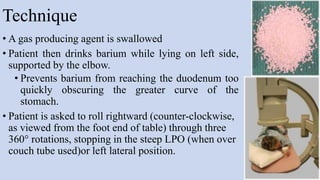
• A gas producing agent is swallowed
• Patient then drinks barium while lying on left side,
supported by the elbow.
• Prevents barium from reaching the duodenum too
quickly obscuring the greater curve of the
stomach.
• Patient is asked to roll rightward (counter-clockwise,
as viewed from the foot end of table) through three
360° rotations, stopping in the steep LPO (when over
couch tube used)or left lateral position.
56
Contd…
• (If patient cannot turn around, he should be rolled back and forth three
times from one lateral position to the other.)
• This is done to obtain good barium coating of the gastric mucosa while
the CO2 will distend the gastric lumen.
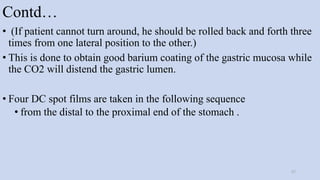
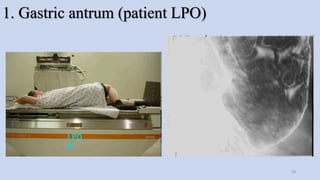
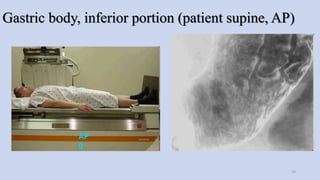
• Four DC spot films are taken in the following sequence
• from the distal to the proximal end of the stomach .
57
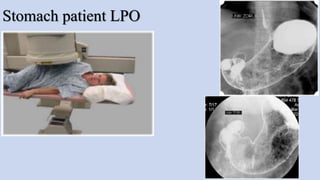
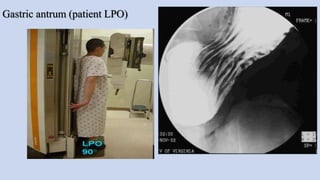
1. Gastric antrum (patient LPO)
58
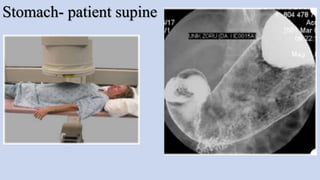
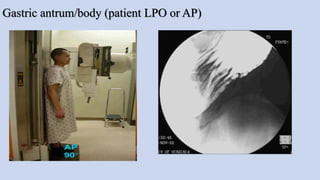
Gastric body, inferior portion (patient supine, AP)
59
Fundus (patient right lateral)
60
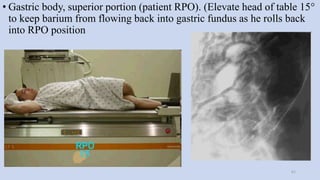
• Gastric body, superior portion (patient RPO). (Elevate head of table 15°
to keep barium from flowing back into gastric fundus as he rolls back
into RPO position
61
Contd…
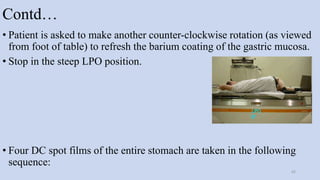
• Patient is asked to make another counter-clockwise rotation (as viewed
from foot of table) to refresh the barium coating of the gastric mucosa.
• Stop in the steep LPO position.
• Four DC spot films of the entire stomach are taken in the following
sequence:
62
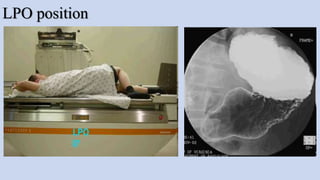
LPO position
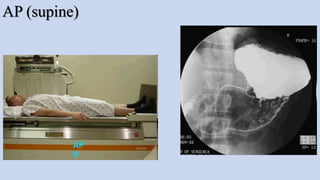
AP (supine)
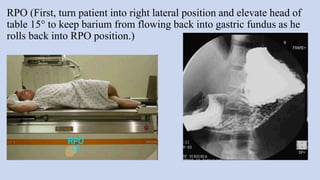
RPO (First, turn patient into right lateral position and elevate head of
table 15° to keep barium from flowing back into gastric fundus as he
rolls back into RPO position.)
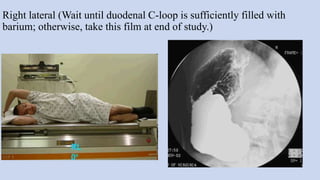
Right lateral (Wait until duodenal C-loop is sufficiently filled with
barium; otherwise, take this film at end of study.)
Stomach patient LPO
Stomach- patient supine
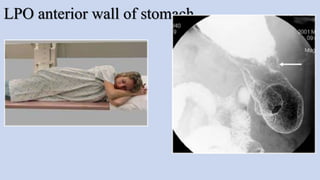
LPO anterior wall of stomach
Contd..
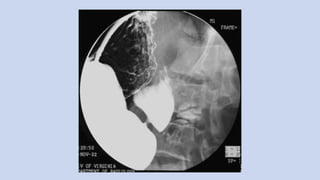
• Increase kVp to 125 for single-contrast graded-compression (SCGC)
spot filming.
• Turn patient into right anterior oblique (RAO) position.
• Place compression paddle beneath patient and inflate balloon for graded
compression of duodenal bulb.
• Take one SCGC spot (4-on-1 film format) of duodenal bulb and one SC
spot of distended proximal duodenal loop.
Contd..
• Turn x-ray table upright. Use Holzknecht paddle and/or compression
cone on fluoroscope to obtain graded compression of duodenal bulb.
Take two SCGC spots (4-on-1 format) of the bulb.
• Then, use compression cone on fluoroscope (or Holzknecht paddle if
patient is obese) and take four SCGC spots (4-on-1 film format) of:
Gastric antrum (patient LPO)
Gastric antrum/body (patient LPO or AP)
Gastric body (patient AP)
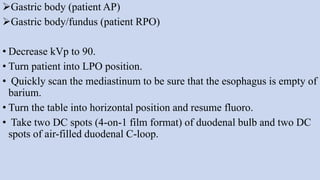
Gastric body/fundus (patient RPO)
• Decrease kVp to 90.
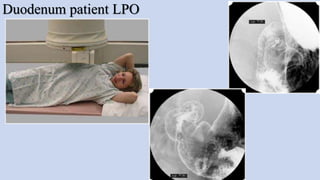
• Turn patient into LPO position.
• Quickly scan the mediastinum to be sure that the esophagus is empty of
barium.
• Turn the table into horizontal position and resume fluoro.
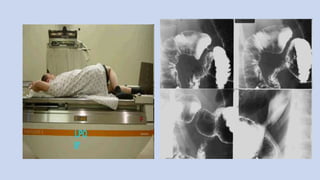
• Take two DC spots (4-on-1 film format) of duodenal bulb and two DC
spots of air-filled duodenal C-loop.
Duodenum patient LPO
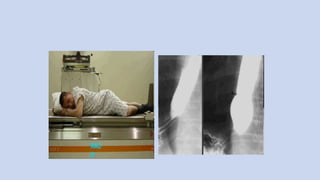
Observe for spontaneous gastro esophageal reflux as you turn patient
towards you (counter-clockwise if viewed from foot of table) into RAO
position.
• Increase kVp to 125.
• Have the patient drink several single swallows of dilute, non-
carbonated barium through a straw.
• Observe esophageal motility and also look for anatomic lesions.
• Take one SC spot (2-on-1 format) of the barium-distended lower
esophagus and gastric cardia during breath-holding and one SC spot
of the same area during Valsalva maneuver to evaluate for a possible
sliding hiatal hernia.
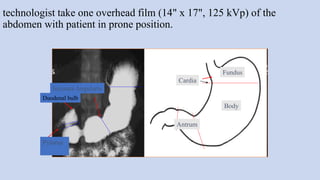
technologist take one overhead film (14" x 17", 125 kVp) of the
abdomen with patient in prone position.
Incisura Angularis
Fundus
Body
Antrum
Pylorus
Cardia
Duodenal bulb
81
Aftercare
• Patient should be warned that bowel motions will be white and difficult to
flush for few days
• Advised to take adequate water to prevent barium impaction. Laxative may be
used if required
• If buscopan is used, the blurring of vision should be subsided before patient
leaves the department.
Complications:
• Leakage of Ba from unsuspected perforation leading to Ba peritonitis
• Aspiration of stomach contents (due to buscopan)
• Barium impaction (partial bowel obstruction to complete bowel
obstruction)
• Barium appendicitis if Ba impacted in appendix
• Adverse effects of pharmacological agents used.
References :-
1. A guide of radiological procedure 5th edit (S.
chapman)
2. Previous slides
3. Google.com
84
85

Procedure of upper gi

  • 1.
    Procedure of upperGI Yashawant ku. Yadav Bsc MIT 2nd year NAMS Bir Hospital 1
  • 2.
    Contents • Introduction • Anatomyof upper GI • Indications of barium swallow & Meal and it’s Contraindications • Contrast medium • Equipment • Patient Preparation • Technique • Filming • Aftercare • References 2
  • 3.
    Introduction • A bariumswallow is a special x-ray to look at the esophagus. • By oral administration of bariumsuphate or gastrogarffin contast media. • In which we can detect pathologies , radiolucent foreign body , congenital anomalies of upper GI which is not seen in general x - ray radiograph • A barium meal is a special x-ray to look at the stomach and duodenum . 3
  • 4.
    Anatomy of upperGI (glance) Organ involve in upper GI a. Mouth b. Pharynx c. Esophagus d. Stomach e. duodenum 4
  • 5.
    Wall of GI/ layers Gi is formed by 4 layers 1. Mucus layer (innermost) have 3 layer 2. Submucus 3.Muscular 4. Fibrous layer or serous 5
  • 6.
    Mouth • Mouth isthe first portion of alimentary canal that receives food & produces saliva. • Divided into; i. Outer, smaller portion – vestibule. ii. Inner larger part – oral cavity proper. Posteriorly cavity communicates with pharynx through the oropharyngeal isthmus. 6
  • 7.
    Pharynx • Muscular tube12 to 14 cm long • Extends from the base of the skull to the level of the 6th cervical vertebra, which continues with the esophagus. It is divided into 3 parts. 1.Nasopharynx 2.Oropharynx 3.Laryngopharynx 7
  • 8.
    Esophagus Muscular tube extendingfrom Pharynx(at the level of Cricoid cartilage, C6 level) to cardiac end of stomach(T11). • 20-25cm long • Crosses diaphragm at T10 level • No enzyme is secreted Sphincter • Esophagus is surrounded at top & bottom by muscular ring, known as upper & lower esophageal sphincter respectively. • Protects oesophagus and respiratory system from acidic secretion and regurgitation of food particle. 8
  • 9.
    Contd.. Normal constrictions ofesophagus :- a. At upper esophageal sphincter. b. At the level where it is crossed by arch of aorta. c. At the level where it is crossed by left main bronchus. d. At the level where it pierces the diaphragm. 9
  • 10.
    Stomach • Muscular bagforming widest & most distensible part of digestive tube. • Connected: above to lower end of esophagus, & below to duodenum. • Act as reservoir of food & helps in digestion of carbohydrates, protein &fats. • Location: lies obliquely in upper & left part of abdomen, occupy epigastric, umbilical & left hypochondriac region. • Capacity: at birth- 30ml, at puberty- 1 litres & at adult - 1.5 to 2 litres. • Shaped: J shaped structure. 10
  • 11.
    Contd… External features: • Twoorifices: cardiac orifice (T11), pyloric orifice ( L1). • Two curvature – Lesser curvature: concave form right border. – Greater curvature: convex & form left border. At its upper end present cardiac notch which separate it from oesophagus. • Two surfaces: anterior or anterosuperior & posterior or posteroinferior. • Divided into 3 regions – Fundus, Body and pyloric antrum. 11
  • 12.
    Duodenum • Shortest, widest& most fixed part of small intestine. • Extent from pylorus to duodenojejunal flexure. • Curved around the head of pancreas. • Lies opposite to 1st ,2nd & 3rd lumbar vertebrae. • Both Pancreatic duct and common bile duct opens into the duodenum through “ampulla of vater”. • 25 cm long & divided into 4 parts 12
  • 13.
    Indications B/S Dysphasia Congenital abnormalitiesof esophagus such as TOF, Atresia, Duplex esophagus etc. Pathological investigation of esophagus (intra/extra esophageal benign/malignant growth) Retrosternal pain, heart burn, regurgitation and odynophagia Hiatus hernia Motility disorder such as achalasia, diffuse esophageal spasm etc. Stricture/diverticula formation Esophageal varices and Left atrial enlargement Assessment of abnormality of pharyngoesophageal junction including zenker’s diverticulum and cricoid web . 13
  • 14.
    Contraindication's of B/S Recentlyoperated patient For suspected perforation, Barium is contraindicated. For TOF or if there is possibility of aspiration, Gastrograffin is contraindicated. 14
  • 15.
    Contrast media Barium suspension/powder,E-Z HD 250% (w/v), 100 ml or more. Gastrograffin or LOCM used if perforation suspected. Barium or LOCM for TOF. LOCM used if aspiration is a possibility. 30% of barium sulphate suspension for high Kv technique 15
  • 16.
    Equipment High power/ frequencyx-ray generator. Fluoroscopy unit with IITV system. Tilting type of x-ray table. Rapid serial radiography (at least 6 frame per second) or video recording, required for assessment of laryngopharynx and upper esophagus during deglutition. Radiation protection devices Emergency recovery equipment . 16
  • 17.
  • 18.
    Patients preparation Because theesophagus is empty most of the time, patients need no preparation for an esophagram unless an upper GI series is to follow. None in general, but nil orally 6 hours prior to the procedure in case of distal esophagus and done in conjunction with Barium Meal. Ensure that no contraindication to the contrast agent used. Procedure should be explained to patient before undergoing the procedure. Preliminary film taken if perforation suspected. 18
  • 19.
    Technique Single contrast study Onlypositive contrast medium used. In diagnosis of gross pathology Not suitable for visualization of mucosal pattern. Double contrast study Both positive and negative contrast media used Small structural anatomy and minute mucosal pattern visualized. 19
  • 20.
    Contd.. Single contrast study Patientin erect RAO position. A mouthful of Barium given and asked to swallow rapidly to see the distension of esophagus. Flow of barium observed fluoroscopically and films taken depending upon the area of obstruction and etiology 20 Double contrast study Barium solution of high density and low viscosity ≈250% w/v for mucosal coating. Normally, Carbon dioxide given as negative contrast medium. A mouthful of Barium given and asked to swallow rapidly to see the distension of esophagus. Flow of barium observed fluoroscopically and films taken depending upon the area of obstruction and etiology.
  • 21.
    21 • Single Contrast• Double Contrast
  • 22.
    Filming RAO  to throwthe esophagus clear of the spine Spot films of upper and lower esophagus is taken in  RAO  Right Lateral  PA or AP -Prone head down (15-30 degrees) for hiatus hernia.  Left oblique -For cardiac shadow  Prone (RPO) -For esophageal varices 22
  • 23.
    Specific conditions Severe dysphagiafor both solid and liquid :- • A little dilute barium is given initially 5 ml . • Further filming and contrast depends on the abnormalities observed.  Pharyngeal web:- • Video fluoroscopy is best technique for the investigation of disorders of swallowing in frontal and lateral projection. • 50/50 dilution of standard high density barium will show web more readily. • Films supine for frontal and erect for lateral are taken at maximum distension of pharynx . 23
  • 24.
    Foreign body • Todetect the level of obstruction in case of radio lucent FB in the oesophagus . A marsh mallow coated with barium is swallowed whole . • Marsh mallow hindered at the level of obstruction , (cotton soak can be used but marsh mallow dissolved spontaneously . In carcinoma:- • High viscosity , normal density liquid barium is given 24
  • 25.
    Motility Disorder • Aminimum 5 mouthful of contrast should be given to the study of motility disorders . • Out of 5 , 2 mouthful of contrast should be abnormal for positive diagnosis . • For motility disorder a prone swallow is essential to assess oesophageal contraction in the absence of gravity. • Disorder are either of peristalsis or sphincter abnormalities . Lower and upper O/S.  Achalasia:- • Esophagus should be cleaned thoroughly so that secondary achalasia due to Carcinoma esophagus may not missed . • Barium 80%w/v is used and patient in erect position. • To differentiate achalasia from other condition show abnormal peristalsis . 25
  • 26.
    Contd.. • Mecholyl testis done .on administration of mecholyl there will be hyperperistalsis pain and streaks of contrast entering the stomach conforming the diagnosis of achalasia ,( Amyl Nitrate is alternative) Trachea oesophageal fistula:- 1. Congenital & Acquired • Ideally contrast is non ionic (water soluble ) • When barium is used then it should be fluid like and Pt. should be lying lateral . • Pt. should keep in prone if fistula is not identifiable in lateral . 26
  • 27.
    Contd.. • If fistulais seen the procedure should be stopped , barium aspiration may result in inflammation and granuloma formation in the lungs . • To demonstrate the TOF in infants , a Ryle’s tube is introduce to the level of mid esophagus and contrast is injected while withdrawing the tube slowly. • Bothe lateral and prone views to be assessed.  Hiatus hernia :- • High abdominal pressure is required to demonstrate hiatus hernia • Pt. has to strain • Pt. ask to lie down straighten the leg and then raise them up. • Manual compression of abdomen • Pt. stands upright ask him to bend downward with lag straight . • Stomach should be well distended otherwise hiatus hernia is not may not demonstrate . 27
  • 28.
    Gastro esophageal reflux •Siphon test , fill the stomach 50% with barium ,follows with 1-2 mouthfuls of water to remove the trace of barium in the esophagus . • Pt. supine with left side 150 up. • Keep one mouth of water pt. mouth, ask the pt. to swallow it a jet of barium will shot into the water column as it enter the G.O junction . • Alternatively with full stomach ask the pt. to roll from side on the table , reflux will be seen . • To promote reflux abdominal pressure should be raised Oesophageal varices :- • Supine right side up position high density thin barium should be used . • Varices are well demonstrated after Buscopan and valslave maneuver . 28
  • 29.
    Modifications Primarily, to demonstrateTOF in infant, a nasogastric tube is introduced to the level of the mid-esophagus from where contrast medium injected. Also performed to demonstrate the lesion of lower esophagus, Reflux esophagitis, Esophageal atresia, intubated patient etc  Contrast medium is syringed in, to distend the esophagus, pressuring it through any small fistula.  Radiographs should be taken in the lateral projection during simultaneous injection of c/m and withdrawal of the tube.  Pull-back technique is not supposed to be necessary in the majority of children (some authors). 29
  • 30.
    Aftercare/Complications  Aftercare  Advisedto drink plenty fluid.  Informed about the white stool color for few days. Complications Leakage of barium from an unsuspected perforation Aspiration 30
  • 31.
    Common pathologies  Hiatalhernia  Extension of stomach into chest through esophageal hiatus  more prominent when supine 31
  • 32.
  • 33.
    Achalasia -also termed cardio-spasm,is a motor disorder of the esophagus in which peristalsis is reduced along the distal two-thirds of the esophagus. • Lower esophageal sphincter fails to relax • Smooth, tapered distal esophageal narrowing. 33
  • 34.
  • 35.
    Zenker's diverticulum • Zenker'sdiverticulum is characterized by a large outpouching of the esophagus just above the upper esophageal sphincter. • It is believed to be caused by weakening of the muscle wall. • Involves Horizontal & oblique fibers of inferior constrictor muscles. • Associated incomplete cricopharyngeal muscle relaxation. 35
  • 36.
  • 37.
    Esophageal varices  dilationof the veins in the distal esophagus.  often seen with acute liver disease, such as cirrhosis due to increased portal hypertension.  Advanced esophageal varices present with narrowing of the distal 3rd of the esophagus and a “wormlike” or “cobblestone” appearance. 37
  • 38.
    GERD the entry ofgastric contents into the esophagus, irritating the lining of the esophagus. Esophageal reflux is reported as heartburn by most patients. In advanced cases, the distal esophagus demonstrates longitudinal streaks 38
  • 39.
    Barium Meal • Aradiological examination of stomach and duodenum following the oral administration of contrast medium normally Barium sulfate 39
  • 40.
    Indications • Dyspepsia • Vomiting •Weight loss • Epigastric pain • Hematemesis • Abdominal masses • Tuberculosis of GI tract • Suspected perforation • Failed upper GI endoscopy • ULCERATION AND CARCINOMA 40
  • 41.
    Contraindications • Recently operatedpatient . • Complete large bowel obstruction. • History/suspicion of aspiration . • Fistulous communication with any organ other than parts of GIT . • Recent biopsy of GIT , as barium granuloma formed at biopsy site. 41
  • 42.
    Patient preparation • Nilorally up to 6 hours prior to the procedure • Ensure that no contraindication to the contrast agent used. • Procedure should be explained to patient before undergoing the examination. • Smoking should not be allowed in the examination day. • diabetic Patients should be scheduled at morning. 42
  • 43.
    Technique 1. Single-contrast +graded compression (SCGC) 2. Double-contrast (DC) 3. Biphasic method: Combined DC + SCGC. 43
  • 44.
    Single contrast +Graded compression • The stomach is filled and distended with dilute barium or a water- soluble contrast agent (SC). • The stomach is compressed either manually or by positioning to allow for adequate x-ray penetration in the evaluation of each anatomical segment (GC). • Single contrast with graded compression (SCGC) technique assesses thickness of the gastric folds and evaluation of gastric emptying. • Large luminal defects can be detected. • The anterior gastric wall is evaluated on the prone films, an area which may not be well demonstrated on a routine double-contrast examination . 44
  • 45.
    Indications of SCGCtechnique: • Children: • Usually not necessary to demonstrate mucosal pattern • Very ill adults: • When not possible to move in different positions • To demonstrate gross pathology only. 45
  • 46.
    Double-contrast study:- • Combinesthe principles of • distension, • mucosal coating and • proper projection • A small amount of high-density barium suspension is used to coat the mucosal surface and air or CO2 gas to distend the lumen. • Both barium and air are used for contrast. • Images are obtained as the patient rolls in various positions to coat the gastric mucosa with contrast. 46
  • 47.
    Contd.. • Double-contrast techniqueprovides exquisite detail of the mucosal surface of the stomach. • Lesions on the dependent surface of the stomach (the posterior wall in the supine patient) are best seen using double-contrast technique • Popularized by the Japanese to diagnose early gastric carcinoma. 47
  • 48.
    Biphasic-Contrast Exam • Combinesthe best features of the DC and the SCGC techniques in one diagnostic procedure. • Performed with a single barium suspension that can provide excellent mucosal coating during gaseous distention in the DC phase of the study and also sufficient transparency to permit “see through” of the contrast agent during the SCGC phase. Why biphasic? 48
  • 49.
    Contd.. •DC technique • givesexcellent definition of the lesser and greater curvatures and the posterior wall of the stomach; • however, satisfactory DC images of the anterior wall of the distal stomach and duodenum are very hard to obtain. •SCGC: • anterior wall of these structures could be demonstrated in face by filling the stomach and duodenum with a low-density barium suspension and applying graded compression to permit the examiner to “see through” these viscera •Combination: takes advantages of both 49
  • 50.
    Contd… • For biphasicstudy bubbly barium is developed. • A medium-density barium suspension which can be administered simultaneously with a gas-producing agent in the form of a cold, carbonated drink (“bubbly barium”) 50
  • 51.
    Contrast Media • Highdensity, low viscosity barium sulphate for DC study. • 250% w/v • ~135ml • Low density barium (100%w/v) for single contrast study. • Medium density bubbly barium for biphasic study. • Effervescent: • Used for double contrast study. • Carbex granules or tablets • Composed of sodium bicarbonate, citrate and an antifoaming agent (simethicone). • When swallowed with a small amount of water, the granules or tablets release 300–500 ml of carbon dioxide which distends the stomach 51
  • 52.
    Contd.. • Water-soluble contrastshould be used when • perforation or • post-operative anastomotic failure is suspected. Pharmacological agents: • To relax the stomach and delay gastric emptying • Buscopan 20mg i.v. or • Glucagon 0.1 to 0.2mg i.v • Metoclopramide 20 mg oral/ i.v 52
  • 53.
    Patient preparation:- • NPOx 6 hours to ensure adequate gastric emptying • Avoid smoking : • Increases gastric secretions which impairs the barium coating of the stomach. • Increases gastric motility. • Question the patient about: - • relevant symptoms • previous gastric surgery • modification of technique required • having been NPO since midnight • the possibility of pregnancy 53
  • 54.
    Contd.. • Explain theprocedure to the patient. • Describe how to perform breath-holding during spot filming • Caution the patient not to belch after ingesting carbex granules or drinking the “bubbly barium”. • If the patient is to have both a cervical/esophageal barium swallow (BS) and UGI, start with the UGI and do the examination of the hypopharynx and cervical esophagus at the end of the study. 54
  • 55.
    Spot-film technique:- • Phototimed90 kVp (70-120kVp) is used for all double-contrast filming; • 125 kVp (120-150kVp) for all single-contrast filming. Preliminary film • Required • if there is any question of perforation or obstruction, • history of recent contrast examination 55
  • 56.
    Technique • A gasproducing agent is swallowed • Patient then drinks barium while lying on left side, supported by the elbow. • Prevents barium from reaching the duodenum too quickly obscuring the greater curve of the stomach. • Patient is asked to roll rightward (counter-clockwise, as viewed from the foot end of table) through three 360° rotations, stopping in the steep LPO (when over couch tube used)or left lateral position. 56
  • 57.
    Contd… • (If patientcannot turn around, he should be rolled back and forth three times from one lateral position to the other.) • This is done to obtain good barium coating of the gastric mucosa while the CO2 will distend the gastric lumen. • Four DC spot films are taken in the following sequence • from the distal to the proximal end of the stomach . 57
  • 58.
    1. Gastric antrum(patient LPO) 58
  • 59.
    Gastric body, inferiorportion (patient supine, AP) 59
  • 60.
  • 61.
    • Gastric body,superior portion (patient RPO). (Elevate head of table 15° to keep barium from flowing back into gastric fundus as he rolls back into RPO position 61
  • 62.
    Contd… • Patient isasked to make another counter-clockwise rotation (as viewed from foot of table) to refresh the barium coating of the gastric mucosa. • Stop in the steep LPO position. • Four DC spot films of the entire stomach are taken in the following sequence: 62
  • 63.
  • 64.
  • 65.
    RPO (First, turnpatient into right lateral position and elevate head of table 15° to keep barium from flowing back into gastric fundus as he rolls back into RPO position.)
  • 66.
    Right lateral (Waituntil duodenal C-loop is sufficiently filled with barium; otherwise, take this film at end of study.)
  • 67.
  • 68.
  • 69.
  • 70.
    Contd.. • Increase kVpto 125 for single-contrast graded-compression (SCGC) spot filming. • Turn patient into right anterior oblique (RAO) position. • Place compression paddle beneath patient and inflate balloon for graded compression of duodenal bulb. • Take one SCGC spot (4-on-1 film format) of duodenal bulb and one SC spot of distended proximal duodenal loop.
  • 72.
    Contd.. • Turn x-raytable upright. Use Holzknecht paddle and/or compression cone on fluoroscope to obtain graded compression of duodenal bulb. Take two SCGC spots (4-on-1 format) of the bulb. • Then, use compression cone on fluoroscope (or Holzknecht paddle if patient is obese) and take four SCGC spots (4-on-1 film format) of:
  • 73.
  • 74.
  • 75.
    Gastric body (patientAP) Gastric body/fundus (patient RPO) • Decrease kVp to 90. • Turn patient into LPO position. • Quickly scan the mediastinum to be sure that the esophagus is empty of barium. • Turn the table into horizontal position and resume fluoro. • Take two DC spots (4-on-1 film format) of duodenal bulb and two DC spots of air-filled duodenal C-loop.
  • 77.
  • 78.
    Observe for spontaneousgastro esophageal reflux as you turn patient towards you (counter-clockwise if viewed from foot of table) into RAO position. • Increase kVp to 125. • Have the patient drink several single swallows of dilute, non- carbonated barium through a straw. • Observe esophageal motility and also look for anatomic lesions. • Take one SC spot (2-on-1 format) of the barium-distended lower esophagus and gastric cardia during breath-holding and one SC spot of the same area during Valsalva maneuver to evaluate for a possible sliding hiatal hernia.
  • 80.
    technologist take oneoverhead film (14" x 17", 125 kVp) of the abdomen with patient in prone position. Incisura Angularis Fundus Body Antrum Pylorus Cardia Duodenal bulb
  • 81.
  • 82.
    Aftercare • Patient shouldbe warned that bowel motions will be white and difficult to flush for few days • Advised to take adequate water to prevent barium impaction. Laxative may be used if required • If buscopan is used, the blurring of vision should be subsided before patient leaves the department.
  • 83.
    Complications: • Leakage ofBa from unsuspected perforation leading to Ba peritonitis • Aspiration of stomach contents (due to buscopan) • Barium impaction (partial bowel obstruction to complete bowel obstruction) • Barium appendicitis if Ba impacted in appendix • Adverse effects of pharmacological agents used.
  • 84.
    References :- 1. Aguide of radiological procedure 5th edit (S. chapman) 2. Previous slides 3. Google.com 84
  • 85.

Editor's Notes

  • #6 Epithelial layer stratified squamous above esophagus columnar epithelial after that Lamina propria , connective tissue contain fibroblast . Microphages , eosinophils ,lymphocytes Muscularis Submucus , after oesophagus , loose collagen elastic reticular fiber some cell of connective tissue , lymphatic vessel blood vessel and nerves Muscular layer . Above pharynx skeletal esophagus skeletal and smooth after that smooth Fibrous covering pharynx and esophagus remaining serous covering
  • #14 1.
  • #53 Hyoscine – n butyl bromide // immediate onset of action / cost effective Dis advantage :- blurry vision , dry mouth bradycardia- tachycardia , urinary retention, Contra indi :- myasthenia gravis , paralytic ilius etc More potent smooth muscle relaxant , short duration of action, cost effective dis advan :- long onset of action 1 min Maxolon (dopamine antagonist ) Rappid gastric emptying thus increase jejunal peristalsis Disadvantage , extramedullary side effect may occur if dose exceed 0.5mg/kg more likely in children/ young