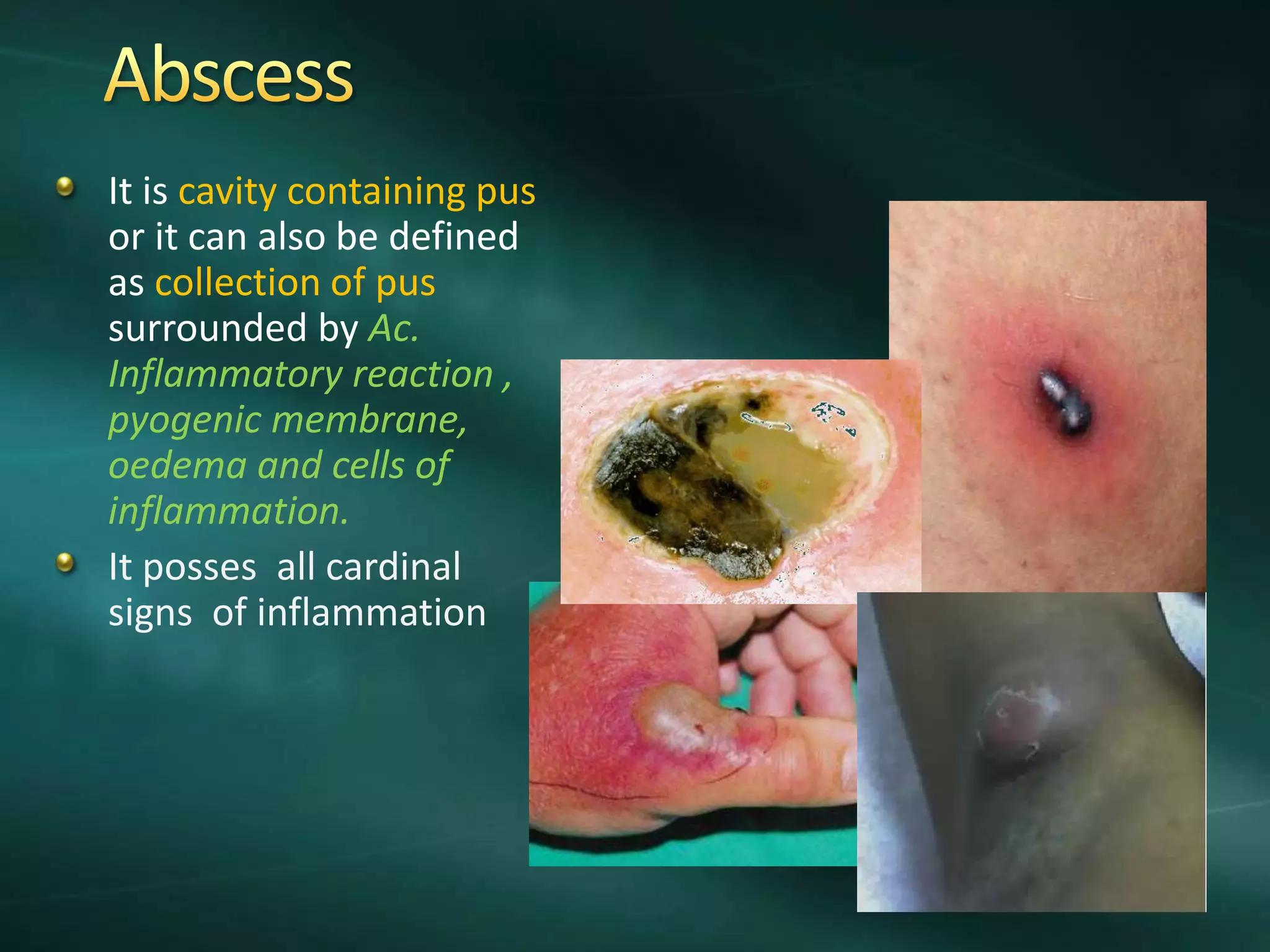
It is cavity containing pus
or it can also be defined
as collection of pus
surrounded by Ac.
Inflammatory reaction ,
pyogenic membrane,
oedema and cells of
inflammation.
It posses all cardinal
signs of inflammation
Pus : collection of dead / dying leucocytes & bacteria
Pyogenic Membrane : An area immediately around the
abscess infiltrated by leucocytes & fibrinous exudate
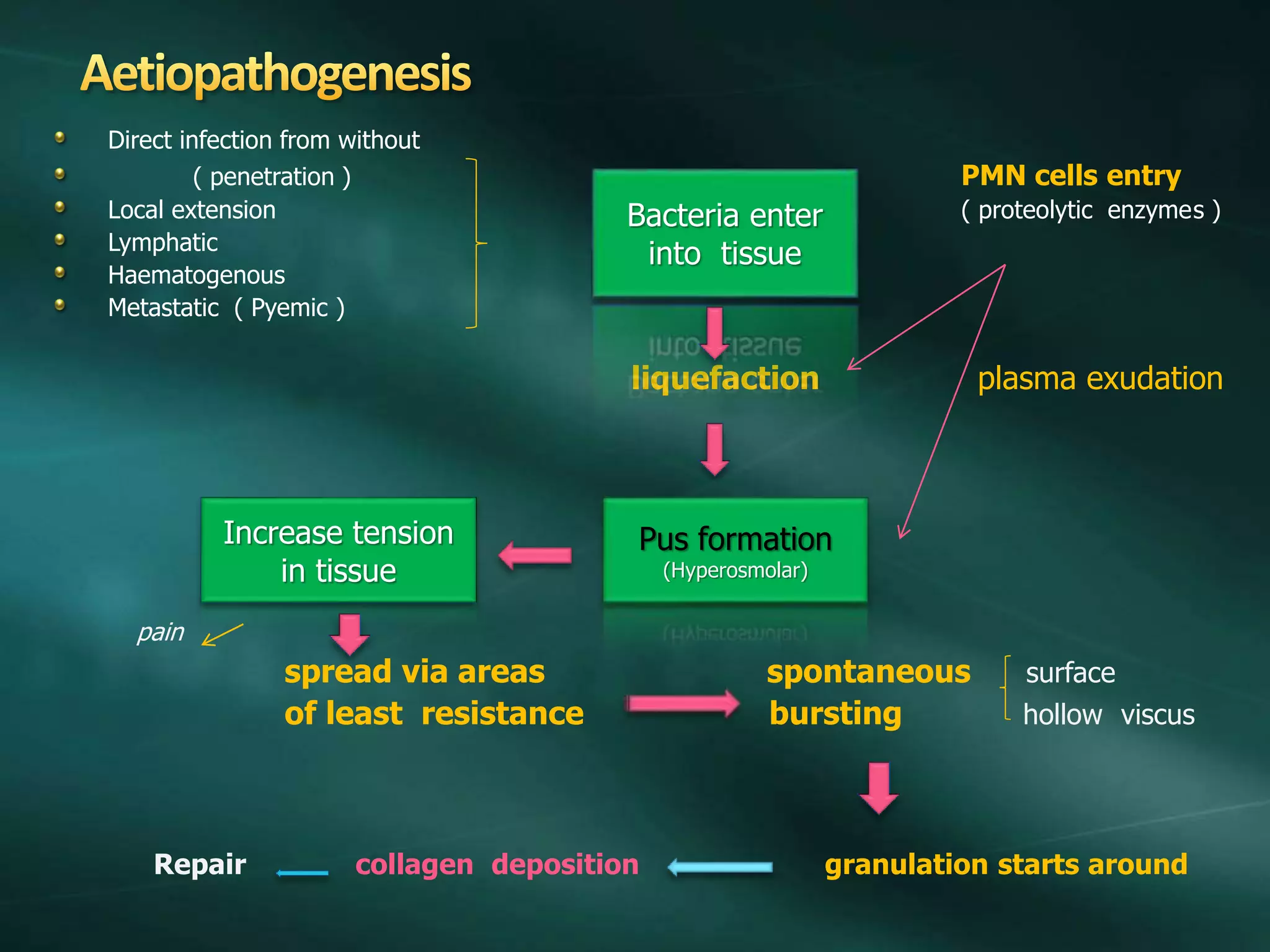
Direct infection from without
( penetration ) PMN cells entry
Local extension ( proteolytic enzymes )
Lymphatic
Haematogenous
Metastatic ( Pyemic )
liquefaction plasma exudation
pain
spread via areas spontaneous surface
of least resistance bursting hollow viscus
Repair collagen deposition granulation starts around
Bacteria enter
into tissue
Pus formation
(Hyperosmolar)
Increase tension
in tissue
pathology
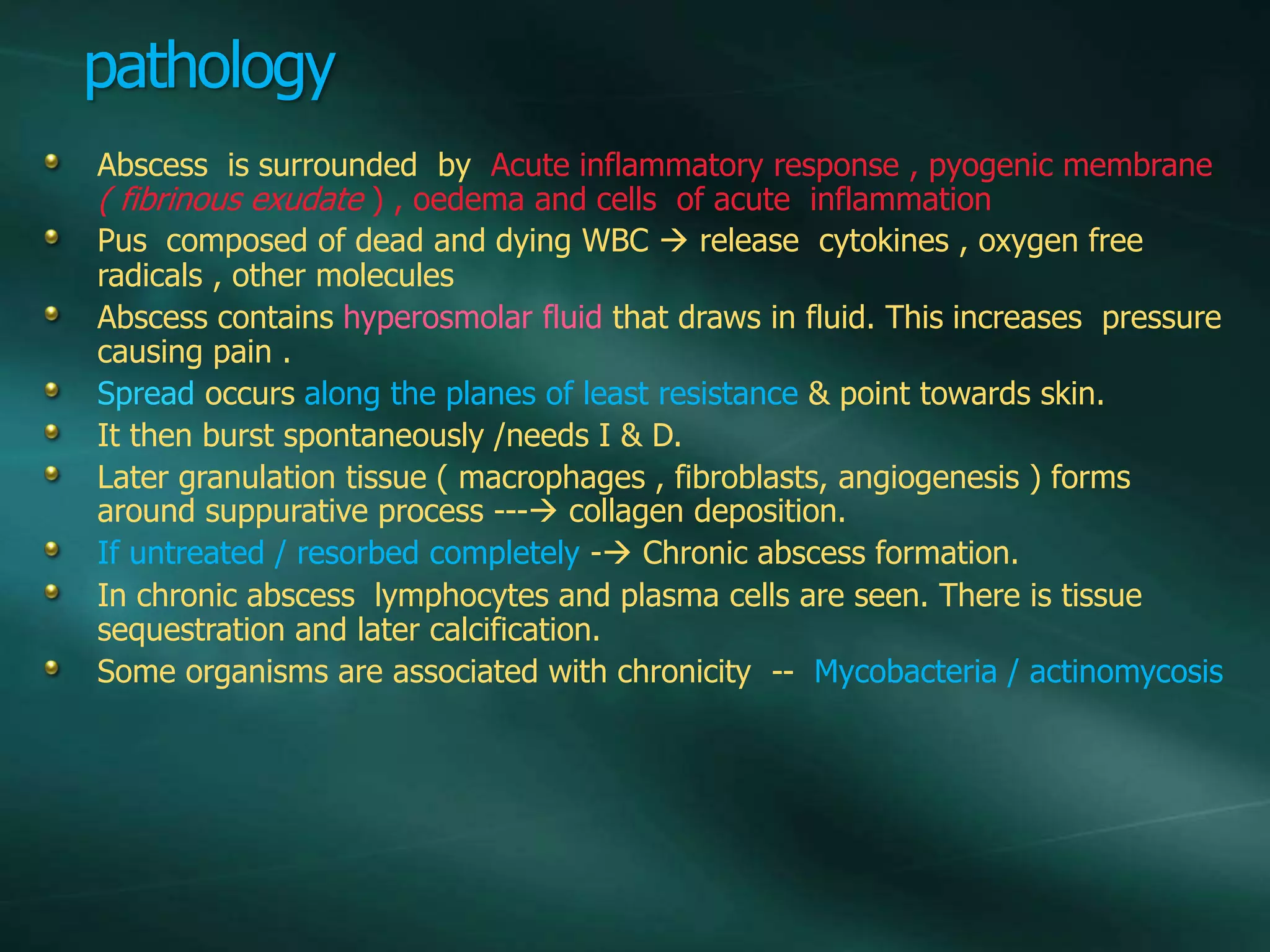
Abscess is surrounded by Acute inflammatory response , pyogenic membrane
( fibrinous exudate ) , oedema and cells of acute inflammation
Pus composed of dead and dying WBC  release cytokines , oxygen free
radicals , other molecules
Abscess contains hyperosmolar fluid that draws in fluid. This increases pressure
causing pain .
Spread occurs along the planes of least resistance & point towards skin.
It then burst spontaneously /needs I & D.
Later granulation tissue ( macrophages , fibroblasts, angiogenesis ) forms
around suppurative process --- collagen deposition.
If untreated / resorbed completely - Chronic abscess formation.
In chronic abscess lymphocytes and plasma cells are seen. There is tissue
sequestration and later calcification.
Some organisms are associated with chronicity -- Mycobacteria / actinomycosis
Typesofabscess
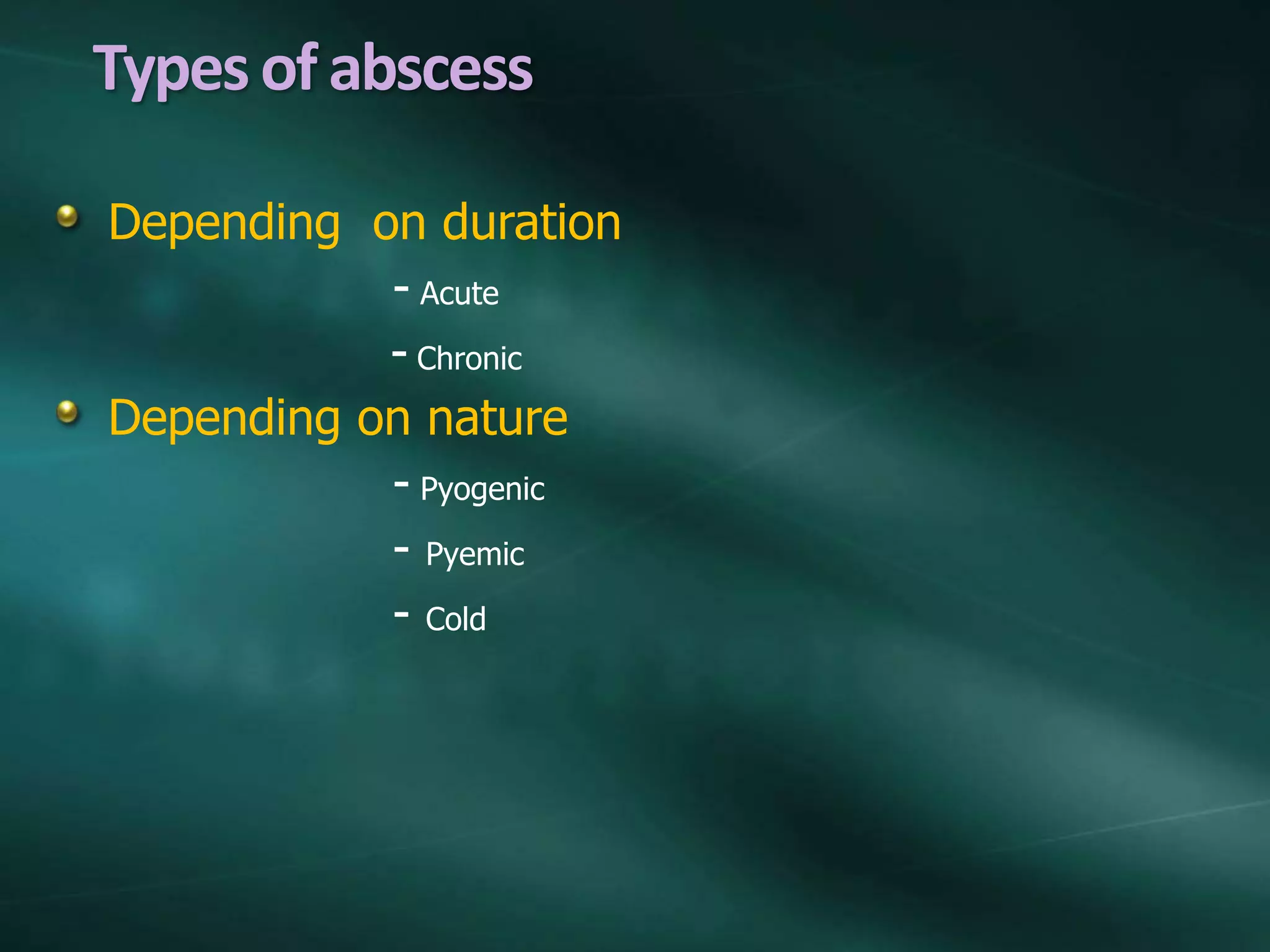
Depending on duration
- Acute
- Chronic
Depending on nature
- Pyogenic
- Pyemic
- Cold
Features
Depends on : size of abscess , virulence of
organism ,tension in the cavity .
Sense of illness
throbbing pain ( increases with dependency )
Pyrexia
Rigors (due to toxaemia / septicaemia )
Local signs of inflammation - calor ,dolor ,rubor ,tumor
loss of function
( due to hyperemia & inflammatory exudate )
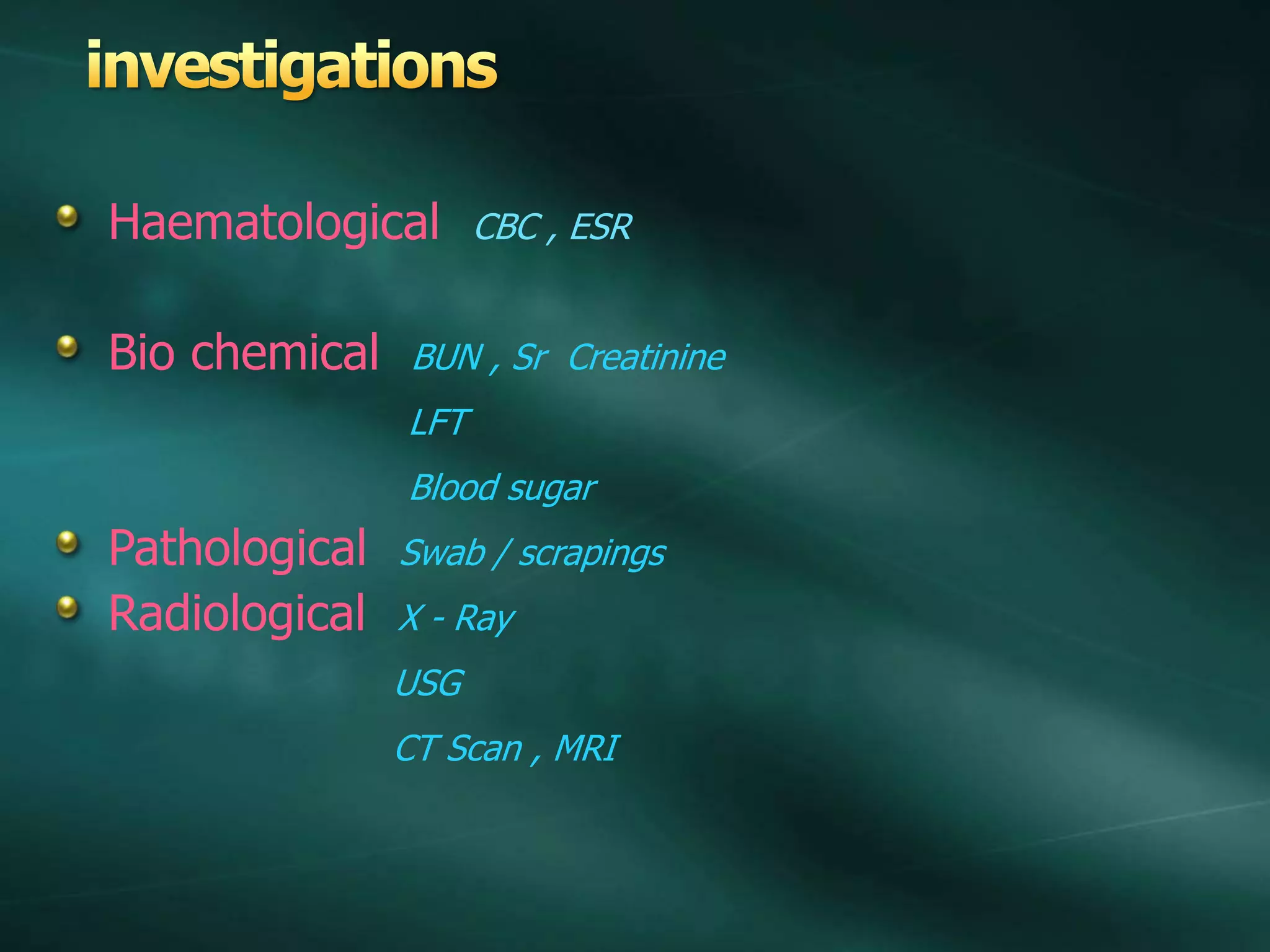
Haematological CBC , ESR
Bio chemical BUN , Sr Creatinine
LFT
Blood sugar
Pathological Swab / scrapings
Radiological X - Ray
USG
CT Scan , MRI
Treatment
Rest
Elevation of affected part
Appropriate antibiotics
Surgery – I & D ( Modified Hilton’s Method )
Aspiration ( for liver abscess , retrosternal abscess ,lung abscess )
I & D : points to remember
Before I & D always confirm the diagnosis by appropriate investigations &
always confirm liquefaction of pus .
Drain the abscess by Hilton’s / modified Hilton’s method .
All loculi need to be opened and curetted.
Clean the abscess cavity after I & D and allow it to heal by secondary
intention .
Location of abscess in deep cavities like pleura & peritoneum ( due to
perianastomotic infection or leak ) is difficult to locate . But with the help of
CT /MRI /USG / isotope scan it can be detected and aspirated under guidance
Role of antibiotics is controversial but definitely required if abscess is
spreading.
Surgical drainage & curettage should be adequate whether antibiotics used or
not.
Primary closure can be tried but it is safe to allow healing by secondary
intention.
Spread
Inadequate drainage  sinus / fistula
Damage to vital structures
Formation of antibioma e.g. breast abscess
Incision of aneurysm
Formation of chronic abscess.
Abscess needs drainage and curettage .
Modern imaging technique may allow
guided aspiration.
Antibiotics required if abscess is not located
( i.e. cellulitis )
Healing by secondary intention is
encouraged.
Abscess formation due to spread of infection beyond tonsil
involving tonsiller bed
Quinsy is an old term synonymous with
peritonsillar abscess.
It is derived from the Latin word cynanche
meaning sore throat.
Aetiopathogenesis
PTA usually arises as a complication of an untreated or partially
treated episode of acute tonsillitis.
The infection, in these cases, spreads to the peritonsillar area
(peritonsillitis). This region comprises loose connective tissue and is
hence susceptible to formation of abscess.
PTA can also occur de novo.
Both aerobic and anaerobic bacteria can be causative. Commonly
involved species include streptococci, staphylococci and hemophilus.
Clinical features
Adults commonly affected
Symptoms starts appearing 2-8 days before abscess development
Progressively worsening unilateral sore throat and pain are the earliest
symptoms.
Sudden deterioration with severe pain during attack of tonsillitis
Fever, malaise, headache & distortion of vowels informally known as "hot
potato voice" may appear.
Neck pain associated with tender, swollen lymph nodes, referred ear pain and
halitosis are also common
Increase salivation.
Trismus ( difficulty in opening mouth – due to spasm induced in pterygoid
muscle due to infection )
clinical features
On examination ( good illumination and suction may required )
• Erythematous, swollen tonsil with
contralateral uvula displaced medially
• Trismus
• Edema of palatine tonsils
• Diffuse swelling of soft palate
• superior to affected tonsil
Purulent exudate on tonsils
• Drooling
• Muffled, “hot potato” voice
• Cervical lymphadenopathy
• Abscess may point out.
Investigations
Detailed history & good examination is required
Haematological
Biochemical
Some times CT scan neck may be needed
DifferentialDiagnosis
Peritonsillar cellulitis
Cervical adenitis
Tonsillar abscess
Dental infections
Mononucleosis
Salivary gland infection
Foreign body aspiration
Mastoid infection
Neoplasms (lymphoma, leukemia)
Aneurysm of internal carotid artery
Treatment
Abscess not pointing
Broad spectrum antibiotics.
NSAID
Abscess pointing
I & D required
Adult Children
Local anesthesia Gen anesthesia
2% lignocain spray
Pt sits upward
Incision – midway bet
- ween uvula
& upper 3rd
molar
Forcep pushed & open
Pus drained
complications
Parapharyngeal abscess
Extension of abscess in other deep neck spaces leading to airway
compromise
Septicaemia
Possible Necrosis of surrounding deep tissues
In rare cases, Mediastinitis
End of lecture 3

Abscess

  • 1.
    It is cavitycontaining pus or it can also be defined as collection of pus surrounded by Ac. Inflammatory reaction , pyogenic membrane, oedema and cells of inflammation. It posses all cardinal signs of inflammation
  • 2.
    Pus : collectionof dead / dying leucocytes & bacteria Pyogenic Membrane : An area immediately around the abscess infiltrated by leucocytes & fibrinous exudate
  • 3.
    Direct infection fromwithout ( penetration ) PMN cells entry Local extension ( proteolytic enzymes ) Lymphatic Haematogenous Metastatic ( Pyemic ) liquefaction plasma exudation pain spread via areas spontaneous surface of least resistance bursting hollow viscus Repair collagen deposition granulation starts around Bacteria enter into tissue Pus formation (Hyperosmolar) Increase tension in tissue
  • 4.
    pathology Abscess is surroundedby Acute inflammatory response , pyogenic membrane ( fibrinous exudate ) , oedema and cells of acute inflammation Pus composed of dead and dying WBC  release cytokines , oxygen free radicals , other molecules Abscess contains hyperosmolar fluid that draws in fluid. This increases pressure causing pain . Spread occurs along the planes of least resistance & point towards skin. It then burst spontaneously /needs I & D. Later granulation tissue ( macrophages , fibroblasts, angiogenesis ) forms around suppurative process --- collagen deposition. If untreated / resorbed completely - Chronic abscess formation. In chronic abscess lymphocytes and plasma cells are seen. There is tissue sequestration and later calcification. Some organisms are associated with chronicity -- Mycobacteria / actinomycosis
  • 5.
    Typesofabscess Depending on duration -Acute - Chronic Depending on nature - Pyogenic - Pyemic - Cold
  • 6.
    Features Depends on :size of abscess , virulence of organism ,tension in the cavity . Sense of illness throbbing pain ( increases with dependency ) Pyrexia Rigors (due to toxaemia / septicaemia ) Local signs of inflammation - calor ,dolor ,rubor ,tumor loss of function ( due to hyperemia & inflammatory exudate )
  • 7.
    Haematological CBC ,ESR Bio chemical BUN , Sr Creatinine LFT Blood sugar Pathological Swab / scrapings Radiological X - Ray USG CT Scan , MRI
  • 8.
    Treatment Rest Elevation of affectedpart Appropriate antibiotics Surgery – I & D ( Modified Hilton’s Method ) Aspiration ( for liver abscess , retrosternal abscess ,lung abscess )
  • 9.
    I & D: points to remember Before I & D always confirm the diagnosis by appropriate investigations & always confirm liquefaction of pus . Drain the abscess by Hilton’s / modified Hilton’s method . All loculi need to be opened and curetted. Clean the abscess cavity after I & D and allow it to heal by secondary intention . Location of abscess in deep cavities like pleura & peritoneum ( due to perianastomotic infection or leak ) is difficult to locate . But with the help of CT /MRI /USG / isotope scan it can be detected and aspirated under guidance Role of antibiotics is controversial but definitely required if abscess is spreading. Surgical drainage & curettage should be adequate whether antibiotics used or not. Primary closure can be tried but it is safe to allow healing by secondary intention.
  • 10.
    Spread Inadequate drainage sinus / fistula Damage to vital structures Formation of antibioma e.g. breast abscess Incision of aneurysm Formation of chronic abscess.
  • 11.
    Abscess needs drainageand curettage . Modern imaging technique may allow guided aspiration. Antibiotics required if abscess is not located ( i.e. cellulitis ) Healing by secondary intention is encouraged.
  • 12.
    Abscess formation dueto spread of infection beyond tonsil involving tonsiller bed Quinsy is an old term synonymous with peritonsillar abscess. It is derived from the Latin word cynanche meaning sore throat.
  • 13.
    Aetiopathogenesis PTA usually arisesas a complication of an untreated or partially treated episode of acute tonsillitis. The infection, in these cases, spreads to the peritonsillar area (peritonsillitis). This region comprises loose connective tissue and is hence susceptible to formation of abscess. PTA can also occur de novo. Both aerobic and anaerobic bacteria can be causative. Commonly involved species include streptococci, staphylococci and hemophilus.
  • 14.
    Clinical features Adults commonlyaffected Symptoms starts appearing 2-8 days before abscess development Progressively worsening unilateral sore throat and pain are the earliest symptoms. Sudden deterioration with severe pain during attack of tonsillitis Fever, malaise, headache & distortion of vowels informally known as "hot potato voice" may appear. Neck pain associated with tender, swollen lymph nodes, referred ear pain and halitosis are also common Increase salivation. Trismus ( difficulty in opening mouth – due to spasm induced in pterygoid muscle due to infection )
  • 15.
    clinical features On examination( good illumination and suction may required ) • Erythematous, swollen tonsil with contralateral uvula displaced medially • Trismus • Edema of palatine tonsils • Diffuse swelling of soft palate • superior to affected tonsil Purulent exudate on tonsils • Drooling • Muffled, “hot potato” voice • Cervical lymphadenopathy • Abscess may point out.
  • 16.
    Investigations Detailed history &good examination is required Haematological Biochemical Some times CT scan neck may be needed
  • 17.
    DifferentialDiagnosis Peritonsillar cellulitis Cervical adenitis Tonsillarabscess Dental infections Mononucleosis Salivary gland infection Foreign body aspiration Mastoid infection Neoplasms (lymphoma, leukemia) Aneurysm of internal carotid artery
  • 18.
    Treatment Abscess not pointing Broadspectrum antibiotics. NSAID Abscess pointing I & D required Adult Children Local anesthesia Gen anesthesia 2% lignocain spray Pt sits upward Incision – midway bet - ween uvula & upper 3rd molar Forcep pushed & open Pus drained
  • 19.
    complications Parapharyngeal abscess Extension ofabscess in other deep neck spaces leading to airway compromise Septicaemia Possible Necrosis of surrounding deep tissues In rare cases, Mediastinitis
  • 20.