The Baroque (2)
1
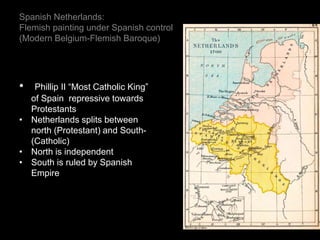
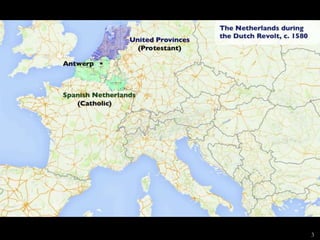
Spanish Netherlands:
Flemish painting under Spanish control
(Modern Belgium-Flemish Baroque)
• Phillip II “Most Catholic King”
of Spain repressive towards
Protestants
• Netherlands splits between
north (Protestant) and South-
(Catholic)
• North is independent
• South is ruled by Spanish
Empire
3
4
5
6
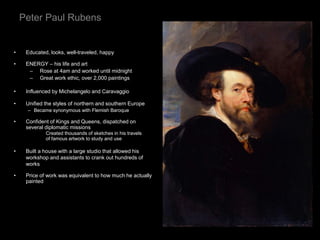
Peter Paul Rubens
• Educated, looks, well-traveled, happy
• ENERGY – his life and art
– Rose at 4am and worked until midnight
– Great work ethic, over 2,000 paintings
• Influenced by Michelangelo and Caravaggio
• Unified the styles of northern and southern Europe
– Became synonymous with Flemish Baroque
• Confident of Kings and Queens, dispatched on
several diplomatic missions
Created thousands of sketches in his travels
of famous artwork to study and use
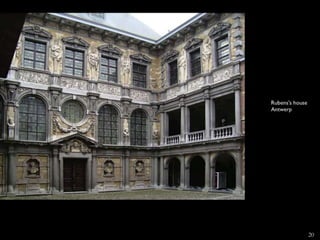
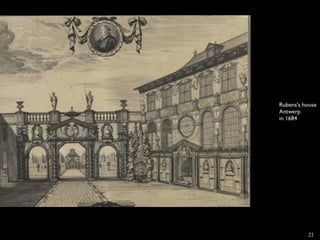
• Built a house with a large studio that allowed his
workshop and assistants to crank out hundreds of
works
• Price of work was equivalent to how much he actually
painted
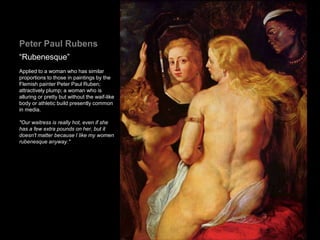
Peter Paul Rubens
“Rubenesque”
Applied to a woman who has similar
proportions to those in paintings by the
Flemish painter Peter Paul Ruben;
attractively plump; a woman who is
alluring or pretty but without the waif-like
body or athletic build presently common
in media.
"Our waitress is really hot, even if she
has a few extra pounds on her, but it
doesn't matter because I like my women
rubenesque anyway."
9
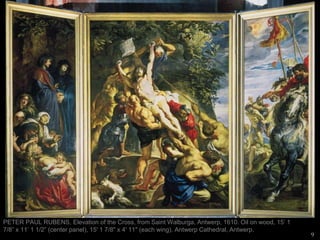
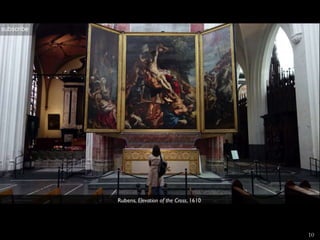
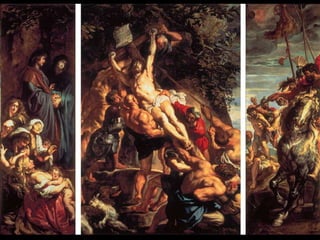
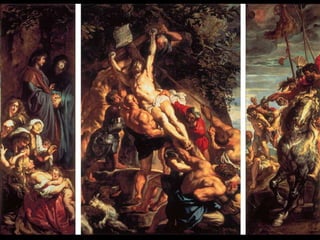
PETER PAUL RUBENS, Elevation of the Cross, from Saint Walburga, Antwerp, 1610. Oil on wood, 15’ 1
7/8” x 11’ 1 1/2” (center panel), 15' 1 7/8" x 4' 11" (each wing). Antwerp Cathedral, Antwerp.
10
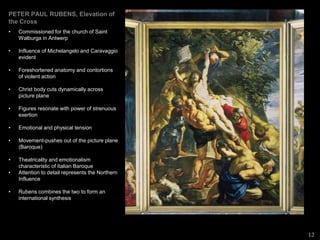
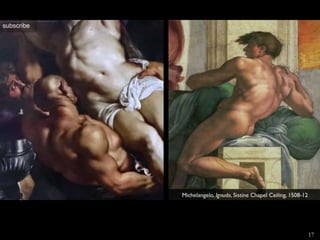
PETER PAUL RUBENS, Elevation of
the Cross
• Commissioned for the church of Saint
Walburga in Antwerp
• Influence of Michelangelo and Caravaggio
evident
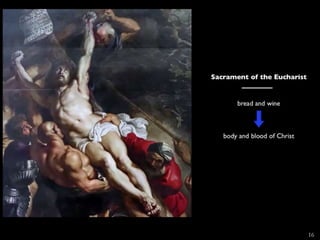
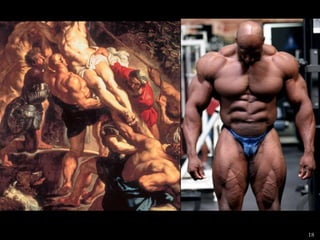
• Foreshortened anatomy and contortions
of violent action
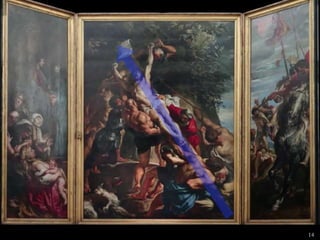
• Christ body cuts dynamically across
picture plane
• Figures resonate with power of strenuous
exertion
• Emotional and physical tension
• Movement-pushes out of the picture plane
(Baroque)
• Theatricality and emotionalism
characteristic of Italian Baroque
• Attention to detail represents the Northern
Influence
• Rubens combines the two to form an
international synthesis
12
14
15
16
17
18
20
21
22
23
24
25
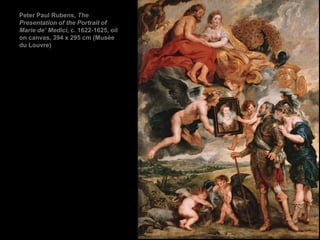
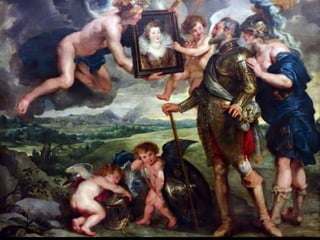
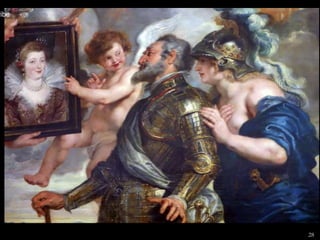
Peter Paul Rubens, The
Presentation of the Portrait of
Marie de’ Medici, c. 1622-1625, oil
on canvas, 394 x 295 cm (Musée
du Louvre)
27
28
29
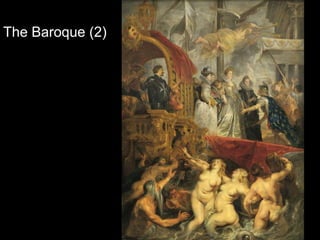
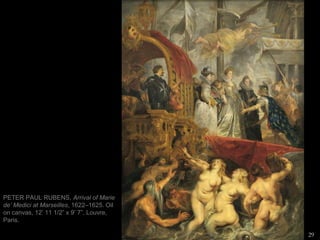
PETER PAUL RUBENS, Arrival of Marie
de’ Medici at Marseilles, 1622–1625. Oil
on canvas, 12’ 11 1/2” x 9’ 7”. Louvre,
Paris.
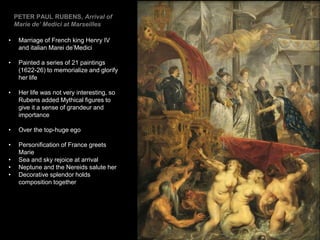
PETER PAUL RUBENS, Arrival of
Marie de’ Medici at Marseilles
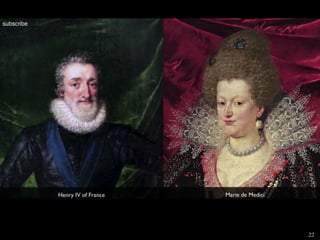
• Marriage of French king Henry IV
and italian Marei de’Medici
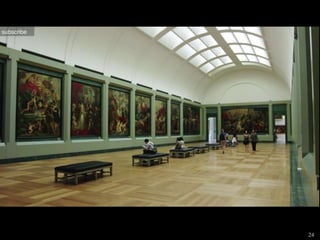
• Painted a series of 21 paintings
(1622-26) to memorialize and glorify
her life
• Her life was not very interesting, so
Rubens added Mythical figures to
give it a sense of grandeur and
importance
• Over the top-huge ego
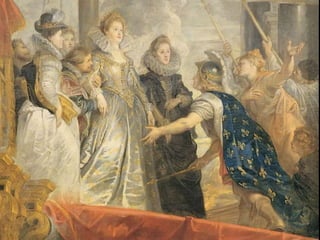
• Personification of France greets
Marie
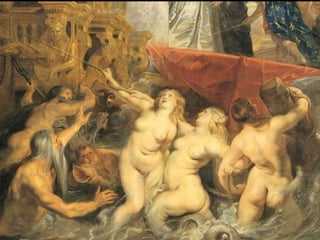
• Sea and sky rejoice at arrival
• Neptune and the Nereids salute her
• Decorative splendor holds
composition together
30
31
32
33
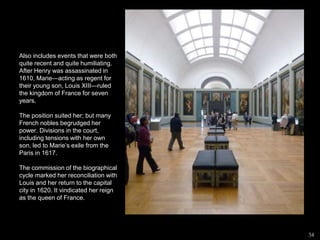
Also includes events that were both
quite recent and quite humiliating.
After Henry was assassinated in
1610, Marie—acting as regent for
their young son, Louis XIII—ruled
the kingdom of France for seven
years.
The position suited her; but many
French nobles begrudged her
power. Divisions in the court,
including tensions with her own
son, led to Marie’s exile from the
Paris in 1617.
The commission of the biographical
cycle marked her reconciliation with
Louis and her return to the capital
city in 1620. It vindicated her reign
as the queen of France.
34
35
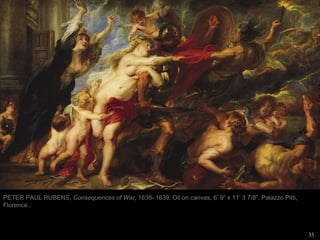
PETER PAUL RUBENS, Consequences of War, 1638–1639. Oil on canvas, 6’ 9” x 11’ 3 7/8”. Palazzo Pitti,
Florence..
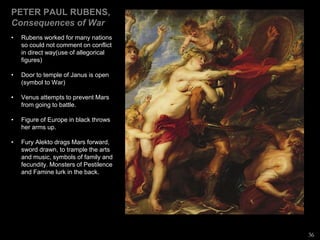
PETER PAUL RUBENS,
Consequences of War
• Rubens worked for many nations
so could not comment on conflict
in direct way(use of allegorical
figures)
• Door to temple of Janus is open
(symbol to War)
• Venus attempts to prevent Mars
from going to battle.
• Figure of Europe in black throws
her arms up.
• Fury Alekto drags Mars forward,
sword drawn, to trample the arts
and music, symbols of family and
fecundity. Monsters of Pestilence
and Famine lurk in the back.
36
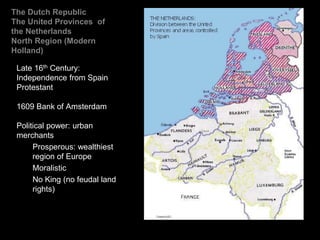
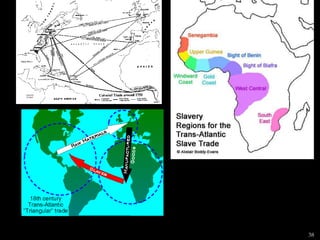
The Dutch Republic
The United Provinces of
the Netherlands
North Region (Modern
Holland)
Late 16th Century:
Independence from Spain
Protestant
1609 Bank of Amsterdam
Political power: urban
merchants
Prosperous: wealthiest
region of Europe
Moralistic
No King (no feudal land
rights)
38
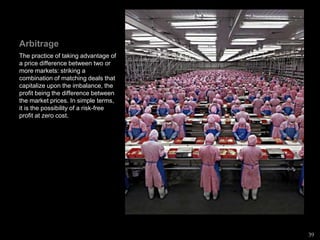
Arbitrage
The practice of taking advantage of
a price difference between two or
more markets: striking a
combination of matching deals that
capitalize upon the imbalance, the
profit being the difference between
the market prices. In simple terms,
it is the possibility of a risk-free
profit at zero cost.
39
40
41
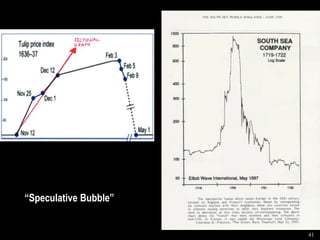
“Speculative Bubble”
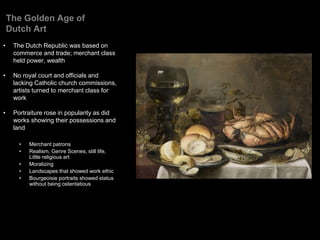
The Golden Age of
Dutch Art
• The Dutch Republic was based on
commerce and trade; merchant class
held power, wealth
• No royal court and officials and
lacking Catholic church commissions,
artists turned to merchant class for
work
• Portraiture rose in popularity as did
works showing their possessions and
land
• Merchant patrons
• Realism, Genre Scenes, still life,
Little religious art
• Moralizing
• Landscapes that showed work ethic
• Bourgeoisie portraits showed status
without being ostentatious
43
44
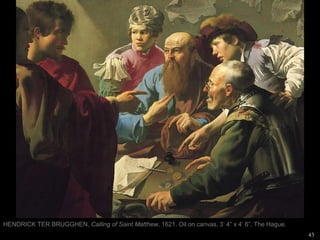
HENDRICK TER BRUGGHEN, Calling of Saint Matthew, 1621. Oil on canvas, 3’ 4” x 4’ 6”. The Hague.
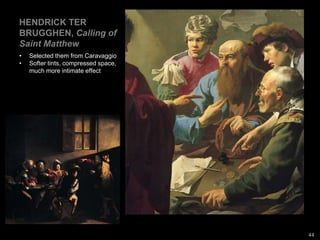
HENDRICK TER
BRUGGHEN, Calling of
Saint Matthew
• Selected them from Caravaggio
• Softer tints, compressed space,
much more intimate effect
45
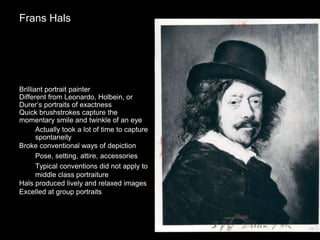
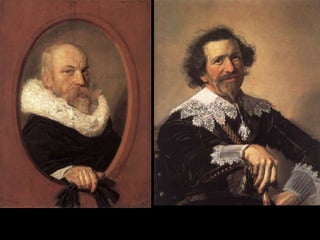
Frans Hals
Brilliant portrait painter
Different from Leonardo, Holbein, or
Durer’s portraits of exactness
Quick brushstrokes capture the
momentary smile and twinkle of an eye
Actually took a lot of time to capture
spontaneity
Broke conventional ways of depiction
Pose, setting, attire, accessories
Typical conventions did not apply to
middle class portraiture
Hals produced lively and relaxed images
Excelled at group portraits
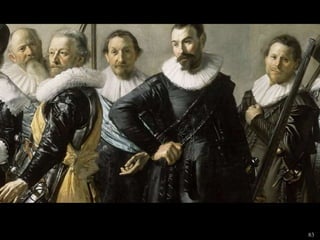
47
48
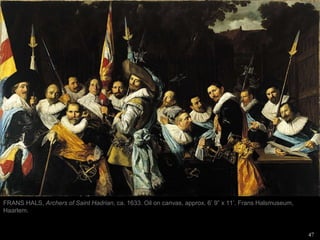
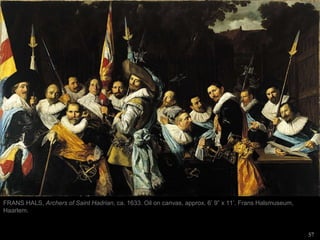
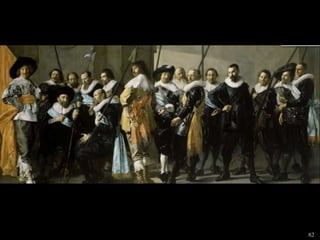
FRANS HALS, Archers of Saint Hadrian, ca. 1633. Oil on canvas, approx. 6’ 9” x 11’. Frans Halsmuseum,
Haarlem.
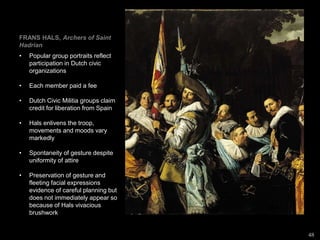
FRANS HALS, Archers of Saint
Hadrian
• Popular group portraits reflect
participation in Dutch civic
organizations
• Each member paid a fee
• Dutch Civic Militia groups claim
credit for liberation from Spain
• Hals enlivens the troop,
movements and moods vary
markedly
• Spontaneity of gesture despite
uniformity of attire
• Preservation of gesture and
fleeting facial expressions
evidence of careful planning but
does not immediately appear so
because of Hals vivacious
brushwork
49
52
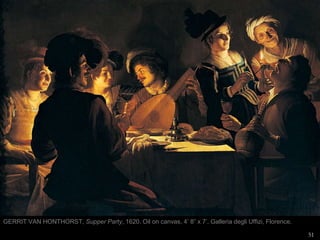
GERRIT VAN HONTHORST, Supper Party, 1620. Oil on canvas, 4’ 8” x 7’. Galleria degli Uffizi, Florence.
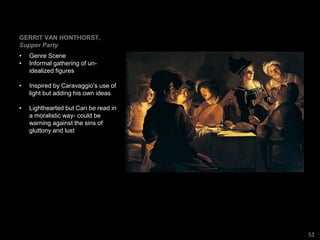
GERRIT VAN HONTHORST,
Supper Party
• Genre Scene
• Informal gathering of un-
idealized figures
• Inspired by Caravaggio’s use of
light but adding his own ideas
• Lighthearted but Can be read in
a moralistic way- could be
warning against the sins of
gluttony and lust
53
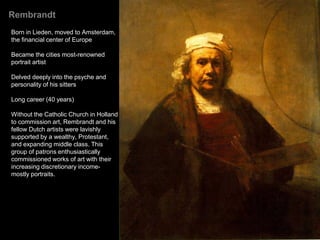
Rembrandt
Born in Lieden, moved to Amsterdam,
the financial center of Europe
Became the cities most-renowned
portrait artist
Delved deeply into the psyche and
personality of his sitters
Long career (40 years)
Without the Catholic Church in Holland
to commission art, Rembrandt and his
fellow Dutch artists were lavishly
supported by a wealthy, Protestant,
and expanding middle class. This
group of patrons enthusiastically
commissioned works of art with their
increasing discretionary income-
mostly portraits.
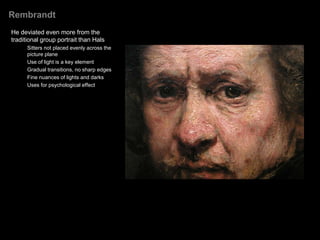
Rembrandt
He deviated even more from the
traditional group portrait than Hals
Sitters not placed evenly across the
picture plane
Use of light is a key element
Gradual transitions, no sharp edges
Fine nuances of lights and darks
Uses for psychological effect
56
57
58
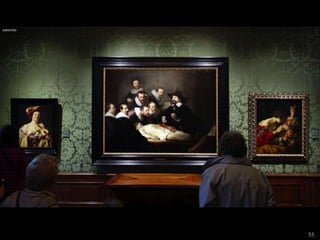
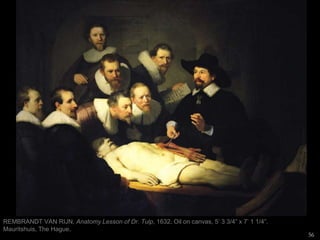
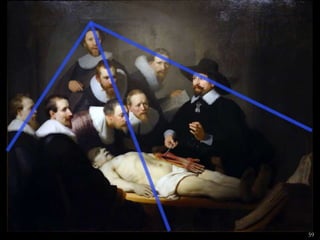
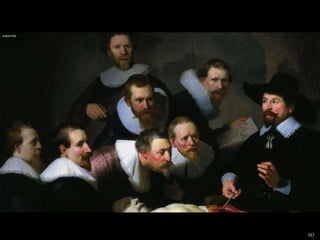
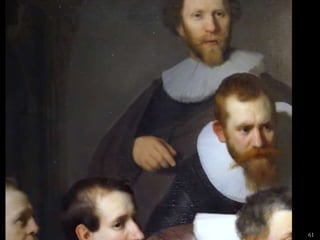
REMBRANDT VAN RIJN, Anatomy Lesson of Dr. Tulp, 1632. Oil on canvas, 5’ 3 3/4” x 7’ 1 1/4”.
Mauritshuis, The Hague.
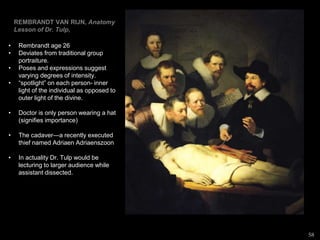
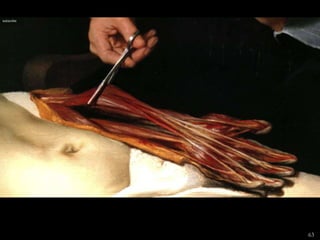
REMBRANDT VAN RIJN, Anatomy
Lesson of Dr. Tulp,
• Rembrandt age 26
• Deviates from traditional group
portraiture.
• Poses and expressions suggest
varying degrees of intensity.
• “spotlight” on each person- inner
light of the individual as opposed to
outer light of the divine.
• Doctor is only person wearing a hat
(signifies importance)
• The cadaver—a recently executed
thief named Adriaen Adriaenszoon
• In actuality Dr. Tulp would be
lecturing to larger audience while
assistant dissected.
59
60
61
REMBRANDT VAN RIJN, Anatomy Lesson of Dr. Tulp, 1632. Oil on canvas, 5’ 3 3/4” x 7’ 1 1/4”.
Mauritshuis, The Hague.
62
63
64
65
66
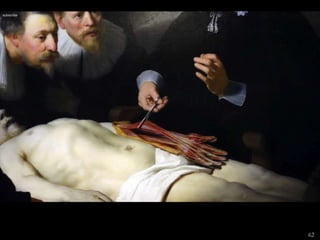
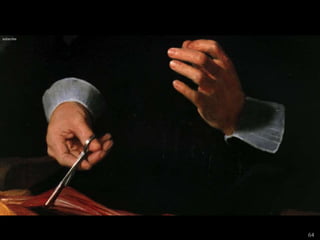
Surgeons hand
Artists Hand
67
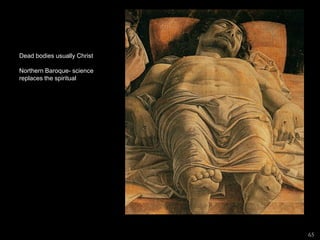
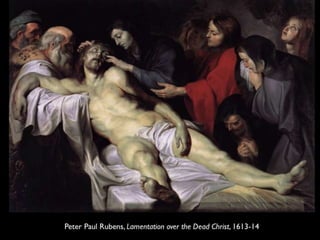
Dead bodies usually Christ
Northern Baroque- science
replaces the spiritual
68
69
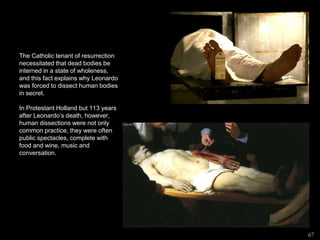
The Catholic tenant of resurrection
necessitated that dead bodies be
interned in a state of wholeness,
and this fact explains why Leonardo
was forced to dissect human bodies
in secret.
In Protestant Holland but 113 years
after Leonardo’s death, however,
human dissections were not only
common practice, they were often
public spectacles, complete with
food and wine, music and
conversation.
70
71
72
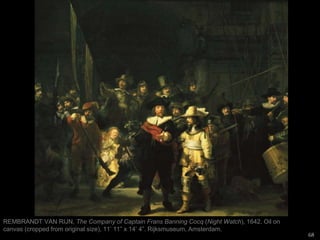
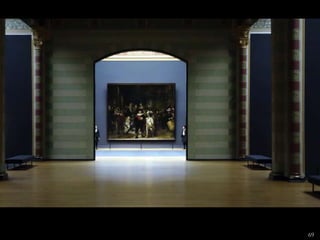
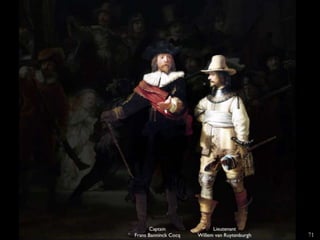
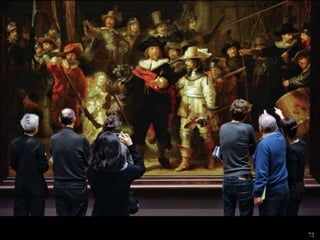
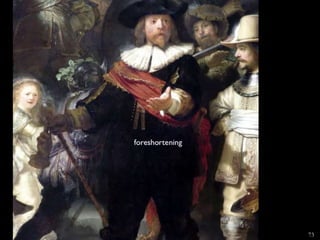
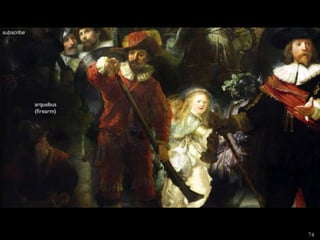
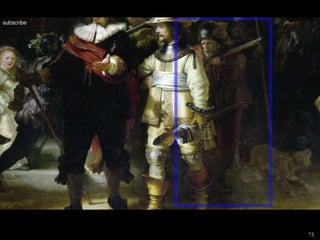
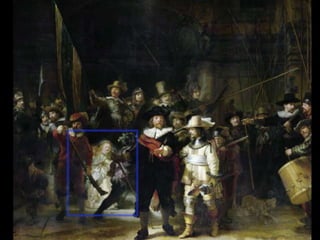
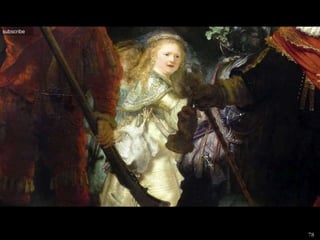
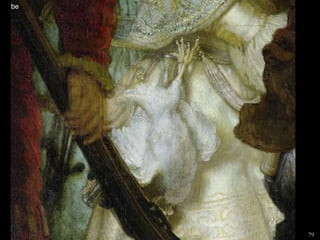
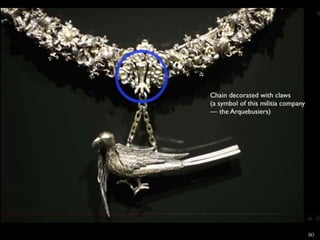
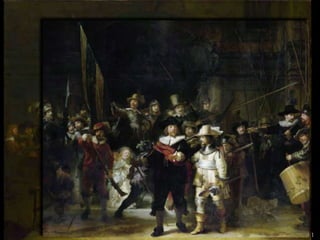
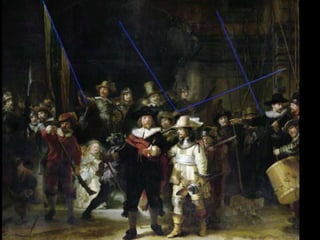
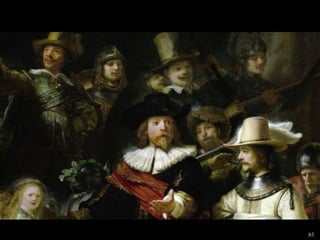
REMBRANDT VAN RIJN, The Company of Captain Frans Banning Cocq (Night Watch), 1642. Oil on
canvas (cropped from original size), 11’ 11” x 14’ 4”. Rijksmuseum, Amsterdam.
73
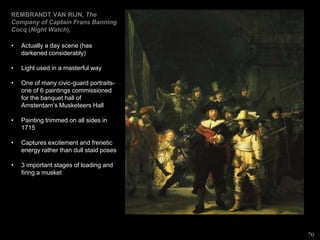
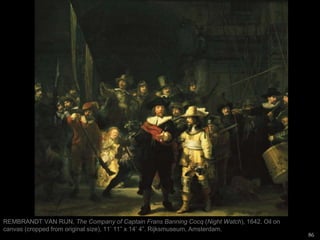
REMBRANDT VAN RIJN, The
Company of Captain Frans Banning
Cocq (Night Watch),
• Actually a day scene (has
darkened considerably)
• Light used in a masterful way
• One of many civic-guard portraits-
one of 6 paintings commissioned
for the banquet hall of
Amsterdam’s Musketeers Hall
• Painting trimmed on all sides in
1715
• Captures excitement and frenetic
energy rather than dull staid poses
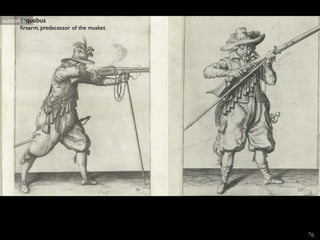
• 3 important stages of loading and
firing a musket
74
75
76
77
78
79
80
81
82
83
84
85
86
87
88
89
90
REMBRANDT VAN RIJN, The Company of Captain Frans Banning Cocq (Night Watch), 1642. Oil on
canvas (cropped from original size), 11’ 11” x 14’ 4”. Rijksmuseum, Amsterdam.
91
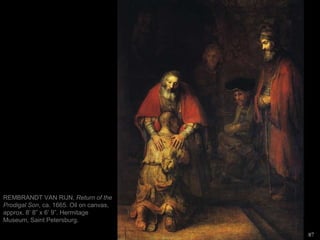
REMBRANDT VAN RIJN, Return of the
Prodigal Son, ca. 1665. Oil on canvas,
approx. 8’ 8” x 6’ 9”. Hermitage
Museum, Saint Petersburg.
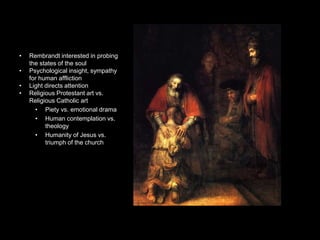
• Rembrandt interested in probing
the states of the soul
• Psychological insight, sympathy
for human affliction
• Light directs attention
• Religious Protestant art vs.
Religious Catholic art
• Piety vs. emotional drama
• Human contemplation vs.
theology
• Humanity of Jesus vs.
triumph of the church
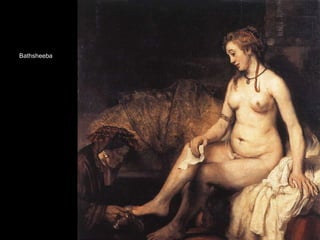
Bathsheeba
93
99
101
104
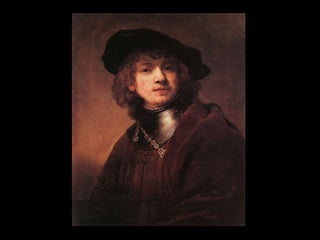
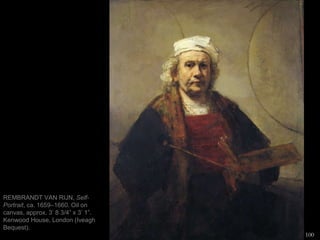
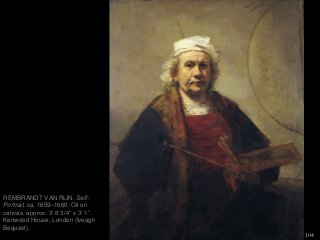
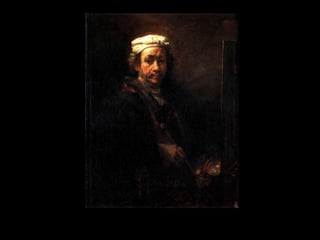
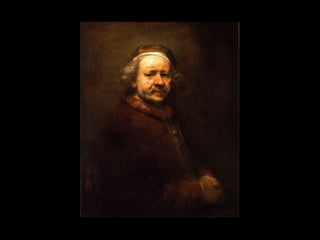
REMBRANDT VAN RIJN, Self-
Portrait, ca. 1659–1660. Oil on
canvas, approx. 3’ 8 3/4” x 3’ 1”.
Kenwood House, London (Iveagh
Bequest).
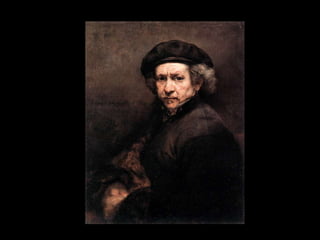
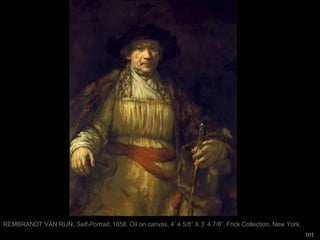
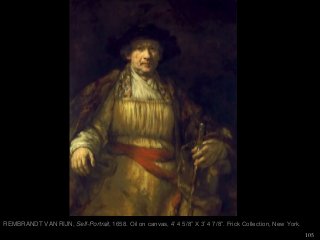
REMBRANDT VAN RIJN, Self-Portrait, 1658. Oil on canvas, 4’ 4 5/8” X 3’ 4 7/8”. Frick Collection, New York.
105

Reformation to Baroque 2

  • 1.
  • 2.
    Spanish Netherlands: Flemish paintingunder Spanish control (Modern Belgium-Flemish Baroque) • Phillip II “Most Catholic King” of Spain repressive towards Protestants • Netherlands splits between north (Protestant) and South- (Catholic) • North is independent • South is ruled by Spanish Empire
  • 3.
  • 4.
  • 5.
  • 6.
  • 7.
    Peter Paul Rubens •Educated, looks, well-traveled, happy • ENERGY – his life and art – Rose at 4am and worked until midnight – Great work ethic, over 2,000 paintings • Influenced by Michelangelo and Caravaggio • Unified the styles of northern and southern Europe – Became synonymous with Flemish Baroque • Confident of Kings and Queens, dispatched on several diplomatic missions Created thousands of sketches in his travels of famous artwork to study and use • Built a house with a large studio that allowed his workshop and assistants to crank out hundreds of works • Price of work was equivalent to how much he actually painted
  • 8.
    Peter Paul Rubens “Rubenesque” Appliedto a woman who has similar proportions to those in paintings by the Flemish painter Peter Paul Ruben; attractively plump; a woman who is alluring or pretty but without the waif-like body or athletic build presently common in media. "Our waitress is really hot, even if she has a few extra pounds on her, but it doesn't matter because I like my women rubenesque anyway."
  • 9.
    9 PETER PAUL RUBENS,Elevation of the Cross, from Saint Walburga, Antwerp, 1610. Oil on wood, 15’ 1 7/8” x 11’ 1 1/2” (center panel), 15' 1 7/8" x 4' 11" (each wing). Antwerp Cathedral, Antwerp.
  • 10.
  • 12.
    PETER PAUL RUBENS,Elevation of the Cross • Commissioned for the church of Saint Walburga in Antwerp • Influence of Michelangelo and Caravaggio evident • Foreshortened anatomy and contortions of violent action • Christ body cuts dynamically across picture plane • Figures resonate with power of strenuous exertion • Emotional and physical tension • Movement-pushes out of the picture plane (Baroque) • Theatricality and emotionalism characteristic of Italian Baroque • Attention to detail represents the Northern Influence • Rubens combines the two to form an international synthesis 12
  • 14.
  • 15.
  • 16.
  • 17.
  • 18.
  • 20.
  • 21.
  • 22.
  • 23.
  • 24.
  • 25.
  • 26.
    Peter Paul Rubens,The Presentation of the Portrait of Marie de’ Medici, c. 1622-1625, oil on canvas, 394 x 295 cm (Musée du Louvre)
  • 27.
  • 28.
  • 29.
    29 PETER PAUL RUBENS,Arrival of Marie de’ Medici at Marseilles, 1622–1625. Oil on canvas, 12’ 11 1/2” x 9’ 7”. Louvre, Paris.
  • 30.
    PETER PAUL RUBENS,Arrival of Marie de’ Medici at Marseilles • Marriage of French king Henry IV and italian Marei de’Medici • Painted a series of 21 paintings (1622-26) to memorialize and glorify her life • Her life was not very interesting, so Rubens added Mythical figures to give it a sense of grandeur and importance • Over the top-huge ego • Personification of France greets Marie • Sea and sky rejoice at arrival • Neptune and the Nereids salute her • Decorative splendor holds composition together 30
  • 31.
  • 32.
  • 33.
  • 34.
    Also includes eventsthat were both quite recent and quite humiliating. After Henry was assassinated in 1610, Marie—acting as regent for their young son, Louis XIII—ruled the kingdom of France for seven years. The position suited her; but many French nobles begrudged her power. Divisions in the court, including tensions with her own son, led to Marie’s exile from the Paris in 1617. The commission of the biographical cycle marked her reconciliation with Louis and her return to the capital city in 1620. It vindicated her reign as the queen of France. 34
  • 35.
    35 PETER PAUL RUBENS,Consequences of War, 1638–1639. Oil on canvas, 6’ 9” x 11’ 3 7/8”. Palazzo Pitti, Florence..
  • 36.
    PETER PAUL RUBENS, Consequencesof War • Rubens worked for many nations so could not comment on conflict in direct way(use of allegorical figures) • Door to temple of Janus is open (symbol to War) • Venus attempts to prevent Mars from going to battle. • Figure of Europe in black throws her arms up. • Fury Alekto drags Mars forward, sword drawn, to trample the arts and music, symbols of family and fecundity. Monsters of Pestilence and Famine lurk in the back. 36
  • 37.
    The Dutch Republic TheUnited Provinces of the Netherlands North Region (Modern Holland) Late 16th Century: Independence from Spain Protestant 1609 Bank of Amsterdam Political power: urban merchants Prosperous: wealthiest region of Europe Moralistic No King (no feudal land rights)
  • 38.
  • 39.
    Arbitrage The practice oftaking advantage of a price difference between two or more markets: striking a combination of matching deals that capitalize upon the imbalance, the profit being the difference between the market prices. In simple terms, it is the possibility of a risk-free profit at zero cost. 39
  • 40.
  • 41.
  • 42.
    The Golden Ageof Dutch Art • The Dutch Republic was based on commerce and trade; merchant class held power, wealth • No royal court and officials and lacking Catholic church commissions, artists turned to merchant class for work • Portraiture rose in popularity as did works showing their possessions and land • Merchant patrons • Realism, Genre Scenes, still life, Little religious art • Moralizing • Landscapes that showed work ethic • Bourgeoisie portraits showed status without being ostentatious
  • 43.
  • 44.
    44 HENDRICK TER BRUGGHEN,Calling of Saint Matthew, 1621. Oil on canvas, 3’ 4” x 4’ 6”. The Hague.
  • 45.
    HENDRICK TER BRUGGHEN, Callingof Saint Matthew • Selected them from Caravaggio • Softer tints, compressed space, much more intimate effect 45
  • 46.
    Frans Hals Brilliant portraitpainter Different from Leonardo, Holbein, or Durer’s portraits of exactness Quick brushstrokes capture the momentary smile and twinkle of an eye Actually took a lot of time to capture spontaneity Broke conventional ways of depiction Pose, setting, attire, accessories Typical conventions did not apply to middle class portraiture Hals produced lively and relaxed images Excelled at group portraits
  • 47.
  • 48.
    48 FRANS HALS, Archersof Saint Hadrian, ca. 1633. Oil on canvas, approx. 6’ 9” x 11’. Frans Halsmuseum, Haarlem.
  • 49.
    FRANS HALS, Archersof Saint Hadrian • Popular group portraits reflect participation in Dutch civic organizations • Each member paid a fee • Dutch Civic Militia groups claim credit for liberation from Spain • Hals enlivens the troop, movements and moods vary markedly • Spontaneity of gesture despite uniformity of attire • Preservation of gesture and fleeting facial expressions evidence of careful planning but does not immediately appear so because of Hals vivacious brushwork 49
  • 52.
    52 GERRIT VAN HONTHORST,Supper Party, 1620. Oil on canvas, 4’ 8” x 7’. Galleria degli Uffizi, Florence.
  • 53.
    GERRIT VAN HONTHORST, SupperParty • Genre Scene • Informal gathering of un- idealized figures • Inspired by Caravaggio’s use of light but adding his own ideas • Lighthearted but Can be read in a moralistic way- could be warning against the sins of gluttony and lust 53
  • 54.
    Rembrandt Born in Lieden,moved to Amsterdam, the financial center of Europe Became the cities most-renowned portrait artist Delved deeply into the psyche and personality of his sitters Long career (40 years) Without the Catholic Church in Holland to commission art, Rembrandt and his fellow Dutch artists were lavishly supported by a wealthy, Protestant, and expanding middle class. This group of patrons enthusiastically commissioned works of art with their increasing discretionary income- mostly portraits.
  • 55.
    Rembrandt He deviated evenmore from the traditional group portrait than Hals Sitters not placed evenly across the picture plane Use of light is a key element Gradual transitions, no sharp edges Fine nuances of lights and darks Uses for psychological effect
  • 56.
  • 57.
  • 58.
    58 REMBRANDT VAN RIJN,Anatomy Lesson of Dr. Tulp, 1632. Oil on canvas, 5’ 3 3/4” x 7’ 1 1/4”. Mauritshuis, The Hague.
  • 59.
    REMBRANDT VAN RIJN,Anatomy Lesson of Dr. Tulp, • Rembrandt age 26 • Deviates from traditional group portraiture. • Poses and expressions suggest varying degrees of intensity. • “spotlight” on each person- inner light of the individual as opposed to outer light of the divine. • Doctor is only person wearing a hat (signifies importance) • The cadaver—a recently executed thief named Adriaen Adriaenszoon • In actuality Dr. Tulp would be lecturing to larger audience while assistant dissected. 59
  • 60.
  • 61.
    61 REMBRANDT VAN RIJN,Anatomy Lesson of Dr. Tulp, 1632. Oil on canvas, 5’ 3 3/4” x 7’ 1 1/4”. Mauritshuis, The Hague.
  • 62.
  • 63.
  • 64.
  • 65.
  • 66.
  • 67.
  • 68.
    Dead bodies usuallyChrist Northern Baroque- science replaces the spiritual 68
  • 69.
  • 70.
    The Catholic tenantof resurrection necessitated that dead bodies be interned in a state of wholeness, and this fact explains why Leonardo was forced to dissect human bodies in secret. In Protestant Holland but 113 years after Leonardo’s death, however, human dissections were not only common practice, they were often public spectacles, complete with food and wine, music and conversation. 70
  • 71.
  • 72.
    72 REMBRANDT VAN RIJN,The Company of Captain Frans Banning Cocq (Night Watch), 1642. Oil on canvas (cropped from original size), 11’ 11” x 14’ 4”. Rijksmuseum, Amsterdam.
  • 73.
  • 74.
    REMBRANDT VAN RIJN,The Company of Captain Frans Banning Cocq (Night Watch), • Actually a day scene (has darkened considerably) • Light used in a masterful way • One of many civic-guard portraits- one of 6 paintings commissioned for the banquet hall of Amsterdam’s Musketeers Hall • Painting trimmed on all sides in 1715 • Captures excitement and frenetic energy rather than dull staid poses • 3 important stages of loading and firing a musket 74
  • 75.
  • 76.
  • 77.
  • 78.
  • 79.
  • 80.
  • 81.
  • 82.
  • 83.
  • 84.
  • 85.
  • 86.
  • 87.
  • 88.
  • 89.
  • 90.
    90 REMBRANDT VAN RIJN,The Company of Captain Frans Banning Cocq (Night Watch), 1642. Oil on canvas (cropped from original size), 11’ 11” x 14’ 4”. Rijksmuseum, Amsterdam.
  • 91.
    91 REMBRANDT VAN RIJN,Return of the Prodigal Son, ca. 1665. Oil on canvas, approx. 8’ 8” x 6’ 9”. Hermitage Museum, Saint Petersburg.
  • 92.
    • Rembrandt interestedin probing the states of the soul • Psychological insight, sympathy for human affliction • Light directs attention • Religious Protestant art vs. Religious Catholic art • Piety vs. emotional drama • Human contemplation vs. theology • Humanity of Jesus vs. triumph of the church
  • 93.
  • 99.
  • 101.
  • 104.
    104 REMBRANDT VAN RIJN,Self- Portrait, ca. 1659–1660. Oil on canvas, approx. 3’ 8 3/4” x 3’ 1”. Kenwood House, London (Iveagh Bequest).
  • 105.
    REMBRANDT VAN RIJN,Self-Portrait, 1658. Oil on canvas, 4’ 4 5/8” X 3’ 4 7/8”. Frick Collection, New York. 105