Small-Scale Irrigation:
Present & Future
Claudia Ringler
IFPRI
Small-Scale Irrigation: A thriving but
overlooked sector with large potential
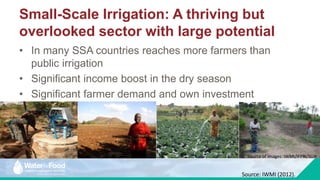
• In many SSA countries reaches more farmers than
public irrigation
• Significant income boost in the dry season
• Significant farmer demand and own investment
Source of images: IWMI/IFPRI/SUA.
Source: IWMI (2012).
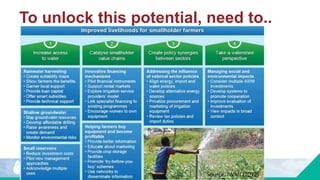
To unlock this potential, need to..
Source: IWMI (2012).
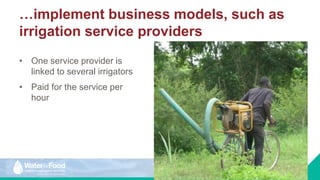
…implement business models, such as
irrigation service providers
• One service provider is
linked to several irrigators
• Paid for the service per
hour
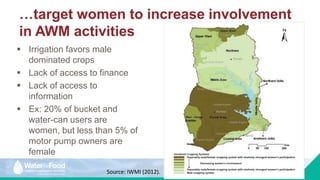
…target women to increase involvement
in AWM activities
 Irrigation favors male
dominated crops
 Lack of access to finance
 Lack of access to
information
 Ex: 20% of bucket and
water-can users are
women, but less than 5% of
motor pump owners are
female
Source: IWMI (2012).
Small-Scale Irrigation:
New analyses
• Expanded geographies
• New solutions
• Benefits of SSI beyond yields & revenues
(climate resilience, health, nutrition, and gender)
New geographies: Flood and dry-season
management in Nigeria
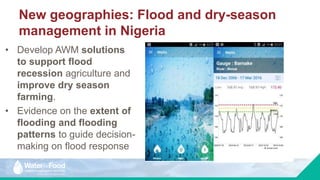
• Develop AWM solutions
to support flood
recession agriculture and
improve dry season
farming.
• Evidence on the extent of
flooding and flooding
patterns to guide decision-
making on flood response Irrigation suitability for small reservoirs: Anambra,
Benue, and Kogi States, Nigeria. Source: Xie et al.
forthcoming
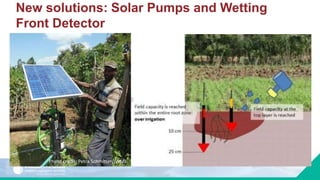
New solutions: Solar Pumps and Wetting
Front Detector
Photo credit: Petra Schmitter/IWMI.
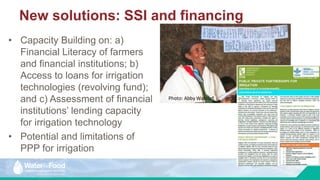
• Capacity Building on: a)
Financial Literacy of farmers
and financial institutions; b)
Access to loans for irrigation
technologies (revolving fund);
and c) Assessment of financial
institutions’ lending capacity
for irrigation technology
• Potential and limitations of
PPP for irrigation
New solutions: SSI and financing
Photo: Abby Waldorf.
• To what extent can SSI
address climate variability and
long-term climate change?
• Is SSI a climate-resilient
activity and to what extent is
SSI a precursor to any other
climate-smart agricultural
activity?
Benefits: SSI and climate resilience
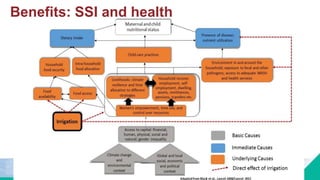
Benefits: SSI and health
Benefits: SSI and nutrition (in red statistically significant changes)
Ethiopia Tanzania
Non-irrigators
n=185
Irrigators
n=284
Non-irrigators
n=224
Irrigators
n=227
Mean Mean Mean Mean
Household food insecurity
access scale, 0-27 [higher
means worse]
5.78 4.04 3.92 2.58
Female dietary diversity
score: number of categories
consumed
3.69 3.58 3.71 4.20
Household dietary diversity:
number of food categories
consumed
5.69 6.06 4.88 5.63
Source: IFPRI-ILSSI 2016.
Benefits: SSI and women’s empowerment
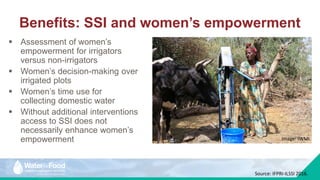
 Assessment of women’s
empowerment for irrigators
versus non-irrigators
 Women’s decision-making over
irrigated plots
 Women’s time use for
collecting domestic water
 Without additional interventions
access to SSI does not
necessarily enhance women’s
empowerment Image: IWMI.
Source: IFPRI-ILSSI 2016.
Conclusion
 SSI continues to grow in SSA
 SSI has the potential for large-scale benefits beyond
yields and income if climate resilience, health, nutrition,
and gender considerations are actively promoted, if there
is sufficient support for input and output markets, and if
information and credit constraints are addressed
 For SSI to remain successful, institutions for managing
shortages and depletion are also urgently needed.

Small-Scale Irrigation: Present & Future

  • 1.
    Small-Scale Irrigation: Present &Future Claudia Ringler IFPRI
  • 2.
    Small-Scale Irrigation: Athriving but overlooked sector with large potential • In many SSA countries reaches more farmers than public irrigation • Significant income boost in the dry season • Significant farmer demand and own investment Source of images: IWMI/IFPRI/SUA. Source: IWMI (2012).
  • 3.
    To unlock thispotential, need to.. Source: IWMI (2012).
  • 4.
    …implement business models,such as irrigation service providers • One service provider is linked to several irrigators • Paid for the service per hour
  • 5.
    …target women toincrease involvement in AWM activities  Irrigation favors male dominated crops  Lack of access to finance  Lack of access to information  Ex: 20% of bucket and water-can users are women, but less than 5% of motor pump owners are female Source: IWMI (2012).
  • 6.
    Small-Scale Irrigation: New analyses •Expanded geographies • New solutions • Benefits of SSI beyond yields & revenues (climate resilience, health, nutrition, and gender)
  • 7.
    New geographies: Floodand dry-season management in Nigeria • Develop AWM solutions to support flood recession agriculture and improve dry season farming. • Evidence on the extent of flooding and flooding patterns to guide decision- making on flood response Irrigation suitability for small reservoirs: Anambra, Benue, and Kogi States, Nigeria. Source: Xie et al. forthcoming
  • 8.
    New solutions: SolarPumps and Wetting Front Detector Photo credit: Petra Schmitter/IWMI.
  • 9.
    • Capacity Buildingon: a) Financial Literacy of farmers and financial institutions; b) Access to loans for irrigation technologies (revolving fund); and c) Assessment of financial institutions’ lending capacity for irrigation technology • Potential and limitations of PPP for irrigation New solutions: SSI and financing Photo: Abby Waldorf.
  • 10.
    • To whatextent can SSI address climate variability and long-term climate change? • Is SSI a climate-resilient activity and to what extent is SSI a precursor to any other climate-smart agricultural activity? Benefits: SSI and climate resilience
  • 11.
  • 12.
    Benefits: SSI andnutrition (in red statistically significant changes) Ethiopia Tanzania Non-irrigators n=185 Irrigators n=284 Non-irrigators n=224 Irrigators n=227 Mean Mean Mean Mean Household food insecurity access scale, 0-27 [higher means worse] 5.78 4.04 3.92 2.58 Female dietary diversity score: number of categories consumed 3.69 3.58 3.71 4.20 Household dietary diversity: number of food categories consumed 5.69 6.06 4.88 5.63 Source: IFPRI-ILSSI 2016.
  • 13.
    Benefits: SSI andwomen’s empowerment  Assessment of women’s empowerment for irrigators versus non-irrigators  Women’s decision-making over irrigated plots  Women’s time use for collecting domestic water  Without additional interventions access to SSI does not necessarily enhance women’s empowerment Image: IWMI. Source: IFPRI-ILSSI 2016.
  • 14.
    Conclusion  SSI continuesto grow in SSA  SSI has the potential for large-scale benefits beyond yields and income if climate resilience, health, nutrition, and gender considerations are actively promoted, if there is sufficient support for input and output markets, and if information and credit constraints are addressed  For SSI to remain successful, institutions for managing shortages and depletion are also urgently needed.

Editor's Notes

  • #5 To replace slide 16 to bring in gender elements
  • #6 To replace slide 16 to bring in gender elements
  • #8 WetIn App allows users to monitor rivers and streams in the Niger-Benue river system in Nigeria. The application provides 5-day river height forecasts at 4-5 stations using upstream-downstream forecast rating techniques from space-borne radar altimetry and hydraulic modeling. It also provides a graphical view of river water levels, historical information on flooding and the projected impact of climate change on water levels. Figure 1: WetIn app Figure 2: Screenshot showing time-series water level derived and estimated for the Barnake gauge station in Benue river, Nigeria
  • #14 To replace slide 16 to bring in gender elements
  • #15 To replace slide 16 to bring in gender elements