Balance Theory
By: Vladimir, Maria, Rose
Introduction

  The Balance Theory was introduced by Fritz
  Heider
  The main role of this theory is that
  consumers are motivated to maintain
  perceived consistency in the relations
  found in a system
  Consistency principle states that human
  beings prefer consistency among their
  beliefs, attitudes, and behaviors.
  Balance Theory focuses on the relations
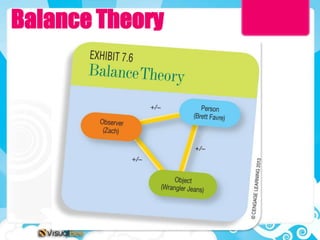
  between observer, person and object.
  The relation between these elements may
  be positive or negative.
Note that system composed of observer, person and object
is referred to as a triad because it consists of three elements.


The relations between the elements are referred to be
sentiment relations or unit relations.
Sentiment relations are the relations between the observer
and the other elements in the system


The object-person relation is a unit relation. Unit relations are
based on the idea that two elements are in some way
connected to one another.
Balance Theory
•   http://www.youtube.com/watch?v=M2epB4K1rnc&feature=related

•   http://www.youtube.com/watch?feature=endscreen&v=vrVNPmzXH
    0E&NR=1
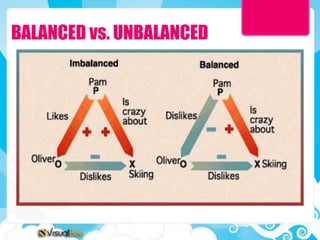
BALANCED vs. UNBALANCED
This example illustrates a key premise of balance
theory


  Consistency in the triad is maintained when the
  multiplication of the signs in the sentiment and unit
  relations result in a positive value.
  When the resulting value is negative, consumers are
  motivated to change the feelings associated with one of
  the relations.
Example:
 Suppose Zach
 does not like
 Brett. That is,
 there is
 negative
 sentiment
 relation
 between them.
CONCLUSION

According to the theory, weak perceived relations
are generally changed, while stronger relations
remain unchanged.

Balance theory is often used to explain effectiveness
and has also been applied in product placement in
televisions shows, goal-oriented behavior and
consumer-brand relationships.
SHORT VIDEO


 http://www.youtube.com/watch?v=20iA3U
 Ud1WA

Balance Theory

  • 1.
  • 2.
    Introduction TheBalance Theory was introduced by Fritz Heider The main role of this theory is that consumers are motivated to maintain perceived consistency in the relations found in a system Consistency principle states that human beings prefer consistency among their beliefs, attitudes, and behaviors. Balance Theory focuses on the relations between observer, person and object. The relation between these elements may be positive or negative.
  • 3.
    Note that systemcomposed of observer, person and object is referred to as a triad because it consists of three elements. The relations between the elements are referred to be sentiment relations or unit relations.
  • 4.
    Sentiment relations arethe relations between the observer and the other elements in the system The object-person relation is a unit relation. Unit relations are based on the idea that two elements are in some way connected to one another.
  • 5.
  • 6.
    http://www.youtube.com/watch?v=M2epB4K1rnc&feature=related • http://www.youtube.com/watch?feature=endscreen&v=vrVNPmzXH 0E&NR=1
  • 7.
  • 8.
    This example illustratesa key premise of balance theory Consistency in the triad is maintained when the multiplication of the signs in the sentiment and unit relations result in a positive value. When the resulting value is negative, consumers are motivated to change the feelings associated with one of the relations.
  • 9.
    Example: Suppose Zach does not like Brett. That is, there is negative sentiment relation between them.
  • 10.
    CONCLUSION According to thetheory, weak perceived relations are generally changed, while stronger relations remain unchanged. Balance theory is often used to explain effectiveness and has also been applied in product placement in televisions shows, goal-oriented behavior and consumer-brand relationships.
  • 11.