RESPIRATORY FAILRE
VIJAY
DEFINITION
Respiratory failure can be defined as a syndrome in which the
respiratory system fails to meet one or both of its
gas exchange functions,
Oxygenation
Carbondioxide Elimination
3
TYPES OF RESPIRATORY FAILURE
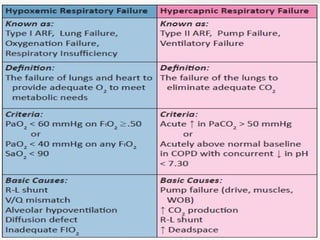
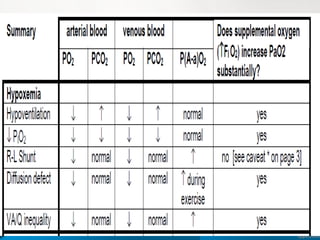
TYPE 1 (HYPOXEMIC ): PO2 < 60 mmHg on room air.
TYPE 2 (HYPERCAPNIC / VENTILATORY): PCO2 > 50 mmHg
TYPE 3 (PERI-OPERATIVE): This is generally a subset of type 1
failure but is sometimes considered separately because it is
so common.
TYPE 4 (SHOCK): secondary to cardiovascular instability.
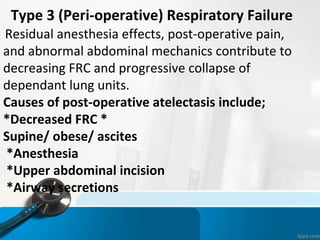
Type 3 (Peri-operative) Respiratory Failure
Residual anesthesia effects, post-operative pain,
and abnormal abdominal mechanics contribute to
decreasing FRC and progressive collapse of
dependant lung units.
Causes of post-operative atelectasis include;
*Decreased FRC *
Supine/ obese/ ascites
*Anesthesia
*Upper abdominal incision
*Airway secretions
Type 4 (Shock) Type IV
Describes patients who are intubated and ventilated in
the process of resuscitation for shock
*cardiogenic
*hypovolemic
*septic
Type 1respiratory failure
•
Type 1 respiratory failure is defined as a low level of
oxygen in the blood (hypoxemia) without an
increased level of carbon dioxide in the blood
(hypercapnia), and indeed the PaCO2 may be normal
or low.
•
It is typically caused by a
•
ventilation/perfusion (V/Q) mismatch; the volume of
air flowing in and out of the lungs is not matched
with the flow of blood to the lungs.
TYPE 1 RESPIRATORY FAILURE
•
The basic defect in is failure of oxygenation
characterized by
•
PaO2decreased (< 60 mmHg )
•
PaCO2normal or decreased (<50 mmHg)
•
PA-aO2increased
Hypoxic Respiratory Failure
•
Low ambient oxygen (e.g. at high altitude)
•
V/Q mismatch (parts of the lung receive oxygen but not
enough blood to absorb it, e.g. pulmonary embolism)
•
Alveolar hypoventilation (decreased minute volume due to
reduced respiratory muscle activity, e.g. in
acute neuromuscular disease); this form can also cause
type 2 respiratory failure if severe
•
Diffusion problem (oxygen cannot enter the capillaries due
to parenchymal disease, e.g. in pneumonia or ARDS)
•
Shunt (oxygenated blood mixes with non-oxygenated blood
from the venous system, e.g. right-to-left shunt)
LOW INSPIRED OXYGEN [ PI O2 ]
•
Examples-
•
A decrease in barometric pressure [e.g. breathing at high
altitude].
•
A decrease in FIO2 – accidental [e.g. anesthetist does not
supply enough oxygen or improper installation of oxygen
supply lines or a leak in the breathing circuit].
•
P(A-a)O2 normal
•
PaCO2 is decreased. This reduction in PaCO2 (hypocapnia) is
due to hyperventilation in response to hypoxemia.
•
Peripheral chemoreceptors sense the low arterial PO2 and
initiate an increase in ventilation through their input to the
medullary respiratory centre
RIGHT TO LEFT SHUNT
•
Shunt refers to the entry of blood into the systemic arterial
system without going through ventilated areas of lung.
•
Shunt may be anatomical or physiological.
•
P(A-a)O2 is elevated.
•
PaCO2 is normal.
RIGHT TO LEFT SHUNT
•
Anatomic shunt: when a portion of blood bypasses the
lungs through an anatomic channel.
•
In healthy individuals
•
i) A portion of the bronchial circulation’s (blood supply to the
conducting zone of the airways) venous blood drains into the
•
pulmonary vein.
•
ii) A portion of the coronary circulation’s venous blood drains
through the thebesian veins into the left ventricle.
•
note: i & ii represent about 2% of the cardiac output and
account for 1/3 of the normal P(A-a)O2 observed in health.
RIGHT TO LEFT SHUNT
•
Congenital abnormalities
•
i) intra-cardiac shunt [e.g. Tetralogy of Fallot: ventricular
septal defect + pulmonary artery stenosis]
•
ii) intra-pulmonary fistulas [direct communication between a
branch of the pulmonary artery and a pulmonary vein].
RIGHT TO LEFT SHUNT
•
Physiologic shunt: In disease states, a portion of the
cardiac output goes through the regular pulmonary vasculature
but
does not come into contact with alveolar air due to filling of
the alveolar spaces with fluid [e.g. pneumonia, drowning,
pulmonary edema]
•
An important diagnostic feature of a shunt
is that the arterial Po2 does not rise to the
normal level when the patient is given 100%
oxygen to breathe.
RIGHT TO LEFT SHUNT
•
Examples of
intrapulmonary shunt.
(a) Collapsed and
fluid filled alveoli are
examples of
intrapulmonary shunt.
•
(b) Anomalous blood
return of mixed
venous blood
bypasses the alveolus
and thereby
contributes to the
development of
intrapulmonary shunt.
Ventilation Perfusion ratio VA/Q
The overall V/Q = 0.8 [ ven=4lpm, per=5lpm]
Ranges between 0.3 and 3.0
Upper zone –nondependent area has higher ≥ 1
Lowe zone – dependent area has lower ≤ 1
VP ratio indicates overall respiratory functional
status of lung
V/Q = 0 means ,no ventilation-called SHUNT
V/Q = ∞ means ,no perfusion – called DEAD SPACE
The overall V/Q = 0.8 [ V=4Lper min, P=5L per min
Ranges between 0.3 and 3.0
Upper zone –nondependent area has higher ≥ 1
Lowe zone – dependent area has lower ≤ 1
VP ratio indicates overall respiratory functional status of
lung
V/Q = 0 means ,no ventilation-called SHUNT
V/Q = ∞ means ,no perfusion – called DEAD SPACE
Ventilation Perfusion ratio VA/Q
19

SHUNTS have different effects on arterial PCO2 (PaCO2 ) than on arterial
PO2 (PaO2 ). Blood passing through under ventilated alveoli tends to retain
its CO2 and does not take up enough O2.

Blood traversing over ventilated alveoli gives off an excessive amount of
CO2, but cannot take up increased amount of O2 because of the shape of
the oxygen-hemoglobin (oxy-Hb) dissociation curve.

2 from the
over ventilated alveoli to compensate for the under ventilated alveoli.

Thus, with Shunt, PACO2 -to-PaCO2 gradients are small, and PAO2 -to-PaO2
gradients are usually large.
20
VENTILATION PERFUSION INEQUALITY
•
PaCO2 is normal
•
P(A-a)O2 is elevated
•
VA/Q inequality is the most common cause of hypoxemia in
disease states
VENTILATION PERFUSION INEQUALITY
•
The distribution of ventilation varies with common events,
such as changes in body posture, lung volumes, and age.
•
Increasing age produces a gradual increase in the degree of the
VA/Q inequality.
•
Ventilation–perfusion imbalance exists even in the normal
lung, depending on the region, but remains fairly tightly
regulated when assessing normal lung aggregate function
VENTILATION PERFUSION
INEQUALITY
TYPE 2 RESPIRATORY FAILURE
•
Hypoxemia with hypercapnia
•
The basic defect in type 2 respiratory failure is
characterized by:
•
PaO2decreased (< 60 mmHg )
•
PaCO2increased (> 50 mmHg )
•
PA-aO2normal
•
Ph decreased
Type 2 respiratory failure is caused by
inadequate alveolar ventilation; both oxygen and
carbon dioxide are affected.
Defined as the buildup of carbon dioxide levels
(PaCO2) that has been generated by the body but
cannot be eliminated. The underlying causes include:
•
Increased airways resistance (chronic obstructive
pulmonary disease, asthma, suffocation)
•
Reduced breathing effort (drug effects, brain stem lesion,
extreme obesity)
•
A decrease in the area of the lung available for gas
exchange (such as in chronic bronchitis)
•
Neuromuscular problems (Guillain-Barré syndrome,motor
neuron disease)
•
Deformed (kyphoscoliosis), rigid (ankylosing spondylitis),
or flail chest.
26
HYPOVENTILATION
•
Hypoventilation is used here to refer to conditions in which
alveolar ventilation is abnormally low in relation to oxygen
uptake or carbon dioxide output.
•
Alveolar ventilation is the volume of fresh inspired gas going
to the alveoli (i.e. Non–dead space ventilation).
•
Hypoventilation occurs when the alveolar ventilation is
reduced and the alveolar Po2 therefore settles out at a lower
level than normal. For the same reason, the alveolar Pco2, and
therefore arterial Pco2, are also raised
HYPOVENTILATION
•
P(A-a)O2 is normal.
•
PaCO2 is elevated (hypercapnia)
•
Increasing the fraction of inspired oxygen (FIO2) can alleviate
the hypoxemia and the hypercapnia can be corrected by
mechanically ventilating the patient to eliminate CO2.
HYPOVENTILATION
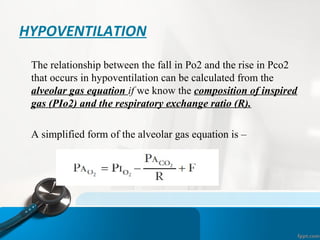
•
The relationship between the fall in Po2 and the rise in Pco2
that occurs in hypoventilation can be calculated from the
alveolar gas equation if we know the composition of inspired
gas (PIo2) and the respiratory exchange ratio (R).
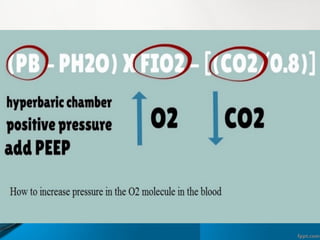
•
A simplified form of the alveolar gas equation is –
CAUSES OF HYPOVENTILATION
1. depression of the respiratory center by drugs, such as
morphine derivatives and barbiturates.
2. diseases of the brain stem, such as encephalitis.
3. abnormalities of the spinal cord conducting pathways, such
as high cervical dislocation; anterior horn cell diseases,
including poliomyelitis.
4. affecting the phrenic nerves or supplying the intercostal
muscles;
CAUSES OF HYPOVENTILATION
5.diseases of the myoneural junction, such as myasthenia
gravis;
6.diseases of the respiratory muscles themselves, such as
progressive muscular dystrophy; thoracic cage
abnormalities (e.g., crushed chest);
7. diseases of nerves to respiratory muscles (e.g., Guillain-
Barrý syndrome);
8.upper airway obstruction (e.g., thymoma);
9. hypoventilation associated with extreme obesity
(pickwickian syndrome)
10. miscellaneous causes, such as metabolic alkalosis and
idiopathic states.
CAUSE OF HYPO VENTILATION
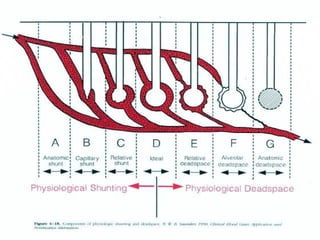
Shunt versus Dead space
•
Anatomic shunt cause deoxygenated blood to
transfer into the systemic circulation without passing
through the pulmonary circulation:
•
Bronchial and Thebesian Veins
•
Accounts for 75% of the difference between alveolar
O2 and arterial O2.
37
DEAD SPACE
Not all inspired gas participating in alveolar gas
exchange
DEAD SPACE – VD
Some gas remains in the non respiratory airways
ANATOMIC DEAD SPACE
Some gas in the non per fused /low per fused
alveoli
PHYSIOLOGIC DEAD SPACE
38
DEAD SPACE
Means – Wasted Ventilation
Dead Space estimated as ratio Vd/Vt
Dead space expressed as a fraction of total tidal volume Vd/Vt
Vd = PACO2-PECO2
Vt PACO2
Normal dead space ratio < 33%
Q
V
V/Q= ∞
39
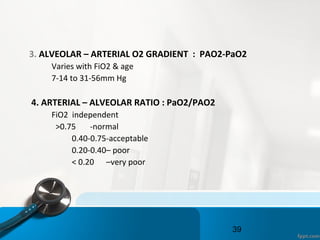
3. ALVEOLAR – ARTERIAL O2 GRADIENT : PAO2-PaO2
Varies with FiO2 & age
7-14 to 31-56mm Hg
4. ARTERIAL – ALVEOLAR RATIO : PaO2/PAO2
FiO2 independent
>0.75 -normal
0.40-0.75-acceptable
0.20-0.40– poor
< 0.20 –very poor
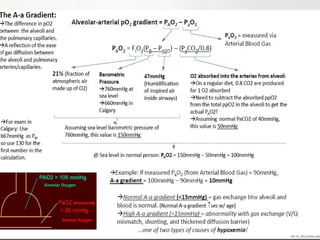
Alveolar–arterial gradient
The Alveolar–arterial gradient ( A–a gradient
is a measure of the difference between
the alveolar concentration (A) of oxygen and
the arterial (a) concentration of oxygen.
It is used in diagnosing the source of hypoxemia.
It helps to assess the integrity of alveolar capillary unit.
For example, in high altitude, the arterial oxygen [[PaO2]]
is low but only because the alveolar oxygen (PAO2) is also
low. However, in states of ventilation perfusion
mismatch, such as pulmonary embolism or right-to-left
shunt, oxygen is not effectively transferred from
the alveoli to the blood which results in elevated A-a
gradient
Respiratory failure
Respiratory failure
Respiratory failure
Respiratory failure
Respiratory failure

Respiratory failure

  • 1.
  • 2.
    DEFINITION Respiratory failure canbe defined as a syndrome in which the respiratory system fails to meet one or both of its gas exchange functions, Oxygenation Carbondioxide Elimination
  • 3.
    3 TYPES OF RESPIRATORYFAILURE TYPE 1 (HYPOXEMIC ): PO2 < 60 mmHg on room air. TYPE 2 (HYPERCAPNIC / VENTILATORY): PCO2 > 50 mmHg TYPE 3 (PERI-OPERATIVE): This is generally a subset of type 1 failure but is sometimes considered separately because it is so common. TYPE 4 (SHOCK): secondary to cardiovascular instability.
  • 4.
    Type 3 (Peri-operative)Respiratory Failure Residual anesthesia effects, post-operative pain, and abnormal abdominal mechanics contribute to decreasing FRC and progressive collapse of dependant lung units. Causes of post-operative atelectasis include; *Decreased FRC * Supine/ obese/ ascites *Anesthesia *Upper abdominal incision *Airway secretions
  • 5.
    Type 4 (Shock)Type IV Describes patients who are intubated and ventilated in the process of resuscitation for shock *cardiogenic *hypovolemic *septic
  • 8.
    Type 1respiratory failure • Type1 respiratory failure is defined as a low level of oxygen in the blood (hypoxemia) without an increased level of carbon dioxide in the blood (hypercapnia), and indeed the PaCO2 may be normal or low. • It is typically caused by a • ventilation/perfusion (V/Q) mismatch; the volume of air flowing in and out of the lungs is not matched with the flow of blood to the lungs.
  • 9.
    TYPE 1 RESPIRATORYFAILURE • The basic defect in is failure of oxygenation characterized by • PaO2decreased (< 60 mmHg ) • PaCO2normal or decreased (<50 mmHg) • PA-aO2increased
  • 10.
    Hypoxic Respiratory Failure • Lowambient oxygen (e.g. at high altitude) • V/Q mismatch (parts of the lung receive oxygen but not enough blood to absorb it, e.g. pulmonary embolism) • Alveolar hypoventilation (decreased minute volume due to reduced respiratory muscle activity, e.g. in acute neuromuscular disease); this form can also cause type 2 respiratory failure if severe • Diffusion problem (oxygen cannot enter the capillaries due to parenchymal disease, e.g. in pneumonia or ARDS) • Shunt (oxygenated blood mixes with non-oxygenated blood from the venous system, e.g. right-to-left shunt)
  • 11.
    LOW INSPIRED OXYGEN[ PI O2 ] • Examples- • A decrease in barometric pressure [e.g. breathing at high altitude]. • A decrease in FIO2 – accidental [e.g. anesthetist does not supply enough oxygen or improper installation of oxygen supply lines or a leak in the breathing circuit]. • P(A-a)O2 normal • PaCO2 is decreased. This reduction in PaCO2 (hypocapnia) is due to hyperventilation in response to hypoxemia. • Peripheral chemoreceptors sense the low arterial PO2 and initiate an increase in ventilation through their input to the medullary respiratory centre
  • 12.
    RIGHT TO LEFTSHUNT • Shunt refers to the entry of blood into the systemic arterial system without going through ventilated areas of lung. • Shunt may be anatomical or physiological. • P(A-a)O2 is elevated. • PaCO2 is normal.
  • 13.
    RIGHT TO LEFTSHUNT • Anatomic shunt: when a portion of blood bypasses the lungs through an anatomic channel. • In healthy individuals • i) A portion of the bronchial circulation’s (blood supply to the conducting zone of the airways) venous blood drains into the • pulmonary vein. • ii) A portion of the coronary circulation’s venous blood drains through the thebesian veins into the left ventricle. • note: i & ii represent about 2% of the cardiac output and account for 1/3 of the normal P(A-a)O2 observed in health.
  • 14.
    RIGHT TO LEFTSHUNT • Congenital abnormalities • i) intra-cardiac shunt [e.g. Tetralogy of Fallot: ventricular septal defect + pulmonary artery stenosis] • ii) intra-pulmonary fistulas [direct communication between a branch of the pulmonary artery and a pulmonary vein].
  • 15.
    RIGHT TO LEFTSHUNT • Physiologic shunt: In disease states, a portion of the cardiac output goes through the regular pulmonary vasculature but does not come into contact with alveolar air due to filling of the alveolar spaces with fluid [e.g. pneumonia, drowning, pulmonary edema] • An important diagnostic feature of a shunt is that the arterial Po2 does not rise to the normal level when the patient is given 100% oxygen to breathe.
  • 16.
    RIGHT TO LEFTSHUNT • Examples of intrapulmonary shunt. (a) Collapsed and fluid filled alveoli are examples of intrapulmonary shunt. • (b) Anomalous blood return of mixed venous blood bypasses the alveolus and thereby contributes to the development of intrapulmonary shunt.
  • 17.
    Ventilation Perfusion ratioVA/Q The overall V/Q = 0.8 [ ven=4lpm, per=5lpm] Ranges between 0.3 and 3.0 Upper zone –nondependent area has higher ≥ 1 Lowe zone – dependent area has lower ≤ 1 VP ratio indicates overall respiratory functional status of lung V/Q = 0 means ,no ventilation-called SHUNT V/Q = ∞ means ,no perfusion – called DEAD SPACE
  • 18.
    The overall V/Q= 0.8 [ V=4Lper min, P=5L per min Ranges between 0.3 and 3.0 Upper zone –nondependent area has higher ≥ 1 Lowe zone – dependent area has lower ≤ 1 VP ratio indicates overall respiratory functional status of lung V/Q = 0 means ,no ventilation-called SHUNT V/Q = ∞ means ,no perfusion – called DEAD SPACE Ventilation Perfusion ratio VA/Q
  • 19.
    19  SHUNTS have differenteffects on arterial PCO2 (PaCO2 ) than on arterial PO2 (PaO2 ). Blood passing through under ventilated alveoli tends to retain its CO2 and does not take up enough O2.  Blood traversing over ventilated alveoli gives off an excessive amount of CO2, but cannot take up increased amount of O2 because of the shape of the oxygen-hemoglobin (oxy-Hb) dissociation curve.  2 from the over ventilated alveoli to compensate for the under ventilated alveoli.  Thus, with Shunt, PACO2 -to-PaCO2 gradients are small, and PAO2 -to-PaO2 gradients are usually large.
  • 20.
    20 VENTILATION PERFUSION INEQUALITY • PaCO2is normal • P(A-a)O2 is elevated • VA/Q inequality is the most common cause of hypoxemia in disease states
  • 21.
    VENTILATION PERFUSION INEQUALITY • Thedistribution of ventilation varies with common events, such as changes in body posture, lung volumes, and age. • Increasing age produces a gradual increase in the degree of the VA/Q inequality. • Ventilation–perfusion imbalance exists even in the normal lung, depending on the region, but remains fairly tightly regulated when assessing normal lung aggregate function
  • 22.
  • 23.
    TYPE 2 RESPIRATORYFAILURE • Hypoxemia with hypercapnia • The basic defect in type 2 respiratory failure is characterized by: • PaO2decreased (< 60 mmHg ) • PaCO2increased (> 50 mmHg ) • PA-aO2normal • Ph decreased
  • 24.
    Type 2 respiratoryfailure is caused by inadequate alveolar ventilation; both oxygen and carbon dioxide are affected. Defined as the buildup of carbon dioxide levels (PaCO2) that has been generated by the body but cannot be eliminated. The underlying causes include:
  • 25.
    • Increased airways resistance(chronic obstructive pulmonary disease, asthma, suffocation) • Reduced breathing effort (drug effects, brain stem lesion, extreme obesity) • A decrease in the area of the lung available for gas exchange (such as in chronic bronchitis) • Neuromuscular problems (Guillain-Barré syndrome,motor neuron disease) • Deformed (kyphoscoliosis), rigid (ankylosing spondylitis), or flail chest.
  • 26.
    26 HYPOVENTILATION • Hypoventilation is usedhere to refer to conditions in which alveolar ventilation is abnormally low in relation to oxygen uptake or carbon dioxide output. • Alveolar ventilation is the volume of fresh inspired gas going to the alveoli (i.e. Non–dead space ventilation). • Hypoventilation occurs when the alveolar ventilation is reduced and the alveolar Po2 therefore settles out at a lower level than normal. For the same reason, the alveolar Pco2, and therefore arterial Pco2, are also raised
  • 27.
    HYPOVENTILATION • P(A-a)O2 is normal. • PaCO2is elevated (hypercapnia) • Increasing the fraction of inspired oxygen (FIO2) can alleviate the hypoxemia and the hypercapnia can be corrected by mechanically ventilating the patient to eliminate CO2.
  • 28.
    HYPOVENTILATION • The relationship betweenthe fall in Po2 and the rise in Pco2 that occurs in hypoventilation can be calculated from the alveolar gas equation if we know the composition of inspired gas (PIo2) and the respiratory exchange ratio (R). • A simplified form of the alveolar gas equation is –
  • 29.
    CAUSES OF HYPOVENTILATION 1.depression of the respiratory center by drugs, such as morphine derivatives and barbiturates. 2. diseases of the brain stem, such as encephalitis. 3. abnormalities of the spinal cord conducting pathways, such as high cervical dislocation; anterior horn cell diseases, including poliomyelitis. 4. affecting the phrenic nerves or supplying the intercostal muscles;
  • 30.
    CAUSES OF HYPOVENTILATION 5.diseasesof the myoneural junction, such as myasthenia gravis; 6.diseases of the respiratory muscles themselves, such as progressive muscular dystrophy; thoracic cage abnormalities (e.g., crushed chest); 7. diseases of nerves to respiratory muscles (e.g., Guillain- Barrý syndrome); 8.upper airway obstruction (e.g., thymoma); 9. hypoventilation associated with extreme obesity (pickwickian syndrome) 10. miscellaneous causes, such as metabolic alkalosis and idiopathic states.
  • 31.
    CAUSE OF HYPOVENTILATION
  • 34.
    Shunt versus Deadspace • Anatomic shunt cause deoxygenated blood to transfer into the systemic circulation without passing through the pulmonary circulation: • Bronchial and Thebesian Veins • Accounts for 75% of the difference between alveolar O2 and arterial O2.
  • 37.
    37 DEAD SPACE Not allinspired gas participating in alveolar gas exchange DEAD SPACE – VD Some gas remains in the non respiratory airways ANATOMIC DEAD SPACE Some gas in the non per fused /low per fused alveoli PHYSIOLOGIC DEAD SPACE
  • 38.
    38 DEAD SPACE Means –Wasted Ventilation Dead Space estimated as ratio Vd/Vt Dead space expressed as a fraction of total tidal volume Vd/Vt Vd = PACO2-PECO2 Vt PACO2 Normal dead space ratio < 33% Q V V/Q= ∞
  • 39.
    39 3. ALVEOLAR –ARTERIAL O2 GRADIENT : PAO2-PaO2 Varies with FiO2 & age 7-14 to 31-56mm Hg 4. ARTERIAL – ALVEOLAR RATIO : PaO2/PAO2 FiO2 independent >0.75 -normal 0.40-0.75-acceptable 0.20-0.40– poor < 0.20 –very poor
  • 40.
  • 41.
    The Alveolar–arterial gradient( A–a gradient is a measure of the difference between the alveolar concentration (A) of oxygen and the arterial (a) concentration of oxygen. It is used in diagnosing the source of hypoxemia. It helps to assess the integrity of alveolar capillary unit. For example, in high altitude, the arterial oxygen [[PaO2]] is low but only because the alveolar oxygen (PAO2) is also low. However, in states of ventilation perfusion mismatch, such as pulmonary embolism or right-to-left shunt, oxygen is not effectively transferred from the alveoli to the blood which results in elevated A-a gradient