LINEAR DIFFERENTIAL EQUATIONS


                            SEBASTIAN VATTAMATTAM


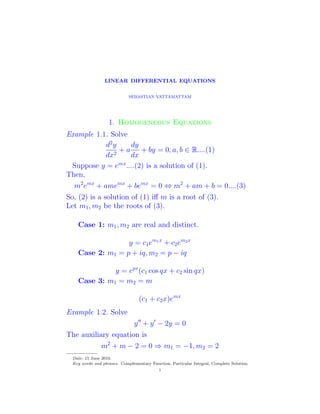
                  1. Homogeneous Equations
Example 1.1. Solve
              d2 y    dy
                   + a + by = 0, a, b ∈ R....(1)
              dx2     dx
  Suppose y = emx ....(2) is a solution of (1).
Then,
  m2 emx + amemx + bemx = 0 ⇔ m2 + am + b = 0....(3)
So, (2) is a solution of (1) iff m is a root of (3).
Let m1 , m2 be the roots of (3).

   Case 1: m1 , m2 are real and distinct.

                 y = c1 em1 x + c2 em2 x
   Case 2: m1 = p + iq, m2 = p − iq

             y = epx (c1 cos qx + c2 sin qx)
   Case 3: m1 = m2 = m

                                 (c1 + c2 x)emx
Example 1.2. Solve
                     y + y − 2y = 0
The auxiliary equation is
           m2 + m − 2 = 0 ⇒ m1 = −1, m2 = 2
 Date: 15 June 2010.
 Key words and phrases. Complementary Function, Particular Integral, Complete Solution.
                                           1
2                                    SEBASTIAN VATTAMATTAM


General Solution is
                                         y = c1 e−x + c2 e2x
Example 1.3. Solve
                                     y − 2y + 10y = 0
The auxiliary equation is
          m2 − 2m + 10 = 0 ⇒ m1 = 1 + 3i, m2 = 1 − 3i
General Solution is
                            y = ex (c1 cos 3x + c2 sin 3x
Example 1.4. Solve
         y − 2y + 10y = 0 given that y(0) = 4, y (0) = 1
The auxiliary equation is
          m2 − 2m + 10 = 0 ⇒ m1 = 1 + 3i, m2 = 1 − 3i
General Solution is
                        y(x) = ex (c1 cos 3x + c2 sin 3x)
                  y(0) = c1 ⇒ c1 = 4....(1)
 y (x) = ex (c1 cos 3x + c2 sin 3x − 3c1 sin 3x + 3c2 cos 3x)
Therefore
                   y (0) = c1 + 3c2 ⇒ c1 + 3c2 = 1....(2)
From (1) and (2), c1 = 4, c2 = −1 Therefore, the solution
is
              y(x) = ex (4 cos 3x − sin 3x)
Remember
               d x
                 e f (x) = ex [f (x) + f (x)]
              dx
                                     1
Example 1.5. Solve
                                           y + n2 y = 0
    1Similar to Ex 4, p.190 in [1]
ORDINARY DIFFERENTIAL EQUATIONS   3


The auxiliary equation is
                 m2 + n2 = 0 ⇒ m1 = ni, m2 = −ni
General Solution is
                         y = c1 cos nx + c2 sin nx
Example 1.6. Solve
                           y + 8y + 16y = 0
The auxiliary equation is
                 m2 + 8m + 16 = 0 ⇒ m1 = −4, −4
General Solution is
                          y(x) = (c1 + c2 x)e−4x
Example 1.7. Solve
                y − 4y + 4y = 0, y(0) = 3, y (0) = 1
General Solution is
                           y(x) = (c1 + c2 x)e2x
                        y(0) = c1 ⇒ c1 = 3....(1)
                      y (x) = c2 e2x + 2(c1 + c2 x)e2x
Therefore
                y (0) = c2 + 2c1 ⇒ c2 + 2c1 = 1....(2)
From (1) and (2), c1 = 3, c2 = −5 Therefore, the solution
is
                   y(x) = (3 − 5x)e2x
                           2
Example 1.8. Solve
                        2y − 5y − 4y + 3y = 0
The auxiliary equation is
                        2m3 − 5m2 − 4m + 3 = 0
 2Ex 1, p.88 of [1]
4                            SEBASTIAN VATTAMATTAM


Solution by synthetic division:
           1 2 -5 -4 3              -1 2 -5 -4 3
Try m = 1        2 -3 -7 Try m = −1      -2 7 -3
              2 -3 -7 [-4]             2 -7 3 [0]
2m3 −5m2 −4m+3 = (m+1)(2m2 −7m+3) = (m+1)(2m−1)(m−3) = 0
                             ⇒ m = 1/2, −1, 3
General Solution is
                          y = Aex/2 + Be−x + Ce3x
                            3
Example 1.9. Solve
                          y + 3y + 3y + 2y = 0
The auxiliary equation is
                          m3 + 3m2 + 3m + 2 = 0
Solution by synthetic division:
             -1 1 3 3 2                -2 1 3 3 2
Try m = −1         -1 -2 -1 Try m = −2      -2 -2 -2
                1 2 1 [1]                 1 1 1 [0]
     m3 + 3m2 + 3m + 2 = 0 = (m + 2)(m2 + m + 1) = 0
                ⇒ m = −2, −1/2 ± i1/2
General Solution is
                                √            √
                                  3x           3x
       y = Ae−2x + e−x/2 (C cos      + D sin      )
                                 2            2
          2. Non-homogeneous Equations
    Inverse Operators

    (1)
                            1
                              φ(x) =      φ(x)dx
                            D
    3Ex 3, p.190 in [1]
ORDINARY DIFFERENTIAL EQUATIONS                   5


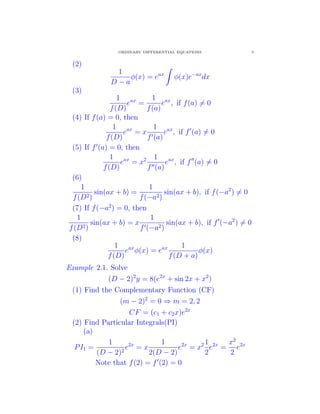
 (2)
               1
                  φ(x) = eax         φ(x)e−ax dx
              D−a
 (3)
                   1 ax       1 ax
                       e =        e , if f (a) = 0
                f (D)       f (a)
 (4) If f (a) = 0, then
                 1 ax          1 ax
                     e =x          e , if f (a) = 0
              f (D)         f (a)
 (5) If f (a) = 0, then
                1 ax           1 ax
                    e = x2         e , if f (a) = 0
             f (D)          f (a)
 (6)
     1                       1
       2)
          sin(ax + b) =         2)
                                   sin(ax + b), if f (−a2 ) = 0
 f (D                    f (−a
 (7) If f (−a2 ) = 0, then
   1                         1
      2)
         sin(ax + b) = x            sin(ax + b), if f (−a2 ) = 0
f (D                     f (−a2 )
 (8)
                  1 ax                   1
                      e φ(x) = eax             φ(x)
               f (D)                 f (D + a)
Example 2.1. Solve
            (D − 2)2 y = 8(e2x + sin 2x + x2 )
 (1) Find the Complementary Function (CF)
                (m − 2)2 = 0 ⇒ m = 2, 2
                   CF = (c1 + c2 x)e2x
 (2) Find Particular Integrals(PI)
     (a)
            1      2x         1     2x 2 1 2x x2 2x
  P I1 =          e =x             e =x e = e
         (D − 2)2         2(D − 2)       2    2
         Note that f (2) = f (2) = 0
6                             SEBASTIAN VATTAMATTAM


        (b)
           1                     1                    1                 11
P I2 =           sin 2x = 2             sin 2x =             sin 2x = −    sin 2
        (D − 2)2           D − 4D + 4            −4 − 4D + 4            4D
      (c)
           1               1               1          1                1    2D
P I3 =           x2 =           x2 =             x2 = (1−D/2)−2 x2 = [1+
        (D − 2)2       (2 − D)2      4(1 − D/2)2      4                4     2
  (3) Complete solution is
                y = CF + P I1 + P I2 + P I3
                                 References
[1] P. Kandasamy etc,Engineering Mathematics- For First Year ,S. Chand & Company Ltd

    Mary Bhavan, Vallikkad Road, Ettumanoor - 686631
    E-mail address: vattamattam@gmail.com

Linear Differential Equations1

  • 1.
    LINEAR DIFFERENTIAL EQUATIONS SEBASTIAN VATTAMATTAM 1. Homogeneous Equations Example 1.1. Solve d2 y dy + a + by = 0, a, b ∈ R....(1) dx2 dx Suppose y = emx ....(2) is a solution of (1). Then, m2 emx + amemx + bemx = 0 ⇔ m2 + am + b = 0....(3) So, (2) is a solution of (1) iff m is a root of (3). Let m1 , m2 be the roots of (3). Case 1: m1 , m2 are real and distinct. y = c1 em1 x + c2 em2 x Case 2: m1 = p + iq, m2 = p − iq y = epx (c1 cos qx + c2 sin qx) Case 3: m1 = m2 = m (c1 + c2 x)emx Example 1.2. Solve y + y − 2y = 0 The auxiliary equation is m2 + m − 2 = 0 ⇒ m1 = −1, m2 = 2 Date: 15 June 2010. Key words and phrases. Complementary Function, Particular Integral, Complete Solution. 1
  • 2.
    2 SEBASTIAN VATTAMATTAM General Solution is y = c1 e−x + c2 e2x Example 1.3. Solve y − 2y + 10y = 0 The auxiliary equation is m2 − 2m + 10 = 0 ⇒ m1 = 1 + 3i, m2 = 1 − 3i General Solution is y = ex (c1 cos 3x + c2 sin 3x Example 1.4. Solve y − 2y + 10y = 0 given that y(0) = 4, y (0) = 1 The auxiliary equation is m2 − 2m + 10 = 0 ⇒ m1 = 1 + 3i, m2 = 1 − 3i General Solution is y(x) = ex (c1 cos 3x + c2 sin 3x) y(0) = c1 ⇒ c1 = 4....(1) y (x) = ex (c1 cos 3x + c2 sin 3x − 3c1 sin 3x + 3c2 cos 3x) Therefore y (0) = c1 + 3c2 ⇒ c1 + 3c2 = 1....(2) From (1) and (2), c1 = 4, c2 = −1 Therefore, the solution is y(x) = ex (4 cos 3x − sin 3x) Remember d x e f (x) = ex [f (x) + f (x)] dx 1 Example 1.5. Solve y + n2 y = 0 1Similar to Ex 4, p.190 in [1]
  • 3.
    ORDINARY DIFFERENTIAL EQUATIONS 3 The auxiliary equation is m2 + n2 = 0 ⇒ m1 = ni, m2 = −ni General Solution is y = c1 cos nx + c2 sin nx Example 1.6. Solve y + 8y + 16y = 0 The auxiliary equation is m2 + 8m + 16 = 0 ⇒ m1 = −4, −4 General Solution is y(x) = (c1 + c2 x)e−4x Example 1.7. Solve y − 4y + 4y = 0, y(0) = 3, y (0) = 1 General Solution is y(x) = (c1 + c2 x)e2x y(0) = c1 ⇒ c1 = 3....(1) y (x) = c2 e2x + 2(c1 + c2 x)e2x Therefore y (0) = c2 + 2c1 ⇒ c2 + 2c1 = 1....(2) From (1) and (2), c1 = 3, c2 = −5 Therefore, the solution is y(x) = (3 − 5x)e2x 2 Example 1.8. Solve 2y − 5y − 4y + 3y = 0 The auxiliary equation is 2m3 − 5m2 − 4m + 3 = 0 2Ex 1, p.88 of [1]
  • 4.
    4 SEBASTIAN VATTAMATTAM Solution by synthetic division: 1 2 -5 -4 3 -1 2 -5 -4 3 Try m = 1 2 -3 -7 Try m = −1 -2 7 -3 2 -3 -7 [-4] 2 -7 3 [0] 2m3 −5m2 −4m+3 = (m+1)(2m2 −7m+3) = (m+1)(2m−1)(m−3) = 0 ⇒ m = 1/2, −1, 3 General Solution is y = Aex/2 + Be−x + Ce3x 3 Example 1.9. Solve y + 3y + 3y + 2y = 0 The auxiliary equation is m3 + 3m2 + 3m + 2 = 0 Solution by synthetic division: -1 1 3 3 2 -2 1 3 3 2 Try m = −1 -1 -2 -1 Try m = −2 -2 -2 -2 1 2 1 [1] 1 1 1 [0] m3 + 3m2 + 3m + 2 = 0 = (m + 2)(m2 + m + 1) = 0 ⇒ m = −2, −1/2 ± i1/2 General Solution is √ √ 3x 3x y = Ae−2x + e−x/2 (C cos + D sin ) 2 2 2. Non-homogeneous Equations Inverse Operators (1) 1 φ(x) = φ(x)dx D 3Ex 3, p.190 in [1]
  • 5.
    ORDINARY DIFFERENTIAL EQUATIONS 5 (2) 1 φ(x) = eax φ(x)e−ax dx D−a (3) 1 ax 1 ax e = e , if f (a) = 0 f (D) f (a) (4) If f (a) = 0, then 1 ax 1 ax e =x e , if f (a) = 0 f (D) f (a) (5) If f (a) = 0, then 1 ax 1 ax e = x2 e , if f (a) = 0 f (D) f (a) (6) 1 1 2) sin(ax + b) = 2) sin(ax + b), if f (−a2 ) = 0 f (D f (−a (7) If f (−a2 ) = 0, then 1 1 2) sin(ax + b) = x sin(ax + b), if f (−a2 ) = 0 f (D f (−a2 ) (8) 1 ax 1 e φ(x) = eax φ(x) f (D) f (D + a) Example 2.1. Solve (D − 2)2 y = 8(e2x + sin 2x + x2 ) (1) Find the Complementary Function (CF) (m − 2)2 = 0 ⇒ m = 2, 2 CF = (c1 + c2 x)e2x (2) Find Particular Integrals(PI) (a) 1 2x 1 2x 2 1 2x x2 2x P I1 = e =x e =x e = e (D − 2)2 2(D − 2) 2 2 Note that f (2) = f (2) = 0
  • 6.
    6 SEBASTIAN VATTAMATTAM (b) 1 1 1 11 P I2 = sin 2x = 2 sin 2x = sin 2x = − sin 2 (D − 2)2 D − 4D + 4 −4 − 4D + 4 4D (c) 1 1 1 1 1 2D P I3 = x2 = x2 = x2 = (1−D/2)−2 x2 = [1+ (D − 2)2 (2 − D)2 4(1 − D/2)2 4 4 2 (3) Complete solution is y = CF + P I1 + P I2 + P I3 References [1] P. Kandasamy etc,Engineering Mathematics- For First Year ,S. Chand & Company Ltd Mary Bhavan, Vallikkad Road, Ettumanoor - 686631 E-mail address: vattamattam@gmail.com