Design of Pelton
    turbines
When to use a Pelton
      turbine
Energy conversion in a
      Pelton turbine

Outlet   Outlet of    Inlet of   Outlet of     Inlet of
         the runner   the runner the needle    the needle


                                              c2
                                              2
Main dimensions for the
    Pelton runner
The ideal Pelton runner
Absolute velocity from nozzle:
                                          c1
 c1 = 2 ⋅ g ⋅ H n                 c1 =            =1
                                       2 ⋅ g ⋅ Hn

 Circumferential speed:

     c1u 1
u1 =    = ⋅ 2 ⋅ g ⋅ Hn                          u1 = 0.5
      2 2
  Euler`s turbine equation:

  ηh = 2(u1 ⋅ c1u − u 2 ⋅ c 2 u )

    c1u = 1         cu 2 = 0

η h = 2 ⋅ (u1 ⋅ c1u − u 2 ⋅ c 2u ) = 2 ⋅ (0,5 ⋅1.0 − 0,5 ⋅ 0) = 1
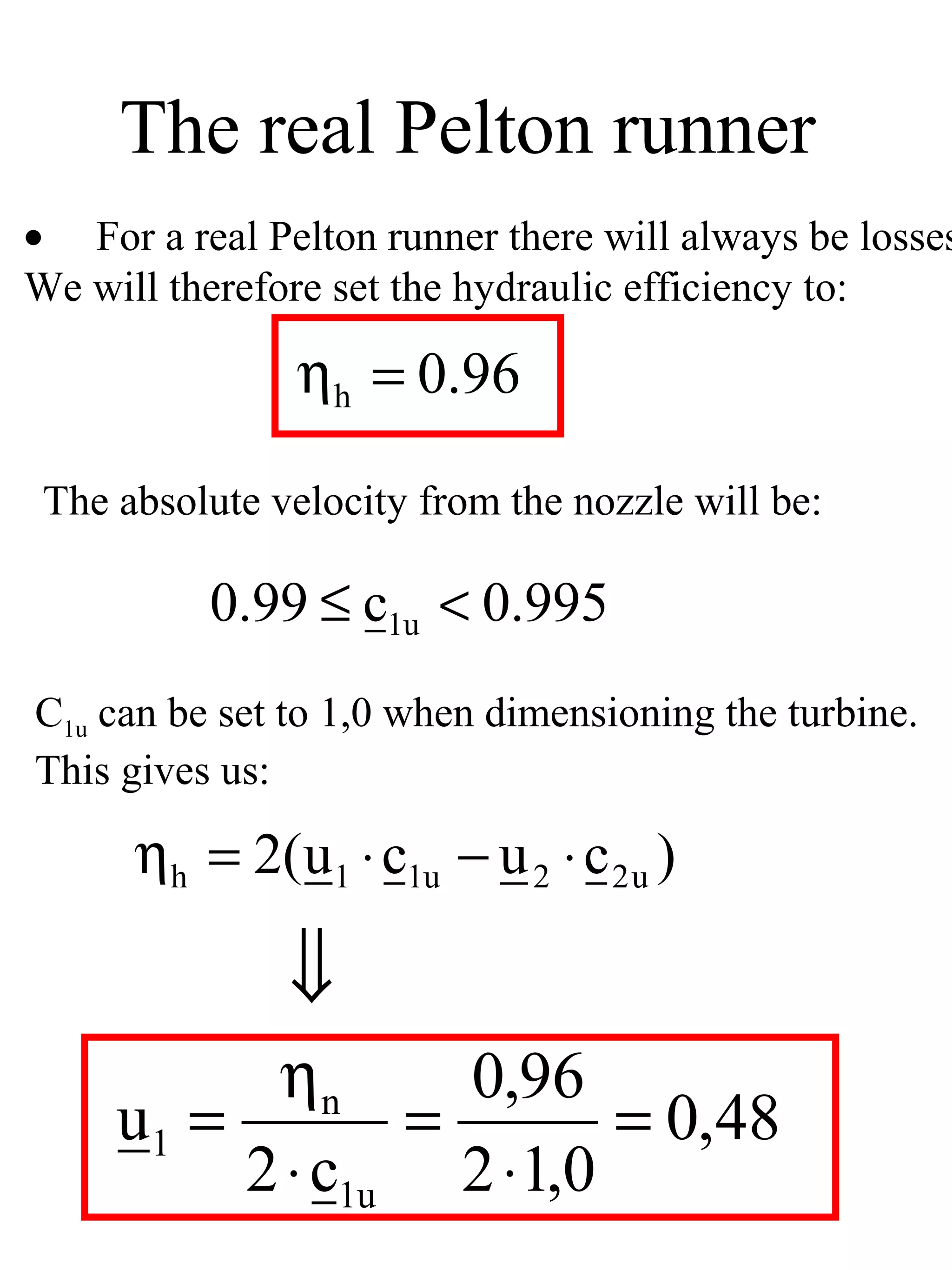
The real Pelton runner
• For a real Pelton runner there will always be losses
We will therefore set the hydraulic efficiency to:

                ηh = 0.96

 The absolute velocity from the nozzle will be:

          0.99 ≤ c1u < 0.995
C1u can be set to 1,0 when dimensioning the turbine.
This gives us:

      ηh = 2(u1 ⋅ c1u − u 2 ⋅ c 2 u )

               ⇓
           ηn      0,96
     u1 =        =       = 0,48
          2 ⋅ c1u 2 ⋅1,0
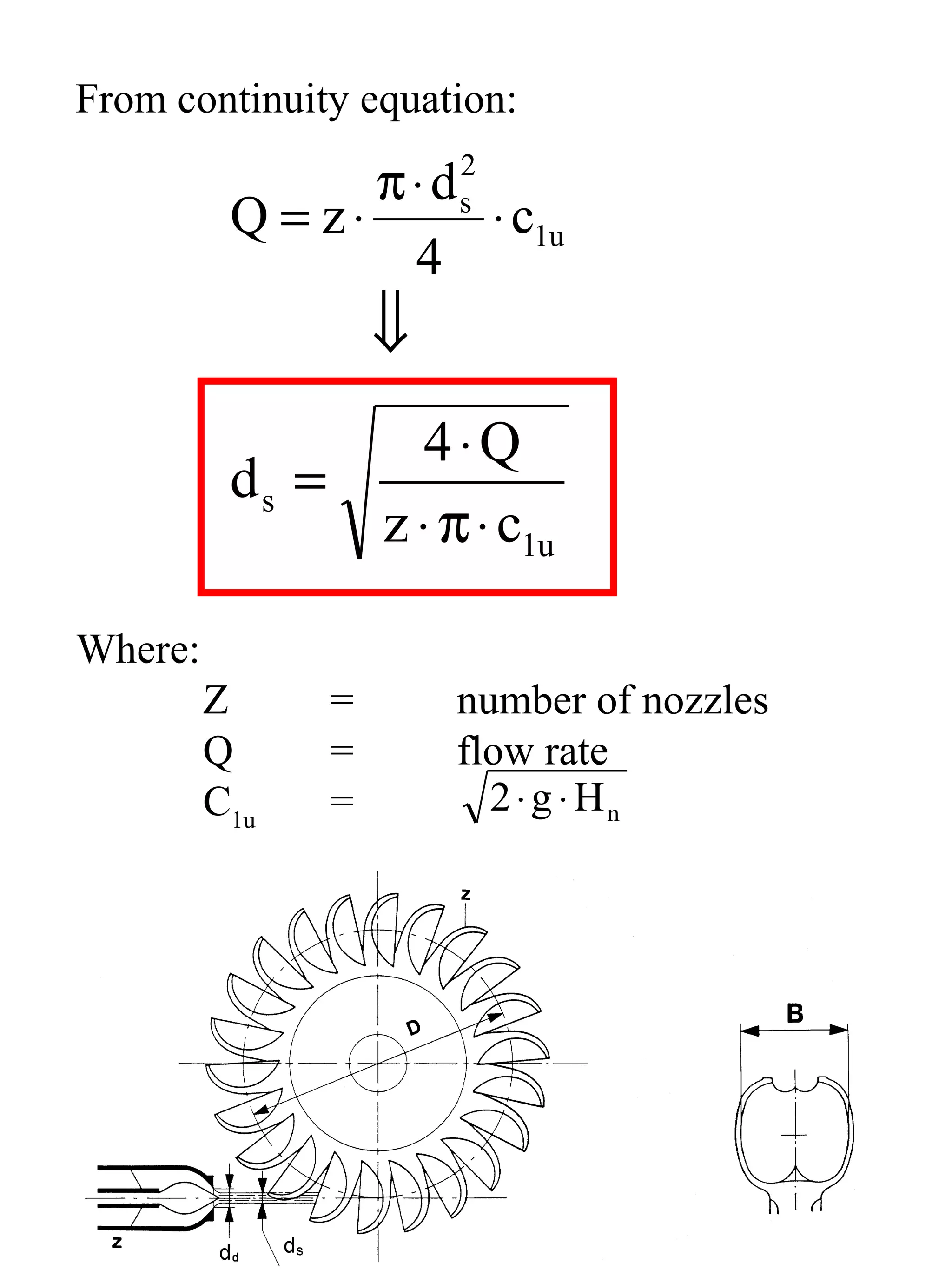
From continuity equation:

                 π⋅d   2
          Q = z⋅     ⋅ c1u
                       s

                  4
                   ⇓
                  4⋅Q
          ds =
               z ⋅ π ⋅ c1u

Where:
         Z     =       number of nozzles
         Q     =       flow rate
         C1u   =         2 ⋅ g ⋅ Hn
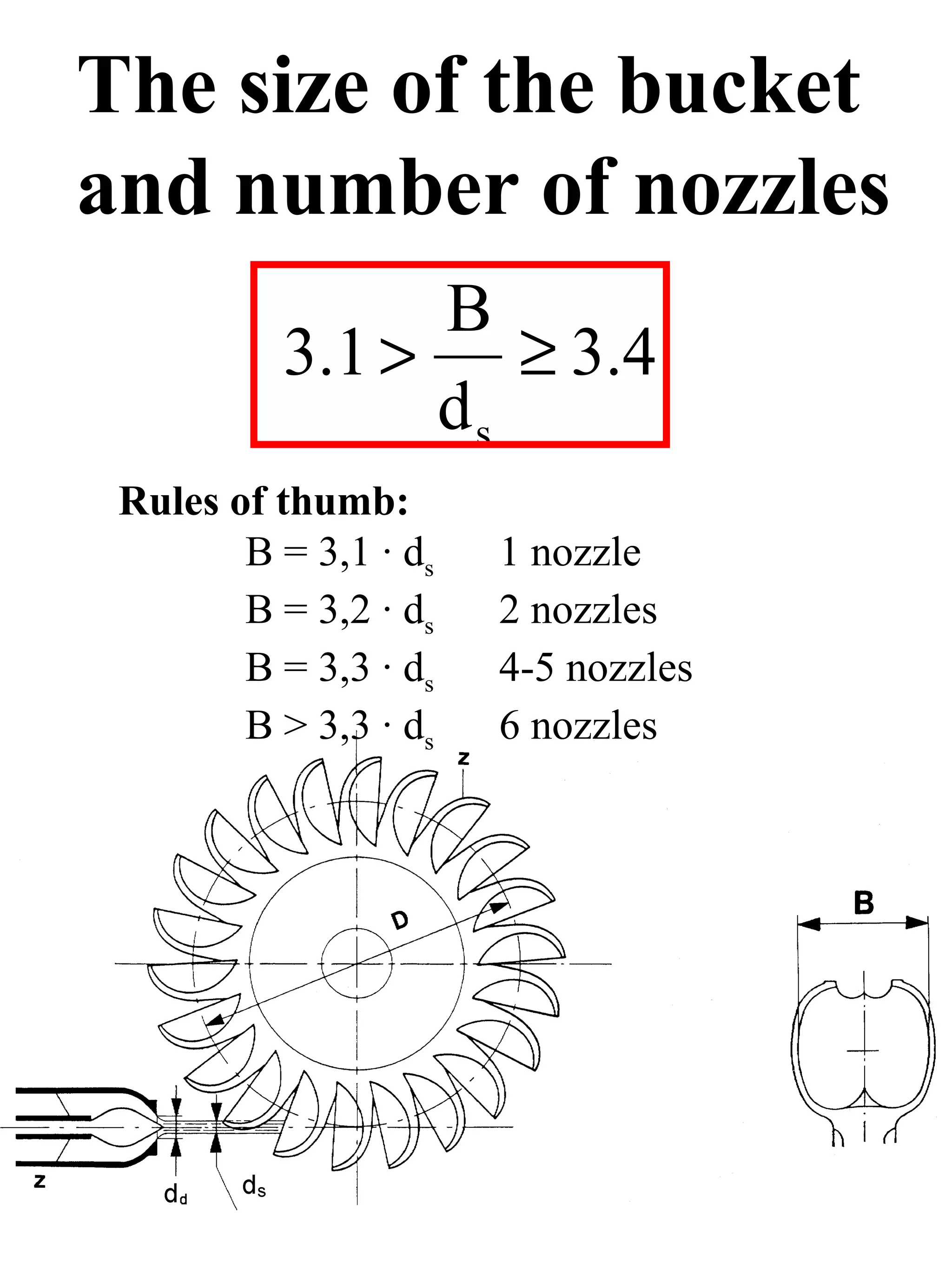
The size of the bucket
and number of nozzles
               B
          3.1 > ≥ 3.4
               ds
 Rules of thumb:
        B = 3,1 · ds   1 nozzle
        B = 3,2 · ds   2 nozzles
        B = 3,3 · ds   4-5 nozzles
        B > 3,3 · ds   6 nozzles
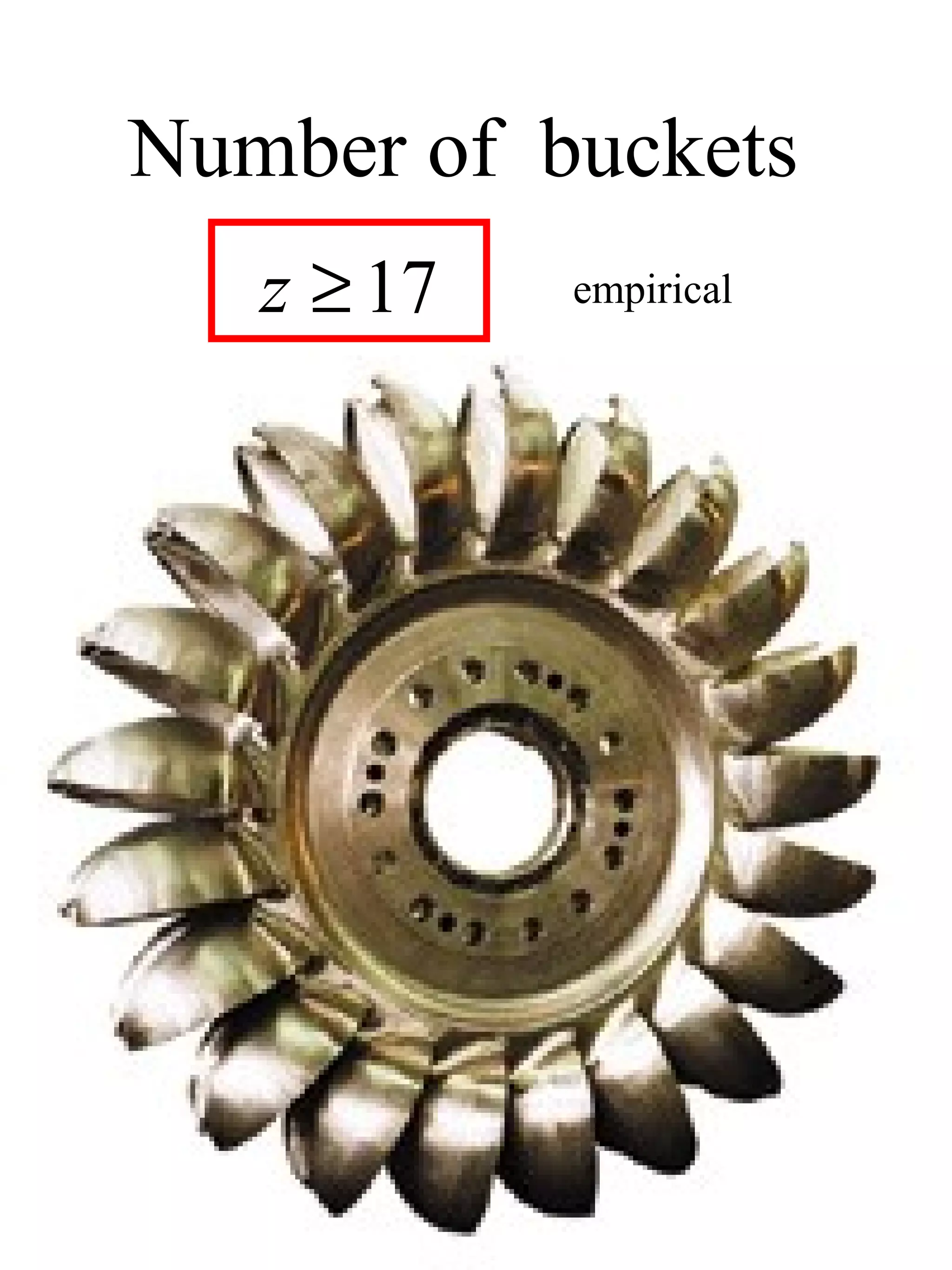
Number of buckets
   z ≥ 17   empirical
Number of buckets
Runner diameter
Rules of thumb:
       D = 10 · ds   Hn < 500 m
       D = 15 · ds   Hn = 1300 m

D < 9,5 · ds   must be avoided because water
               will be lost
D > 15 · ds    is for very high head Pelton
Speed number
             Ω = ω Q⋅z
                                   c1u = 1,0
   π ⋅ ds
        2
                  π ⋅ ds
                       2
Q=        ⋅ c1u =                  u1 = 0,5
     4              4
       ω          2 ⋅ u1        2 ⋅ g ⋅ Hn   1
ω=           =              =              =
   2 ⋅ g ⋅ Hn D ⋅ 2 ⋅ g ⋅ Hn D ⋅ 2 ⋅ g ⋅ Hn D

              1 π ⋅ ds ⋅ z
                     2
Ω = ω⋅ Q ⋅ z = ⋅
              D     4


                    ds       π⋅z
                 Ω=
                    D         4
For the diameter:     D = 10 · ds
and one nozzle:       z=1

    ds     π ⋅ z 1 π ⋅1
 Ω=             =       = 0,09
    D       4     10 4
The maximum speed number for a Pelton
turbine with one nozzle is Ω = 0,09


  For the diameter:     D = 10 · ds
  and six nozzle:             z=6

     ds     π⋅z 1 π⋅6
  Ω=           =      = 0,22
     D       4   10 4
 The maximum speed number for a Pelton
 turbine today is Ω = 0,22
Dimensioning of a
       Pelton turbine
1.   The flow rate and head are given
        *H = 1130 m
        *Q = 28,5 m3/s
        *P = 288 MW


2.   Choose reduced values
        c1u = 1            ⇒         c1u = 149 m/s
        u1 = 0,48          ⇒         u1 = 71 m/s

3.   Choose the number of nozzles
        z=5

4.   Calculate ds from continuity for one nozzle
                 4⋅Q
       ds =               = 0,22 m
              z ⋅ π ⋅ c1u
5.   Choose the bucket width
        B = 3,3 · ds= 0,73 m
6.     Find the diameter by interpolation

       D
          = 0,005 ⋅ H n + 8 = 13,65
       ds
            ⇓
       D = 13,65 ⋅ d s = 3,0 m


     D/ds
       15


       10

            400                  1400   Hn [m]
7.   Calculate the speed:
                D 2⋅Π ⋅n D
     u1 = ω ⋅     =     ⋅
                2   60    2
        ⇓
       u ⋅ 60
     n= 1     = 452 rpm
        Π⋅D


8.   Choose the number of poles on the generator:

     The speed of the runner is given by the generator and
     the net frequency:
                 3000
           n=         [rpm]
                  Zp

     where Zp=number of poles on the generator


     The number of poles will be:

                 3000
         Zp =         = 6,64 = 7
                  n
9.    Recalculate the speed:


           3000
      n=        = 428,6 [rpm]
            Zp

10.   Recalculate the diameter:
                 D 2⋅Π ⋅n D      u ⋅ 60
      u1 = ω ⋅     =     ⋅   ⇒ D= 1     = 3,16 m
                 2   60    2      Π⋅n

11.   Choose the number of buckets

      z = 22
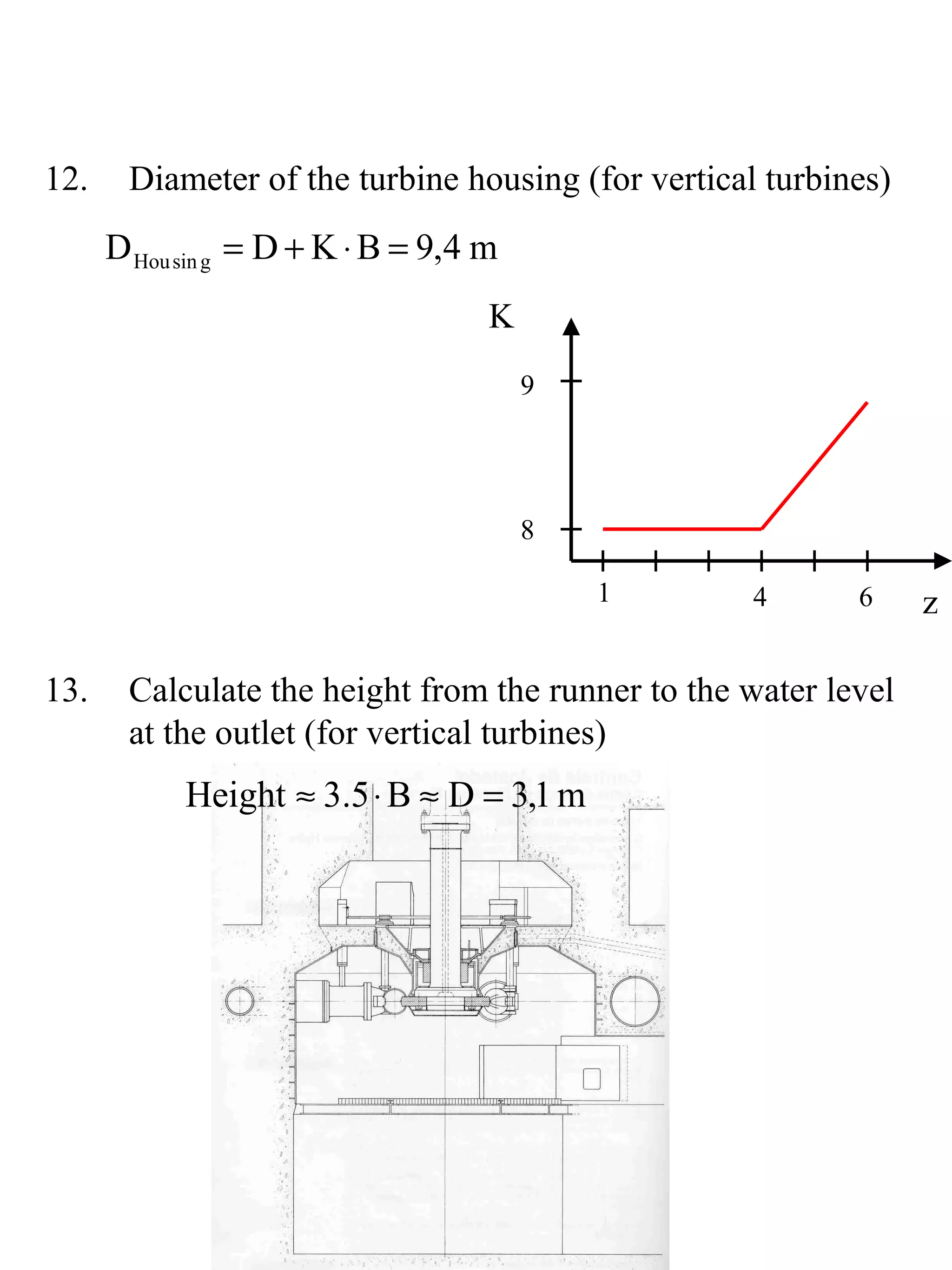
12.    Diameter of the turbine housing (for vertical turbines)
      D Hou sin g = D + K ⋅ B = 9,4 m
                                    K
                                        9


                                        8

                                            1       4      6     z

13.    Calculate the height from the runner to the water level
       at the outlet (for vertical turbines)
            Height ≈ 3.5 ⋅ B ≈ D = 3,1 m
Given values:    Chosen values:   Calculated values:
*Q = 28,5 m3/s   c1u = 1          ds = 0,22 m
*H = 1130 m      u1 = 0,48        n = 428,6 rpm
                 z=5              D = 3, 16 m
                 B = 0,73 m       Height = 3,1 m
                 z = 22           Dhousing= 9,4 m
                 Zp = 7           *P = 288 MW
*Q = 28,5 m3/s
                         *H = 1130 m
                         *P = 288 MW

                             GE Hydro
Jostedal, Sogn og Fjordane
*Q = 28,5 m3/s
          *H = 1130 m
          *P = 288 MW

                             GE Hydro
Jostedal, Sogn og Fjordane
Example
     Khimti Power Plant
1. The flow rate and head are given
      *H = 660 m
      *Q = 2,15 m3/s
      *P = 12 MW


2. Choose reduced values
      c1u = 1          ⇒   c1u = 114 m/s
      u1 = 0,48        ⇒   u1 = 54,6 m/s


3. Choose the number of nozzles
      z=1
Example
     Khimti Power Plant
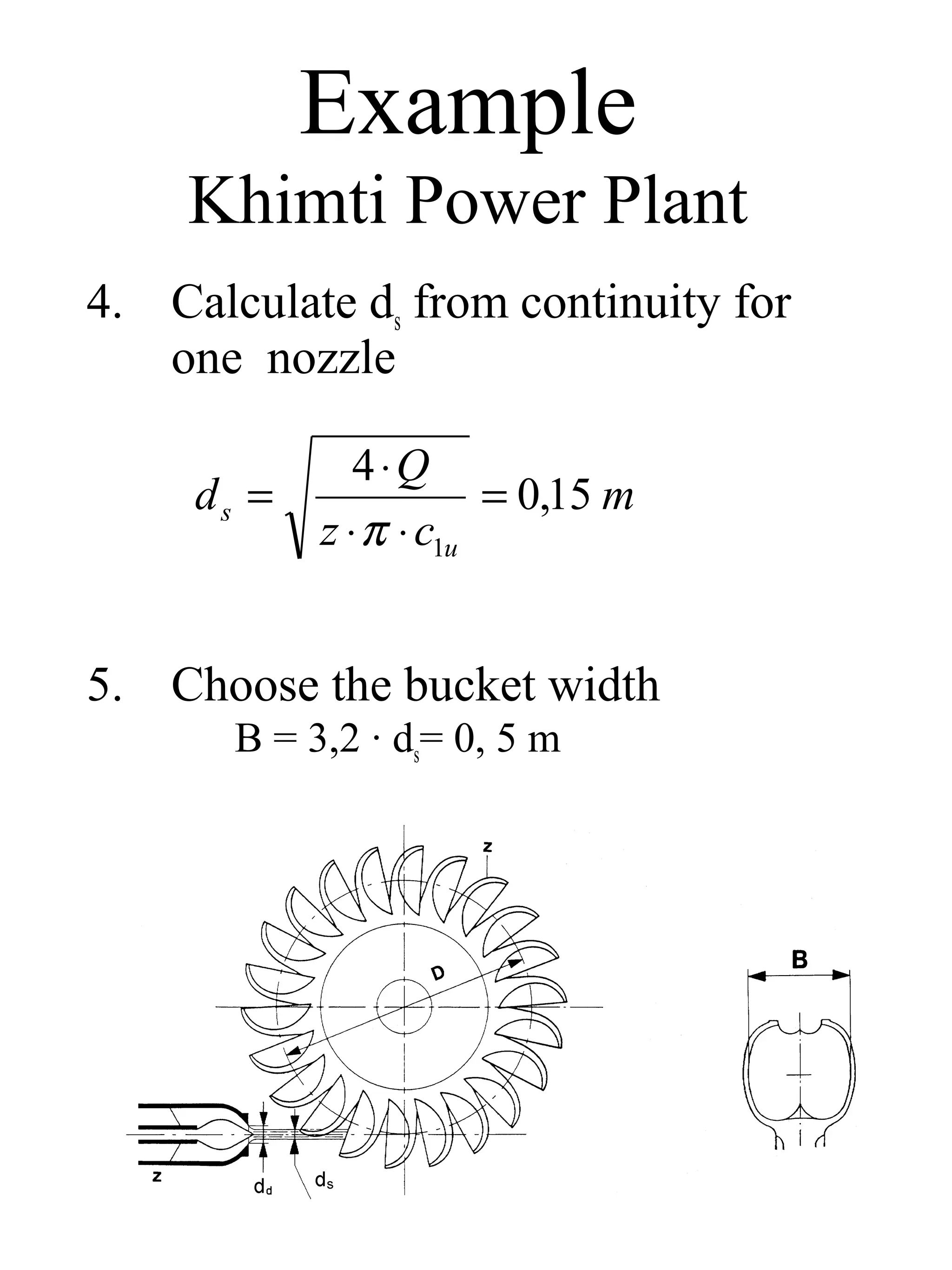
4. Calculate ds from continuity for
   one nozzle

               4⋅Q
     ds =               = 0,15 m
            z ⋅ π ⋅ c1u


5. Choose the bucket width
       B = 3,2 · ds= 0, 5 m
6. Find the diameter by interpolation
           D
              = 0,005 ⋅ H n + 8 = 11,3
           ds
                ⇓
           D = 11,3 ⋅ d s = 1,7 m
  D/ds
    15


    10

         400             1400   Hn [m]
7. Calculate the speed:
            D 2⋅Π ⋅n D
    u1 = ω ⋅ =      ⋅
            2   60    2
         ⇓
         u1 ⋅ 60
    n=           = 613 rpm
         Π⋅D

8. Choose the number of poles on the
   generator:
   The speed of the runner is given by
   the generator and the net frequency:
                      3000
                   n=      [rpm]
                       Zp

    where Zp=number of poles on the
    generator

    The number of poles will be:

              3000
         Zp =      = 4,9 = 5
                n
9. Recalculate the speed:


               3000
            n=      = 600 [rpm]
                Zp

10. Recalculate the diameter:


           D 2⋅Π ⋅n D           u1 ⋅ 60
u1 = ω ⋅     =     ⋅     ⇒ D=           = 1,74 m
           2   60    2           Π⋅n


11. Choose the number of buckets

      z = 22

Pelton turbine (1)

  • 1.
  • 2.
    When to usea Pelton turbine
  • 3.
    Energy conversion ina Pelton turbine Outlet Outlet of Inlet of Outlet of Inlet of the runner the runner the needle the needle c2 2
  • 4.
    Main dimensions forthe Pelton runner
  • 6.
    The ideal Peltonrunner Absolute velocity from nozzle: c1 c1 = 2 ⋅ g ⋅ H n c1 = =1 2 ⋅ g ⋅ Hn Circumferential speed: c1u 1 u1 = = ⋅ 2 ⋅ g ⋅ Hn u1 = 0.5 2 2 Euler`s turbine equation: ηh = 2(u1 ⋅ c1u − u 2 ⋅ c 2 u ) c1u = 1 cu 2 = 0 η h = 2 ⋅ (u1 ⋅ c1u − u 2 ⋅ c 2u ) = 2 ⋅ (0,5 ⋅1.0 − 0,5 ⋅ 0) = 1
  • 7.
    The real Peltonrunner • For a real Pelton runner there will always be losses We will therefore set the hydraulic efficiency to: ηh = 0.96 The absolute velocity from the nozzle will be: 0.99 ≤ c1u < 0.995 C1u can be set to 1,0 when dimensioning the turbine. This gives us: ηh = 2(u1 ⋅ c1u − u 2 ⋅ c 2 u ) ⇓ ηn 0,96 u1 = = = 0,48 2 ⋅ c1u 2 ⋅1,0
  • 8.
    From continuity equation: π⋅d 2 Q = z⋅ ⋅ c1u s 4 ⇓ 4⋅Q ds = z ⋅ π ⋅ c1u Where: Z = number of nozzles Q = flow rate C1u = 2 ⋅ g ⋅ Hn
  • 9.
    The size ofthe bucket and number of nozzles B 3.1 > ≥ 3.4 ds Rules of thumb: B = 3,1 · ds 1 nozzle B = 3,2 · ds 2 nozzles B = 3,3 · ds 4-5 nozzles B > 3,3 · ds 6 nozzles
  • 10.
    Number of buckets z ≥ 17 empirical
  • 11.
  • 12.
    Runner diameter Rules ofthumb: D = 10 · ds Hn < 500 m D = 15 · ds Hn = 1300 m D < 9,5 · ds must be avoided because water will be lost D > 15 · ds is for very high head Pelton
  • 13.
    Speed number Ω = ω Q⋅z c1u = 1,0 π ⋅ ds 2 π ⋅ ds 2 Q= ⋅ c1u = u1 = 0,5 4 4 ω 2 ⋅ u1 2 ⋅ g ⋅ Hn 1 ω= = = = 2 ⋅ g ⋅ Hn D ⋅ 2 ⋅ g ⋅ Hn D ⋅ 2 ⋅ g ⋅ Hn D 1 π ⋅ ds ⋅ z 2 Ω = ω⋅ Q ⋅ z = ⋅ D 4 ds π⋅z Ω= D 4
  • 14.
    For the diameter: D = 10 · ds and one nozzle: z=1 ds π ⋅ z 1 π ⋅1 Ω= = = 0,09 D 4 10 4 The maximum speed number for a Pelton turbine with one nozzle is Ω = 0,09 For the diameter: D = 10 · ds and six nozzle: z=6 ds π⋅z 1 π⋅6 Ω= = = 0,22 D 4 10 4 The maximum speed number for a Pelton turbine today is Ω = 0,22
  • 15.
    Dimensioning of a Pelton turbine 1. The flow rate and head are given *H = 1130 m *Q = 28,5 m3/s *P = 288 MW 2. Choose reduced values c1u = 1 ⇒ c1u = 149 m/s u1 = 0,48 ⇒ u1 = 71 m/s 3. Choose the number of nozzles z=5 4. Calculate ds from continuity for one nozzle 4⋅Q ds = = 0,22 m z ⋅ π ⋅ c1u
  • 16.
    5. Choose the bucket width B = 3,3 · ds= 0,73 m
  • 17.
    6. Find the diameter by interpolation D = 0,005 ⋅ H n + 8 = 13,65 ds ⇓ D = 13,65 ⋅ d s = 3,0 m D/ds 15 10 400 1400 Hn [m]
  • 18.
    7. Calculate the speed: D 2⋅Π ⋅n D u1 = ω ⋅ = ⋅ 2 60 2 ⇓ u ⋅ 60 n= 1 = 452 rpm Π⋅D 8. Choose the number of poles on the generator: The speed of the runner is given by the generator and the net frequency: 3000 n= [rpm] Zp where Zp=number of poles on the generator The number of poles will be: 3000 Zp = = 6,64 = 7 n
  • 19.
    9. Recalculate the speed: 3000 n= = 428,6 [rpm] Zp 10. Recalculate the diameter: D 2⋅Π ⋅n D u ⋅ 60 u1 = ω ⋅ = ⋅ ⇒ D= 1 = 3,16 m 2 60 2 Π⋅n 11. Choose the number of buckets z = 22
  • 20.
    12. Diameter of the turbine housing (for vertical turbines) D Hou sin g = D + K ⋅ B = 9,4 m K 9 8 1 4 6 z 13. Calculate the height from the runner to the water level at the outlet (for vertical turbines) Height ≈ 3.5 ⋅ B ≈ D = 3,1 m
  • 21.
    Given values: Chosen values: Calculated values: *Q = 28,5 m3/s c1u = 1 ds = 0,22 m *H = 1130 m u1 = 0,48 n = 428,6 rpm z=5 D = 3, 16 m B = 0,73 m Height = 3,1 m z = 22 Dhousing= 9,4 m Zp = 7 *P = 288 MW
  • 22.
    *Q = 28,5m3/s *H = 1130 m *P = 288 MW GE Hydro Jostedal, Sogn og Fjordane
  • 23.
    *Q = 28,5m3/s *H = 1130 m *P = 288 MW GE Hydro Jostedal, Sogn og Fjordane
  • 24.
    Example Khimti Power Plant 1. The flow rate and head are given *H = 660 m *Q = 2,15 m3/s *P = 12 MW 2. Choose reduced values c1u = 1 ⇒ c1u = 114 m/s u1 = 0,48 ⇒ u1 = 54,6 m/s 3. Choose the number of nozzles z=1
  • 25.
    Example Khimti Power Plant 4. Calculate ds from continuity for one nozzle 4⋅Q ds = = 0,15 m z ⋅ π ⋅ c1u 5. Choose the bucket width B = 3,2 · ds= 0, 5 m
  • 26.
    6. Find thediameter by interpolation D = 0,005 ⋅ H n + 8 = 11,3 ds ⇓ D = 11,3 ⋅ d s = 1,7 m D/ds 15 10 400 1400 Hn [m]
  • 27.
    7. Calculate thespeed: D 2⋅Π ⋅n D u1 = ω ⋅ = ⋅ 2 60 2 ⇓ u1 ⋅ 60 n= = 613 rpm Π⋅D 8. Choose the number of poles on the generator: The speed of the runner is given by the generator and the net frequency: 3000 n= [rpm] Zp where Zp=number of poles on the generator The number of poles will be: 3000 Zp = = 4,9 = 5 n
  • 28.
    9. Recalculate thespeed: 3000 n= = 600 [rpm] Zp 10. Recalculate the diameter: D 2⋅Π ⋅n D u1 ⋅ 60 u1 = ω ⋅ = ⋅ ⇒ D= = 1,74 m 2 60 2 Π⋅n 11. Choose the number of buckets z = 22