

Pump – Turbine
(acting as a turbine)
Motor – Generator
(acting as a generator)


Pump – Turbine
(acting as a pump)
Motor – Generator
(acting as a motor)


EGL
HGL
HGL & EGL
HGL & EGL
V2/2g
Gradual expansion of conduit allows kinetic
energy to be converted to pressure head with
much smaller hL at the outlet. Then the HGL
approaches the EGL
P/g
Z
HT
Turbine
Neglecting entrance
and exit losses
Pump
EGL
HGL
EGL
HGL
V2/2g
Abrupt rise in EGL = HP


V2/2g
EGL
HGL
hL due to partially
closed valve
hL due to entrance
hL due to outlet
Valve
Consider entrance
and outlet losses
P/g
Z
Reference datum
HGL & EGL


V2/2g
EGL
HGL
hL due to partially
closed valve
hL due to outlet
Valve
Neglecting entrance
and outlet losses
P/g
Z
Reference datum
HGL & EGL


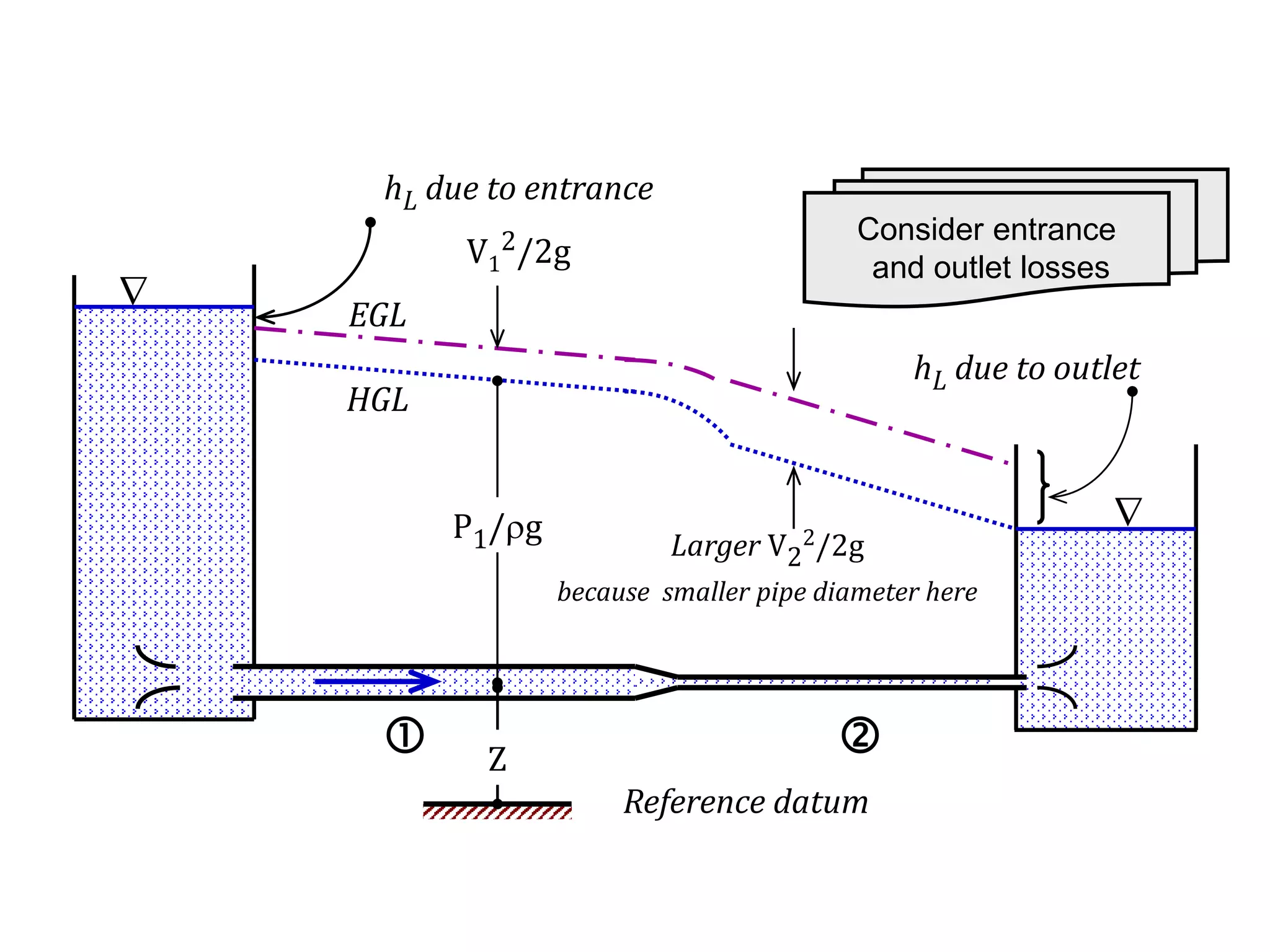
V1
2/2g
EGL
HGL
hL due to entrance
hL due to outlet
Consider entrance
and outlet losses
Larger V2
2/2g
because smaller pipe diameter here
 
P1/g
Z
Reference datum
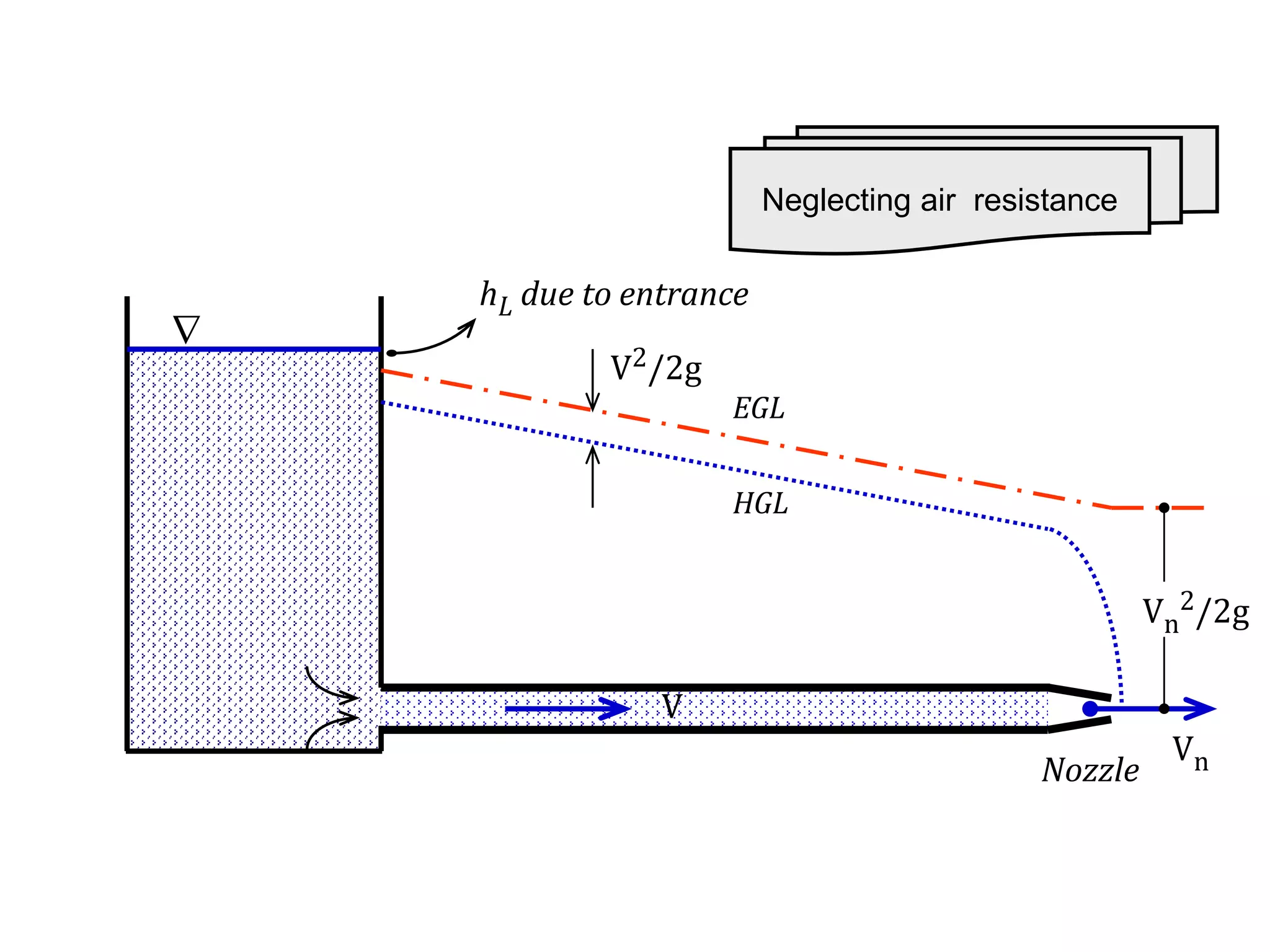
EGL
HGL
V2/2g
V

hL due to entrance
Vn
Vn
2/2g
Neglecting air resistance
Nozzle
EGL
HGL
V2/2g

V
Neglecting air
resistance
hL
P2/g
HGL & EGL
Z2
Z1
Reference datum
Z1
Reference datum
EGL
HGL


Z2
P1/g = +ve
V1
2/2g
P2/g = -ve
(TEL)1 (TEL)2

TEL
Z1
Reference datum
EGL
HGL


Z2
P1/g = +ve
V1
2/2g
P2/g = -ve
(TEL)1 (TEL)2

TEL
EGL
HGL
V2/2g

V
Neglecting air
resistance
hL
P2/g
HGL & EGL
Z2
Z1
Reference datum
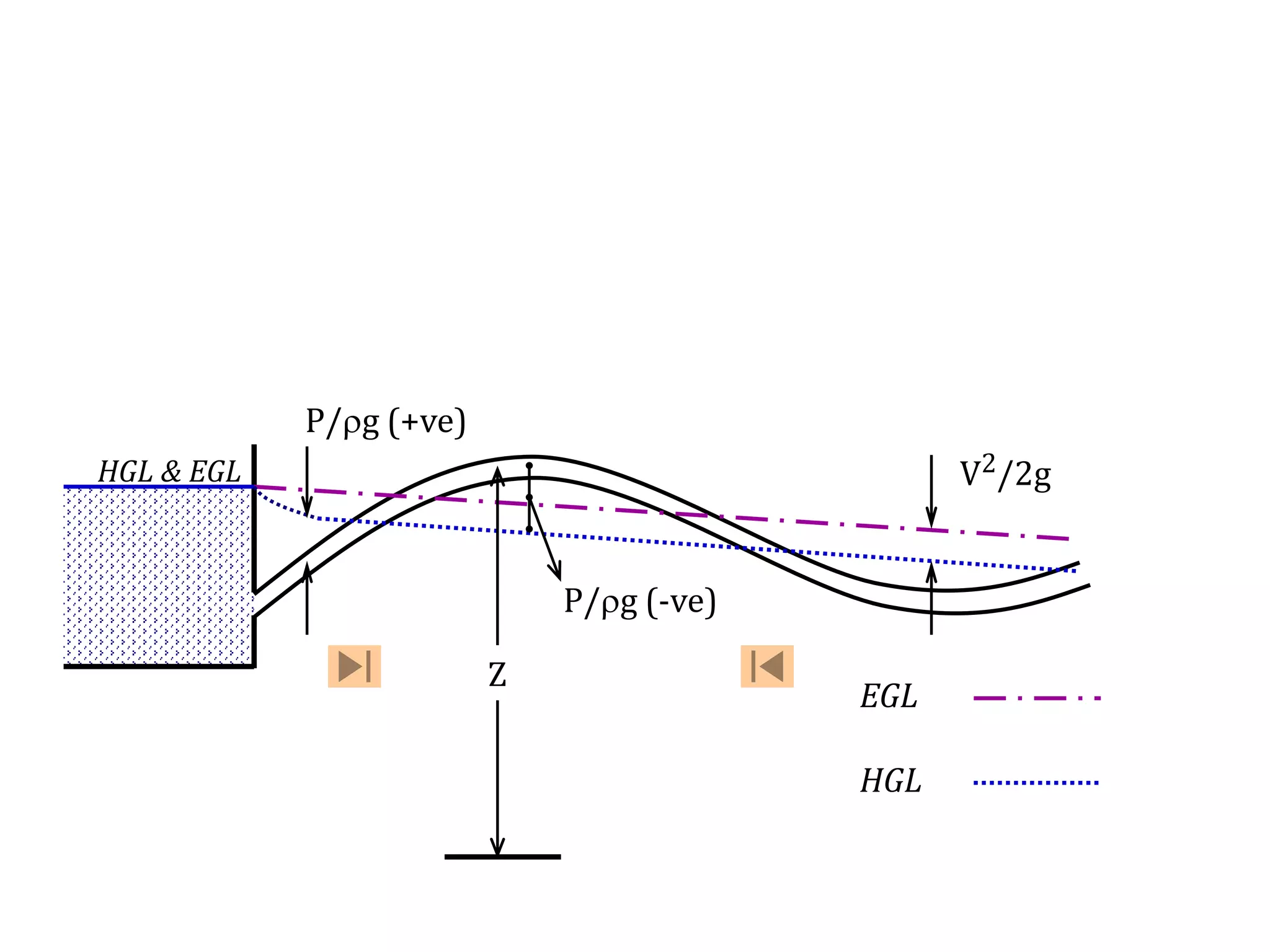
HGL & EGL
P/g (-ve)
EGL
P/g (+ve)
V2/2g
Z
HGL
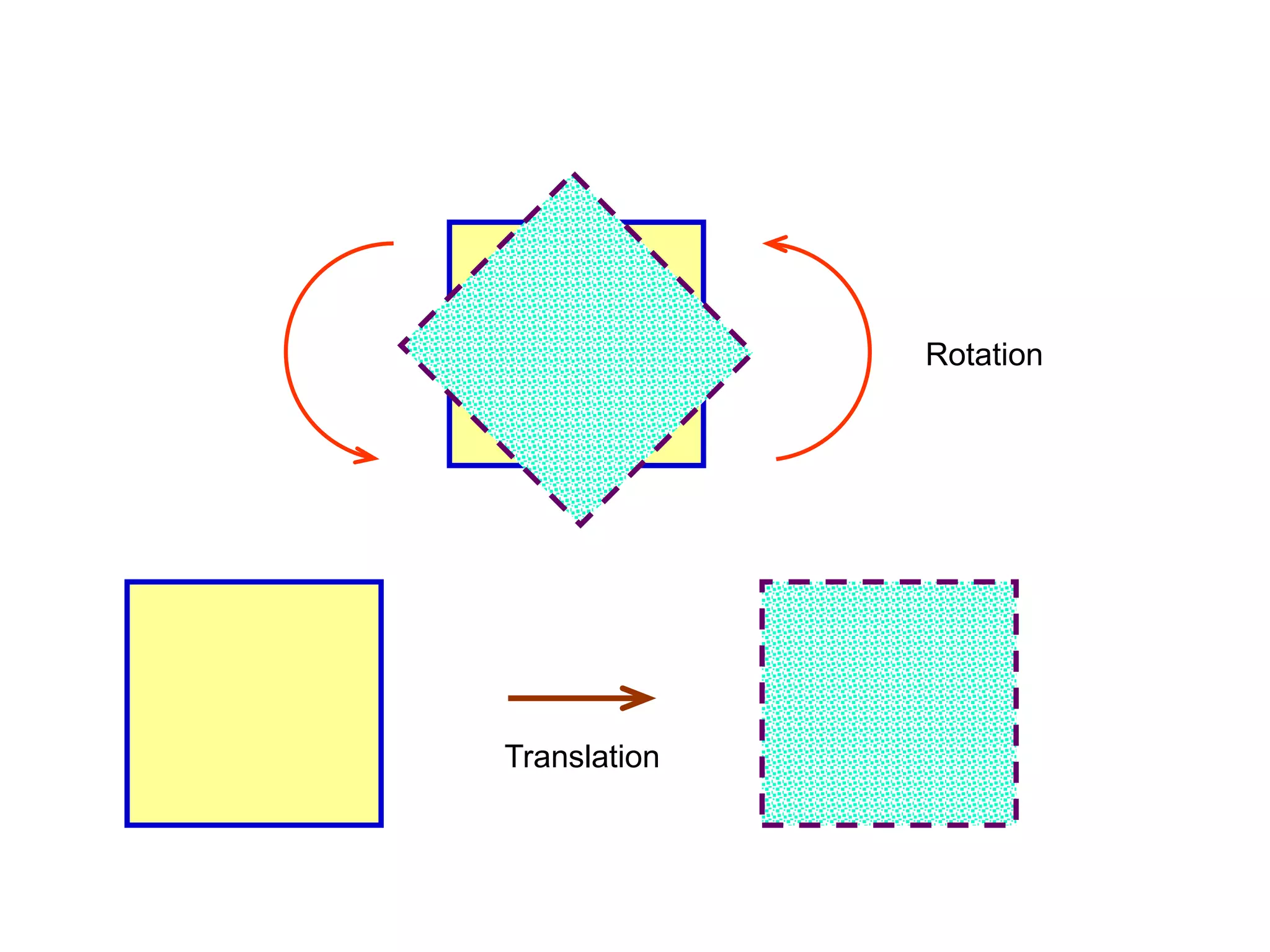
Translation
Rotation
Shear strain
Linear strain
Pathline
Fluid Particle at t = t start
Fluid Particle at t = t end
Fluid Particle at some
intermediate time
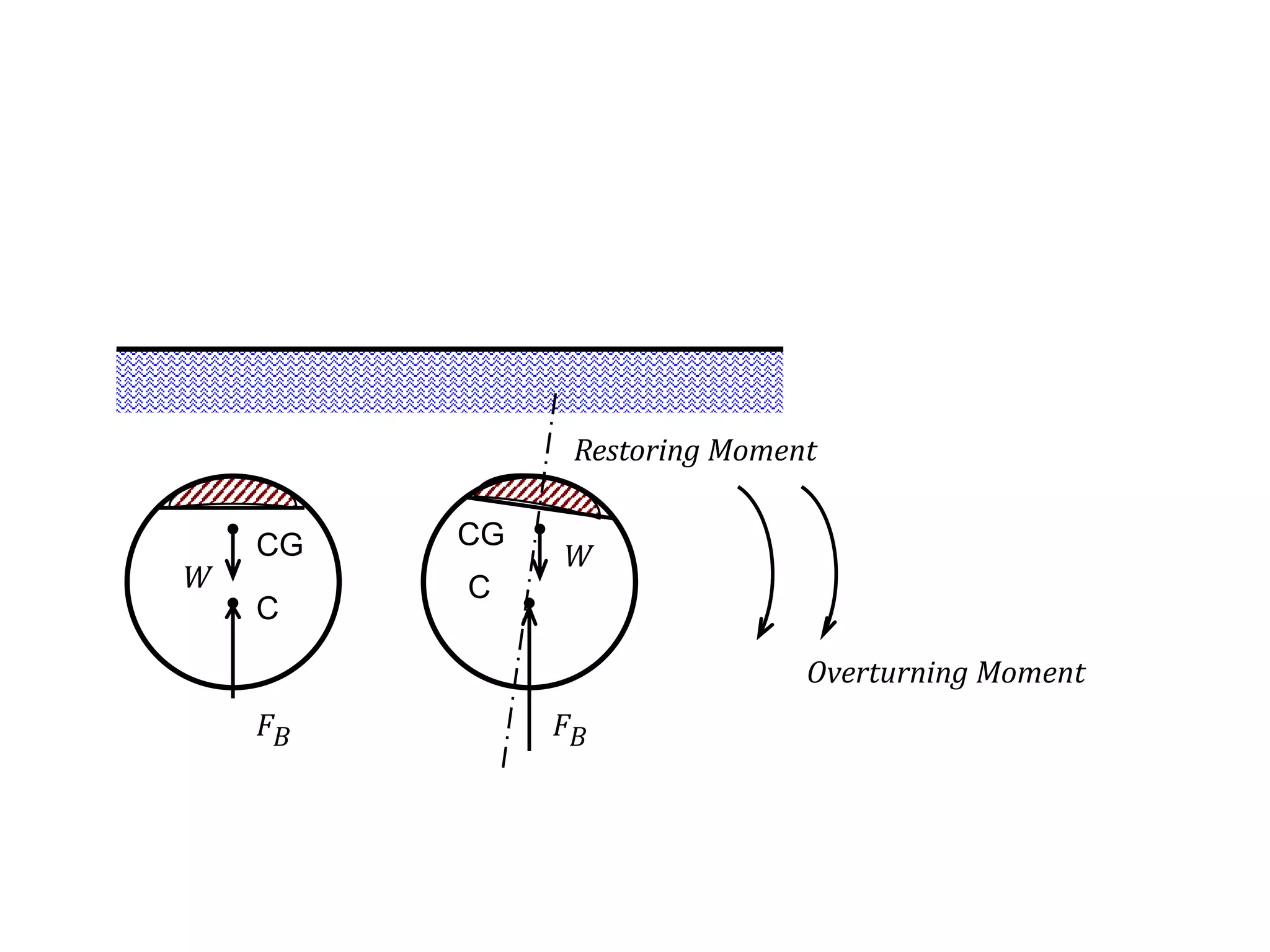
C
CG
C
CG
Restoring Moment
FB
W W
FB
Overturning Moment
C
CG
C
CG
Restoring Moment
FB
W
W
FB
Overturning Moment
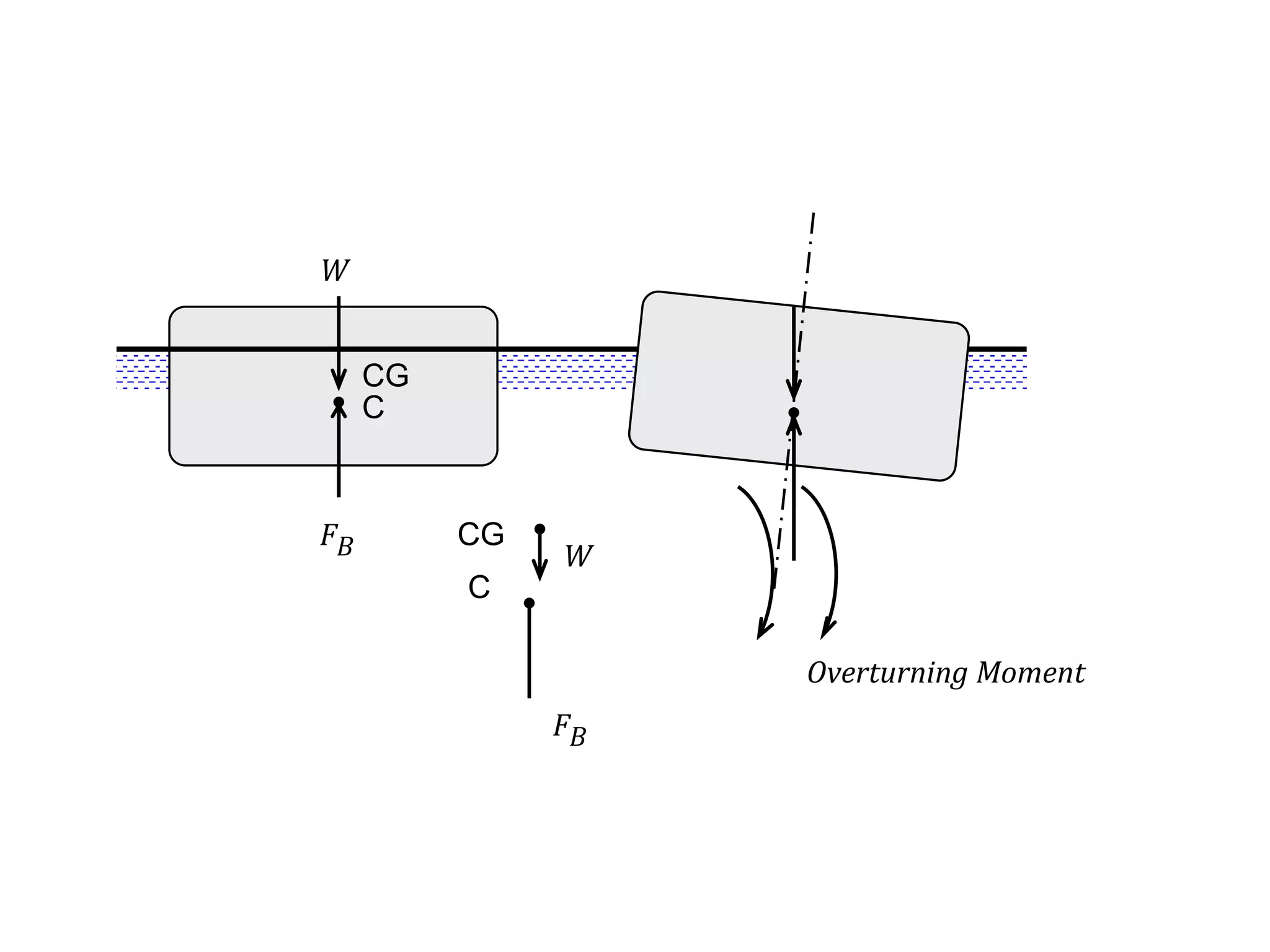
C
CG
C
CG
FB
W
W
FB
Overturning Moment
P1 P2
Reservoir “R”
Gas
diameter “d ”
Liquid density i
2
)
D
/
d
(
h
h 


h
 
diameter D
P1
Reservoir “R”
Gas
Liquid density i
diameter “d ”
diameter “D”
 h
h

P2
L
h
i
h
Liquid density
Liquid density
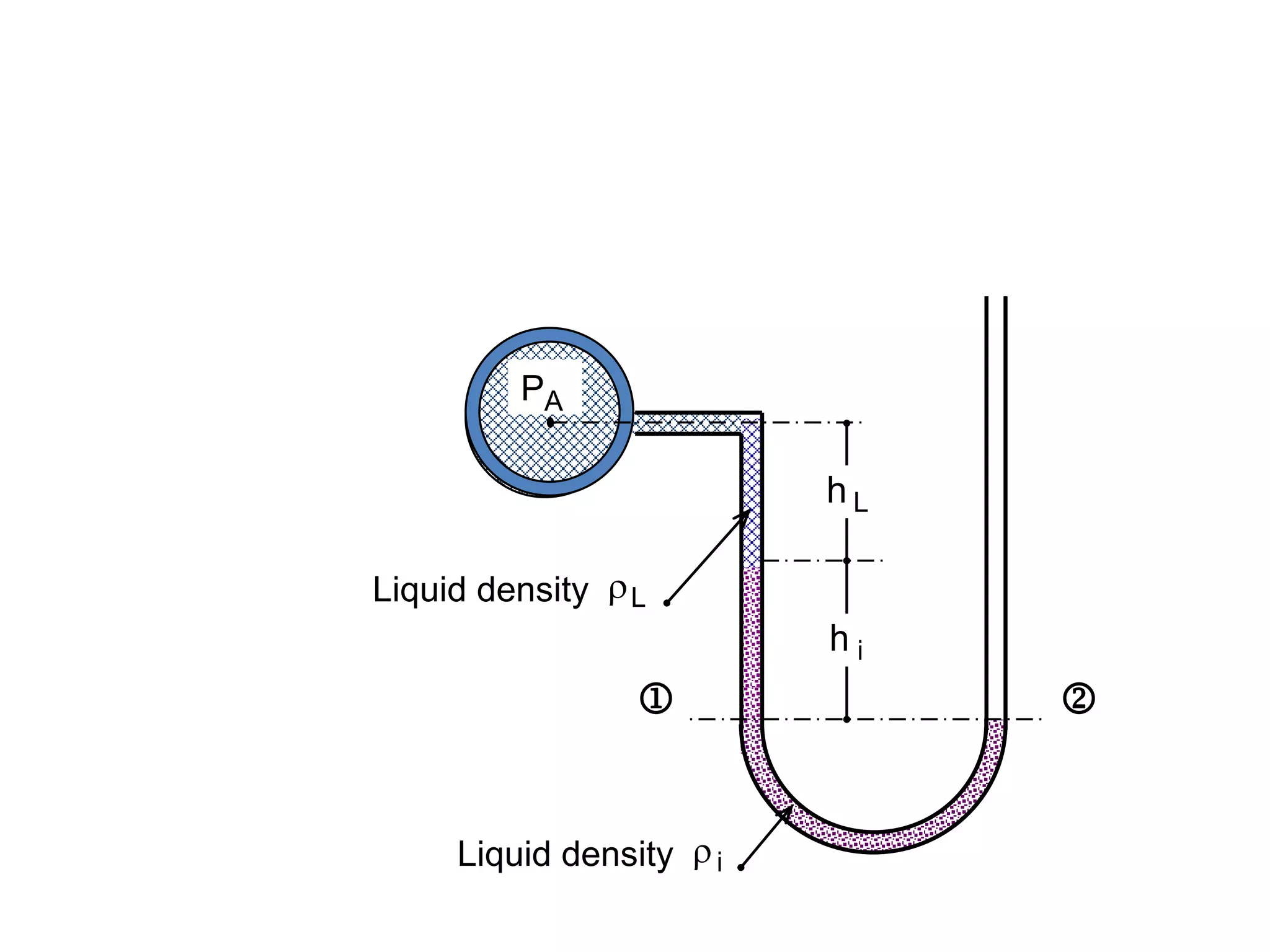
PA



i

L

L
h
i
h
Liquid density
Liquid density
PA


i

L

v
F
H
F
Curved surface projection
onto vertical plane
H
F H
F
v
F
1
w
2
w
1
F 1
F
Air
a
b
c
d e
H
F
v
F
t
F
3
/
H
H
F
v
F
t
F
3
/
H
2
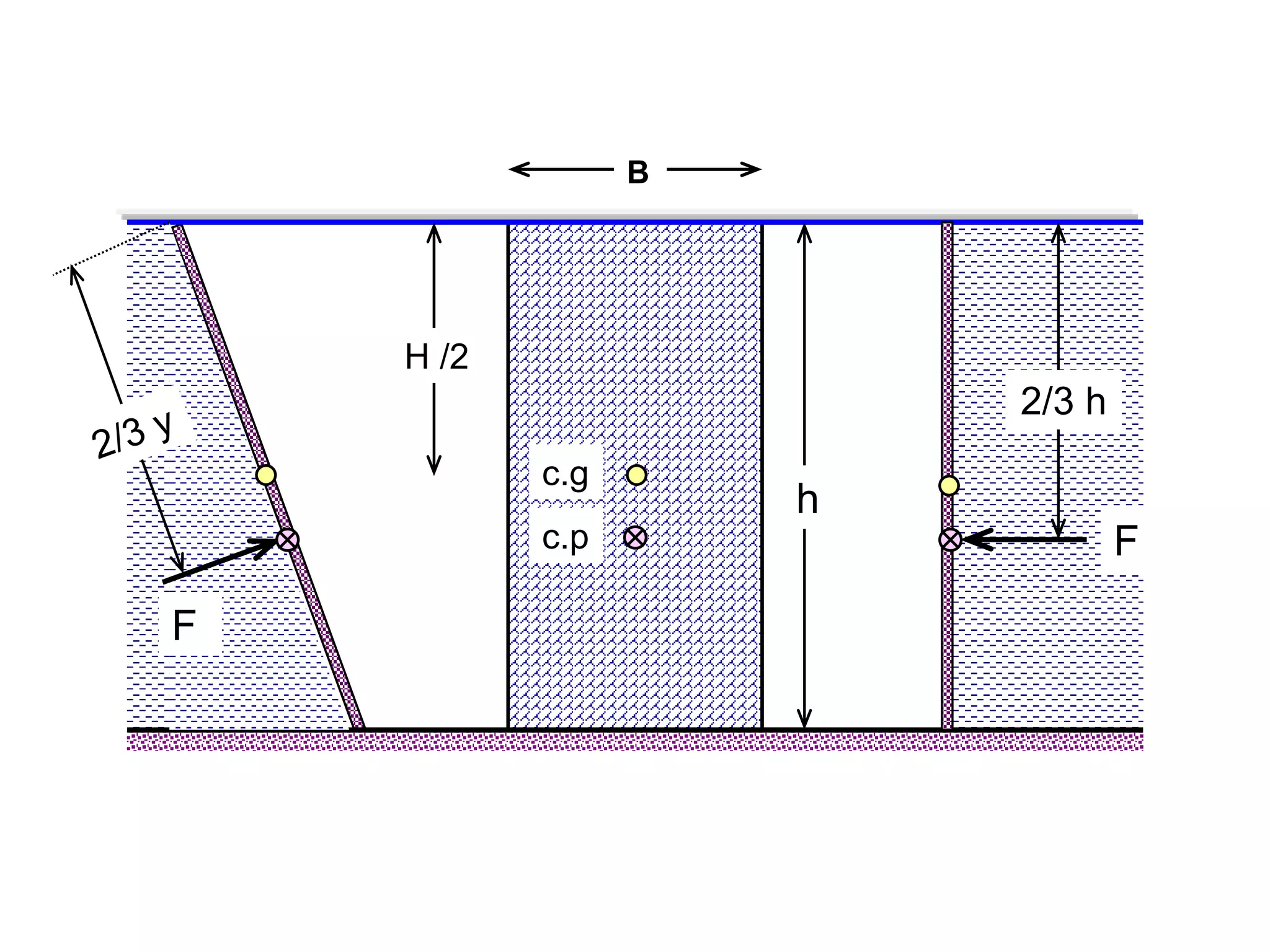
c.g
Gage pressure (suction
or vacuum) @ 2
Absolute zero reference
Absolute pressure @ 2
Absolute pressure @ 1
Local atmospheric pressure reference
Gage pressure @ 1
Pressure

B
F
c.p F
2/3 h
c.g
h
2/3 y
h /2
B
B
F
F
c.g
c.p
h
2/3 h
H /2
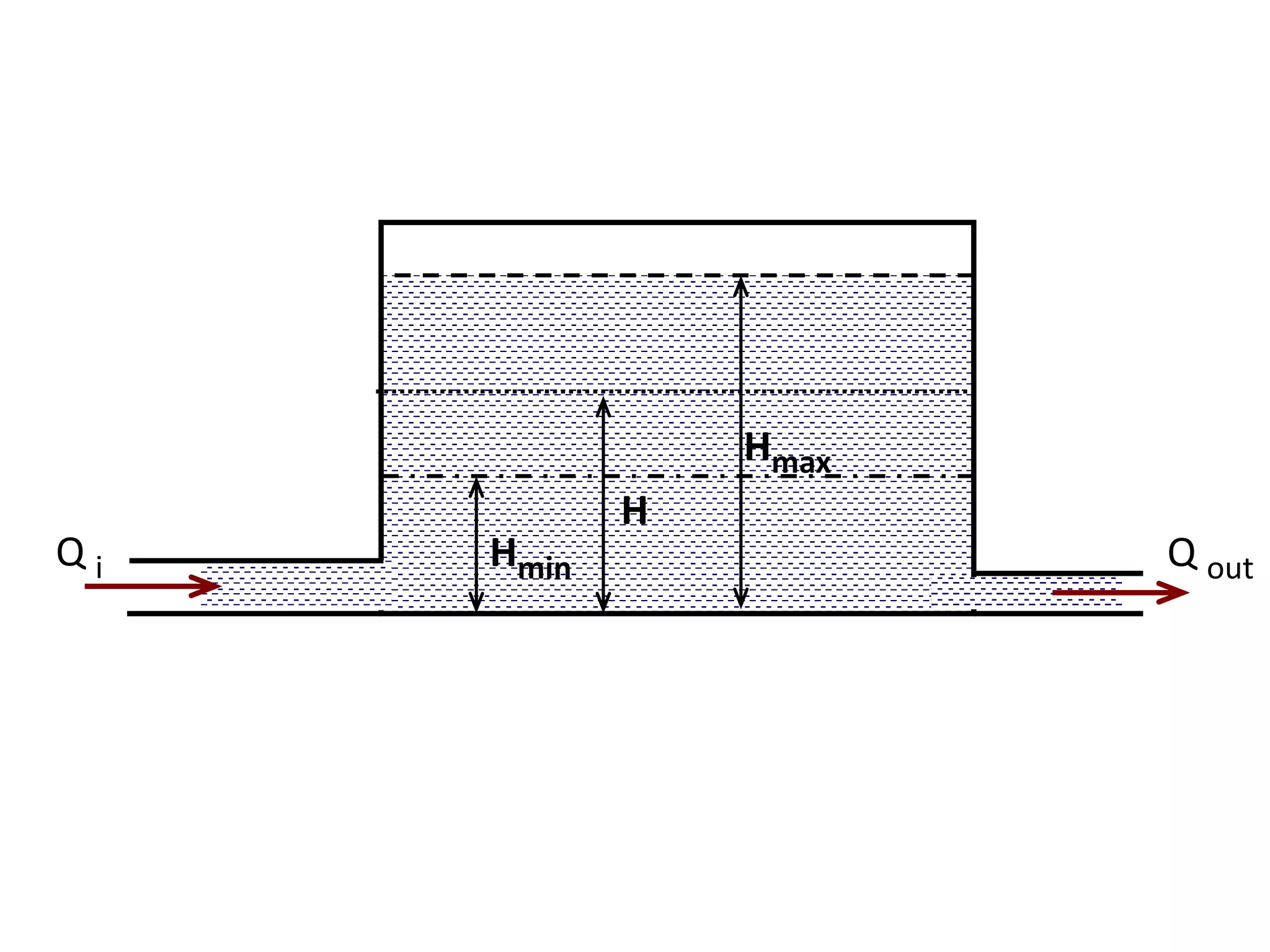
Hmin
Hmax
H
Q i Q out
P3
P2
P1
x
y
s
c
B
A
x
y
z
Patm.
weight
P
B
/2 H
1H : 4V
H
H/4

Crest Level
 Water Level
b
dh
H
h
H
w
P
w
L
1
y



cr
2 y
y 
1
V
cr
2 V
V 
Weir
dA
P
dA
)
dp
P
( 

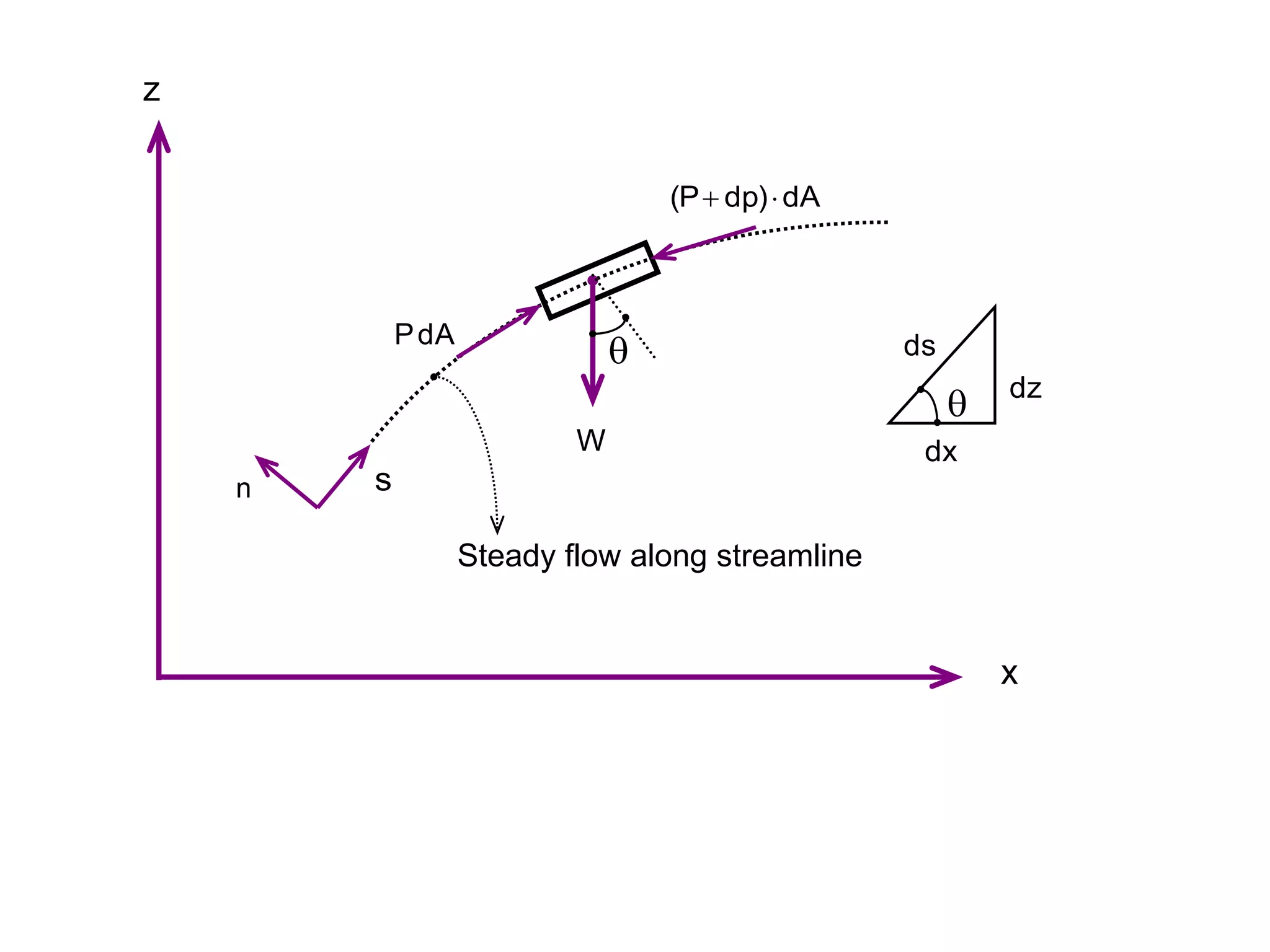
Steady flow along streamline
W dx
dz
ds
s
n


x
z
Streamlines


H
g
/
P1 

0
P .
atm 
2
H
0
P .
atm 
1
H
H
h
d
B
1
H
0
P .
atm 
2
1 H
H
H
d 

2
H
A
 



Diffusing jet
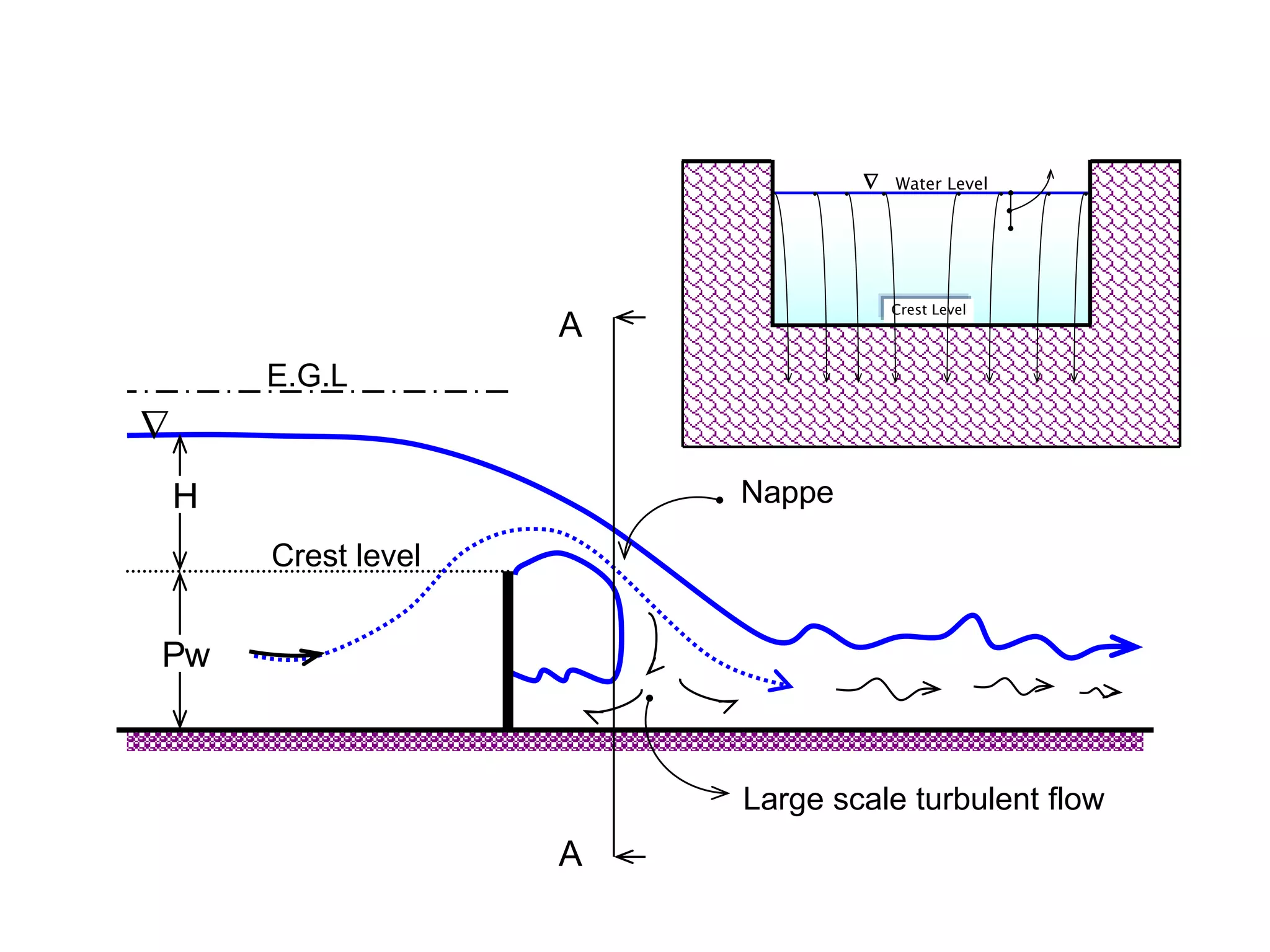
E.G.L

H
Pw
Nappe


Crest level
Crest Level
 Water Level
B
dh
H
h
Large scale turbulent flow
E.G.L

H
Pw
Nappe
Crest level
Large scale turbulent flow
 Water Level
Crest Level
A
A
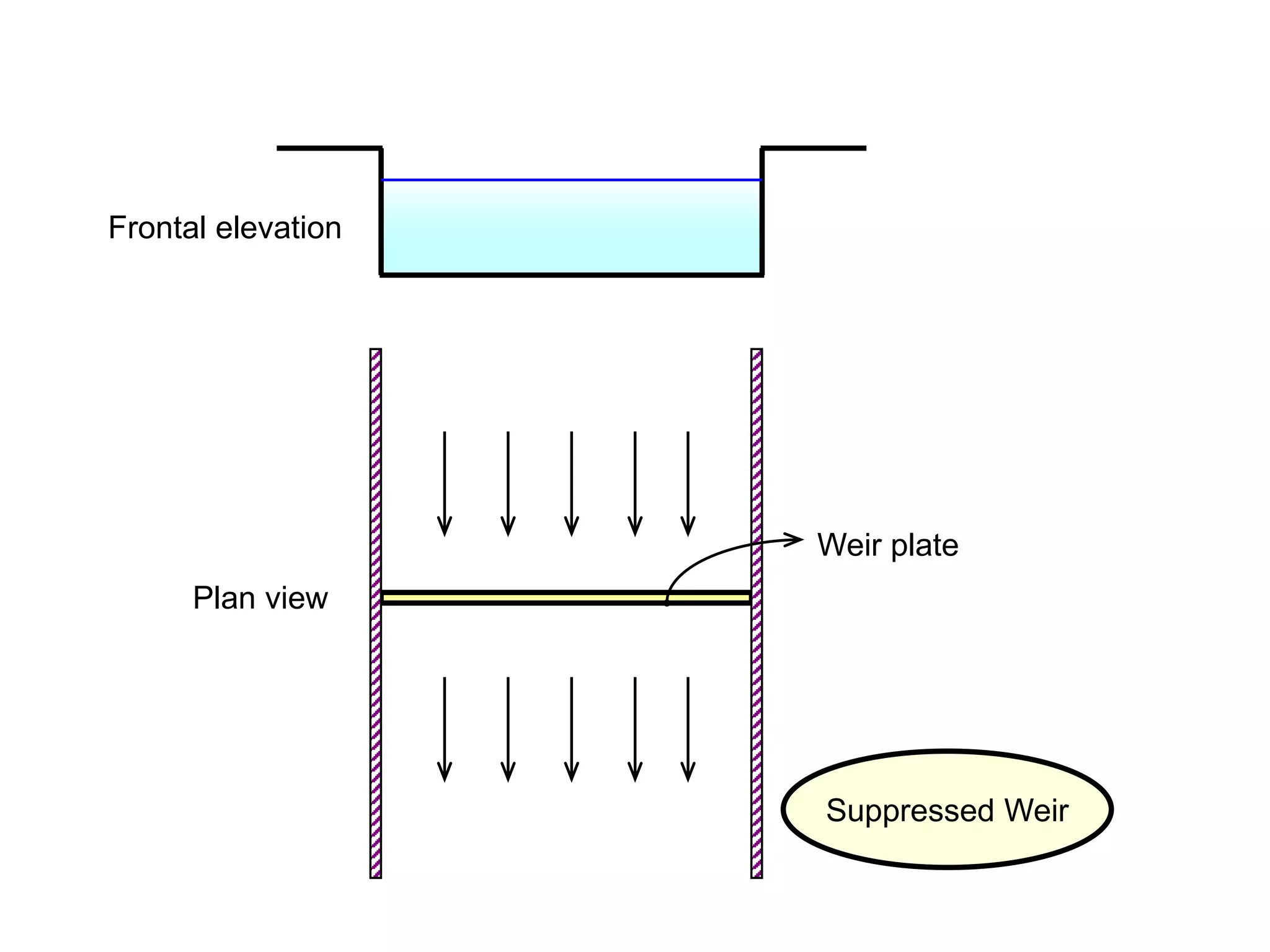
Frontal elevation
Plan view
Weir plate
Suppressed Weir
dh
H
B
b
h

H-h
b/2
/2
Crest Level
 Water Level
B
dh
H
h
 Water Level
B  3H
h
Crest Level
H
2H
0.1 H
0.1 H
2H 2H
 Water Level
B  3H
Crest Level
H
2H
2H
2H
 Water Level
Crest Level
 
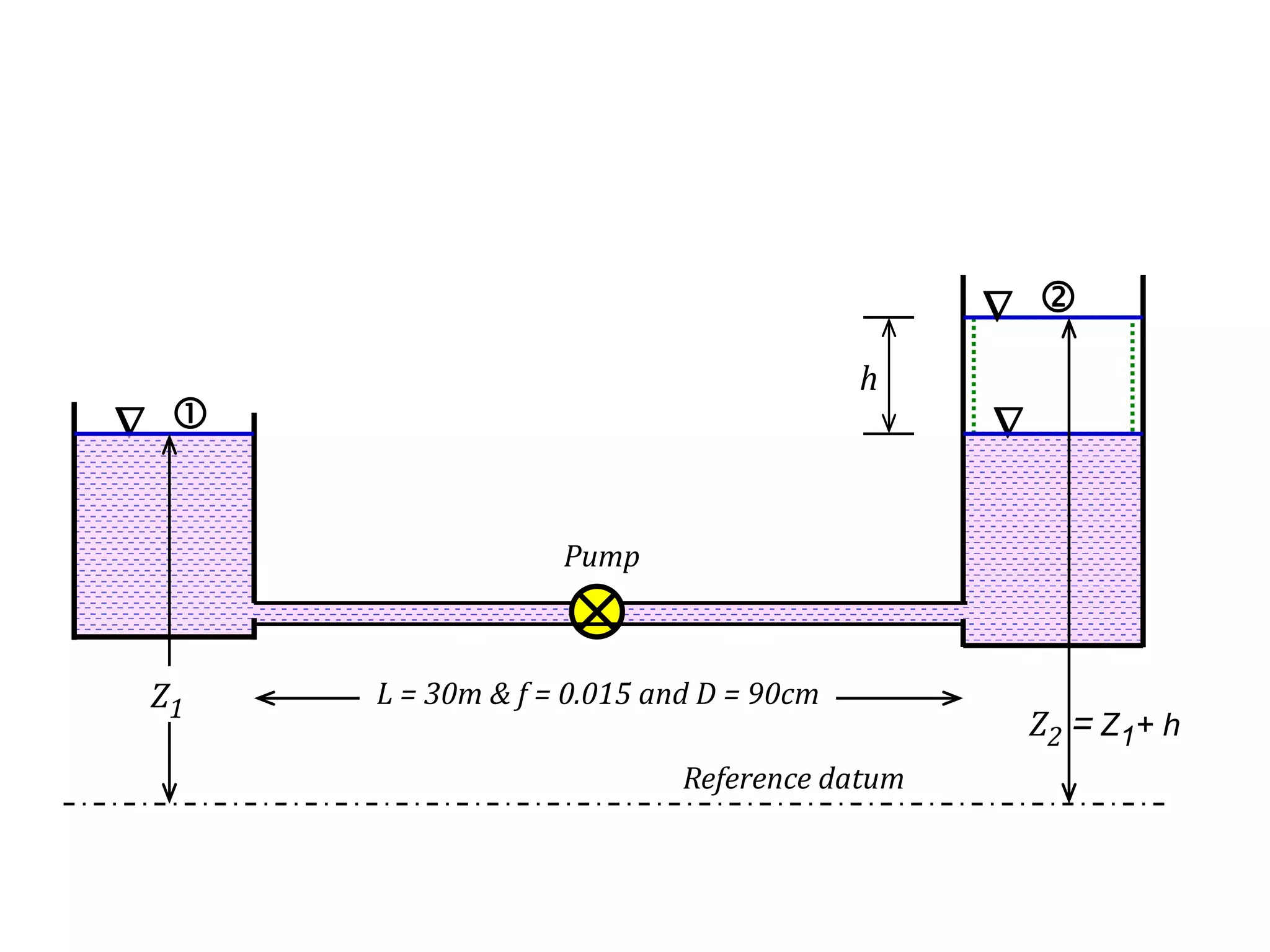
Pump
h

L = 30m & f = 0.015 and D = 90cm


Reference datum
Z2 =Z1+ h
Z1
 
Pump
h

L = 30m & f = 0.015 and D = 90cm


Reference datum
Z2 =Z1+ h
Z1


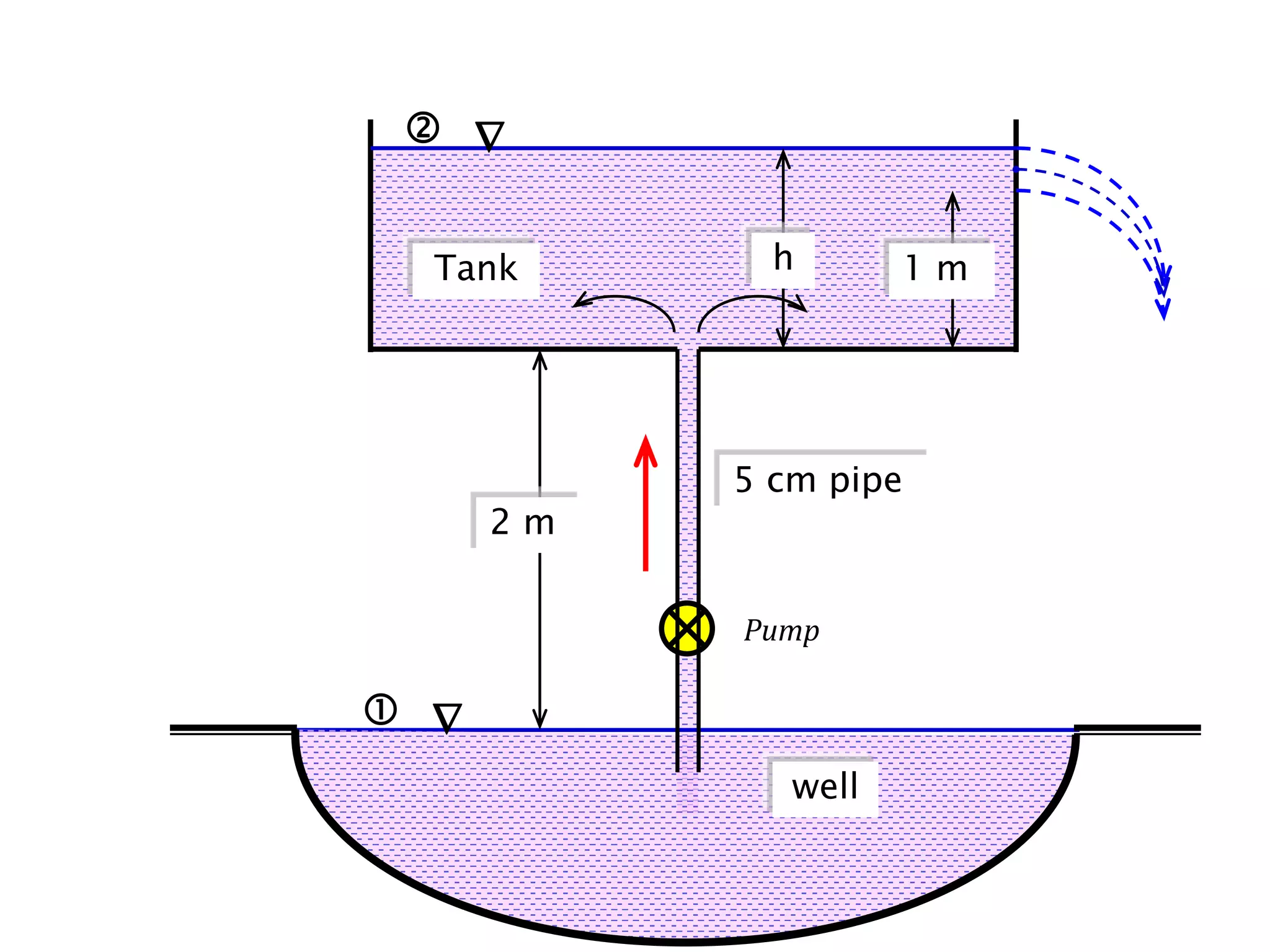
2 m
1 m
h
Pump
5 cm pipe
well
Tank


HR
HT
2 HR


Reservoir
Reservoir
Reservoir
1
3
2
200 m
100 m
100 m 185 m

HGL

Fn



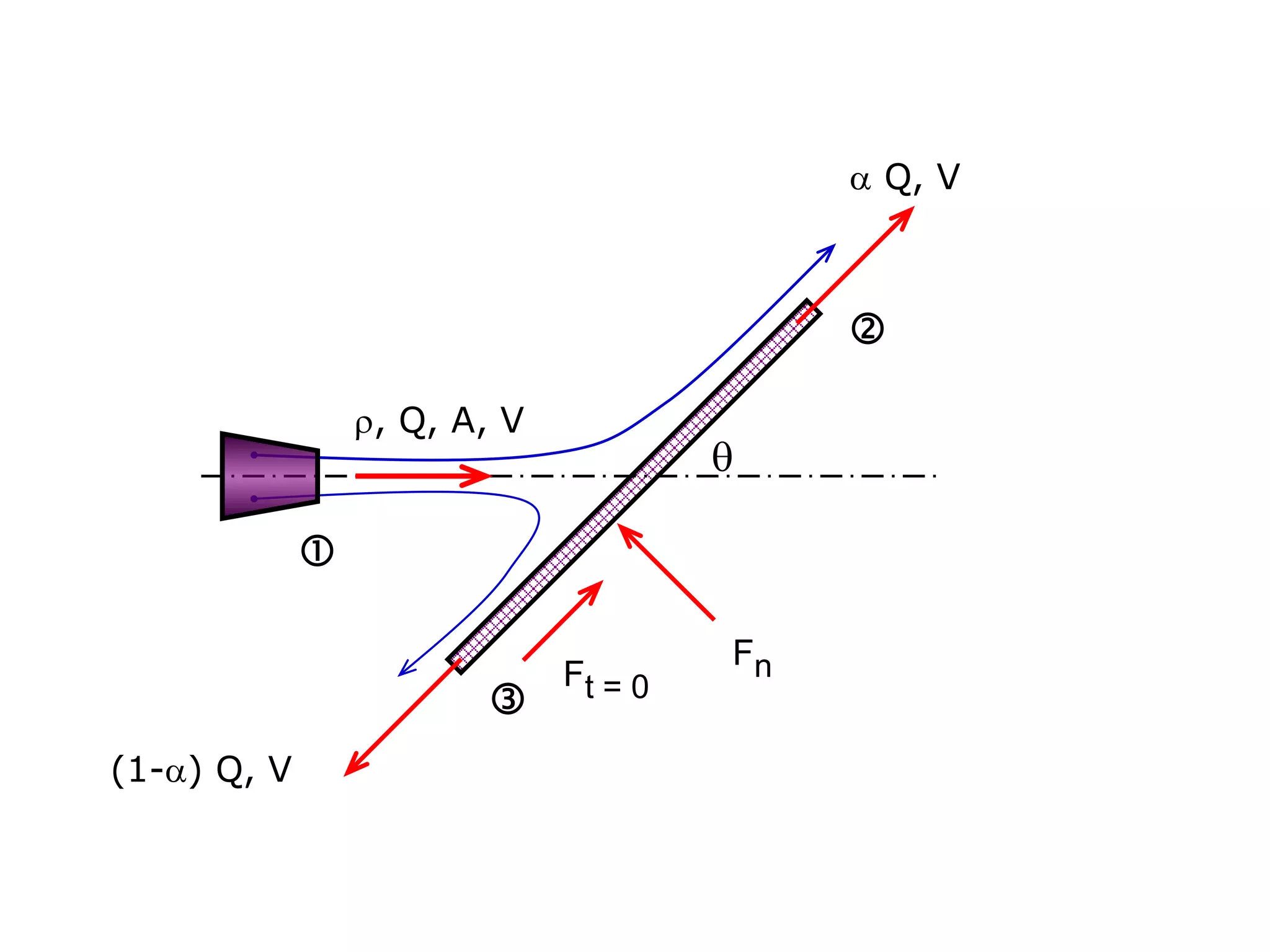
, Q, A, V
 Q, V
(1-) Q, V
Ft = 0

Fn



, Q, A, V
 Q, V
(1-) Q, V
Ft = 0


0.60 m
0.30 m
0.25 cm
 =
90o


H2
0.25 cm
 H2
H1
b
h
b /2
h
 /2
2
tan
h
2
b



dh
2
tan
h
2
)
dh
b
(
dA






dh
Q
50 kpa
Air
3.0 m
1.0 m
 = 60o
Liquid
V1= 14 m/s
Hmax.= ???
A jet of 50 mm dia.



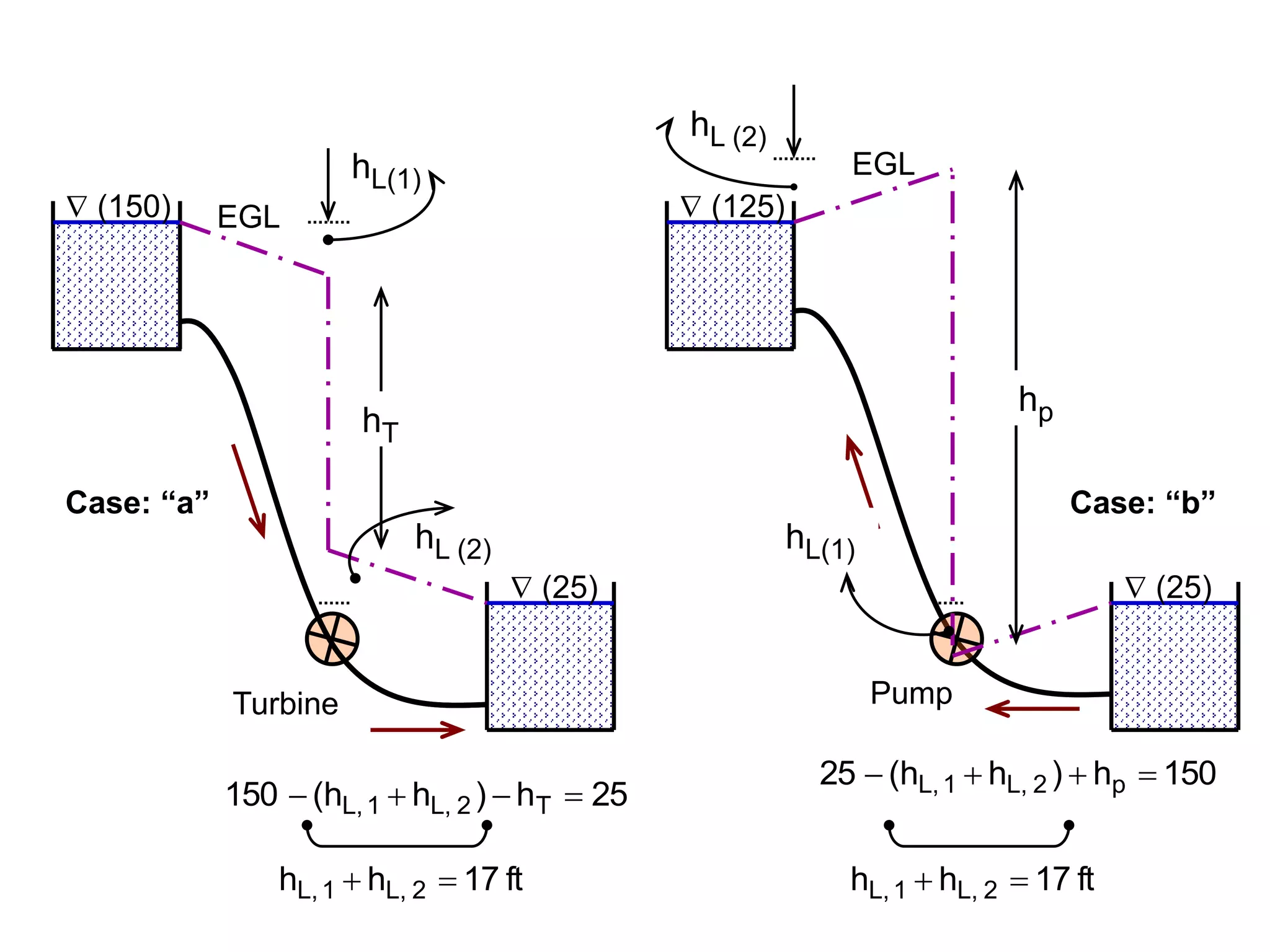
 (125)
 (150)
 (25)  (25)
hT
hL(1)
hL (2)
hL (2)
hp
hL(1)
Pump
Turbine
EGL
EGL
150
h
)
h
h
(
25 p
2
,
L
1
,
L 



25
h
)
h
h
(
150 T
2
,
L
1
,
L 



ft
17
h
h 2
,
L
1
,
L 
 ft
17
h
h 2
,
L
1
,
L 

Case: “a” Case: “b”
 (150)
 (25)
Pump-Turbine


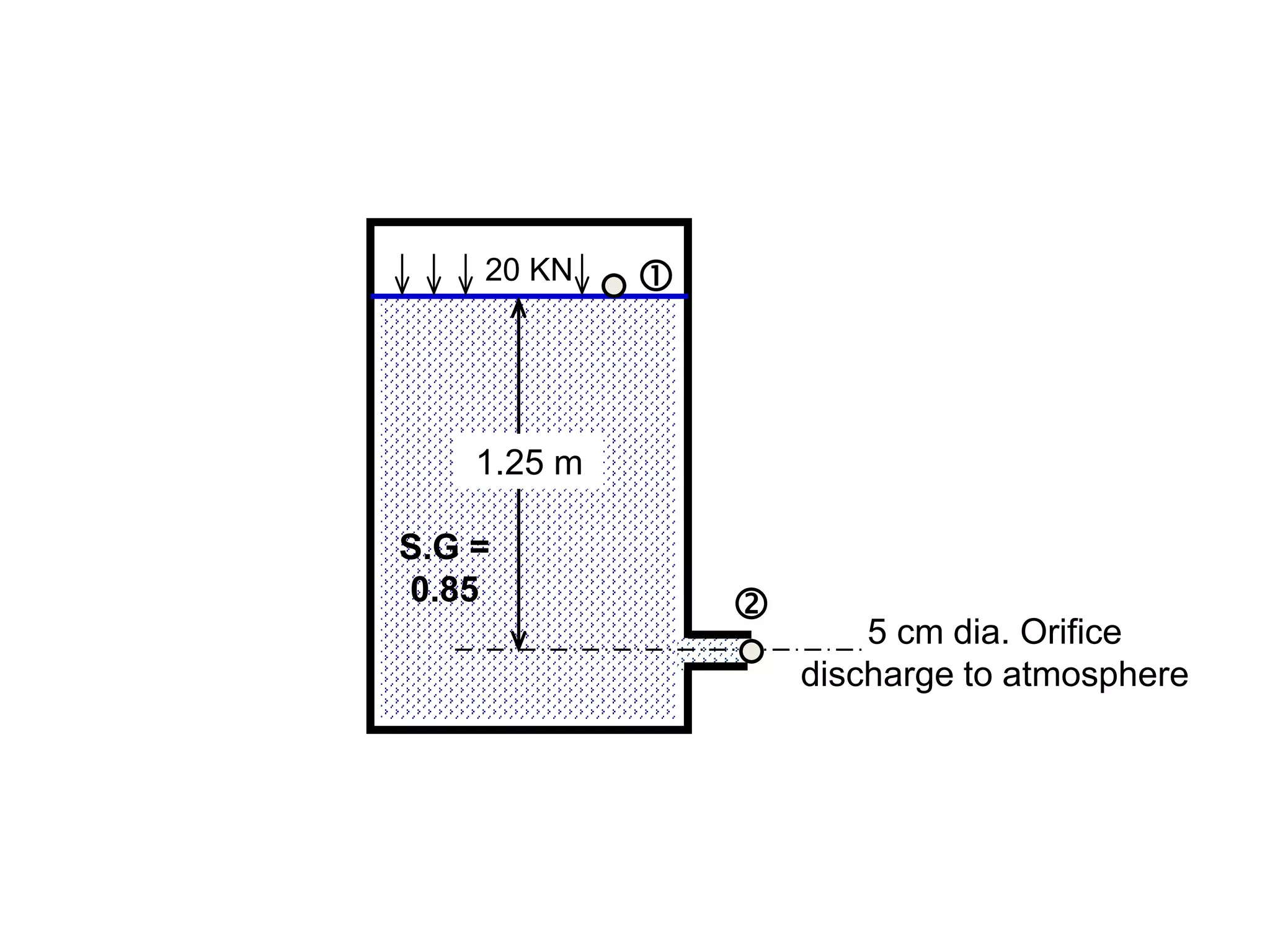
20 KN
1.25 m
S.G =
0.85
5 cm dia. Orifice
discharge to atmosphere


 


4 ft
h
4-in thin walled tubing
6-in
Pump
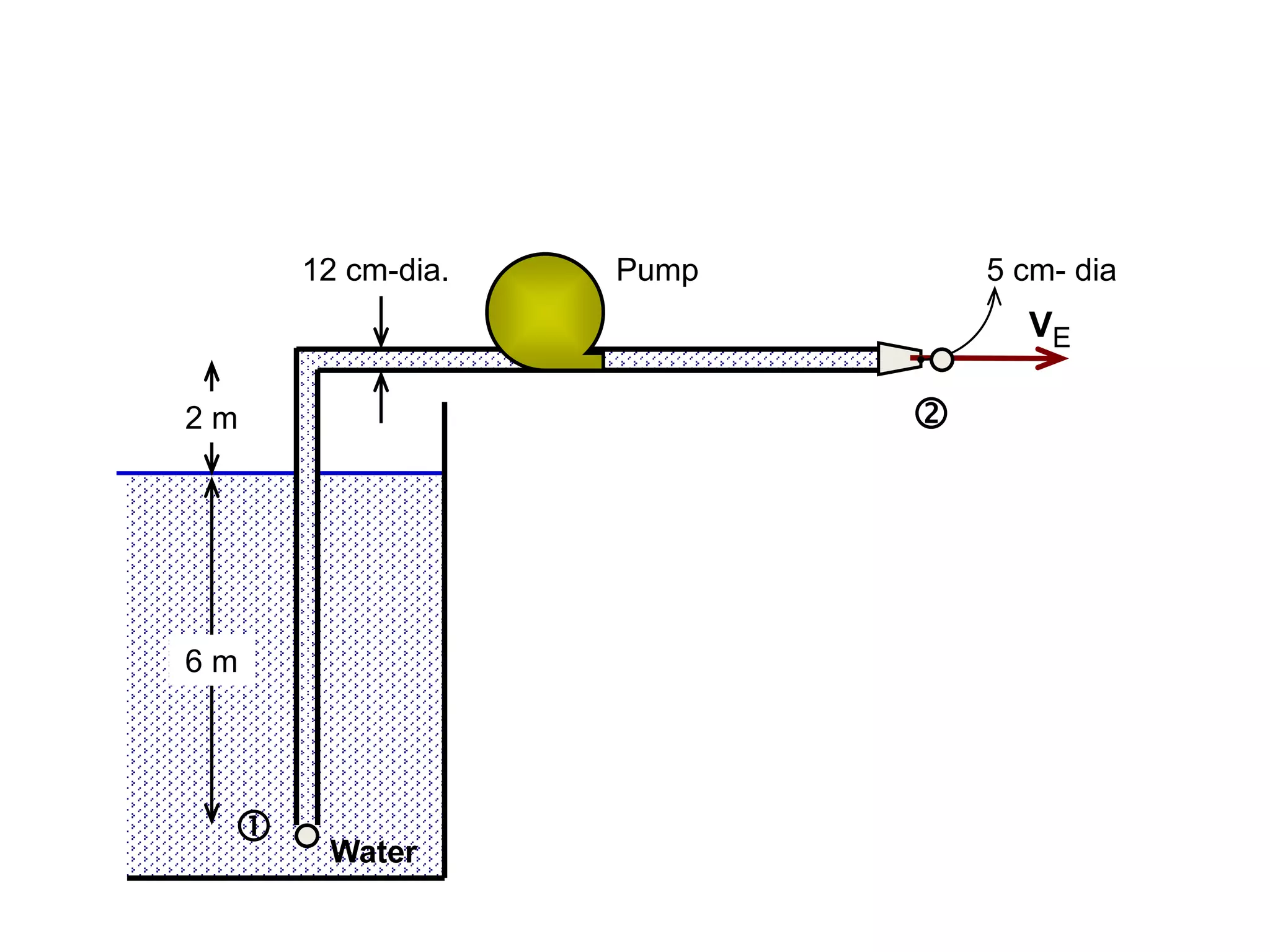
2 m
6 m
VE
12 cm-dia. 5 cm- dia
Water


dA = 0.03 m
Q
hA =???
hB =2 m
A
B
dB = 0.05 m

6.0 m
2.0 m
8.0 m
a
b
c
d
'
o
1
52
36
8
6
tan 







 
6.0 m
2.0 m
8.0 m
a
b
c
d

'
o
43
24


e
y
F
t
F
X
F
s
/
m
40
.
0
Q
and
m
1000
L
,
cm
30
D
:
A
pipe 3



m
3000
L
,
cm
30
D
:
B
pipe 

dz
dy
dx
g

x
Z
y
dy
dx
2
y
y
P
P 







 




dy
dx
2
y
y
P
P 







 




)
z
,
y
,
x
(
P
x
d
y
d
z
d
dx
dy
dz
z
x
y
dz
dy
p
dz
dy
dx
x
p
p 











x
y
z
dz
dy
p z
x
2
dy
y
p
p 













j
i
k
y
x
2
dz
z
p
p 













y
x
2
dz
z
p
p 













150 ft
100 ft
0.00 ft
L
=
1
0
0
0
f
t
&
D
=
1
0
i
n
.
L
=
4
0
0
0
f
t
&
D
=
8
i
n
.
L= 5000 ft & D=12 in.
 (150 ft)
 (100 ft)
 (50 ft)
g
az 

h
Z
g
az 
h
Z
1
p 1
p
1
2 p
p  h
g
2
p
p 1
2 


Density  Density 
Free Fall
of a Liquid az = - g
Upward Acceleration
of a Liquid az = + g
Free Fall of a Fluid Body
Fig. ( ) - The Effect of Acceleration on the Pressure of a Liquid
During Free Fall and Upward Acceleration
az  0 az  0
 g h  g h
h
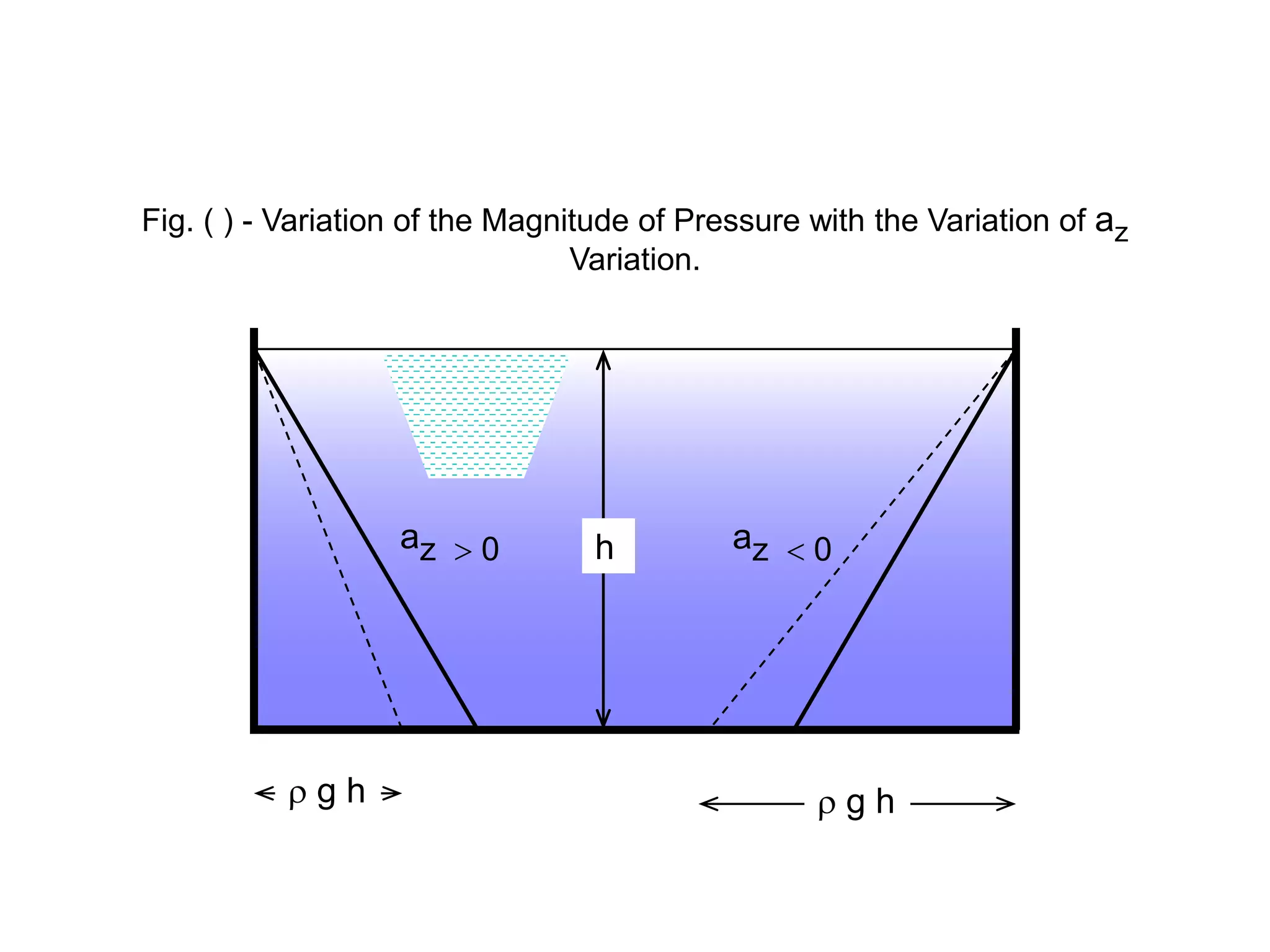
Fig. ( ) - Variation of the Magnitude of Pressure with the Variation of az
Variation.
g
aZ 
y
a
.
const
p1
.
const
p2
.
const
p3
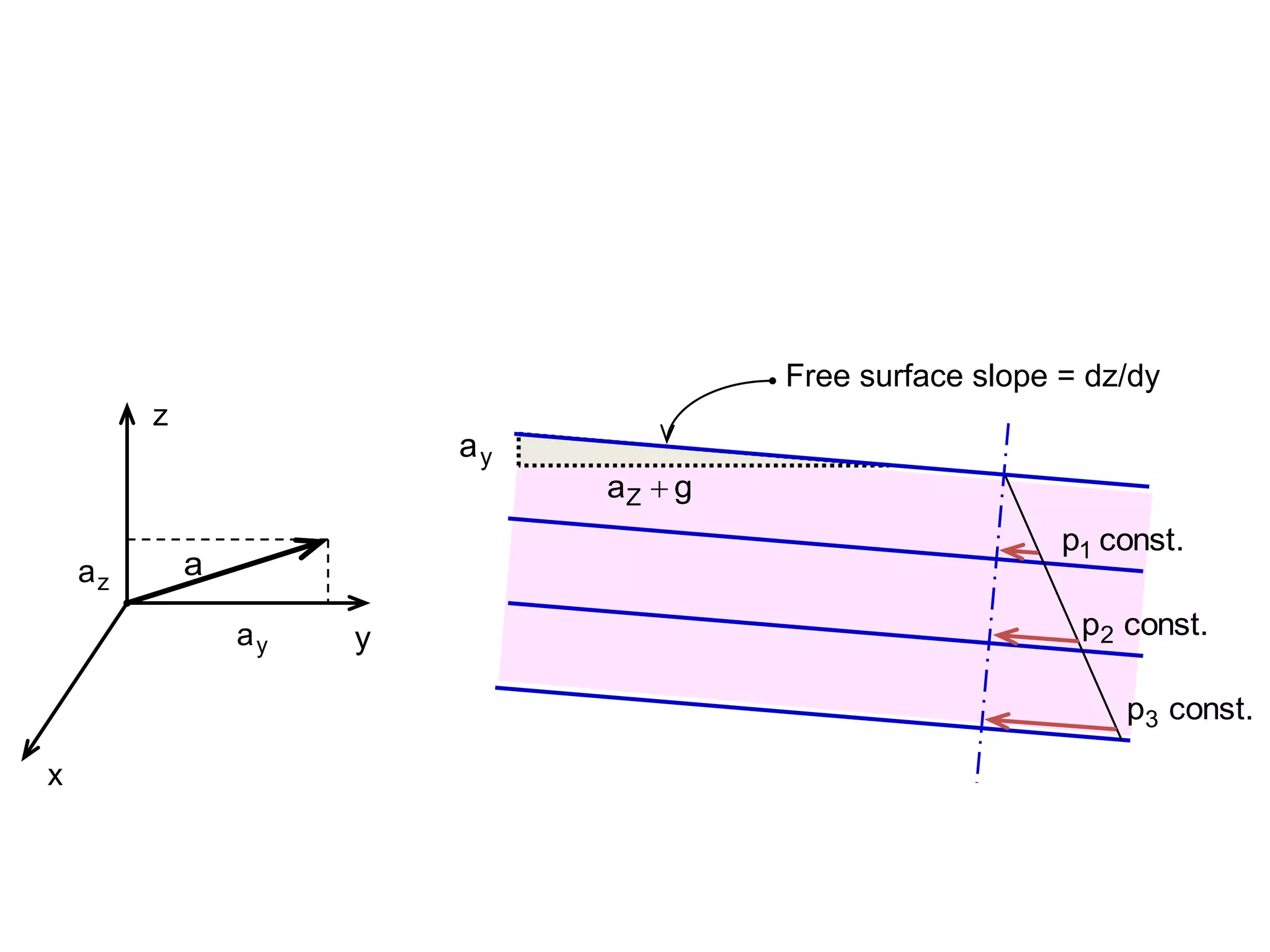
Free surface slope = dz/dy
y
x
z
y
a
z
a a
2
r r
a 

Still Water Level

r
Axis of rotation
R
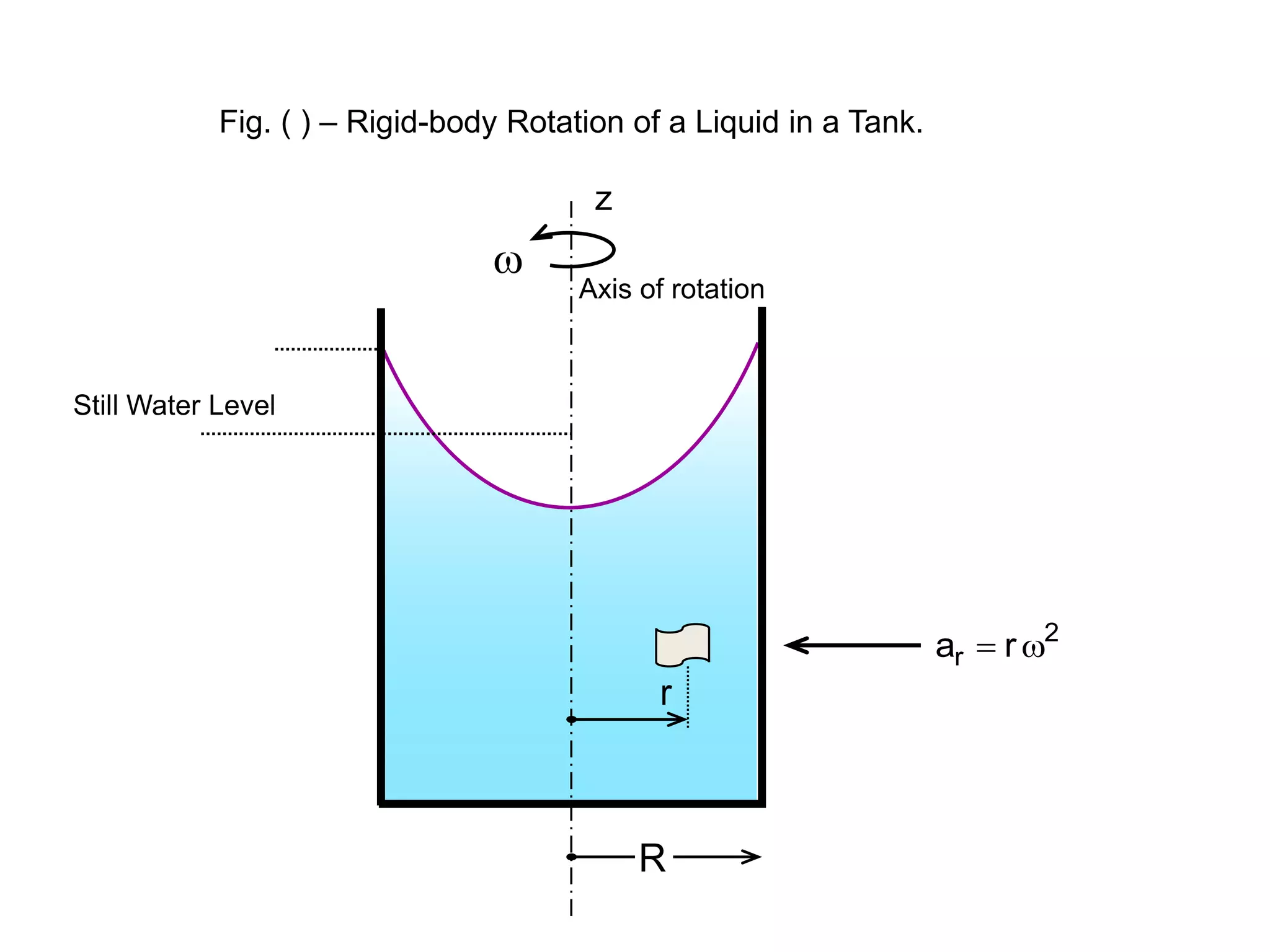
Fig. ( ) – Rigid-body Rotation of a Liquid in a Tank.
z

r
.
const
p1
.
const
p2
.
const
p3
z
.
const
p4
g
2
/
r2
2

Axis of rotation
2
2
max r
g
2
z 



h
R
2
Volume 2


g
2
R
h
2
2


2
h
2
h
Still Water Level

R
Axis of rotation
Rotation
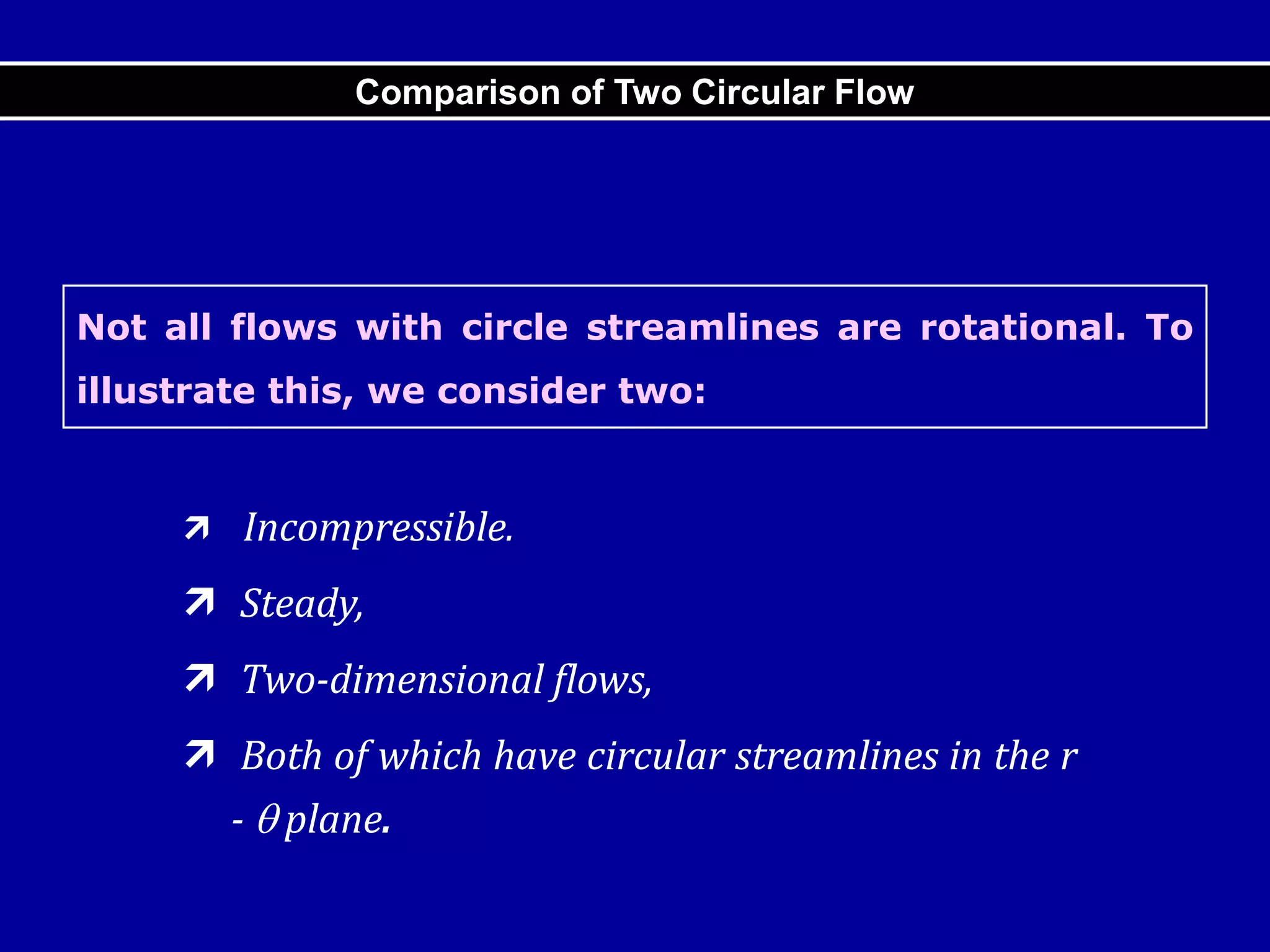
Not all flows with circle streamlines are rotational. To
illustrate this, we consider two:
 Incompressible.
 Steady,
 Two-dimensional flows,
 Both of which have circular streamlines in the r
-  plane.
Comparison of Two Circular Flow
Free Vortex: A free vortex approximates to naturally occurring
circular flows (e.g. circumferential component of the flow
down a drain hole or round a river bend) in which there is no
source of energy.
Forced Vortex: A forced vortex is a circular motion
approximating to the pattern generated by the action of a
mechanical rotor on a fluid. The rotor forces the fluid to
rotate at uniform rotational speed  rad/sec, so V =  r. A
forced vortex is a rotational flow.
Comparison of Two Circular Flow
Flow “A”: Vr = 0 and V = c/r (ii)
We have to note that:
 The “bathtub vortex” formed when water drains through a
bottom hole in a tank, is a good approximation to the free
vortex.
Comparison of Two Circular Flow
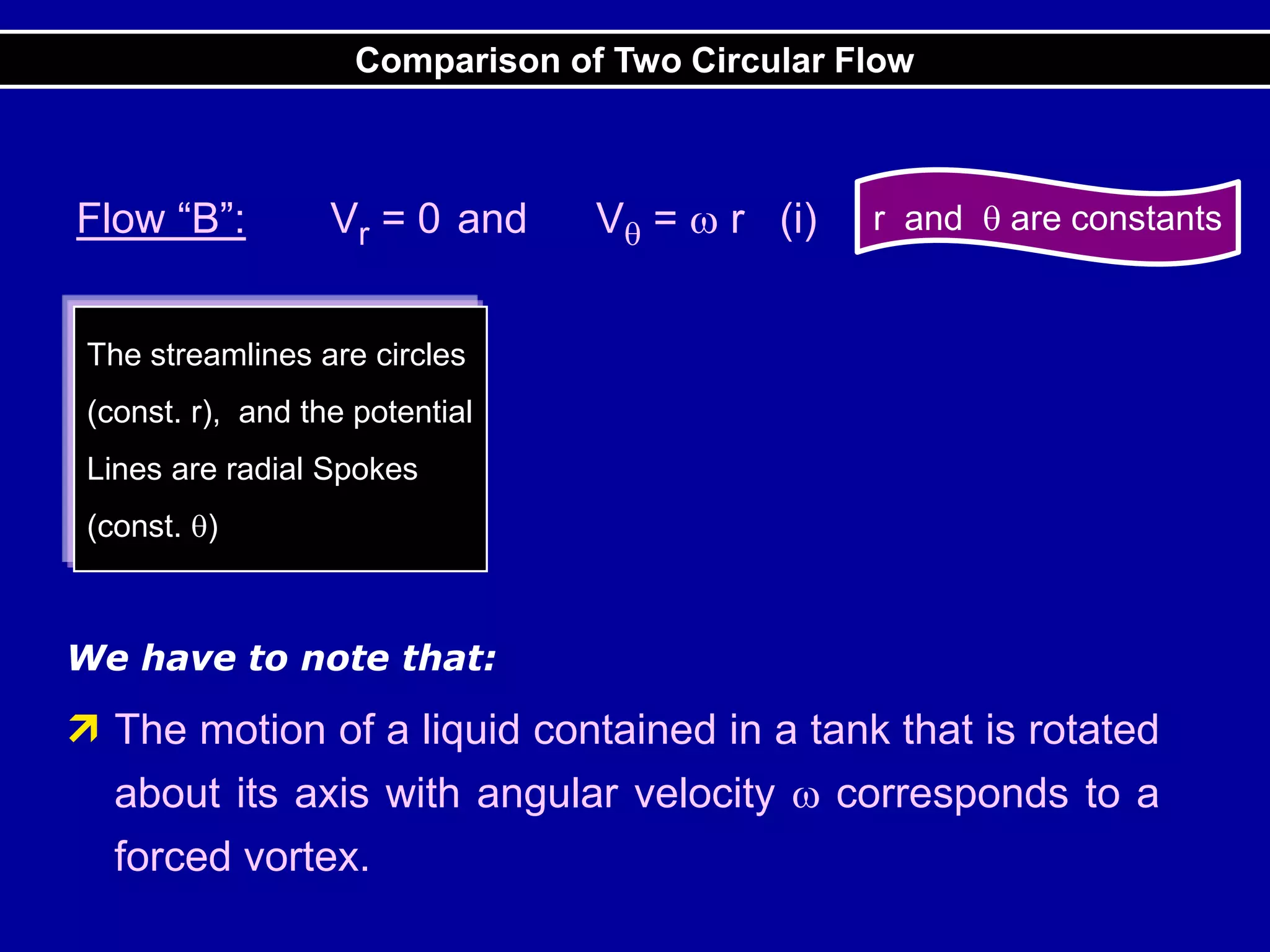
r and  are constants
The streamlines are circles
(const. r), and the potential
Lines are radial Spokes
(const. )
Flow “B”: Vr = 0 and V =  r (i)
We have to note that:
 The motion of a liquid contained in a tank that is rotated
about its axis with angular velocity  corresponds to a
forced vortex.
Comparison of Two Circular Flow
r and  are constants
The streamlines are circles
(const. r), and the potential
Lines are radial Spokes
(const. )

 Solid lines are streamlines,
 Dashed lines are potential lines
Streamlines
Potential lines

Fig. ( ) – Velocity distribution in a Forced Vortex.
Forced Vortex.
V =  r


V
r
Fig. ( ) – Velocity distribution in a Free Vortex.
Free Vortex.
V = c / r
120 ft
Submersible
pump Well
air
P =
40 psi (gage)
Storage tank
“1”
“2”
Reference datum
s
/
ft
028
.
0
449
1
60
745
Q
discharge
The 3



Applying the energy equation (Bernoulli’s eq. ) between the points identified
as “1” and “2” in the shown figure, we have
2
2
L
p
1
2
g
2
V
g
p
z
h
h
g
2
V
g
p
z

























For the given condition, p1= pamt = 0, V1 = V2  0 and taking the water
surface at the well as a reference datum (Z1=0 & Z2 = 120 ft ), the above
equation gives
 0
 0
  















 0
2
.
32
94
.
1
12
40
120
50
.
10
h
0
0
0
2
p
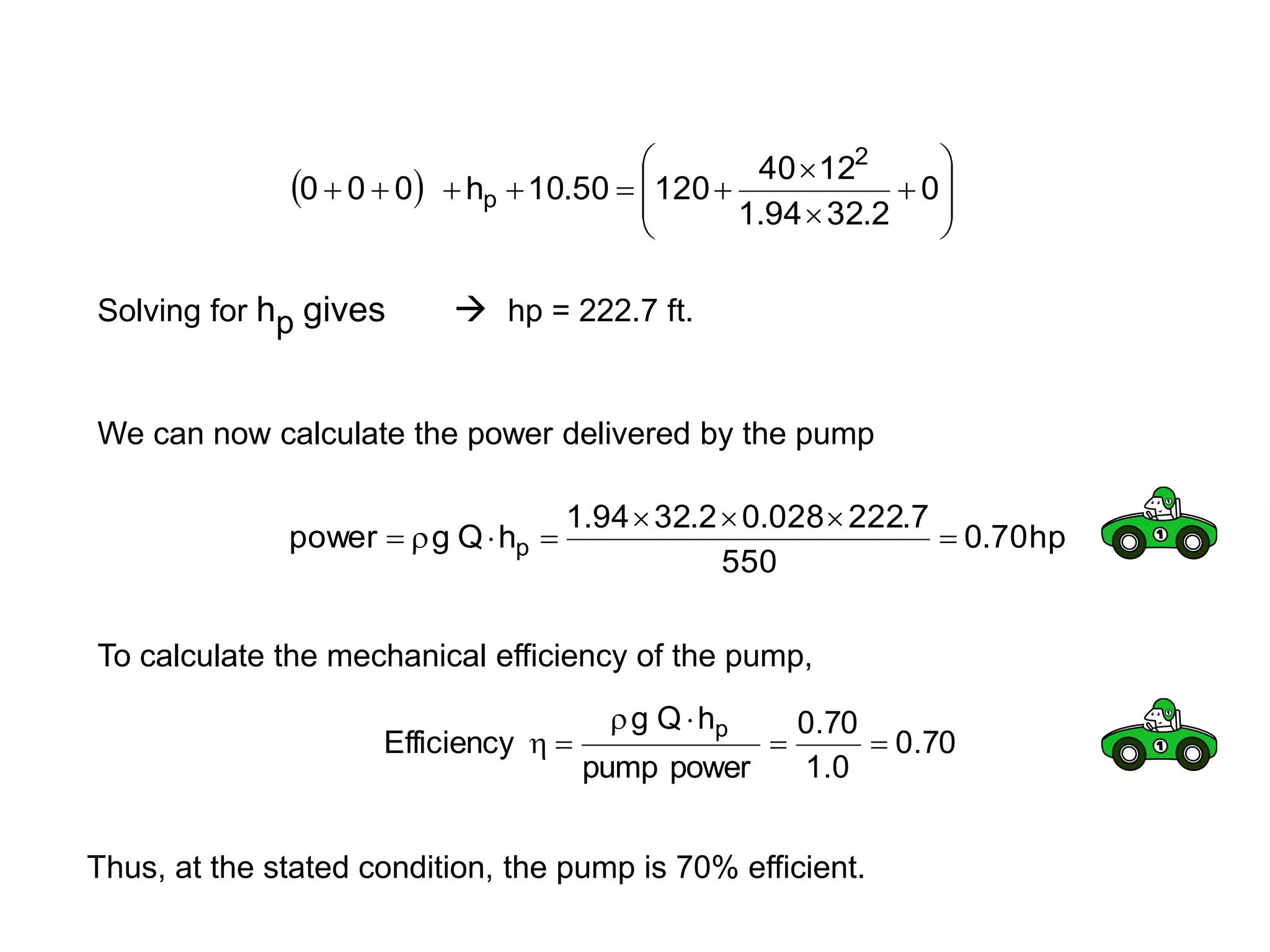
Solving for hp gives  hp = 222.7 ft.
We can now calculate the power delivered by the pump
hp
70
.
0
550
7
.
222
028
.
0
2
.
32
94
.
1
h
Q
g
power p 







To calculate the mechanical efficiency of the pump,
70
.
0
0
.
1
70
.
0
power
pump
h
Q
g
Efficiency
p






Thus, at the stated condition, the pump is 70% efficient.
D d D
1 2
Constriction
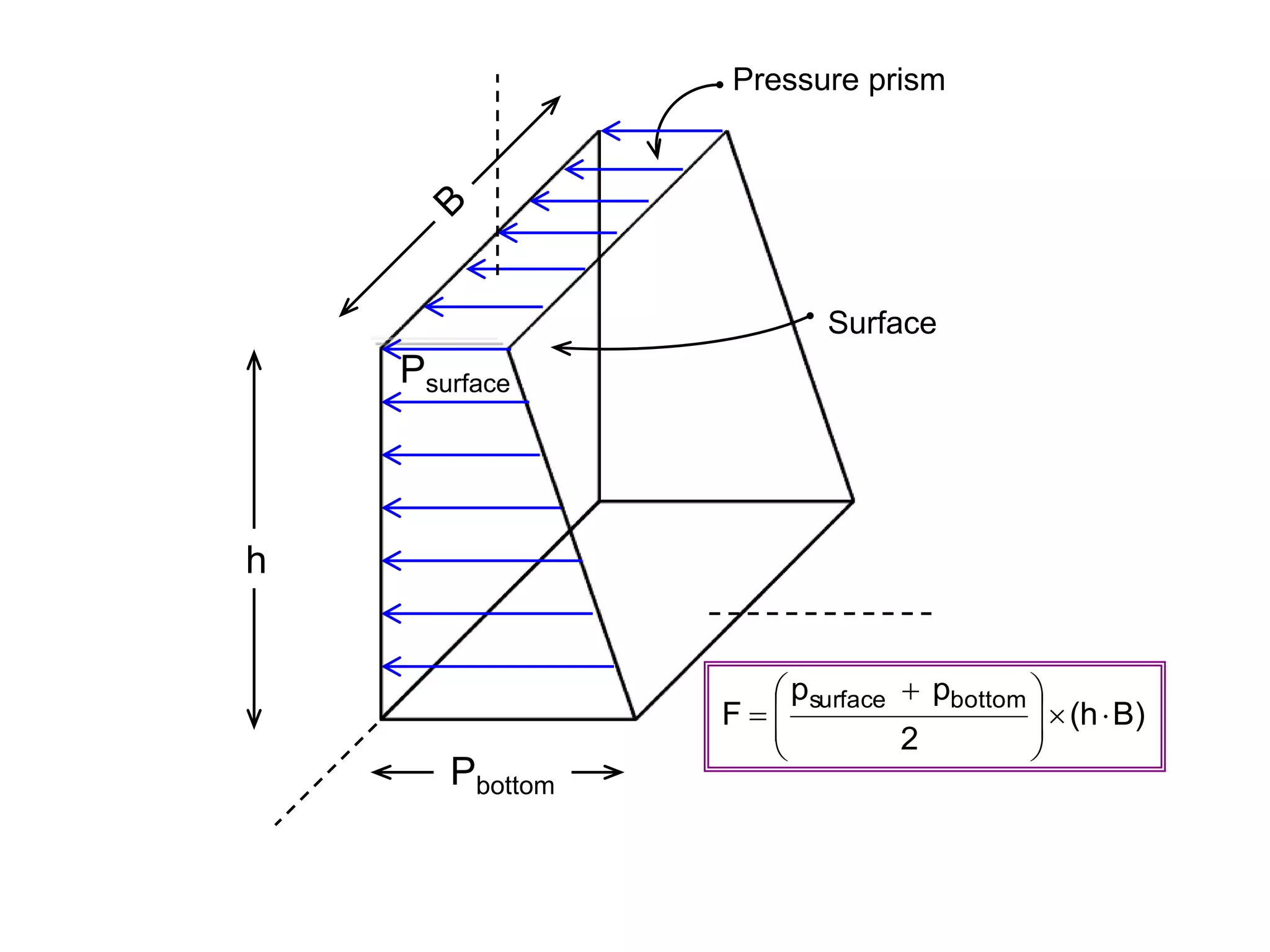
Psurface
h
Pbottom
Pressure prism
Surface
)
B
h
(
2
p
p
F
bottom
surface









 

F
h
c.p
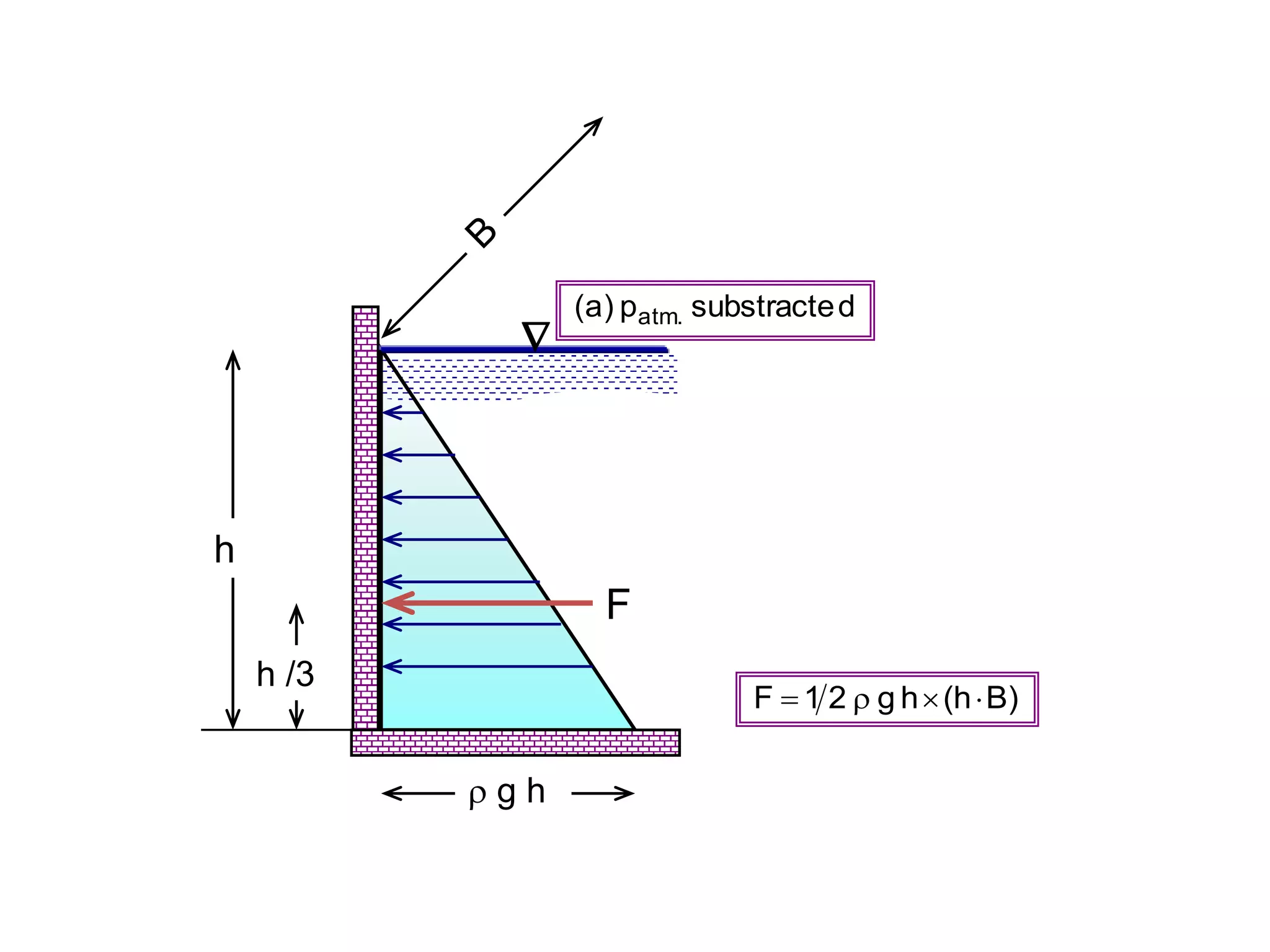
 g h
h /3
)
B
h
(
h
g
2
1
F 



F
h
 g h
h /3
)
B
h
(
h
g
2
1
F 




d
substracte
p
)
a
( .
atm
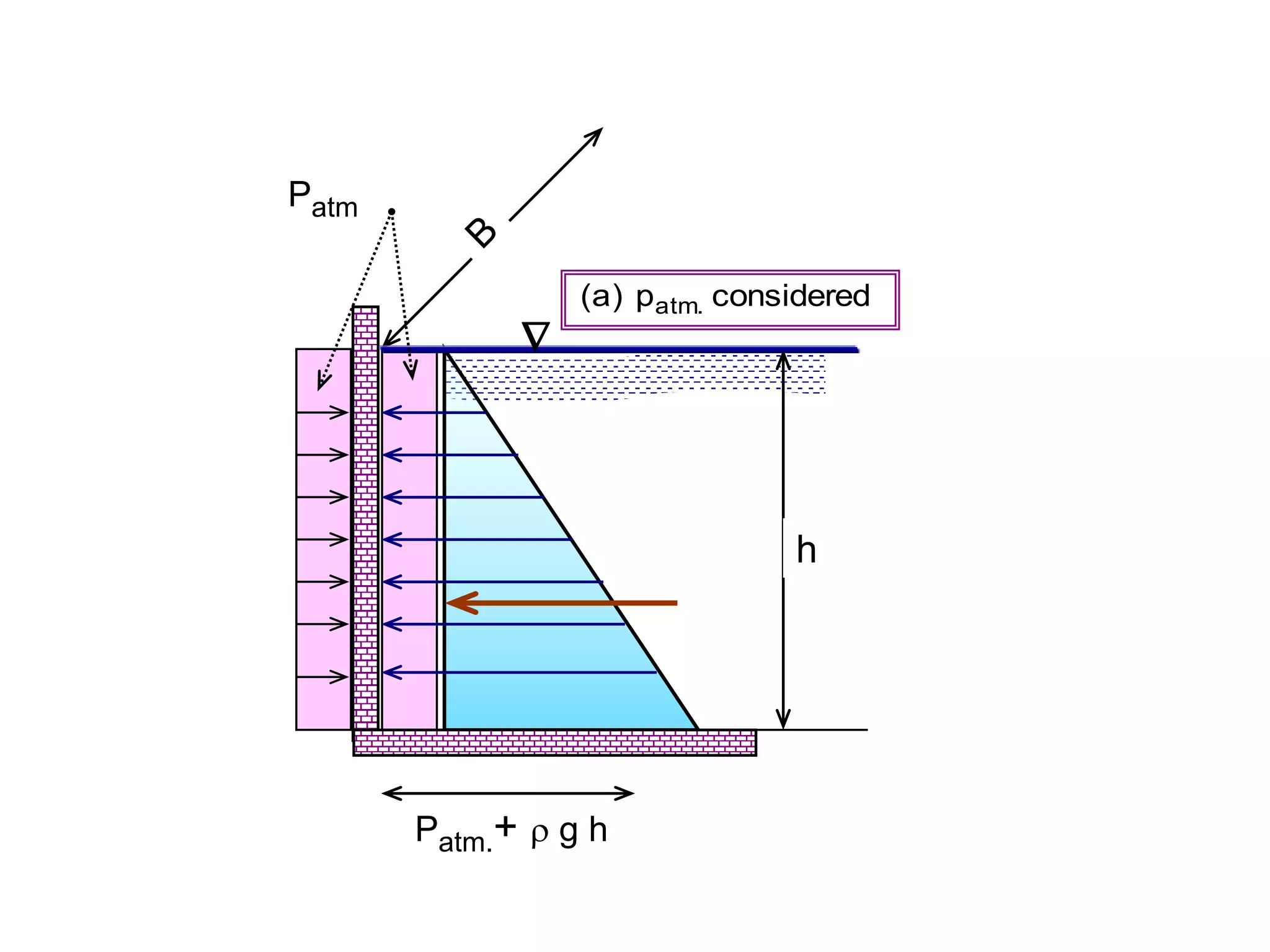
Patm.+  g h
h

considered
p
)
a
( .
atm
Patm
1
1
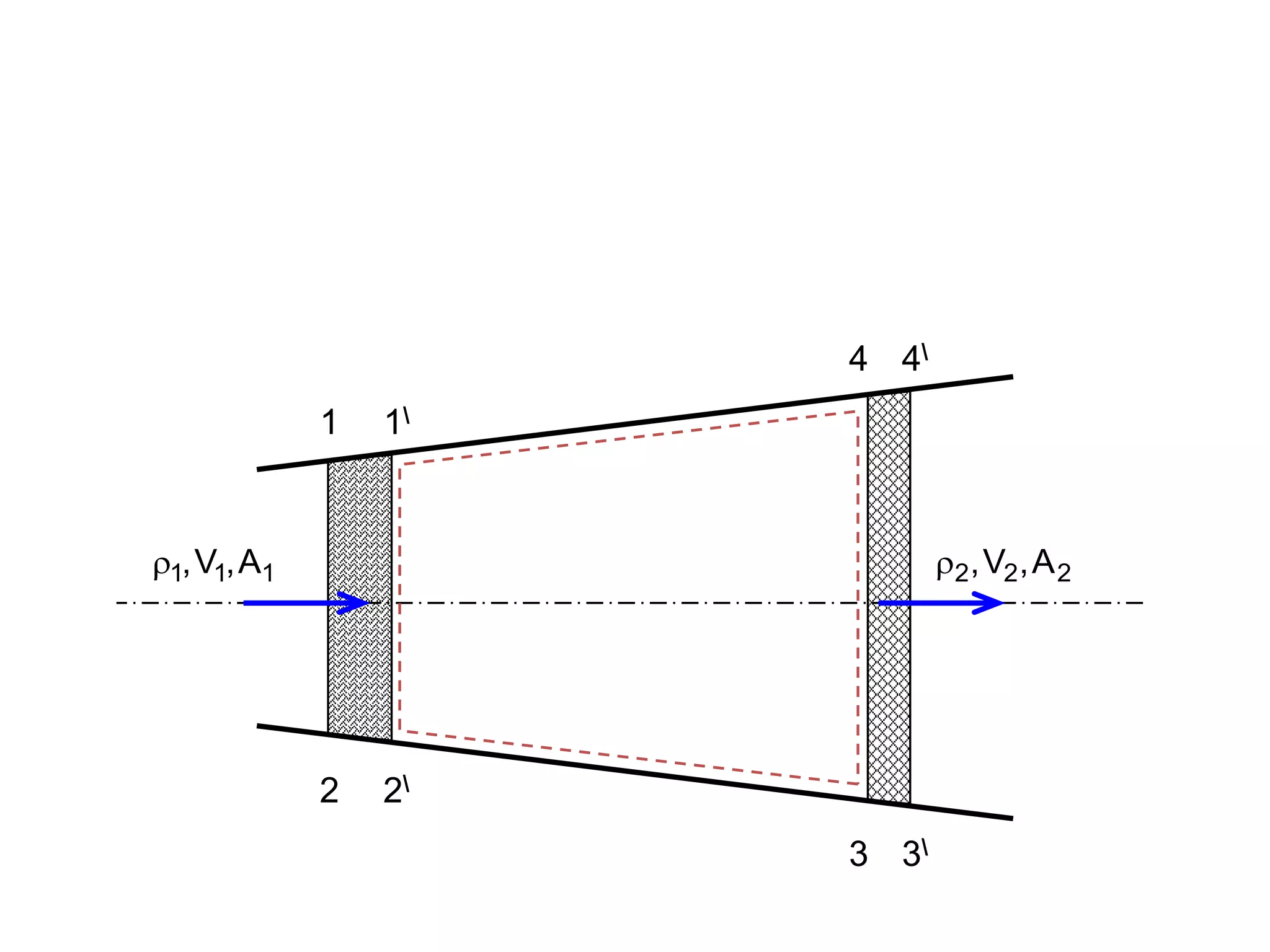
1 A
,
V
,
 2
2
2 A
,
V
,

1 1
2 2
4
4
3
3

x
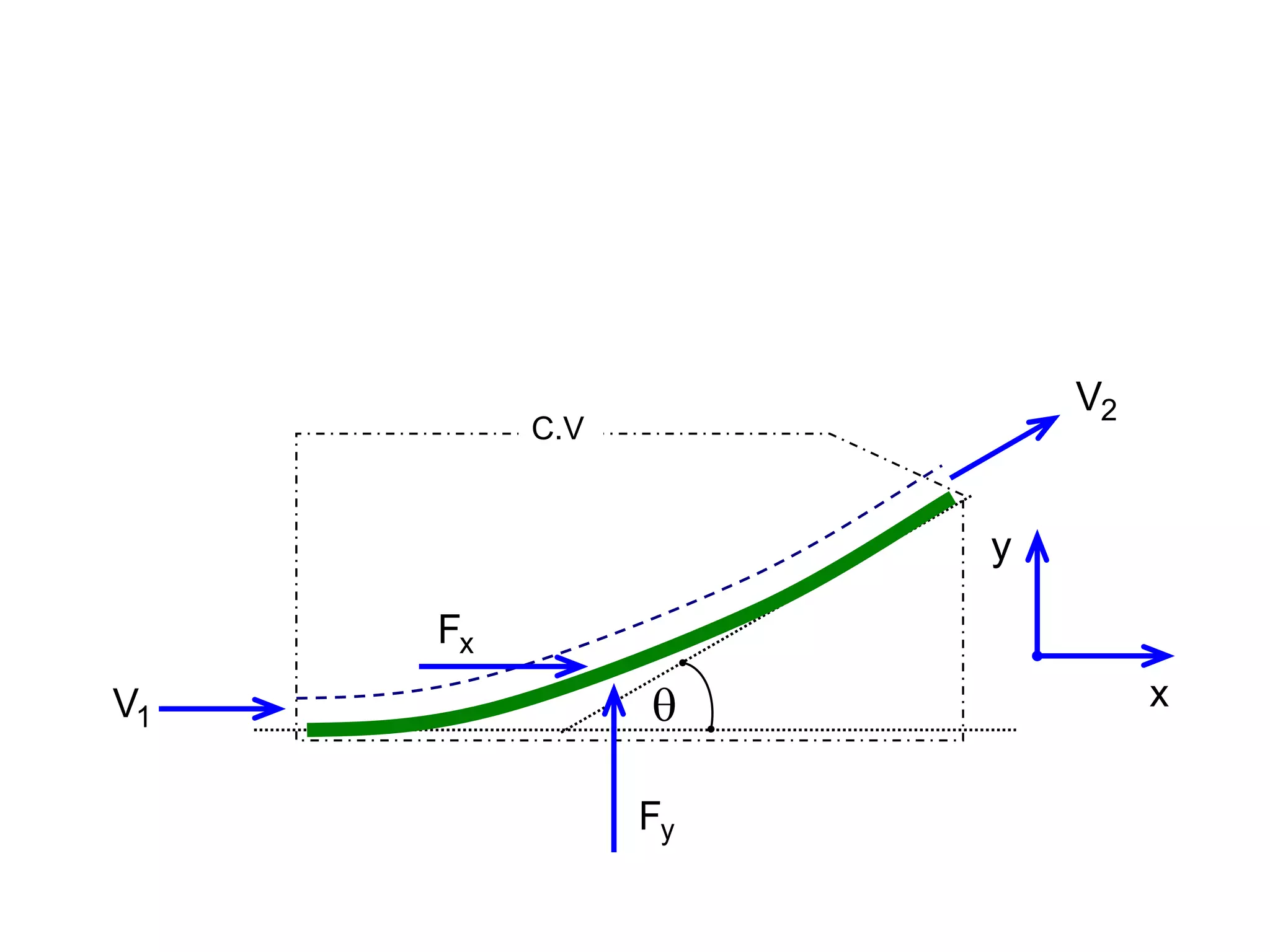
F
y
F
1
V
2
V
x
y
C.V
C.V
x
y
1
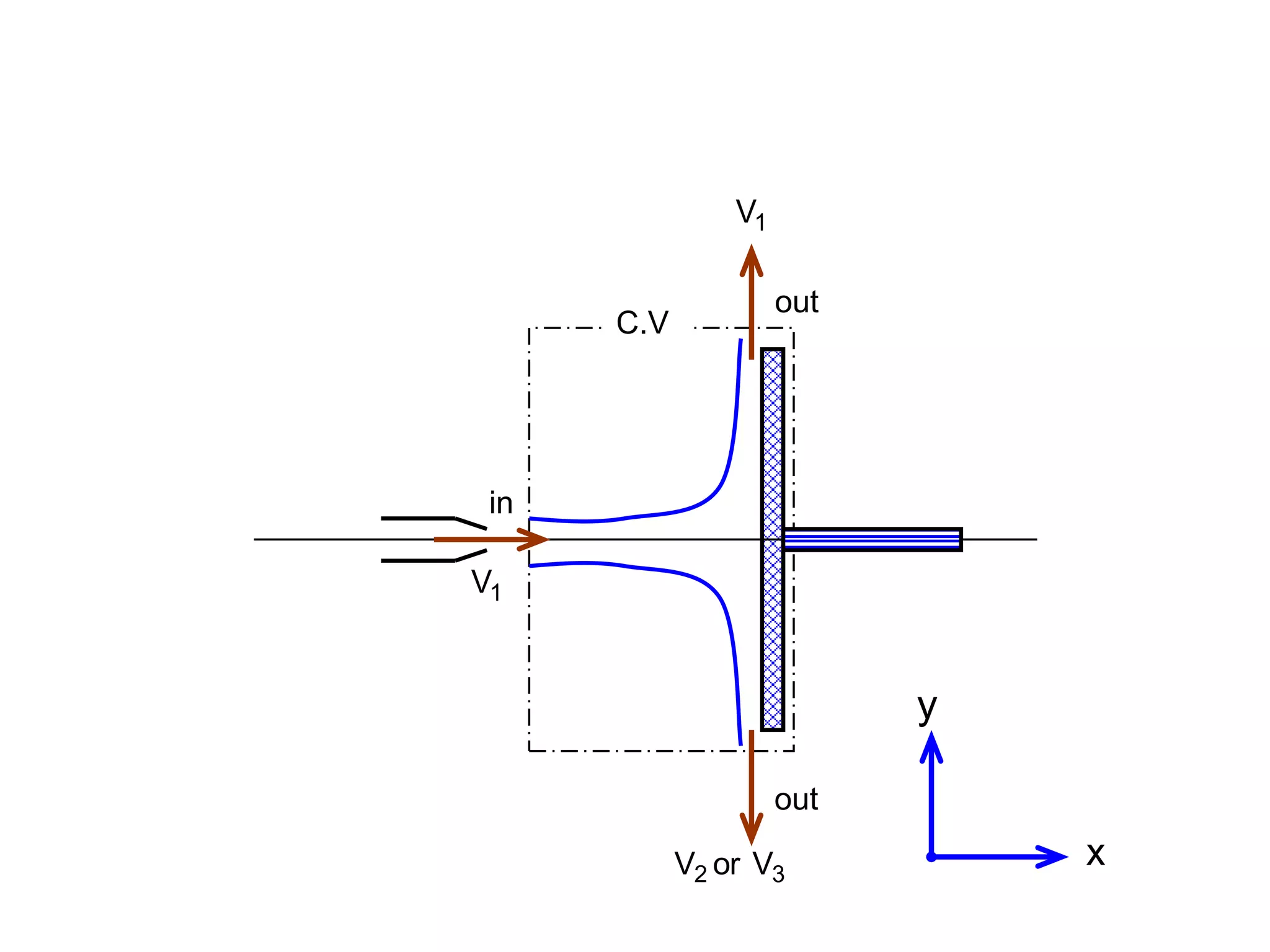
V
1
V
3
2 V
or
V
in
out
out
1
y
2
y
C.V
2
y
g

F2
 
w

1
V
2
V


x
y
1
y
1
V

2
y

2
V
G
F
 
x
y
C.V
C.V
1
y
1
V

G
F
x
y
C.V
1
y
g



1
V
2
V
2
P
1
P
C.V
x
y
x
F
y
F



1
P
2
P
2
V
1
V
Q
y
x
x
F
y
F
C.V

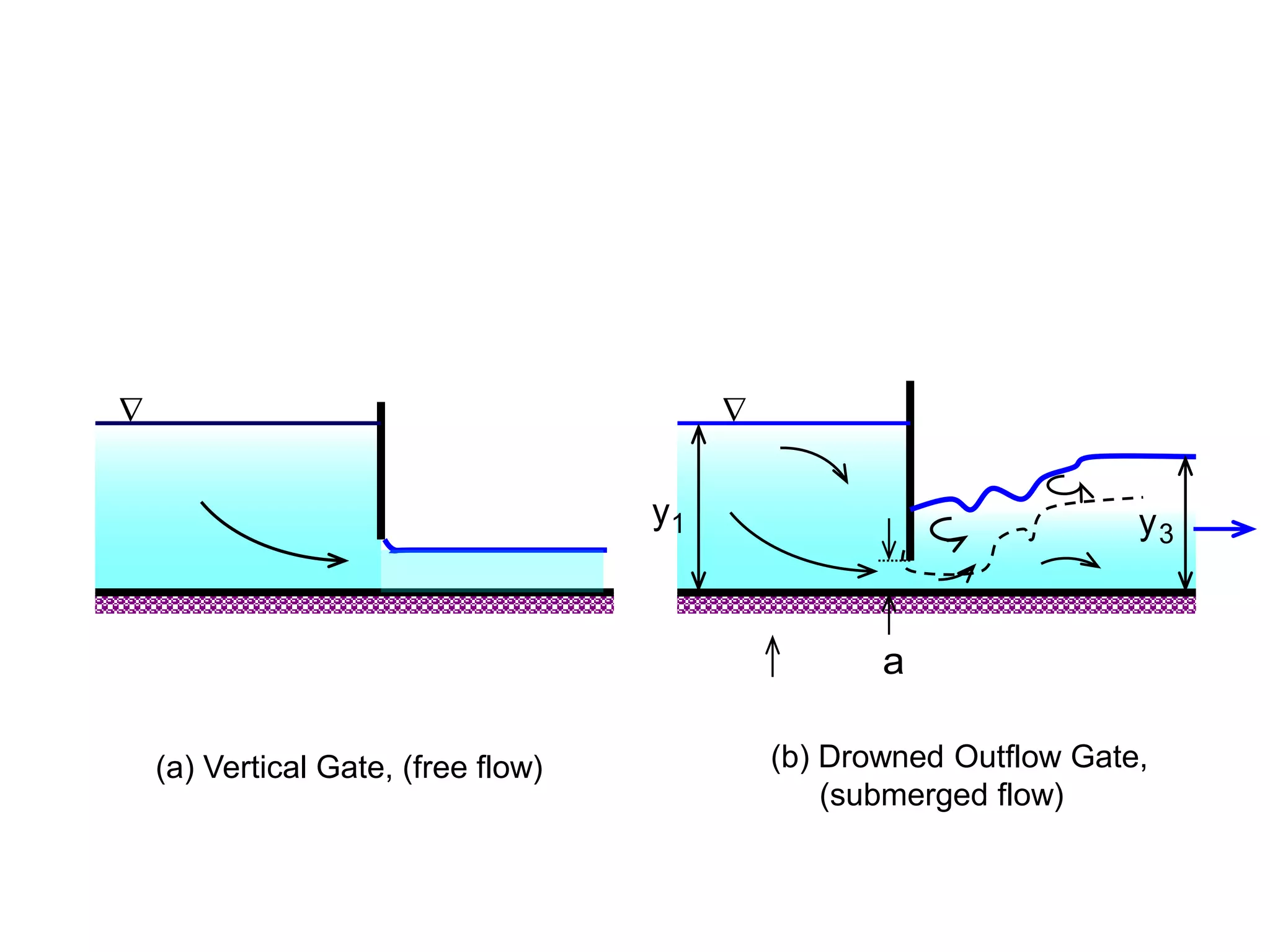
a
(b) Drowned Outflow Gate,
(submerged flow)
(a) Vertical Gate, (free flow)
 
1
y
3
y


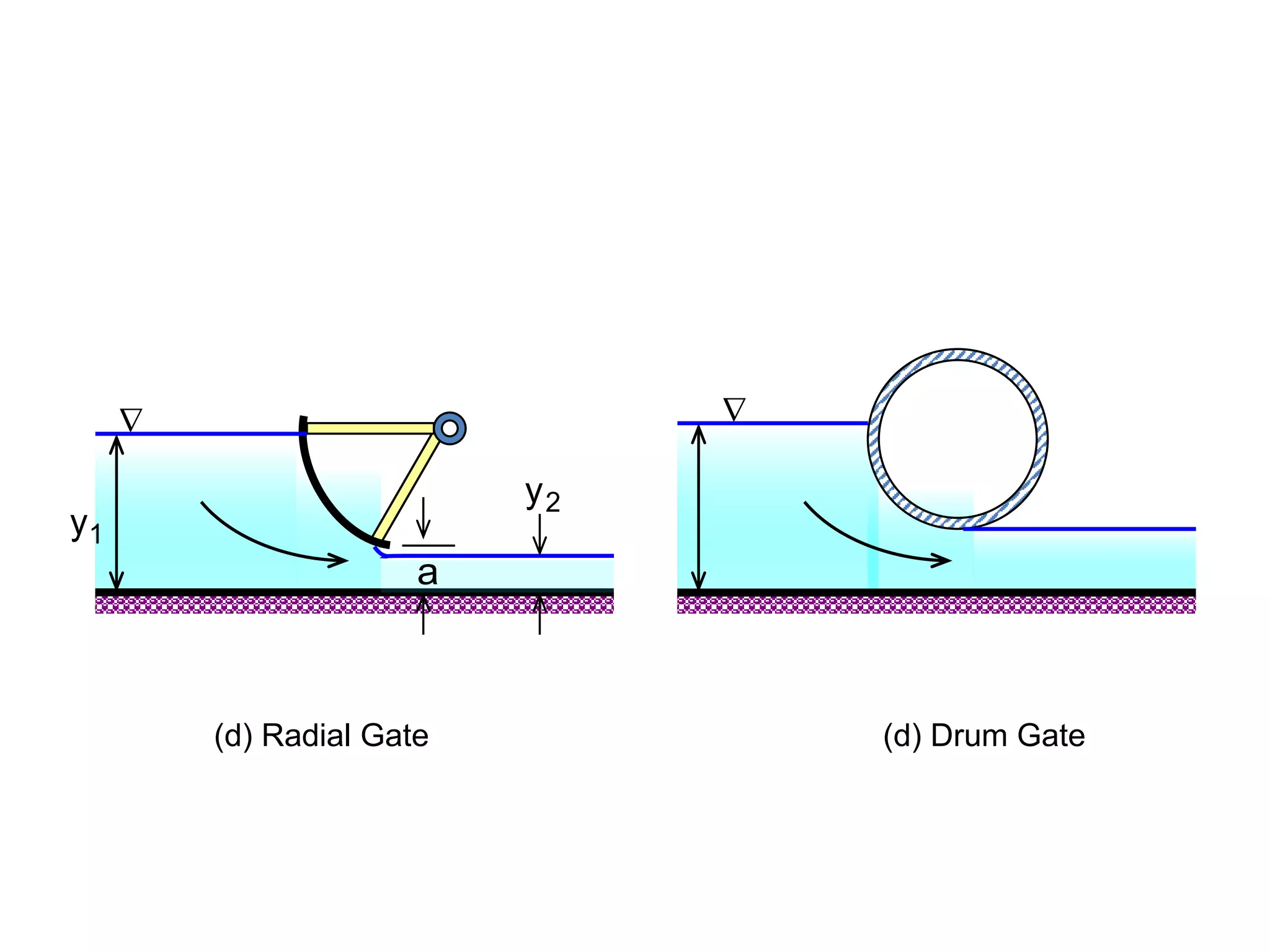
(d) Drum Gate
(d) Radial Gate
1
y
2
y
a

B
Weir plate
Channel
wall
Weir plate
Channel
wall


Weir plate
Channel
wall

0
dy/dx
Fr
1.0 1.5 2.0
0.5
SE < So
SE > So
SE = So
The shown figure is valid for
channels of any constant cross-
sectional shape, provided the
Froude number is interpreted.
2
r
o
E
F
1
S
S
dx
dy



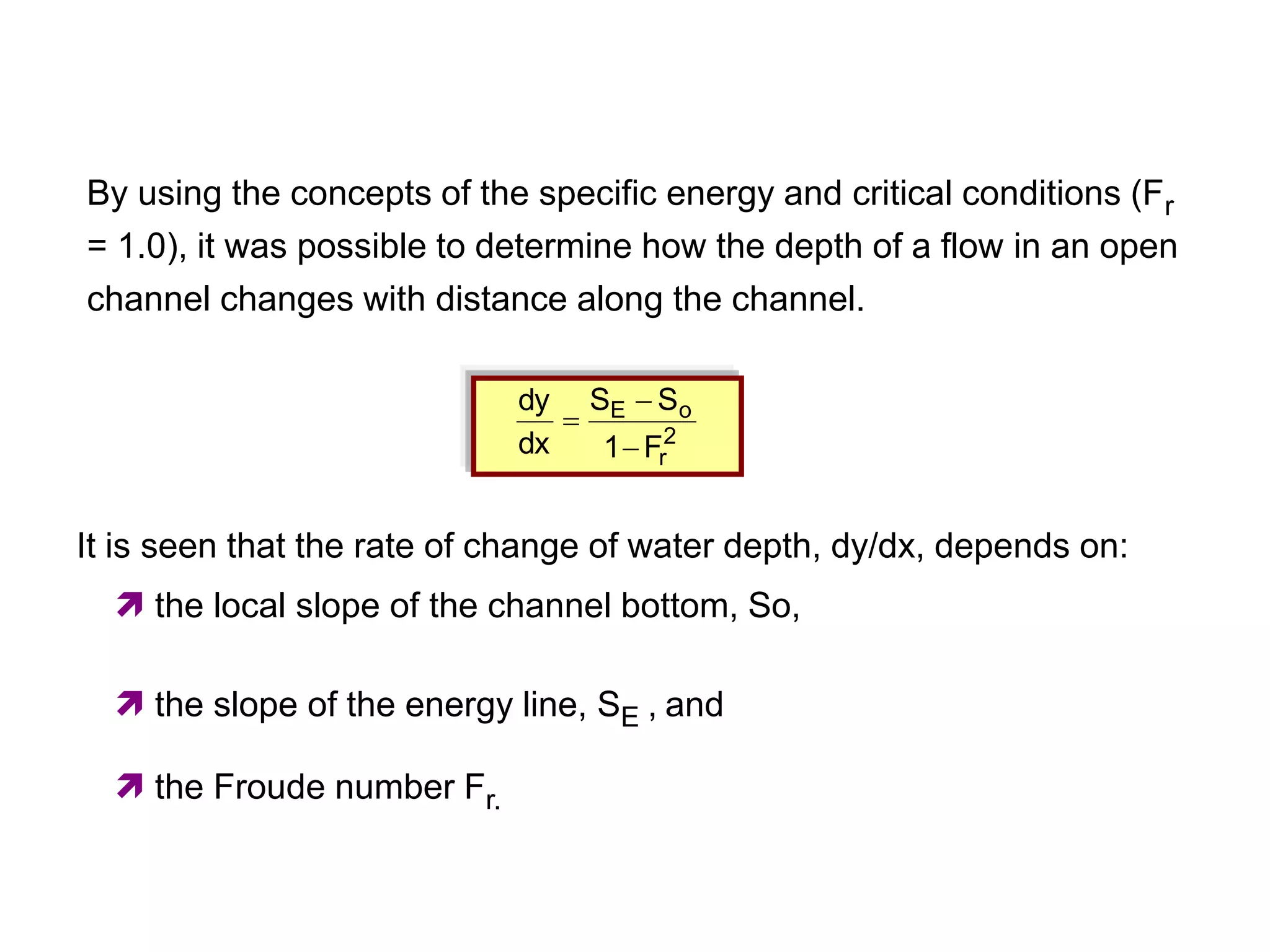
It is seen that the rate of change of water depth, dy/dx, depends on:
 the local slope of the channel bottom, So,
 the slope of the energy line, SE , and
 the Froude number Fr.
By using the concepts of the specific energy and critical conditions (Fr
= 1.0), it was possible to determine how the depth of a flow in an open
channel changes with distance along the channel.
0
dy/dx
Fr
1.0 1.5 2.0
0.5
SE < So
SE > So
SE = So
The shown figure is valid for
channels of any constant cross-
sectional shape, provided the
Froude number is interpreted.
As shown by the shown figure,
the value of dy/dx can be either
negative, zero, or positive,
depending on the values of
these three parameters.
 That is, the channel flow depth may be constant or it may increase or
decrease in the flow direction, depending on the values of So, SE, and
Fr.
 The behavior of subcritical flow may be the opposite of that for
supercritical flow, as shown by the denominator, 1-Fr
2 of the above
shown equation.
 In this section we will consider only rectangular cross-sectional
channels when using this equation
w
w

on
distributi
stress
shear
w 

Actual
niform
U
Shear Stress Distribution on the Wetted Perimeter.


Brinually sketches