Performance curves for turbines
Why?? Or Need??
• Turbines are designed for specific conditions of
Power , speed ,discharge called as designed
conditions
• But most of time of working turbines are required
operated at conditions other than designed
conditions
• Performance curves are important in order to
study performance of turbines at such conditions
PRATIK ACADEMY,SANGLI 9422378762 2
Types of curves
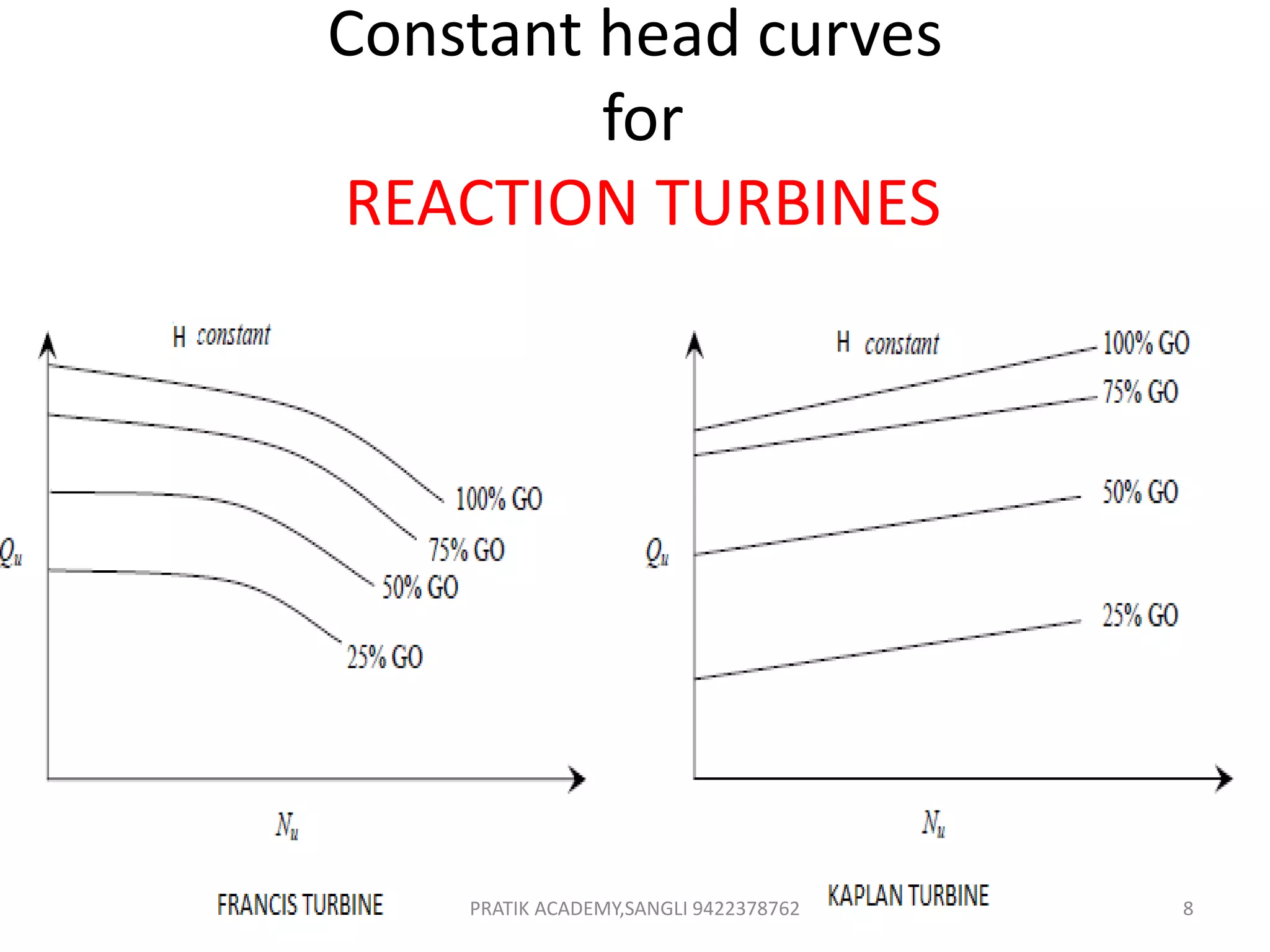
• Constant Head curves or Main curves
Head Maintained Constant
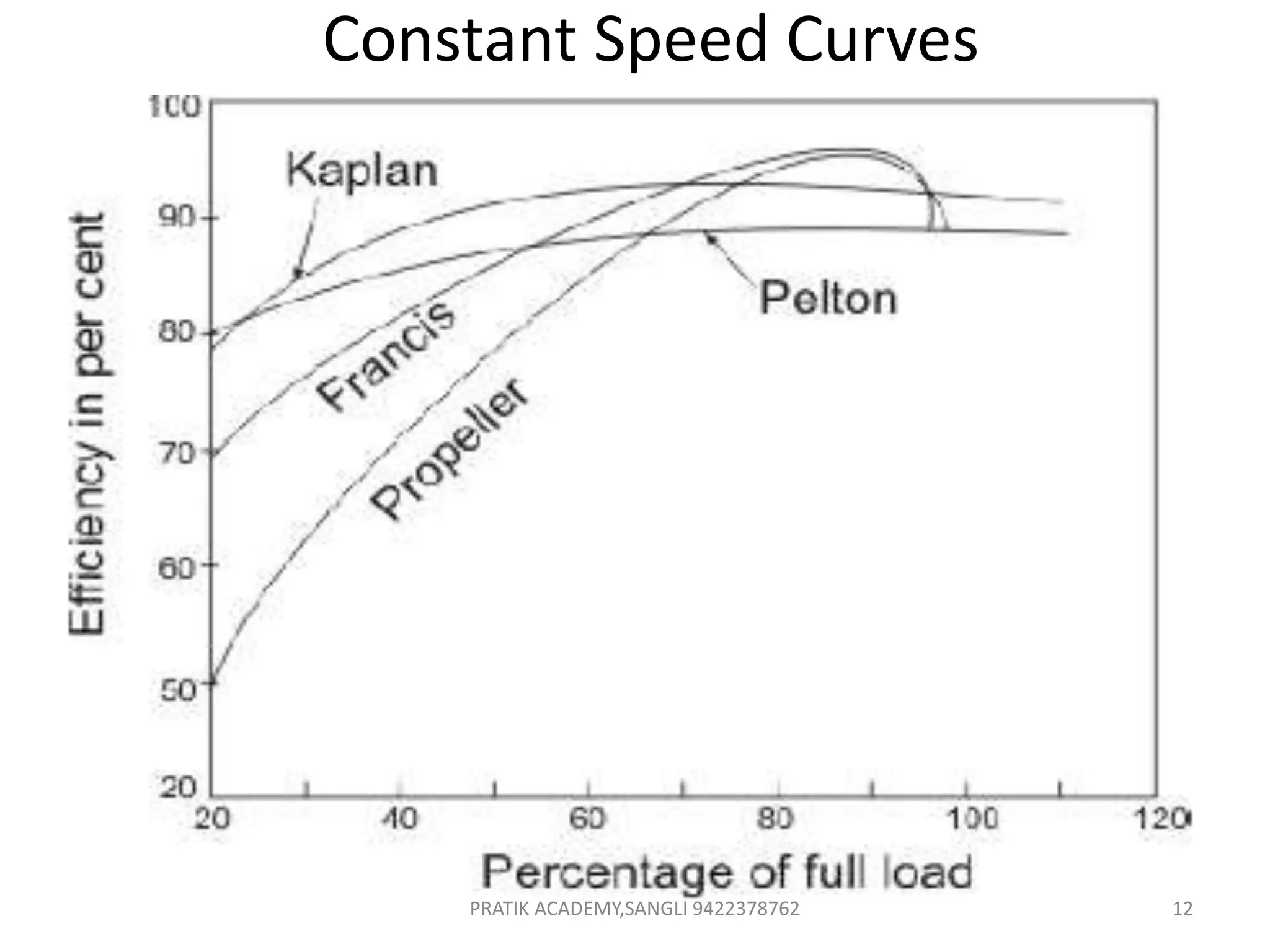
• Constant speed curves or operating curves
Speed Maintain Constant
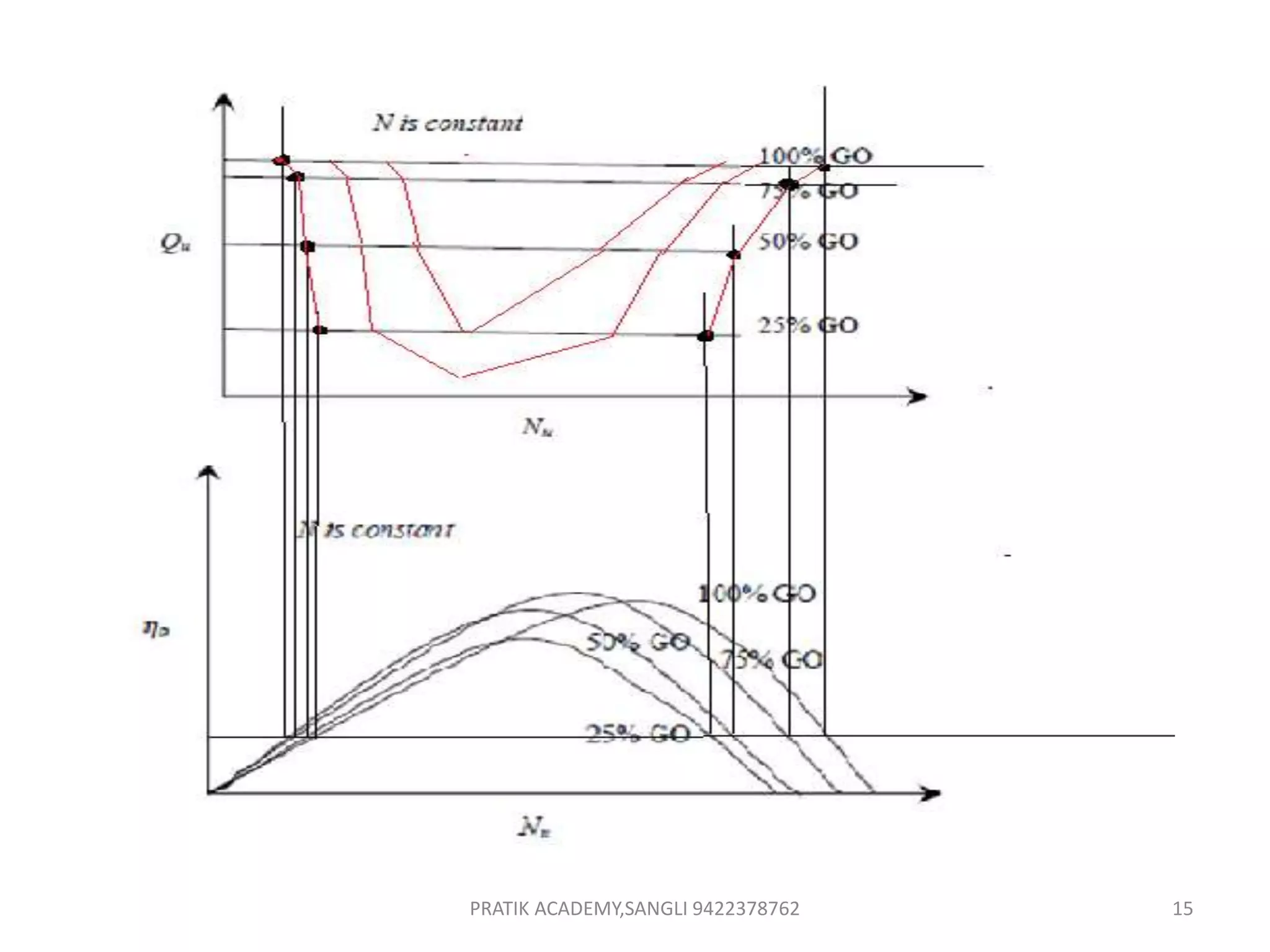
• Constant efficiency or isoefficiency curves
efficiency maintained constant
PRATIK ACADEMY,SANGLI 9422378762 3
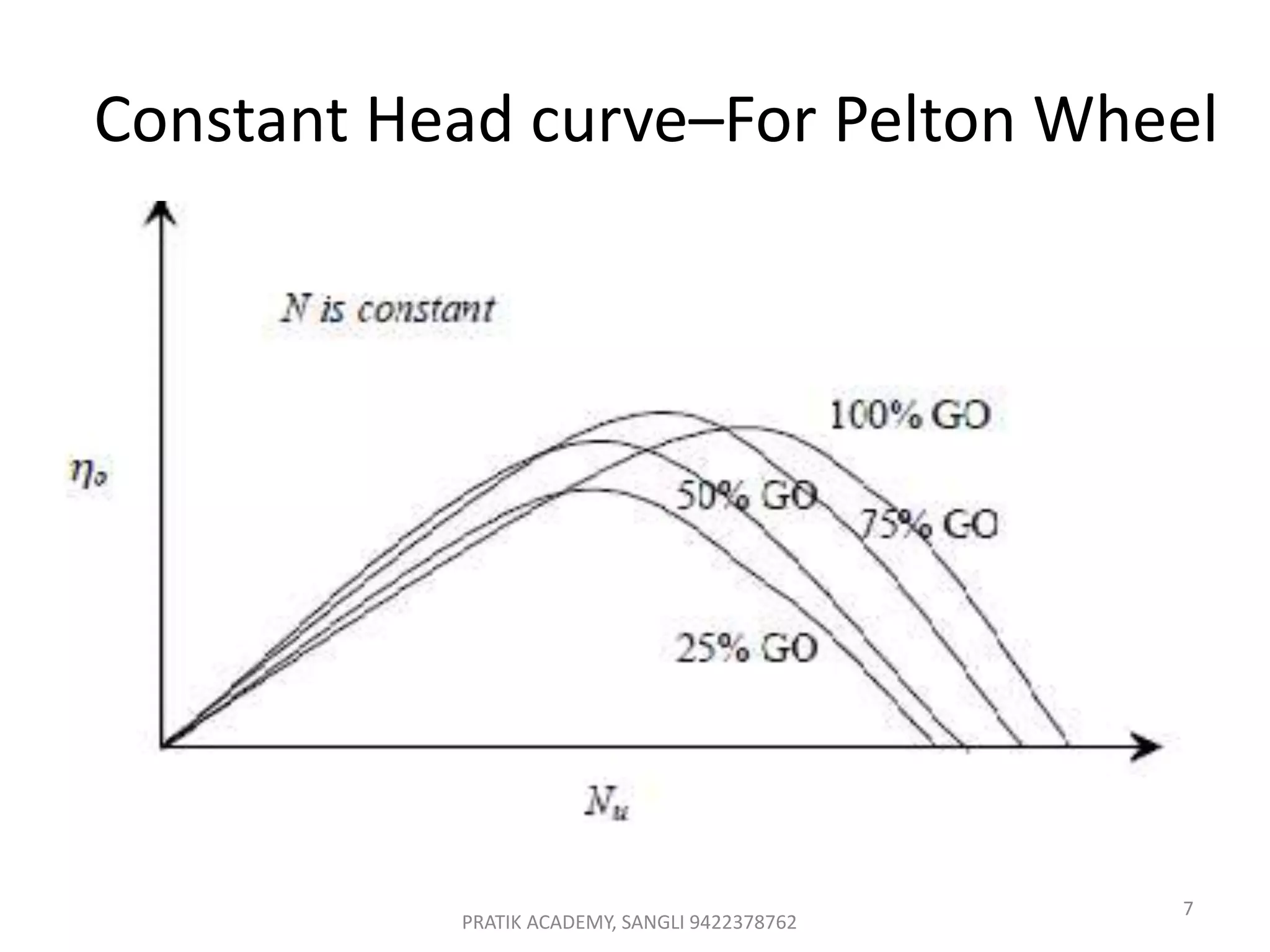
Constant Head Curves
• Procedure
For obtaining these curves test is carried out with
changing only load on turbine in steps &
corresponding Power, speed, discharge are
measured for a particular gate (or spear rod)
opening
Repeating the same procedure for different gate
opening values
After test ,Results are plotted in terms of following
3 graphs
1. Unit discharge Vs Unit speed
2. Unit Power Vs Unit speed
3. Efficiency Vs Unit speed
PRATIK ACADEMY,SANGLI 9422378762 4
Constant Head curve–For Pelton Wheel
PRATIK ACADEMY,SANGLI 9422378762 5
Constant Head curve–For Pelton Wheel
PRATIK ACADEMY,SANGLI 9422378762 6
Constant Head curve–For Pelton Wheel
PRATIK ACADEMY, SANGLI 9422378762
7
Constant head curves
for
REACTION TURBINES
PRATIK ACADEMY,SANGLI 9422378762 8
Constant head curves
for
Reaction Turbines
PRATIK ACADEMY,SANGLI 9422378762 9
Constant Speed Curves
• Procedure
This test is carried out maintaining speed
constant (by increasing discharge) while
increasing load in steps
After test ,Results are plotted in terms of
following 3 graphs
1. Efficiency Vs Discharge
2. Power Vs Discharge
3. Efficiency Vs part load conditionsPRATIK ACADEMY,SANGLI 9422378762 10
Constant Speed Curves
Discharge to
overcome friction PRATIK ACADEMY,SANGLI 9422378762 11
Constant Speed Curves
PRATIK ACADEMY,SANGLI 9422378762 12
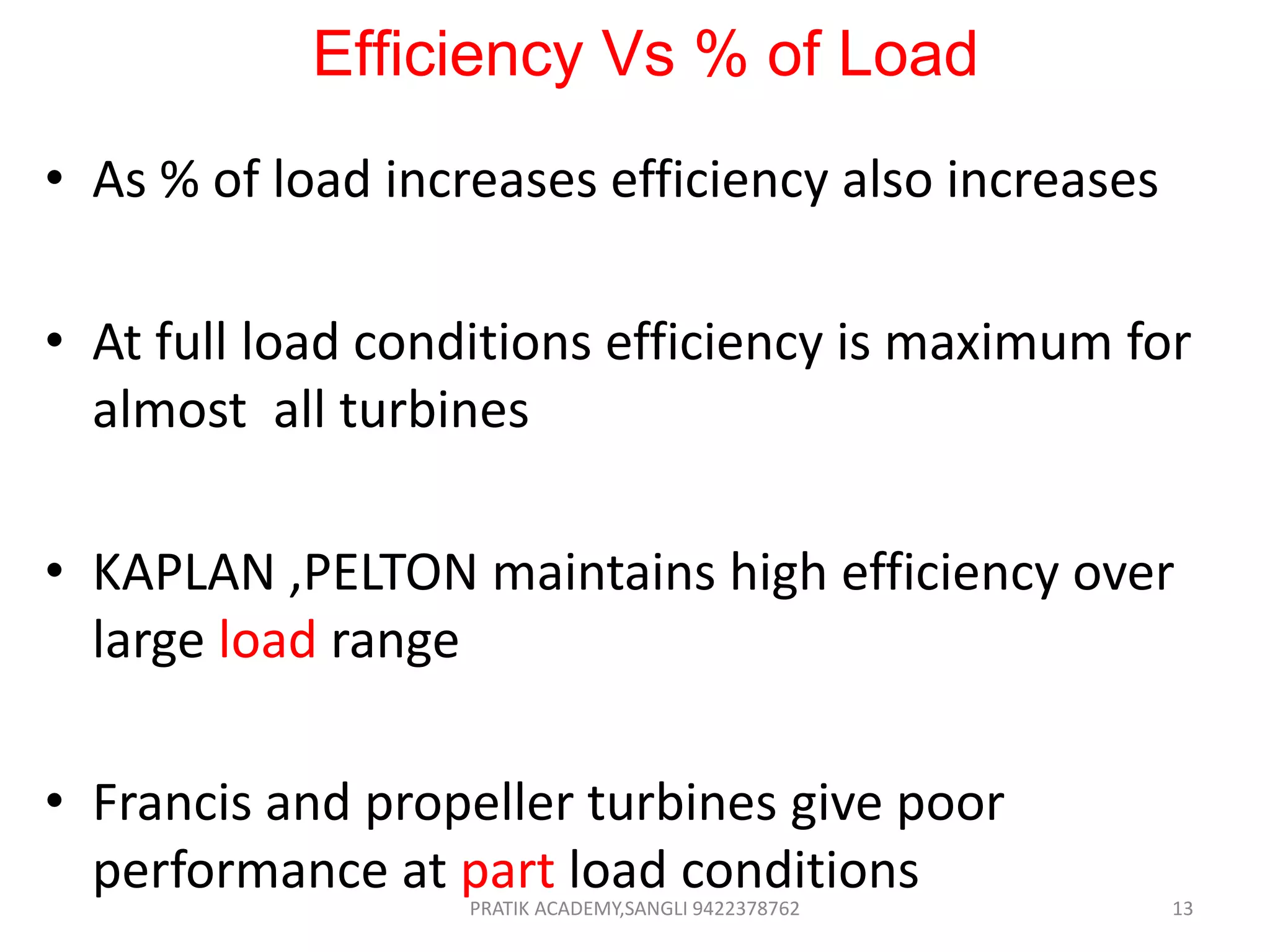
Efficiency Vs % of Load
• As % of load increases efficiency also increases
• At full load conditions efficiency is maximum for
almost all turbines
• KAPLAN ,PELTON maintains high efficiency over
large load range
• Francis and propeller turbines give poor
performance at part load conditionsPRATIK ACADEMY,SANGLI 9422378762 13
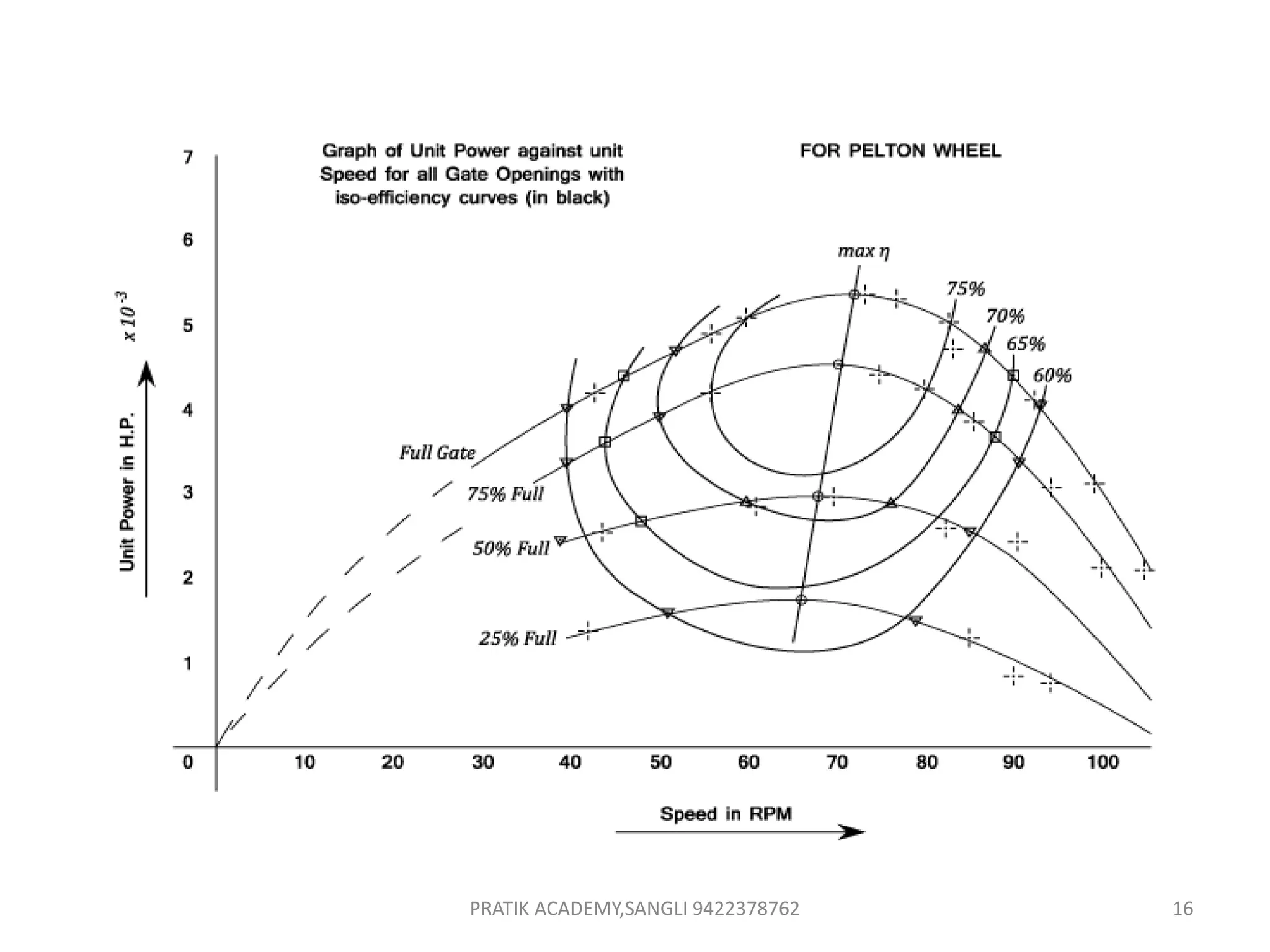
ISO-Efficiency Curves
• These curves are obtained from speed Vs
efficiency & Speed Vs Discharge
• These curves gives zones of constant
efficiency and predicting performance of
turbine at various efficiencies
PRATIK ACADEMY,SANGLI 9422378762 14
PRATIK ACADEMY,SANGLI 9422378762 15
PRATIK ACADEMY,SANGLI 9422378762 16
PRATIK ACADEMY, SANGLI
Dear All , follow below link to find video lecture on
“Hydraulic Turbine Performance Curves”
• https://www.youtube.com/watch?v=LeQVz0vSBjw&list
=PLM38cEkdDRfTXmEB49EiP6WQzCkizLbsx&index=22
Cavitation in Hydraulic Turbines
• https://www.youtube.com/watch?v=5dqJkkaEotk&list=
PLM38cEkdDRfTXmEB49EiP6WQzCkizLbsx&index=23
Please Like and subscribe Our Channel
PRATIK ACADEMY,SANGLI 9422378762 17
At installation
PRATIK ACADEMY,SANGLI 9422378762 18
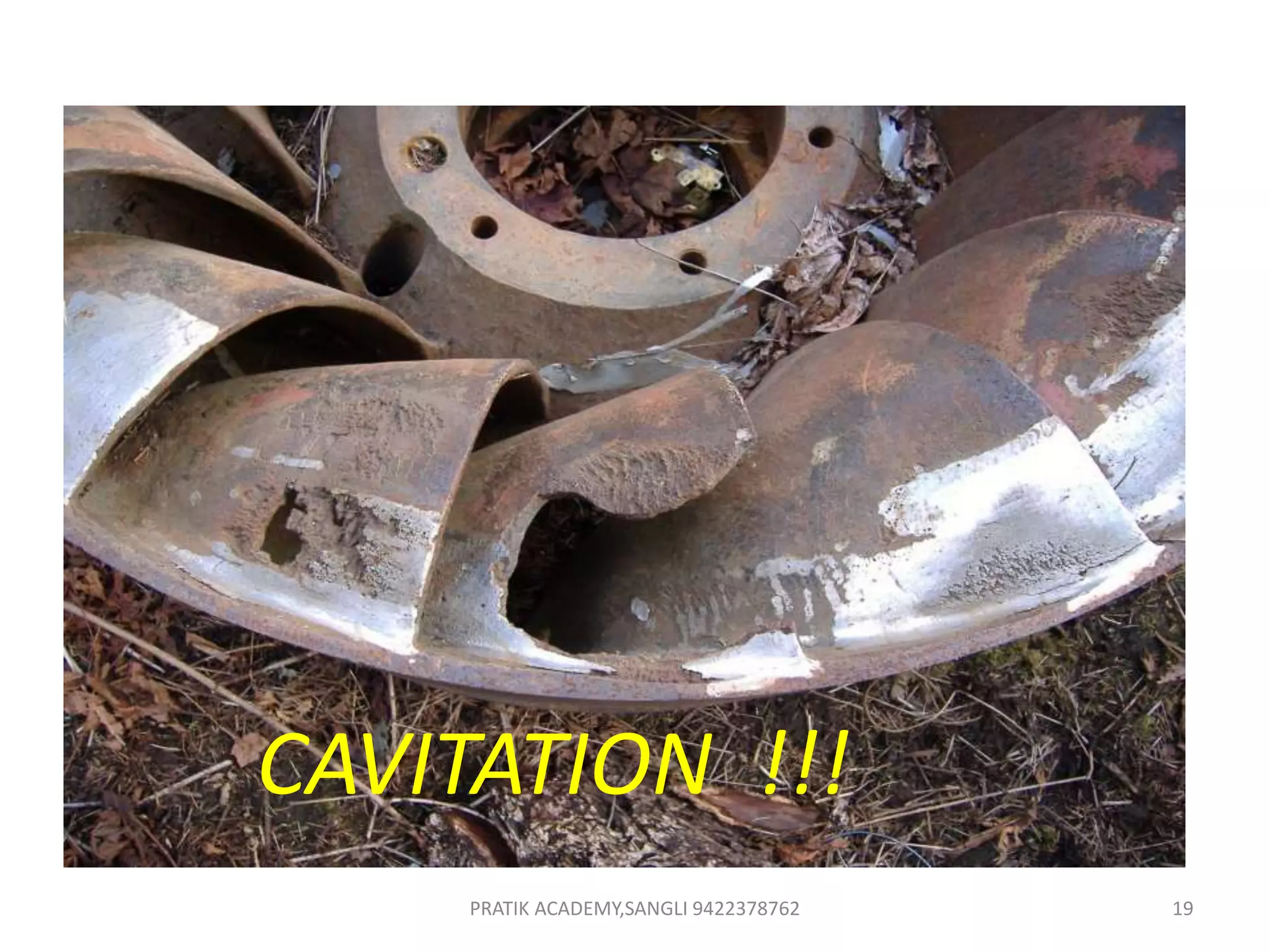
CAVITATION !!!
PRATIK ACADEMY,SANGLI 9422378762 19
CAVITATION !!!
• Mean???
• Why???
• Where???
• Effects???
• How to avoid??
PRATIK ACADEMY,SANGLI 9422378762 20
• Formation ,growth and collapse of bubbles of water @ low
pressure regions of machine
• Pressure at section falls below saturation pressure
corresponding to given temperature
• low pressure regions such as turbine outlet and draft tube
inlet
• vibration, noisy operation, hydraulic losses ,erosion of
surface
• controlling discharge pressure ,using high strength
materials ,selecting proper speed of turbinePRATIK ACADEMY,SANGLI 9422378762 21

TURBINE PERFORMANCE CURVES

  • 1.
  • 2.
    Why?? Or Need?? •Turbines are designed for specific conditions of Power , speed ,discharge called as designed conditions • But most of time of working turbines are required operated at conditions other than designed conditions • Performance curves are important in order to study performance of turbines at such conditions PRATIK ACADEMY,SANGLI 9422378762 2
  • 3.
    Types of curves •Constant Head curves or Main curves Head Maintained Constant • Constant speed curves or operating curves Speed Maintain Constant • Constant efficiency or isoefficiency curves efficiency maintained constant PRATIK ACADEMY,SANGLI 9422378762 3
  • 4.
    Constant Head Curves •Procedure For obtaining these curves test is carried out with changing only load on turbine in steps & corresponding Power, speed, discharge are measured for a particular gate (or spear rod) opening Repeating the same procedure for different gate opening values After test ,Results are plotted in terms of following 3 graphs 1. Unit discharge Vs Unit speed 2. Unit Power Vs Unit speed 3. Efficiency Vs Unit speed PRATIK ACADEMY,SANGLI 9422378762 4
  • 5.
    Constant Head curve–ForPelton Wheel PRATIK ACADEMY,SANGLI 9422378762 5
  • 6.
    Constant Head curve–ForPelton Wheel PRATIK ACADEMY,SANGLI 9422378762 6
  • 7.
    Constant Head curve–ForPelton Wheel PRATIK ACADEMY, SANGLI 9422378762 7
  • 8.
    Constant head curves for REACTIONTURBINES PRATIK ACADEMY,SANGLI 9422378762 8
  • 9.
    Constant head curves for ReactionTurbines PRATIK ACADEMY,SANGLI 9422378762 9
  • 10.
    Constant Speed Curves •Procedure This test is carried out maintaining speed constant (by increasing discharge) while increasing load in steps After test ,Results are plotted in terms of following 3 graphs 1. Efficiency Vs Discharge 2. Power Vs Discharge 3. Efficiency Vs part load conditionsPRATIK ACADEMY,SANGLI 9422378762 10
  • 11.
    Constant Speed Curves Dischargeto overcome friction PRATIK ACADEMY,SANGLI 9422378762 11
  • 12.
    Constant Speed Curves PRATIKACADEMY,SANGLI 9422378762 12
  • 13.
    Efficiency Vs %of Load • As % of load increases efficiency also increases • At full load conditions efficiency is maximum for almost all turbines • KAPLAN ,PELTON maintains high efficiency over large load range • Francis and propeller turbines give poor performance at part load conditionsPRATIK ACADEMY,SANGLI 9422378762 13
  • 14.
    ISO-Efficiency Curves • Thesecurves are obtained from speed Vs efficiency & Speed Vs Discharge • These curves gives zones of constant efficiency and predicting performance of turbine at various efficiencies PRATIK ACADEMY,SANGLI 9422378762 14
  • 15.
  • 16.
  • 17.
    PRATIK ACADEMY, SANGLI DearAll , follow below link to find video lecture on “Hydraulic Turbine Performance Curves” • https://www.youtube.com/watch?v=LeQVz0vSBjw&list =PLM38cEkdDRfTXmEB49EiP6WQzCkizLbsx&index=22 Cavitation in Hydraulic Turbines • https://www.youtube.com/watch?v=5dqJkkaEotk&list= PLM38cEkdDRfTXmEB49EiP6WQzCkizLbsx&index=23 Please Like and subscribe Our Channel PRATIK ACADEMY,SANGLI 9422378762 17
  • 18.
  • 19.
  • 20.
    CAVITATION !!! • Mean??? •Why??? • Where??? • Effects??? • How to avoid?? PRATIK ACADEMY,SANGLI 9422378762 20
  • 21.
    • Formation ,growthand collapse of bubbles of water @ low pressure regions of machine • Pressure at section falls below saturation pressure corresponding to given temperature • low pressure regions such as turbine outlet and draft tube inlet • vibration, noisy operation, hydraulic losses ,erosion of surface • controlling discharge pressure ,using high strength materials ,selecting proper speed of turbinePRATIK ACADEMY,SANGLI 9422378762 21