Graph Theory
Introduction
 What is a graph G?
 It is a pair G = (V, E),
where
 V = V(G) = set of vertices
 E = E(G) = set of edges
 Example:
 V = {s, u, v, w, x, y, z}
 E = {(x,s), (x,v)1, (x,v)2, (x,u),
(v,w), (s,v), (s,u), (s,w), (s,y),
(w,y), (u,y), (u,z),(y,z)}
Edges
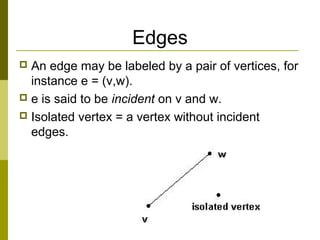
 An edge may be labeled by a pair of vertices, for
instance e = (v,w).
 e is said to be incident on v and w.
 Isolated vertex = a vertex without incident
edges.
Special edges
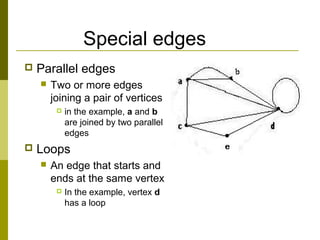
 Parallel edges
 Two or more edges
joining a pair of vertices
 in the example, a and b
are joined by two parallel
edges
 Loops
 An edge that starts and
ends at the same vertex
 In the example, vertex d
has a loop
Special graphs
 Simple graph
 A graph without loops
or parallel edges.
 Weighted graph
 A graph where each
edge is assigned a
numerical label or
“weight”.
Directed graphs (digraphs)
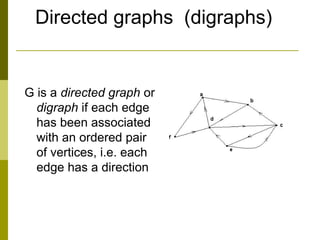
G is a directed graph or
digraph if each edge
has been associated
with an ordered pair
of vertices, i.e. each
edge has a direction
Complete graph K n
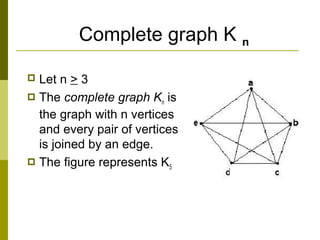
 Let n > 3
 The complete graph Kn is
the graph with n vertices
and every pair of vertices
is joined by an edge.
 The figure represents K5
Connected graphs
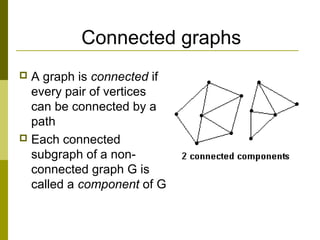
 A graph is connected if
every pair of vertices
can be connected by a
path
 Each connected
subgraph of a non-
connected graph G is
called a component of G
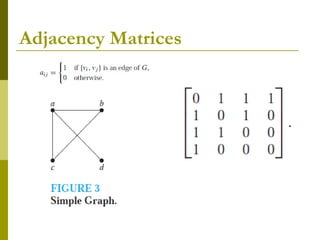
Adjacency Matrices
Incidence matrix
 Incidence matrix
 Label rows with vertices
 Label columns with edges
 1 if an edge is incident to
a vertex, 0 otherwise
e f g h j
v 1 1 0 0 0
w 1 0 1 0 1
x 0 0 0 1 1
y 0 1 1 1 0
Try yourself
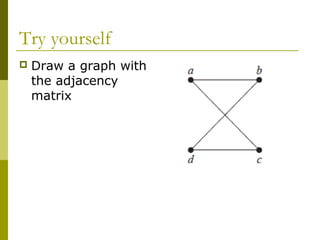
 Draw a graph with
the adjacency
matrix
Paths and cycles
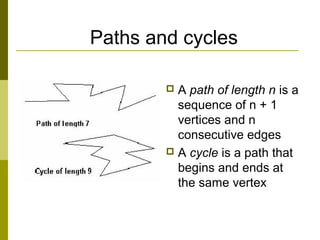
 A path of length n is a
sequence of n + 1
vertices and n
consecutive edges
 A cycle is a path that
begins and ends at
the same vertex
Euler cycles
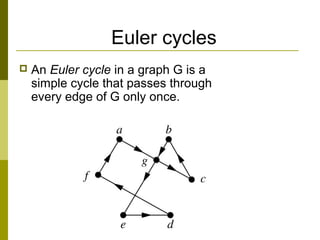
 An Euler cycle in a graph G is a
simple cycle that passes through
every edge of G only once.
Degree of a vertex
 The degree of a vertex
v, denoted by δ(v), is
the number of edges
incident on v
 Example:
 δ(a) = 4, δ(b) = 3,
 δ(c) = 4, δ(d) = 6,
 δ(e) = 4, δ(f) = 4,
 δ(g) = 3.
Sum of the degrees of a graph
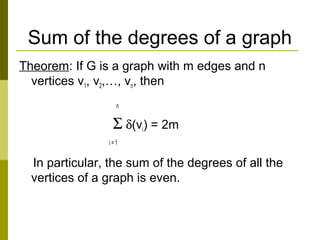
Theorem: If G is a graph with m edges and n
vertices v1, v2,…, vn, then
n
Σ δ(vi) = 2m
i = 1
In particular, the sum of the degrees of all the
vertices of a graph is even.
6.3 Hamiltonian cycles
 Traveling salesperson
problem
 To visit every vertex of a
graph G only once by a
simple cycle.
 Such a cycle is called a
Hamiltonian cycle.
 If a connected graph G has
a Hamiltonian cycle, G is
called a Hamiltonian graph.
Thank you

Graphs - Discrete Math

  • 1.
  • 2.
    Introduction  What isa graph G?  It is a pair G = (V, E), where  V = V(G) = set of vertices  E = E(G) = set of edges  Example:  V = {s, u, v, w, x, y, z}  E = {(x,s), (x,v)1, (x,v)2, (x,u), (v,w), (s,v), (s,u), (s,w), (s,y), (w,y), (u,y), (u,z),(y,z)}
  • 3.
    Edges  An edgemay be labeled by a pair of vertices, for instance e = (v,w).  e is said to be incident on v and w.  Isolated vertex = a vertex without incident edges.
  • 4.
    Special edges  Paralleledges  Two or more edges joining a pair of vertices  in the example, a and b are joined by two parallel edges  Loops  An edge that starts and ends at the same vertex  In the example, vertex d has a loop
  • 5.
    Special graphs  Simplegraph  A graph without loops or parallel edges.  Weighted graph  A graph where each edge is assigned a numerical label or “weight”.
  • 6.
    Directed graphs (digraphs) Gis a directed graph or digraph if each edge has been associated with an ordered pair of vertices, i.e. each edge has a direction
  • 7.
    Complete graph Kn  Let n > 3  The complete graph Kn is the graph with n vertices and every pair of vertices is joined by an edge.  The figure represents K5
  • 8.
    Connected graphs  Agraph is connected if every pair of vertices can be connected by a path  Each connected subgraph of a non- connected graph G is called a component of G
  • 9.
  • 10.
    Incidence matrix  Incidencematrix  Label rows with vertices  Label columns with edges  1 if an edge is incident to a vertex, 0 otherwise e f g h j v 1 1 0 0 0 w 1 0 1 0 1 x 0 0 0 1 1 y 0 1 1 1 0
  • 11.
    Try yourself  Drawa graph with the adjacency matrix
  • 12.
    Paths and cycles A path of length n is a sequence of n + 1 vertices and n consecutive edges  A cycle is a path that begins and ends at the same vertex
  • 13.
    Euler cycles  AnEuler cycle in a graph G is a simple cycle that passes through every edge of G only once.
  • 14.
    Degree of avertex  The degree of a vertex v, denoted by δ(v), is the number of edges incident on v  Example:  δ(a) = 4, δ(b) = 3,  δ(c) = 4, δ(d) = 6,  δ(e) = 4, δ(f) = 4,  δ(g) = 3.
  • 15.
    Sum of thedegrees of a graph Theorem: If G is a graph with m edges and n vertices v1, v2,…, vn, then n Σ δ(vi) = 2m i = 1 In particular, the sum of the degrees of all the vertices of a graph is even.
  • 16.
    6.3 Hamiltonian cycles Traveling salesperson problem  To visit every vertex of a graph G only once by a simple cycle.  Such a cycle is called a Hamiltonian cycle.  If a connected graph G has a Hamiltonian cycle, G is called a Hamiltonian graph.
  • 18.