Definitions - Graph
Ageneralization of the simple concept of a
set of dots, links, edges or arcs.
Representation: Graph G =(V, E) consists set of vertices
denoted by V, or by V(G) and set of edges E, or E(G)
3.
Definitions – EdgeType
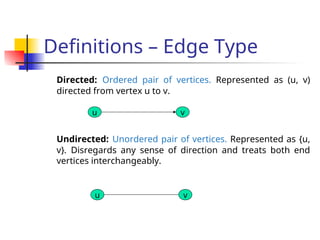
Directed: Ordered pair of vertices. Represented as (u, v)
directed from vertex u to v.
Undirected: Unordered pair of vertices. Represented as {u,
v}. Disregards any sense of direction and treats both end
vertices interchangeably.
u v
u v
4.
Definitions – EdgeType
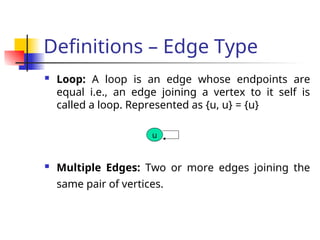
Loop: A loop is an edge whose endpoints are
equal i.e., an edge joining a vertex to it self is
called a loop. Represented as {u, u} = {u}
Multiple Edges: Two or more edges joining the
same pair of vertices.
u
5.
Definitions – GraphType
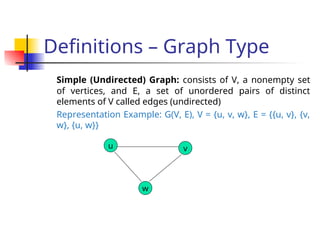
Simple (Undirected) Graph: consists of V, a nonempty set
of vertices, and E, a set of unordered pairs of distinct
elements of V called edges (undirected)
Representation Example: G(V, E), V = {u, v, w}, E = {{u, v}, {v,
w}, {u, w}}
u v
w
6.
Definitions – GraphType
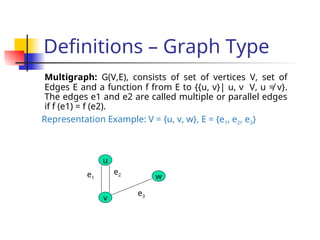
Multigraph: G(V,E), consists of set of vertices V, set of
Edges E and a function f from E to {{u, v}| u, v V, u ≠ v}.
The edges e1 and e2 are called multiple or parallel edges
if f (e1) = f (e2).
Representation Example: V = {u, v, w}, E = {e1, e2, e3}
u
v
w
e1
e2
e3
7.
Definitions – GraphType
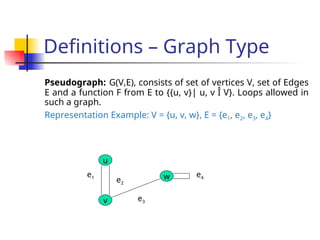
Pseudograph: G(V,E), consists of set of vertices V, set of Edges
E and a function F from E to {{u, v}| u, v Î V}. Loops allowed in
such a graph.
Representation Example: V = {u, v, w}, E = {e1, e2, e3, e4}
u
v
w
e1
e3
e2
e4
8.
Definitions – GraphType
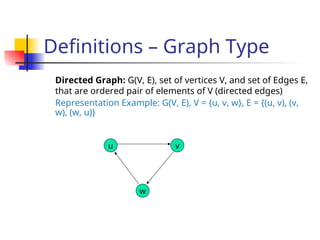
Directed Graph: G(V, E), set of vertices V, and set of Edges E,
that are ordered pair of elements of V (directed edges)
Representation Example: G(V, E), V = {u, v, w}, E = {(u, v), (v,
w), (w, u)}
u
w
v
9.
Definitions – GraphType
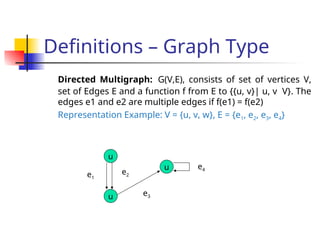
Directed Multigraph: G(V,E), consists of set of vertices V,
set of Edges E and a function f from E to {{u, v}| u, v V}. The
edges e1 and e2 are multiple edges if f(e1) = f(e2)
Representation Example: V = {u, v, w}, E = {e1, e2, e3, e4}
u
u
u
e1
e2
e3
e4
10.
Definitions – GraphType
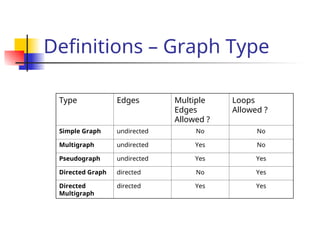
Type Edges Multiple
Edges
Allowed ?
Loops
Allowed ?
Simple Graph undirected No No
Multigraph undirected Yes No
Pseudograph undirected Yes Yes
Directed Graph directed No Yes
Directed
Multigraph
directed Yes Yes
11.
Terminology – Undirectedgraphs
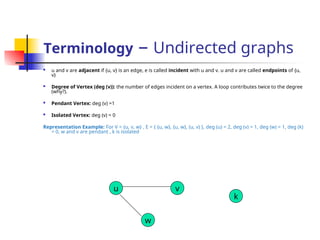
u and v are adjacent if {u, v} is an edge, e is called incident with u and v. u and v are called endpoints of {u,
v}
Degree of Vertex (deg (v)): the number of edges incident on a vertex. A loop contributes twice to the degree
(why?).
Pendant Vertex: deg (v) =1
Isolated Vertex: deg (v) = 0
Representation Example: For V = {u, v, w} , E = { {u, w}, {u, w}, (u, v) }, deg (u) = 2, deg (v) = 1, deg (w) = 1, deg (k)
= 0, w and v are pendant , k is isolated
u
k
w
v
12.
Terminology – Directedgraphs
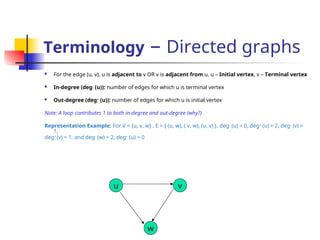
For the edge (u, v), u is adjacent to v OR v is adjacent from u, u – Initial vertex, v – Terminal vertex
In-degree (deg-
(u)): number of edges for which u is terminal vertex
Out-degree (deg+
(u)): number of edges for which u is initial vertex
Note: A loop contributes 1 to both in-degree and out-degree (why?)
Representation Example: For V = {u, v, w} , E = { (u, w), ( v, w), (u, v) }, deg-
(u) = 0, deg+
(u) = 2, deg-
(v) =
1,
deg+
(v) = 1, and deg-
(w) = 2, deg+
(u) = 0
u
w
v
13.
Simple graphs –special
cases
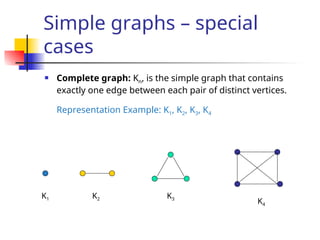
Complete graph: Kn, is the simple graph that contains
exactly one edge between each pair of distinct vertices.
Representation Example: K1, K2, K3, K4
K2
K1
K4
K3
14.
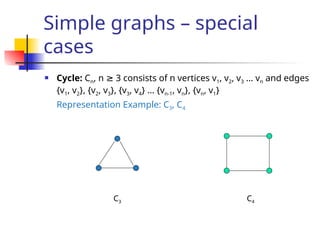
Simple graphs –special
cases
Cycle: Cn, n 3 consists of n vertices v
≥ 1, v2, v3 … vn and edges
{v1, v2}, {v2, v3}, {v3, v4} … {vn-1, vn}, {vn, v1}
Representation Example: C3, C4
C3 C4
15.
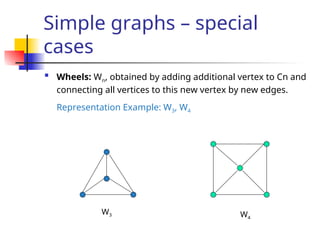
Simple graphs –special
cases
Wheels: Wn, obtained by adding additional vertex to Cn and
connecting all vertices to this new vertex by new edges.
Representation Example: W3, W4
W3 W4
16.
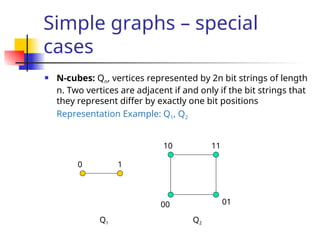
Simple graphs –special
cases
N-cubes: Qn, vertices represented by 2n bit strings of length
n. Two vertices are adjacent if and only if the bit strings that
they represent differ by exactly one bit positions
Representation Example: Q1, Q2
0
10
1
00
11
Q1
01
Q2
17.
Subgraphs
A subgraphof a graph G = (V, E) is a graph H =(V’, E’) where V’ is a
subset of V and E’ is a subset of E
Application example: solving sub-problems within a graph
Representation example: V = {u, v, w}, E = ({u, v}, {v, w}, {w, u}}, H1 ,
H2
u
v w
u
u
w
v v
H1
H2
G
18.
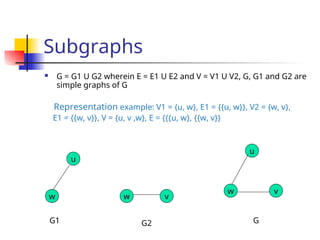
Subgraphs
G =G1 U G2 wherein E = E1 U E2 and V = V1 U V2, G, G1 and G2 are
simple graphs of G
Representation example: V1 = {u, w}, E1 = {{u, w}}, V2 = {w, v},
E1 = {{w, v}}, V = {u, v ,w}, E = {{{u, w}, {{w, v}}
u
v
w w
v
w
u
G1 G2 G
19.
Representation
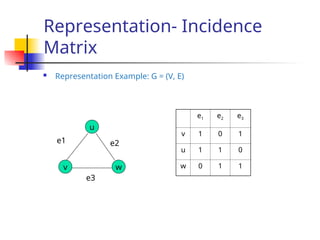
Incidence (Matrix):Most useful when information about
edges is more desirable than information about vertices.
Adjacency (Matrix/List): Most useful when information
about the vertices is more desirable than information about
the edges. These two representations are also most popular
since information about the vertices is often more desirable
than edges in most applications
Representation- Adjacency
Matrix
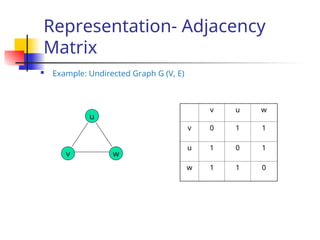
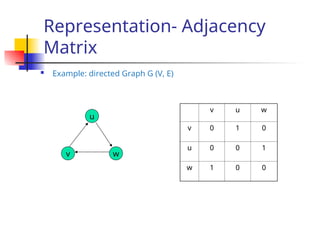
Thereis an N x N matrix, where |V| = N , the Adjacenct Matrix
(NxN) A = [aij]
For undirected graph
For directed graph
This makes it easier to find subgraphs, and to reverse graphs if needed.
otherwise
0
G
of
edge
an
is
)
v
,
(v
if
1
a
j
i
ij
otherwise
0
G
of
edge
an
is
}
v
,
{v
if
1
a
j
i
ij
22.
Representation- Adjacency
Matrix
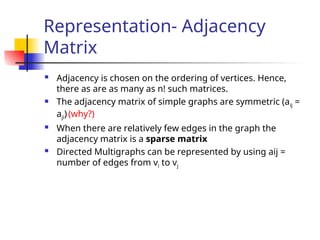
Adjacencyis chosen on the ordering of vertices. Hence,
there as are as many as n! such matrices.
The adjacency matrix of simple graphs are symmetric (aij =
aji) (why?)
When there are relatively few edges in the graph the
adjacency matrix is a sparse matrix
Directed Multigraphs can be represented by using aij =
number of edges from vi to vj

![Representation- Adjacency
Matrix
There is an N x N matrix, where |V| = N , the Adjacenct Matrix
(NxN) A = [aij]
For undirected graph
For directed graph
This makes it easier to find subgraphs, and to reverse graphs if needed.
otherwise
0
G
of
edge
an
is
)
v
,
(v
if
1
a
j
i
ij
otherwise
0
G
of
edge
an
is
}
v
,
{v
if
1
a
j
i
ij](https://image.slidesharecdn.com/lecturegraph-250228090427-9b726806/85/Discrete-Maths141-Graph-Theory-and-Lecture-21-320.jpg)