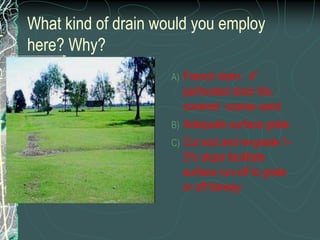
Designing subsoil drains
Discharge area: Subsoil drainsDecide where to discharge the waterDesign UP from discharge point (minimum 1:70)Have uniform fall on all pipes
Discharge area: Subsoil drainsOpen drainCreekBe aware what will happen during floodingDischarge must be above levelDesign the drain FROM the discharge point upwardUniform fall on all pipes
Subsoil drain pattern:Favoured design30-45% angleSmall laterals into larger mainFlexible corrugated tileJoints are offset from each other
Determining pipe sizingManufacturers supply max flow performanceAs pipe length increases, friction loss increasesMain runs with the slopeLaterals run across slope
A fall of .5ft in 49.5 ft is 1:99Efficient and simpleLaterals same distance apartUniform drainage for the whole area
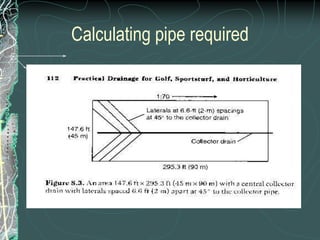
Calculating pipe required
How to size pipeAssume area of 1ac (43,560ft sq)Uniform slope of 1:70, down 295 ft. no cross fallSubsoil drains spaced at 6.6ft, topsoil at 12” HC 2”/hrRainfall event of 2”/hr
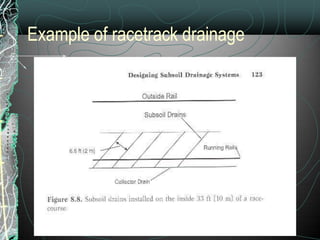
Example of racetrack drainage
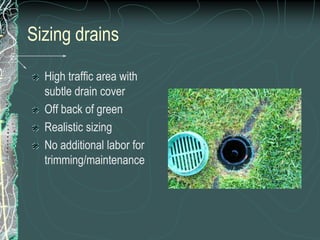
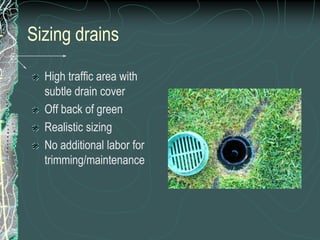
Sizing drainsHigh traffic area with subtle drain coverOff back of greenRealistic sizingNo additional labor for trimming/maintenance
Installing subsoil drainsMigrationFilter materialInstallation techniques
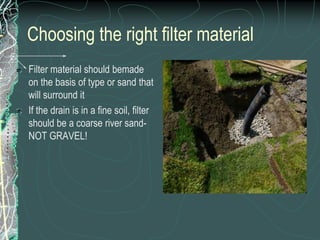
Choosing the right filter materialFilter material should bemade on the basis of type or sand that will surround itIf the drain is in a fine soil, filter should be a coarse river sand-NOT GRAVEL!
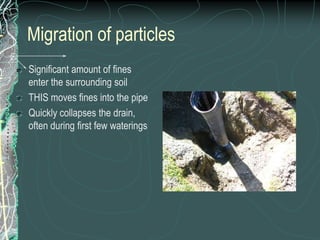
Migration of particlesSignificant amount of fines enter the surrounding soilTHIS moves fines into the pipeQuickly collapses the drain, often during first few waterings
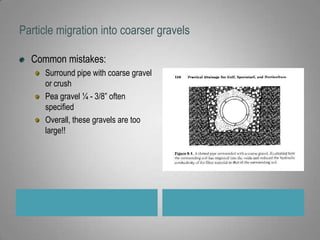
Particle migration into coarser gravelsCommon mistakes:Surround pipe with coarse gravel or crushPea gravel ÂŒ - 3/8” often specifiedOverall, these gravels are too large!!
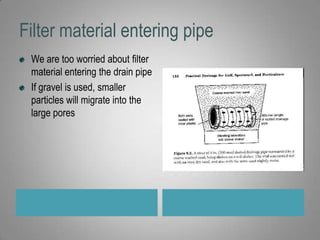
Filter material entering pipe	We are too worried about filter material entering the drain pipeIf gravel is used, smaller particles will migrate into the large pores
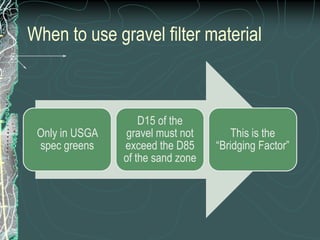
When to use gravel filter material
Clean filter materialMake sure no fines in the filter materialUse HC of the filter material >100”/hr (sand withought fines)Misconception: Sand will not enter drain pipe except from above. Surface area of slots is less that 1% of pipe surface area.
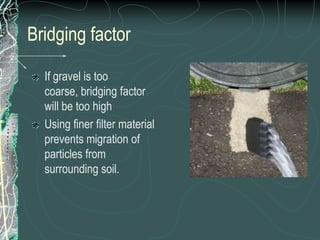
Bridging factorIf gravel is too coarse, bridging factor will be too highUsing finer filter material prevents migration of particles from surrounding soil.
Diameter ratingWhen installing subsoil drains, in any situation other than USGA sand, use clean washed sand. NOT pea gravel, or any gravel with a D15 less than 1mm.  D15 means 15% of the filler is larger than the specified size, 85% spec.
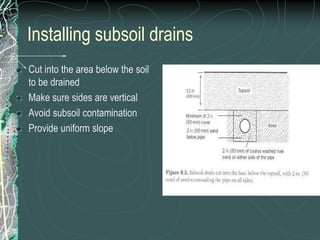
Installing subsoil drainsCut into the area below the soil to be drainedMake sure sides are verticalAvoid subsoil contaminationProvide uniform slope
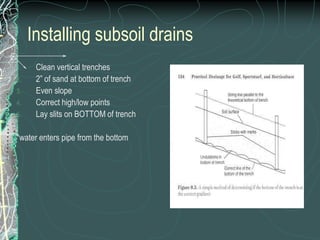
Installing subsoil drainsClean vertical trenches2” of sand at bottom of trenchEven slopeCorrect high/low points Lay slits on BOTTOM of trench*water enters pipe from the bottom
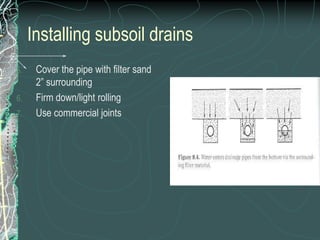
Installing subsoil drainsCover the pipe with filter sand 2” surrounding Firm down/light rollingUse commercial joints
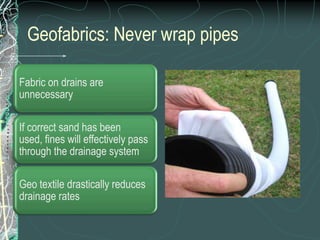
Geofabrics: Never wrap pipes
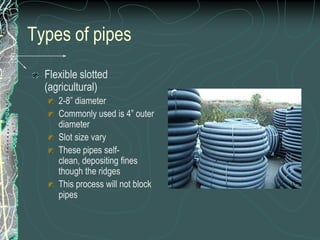
Types of pipesFlexible slotted (agricultural)2-8” diameterCommonly used is 4” outer diameterSlot size varyThese pipes self-clean, depositing fines though the ridgesThis process will not block pipes
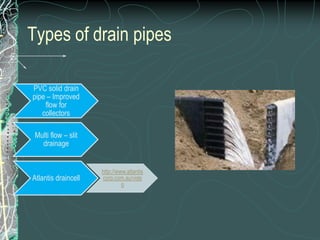
Types of drain pipes
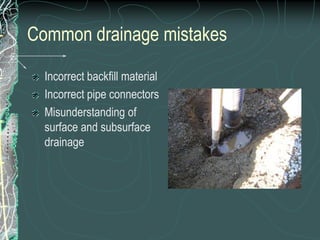
Common drainage mistakesIncorrect backfill materialIncorrect pipe connectorsMisunderstanding of surface and subsurface drainage
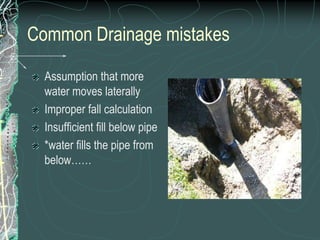
Common Drainage mistakesAssumption that more water moves laterallyImproper fall calculationInsufficient fill below pipe*water fills the pipe from below


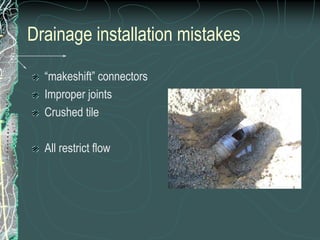
Drainage installation mistakes“makeshift” connectorsImproper jointsCrushed tileAll restrict flow
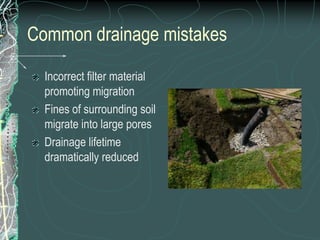
Common drainage mistakesIncorrect filter material promoting migrationFines of surrounding soil migrate into large poresDrainage lifetime dramatically reduced
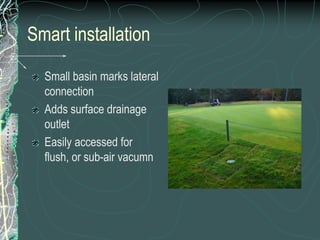
Smart installationSmall basin marks lateral connectionAdds surface drainage outletEasily accessed for flush, or sub-air vacumn
Sizing drainsHigh traffic area with subtle drain coverOff back of greenRealistic sizingNo additional labor for trimming/maintenance
Slit Drainagehttp://tdsdrainage.com/articles.html
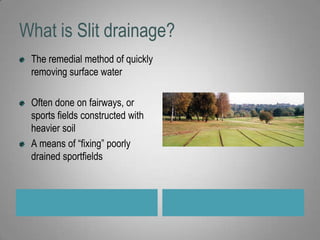
What is Slit drainage?The remedial method of quickly removing surface waterOften done on fairways, or sports fields constructed with heavier soilA means of “fixing” poorly drained sportfields
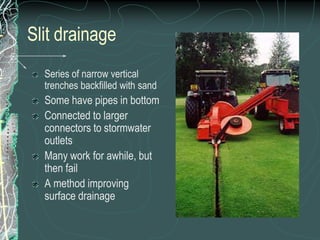
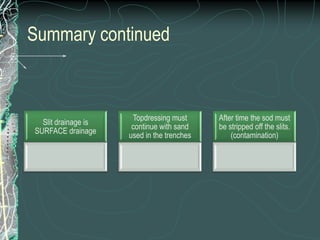
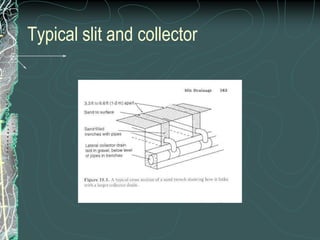
Slit drainageSeries of narrow vertical trenches backfilled with sandSome have pipes in bottomConnected to larger connectors to stormwater outletsMany work for awhile, but then failA method improving surface drainage
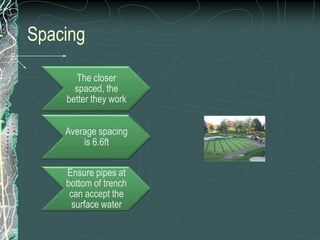
Spacing
Design and planning steps
Typical slit and collector
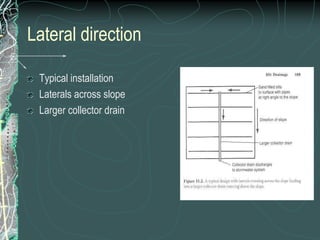
Lateral directionTypical installationLaterals across slopeLarger collector drain
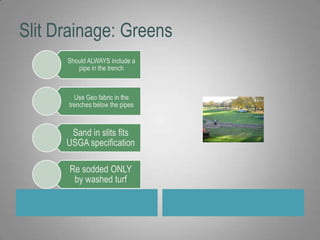
Slit Drainage: Greens
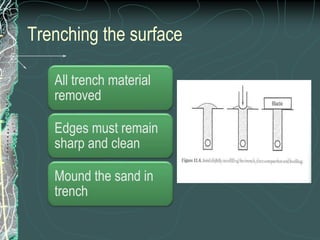
Trenching the surface
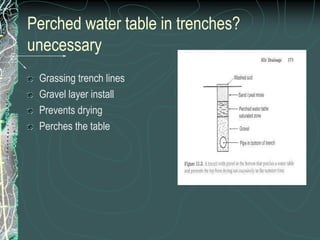
Perched water table in trenches? unecessaryGrassing trench linesGravel layer installPrevents dryingPerches the table
Summary of Slit drainage
Summary continued
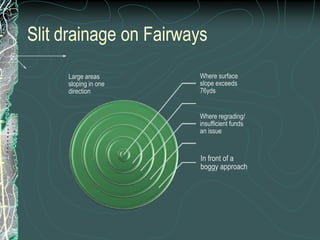
Slit drainage on Fairways
ReviewDrainage
Name 2 examples of moisture-related diseases that can be avoided with good drainage.Pythium root rot
Pythium blight
Rhizoctonia brown patchName 3 advantages to good drainage:less compaction to well-drained soilBetter water absorption after a rainfallImprovement of subsoil moisture conditions
What is the name of the longest and deepest drains on a golf course?Main Collector Drains
Where are the Collector Drains normally installed?In the lowest-lying areas to be drained into irrigation source
How can Slit Drainage save an older green from being totally rebuilt?allows excess water to escape before it can freeze and cause damage to the surface on older push-up style greens.
What is the limitation of slit drainage?Trenches must remain open Routinely opened, or top dressed
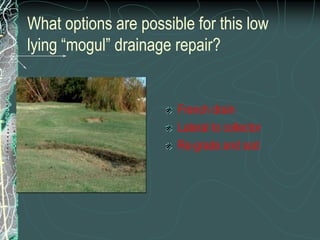
What options are possible for this low lying “mogul” drainage repair?French drainLateral to collectorRe-grade and sod
What  is the slope & run rule of thumb when designing drainage?3% slope, minimum 1%, max run is 1:70
Explain the relationship of a lateral, catch basin, and collector in fairway drainage.Lateral is subsurface drainage system to meet the collector underground, a catch basin intercepts surface water and is connected to main collector
How do contour maps illustrate the best place for an irrigation pond?Contour maps illustrate the lowest point on the golf course.  ideally, natural drainage will occur  into this area.
Slit drains are often used on greens and fairways.  Do they facilitate surface or subsurface drainage? Slit drainage are surface water drainage
Following a slit drainage project, we sod the trenches
..True or False? False
Hydraway drainage systemhttp://www.hydraway.net/video.php
 Hydraway states their product is a subsurface drainage system.   This statement is only minutely correct. ExplainThis is primarily a surface drainage system.
Lateral movement of water in soil is so minute in comparison.Hydraway states their backfill is coarse sand, providing an “additional filter” to remove clay fines in the soil. Although it does not remove fine particles, the design may minimize lateral movement of silt and clay. How?  The impermeable PVC one-sided tile may physically reduce lateral movement of fines from soil to the coarse sand.
Would the Hydraway system work without the tile?  What advantages does the tile really offer?Yes, backfilling with coarse sand will facilitate equivalent surface drainage properties.
The strength of the PVC tile will add to trench longevity by preventing collapse by repeated trafficAlthough you have a trencher, trailer and loader, what other considerations may prompt hiring an outside contractor?  They are liable for failed systems
 daily tasks will not suffer
poor soils can add unknown expenses to the project-these are assumed by the contractor, paid by the job. (breakdowns, labor, design changes etc)  Although the advantages of using slit drainage as effective surface drainage outweight the disadvantages, what additional concerns may you have if performing this project on a putting green?Trench lines should not be sodded unless with washed sod so not to contaminate coarse sand in the trench.
Slit drainage is not a permanent solution, and may need to be done every couple of years.How can trees contribute to poor drainage?by blocking sunlight and air circulation, which reduces both evaporation and 	transpiration of moisture from the turf canopy.
What can you do if your drainage problem is severe due to impermeable soil?Aggressive aeration,
deep tine and solid tine with sand topdressing will
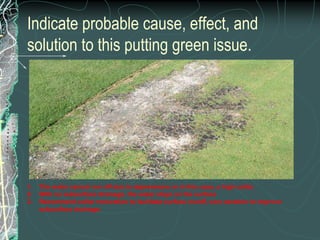
Slit drainage project or reconstruction may be necessary to reduce cost of aggressive aerations.  Indicate probable cause, effect, and solution to this putting green issue.The water cannot run off due to depressions or in this case, a high collar. With no subsurface drainage, the water stays on the surfaceRecommend collar renovation to facilitate surface runoff, core aeration to improve subsurface drainage.

F3 Subsoil drainage and installation

  • 1.
  • 2.
    Discharge area: SubsoildrainsDecide where to discharge the waterDesign UP from discharge point (minimum 1:70)Have uniform fall on all pipes
  • 3.
    Discharge area: SubsoildrainsOpen drainCreekBe aware what will happen during floodingDischarge must be above levelDesign the drain FROM the discharge point upwardUniform fall on all pipes
  • 4.
    Subsoil drain pattern:Favoureddesign30-45% angleSmall laterals into larger mainFlexible corrugated tileJoints are offset from each other
  • 5.
    Determining pipe sizingManufacturerssupply max flow performanceAs pipe length increases, friction loss increasesMain runs with the slopeLaterals run across slope
  • 6.
    A fall of.5ft in 49.5 ft is 1:99Efficient and simpleLaterals same distance apartUniform drainage for the whole area
  • 7.
  • 8.
    How to sizepipeAssume area of 1ac (43,560ft sq)Uniform slope of 1:70, down 295 ft. no cross fallSubsoil drains spaced at 6.6ft, topsoil at 12” HC 2”/hrRainfall event of 2”/hr
  • 9.
  • 10.
    Sizing drainsHigh trafficarea with subtle drain coverOff back of greenRealistic sizingNo additional labor for trimming/maintenance
  • 11.
    Installing subsoil drainsMigrationFiltermaterialInstallation techniques
  • 12.
    Choosing the rightfilter materialFilter material should bemade on the basis of type or sand that will surround itIf the drain is in a fine soil, filter should be a coarse river sand-NOT GRAVEL!
  • 13.
    Migration of particlesSignificantamount of fines enter the surrounding soilTHIS moves fines into the pipeQuickly collapses the drain, often during first few waterings
  • 14.
    Particle migration intocoarser gravelsCommon mistakes:Surround pipe with coarse gravel or crushPea gravel ÂŒ - 3/8” often specifiedOverall, these gravels are too large!!
  • 15.
    Filter material enteringpipe We are too worried about filter material entering the drain pipeIf gravel is used, smaller particles will migrate into the large pores
  • 16.
    When to usegravel filter material
  • 17.
    Clean filter materialMakesure no fines in the filter materialUse HC of the filter material >100”/hr (sand withought fines)Misconception: Sand will not enter drain pipe except from above. Surface area of slots is less that 1% of pipe surface area.
  • 18.
    Bridging factorIf gravelis too coarse, bridging factor will be too highUsing finer filter material prevents migration of particles from surrounding soil.
  • 19.
    Diameter ratingWhen installingsubsoil drains, in any situation other than USGA sand, use clean washed sand. NOT pea gravel, or any gravel with a D15 less than 1mm. D15 means 15% of the filler is larger than the specified size, 85% spec.
  • 20.
    Installing subsoil drainsCutinto the area below the soil to be drainedMake sure sides are verticalAvoid subsoil contaminationProvide uniform slope
  • 21.
    Installing subsoil drainsCleanvertical trenches2” of sand at bottom of trenchEven slopeCorrect high/low points Lay slits on BOTTOM of trench*water enters pipe from the bottom
  • 22.
    Installing subsoil drainsCoverthe pipe with filter sand 2” surrounding Firm down/light rollingUse commercial joints
  • 23.
  • 24.
    Types of pipesFlexibleslotted (agricultural)2-8” diameterCommonly used is 4” outer diameterSlot size varyThese pipes self-clean, depositing fines though the ridgesThis process will not block pipes
  • 25.
  • 26.
    Common drainage mistakesIncorrectbackfill materialIncorrect pipe connectorsMisunderstanding of surface and subsurface drainage
  • 27.
    Common Drainage mistakesAssumptionthat more water moves laterallyImproper fall calculationInsufficient fill below pipe*water fills the pipe from below


  • 28.
    Drainage installation mistakes“makeshift”connectorsImproper jointsCrushed tileAll restrict flow
  • 29.
    Common drainage mistakesIncorrectfilter material promoting migrationFines of surrounding soil migrate into large poresDrainage lifetime dramatically reduced
  • 30.
    Smart installationSmall basinmarks lateral connectionAdds surface drainage outletEasily accessed for flush, or sub-air vacumn
  • 31.
    Sizing drainsHigh trafficarea with subtle drain coverOff back of greenRealistic sizingNo additional labor for trimming/maintenance
  • 32.
  • 33.
    What is Slitdrainage?The remedial method of quickly removing surface waterOften done on fairways, or sports fields constructed with heavier soilA means of “fixing” poorly drained sportfields
  • 34.
    Slit drainageSeries ofnarrow vertical trenches backfilled with sandSome have pipes in bottomConnected to larger connectors to stormwater outletsMany work for awhile, but then failA method improving surface drainage
  • 35.
  • 36.
  • 37.
  • 38.
    Lateral directionTypical installationLateralsacross slopeLarger collector drain
  • 39.
  • 40.
  • 41.
    Perched water tablein trenches? unecessaryGrassing trench linesGravel layer installPrevents dryingPerches the table
  • 42.
  • 43.
  • 44.
  • 45.
  • 46.
    Name 2 examplesof moisture-related diseases that can be avoided with good drainage.Pythium root rot
  • 47.
  • 48.
    Rhizoctonia brown patchName3 advantages to good drainage:less compaction to well-drained soilBetter water absorption after a rainfallImprovement of subsoil moisture conditions
  • 49.
    What is thename of the longest and deepest drains on a golf course?Main Collector Drains
  • 50.
    Where are theCollector Drains normally installed?In the lowest-lying areas to be drained into irrigation source
  • 51.
    How can SlitDrainage save an older green from being totally rebuilt?allows excess water to escape before it can freeze and cause damage to the surface on older push-up style greens.
  • 52.
    What is thelimitation of slit drainage?Trenches must remain open Routinely opened, or top dressed
  • 53.
    What options arepossible for this low lying “mogul” drainage repair?French drainLateral to collectorRe-grade and sod
  • 54.
    What isthe slope & run rule of thumb when designing drainage?3% slope, minimum 1%, max run is 1:70
  • 55.
    Explain the relationshipof a lateral, catch basin, and collector in fairway drainage.Lateral is subsurface drainage system to meet the collector underground, a catch basin intercepts surface water and is connected to main collector
  • 56.
    How do contourmaps illustrate the best place for an irrigation pond?Contour maps illustrate the lowest point on the golf course. ideally, natural drainage will occur into this area.
  • 57.
    Slit drains areoften used on greens and fairways. Do they facilitate surface or subsurface drainage? Slit drainage are surface water drainage
  • 58.
    Following a slitdrainage project, we sod the trenches
..True or False? False
  • 59.
  • 60.
     Hydraway states theirproduct is a subsurface drainage system. This statement is only minutely correct. ExplainThis is primarily a surface drainage system.
  • 61.
    Lateral movement ofwater in soil is so minute in comparison.Hydraway states their backfill is coarse sand, providing an “additional filter” to remove clay fines in the soil. Although it does not remove fine particles, the design may minimize lateral movement of silt and clay. How? The impermeable PVC one-sided tile may physically reduce lateral movement of fines from soil to the coarse sand.
  • 62.
    Would the Hydrawaysystem work without the tile? What advantages does the tile really offer?Yes, backfilling with coarse sand will facilitate equivalent surface drainage properties.
  • 63.
    The strength ofthe PVC tile will add to trench longevity by preventing collapse by repeated trafficAlthough you have a trencher, trailer and loader, what other considerations may prompt hiring an outside contractor? They are liable for failed systems
  • 64.
    daily taskswill not suffer
  • 65.
    poor soils canadd unknown expenses to the project-these are assumed by the contractor, paid by the job. (breakdowns, labor, design changes etc) Although the advantages of using slit drainage as effective surface drainage outweight the disadvantages, what additional concerns may you have if performing this project on a putting green?Trench lines should not be sodded unless with washed sod so not to contaminate coarse sand in the trench.
  • 66.
    Slit drainage isnot a permanent solution, and may need to be done every couple of years.How can trees contribute to poor drainage?by blocking sunlight and air circulation, which reduces both evaporation and transpiration of moisture from the turf canopy.
  • 67.
    What can youdo if your drainage problem is severe due to impermeable soil?Aggressive aeration,
  • 68.
    deep tine andsolid tine with sand topdressing will
  • 69.
    Slit drainage projector reconstruction may be necessary to reduce cost of aggressive aerations. Indicate probable cause, effect, and solution to this putting green issue.The water cannot run off due to depressions or in this case, a high collar. With no subsurface drainage, the water stays on the surfaceRecommend collar renovation to facilitate surface runoff, core aeration to improve subsurface drainage.