Seminar Topic On NUCLEAR POWER PLANT AND ITS IMPORTANCE IN INDIA Tapas kumar Mishra 7 th  sem,Electrical Under the able guidance of Er. M.M. Patra Prof J.K. Maharana(HOD)
CONTENTS Introduction Nuclear reaction Nuclear fission process Nuclear chain reaction Constituents of Nuclear power plant Nuclear Reactor(Main parts) Types of power reactors commonly used Nuclear energy deal in India
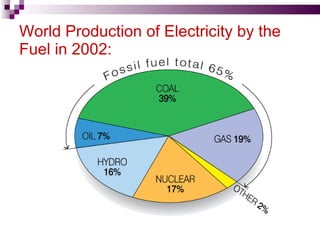
World Production of Electricity by the Fuel in 2002:
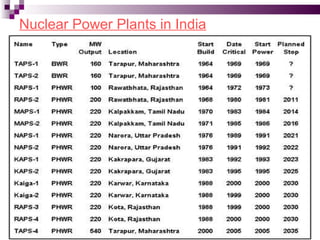
Nuclear Power Plants in India
Nuclear Reaction:- A projectile is taken Mass-Energy conversion acc. to Einstein’s equation
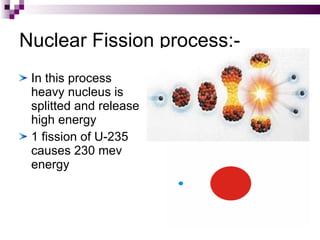
Nuclear Fission process:- In this process heavy nucleus is splitted and release high energy 1 fission of U-235 causes 230 mev energy
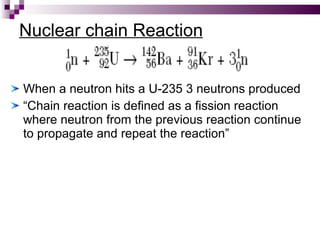
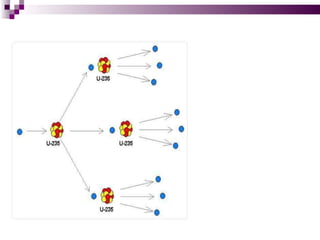
Nuclear chain Reaction When a neutron hits a U-235 3 neutrons produced “ Chain reaction is defined as a fission reaction where neutron from the previous reaction continue to propagate and repeat the reaction”
 
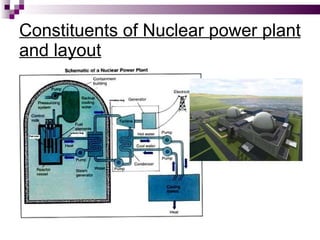
Constituents of Nuclear power plant and layout
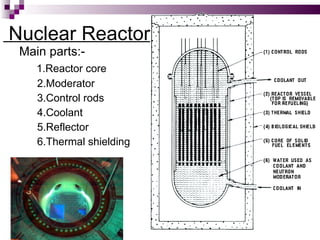
Nuclear Reactor Main parts:- 1.Reactor core 2.Moderator 3.Control rods 4.Coolant 5.Reflector 6.Thermal shielding
Power Reactors in common use Boiling water Reactor(BWR) Pressurized water Reactor(PWR) Heavy water cooled and moderated(CANDU TYPE) Reactor Gas Cooled Reactor Liquid metal cooled Reactor
1.Boiling Water Reactor Fuel used is rich in uranium oxide. Ordinary water is used as both moderator and coolant. Low thermal efficiency. Can’t meet sudden increase of load.
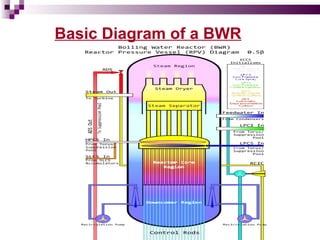
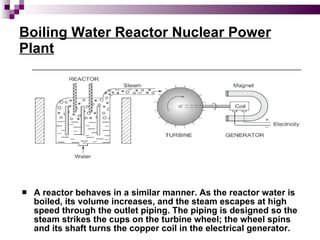
Basic Diagram of a BWR
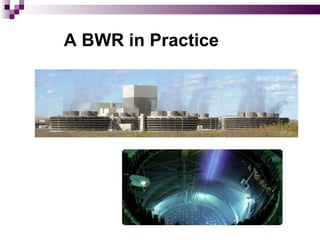
A BWR in Practice
Boiling Water Reactor Nuclear Power Plant A reactor behaves in a similar manner. As the reactor water is boiled, its volume increases, and the steam escapes at high speed through the outlet piping. The piping is designed so the steam strikes the cups on the turbine wheel; the wheel spins and its shaft turns the copper coil in the electrical generator.
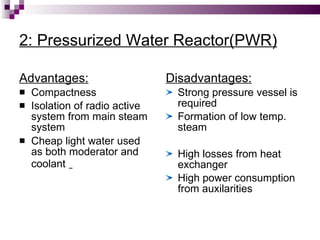
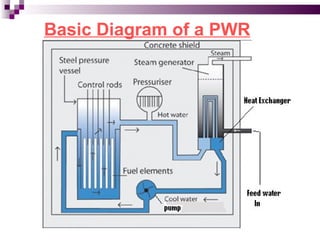
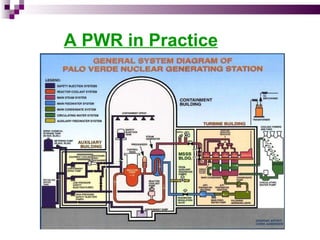
2: Pressurized Water Reactor(PWR) Advantages: Compactness Isolation of radio active system from main steam system Cheap light water used as both moderator and coolant   Disadvantages: Strong pressure vessel is required Formation of low temp. steam High losses from heat exchanger High power consumption from auxilarities
Basic Diagram of a PWR
A PWR in Practice
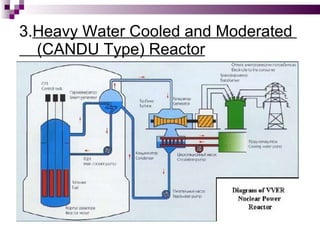
3. Heavy Water Cooled and Moderated    (CANDU Type) Reactor
Description of CANDU type reactor It makes use of heavy hydrogen  isotope   (H 1 2 ) as moderator Primary and secondary cicuits are similar to PWR It’s very expensive to separate Control rods are not required It has high multiplication factor and low level fuel consumption
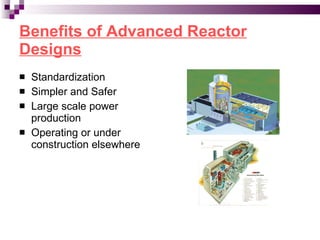
Advanced Reactor Designs Under Consideration GE-Hitachi ABWR – NRC Certified (1997)  Westinghouse AP1000 – NRC Certified (2005) GE-Hitachi ESBWR – Under NRC Review  AREVA US-EPR – Under NRC review  Mitsubishi US-APWR – Under NRC Review
Benefits of Advanced Reactor Designs Standardization Simpler and Safer Large scale power production Operating or under construction elsewhere
Indian Nuclear Program: The Present Status 12 PHWR  & 2 BWR now under operation 4 PHWR and 2 LWR under commission 2950 MW  generation & 3000 MW under commission Successful experiments  with Fast Breeder Test Reactor (FBTR) Prototype Fast Breeder Reactor (PFBR)  for 500MWe  under construction Advanced Heavy Water Reactor (AHWR) using (Pu-Th) O2 MOX for 300MWe: advanced stage of design approval; construction soon to begin.
Reactor Generations Gen I Prototypes in 50’s & 60’s Gen II 70’s & 80’s Today’s Operational Reactors BWR, PWR, CANDU, … Gen III ABWR, APWR Approved 90’s Some Built around the World Gen III+ Current Advanced Designs in the Approval Process Pebble Bed Reactor Gen IV Deploy in 2030 Economical Safe Minimize Waste Reduce Proliferation
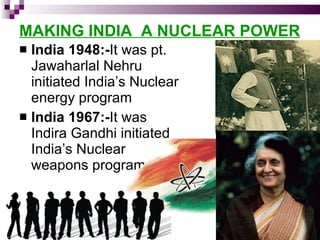
MAKING INDIA  A NUCLEAR POWER India 1948:- It was pt. Jawaharlal Nehru initiated India’s Nuclear energy program India 1967:- It was Indira Gandhi initiated India’s Nuclear weapons program
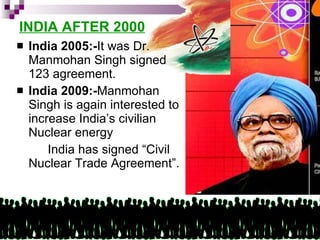
INDIA AFTER 2000 India 2005:- It was Dr. Manmohan Singh signed 123 agreement. India 2009:- Manmohan Singh is again interested to increase India’s civilian Nuclear energy India has signed “Civil Nuclear Trade Agreement”.
THANK YOU

Nuclear power plant

  • 1.
    Seminar Topic OnNUCLEAR POWER PLANT AND ITS IMPORTANCE IN INDIA Tapas kumar Mishra 7 th sem,Electrical Under the able guidance of Er. M.M. Patra Prof J.K. Maharana(HOD)
  • 2.
    CONTENTS Introduction Nuclearreaction Nuclear fission process Nuclear chain reaction Constituents of Nuclear power plant Nuclear Reactor(Main parts) Types of power reactors commonly used Nuclear energy deal in India
  • 3.
    World Production ofElectricity by the Fuel in 2002:
  • 4.
  • 5.
    Nuclear Reaction:- Aprojectile is taken Mass-Energy conversion acc. to Einstein’s equation
  • 6.
    Nuclear Fission process:-In this process heavy nucleus is splitted and release high energy 1 fission of U-235 causes 230 mev energy
  • 7.
    Nuclear chain ReactionWhen a neutron hits a U-235 3 neutrons produced “ Chain reaction is defined as a fission reaction where neutron from the previous reaction continue to propagate and repeat the reaction”
  • 8.
  • 9.
    Constituents of Nuclearpower plant and layout
  • 10.
    Nuclear Reactor Mainparts:- 1.Reactor core 2.Moderator 3.Control rods 4.Coolant 5.Reflector 6.Thermal shielding
  • 11.
    Power Reactors incommon use Boiling water Reactor(BWR) Pressurized water Reactor(PWR) Heavy water cooled and moderated(CANDU TYPE) Reactor Gas Cooled Reactor Liquid metal cooled Reactor
  • 12.
    1.Boiling Water ReactorFuel used is rich in uranium oxide. Ordinary water is used as both moderator and coolant. Low thermal efficiency. Can’t meet sudden increase of load.
  • 13.
  • 14.
    A BWR inPractice
  • 15.
    Boiling Water ReactorNuclear Power Plant A reactor behaves in a similar manner. As the reactor water is boiled, its volume increases, and the steam escapes at high speed through the outlet piping. The piping is designed so the steam strikes the cups on the turbine wheel; the wheel spins and its shaft turns the copper coil in the electrical generator.
  • 16.
    2: Pressurized WaterReactor(PWR) Advantages: Compactness Isolation of radio active system from main steam system Cheap light water used as both moderator and coolant Disadvantages: Strong pressure vessel is required Formation of low temp. steam High losses from heat exchanger High power consumption from auxilarities
  • 17.
  • 18.
    A PWR inPractice
  • 19.
    3. Heavy WaterCooled and Moderated (CANDU Type) Reactor
  • 20.
    Description of CANDUtype reactor It makes use of heavy hydrogen isotope (H 1 2 ) as moderator Primary and secondary cicuits are similar to PWR It’s very expensive to separate Control rods are not required It has high multiplication factor and low level fuel consumption
  • 21.
    Advanced Reactor DesignsUnder Consideration GE-Hitachi ABWR – NRC Certified (1997) Westinghouse AP1000 – NRC Certified (2005) GE-Hitachi ESBWR – Under NRC Review AREVA US-EPR – Under NRC review Mitsubishi US-APWR – Under NRC Review
  • 22.
    Benefits of AdvancedReactor Designs Standardization Simpler and Safer Large scale power production Operating or under construction elsewhere
  • 23.
    Indian Nuclear Program:The Present Status 12 PHWR & 2 BWR now under operation 4 PHWR and 2 LWR under commission 2950 MW generation & 3000 MW under commission Successful experiments with Fast Breeder Test Reactor (FBTR) Prototype Fast Breeder Reactor (PFBR) for 500MWe under construction Advanced Heavy Water Reactor (AHWR) using (Pu-Th) O2 MOX for 300MWe: advanced stage of design approval; construction soon to begin.
  • 24.
    Reactor Generations GenI Prototypes in 50’s & 60’s Gen II 70’s & 80’s Today’s Operational Reactors BWR, PWR, CANDU, … Gen III ABWR, APWR Approved 90’s Some Built around the World Gen III+ Current Advanced Designs in the Approval Process Pebble Bed Reactor Gen IV Deploy in 2030 Economical Safe Minimize Waste Reduce Proliferation
  • 25.
    MAKING INDIA A NUCLEAR POWER India 1948:- It was pt. Jawaharlal Nehru initiated India’s Nuclear energy program India 1967:- It was Indira Gandhi initiated India’s Nuclear weapons program
  • 26.
    INDIA AFTER 2000India 2005:- It was Dr. Manmohan Singh signed 123 agreement. India 2009:- Manmohan Singh is again interested to increase India’s civilian Nuclear energy India has signed “Civil Nuclear Trade Agreement”.
  • 27.