Potential
Medicines
under consideration
For Treatment of COVID-19
No Medicine yet
to prevent or
Cure
What is COVID-19?
COVID-19 is the disease caused by an infection
of the SARS-CoV-2 virus, first identified in the city
of Wuhan, in China's Hubei province in December
2019. COVID-19 was previously known as 2019
Novel Coronavirus (2019-nCoV) respiratory
disease before the World Health Organization
(WHO) declared the official name as COVID-19 in
February 2020.
Symptoms
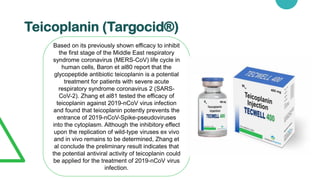
The most common symptoms of COVID-19
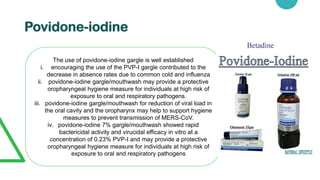
include dry cough, fever, and shortness of
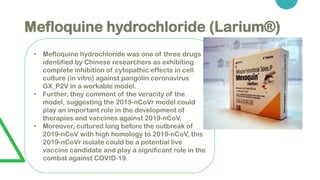
breath. It is thought that symptoms can appear
between 2-14 days after exposure although there
have been isolated cases which suggest this may
be longer. If you develop symptoms, you should
stay at home to prevent the spread of the disease
into the community. Wearing a face mask will help
prevent the spread of the disease to others.
Monoclonal antibodies
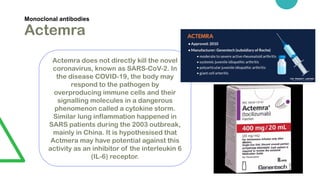
Actemra
Actemra does not directly kill the novel
coronavirus, known as SARS-CoV-2. In
the disease COVID-19, the body may
respond to the pathogen by
overproducing immune cells and their
signalling molecules in a dangerous
phenomenon called a cytokine storm.
Similar lung inflammation happened in
SARS patients during the 2003 outbreak,
mainly in China. It is hypothesised that
Actmera may have potential against this
activity as an inhibitor of the interleukin 6
(IL-6) receptor.
Monoclonal antibodies
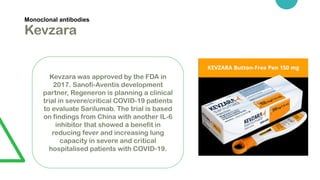
Kevzara
Kevzara was approved by the FDA in
2017. Sanofi-Aventis development
partner, Regeneron is planning a clinical
trial in severe/critical COVID-19 patients
to evaluate Sarilumab. The trial is based
on findings from China with another IL-6
inhibitor that showed a benefit in
reducing fever and increasing lung
capacity in severe and critical
hospitalised patients with COVID-19.
Monoclonal antibodies
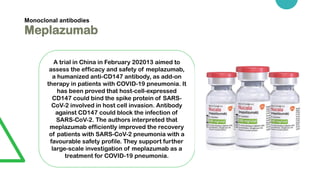
Meplazumab
A trial in China in February 202013 aimed to
assess the efficacy and safety of meplazumab,
a humanized anti-CD147 antibody, as add-on
therapy in patients with COVID-19 pneumonia. It
has been proved that host-cell-expressed
CD147 could bind the spike protein of SARS-
CoV-2 involved in host cell invasion. Antibody
against CD147 could block the infection of
SARS-CoV-2. The authors interpreted that
meplazumab efficiently improved the recovery
of patients with SARS-CoV-2 pneumonia with a
favourable safety profile. They support further
large-scale investigation of meplazumab as a
treatment for COVID-19 pneumonia.
Monoclonal antibodies - immunosuppressants
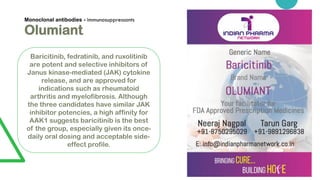
Olumiant
Baricitinib, fedratinib, and ruxolitinib
are potent and selective inhibitors of
Janus kinase-mediated (JAK) cytokine
release, and are approved for
indications such as rheumatoid
arthritis and myelofibrosis. Although
the three candidates have similar JAK
inhibitor potencies, a high affinity for
AAK1 suggests baricitinib is the best
of the group, especially given its once-
daily oral dosing and acceptable side-
effect profile.
Antivirals
Camostat mesylate
Camostat mesylate, a drug approved for human
use in Japan to treat pancreatic inflammation,
inhibits SARS-CoV-2 infection of lung cells in cell
culture.
Danish researchers plan to enrol 180 patients
with COVID-19 in a placebo-controlled trial for
five days to determine effect in vivo. Results are
expected
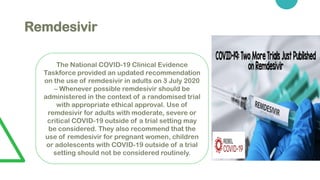
Remdesivir
The National COVID-19 Clinical Evidence
Taskforce provided an updated recommendation
on the use of remdesivir in adults on 3 July 2020
– Whenever possible remdesivir should be
administered in the context of a randomised trial
with appropriate ethical approval. Use of
remdesivir for adults with moderate, severe or
critical COVID-19 outside of a trial setting may
be considered. They also recommend that the
use of remdesivir for pregnant women, children
or adolescents with COVID-19 outside of a trial
setting should not be considered routinely.
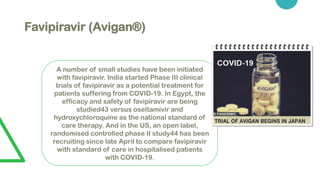
Favipiravir (Avigan®)
A number of small studies have been initiated
with favipiravir. India started Phase III clinical
trials of favipiravir as a potential treatment for
patients suffering from COVID-19. In Egypt, the
efficacy and safety of favipiravir are being
studied43 versus oseltamivir and
hydroxychloroquine as the national standard of
care therapy. And in the US, an open label,
randomised controlled phase II study44 has been
recruiting since late April to compare favipiravir
with standard of care in hospitalised patients
with COVID-19.
Rintatolimod
Rintatolimod is a class of
specifically configured ribonucleic
acid (RNA) compounds targeted as
potential treatment of diseases
with immunologic defects and/or
viral causation. It has been used as
an experimental
immunotherapeutic, for chronic
fatigue syndrome (myalgic
encephalomyelitis) in Australia and
New Zealand.
Rintatolimod is to be tested
as a prophylaxis/early-onset
agent against COVID-19 in a
clinical trial conducted by
Japan’s National Institute of
Infectious Diseases (NIID)
and the University of Tokyo
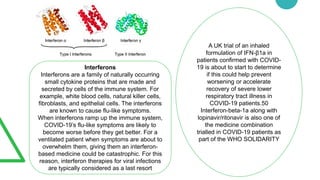
Interferons
Interferons are a family of naturally occurring
small cytokine proteins that are made and
secreted by cells of the immune system. For
example, white blood cells, natural killer cells,
fibroblasts, and epithelial cells. The interferons
are known to cause flu-like symptoms.
When interferons ramp up the immune system,
COVID-19’s flu-like symptoms are likely to
become worse before they get better. For a
ventilated patient when symptoms are about to
overwhelm them, giving them an interferon-
based medicine could be catastrophic. For this
reason, interferon therapies for viral infections
are typically considered as a last resort
A UK trial of an inhaled
formulation of IFN-β1a in
patients confirmed with COVID-
19 is about to start to determine
if this could help prevent
worsening or accelerate
recovery of severe lower
respiratory tract illness in
COVID-19 patients.50
Interferon-beta-1a along with
lopinavir/ritonavir is also one of
the medicine combination
trialled in COVID-19 patients as
part of the WHO SOLIDARITY
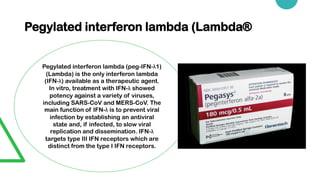
Pegylated interferon lambda (Lambda®
Pegylated interferon lambda (peg-IFN-λ1)
(Lambda) is the only interferon lambda
(IFN-λ) available as a therapeutic agent.
In vitro, treatment with IFN-λ showed
potency against a variety of viruses,
including SARS-CoV and MERS-CoV. The
main function of IFN-λ is to prevent viral
infection by establishing an antiviral
state and, if infected, to slow viral
replication and dissemination. IFN-λ
targets type III IFN receptors which are
distinct from the type I IFN receptors.
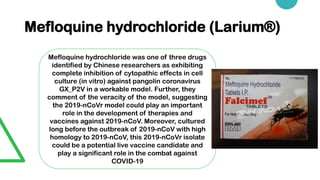
Mefloquine hydrochloride (Larium®)
Mefloquine hydrochloride was one of three drugs
identified by Chinese researchers as exhibiting
complete inhibition of cytopathic effects in cell
culture (in vitro) against pangolin coronavirus
GX_P2V in a workable model. Further, they
comment of the veracity of the model, suggesting
the 2019-nCoVr model could play an important
role in the development of therapies and
vaccines against 2019-nCoV. Moreover, cultured
long before the outbreak of 2019-nCoV with high
homology to 2019-nCoV, this 2019-nCoVr isolate
could be a potential live vaccine candidate and
play a significant role in the combat against
COVID-19
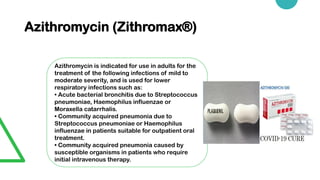
Azithromycin (Zithromax®)
Azithromycin is indicated for use in adults for the
treatment of the following infections of mild to
moderate severity, and is used for lower
respiratory infections such as:
• Acute bacterial bronchitis due to Streptococcus
pneumoniae, Haemophilus influenzae or
Moraxella catarrhalis.
• Community acquired pneumonia due to
Streptococcus pneumoniae or Haemophilus
influenzae in patients suitable for outpatient oral
treatment.
• Community acquired pneumonia caused by
susceptible organisms in patients who require
initial intravenous therapy.
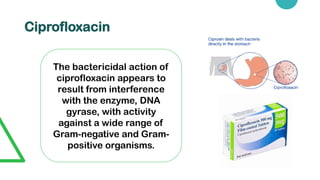
Ciprofloxacin
The bactericidal action of
ciprofloxacin appears to
result from interference
with the enzyme, DNA
gyrase, with activity
against a wide range of
Gram-negative and Gram-
positive organisms.
Teicoplanin (Targocid®)
Based on its previously shown efficacy to inhibit
the first stage of the Middle East respiratory
syndrome coronavirus (MERS-CoV) life cycle in
human cells, Baron et al80 report that the
glycopeptide antibiotic teicoplanin is a potential
treatment for patients with severe acute
respiratory syndrome coronavirus 2 (SARS-
CoV-2). Zhang et al81 tested the efficacy of
teicoplanin against 2019-nCoV virus infection
and found that teicoplanin potently prevents the
entrance of 2019-nCoV-Spike-pseudoviruses
into the cytoplasm. Although the inhibitory effect
upon the replication of wild-type viruses ex vivo
and in vivo remains to be determined, Zhang et
al conclude the preliminary result indicates that
the potential antiviral activity of teicoplanin could
be applied for the treatment of 2019-nCoV virus
infection.
Povidone-iodine
The use of povidone-iodine gargle is well established
i. encouraging the use of the PVP-I gargle contributed to the
decrease in absence rates due to common cold and influenza
ii. povidone-iodine gargle/mouthwash may provide a protective
oropharyngeal hygiene measure for individuals at high risk of
exposure to oral and respiratory pathogens.
iii. povidone-iodine gargle/mouthwash for reduction of viral load in
the oral cavity and the oropharynx may help to support hygiene
measures to prevent transmission of MERS-CoV.
iv. povidone-iodine 7% gargle/mouthwash showed rapid
bactericidal activity and virucidal efficacy in vitro at a
concentration of 0.23% PVP-I and may provide a protective
oropharyngeal hygiene measure for individuals at high risk of
exposure to oral and respiratory pathogens
Mefloquine hydrochloride (Larium®)
• Mefloquine hydrochloride was one of three drugs
identified by Chinese researchers as exhibiting
complete inhibition of cytopathic effects in cell
culture (in vitro) against pangolin coronavirus
GX_P2V in a workable model.
• Further, they comment of the veracity of the
model, suggesting the 2019-nCoVr model could
play an important role in the development of
therapies and vaccines against 2019-nCoV.
• Moreover, cultured long before the outbreak of
2019-nCoV with high homology to 2019-nCoV, this
2019-nCoVr isolate could be a potential live
vaccine candidate and play a significant role in the
combat against COVID-19.
Ivermectin
A collaborative study
published on 3 April
2020 has shown that
the anti-parasitic
drug, ivermectin
stopped the SARS-
CoV-2 virus growing
in cell culture within
48 hours
Investigators cautioned that they
need to establish if the dosage that
can be used safely in humans will be
effective to treat those with
COVID-19.
available
pharmacokinetic
data from
clinically relevant
and excessive
dosing studies
indicate that the
SARS-CoV-2
inhibitory
concentrations
are not likely to
be attainable in
humans.
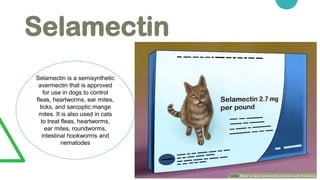
Selamectin
Selamectin is a semisynthetic
avermectin that is approved
for use in dogs to control
fleas, heartworms, ear mites,
ticks, and sarcoptic mange
mites. It is also used in cats
to treat fleas, heartworms,
ear mites, roundworms,
intestinal hookworms and
nematodes
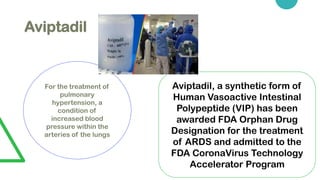
Aviptadil
For the treatment of
pulmonary
hypertension, a
condition of
increased blood
pressure within the
arteries of the lungs
Aviptadil, a synthetic form of
Human Vasoactive Intestinal
Polypeptide (VIP) has been
awarded FDA Orphan Drug
Designation for the treatment
of ARDS and admitted to the
FDA CoronaVirus Technology
Accelerator Program
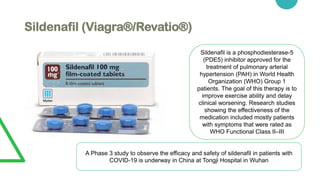
Sildenafil (Viagra®/Revatio®)
Sildenafil is a phosphodiesterase-5
(PDE5) inhibitor approved for the
treatment of pulmonary arterial
hypertension (PAH) in World Health
Organization (WHO) Group 1
patients. The goal of this therapy is to
improve exercise ability and delay
clinical worsening. Research studies
showing the effectiveness of the
medication included mostly patients
with symptoms that were rated as
WHO Functional Class II–III
A Phase 3 study to observe the efficacy and safety of sildenafil in patients with
COVID-19 is underway in China at Tongji Hospital in Wuhan
Ifenprodil
Approved in some countries
in Asia to treat peripheral
vascular disease In Japan:
approved for treatment of the
dizziness caused by cerebral
infarction sequela or
cerebral haemorrhage
sequela, where it is claimed
the medicine improves
cerebral blood flow by
relaxing vascular smooth
muscle and blocking
sympathetic α receptor
Algernon Pharmaceuticals Inc,
based in Vancouver, is a drug
repurposing company that
investigates approved drugs for
new disease applications. The
company has filed new intellectual
property rights around the world for
ifenprodil for the treatment of
respiratory diseases and is working
to develop a proprietary injectable,
slow-release formulation. The
company reports that it has
finalised the protocol for Phase 2
clinical study of ifenprodil for
COVID-19 patients in South Korea
Dexamethasone
Used in a wide range
of conditions for
anti-inflammatory
and immune
suppressant effects
The WHO welcomes the
preliminary results from the
RECOVERY trial101 and is
planning to coordinate a
meta-analysis to increase
the overall understanding of
dexamethasone in COVID-
19. The WHO clinical
guidance will also be
updated to provide
information on the use of
dexamethasone in
COVID-19.
Convalescent plasma
Convalescent plasma
is the liquid part of blood
that contains antibodies.
When someone recovers
from COVID-19, the virus
antibodies stay in their
plasma. It can be directly
transfused into patients, or
used to make a potential
treatment, COVID-19
Immunoglobulin.
The FDA advises antibody
titres are measured on blood
collection before convalescent
plasma is infused. If not
measured a sample of donor
blood should be saved so that
future testing may investigate
if higher titres correlate with
better outcomes
COVID-19 Immunoglobulin will be developed by
CSL Behring in Australia. Firstly, a small batch of
COVID-19 Immunoglobulin will be produced to
develop tests that detect the presence of the
antibodies that fight the SARS-CoV-2 virus. The
second phase will involve a larger batch of COVID-
19 Immunoglobulin for use in clinical trials in
Australia. CSL Behring are part of the global
CoVIg-19 Plasma Alliance.
Melatonin
(Circadin®)
Monotherapy for the short-term
treatment of primary insomnia
characterised by poor quality of
sleep in patients who are aged
55 or over
Zhang et al109 propose that excessive
inflammation, oxidation, and an exaggerated
immune response likely contribute to
COVID-19 pathology. This is based on
clinical features, pathology and the
pathogenesis of acute respiratory disorder
induced by coronaviruses or other
pathogens. They suggest this leads to a
cytokine storm and subsequent progression
to acute lung injury (ALI)/acute respiratory
distress syndrome (ARDS) and often death.
Melatonin, is an anti-inflammatory and anti-
oxidative molecule, and the authors suggest
it may be protective against ALI/ARDS
caused by viral and other pathogens. The
authors also note that melatonin is effective
in critical care patients by reducing vessel
permeability, anxiety, sedation use, and
improving sleeping quality.
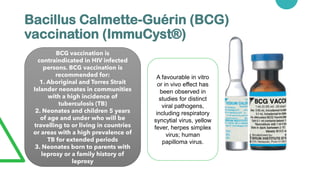
Bacillus Calmette-Guérin (BCG)
vaccination (ImmuCyst®)
BCG vaccination is
contraindicated in HIV infected
persons. BCG vaccination is
recommended for:
1. Aboriginal and Torres Strait
Islander neonates in communities
with a high incidence of
tuberculosis (TB)
2. Neonates and children 5 years
of age and under who will be
travelling to or living in countries
or areas with a high prevalence of
TB for extended periods
3. Neonates born to parents with
leprosy or a family history of
leprosy
A favourable in vitro
or in vivo effect has
been observed in
studies for distinct
viral pathogens,
including respiratory
syncytial virus, yellow
fever, herpes simplex
virus; human
papilloma virus.
QUESTIONS:
maito:primaryinfo@gmail.com
What we do at
primaryinfo.com

Potential meds

  • 1.
    Potential Medicines under consideration For Treatmentof COVID-19 No Medicine yet to prevent or Cure
  • 2.
    What is COVID-19? COVID-19is the disease caused by an infection of the SARS-CoV-2 virus, first identified in the city of Wuhan, in China's Hubei province in December 2019. COVID-19 was previously known as 2019 Novel Coronavirus (2019-nCoV) respiratory disease before the World Health Organization (WHO) declared the official name as COVID-19 in February 2020.
  • 3.
    Symptoms The most commonsymptoms of COVID-19 include dry cough, fever, and shortness of breath. It is thought that symptoms can appear between 2-14 days after exposure although there have been isolated cases which suggest this may be longer. If you develop symptoms, you should stay at home to prevent the spread of the disease into the community. Wearing a face mask will help prevent the spread of the disease to others.
  • 4.
    Monoclonal antibodies Actemra Actemra doesnot directly kill the novel coronavirus, known as SARS-CoV-2. In the disease COVID-19, the body may respond to the pathogen by overproducing immune cells and their signalling molecules in a dangerous phenomenon called a cytokine storm. Similar lung inflammation happened in SARS patients during the 2003 outbreak, mainly in China. It is hypothesised that Actmera may have potential against this activity as an inhibitor of the interleukin 6 (IL-6) receptor.
  • 5.
    Monoclonal antibodies Kevzara Kevzara wasapproved by the FDA in 2017. Sanofi-Aventis development partner, Regeneron is planning a clinical trial in severe/critical COVID-19 patients to evaluate Sarilumab. The trial is based on findings from China with another IL-6 inhibitor that showed a benefit in reducing fever and increasing lung capacity in severe and critical hospitalised patients with COVID-19.
  • 6.
    Monoclonal antibodies Meplazumab A trialin China in February 202013 aimed to assess the efficacy and safety of meplazumab, a humanized anti-CD147 antibody, as add-on therapy in patients with COVID-19 pneumonia. It has been proved that host-cell-expressed CD147 could bind the spike protein of SARS- CoV-2 involved in host cell invasion. Antibody against CD147 could block the infection of SARS-CoV-2. The authors interpreted that meplazumab efficiently improved the recovery of patients with SARS-CoV-2 pneumonia with a favourable safety profile. They support further large-scale investigation of meplazumab as a treatment for COVID-19 pneumonia.
  • 7.
    Monoclonal antibodies -immunosuppressants Olumiant Baricitinib, fedratinib, and ruxolitinib are potent and selective inhibitors of Janus kinase-mediated (JAK) cytokine release, and are approved for indications such as rheumatoid arthritis and myelofibrosis. Although the three candidates have similar JAK inhibitor potencies, a high affinity for AAK1 suggests baricitinib is the best of the group, especially given its once- daily oral dosing and acceptable side- effect profile.
  • 8.
    Antivirals Camostat mesylate Camostat mesylate,a drug approved for human use in Japan to treat pancreatic inflammation, inhibits SARS-CoV-2 infection of lung cells in cell culture. Danish researchers plan to enrol 180 patients with COVID-19 in a placebo-controlled trial for five days to determine effect in vivo. Results are expected
  • 9.
    Remdesivir The National COVID-19Clinical Evidence Taskforce provided an updated recommendation on the use of remdesivir in adults on 3 July 2020 – Whenever possible remdesivir should be administered in the context of a randomised trial with appropriate ethical approval. Use of remdesivir for adults with moderate, severe or critical COVID-19 outside of a trial setting may be considered. They also recommend that the use of remdesivir for pregnant women, children or adolescents with COVID-19 outside of a trial setting should not be considered routinely.
  • 10.
    Favipiravir (Avigan®) A numberof small studies have been initiated with favipiravir. India started Phase III clinical trials of favipiravir as a potential treatment for patients suffering from COVID-19. In Egypt, the efficacy and safety of favipiravir are being studied43 versus oseltamivir and hydroxychloroquine as the national standard of care therapy. And in the US, an open label, randomised controlled phase II study44 has been recruiting since late April to compare favipiravir with standard of care in hospitalised patients with COVID-19.
  • 11.
    Rintatolimod Rintatolimod is aclass of specifically configured ribonucleic acid (RNA) compounds targeted as potential treatment of diseases with immunologic defects and/or viral causation. It has been used as an experimental immunotherapeutic, for chronic fatigue syndrome (myalgic encephalomyelitis) in Australia and New Zealand. Rintatolimod is to be tested as a prophylaxis/early-onset agent against COVID-19 in a clinical trial conducted by Japan’s National Institute of Infectious Diseases (NIID) and the University of Tokyo
  • 12.
    Interferons Interferons are afamily of naturally occurring small cytokine proteins that are made and secreted by cells of the immune system. For example, white blood cells, natural killer cells, fibroblasts, and epithelial cells. The interferons are known to cause flu-like symptoms. When interferons ramp up the immune system, COVID-19’s flu-like symptoms are likely to become worse before they get better. For a ventilated patient when symptoms are about to overwhelm them, giving them an interferon- based medicine could be catastrophic. For this reason, interferon therapies for viral infections are typically considered as a last resort A UK trial of an inhaled formulation of IFN-β1a in patients confirmed with COVID- 19 is about to start to determine if this could help prevent worsening or accelerate recovery of severe lower respiratory tract illness in COVID-19 patients.50 Interferon-beta-1a along with lopinavir/ritonavir is also one of the medicine combination trialled in COVID-19 patients as part of the WHO SOLIDARITY
  • 13.
    Pegylated interferon lambda(Lambda® Pegylated interferon lambda (peg-IFN-λ1) (Lambda) is the only interferon lambda (IFN-λ) available as a therapeutic agent. In vitro, treatment with IFN-λ showed potency against a variety of viruses, including SARS-CoV and MERS-CoV. The main function of IFN-λ is to prevent viral infection by establishing an antiviral state and, if infected, to slow viral replication and dissemination. IFN-λ targets type III IFN receptors which are distinct from the type I IFN receptors.
  • 14.
    Mefloquine hydrochloride (Larium®) Mefloquinehydrochloride was one of three drugs identified by Chinese researchers as exhibiting complete inhibition of cytopathic effects in cell culture (in vitro) against pangolin coronavirus GX_P2V in a workable model. Further, they comment of the veracity of the model, suggesting the 2019-nCoVr model could play an important role in the development of therapies and vaccines against 2019-nCoV. Moreover, cultured long before the outbreak of 2019-nCoV with high homology to 2019-nCoV, this 2019-nCoVr isolate could be a potential live vaccine candidate and play a significant role in the combat against COVID-19
  • 15.
    Azithromycin (Zithromax®) Azithromycin isindicated for use in adults for the treatment of the following infections of mild to moderate severity, and is used for lower respiratory infections such as: • Acute bacterial bronchitis due to Streptococcus pneumoniae, Haemophilus influenzae or Moraxella catarrhalis. • Community acquired pneumonia due to Streptococcus pneumoniae or Haemophilus influenzae in patients suitable for outpatient oral treatment. • Community acquired pneumonia caused by susceptible organisms in patients who require initial intravenous therapy.
  • 16.
    Ciprofloxacin The bactericidal actionof ciprofloxacin appears to result from interference with the enzyme, DNA gyrase, with activity against a wide range of Gram-negative and Gram- positive organisms.
  • 17.
    Teicoplanin (Targocid®) Based onits previously shown efficacy to inhibit the first stage of the Middle East respiratory syndrome coronavirus (MERS-CoV) life cycle in human cells, Baron et al80 report that the glycopeptide antibiotic teicoplanin is a potential treatment for patients with severe acute respiratory syndrome coronavirus 2 (SARS- CoV-2). Zhang et al81 tested the efficacy of teicoplanin against 2019-nCoV virus infection and found that teicoplanin potently prevents the entrance of 2019-nCoV-Spike-pseudoviruses into the cytoplasm. Although the inhibitory effect upon the replication of wild-type viruses ex vivo and in vivo remains to be determined, Zhang et al conclude the preliminary result indicates that the potential antiviral activity of teicoplanin could be applied for the treatment of 2019-nCoV virus infection.
  • 18.
    Povidone-iodine The use ofpovidone-iodine gargle is well established i. encouraging the use of the PVP-I gargle contributed to the decrease in absence rates due to common cold and influenza ii. povidone-iodine gargle/mouthwash may provide a protective oropharyngeal hygiene measure for individuals at high risk of exposure to oral and respiratory pathogens. iii. povidone-iodine gargle/mouthwash for reduction of viral load in the oral cavity and the oropharynx may help to support hygiene measures to prevent transmission of MERS-CoV. iv. povidone-iodine 7% gargle/mouthwash showed rapid bactericidal activity and virucidal efficacy in vitro at a concentration of 0.23% PVP-I and may provide a protective oropharyngeal hygiene measure for individuals at high risk of exposure to oral and respiratory pathogens
  • 19.
    Mefloquine hydrochloride (Larium®) •Mefloquine hydrochloride was one of three drugs identified by Chinese researchers as exhibiting complete inhibition of cytopathic effects in cell culture (in vitro) against pangolin coronavirus GX_P2V in a workable model. • Further, they comment of the veracity of the model, suggesting the 2019-nCoVr model could play an important role in the development of therapies and vaccines against 2019-nCoV. • Moreover, cultured long before the outbreak of 2019-nCoV with high homology to 2019-nCoV, this 2019-nCoVr isolate could be a potential live vaccine candidate and play a significant role in the combat against COVID-19.
  • 20.
    Ivermectin A collaborative study publishedon 3 April 2020 has shown that the anti-parasitic drug, ivermectin stopped the SARS- CoV-2 virus growing in cell culture within 48 hours Investigators cautioned that they need to establish if the dosage that can be used safely in humans will be effective to treat those with COVID-19. available pharmacokinetic data from clinically relevant and excessive dosing studies indicate that the SARS-CoV-2 inhibitory concentrations are not likely to be attainable in humans.
  • 21.
    Selamectin Selamectin is asemisynthetic avermectin that is approved for use in dogs to control fleas, heartworms, ear mites, ticks, and sarcoptic mange mites. It is also used in cats to treat fleas, heartworms, ear mites, roundworms, intestinal hookworms and nematodes
  • 22.
    Aviptadil For the treatmentof pulmonary hypertension, a condition of increased blood pressure within the arteries of the lungs Aviptadil, a synthetic form of Human Vasoactive Intestinal Polypeptide (VIP) has been awarded FDA Orphan Drug Designation for the treatment of ARDS and admitted to the FDA CoronaVirus Technology Accelerator Program
  • 23.
    Sildenafil (Viagra®/Revatio®) Sildenafil isa phosphodiesterase-5 (PDE5) inhibitor approved for the treatment of pulmonary arterial hypertension (PAH) in World Health Organization (WHO) Group 1 patients. The goal of this therapy is to improve exercise ability and delay clinical worsening. Research studies showing the effectiveness of the medication included mostly patients with symptoms that were rated as WHO Functional Class II–III A Phase 3 study to observe the efficacy and safety of sildenafil in patients with COVID-19 is underway in China at Tongji Hospital in Wuhan
  • 24.
    Ifenprodil Approved in somecountries in Asia to treat peripheral vascular disease In Japan: approved for treatment of the dizziness caused by cerebral infarction sequela or cerebral haemorrhage sequela, where it is claimed the medicine improves cerebral blood flow by relaxing vascular smooth muscle and blocking sympathetic α receptor Algernon Pharmaceuticals Inc, based in Vancouver, is a drug repurposing company that investigates approved drugs for new disease applications. The company has filed new intellectual property rights around the world for ifenprodil for the treatment of respiratory diseases and is working to develop a proprietary injectable, slow-release formulation. The company reports that it has finalised the protocol for Phase 2 clinical study of ifenprodil for COVID-19 patients in South Korea
  • 25.
    Dexamethasone Used in awide range of conditions for anti-inflammatory and immune suppressant effects The WHO welcomes the preliminary results from the RECOVERY trial101 and is planning to coordinate a meta-analysis to increase the overall understanding of dexamethasone in COVID- 19. The WHO clinical guidance will also be updated to provide information on the use of dexamethasone in COVID-19.
  • 26.
    Convalescent plasma Convalescent plasma isthe liquid part of blood that contains antibodies. When someone recovers from COVID-19, the virus antibodies stay in their plasma. It can be directly transfused into patients, or used to make a potential treatment, COVID-19 Immunoglobulin. The FDA advises antibody titres are measured on blood collection before convalescent plasma is infused. If not measured a sample of donor blood should be saved so that future testing may investigate if higher titres correlate with better outcomes COVID-19 Immunoglobulin will be developed by CSL Behring in Australia. Firstly, a small batch of COVID-19 Immunoglobulin will be produced to develop tests that detect the presence of the antibodies that fight the SARS-CoV-2 virus. The second phase will involve a larger batch of COVID- 19 Immunoglobulin for use in clinical trials in Australia. CSL Behring are part of the global CoVIg-19 Plasma Alliance.
  • 27.
    Melatonin (Circadin®) Monotherapy for theshort-term treatment of primary insomnia characterised by poor quality of sleep in patients who are aged 55 or over Zhang et al109 propose that excessive inflammation, oxidation, and an exaggerated immune response likely contribute to COVID-19 pathology. This is based on clinical features, pathology and the pathogenesis of acute respiratory disorder induced by coronaviruses or other pathogens. They suggest this leads to a cytokine storm and subsequent progression to acute lung injury (ALI)/acute respiratory distress syndrome (ARDS) and often death. Melatonin, is an anti-inflammatory and anti- oxidative molecule, and the authors suggest it may be protective against ALI/ARDS caused by viral and other pathogens. The authors also note that melatonin is effective in critical care patients by reducing vessel permeability, anxiety, sedation use, and improving sleeping quality.
  • 28.
    Bacillus Calmette-Guérin (BCG) vaccination(ImmuCyst®) BCG vaccination is contraindicated in HIV infected persons. BCG vaccination is recommended for: 1. Aboriginal and Torres Strait Islander neonates in communities with a high incidence of tuberculosis (TB) 2. Neonates and children 5 years of age and under who will be travelling to or living in countries or areas with a high prevalence of TB for extended periods 3. Neonates born to parents with leprosy or a family history of leprosy A favourable in vitro or in vivo effect has been observed in studies for distinct viral pathogens, including respiratory syncytial virus, yellow fever, herpes simplex virus; human papilloma virus.
  • 30.