Iron Oxide
Pigments
Pharmaceutical, Food, Cosmetics
Presentation by
Primary Information Services
www.primaryinfo.com
mailto:primaryinfo@gmail.com
Introduction
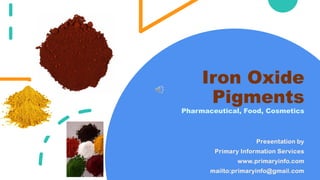
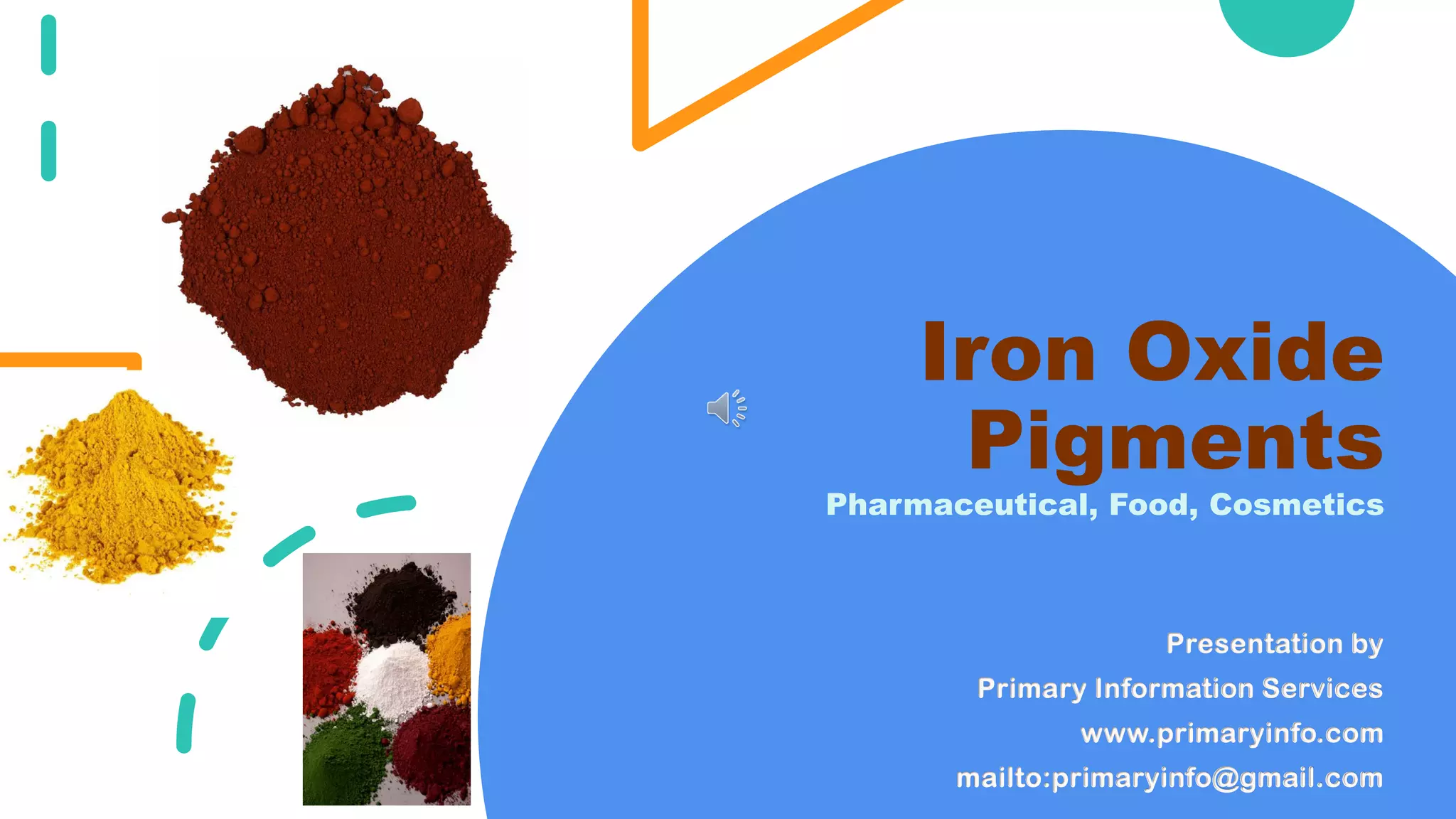
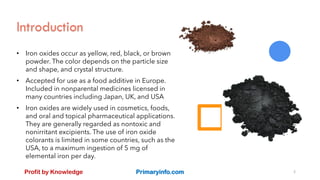
• Iron oxides occur as yellow, red, black, or brown
powder. The color depends on the particle size
and shape, and crystal structure.
• Accepted for use as a food additive in Europe.
Included in nonparental medicines licensed in
many countries including Japan, UK, and USA
• Iron oxides are widely used in cosmetics, foods,
and oral and topical pharmaceutical applications.
They are generally regarded as nontoxic and
nonirritant excipients. The use of iron oxide
colorants is limited in some countries, such as the
USA, to a maximum ingestion of 5 mg of
elemental iron per day.
Profit by Knowledge Primaryinfo.com 2
Iron oxides [1332-37-2] (a) Iron oxide
black [1317-61-9] (b) Iron oxide red
[1309-37-1] (c) Iron oxide yellow
[51274-00-1] (monohydrate); [20344-
49-4] (hydrate)
Chemical Name and CAS
Registry Number
Profit by
Knowledge
Primaryinfo.com 3
Applications in
Pharmaceutical
Formulation or
Technology
• Iron oxides are widely used in
cosmetics, foods, and
pharmaceutical applications as
colorants and UV absorbers.
• As inorganic colorants they are
becoming of increasing importance
as a result of the limitations
affecting some synthetic organic
dyestuffs.
• However, iron oxides also have
restrictions in some countries on
the quantities that may be
consumed, and technically their use
is restricted because of their limited
color range and their abrasiveness.
Profit by Knowledge Primaryinfo.com 4
Three main manufacturing processes are
currently applied for iron oxide pigments:
(a) Solid-state reactions (red, black and
brown): calcination of black or yellow
iron oxides to red iron oxide; thermal
decomposition of ferrous sulfate.
(b) Precipitation process (red, orange,
yellow and black): treatment of ferrous
sulfate solutions with alkali and oxidation.
The Penniman–Zoph process uses
ferrous sulfate, alkali, iron powder and air
or oxygen.
(c) Laux process or aniline process (red,
yellow, and black): reduction of
nitrobenzene to aniline with iron
Method of Manufacture
Profit by knowledge Primaryinfo.com 6
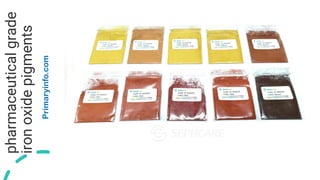
pharmaceutical
grade
iron
oxide
pigments
Primaryinfo.com
Presentation Title 7
Profit by Knowledge Primaryinfo.com 8
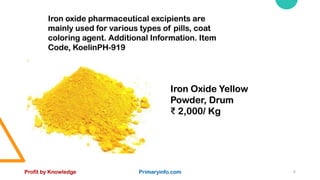
Iron oxide pharmaceutical excipients are
mainly used for various types of pills, coat
coloring agent. Additional Information. Item
Code, KoelinPH-919
Iron Oxide Yellow
Powder, Drum
₹ 2,000/ Kg
Manufacturer
Profit by Knowledge Primaryinfo.com 9
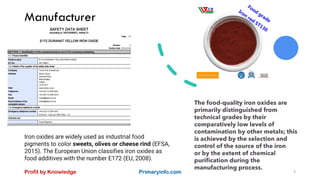
Iron oxides are widely used as industrial food
pigments to color sweets, olives or cheese rind (EFSA,
2015). The European Union classifies iron oxides as
food additives with the number E172 (EU, 2008).
Profit by Knowledge Primaryinfo.com 10
Combination of Silica & Iron Oxide
- Red Colour

Iron oxide-pigments

  • 1.
    Iron Oxide Pigments Pharmaceutical, Food,Cosmetics Presentation by Primary Information Services www.primaryinfo.com mailto:primaryinfo@gmail.com
  • 2.
    Introduction • Iron oxidesoccur as yellow, red, black, or brown powder. The color depends on the particle size and shape, and crystal structure. • Accepted for use as a food additive in Europe. Included in nonparental medicines licensed in many countries including Japan, UK, and USA • Iron oxides are widely used in cosmetics, foods, and oral and topical pharmaceutical applications. They are generally regarded as nontoxic and nonirritant excipients. The use of iron oxide colorants is limited in some countries, such as the USA, to a maximum ingestion of 5 mg of elemental iron per day. Profit by Knowledge Primaryinfo.com 2
  • 3.
    Iron oxides [1332-37-2](a) Iron oxide black [1317-61-9] (b) Iron oxide red [1309-37-1] (c) Iron oxide yellow [51274-00-1] (monohydrate); [20344- 49-4] (hydrate) Chemical Name and CAS Registry Number Profit by Knowledge Primaryinfo.com 3
  • 4.
    Applications in Pharmaceutical Formulation or Technology •Iron oxides are widely used in cosmetics, foods, and pharmaceutical applications as colorants and UV absorbers. • As inorganic colorants they are becoming of increasing importance as a result of the limitations affecting some synthetic organic dyestuffs. • However, iron oxides also have restrictions in some countries on the quantities that may be consumed, and technically their use is restricted because of their limited color range and their abrasiveness. Profit by Knowledge Primaryinfo.com 4
  • 5.
    Three main manufacturingprocesses are currently applied for iron oxide pigments: (a) Solid-state reactions (red, black and brown): calcination of black or yellow iron oxides to red iron oxide; thermal decomposition of ferrous sulfate. (b) Precipitation process (red, orange, yellow and black): treatment of ferrous sulfate solutions with alkali and oxidation. The Penniman–Zoph process uses ferrous sulfate, alkali, iron powder and air or oxygen. (c) Laux process or aniline process (red, yellow, and black): reduction of nitrobenzene to aniline with iron Method of Manufacture
  • 6.
    Profit by knowledgePrimaryinfo.com 6
  • 7.
  • 8.
    Profit by KnowledgePrimaryinfo.com 8 Iron oxide pharmaceutical excipients are mainly used for various types of pills, coat coloring agent. Additional Information. Item Code, KoelinPH-919 Iron Oxide Yellow Powder, Drum ₹ 2,000/ Kg
  • 9.
    Manufacturer Profit by KnowledgePrimaryinfo.com 9 Iron oxides are widely used as industrial food pigments to color sweets, olives or cheese rind (EFSA, 2015). The European Union classifies iron oxides as food additives with the number E172 (EU, 2008).
  • 10.
    Profit by KnowledgePrimaryinfo.com 10 Combination of Silica & Iron Oxide - Red Colour