High Performance Polymers
Submitted to : Dr.Rouchdy Zahran
Presented By : Ahmed Mamdouh
Spring 2019
Alexandria University
Faculty of Engineering
Chemical Engineering Department
Polymer Engineering
Outline
Why HPPs ?
HPPs Market
Examples for common HPPs
Applications
Additives
HPPs market to where?!
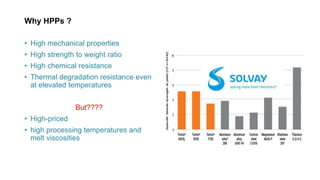
Why HPPs ?
• High mechanical properties
• High strength to weight ratio
• High chemical resistance
• Thermal degradation resistance even
at elevated temperatures
But????
• High-priced
• high processing temperatures and
melt viscosities
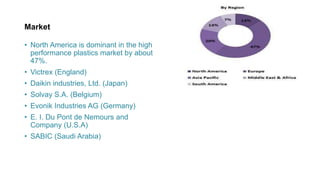
Market
• North America is dominant in the high
performance plastics market by about
47%.
• Victrex (England)
• Daikin industries, Ltd. (Japan)
• Solvay S.A. (Belgium)
• Evonik Industries AG (Germany)
• E. I. Du Pont de Nemours and
Company (U.S.A)
• SABIC (Saudi Arabia)
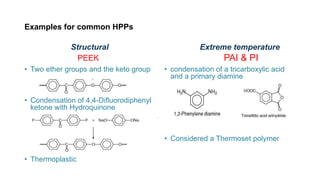
Examples for common HPPs
Structural
PEEK
• Two ether groups and the keto group
• Condensation of 4,4-Difluorodiphenyl
ketone with Hydroquinone
• Thermoplastic
Extreme temperature
PAI & PI
• condensation of a tricarboxylic acid
and a primary diamine
• Considered a Thermoset polymer
PEEK vs PI
• PEEK (like most thermoplastics)
quickly loses its mechanical properties
above the onset of its glass transition
temperature (289˚F for PEEK)
• while PI maintains significant strength
and stiffness at temperatures well
above 500˚F
• Vespel®
Applications
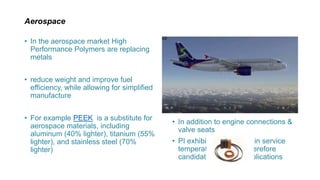
Aerospace
• In addition to engine connections &
valve seats
• PI exhibit a wide range in service
temperature and are therefore
candidates for such applications
• In the aerospace market High
Performance Polymers are replacing
metals
• reduce weight and improve fuel
efficiency, while allowing for simplified
manufacture
• For example PEEK is a substitute for
aerospace materials, including
aluminum (40% lighter), titanium (55%
lighter), and stainless steel (70%
lighter)
Medical & Dental applications
Coating & insulation films
Coating
• Extreme environment conditions
• chemical, high temperature, abrasion,
and wear resistance
• Aerospace applications
• For example VICOTE
Coatings (PEEK-based Coatings)
Insulation films
• polyvinyl fluoride (PVF) film was used
for insulation films but recently HPPs
has partly replaced PVF in this field
• For example APTIV film (PEEK-based
films)
• These systems reduce weight by up
to 60% when compared to PVF film
Additives
Special for
medical & dental
Reinforcing
Processing
Melt stablizers
• In the course of melt processing Some polymers show a strong tendency to crosslink like
unstabilized poly(aryletherketone)s
• This behavior is highly undesirable since the melt viscosity increases
• such as zinc oxide or zinc sulfide
Reinforcing Additives
• Adding glass fiber and carbon fiber
reinforcements to neat polymers
significantly increases strength,
making them suitable for structural
applications
Radiopaque fillers
• PEEK exhibits an X-ray absorption
close to human tissue and is invisible
in X-ray
• Radiopaque fillers ,such as barium
sulphate and tungstene, are opaque
• therefore are visible under x-ray, so a
radiofiller Is added to PEEK
• Unlike metals, the materials do not
generate X-ray artifacts
Anti-microbial additives
• Cause of the contact with blood,
implantable devices and parts need to
be highly biocombaitable
• Therefore silver Oxide (AgO) is added
to HPPs which release of silver ions
upon contact to water
HPPs market to where?!
• 2016 (14.49 billion)
• reach USD 35.27 Billion by 2026
• an increase of 2.5%
Thank you
Thank You

High performance polymers

  • 1.
    High Performance Polymers Submittedto : Dr.Rouchdy Zahran Presented By : Ahmed Mamdouh Spring 2019 Alexandria University Faculty of Engineering Chemical Engineering Department Polymer Engineering
  • 2.
    Outline Why HPPs ? HPPsMarket Examples for common HPPs Applications Additives HPPs market to where?!
  • 4.
    Why HPPs ? •High mechanical properties • High strength to weight ratio • High chemical resistance • Thermal degradation resistance even at elevated temperatures But???? • High-priced • high processing temperatures and melt viscosities
  • 5.
    Market • North Americais dominant in the high performance plastics market by about 47%. • Victrex (England) • Daikin industries, Ltd. (Japan) • Solvay S.A. (Belgium) • Evonik Industries AG (Germany) • E. I. Du Pont de Nemours and Company (U.S.A) • SABIC (Saudi Arabia)
  • 6.
    Examples for commonHPPs Structural PEEK • Two ether groups and the keto group • Condensation of 4,4-Difluorodiphenyl ketone with Hydroquinone • Thermoplastic Extreme temperature PAI & PI • condensation of a tricarboxylic acid and a primary diamine • Considered a Thermoset polymer
  • 7.
    PEEK vs PI •PEEK (like most thermoplastics) quickly loses its mechanical properties above the onset of its glass transition temperature (289˚F for PEEK) • while PI maintains significant strength and stiffness at temperatures well above 500˚F • Vespel®
  • 8.
  • 9.
    Aerospace • In additionto engine connections & valve seats • PI exhibit a wide range in service temperature and are therefore candidates for such applications • In the aerospace market High Performance Polymers are replacing metals • reduce weight and improve fuel efficiency, while allowing for simplified manufacture • For example PEEK is a substitute for aerospace materials, including aluminum (40% lighter), titanium (55% lighter), and stainless steel (70% lighter)
  • 10.
    Medical & Dentalapplications
  • 12.
    Coating & insulationfilms Coating • Extreme environment conditions • chemical, high temperature, abrasion, and wear resistance • Aerospace applications • For example VICOTE Coatings (PEEK-based Coatings) Insulation films • polyvinyl fluoride (PVF) film was used for insulation films but recently HPPs has partly replaced PVF in this field • For example APTIV film (PEEK-based films) • These systems reduce weight by up to 60% when compared to PVF film
  • 13.
    Additives Special for medical &dental Reinforcing Processing
  • 14.
    Melt stablizers • Inthe course of melt processing Some polymers show a strong tendency to crosslink like unstabilized poly(aryletherketone)s • This behavior is highly undesirable since the melt viscosity increases • such as zinc oxide or zinc sulfide
  • 15.
    Reinforcing Additives • Addingglass fiber and carbon fiber reinforcements to neat polymers significantly increases strength, making them suitable for structural applications
  • 16.
    Radiopaque fillers • PEEKexhibits an X-ray absorption close to human tissue and is invisible in X-ray • Radiopaque fillers ,such as barium sulphate and tungstene, are opaque • therefore are visible under x-ray, so a radiofiller Is added to PEEK • Unlike metals, the materials do not generate X-ray artifacts
  • 17.
    Anti-microbial additives • Causeof the contact with blood, implantable devices and parts need to be highly biocombaitable • Therefore silver Oxide (AgO) is added to HPPs which release of silver ions upon contact to water
  • 18.
  • 19.
    • 2016 (14.49billion) • reach USD 35.27 Billion by 2026 • an increase of 2.5%
  • 20.