Company
- Definition
- Features
- Types
- Levels
 Prepared by,
Thejas P
COMPANY
Definition:
“A company can be defined as an "artificial person",
invisible, intangible, created by or under law, with a discrete legal
entity, perpetual succession and a common seal.[citation needed]
It is not affected by the death, insanity or insolvency of an
individual member”
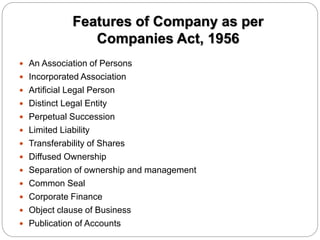
Features of Company as per
Companies Act, 1956
 An Association of Persons
 Incorporated Association
 Artificial Legal Person
 Distinct Legal Entity
 Perpetual Succession
 Limited Liability
 Transferability of Shares
 Diffused Ownership
 Separation of ownership and management
 Common Seal
 Corporate Finance
 Object clause of Business
 Publication of Accounts
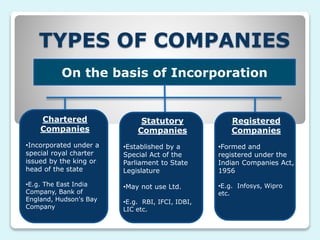
TYPES OF COMPANIES
On the basis of Incorporation
Chartered
Companies
•Incorporated under a
special royal charter
issued by the king or
head of the state
•E.g. The East India
Company, Bank of
England, Hudson's Bay
Company
Statutory
Companies
•Established by a
Special Act of the
Parliament to State
Legislature
•May not use Ltd.
•E.g. RBI, IFCI, IDBI,
LIC etc.
Registered
Companies
•Formed and
registered under the
Indian Companies Act,
1956
•E.g. Infosys, Wipro
etc.
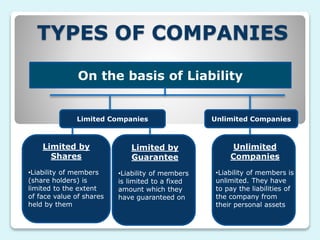
TYPES OF COMPANIES
On the basis of Liability
Limited by
Shares
•Liability of members
(share holders) is
limited to the extent
of face value of shares
held by them
Unlimited
Companies
•Liability of members is
unlimited. They have
to pay the liabilities of
the company from
their personal assets
Limited by
Guarantee
•Liability of members
is limited to a fixed
amount which they
have guaranteed on
Limited Companies Unlimited Companies
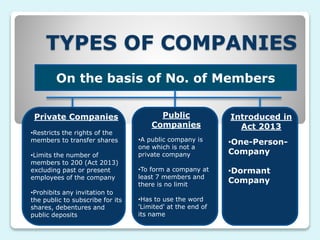
TYPES OF COMPANIES
On the basis of No. of Members
Private Companies
•Restricts the rights of the
members to transfer shares
•Limits the number of
members to 200 (Act 2013)
excluding past or present
employees of the company
•Prohibits any invitation to
the public to subscribe for its
shares, debentures and
public deposits
Public
Companies
•A public company is
one which is not a
private company
•To form a company at
least 7 members and
there is no limit
•Has to use the word
'Limited' at the end of
its name
Introduced in
Act 2013
•One-Person-
Company
•Dormant
Company
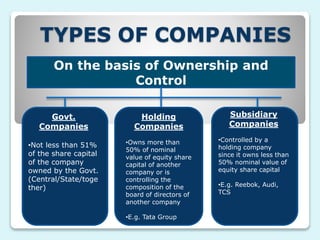
TYPES OF COMPANIES
On the basis of Ownership and
Control
Govt.
Companies
•Not less than 51%
of the share capital
of the company
owned by the Govt.
(Central/State/toge
ther)
Holding
Companies
•Owns more than
50% of nominal
value of equity share
capital of another
company or is
controlling the
composition of the
board of directors of
another company
•E.g. Tata Group
Subsidiary
Companies
•Controlled by a
holding company
since it owns less than
50% nominal value of
equity share capital
•E.g. Reebok, Audi,
TCS
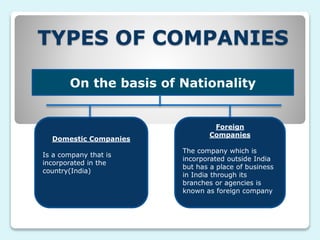
TYPES OF COMPANIES
On the basis of Nationality
Domestic Companies
Is a company that is
incorporated in the
country(India)
Foreign
Companies
The company which is
incorporated outside India
but has a place of business
in India through its
branches or agencies is
known as foreign company
It mainly consists of three levels of management.
They are as follows:
1)TOP LEVEL MANAGEMENT
2)MIDDLE LEVEL MANAGEMENT
3)LOWER LEVEL MANAGEMENT
 Top-level management consists of boards of
directors, presidents, vice-presidents, CEOs,
general managers and senior managers, etc.
 They develop goals, strategic plans, and company
policies and make decisions about the direction of
the business.
 Top managers need to have more conceptual skill
than technical skill. They understand how
competition, world economies, politics, and social
trends affect organizational effectiveness.
 Middle management is at the center of a hierarchical
organization, subordinate to the senior management
but above the lowest levels of operational staff.
 They are accountable to top management for their
department's function. They provide guidance to
lower-level managers and inspire them to perform
better.
 Middle-management functions generally revolve
around enabling teams of workers to perform
effectively and efficiently and reporting these
performance indicators to upper management.
 Low-level managers focus on controlling and
directing. They serve as role models for the
employees they supervise.
 Assigning employees tasks.
 Guiding and supervising employees on day-to-day
activities.
 Ensuring the quality and quantity of production.

Company Definition, Meaning, Features, Types and Structure

  • 1.
    Company - Definition - Features -Types - Levels  Prepared by, Thejas P
  • 2.
    COMPANY Definition: “A company canbe defined as an "artificial person", invisible, intangible, created by or under law, with a discrete legal entity, perpetual succession and a common seal.[citation needed] It is not affected by the death, insanity or insolvency of an individual member”
  • 3.
    Features of Companyas per Companies Act, 1956  An Association of Persons  Incorporated Association  Artificial Legal Person  Distinct Legal Entity  Perpetual Succession  Limited Liability  Transferability of Shares  Diffused Ownership  Separation of ownership and management  Common Seal  Corporate Finance  Object clause of Business  Publication of Accounts
  • 4.
    TYPES OF COMPANIES Onthe basis of Incorporation Chartered Companies •Incorporated under a special royal charter issued by the king or head of the state •E.g. The East India Company, Bank of England, Hudson's Bay Company Statutory Companies •Established by a Special Act of the Parliament to State Legislature •May not use Ltd. •E.g. RBI, IFCI, IDBI, LIC etc. Registered Companies •Formed and registered under the Indian Companies Act, 1956 •E.g. Infosys, Wipro etc.
  • 5.
    TYPES OF COMPANIES Onthe basis of Liability Limited by Shares •Liability of members (share holders) is limited to the extent of face value of shares held by them Unlimited Companies •Liability of members is unlimited. They have to pay the liabilities of the company from their personal assets Limited by Guarantee •Liability of members is limited to a fixed amount which they have guaranteed on Limited Companies Unlimited Companies
  • 6.
    TYPES OF COMPANIES Onthe basis of No. of Members Private Companies •Restricts the rights of the members to transfer shares •Limits the number of members to 200 (Act 2013) excluding past or present employees of the company •Prohibits any invitation to the public to subscribe for its shares, debentures and public deposits Public Companies •A public company is one which is not a private company •To form a company at least 7 members and there is no limit •Has to use the word 'Limited' at the end of its name Introduced in Act 2013 •One-Person- Company •Dormant Company
  • 7.
    TYPES OF COMPANIES Onthe basis of Ownership and Control Govt. Companies •Not less than 51% of the share capital of the company owned by the Govt. (Central/State/toge ther) Holding Companies •Owns more than 50% of nominal value of equity share capital of another company or is controlling the composition of the board of directors of another company •E.g. Tata Group Subsidiary Companies •Controlled by a holding company since it owns less than 50% nominal value of equity share capital •E.g. Reebok, Audi, TCS
  • 8.
    TYPES OF COMPANIES Onthe basis of Nationality Domestic Companies Is a company that is incorporated in the country(India) Foreign Companies The company which is incorporated outside India but has a place of business in India through its branches or agencies is known as foreign company
  • 9.
    It mainly consistsof three levels of management. They are as follows: 1)TOP LEVEL MANAGEMENT 2)MIDDLE LEVEL MANAGEMENT 3)LOWER LEVEL MANAGEMENT
  • 10.
     Top-level managementconsists of boards of directors, presidents, vice-presidents, CEOs, general managers and senior managers, etc.  They develop goals, strategic plans, and company policies and make decisions about the direction of the business.  Top managers need to have more conceptual skill than technical skill. They understand how competition, world economies, politics, and social trends affect organizational effectiveness.
  • 11.
     Middle managementis at the center of a hierarchical organization, subordinate to the senior management but above the lowest levels of operational staff.  They are accountable to top management for their department's function. They provide guidance to lower-level managers and inspire them to perform better.  Middle-management functions generally revolve around enabling teams of workers to perform effectively and efficiently and reporting these performance indicators to upper management.
  • 12.
     Low-level managersfocus on controlling and directing. They serve as role models for the employees they supervise.  Assigning employees tasks.  Guiding and supervising employees on day-to-day activities.  Ensuring the quality and quantity of production.

Editor's Notes

  • #5 Reference http://www.preservearticles.com/201101183543/classification-of-companies-on-the-basis-of-incorporation.html http://accountlearning.blogspot.in/2011/04/types-of-companies.html
  • #6 http://ezinearticles.com/?Companies-Are-Classified-in-the-Following-Basis&id=3915488
  • #7 https://www.pwc.in/assets/pdfs/publications/2013/companies-act-2013-key-highlights-and-analysis.pdf The company is required to add 'Private Limited' as part of its name.
  • #8 http://ezinearticles.com/?Companies-Are-Classified-in-the-Following-Basis&id=3915488
  • #9 http://ezinearticles.com/?Companies-Are-Classified-in-the-Following-Basis&id=3915488