APPLIED THERMODYNAMICS
EL 325 (3+0)
Topic 3
Laws
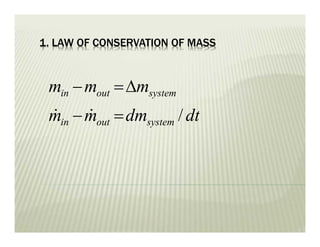
1. LAW OF CONSERVATION OF MASS
dtdmmm
mmm
systemoutin
systemoutin
/


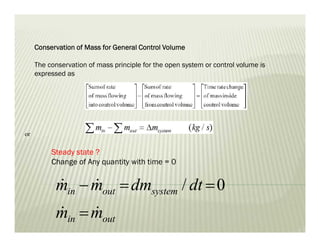
Conservation of Mass for General Control Volume
The conservation of mass principle for the open system or control volume is
expressed as
or
Steady state ?
Change of Any quantity with time = 0
outin
systemoutin
mm
dtdmmm



 0/
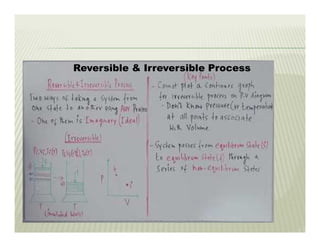
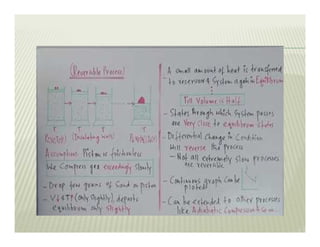
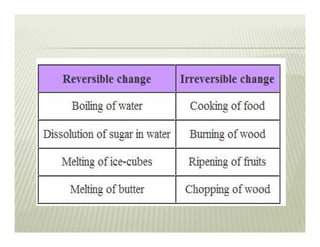
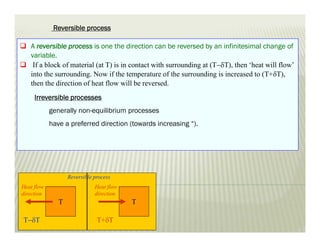
Reversible & Irreversible Process
 A reversible process is one the direction can be reversed by an infinitesimal change of
variable.
 If a block of material (at T) is in contact with surrounding at (TT), then ‘heat will flow’
into the surrounding. Now if the temperature of the surrounding is increased to (T+T),
then the direction of heat flow will be reversed.
Irreversible processes
generally non-equilibrium processes
have a preferred direction (towards increasing “).
T
Heat flow
direction
T+T
T
Heat flow
direction
TT
Reversible process
Reversible process
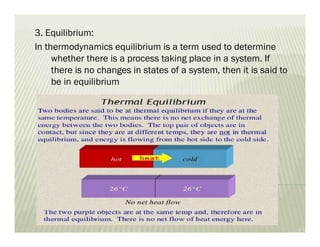
3. Equilibrium:
In thermodynamics equilibrium is a term used to determine
whether there is a process taking place in a system. If
there is no changes in states of a system, then it is said to
be in equilibrium
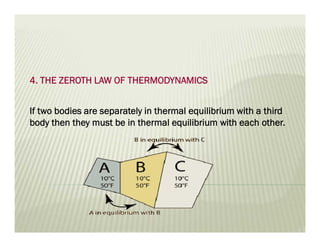
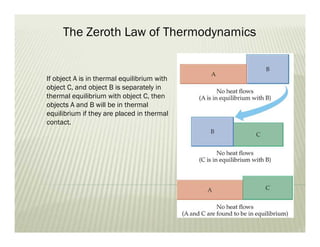
4. THE ZEROTH LAW OF THERMODYNAMICS
If two bodies are separately in thermal equilibrium with a third
body then they must be in thermal equilibrium with each other.
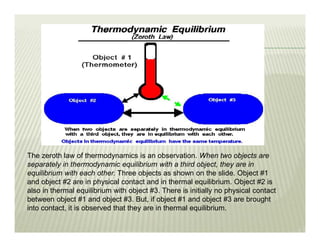
The zeroth law of thermodynamics is an observation. When two objects are
separately in thermodynamic equilibrium with a third object, they are in
equilibrium with each other. Three objects as shown on the slide. Object #1
and object #2 are in physical contact and in thermal equilibrium. Object #2 is
also in thermal equilibrium with object #3. There is initially no physical contact
between object #1 and object #3. But, if object #1 and object #3 are brought
into contact, it is observed that they are in thermal equilibrium.
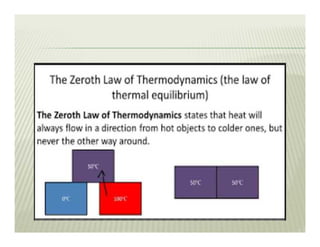
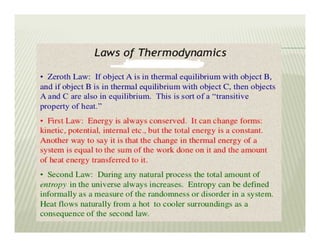
The Zeroth Law of Thermodynamics
If object A is in thermal equilibrium with
object C, and object B is separately in
thermal equilibrium with object C, then
objects A and B will be in thermal
equilibrium if they are placed in thermal
contact.
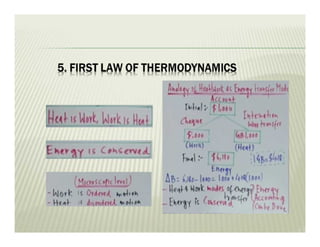
5. FIRST LAW OF THERMODYNAMICS
•Energy can be neither created nor destroyed but only transformed
•In thermodynamics cycles , if work is transferred during the cycle
then, since there is no final change in the properties of the working
substance, the energy to provide a work must have been transferred as
heat and must exactly equal to work.
Thus, for a cycle, there is no net property change:
Net heat transfer = Net work transfer
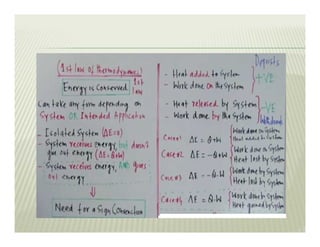
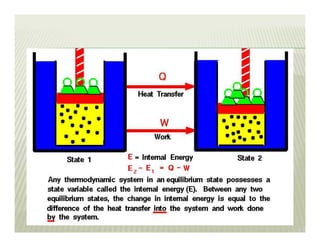
First law of thermodynamics:
Energy In = Energy Out
For open system: W = Q
For closed system which does not execute a
cycle: Q = W + U (If heat and work transfers
are not equal)
ENTROPY
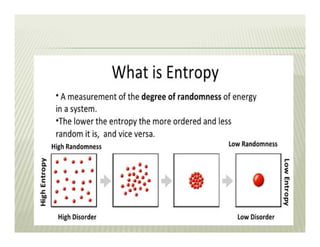
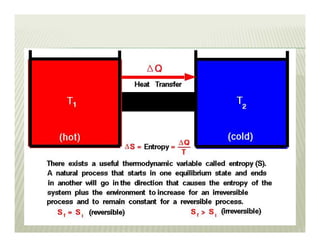
It is the measure of the disorder in the system.
As the change in entropy can be described as the heat added
per unit temperature
ΔS = Q/T
where S is the change in entropy,
Q is the heat flow into or out of a system, and T is the
absolute temperature in degrees Kelvin (K).
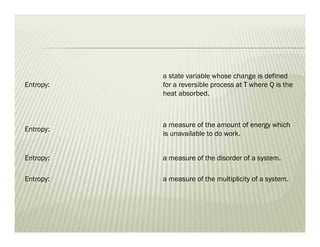
Entropy:
a state variable whose change is defined
for a reversible process at T where Q is the
heat absorbed.
Entropy:
a measure of the amount of energy which
is unavailable to do work.
Entropy: a measure of the disorder of a system.
Entropy: a measure of the multiplicity of a system.
THE SECOND LAW OF THERMODYNAMICS
5. THE SECOND LAW OF THERMODYNAMICS
5.1.CLAUSIUS STATEMENT
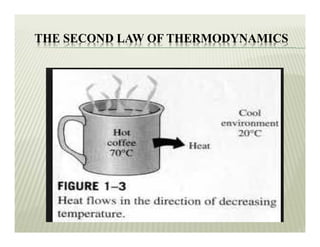
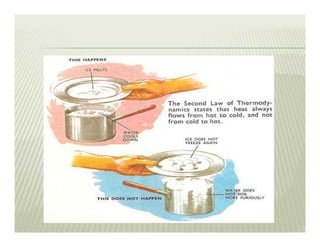
The second law of thermodynamics describes the flow of
energy in nature in processes which are irreversible.
The second law of thermodynamics may be expressed in
many specific ways.
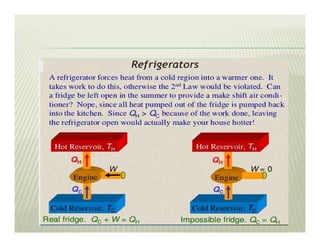
Second Law and Refrigerator
It is not possible for heat to flow from a colder
body to a warmer body without any work having
been done to accomplish this flow. Energy will
not flow spontaneously from a low temperature
object to a higher temperature object.
5.2. KELVIN-PLANCK STATEMENT
Second Law and Heat Engine
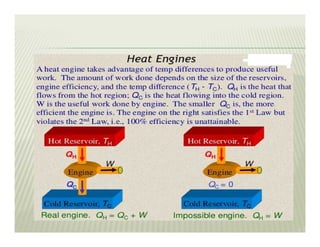
It is impossible to extract an amount of heat from
a hot reservoir and use it all to do work. Some
amount of heat must be exhausted to a cold
reservoir.
It means that the efficiency of a heat engine cycle
is never 100%.
Thus ,
Net work transfer = Net heat Transfer
But generally,
Net work transfer is less than Net heat transfer.
This means that some heat transfer must be rejected and is lost.
HEAT ENGINE
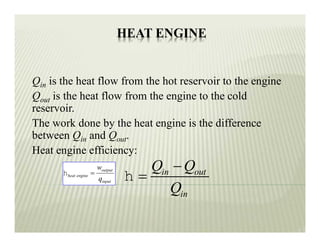
Qin is the heat flow from the hot reservoir to the engine
Qout is the heat flow from the engine to the cold
reservoir.
The work done by the heat engine is the difference
between Qin and Qout.
Heat engine efficiency:
in out
in
Q Q
Q



output
heat engine
input
w
q
 
5.1. PERPETUAL MOTION OF THE
FIRST KIND
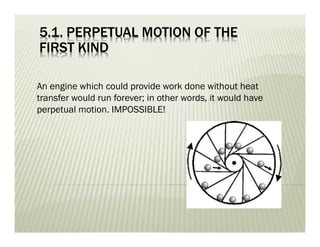
An engine which could provide work done without heat
transfer would run forever; in other words, it would have
perpetual motion. IMPOSSIBLE!
WHAT IS “PERPETUAL MOTION”?
“Perpetual Motion”
• Describes HYPOTHETICAL MACHINES that
operate or produce useful work indefinitely &,
more generally, hypothetical machines that
produce
more work or energy than they consume,
whether they might operate indefinitely or not.
• There is undisputed scientific consensus that
Perpetual motion would violate
either the 1st Law or the 2nd Law
of Thermodynamics, OR BOTH!
“Perpetual Motion”
• Describes a theoretical machine that, without any
losses due to friction or other forms of
dissipation of energy, would continue to operate
indefinitely at the same rate without any external
energy being applied to it.
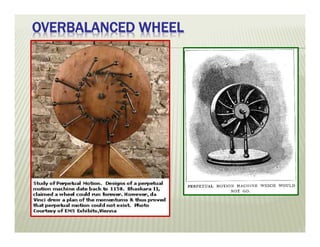
OVERBALANCED WHEEL
Applied thermodynamics(lecture 3)

Applied thermodynamics(lecture 3)

  • 1.
  • 2.
  • 3.
    1. LAW OFCONSERVATION OF MASS dtdmmm mmm systemoutin systemoutin /  
  • 4.
    Conservation of Massfor General Control Volume The conservation of mass principle for the open system or control volume is expressed as or Steady state ? Change of Any quantity with time = 0 outin systemoutin mm dtdmmm     0/
  • 5.
  • 8.
     A reversibleprocess is one the direction can be reversed by an infinitesimal change of variable.  If a block of material (at T) is in contact with surrounding at (TT), then ‘heat will flow’ into the surrounding. Now if the temperature of the surrounding is increased to (T+T), then the direction of heat flow will be reversed. Irreversible processes generally non-equilibrium processes have a preferred direction (towards increasing “). T Heat flow direction T+T T Heat flow direction TT Reversible process Reversible process
  • 9.
    3. Equilibrium: In thermodynamicsequilibrium is a term used to determine whether there is a process taking place in a system. If there is no changes in states of a system, then it is said to be in equilibrium
  • 10.
    4. THE ZEROTHLAW OF THERMODYNAMICS If two bodies are separately in thermal equilibrium with a third body then they must be in thermal equilibrium with each other.
  • 12.
    The zeroth lawof thermodynamics is an observation. When two objects are separately in thermodynamic equilibrium with a third object, they are in equilibrium with each other. Three objects as shown on the slide. Object #1 and object #2 are in physical contact and in thermal equilibrium. Object #2 is also in thermal equilibrium with object #3. There is initially no physical contact between object #1 and object #3. But, if object #1 and object #3 are brought into contact, it is observed that they are in thermal equilibrium.
  • 13.
    The Zeroth Lawof Thermodynamics If object A is in thermal equilibrium with object C, and object B is separately in thermal equilibrium with object C, then objects A and B will be in thermal equilibrium if they are placed in thermal contact.
  • 17.
    5. FIRST LAWOF THERMODYNAMICS •Energy can be neither created nor destroyed but only transformed •In thermodynamics cycles , if work is transferred during the cycle then, since there is no final change in the properties of the working substance, the energy to provide a work must have been transferred as heat and must exactly equal to work. Thus, for a cycle, there is no net property change: Net heat transfer = Net work transfer
  • 18.
    First law ofthermodynamics: Energy In = Energy Out For open system: W = Q For closed system which does not execute a cycle: Q = W + U (If heat and work transfers are not equal)
  • 20.
    ENTROPY It is themeasure of the disorder in the system. As the change in entropy can be described as the heat added per unit temperature ΔS = Q/T where S is the change in entropy, Q is the heat flow into or out of a system, and T is the absolute temperature in degrees Kelvin (K).
  • 21.
    Entropy: a state variablewhose change is defined for a reversible process at T where Q is the heat absorbed. Entropy: a measure of the amount of energy which is unavailable to do work. Entropy: a measure of the disorder of a system. Entropy: a measure of the multiplicity of a system.
  • 22.
    THE SECOND LAWOF THERMODYNAMICS
  • 25.
    5. THE SECONDLAW OF THERMODYNAMICS 5.1.CLAUSIUS STATEMENT The second law of thermodynamics describes the flow of energy in nature in processes which are irreversible. The second law of thermodynamics may be expressed in many specific ways. Second Law and Refrigerator It is not possible for heat to flow from a colder body to a warmer body without any work having been done to accomplish this flow. Energy will not flow spontaneously from a low temperature object to a higher temperature object.
  • 27.
    5.2. KELVIN-PLANCK STATEMENT SecondLaw and Heat Engine It is impossible to extract an amount of heat from a hot reservoir and use it all to do work. Some amount of heat must be exhausted to a cold reservoir. It means that the efficiency of a heat engine cycle is never 100%.
  • 28.
    Thus , Net worktransfer = Net heat Transfer But generally, Net work transfer is less than Net heat transfer. This means that some heat transfer must be rejected and is lost.
  • 30.
    HEAT ENGINE Qin isthe heat flow from the hot reservoir to the engine Qout is the heat flow from the engine to the cold reservoir. The work done by the heat engine is the difference between Qin and Qout. Heat engine efficiency: in out in Q Q Q    output heat engine input w q  
  • 31.
    5.1. PERPETUAL MOTIONOF THE FIRST KIND An engine which could provide work done without heat transfer would run forever; in other words, it would have perpetual motion. IMPOSSIBLE!
  • 32.
    WHAT IS “PERPETUALMOTION”? “Perpetual Motion” • Describes HYPOTHETICAL MACHINES that operate or produce useful work indefinitely &, more generally, hypothetical machines that produce more work or energy than they consume, whether they might operate indefinitely or not. • There is undisputed scientific consensus that Perpetual motion would violate either the 1st Law or the 2nd Law of Thermodynamics, OR BOTH!
  • 33.
    “Perpetual Motion” • Describesa theoretical machine that, without any losses due to friction or other forms of dissipation of energy, would continue to operate indefinitely at the same rate without any external energy being applied to it.
  • 34.