AHA Scientific Statement
Acute Heart Failure Syndromes:
Emergency Department Presentation,
Treatment, and Disposition:
Current Approaches and Future Aims
Circulation. Nov 9, 2010;122:1975-1996
What Happens Currently in the ED:
Diagnosis, Treatment, and Disposition?
• Rapid stabilization, treatment, and disposition
of acute emergencies such as shock,
arrhythmias, or STEMI, as opposed to the
timely recognition and treatment of more
subtle or complicated forms of AHFS which
most often are related to decompensation of
underlying, chronic HF.
Current Diagnostics
• The evaluation of possible AHFS in the ED
includes history, physical examination, CXR, 12-
lead ECG,cardiac troponin I or T, electrolytes, and
CBC.
• The BNP and N-terminal (NT)-proBNP have
demonstrated diagnosticutility when clinical
uncertaintyremains after initial history, physical
examination, and CXR.
• Either BNP or NT-proBNP should be measured in
patients in whom there is clinical uncertainty
concerning the diagnosis of AHFS.
• Both BNP and NT-proBNP are elevated in AHFS
and the magnitude of marker elevation is
correlated with severity of illness.
• BNP is highly useful to exclude AHFS.
• BNP and NT-proBNP can be elevated in sepsis,
pulmonary hypertension, older age, renal
insufficiency, atrial fibrillation, pulmonary
embolism and obesity.
Optimal NT-proBNP cut-points for
the diagnosis or exclusion of AHFS
• BNP and NT-proBNP single cut point of 300 pg/mL to rule out
AHFS
• 2 cut points to rule in AHFS depending on age:
– <50 years old ( >450 pg/mL)
– >50 years old ( >900 pg/mL)
Am J Cardiol. 2005;95:948–954.
• Age-independent cutoff of 900 pg/mL
• Age-stratified approach of 450/900/1800 for patients aged
<50/50 to 75/>75 years
Eur Heart J 2006;27:330–337
Am J Cardiol. 2008;101:29–38
• BNP testing led to reductions in the
– Number of patients hospitalized
(75% v.s. 85%, p=0.008)
– Time to discharge
(8.0 days versus 11.0 days, p=0.001)
– Cost
($5410 versus $7264, p=0.006)
– Time to treatment
(63 minutes versus 90 minutes, p=0.03)
Current Therapy
• Heterogeneous Presentations Met With
Homogeneous Therapy
• Regardless of the baseline cardiac
pathophysiology, critical presenting features such
as hemodynamic status, presence (or absence) of
myocardial ischemia, and renal dysfunction, the
current goals of ED therapy are to relieve
congestion, balance hemodynamics, achieve
euvolemia, and avoid harm, such as myocardial
and renal injury.
• Initial stabilization focuses on determining
whether the patient requiresventilatory
support, either via endotracheal intubation or
noninvasive ventilation (NIV).
• Diuretics and vasodilators, including
intravenous ACEI, are frequently used in the
treatment of AHFS patients with congestion
and normal or elevated blood pressure.
• Patients with AHFS and low cardiac output and
monitored by a pulmonary artery catheter
suggests that 0.8 mg of sublingual
nitroglycerin causes a clinically significant
decrease in systemic vascular resistance and
an increase in the cardiac index in less than 30
minutes.
• ED patients with AHFS can be assigned into 2
groups based on presentation blood pressure:
1. Hypertensive (>140 mmHg)
2. Normotensive (<140 mmHg)
Hypotension (<90 mmHg) and cardiogenic shock are
rare and make up < 5% of ED presentations
• Hypertension may appear to be the most
acutely ill, but aggressive blood pressure
management often results in rapid resolution
of symptoms.
ED Disposition Decision Making
• The ED disposition decision of AHFS
– Admit to ED observation unit
– In-hospital telemetry unit
– Intensive care unit
– Discharge to the outpatient environment
• 80% of patients who present to the ED with
AHFS are hospitalized.
Predictors of Adverse Events
• Elevated BUN or creatinine
• Hyponatremia
• Ischemic ECG changes
• Elevated BNP levels
• Elevated troponins
• Low systolic blood pressure
Morbidity and Mortality in
Hospitalized Patients with AHFS
• The average risk of death during hospital
admission for AHFS is apprximately 4%.
• Patients requiring the use of inotropic agents
had a mortality rate of 12% to 13%.
• The use of vasodilators has been associated
with a mortality risk of 4.7% for nitroglycerin
and 7.1% for nesiritide.
• Factors associated with favorable prognosis during
hospitalization for AHFS include hospital admission
related to de novo AHFS and pre-hospitalization
therapy with ACE inhibitors or β-blockers.
• Traditional HF medical therapy including ACE
inhibitors, ARB, β-blockers, and selective aldosterone
receptor antagonists.
Early initiation of this therapy, before hospital
discharge, with appropriate titration, improves
symptoms, reduces hospitalizations, and saves lives.
Assessment and Avoiding Readmission
• Predictors for repeat hospitalization include
pulmonary infections, angina, hypertension,
arrhythmias, medication nonadherence, diet
nonadherence, and other noncardiac medical
problems.
• Inpatient education begins in the ED, where
the impact of the "teachable moment" may
be highest, and continues until discharge.
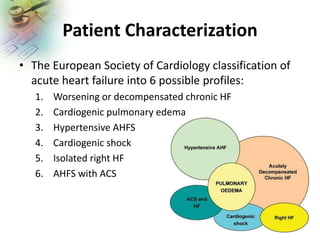
Patient Characterization
• The European Society of Cardiology classification of
acute heart failure into 6 possible profiles:
1. Worsening or decompensated chronic HF
2. Cardiogenic pulmonary edema
3. Hypertensive AHFS
4. Cardiogenic shock
5. Isolated right HF
6. AHFS with ACS
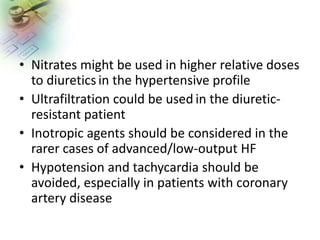
• Nitrates might be used in higher relative doses
to diuretics in the hypertensive profile
• Ultrafiltration could be used in the diuretic-
resistant patient
• Inotropic agents should be considered in the
rarer cases of advanced/low-output HF
• Hypotension and tachycardia should be
avoided, especially in patients with coronary
artery disease
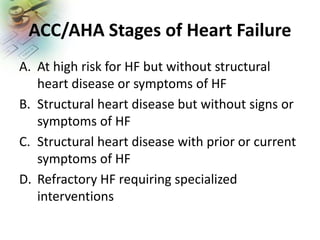
ACC/AHA Stages of Heart Failure
A. At high risk for HF but without structural
heart disease or symptoms of HF
B. Structural heart disease but without signs or
symptoms of HF
C. Structural heart disease with prior or current
symptoms of HF
D. Refractory HF requiring specialized
interventions
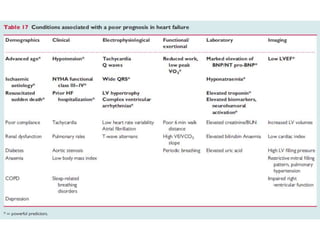
Risk Stratification
• Low-Risk, Not High-Risk Markers Are Necessary
• Hypotension, hyponatremia, renal dysfunction,
increased troponin levels, and elevated BNP all
portend a poor prognosis.
• The absence of high-risk markers does not define a
low-risk patient. (ie, those with normal troponins,
serum sodium, and renal function).
• Data suggest that EP would be comfortable
discharging a patient if there was a combined overall
risk of in-hospital events or 30-day mortality of <2%.
"Medical decision making" is the science
of statistically examining detailed
clinical data to develop mathematical
models or predictive instruments to
guide appropriate clinical care of
patients with complex diseases.

Acute Heart Failure Syndromes

  • 1.
    AHA Scientific Statement AcuteHeart Failure Syndromes: Emergency Department Presentation, Treatment, and Disposition: Current Approaches and Future Aims Circulation. Nov 9, 2010;122:1975-1996
  • 2.
    What Happens Currentlyin the ED: Diagnosis, Treatment, and Disposition? • Rapid stabilization, treatment, and disposition of acute emergencies such as shock, arrhythmias, or STEMI, as opposed to the timely recognition and treatment of more subtle or complicated forms of AHFS which most often are related to decompensation of underlying, chronic HF.
  • 3.
    Current Diagnostics • Theevaluation of possible AHFS in the ED includes history, physical examination, CXR, 12- lead ECG,cardiac troponin I or T, electrolytes, and CBC. • The BNP and N-terminal (NT)-proBNP have demonstrated diagnosticutility when clinical uncertaintyremains after initial history, physical examination, and CXR. • Either BNP or NT-proBNP should be measured in patients in whom there is clinical uncertainty concerning the diagnosis of AHFS.
  • 4.
    • Both BNPand NT-proBNP are elevated in AHFS and the magnitude of marker elevation is correlated with severity of illness. • BNP is highly useful to exclude AHFS. • BNP and NT-proBNP can be elevated in sepsis, pulmonary hypertension, older age, renal insufficiency, atrial fibrillation, pulmonary embolism and obesity.
  • 5.
    Optimal NT-proBNP cut-pointsfor the diagnosis or exclusion of AHFS • BNP and NT-proBNP single cut point of 300 pg/mL to rule out AHFS • 2 cut points to rule in AHFS depending on age: – <50 years old ( >450 pg/mL) – >50 years old ( >900 pg/mL) Am J Cardiol. 2005;95:948–954. • Age-independent cutoff of 900 pg/mL • Age-stratified approach of 450/900/1800 for patients aged <50/50 to 75/>75 years Eur Heart J 2006;27:330–337 Am J Cardiol. 2008;101:29–38
  • 6.
    • BNP testingled to reductions in the – Number of patients hospitalized (75% v.s. 85%, p=0.008) – Time to discharge (8.0 days versus 11.0 days, p=0.001) – Cost ($5410 versus $7264, p=0.006) – Time to treatment (63 minutes versus 90 minutes, p=0.03)
  • 7.
    Current Therapy • HeterogeneousPresentations Met With Homogeneous Therapy • Regardless of the baseline cardiac pathophysiology, critical presenting features such as hemodynamic status, presence (or absence) of myocardial ischemia, and renal dysfunction, the current goals of ED therapy are to relieve congestion, balance hemodynamics, achieve euvolemia, and avoid harm, such as myocardial and renal injury.
  • 8.
    • Initial stabilizationfocuses on determining whether the patient requiresventilatory support, either via endotracheal intubation or noninvasive ventilation (NIV). • Diuretics and vasodilators, including intravenous ACEI, are frequently used in the treatment of AHFS patients with congestion and normal or elevated blood pressure.
  • 9.
    • Patients withAHFS and low cardiac output and monitored by a pulmonary artery catheter suggests that 0.8 mg of sublingual nitroglycerin causes a clinically significant decrease in systemic vascular resistance and an increase in the cardiac index in less than 30 minutes.
  • 10.
    • ED patientswith AHFS can be assigned into 2 groups based on presentation blood pressure: 1. Hypertensive (>140 mmHg) 2. Normotensive (<140 mmHg) Hypotension (<90 mmHg) and cardiogenic shock are rare and make up < 5% of ED presentations • Hypertension may appear to be the most acutely ill, but aggressive blood pressure management often results in rapid resolution of symptoms.
  • 11.
    ED Disposition DecisionMaking • The ED disposition decision of AHFS – Admit to ED observation unit – In-hospital telemetry unit – Intensive care unit – Discharge to the outpatient environment • 80% of patients who present to the ED with AHFS are hospitalized.
  • 12.
    Predictors of AdverseEvents • Elevated BUN or creatinine • Hyponatremia • Ischemic ECG changes • Elevated BNP levels • Elevated troponins • Low systolic blood pressure
  • 13.
    Morbidity and Mortalityin Hospitalized Patients with AHFS • The average risk of death during hospital admission for AHFS is apprximately 4%. • Patients requiring the use of inotropic agents had a mortality rate of 12% to 13%. • The use of vasodilators has been associated with a mortality risk of 4.7% for nitroglycerin and 7.1% for nesiritide.
  • 14.
    • Factors associatedwith favorable prognosis during hospitalization for AHFS include hospital admission related to de novo AHFS and pre-hospitalization therapy with ACE inhibitors or β-blockers. • Traditional HF medical therapy including ACE inhibitors, ARB, β-blockers, and selective aldosterone receptor antagonists. Early initiation of this therapy, before hospital discharge, with appropriate titration, improves symptoms, reduces hospitalizations, and saves lives.
  • 15.
    Assessment and AvoidingReadmission • Predictors for repeat hospitalization include pulmonary infections, angina, hypertension, arrhythmias, medication nonadherence, diet nonadherence, and other noncardiac medical problems. • Inpatient education begins in the ED, where the impact of the "teachable moment" may be highest, and continues until discharge.
  • 16.
    Patient Characterization • TheEuropean Society of Cardiology classification of acute heart failure into 6 possible profiles: 1. Worsening or decompensated chronic HF 2. Cardiogenic pulmonary edema 3. Hypertensive AHFS 4. Cardiogenic shock 5. Isolated right HF 6. AHFS with ACS
  • 17.
    • Nitrates mightbe used in higher relative doses to diuretics in the hypertensive profile • Ultrafiltration could be used in the diuretic- resistant patient • Inotropic agents should be considered in the rarer cases of advanced/low-output HF • Hypotension and tachycardia should be avoided, especially in patients with coronary artery disease
  • 18.
    ACC/AHA Stages ofHeart Failure A. At high risk for HF but without structural heart disease or symptoms of HF B. Structural heart disease but without signs or symptoms of HF C. Structural heart disease with prior or current symptoms of HF D. Refractory HF requiring specialized interventions
  • 20.
    Risk Stratification • Low-Risk,Not High-Risk Markers Are Necessary • Hypotension, hyponatremia, renal dysfunction, increased troponin levels, and elevated BNP all portend a poor prognosis. • The absence of high-risk markers does not define a low-risk patient. (ie, those with normal troponins, serum sodium, and renal function). • Data suggest that EP would be comfortable discharging a patient if there was a combined overall risk of in-hospital events or 30-day mortality of <2%.
  • 21.
    "Medical decision making"is the science of statistically examining detailed clinical data to develop mathematical models or predictive instruments to guide appropriate clinical care of patients with complex diseases.