Lecture Six
Pragmatic Development
Pragmatics …
• Pragmatics = the part played by language
in social situations and relationships.
• Del Hymes: ‘communicative competence’
When to speak
How to respond to others
Appropriate registers
Language functions …
• Bottom line: children are motivated to
acquire language because it serves certain
purposes/functions for them.
• Halliday (1975): seven functions …
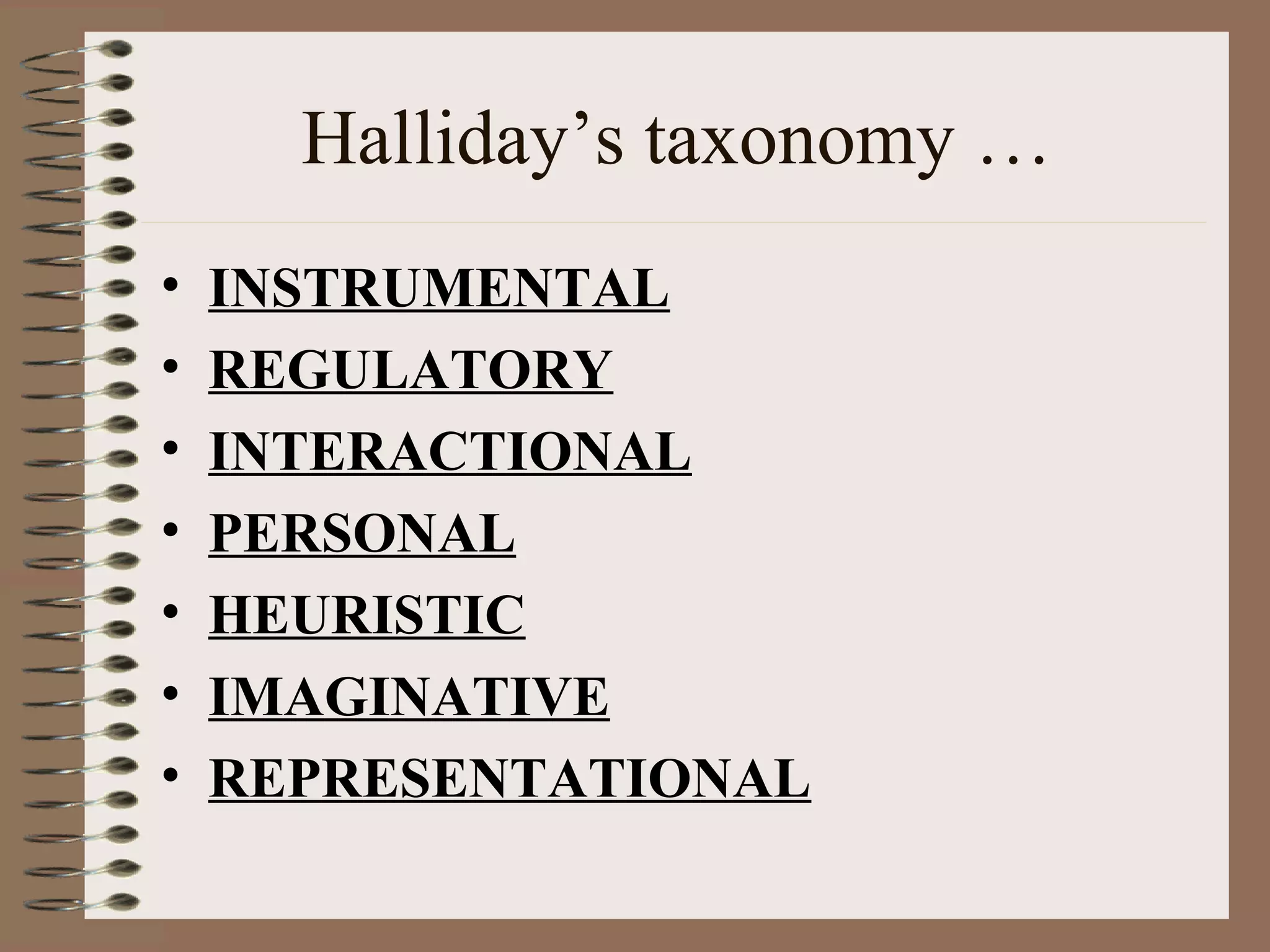
Halliday’s taxonomy …
• INSTRUMENTAL
• REGULATORY
• INTERACTIONAL
• PERSONAL
• HEURISTIC
• IMAGINATIVE
• REPRESENTATIONAL
Be careful …
• As with other
elements of language
acquisition, remember
that pragmatic
development begins
before a child starts
to speak.
Early years …
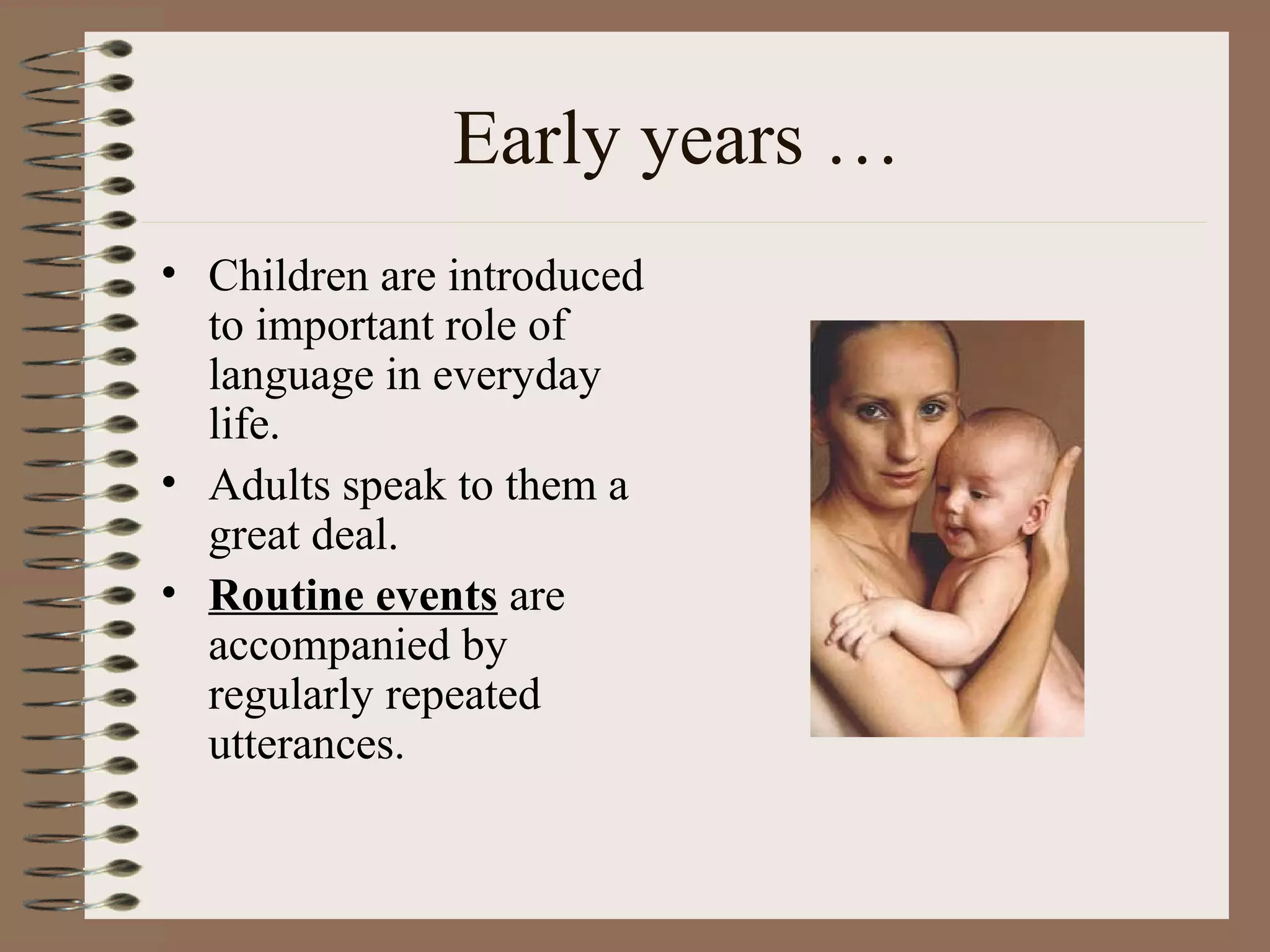
• Children are introduced
to important role of
language in everyday
life.
• Adults speak to them a
great deal.
• Routine events are
accompanied by
regularly repeated
utterances.
Conversation preparation …
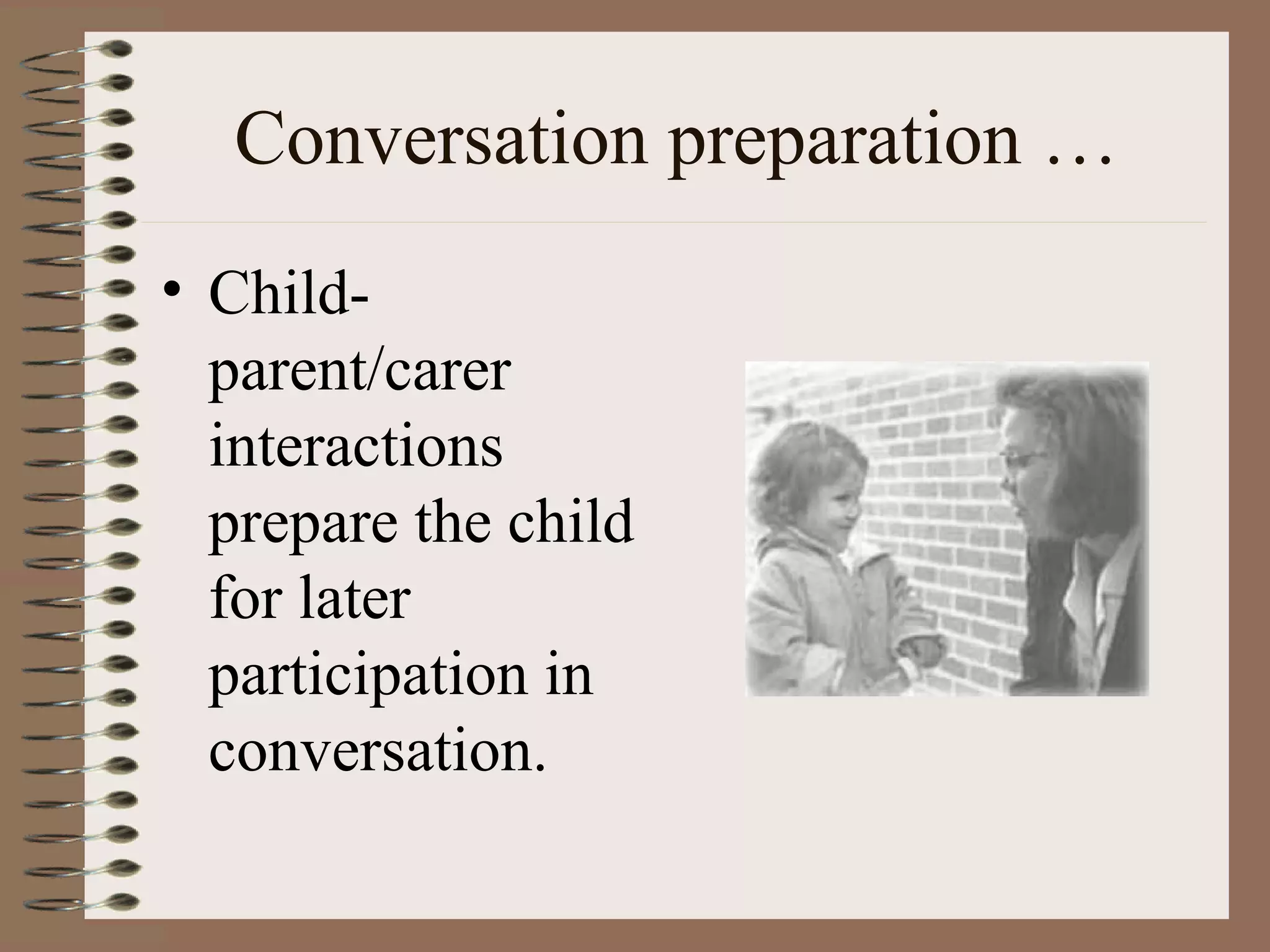
• Child-
parent/carer
interactions
prepare the child
for later
participation in
conversation.
Bancroft (1996) …
• ‘Peek-a-boo’ parallels:
Turn-taking
Response
Common purpose and understand the
sequence
Pleasure
Other interactions …
• Despite the fact that the child has not yet
begun to speak, adults will:
Ask questions
Express agreement
Give approving/disapproving responses
First conversations …
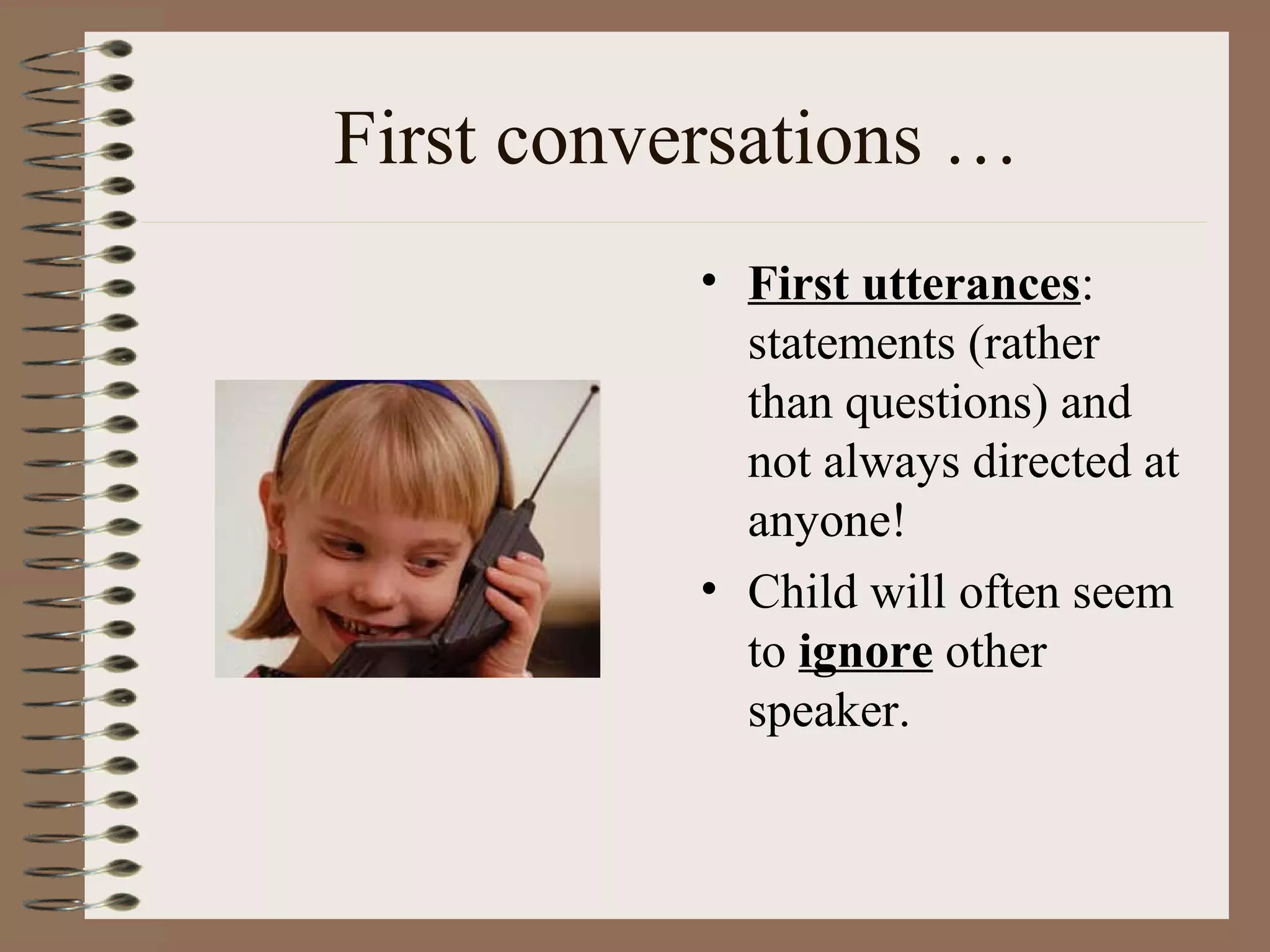
• First utterances:
statements (rather
than questions) and
not always directed at
anyone!
• Child will often seem
to ignore other
speaker.
First conversations …
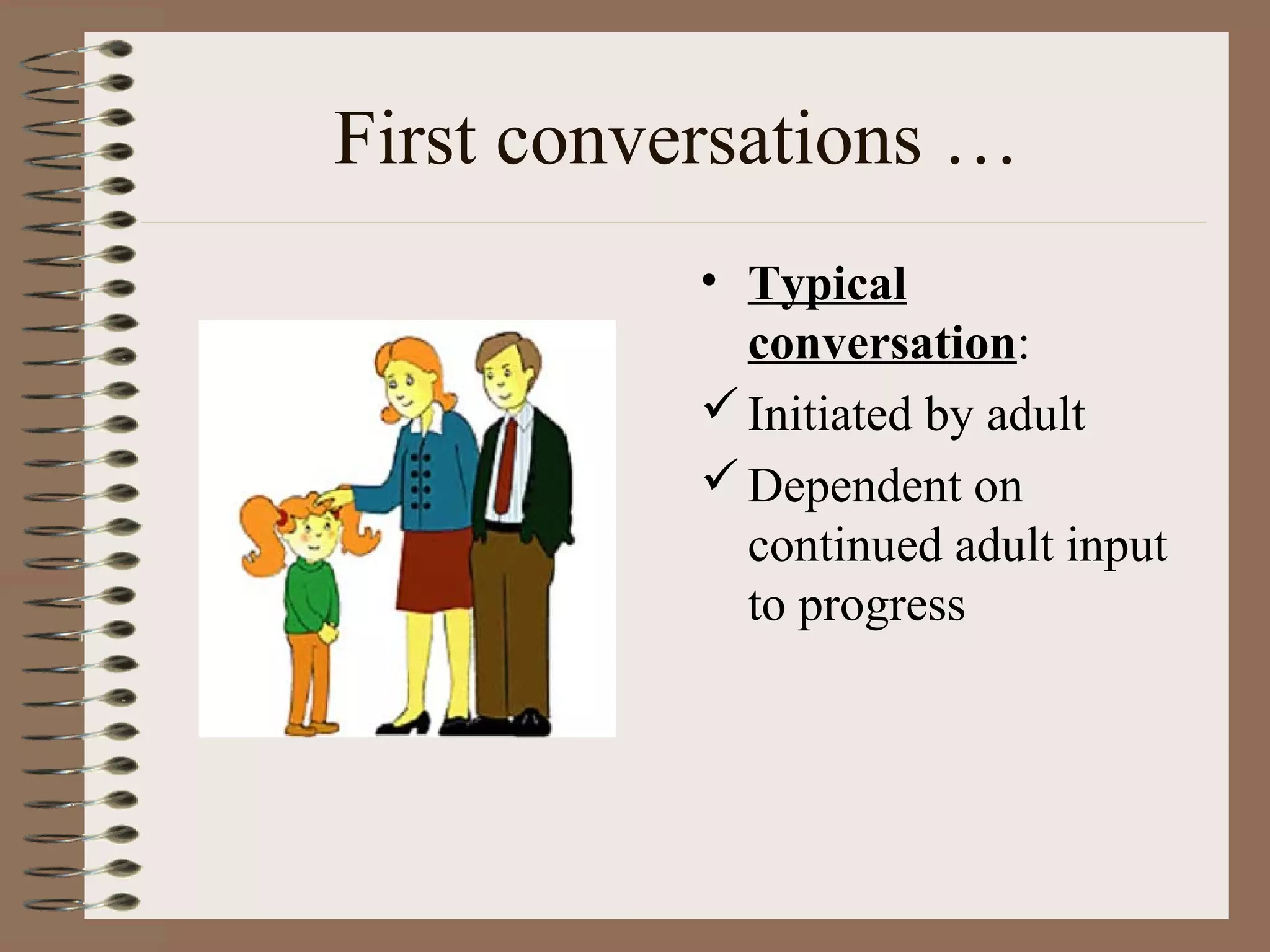
• Typical
conversation:
Initiated by adult
Dependent on
continued adult input
to progress
Later development …
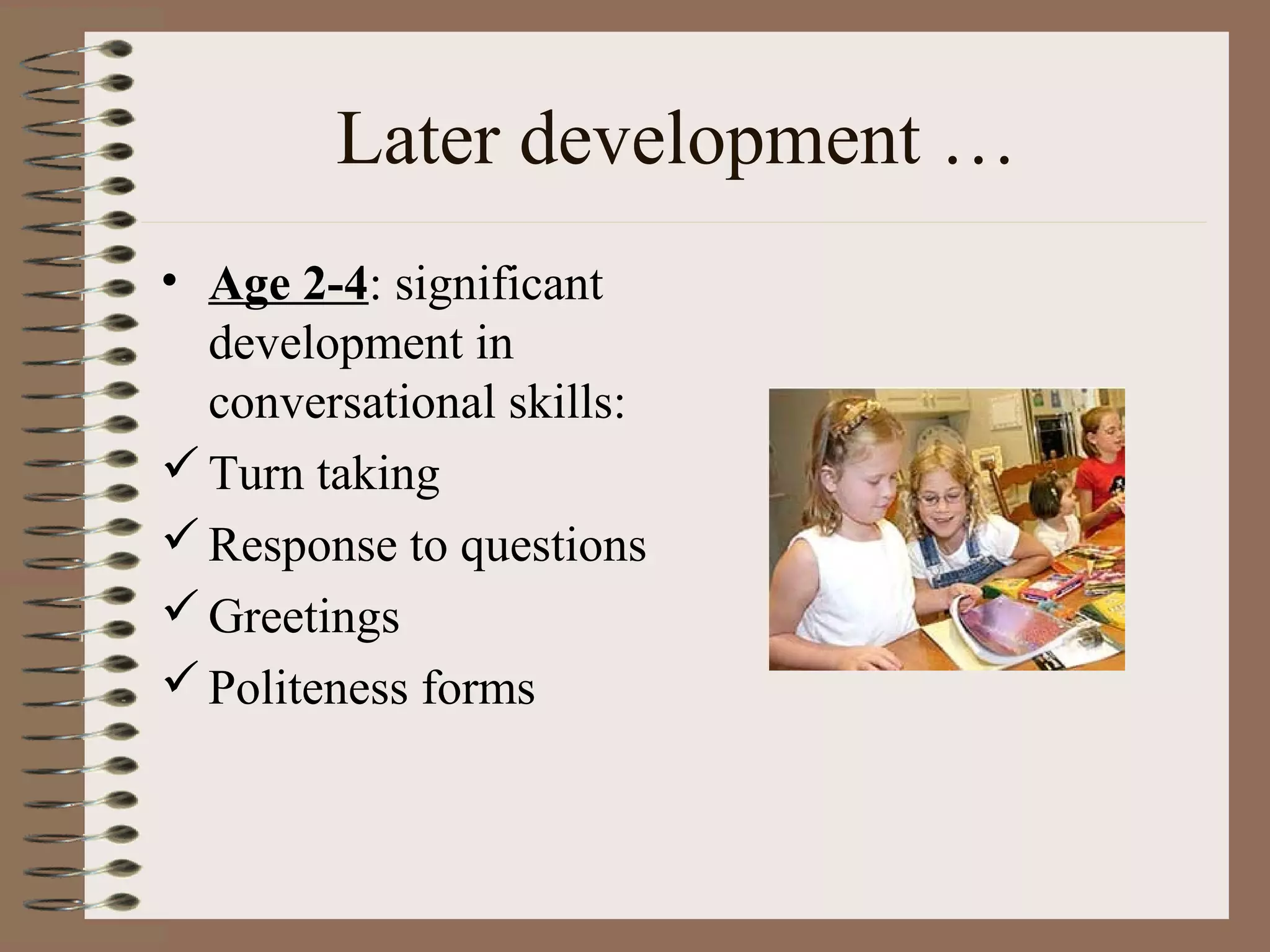
• Age 2-4: significant
development in
conversational skills:
Turn taking
Response to questions
Greetings
Politeness forms
Speech Convergence and
Accommodation Theory
• Yousef (1991)
• Group of children in Trinidad
• Children responded to different social
situations by using different varieties of
English
Speech Convergence and
Accommodation Theory
• Janet (3, 9): Past tense verb forms:
Conversation with mother: 100% SE
Family helper (a Trinidadian English
speaker): decreasing amounts
Brother/same age children: decreasing
amounts
After starting school …
• Children
develop
increased
sensitivity to
the needs of
their listener.
• Greater
understanding of
language more
appropriate to
formal situations
(register).
Vocabulary test …
• COMMUNICATIVE COMPETENCE
• LANGUAGE FUNCTION
• INSTRUMENTAL
• REGULATORY
• INTERACTIONAL
• PERSONAL
• HEURISTIC
• IMAGINATIVE
• REPRESENTATIONAL
Vocabulary test …
• SPEECH CONVERGENCE
• ACCOMMODATION THEORY
• REGISTER

Language Acquisition: Lecture 6 Pragmatic Development

  • 1.
  • 2.
    Pragmatics … • Pragmatics= the part played by language in social situations and relationships. • Del Hymes: ‘communicative competence’ When to speak How to respond to others Appropriate registers
  • 3.
    Language functions … •Bottom line: children are motivated to acquire language because it serves certain purposes/functions for them. • Halliday (1975): seven functions …
  • 4.
    Halliday’s taxonomy … •INSTRUMENTAL • REGULATORY • INTERACTIONAL • PERSONAL • HEURISTIC • IMAGINATIVE • REPRESENTATIONAL
  • 5.
    Be careful … •As with other elements of language acquisition, remember that pragmatic development begins before a child starts to speak.
  • 6.
    Early years … •Children are introduced to important role of language in everyday life. • Adults speak to them a great deal. • Routine events are accompanied by regularly repeated utterances.
  • 7.
    Conversation preparation … •Child- parent/carer interactions prepare the child for later participation in conversation.
  • 8.
    Bancroft (1996) … •‘Peek-a-boo’ parallels: Turn-taking Response Common purpose and understand the sequence Pleasure
  • 9.
    Other interactions … •Despite the fact that the child has not yet begun to speak, adults will: Ask questions Express agreement Give approving/disapproving responses
  • 10.
    First conversations … •First utterances: statements (rather than questions) and not always directed at anyone! • Child will often seem to ignore other speaker.
  • 11.
    First conversations … •Typical conversation: Initiated by adult Dependent on continued adult input to progress
  • 12.
    Later development … •Age 2-4: significant development in conversational skills: Turn taking Response to questions Greetings Politeness forms
  • 13.
    Speech Convergence and AccommodationTheory • Yousef (1991) • Group of children in Trinidad • Children responded to different social situations by using different varieties of English
  • 14.
    Speech Convergence and AccommodationTheory • Janet (3, 9): Past tense verb forms: Conversation with mother: 100% SE Family helper (a Trinidadian English speaker): decreasing amounts Brother/same age children: decreasing amounts
  • 15.
    After starting school… • Children develop increased sensitivity to the needs of their listener. • Greater understanding of language more appropriate to formal situations (register).
  • 16.
    Vocabulary test … •COMMUNICATIVE COMPETENCE • LANGUAGE FUNCTION • INSTRUMENTAL • REGULATORY • INTERACTIONAL • PERSONAL • HEURISTIC • IMAGINATIVE • REPRESENTATIONAL
  • 17.
    Vocabulary test … •SPEECH CONVERGENCE • ACCOMMODATION THEORY • REGISTER