Muscular System
SEHS Topic 1.2
IB
Sports,
exercise and
health science Anatomy
Starter-Group Activity
Decide whether the following statements are true or false
Topic 1
Anatomy
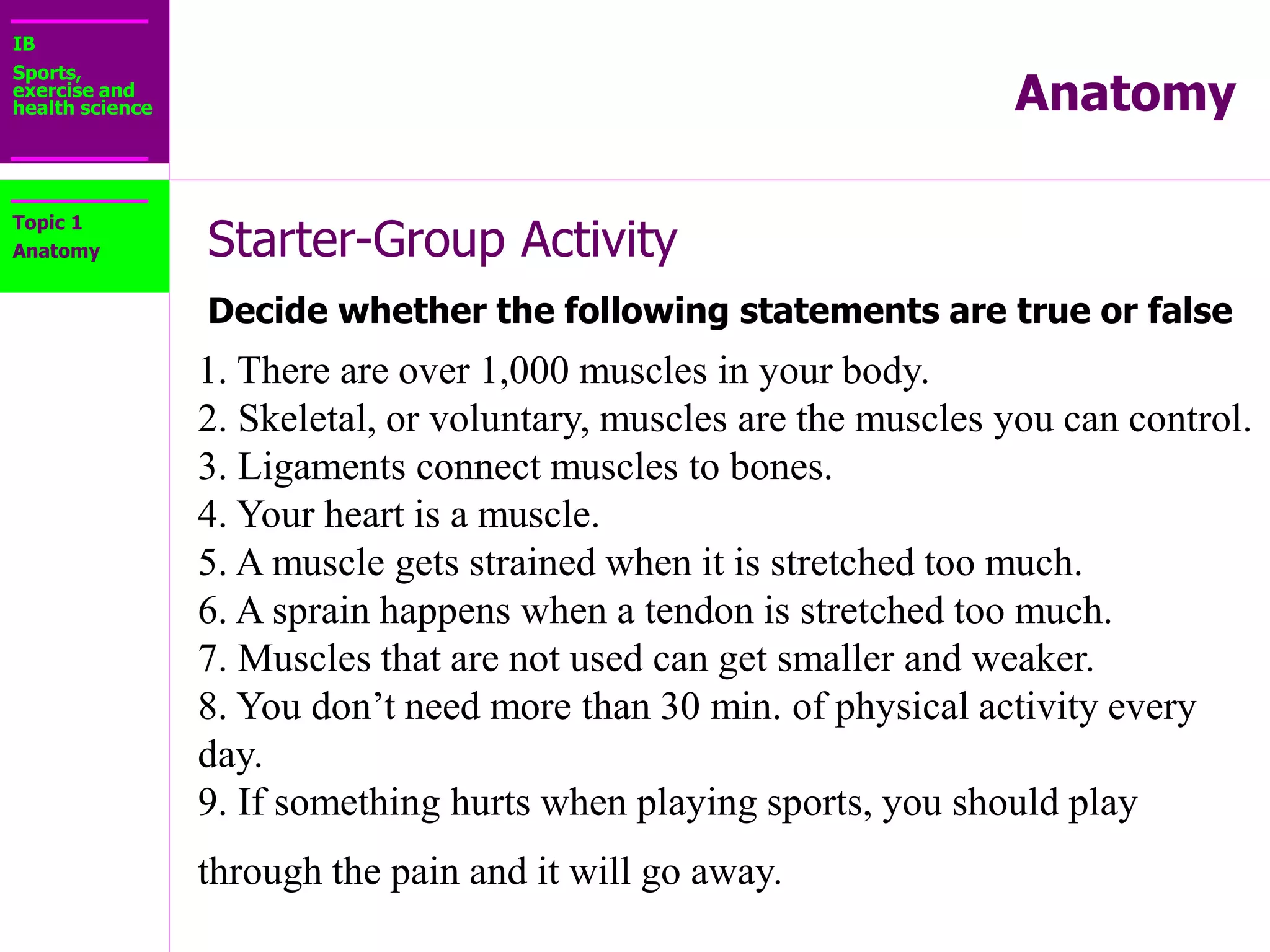
1. There are over 1,000 muscles in your body.
2. Skeletal, or voluntary, muscles are the muscles you can control.
3. Ligaments connect muscles to bones.
4. Your heart is a muscle.
5. A muscle gets strained when it is stretched too much.
6. A sprain happens when a tendon is stretched too much.
7. Muscles that are not used can get smaller and weaker.
8. You don’t need more than 30 min. of physical activity every
day.
9. If something hurts when playing sports, you should play
through the pain and it will go away.
IB
Sports,
exercise and
health science Anatomy
Starter-Group Activity
Decide whether the following statements are true or false
Topic 1
Anatomy
STARTER – Group Activity
Decide whether the following statements are true or false:
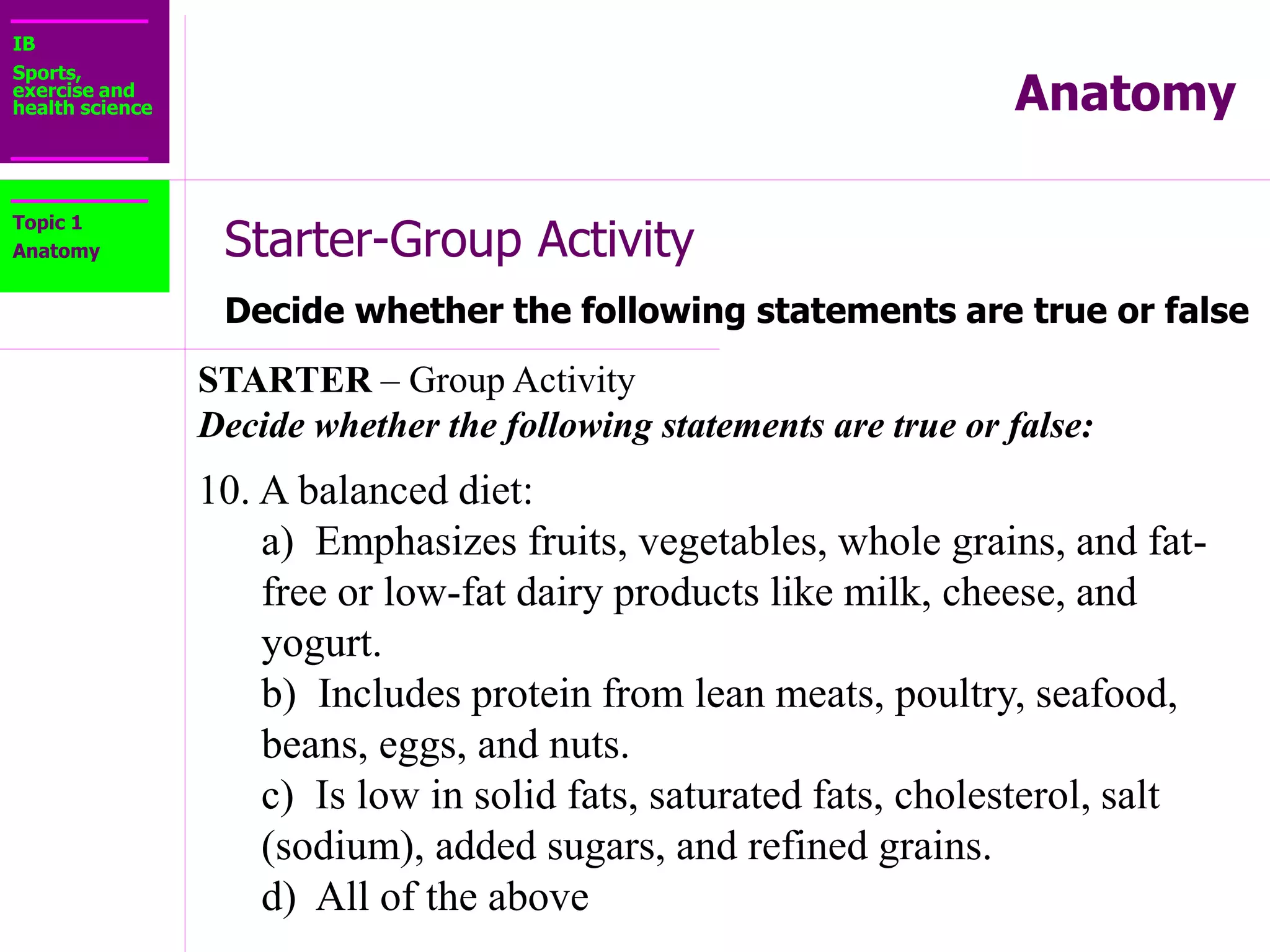
10. A balanced diet:
a) Emphasizes fruits, vegetables, whole grains, and fat-
free or low-fat dairy products like milk, cheese, and
yogurt.
b) Includes protein from lean meats, poultry, seafood,
beans, eggs, and nuts.
c) Is low in solid fats, saturated fats, cholesterol, salt
(sodium), added sugars, and refined grains.
d) All of the above
1.2.2
IB
Sports,
exercise and
health science Anatomy
1.2.2 Distinguish between the different types
of muscle
Topic 1
Anatomy
 Skeletal
 Cardiac
 Smooth
IB
Sports,
exercise and
health science Anatomy
1.2.2 Distinguish between the different types
of muscle
Topic 1
Anatomy
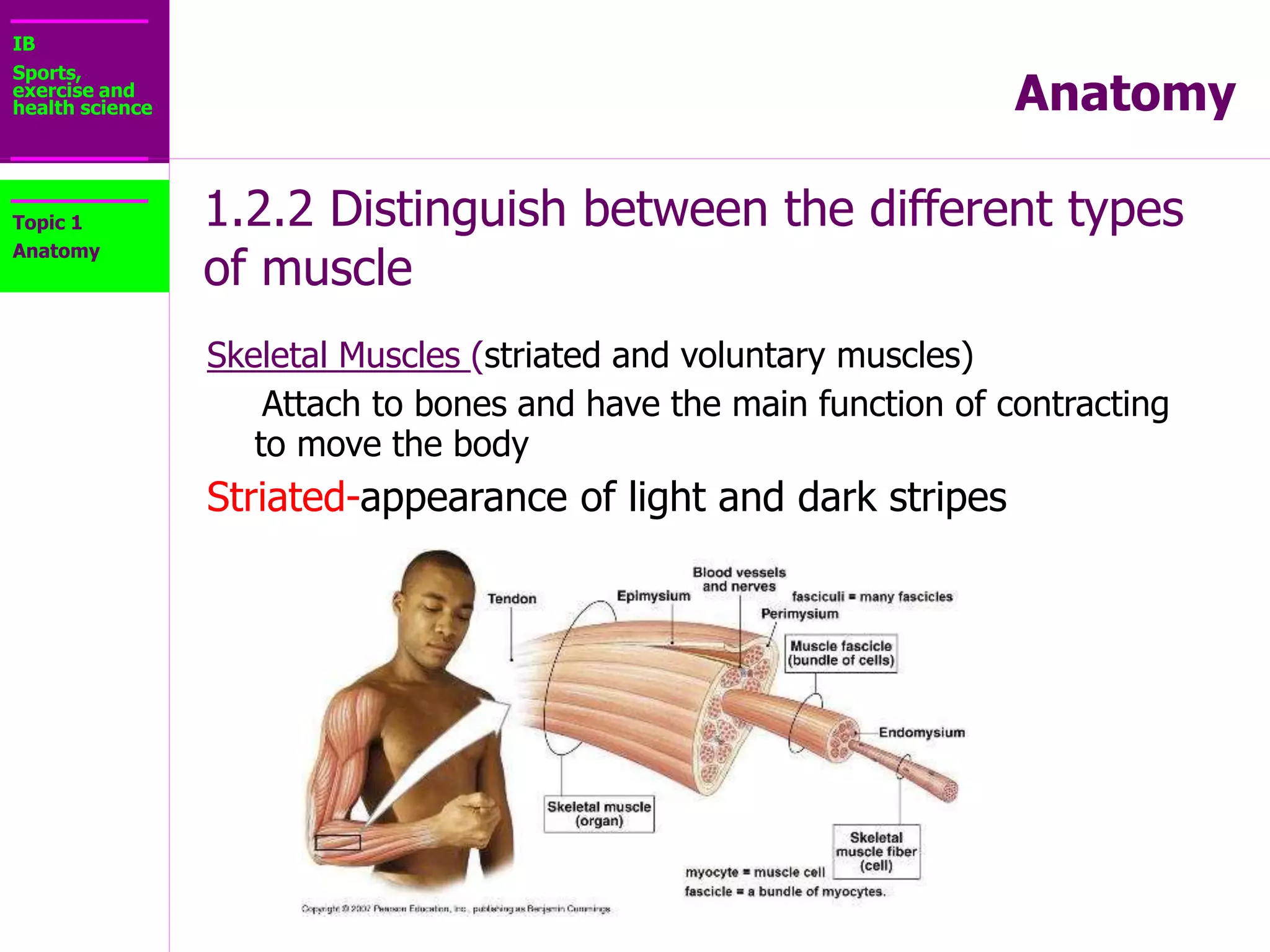
Skeletal Muscles (striated and voluntary muscles)
Attach to bones and have the main function of contracting
to move the body
Striated-appearance of light and dark stripes
IB
Sports,
exercise and
health science Anatomy
1.2.2 Distinguish between the different types
of muscle
Topic 1
Anatomy
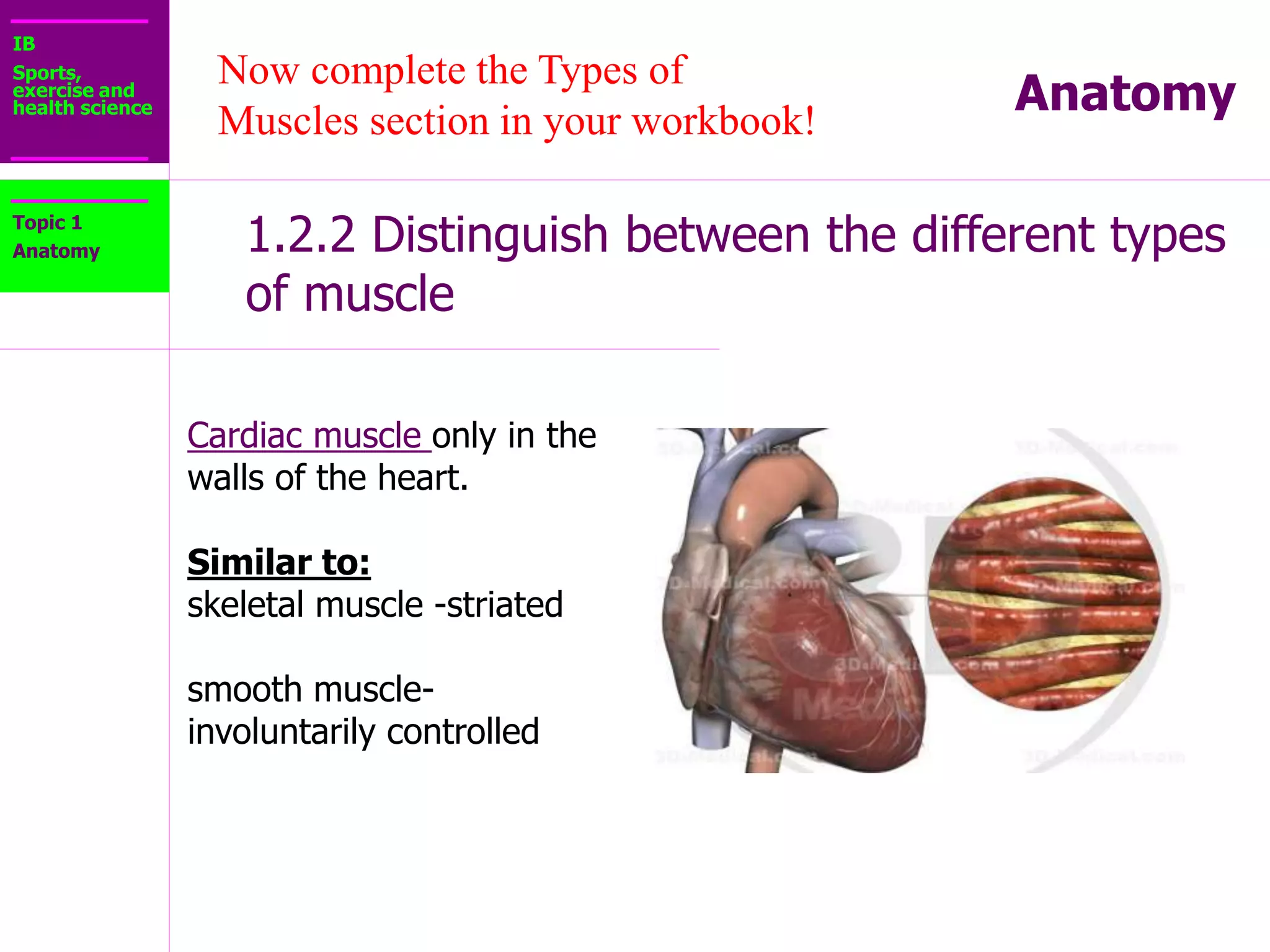
Cardiac muscle only in the
walls of the heart.
Similar to:
skeletal muscle -striated
smooth muscle-
involuntarily controlled
Now complete the Types of
Muscles section in your workbook!
IB
Sports,
exercise and
health science Anatomy
1.2.2 Distinguish between the different types
of muscle
Topic 1
Anatomy
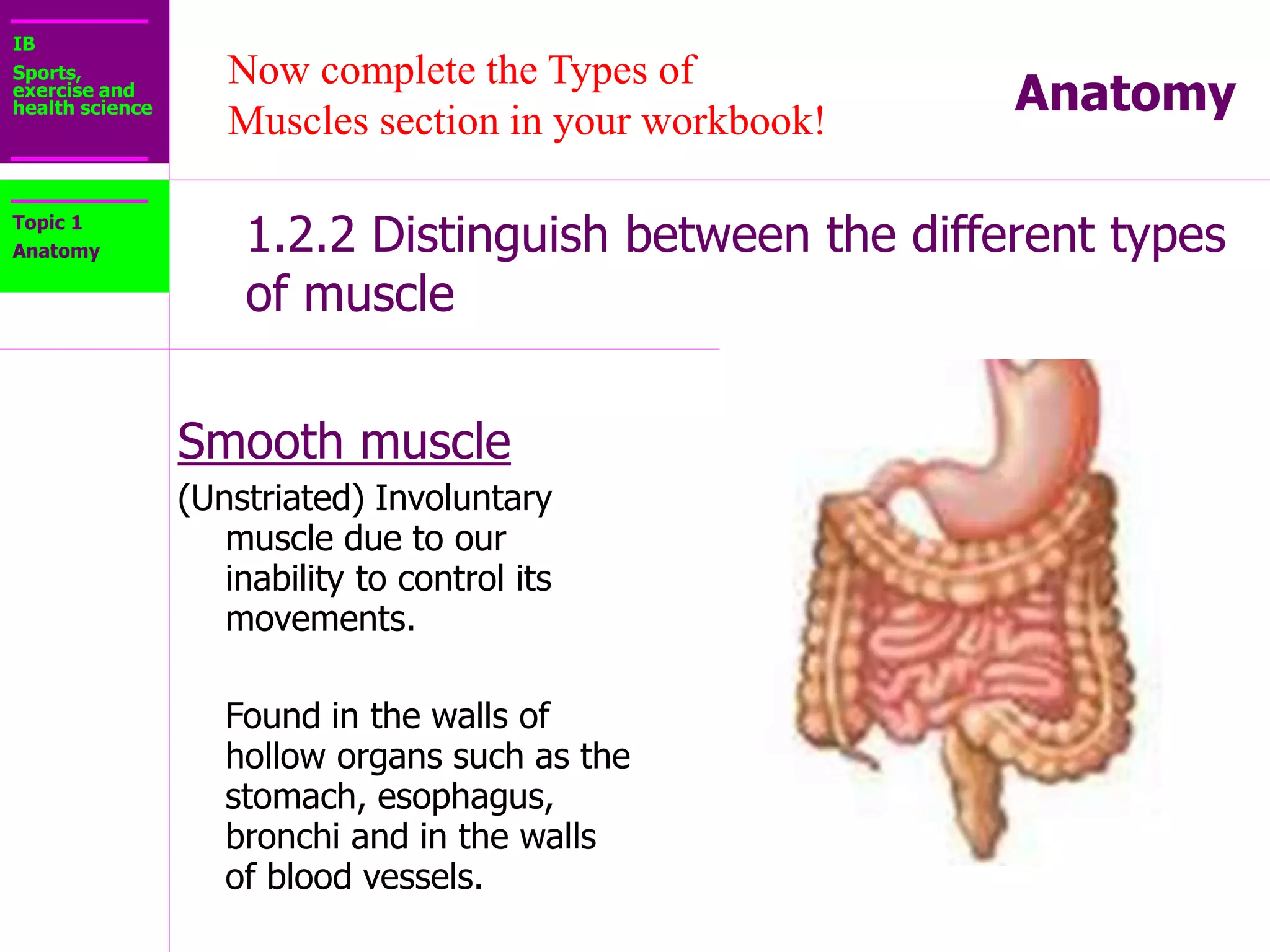
Smooth muscle
(Unstriated) Involuntary
muscle due to our
inability to control its
movements.
Found in the walls of
hollow organs such as the
stomach, esophagus,
bronchi and in the walls
of blood vessels.
Now complete the Types of
Muscles section in your workbook!
IB
Sports,
exercise and
health science Anatomy
REVIEW POINT
1.2.2 Distinguish between the different types
of muscle
Topic 1
Anatomy
 Skeletal
 Cardiac
 Smooth
DET PDHPE Distance Education Programme.
IB
Sports,
exercise and
health science Anatomy
Thinking
What do we use our muscles
for?
Talk and make a
list – 2 minutes
Topic 1
Anatomy
IB
Sports,
exercise and
health science Anatomy
Topic 1
Anatomy
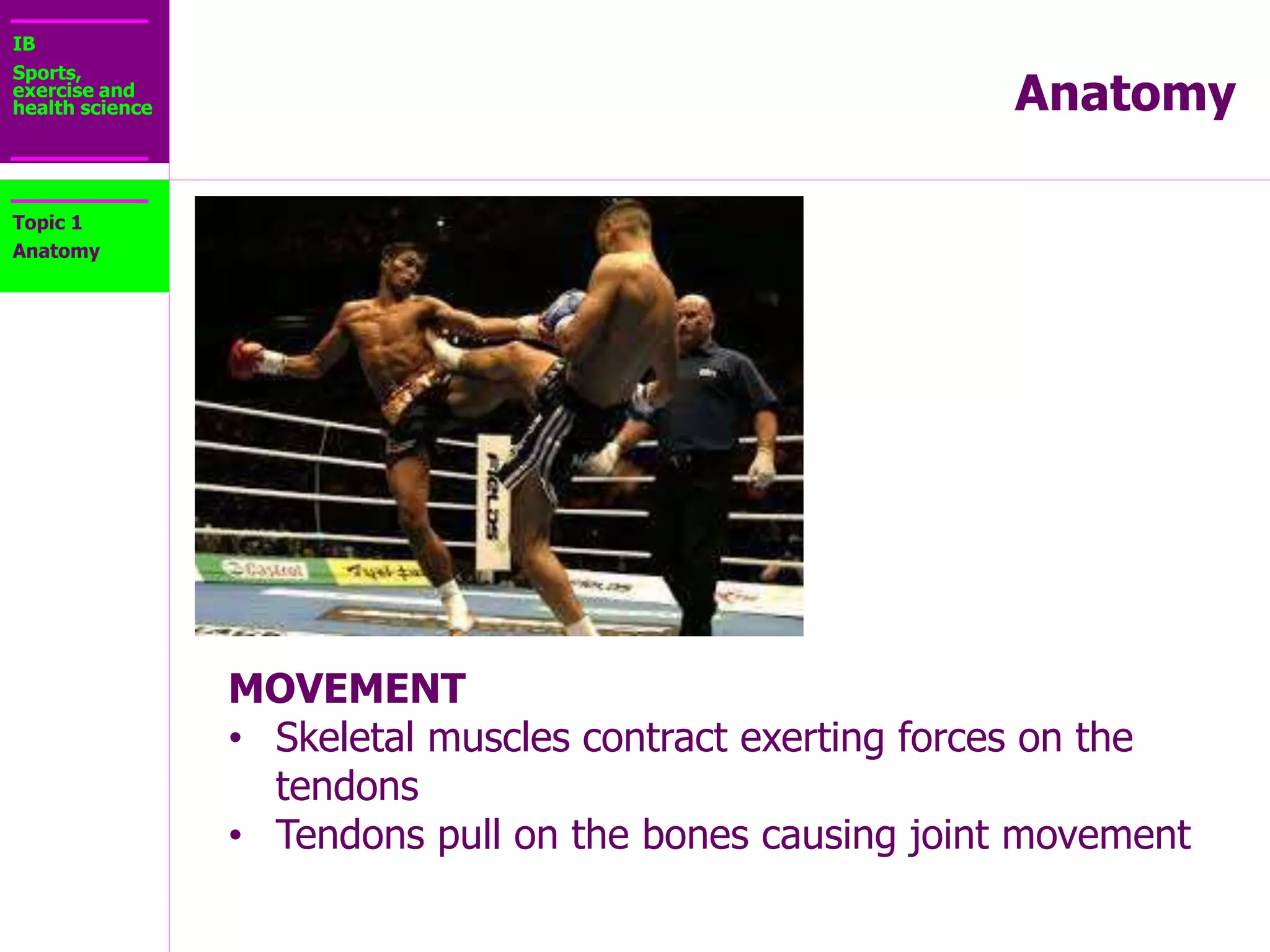
MOVEMENT
• Skeletal muscles contract exerting forces on the
tendons
• Tendons pull on the bones causing joint movement
IB
Sports,
exercise and
health science Anatomy
Topic 1
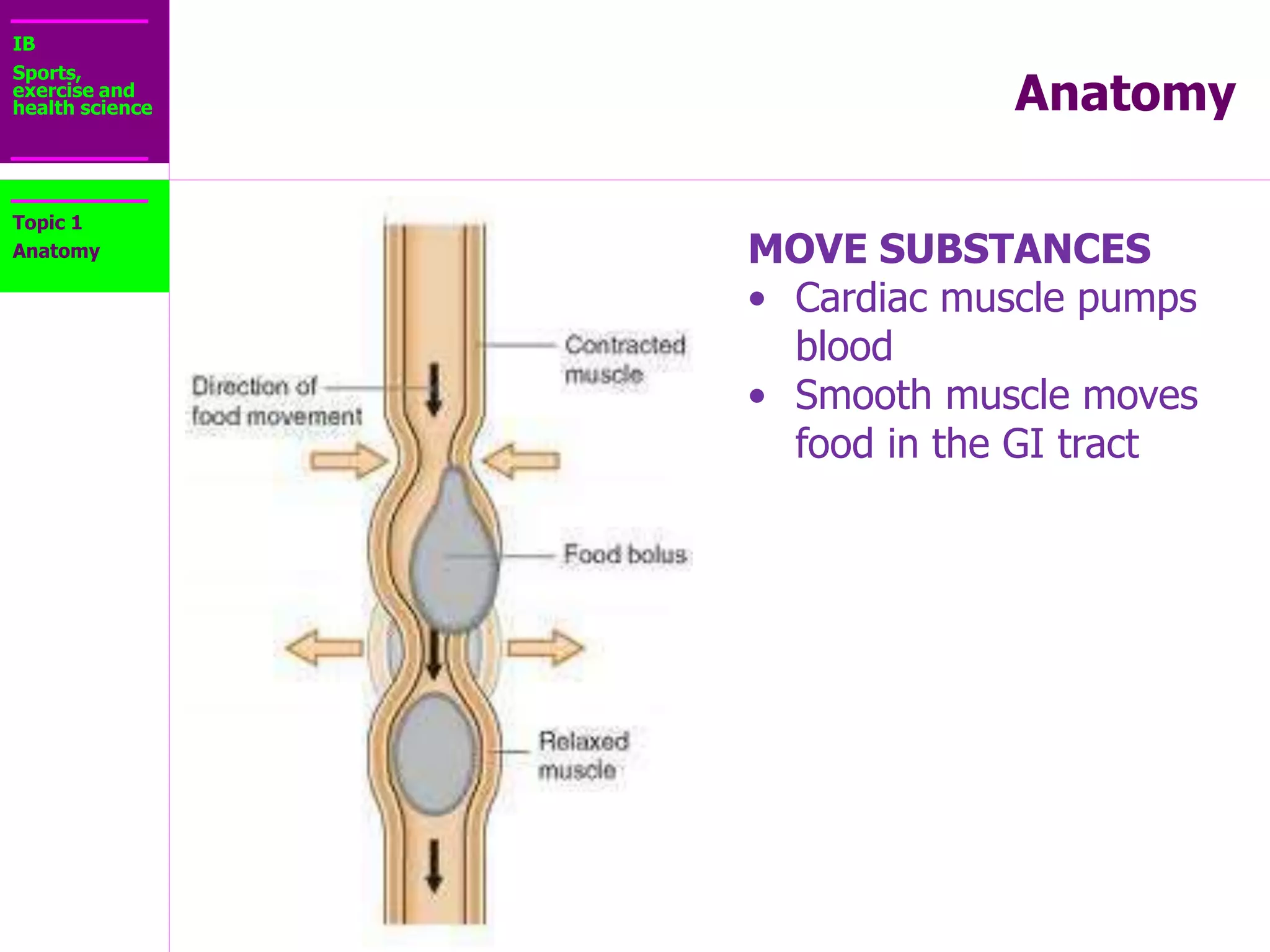
Anatomy MOVE SUBSTANCES
• Cardiac muscle pumps
blood
• Smooth muscle moves
food in the GI tract
IB
Sports,
exercise and
health science Anatomy
Topic 1
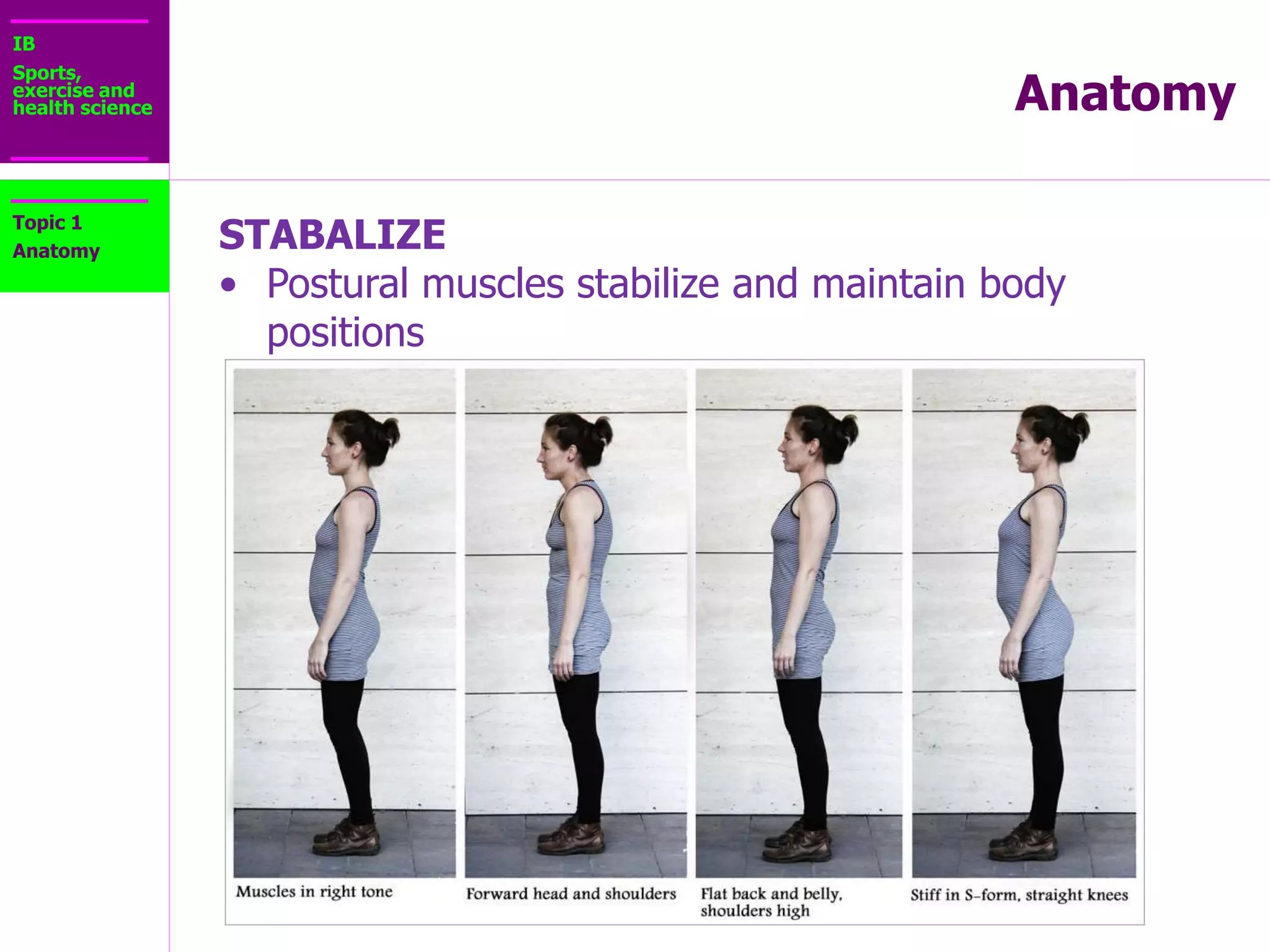
Anatomy STABALIZE
• Postural muscles stabilize and maintain body
positions
IB
Sports,
exercise and
health science Anatomy
Topic 1
Anatomy
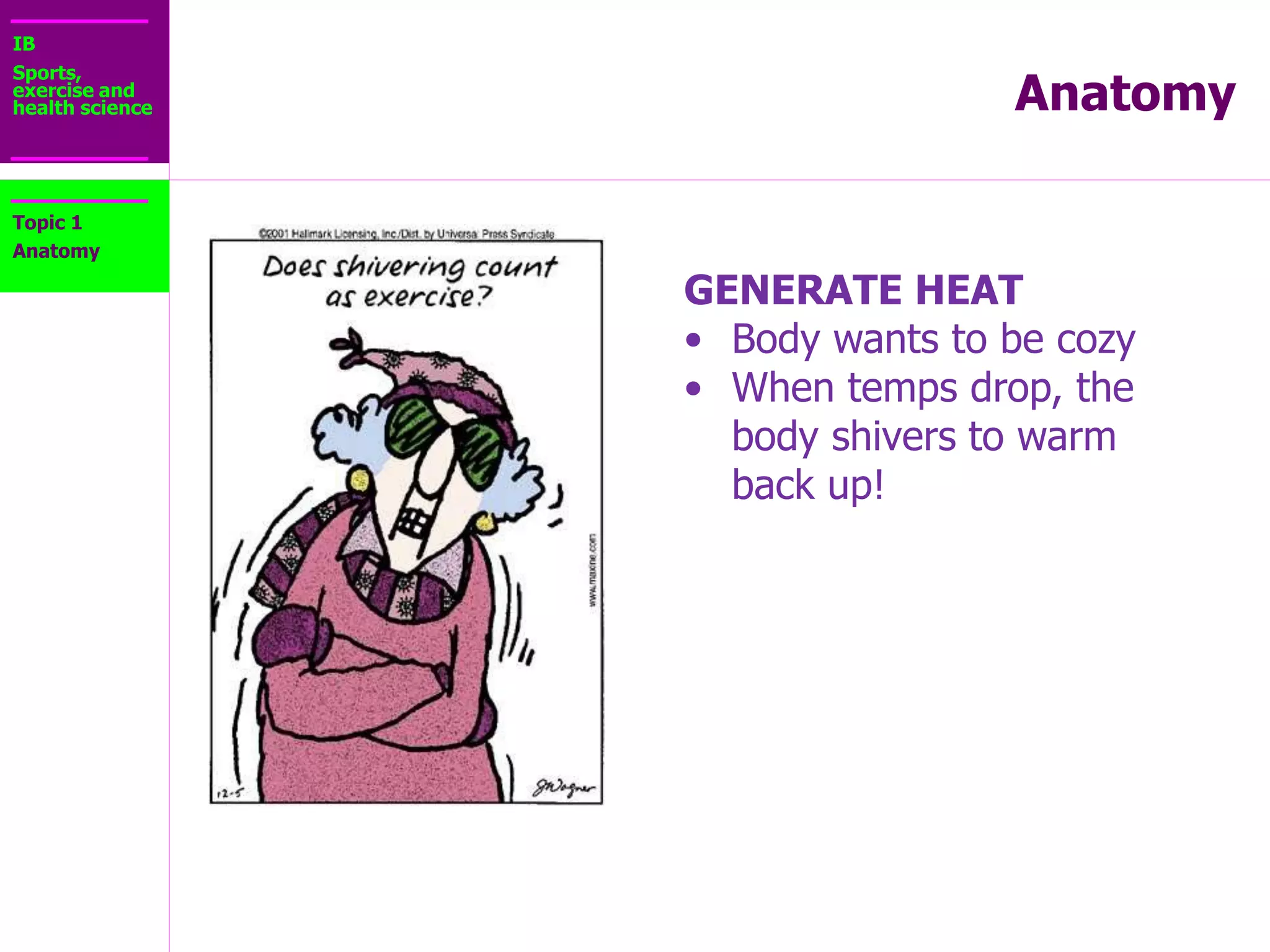
GENERATE HEAT
• Body wants to be cozy
• When temps drop, the
body shivers to warm
back up!
IB
Sports,
exercise and
health science Anatomy
REVIEW POINT
Four functions of muscles
Topic 1
Anatomy
 Movement
 Move Substances
 Stabilize the body
 Generate heat
DET PDHPE Distance Education Programme.
1.2.1
IB
Sports,
exercise and
health science Anatomy
Thinking
What characteristics do ALL
muscles have?
Talk and decide
Topic 1
Anatomy
IB
Sports,
exercise and
health science Anatomy
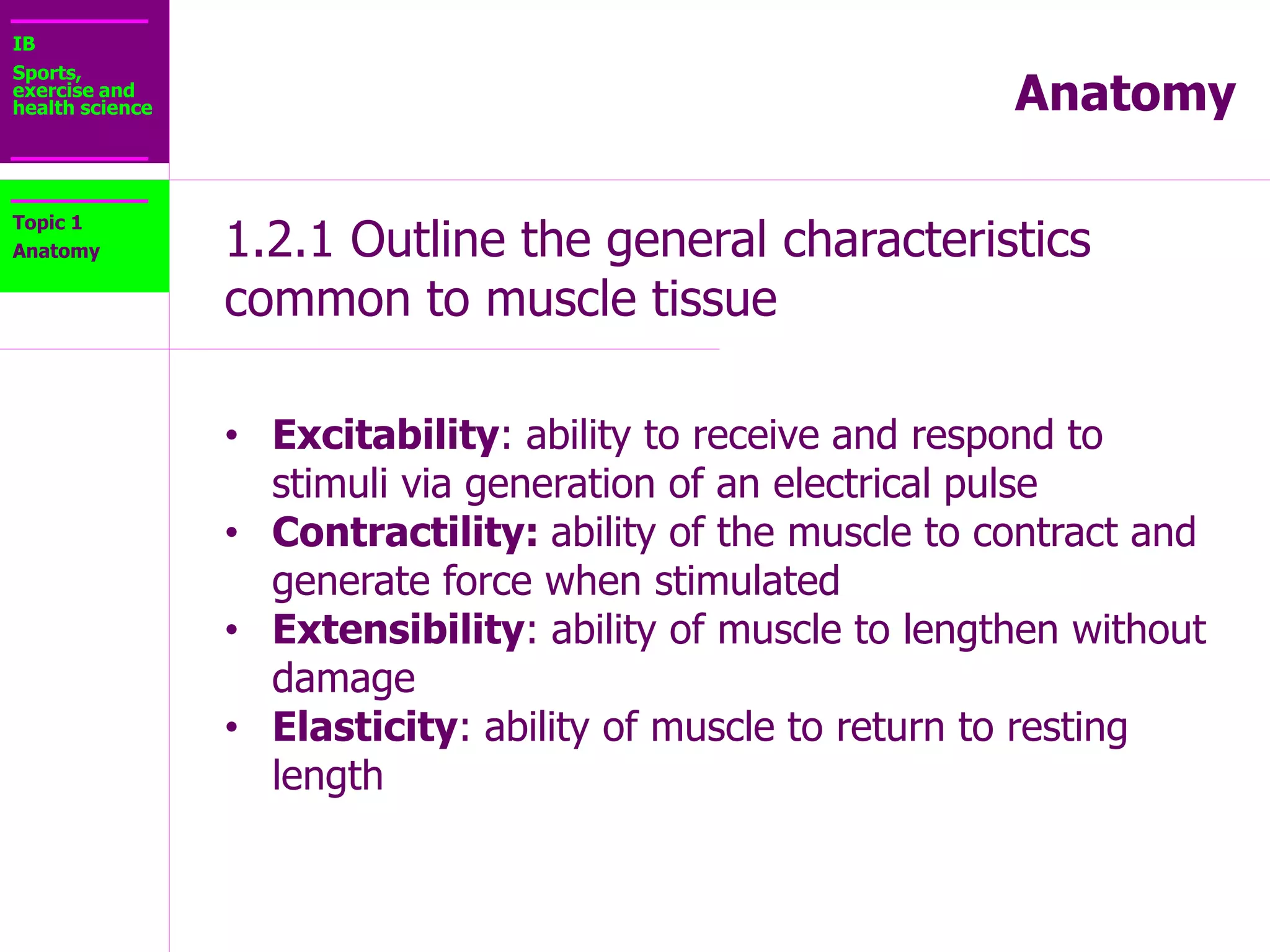
1.2.1 Outline the general characteristics
common to muscle tissue
Topic 1
Anatomy
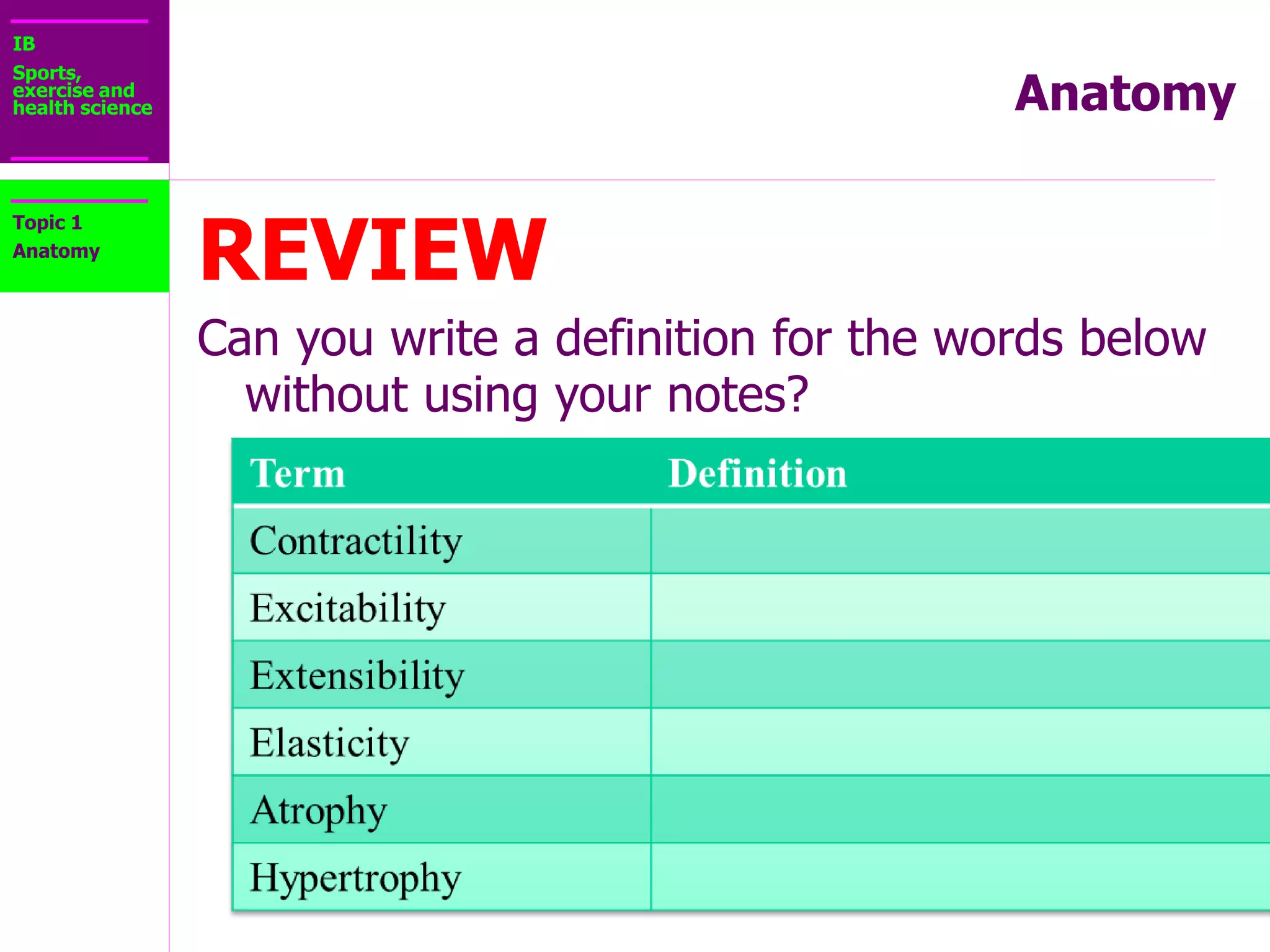
• Excitability: ability to receive and respond to
stimuli via generation of an electrical pulse
• Contractility: ability of the muscle to contract and
generate force when stimulated
• Extensibility: ability of muscle to lengthen without
damage
• Elasticity: ability of muscle to return to resting
length
IB
Sports,
exercise and
health science Anatomy
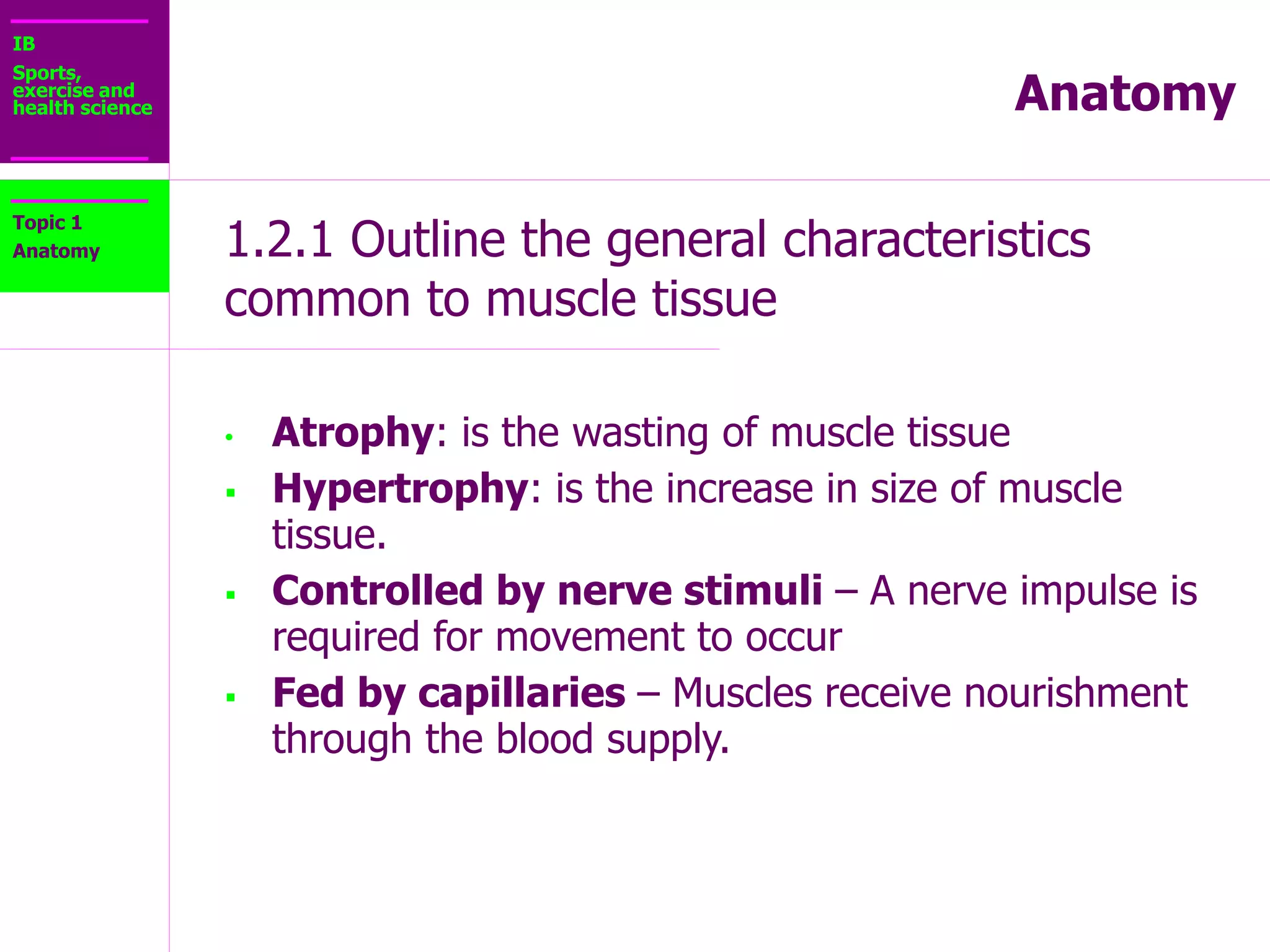
1.2.1 Outline the general characteristics
common to muscle tissue
Topic 1
Anatomy
• Atrophy: is the wasting of muscle tissue
 Hypertrophy: is the increase in size of muscle
tissue.
 Controlled by nerve stimuli – A nerve impulse is
required for movement to occur
 Fed by capillaries – Muscles receive nourishment
through the blood supply.
IB
Sports,
exercise and
health science Anatomy
REVIEW
Can you write a definition for the words below
without using your notes?
Topic 1
Anatomy
1.2.3
Annotate the Structure of Skeletal Muscle
IB
Sports,
exercise and
health science Anatomy
1.2.3 Annotate the structure of skeletal
muscle
Topic 1
Anatomy
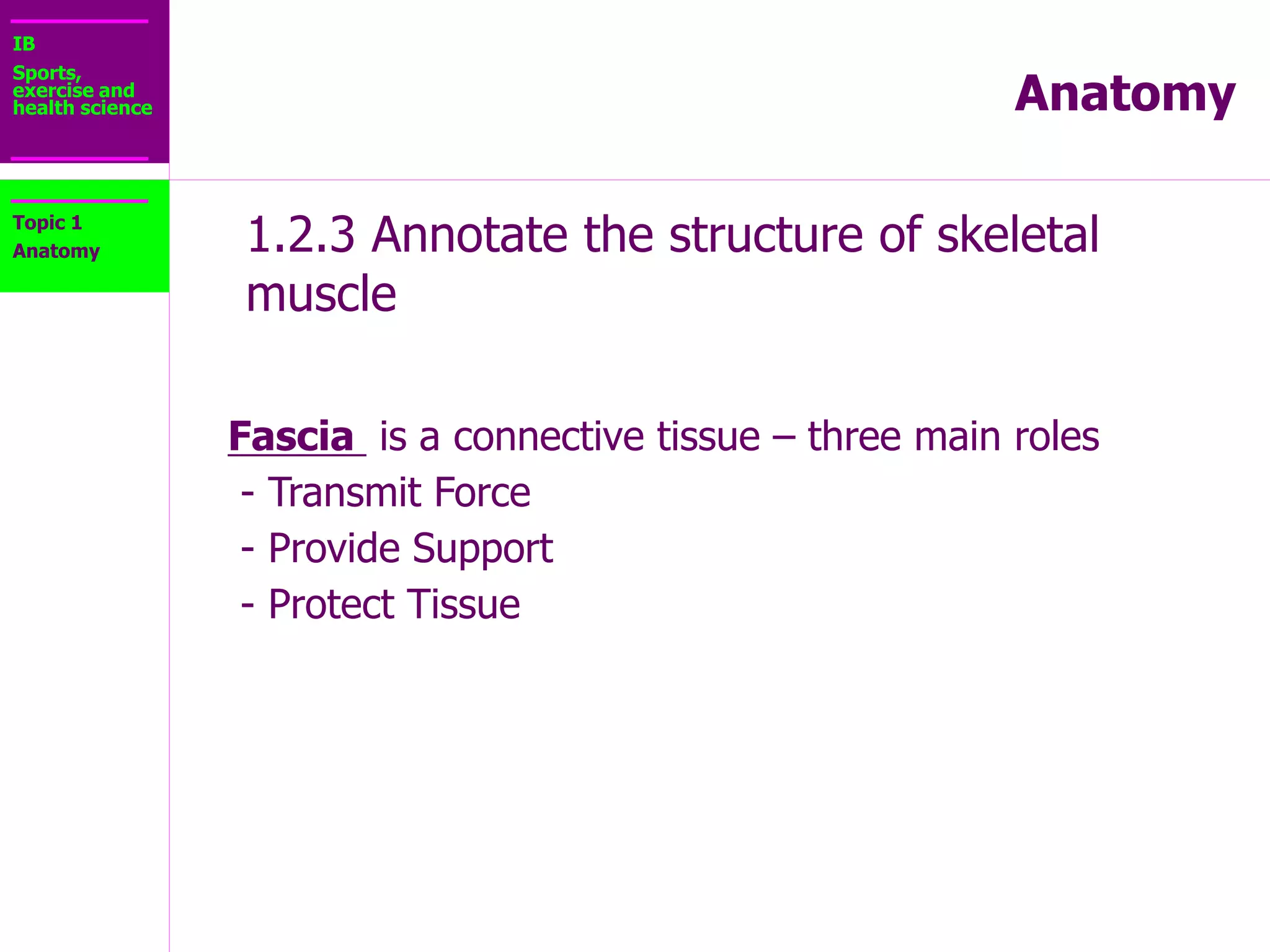
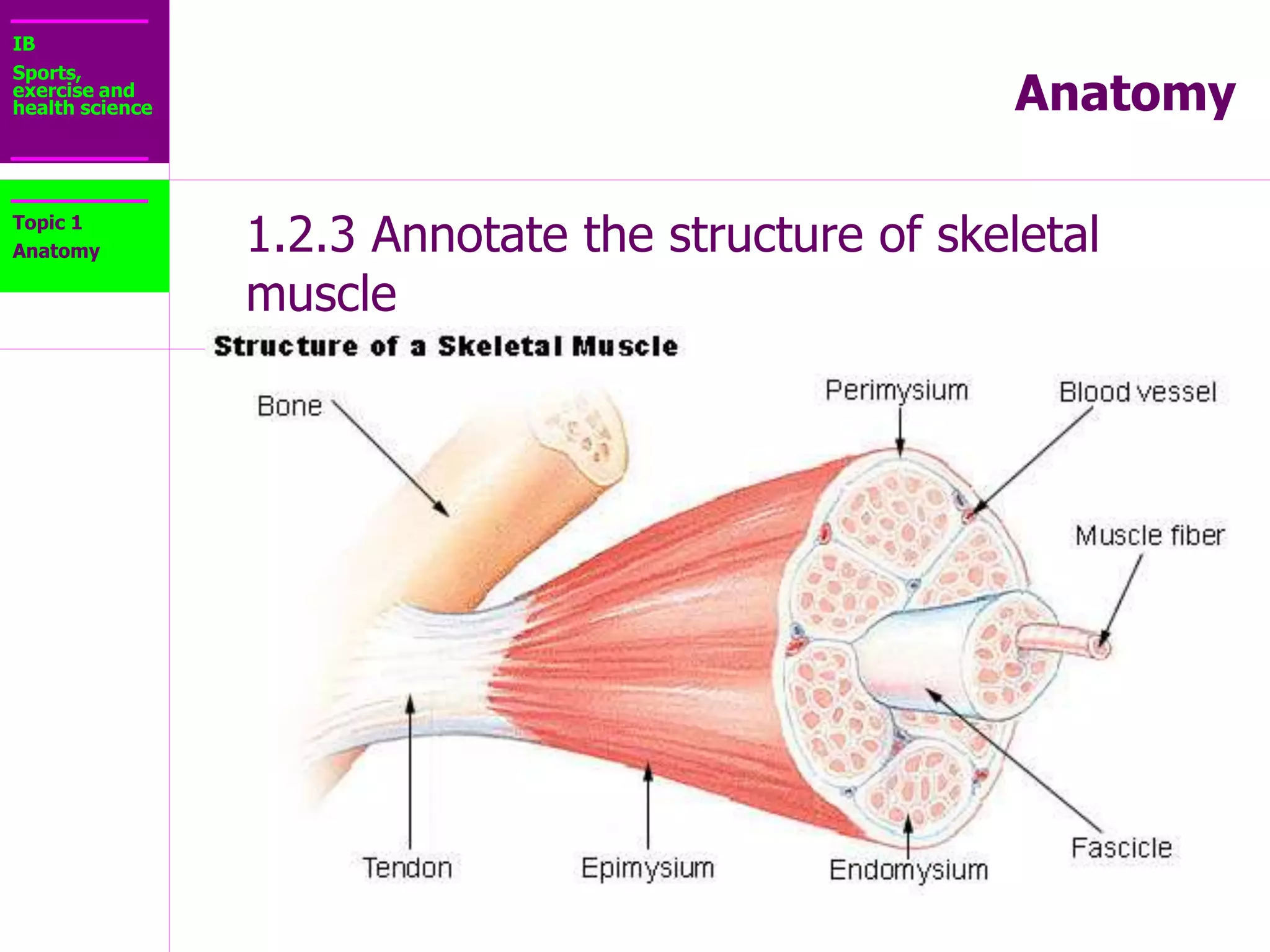
Fascia is a connective tissue – three main roles
- Transmit Force
- Provide Support
- Protect Tissue
IB
Sports,
exercise and
health science Anatomy
1.2.3 Annotate the structure of skeletal
muscle
Topic 1
Anatomy
1.2.4 – 1.2.5
Three Golden Rules of
Skeletal Muscle Activity
Muscles only contract and relax.
Muscles only work on joints they cross.
Muscles work best in the direction of their fibers.
Tip – Muscles in front do one action – in back do the
other. Origin is proximal, Insertion is distal. Larger
end is often the origin
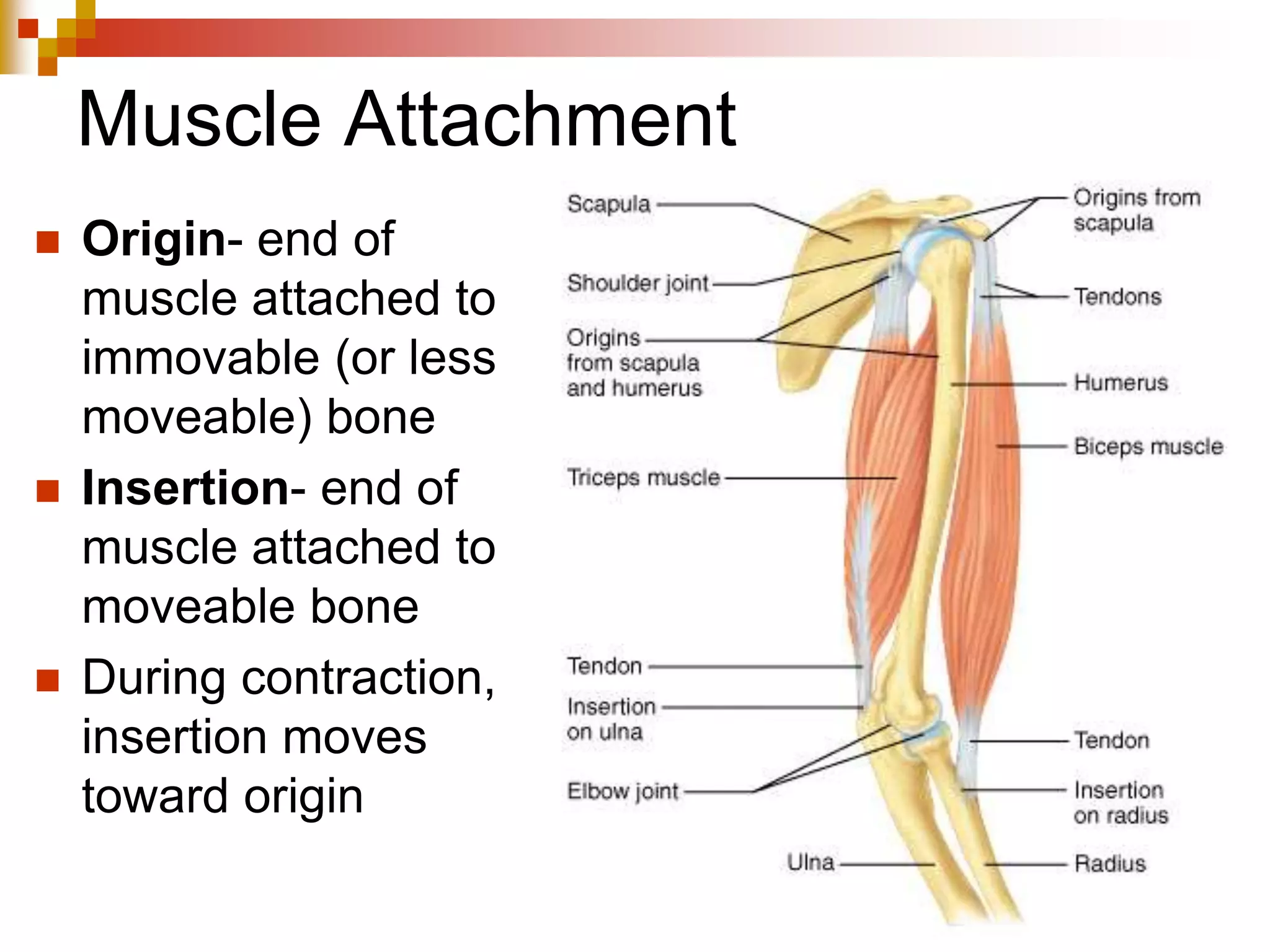
Muscle Attachment
 Origin- end of
muscle attached to
immovable (or less
moveable) bone
 Insertion- end of
muscle attached to
moveable bone
 During contraction,
insertion moves
toward origin
Interactions of Skeletal Muscles
 Agonist/ Prime movers - are the muscles
mostly responsible for the movement
 Antagonists - oppose/reverse movement
 Synergists - work with prime movers to
stabilize the muscle
 Fixators - work with prime movers to
stabilize bone or origin. These are mostly
found around the hip and shoulder joint.
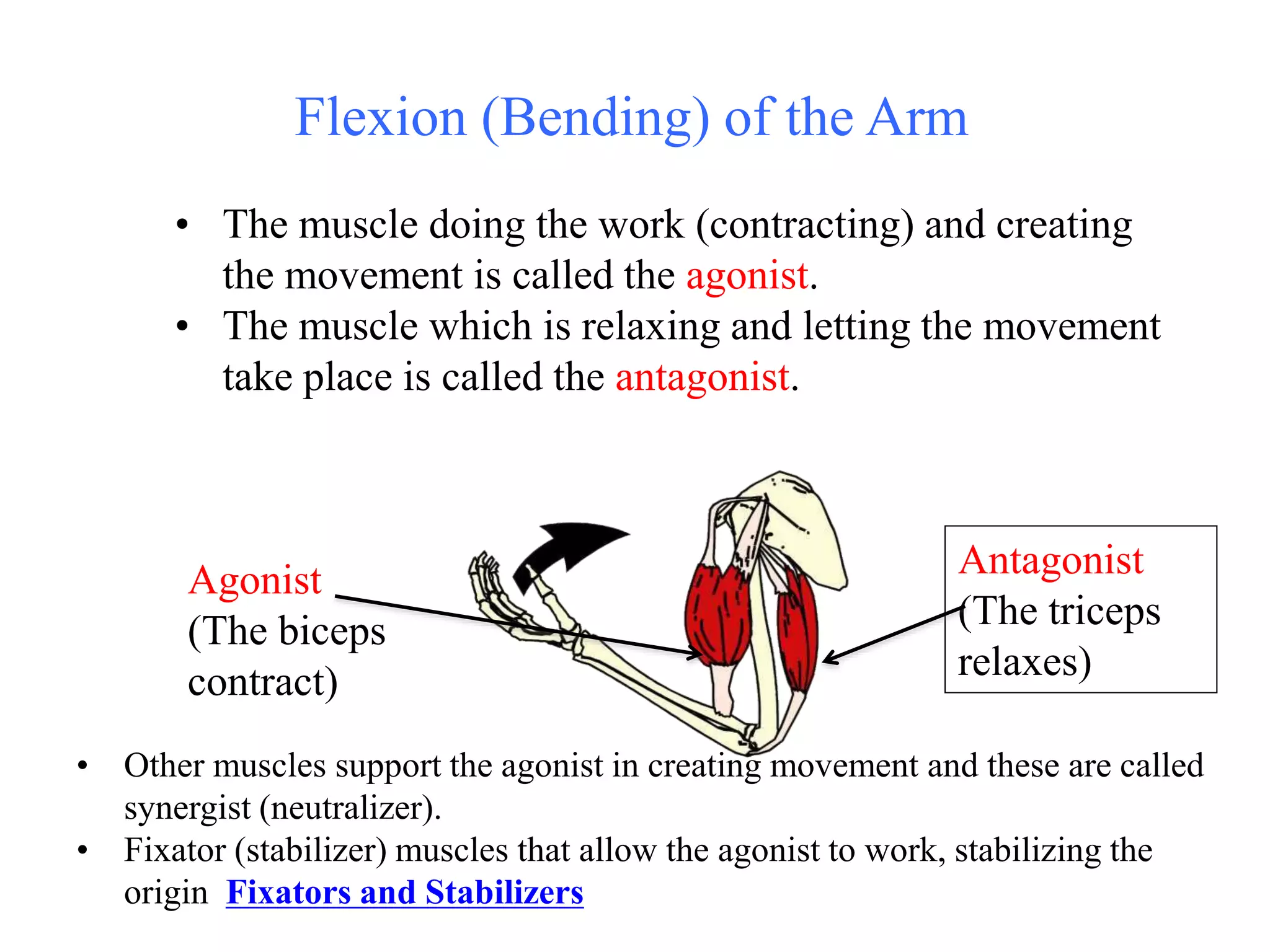
Flexion (Bending) of the Arm
• The muscle doing the work (contracting) and creating
the movement is called the agonist.
• The muscle which is relaxing and letting the movement
take place is called the antagonist.
Agonist
(The biceps
contract)
Antagonist
(The triceps
relaxes)
• Other muscles support the agonist in creating movement and these are called
synergist (neutralizer).
• Fixator (stabilizer) muscles that allow the agonist to work, stabilizing the
origin Fixators and Stabilizers
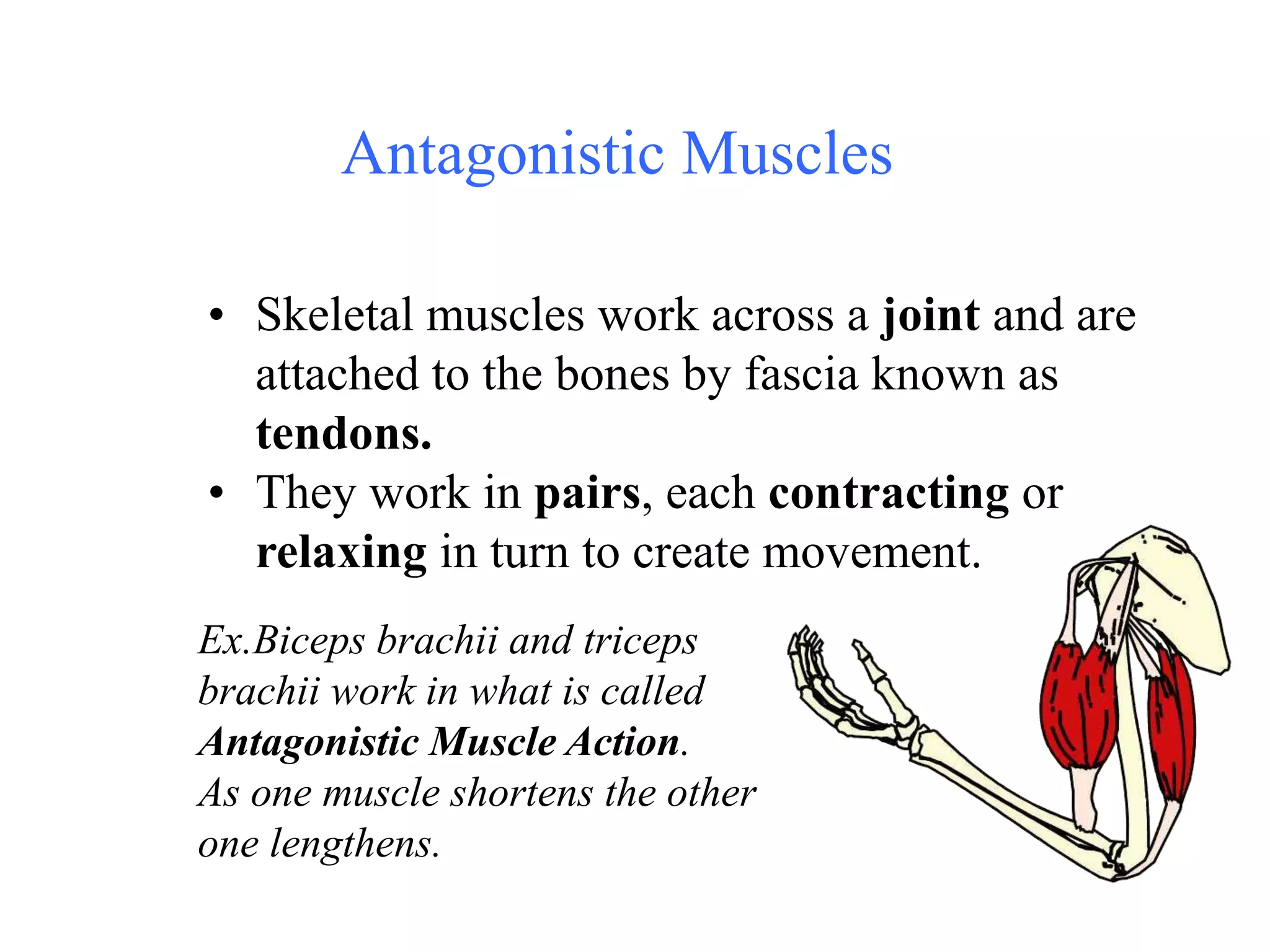
Antagonistic Muscles
• Skeletal muscles work across a joint and are
attached to the bones by fascia known as
tendons.
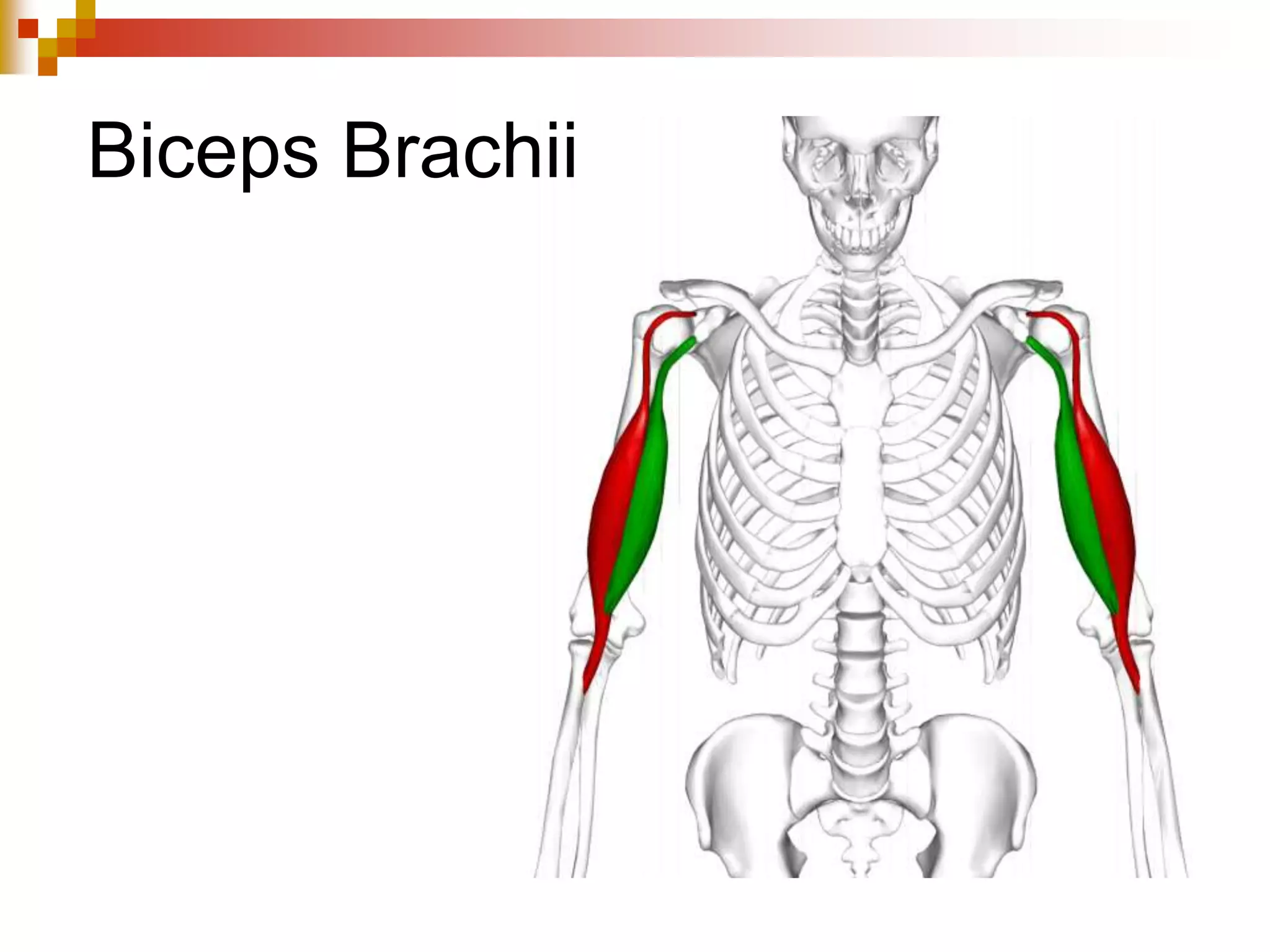
• They work in pairs, each contracting or
relaxing in turn to create movement.
Ex.Biceps brachii and triceps
brachii work in what is called
Antagonistic Muscle Action.
As one muscle shortens the other
one lengthens.
TRUNK
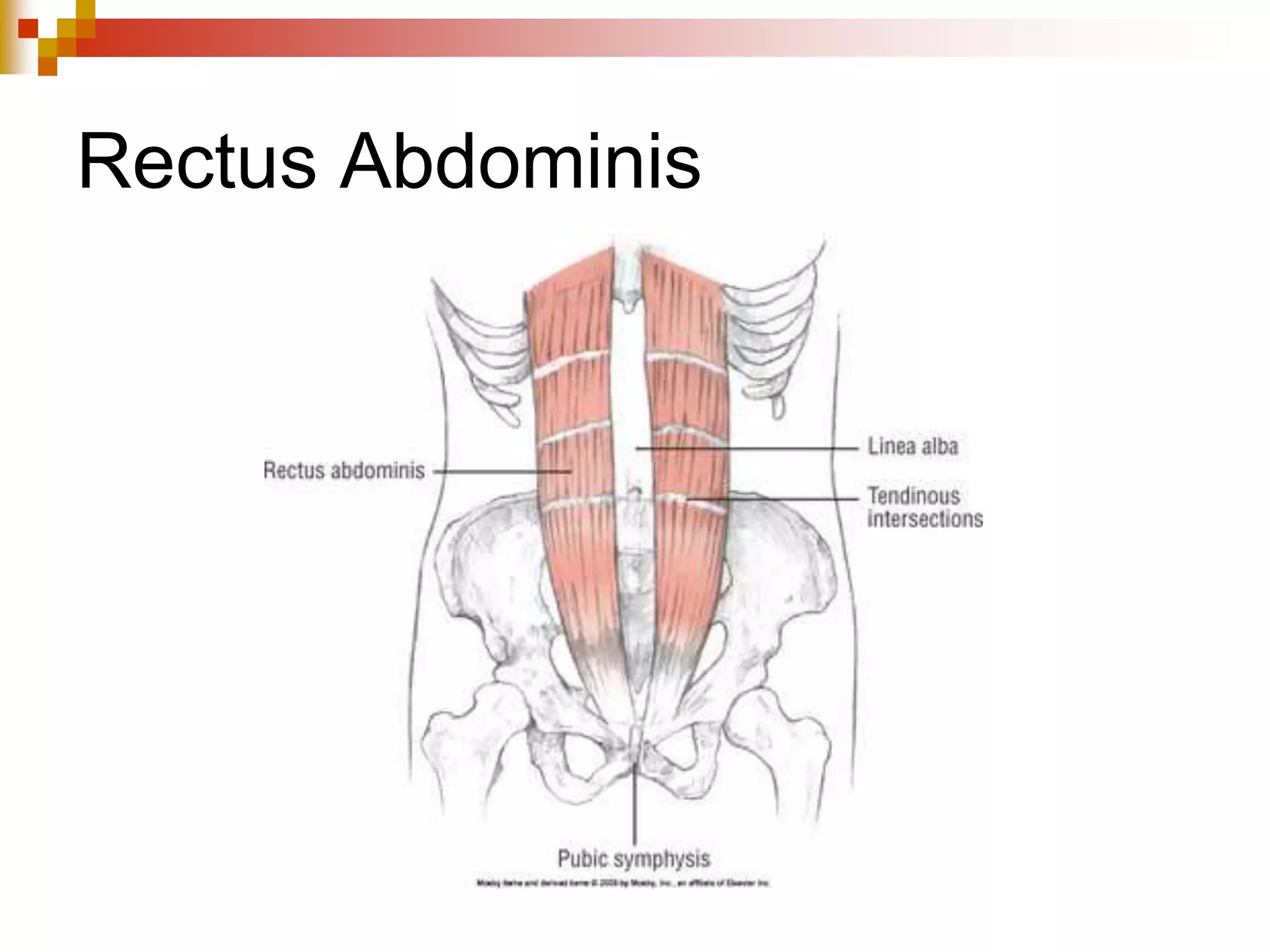
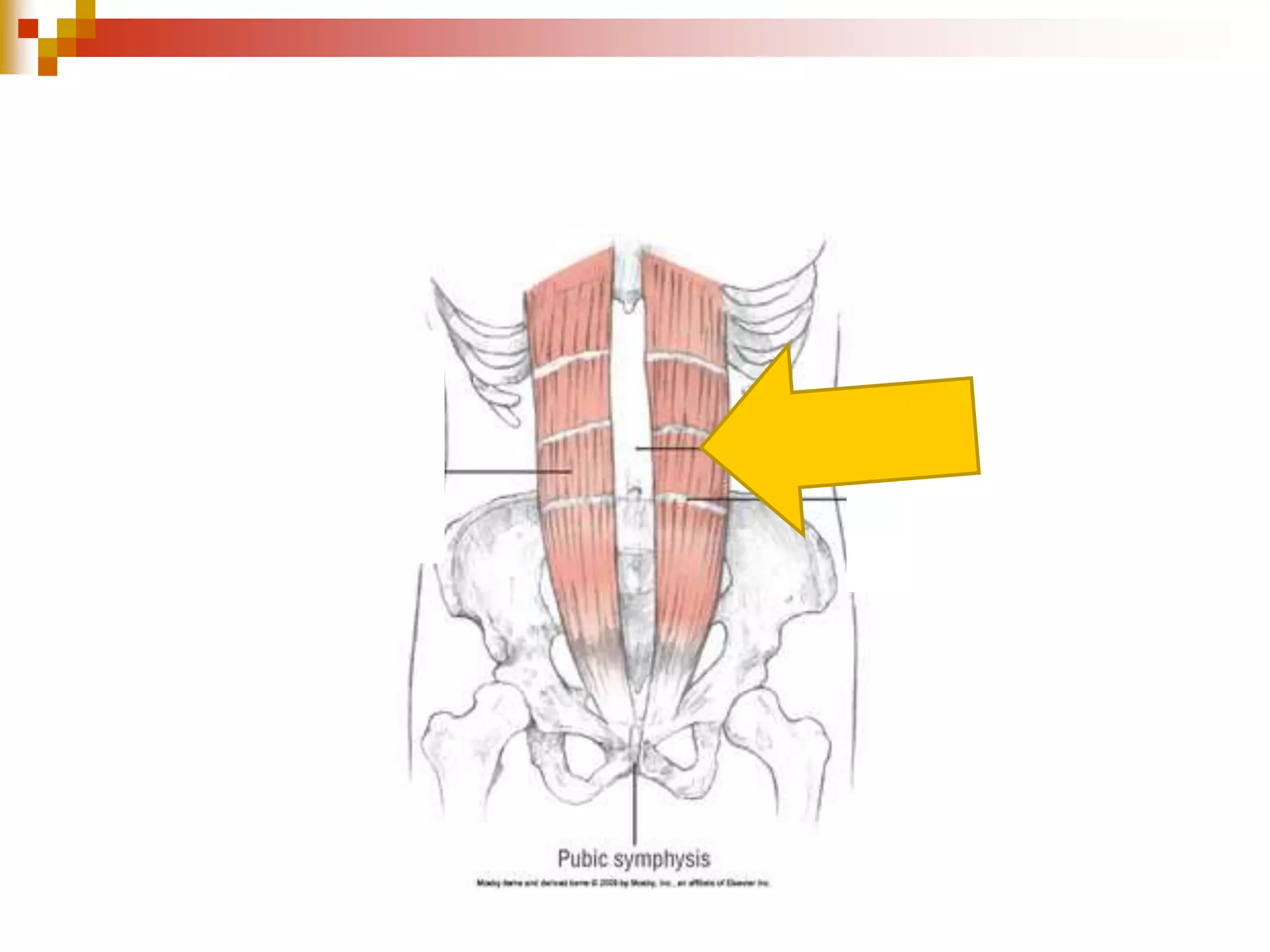
Rectus Abdominis
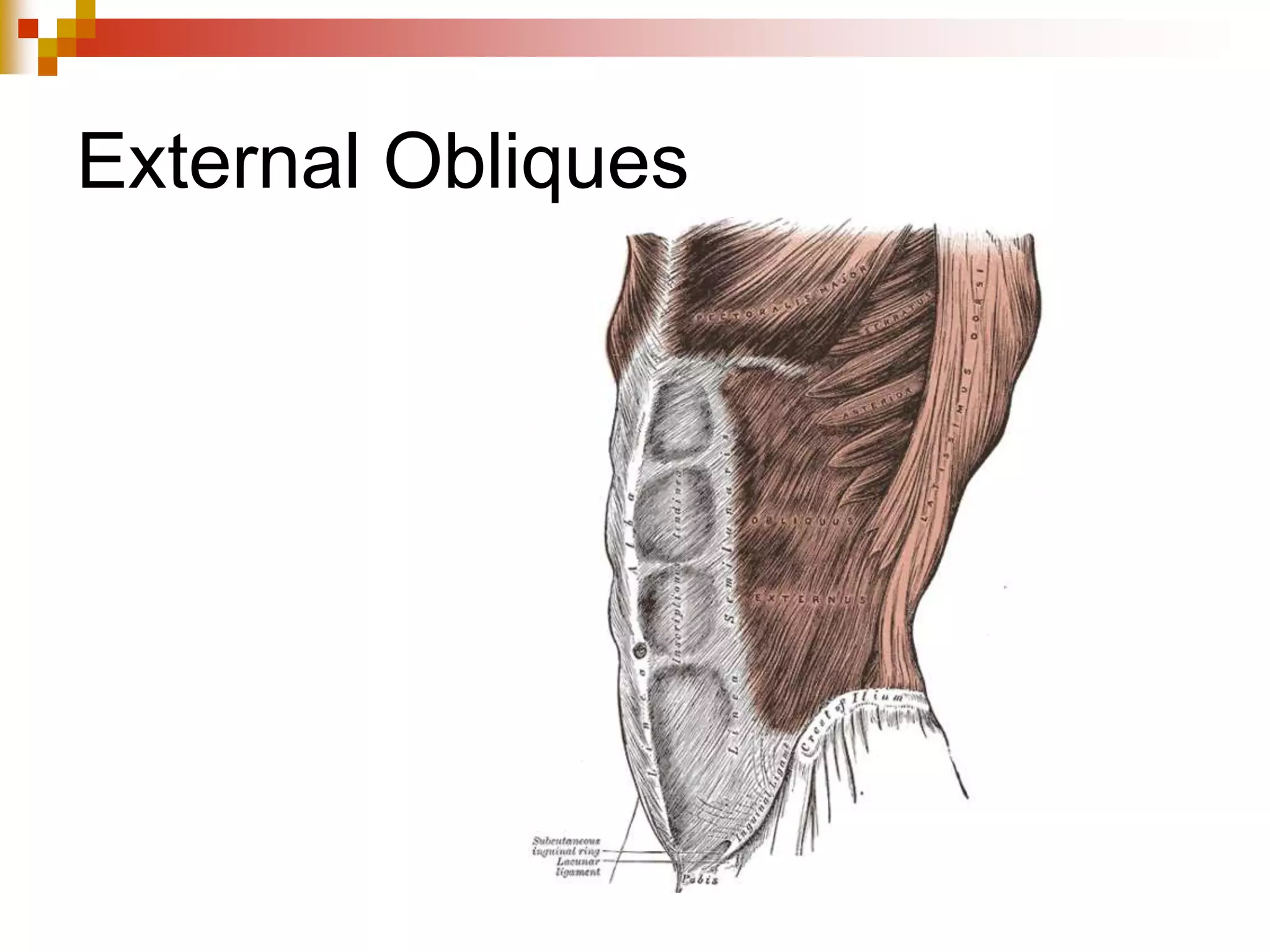
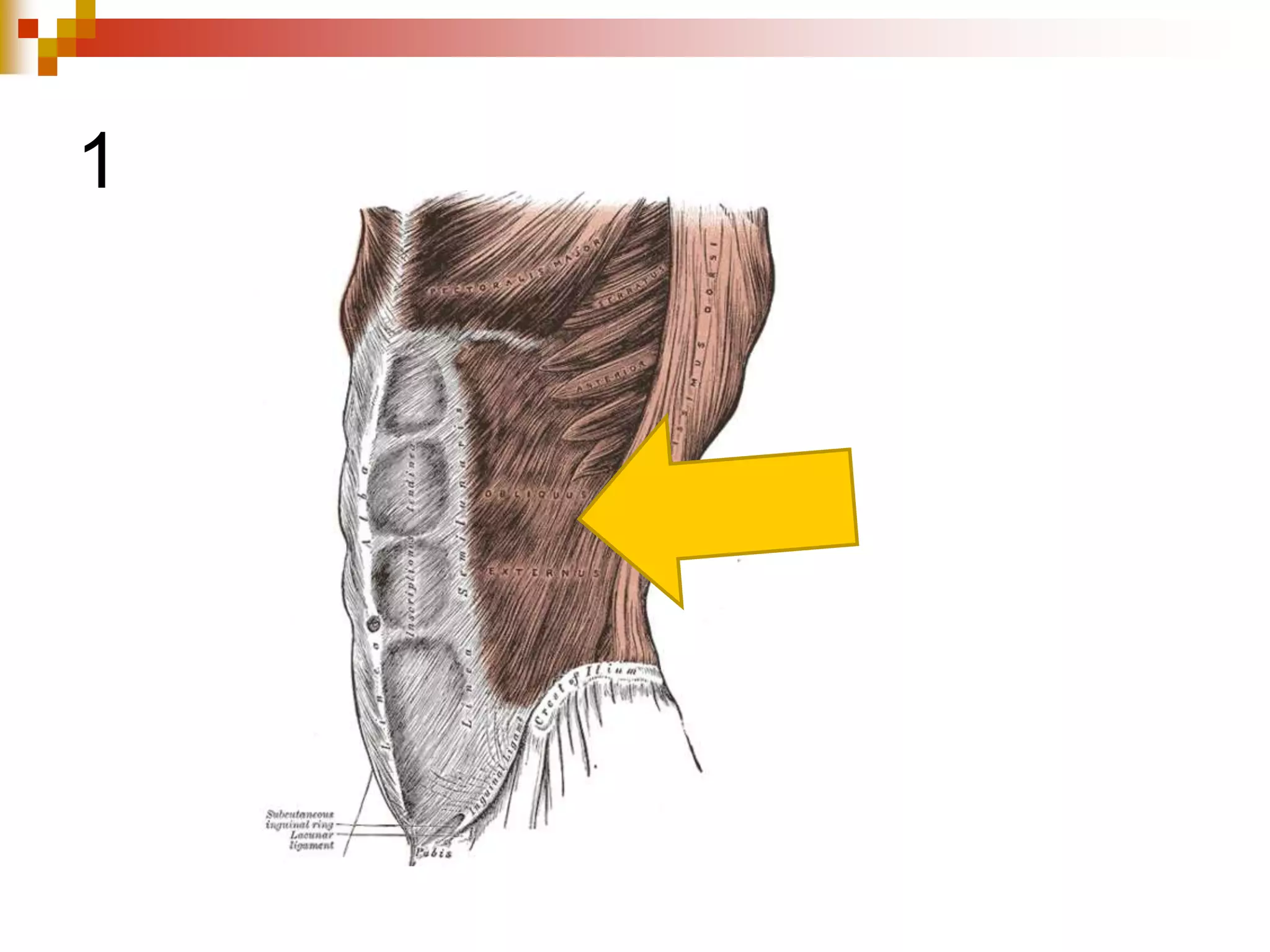
External Obliques
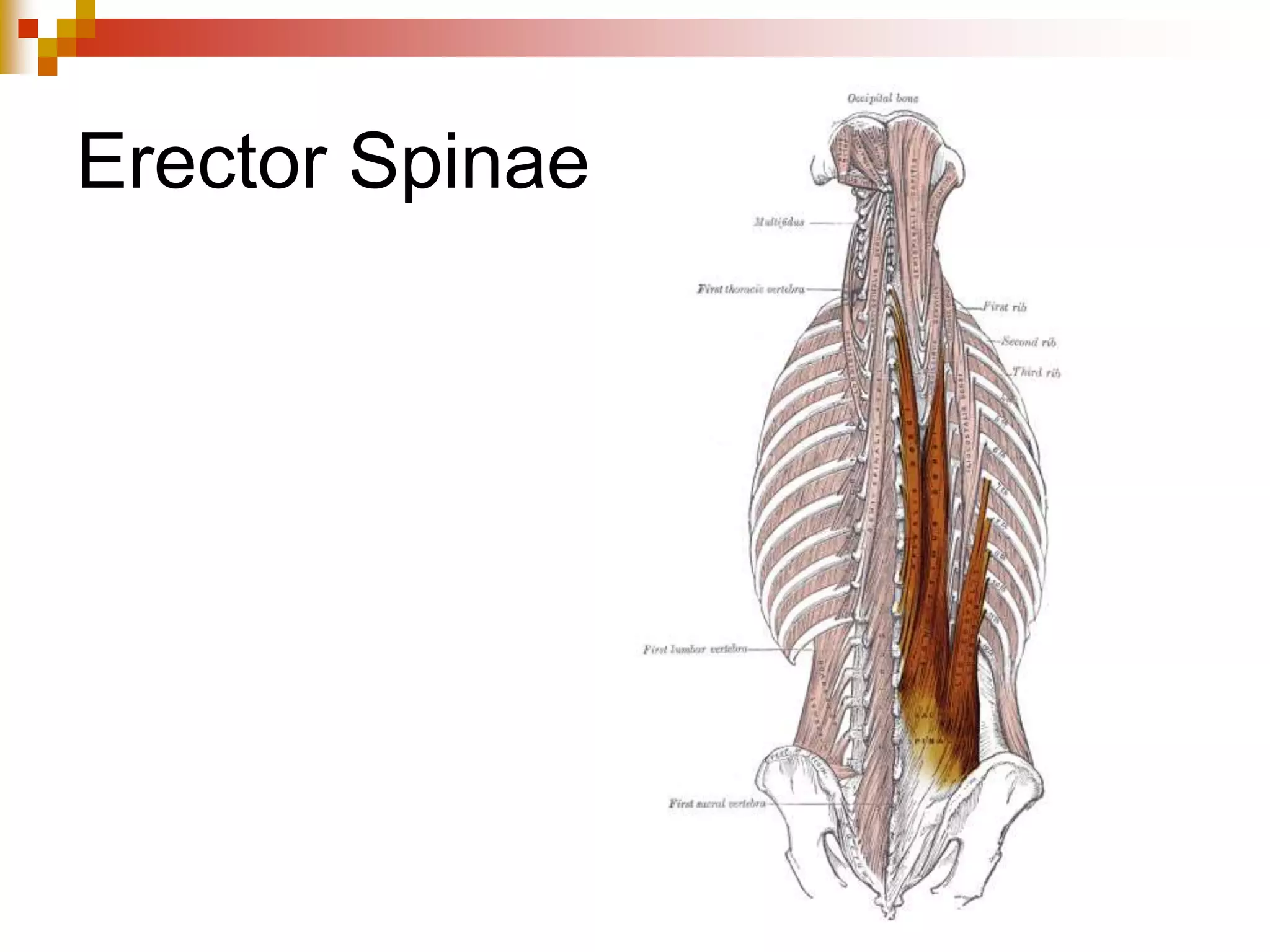
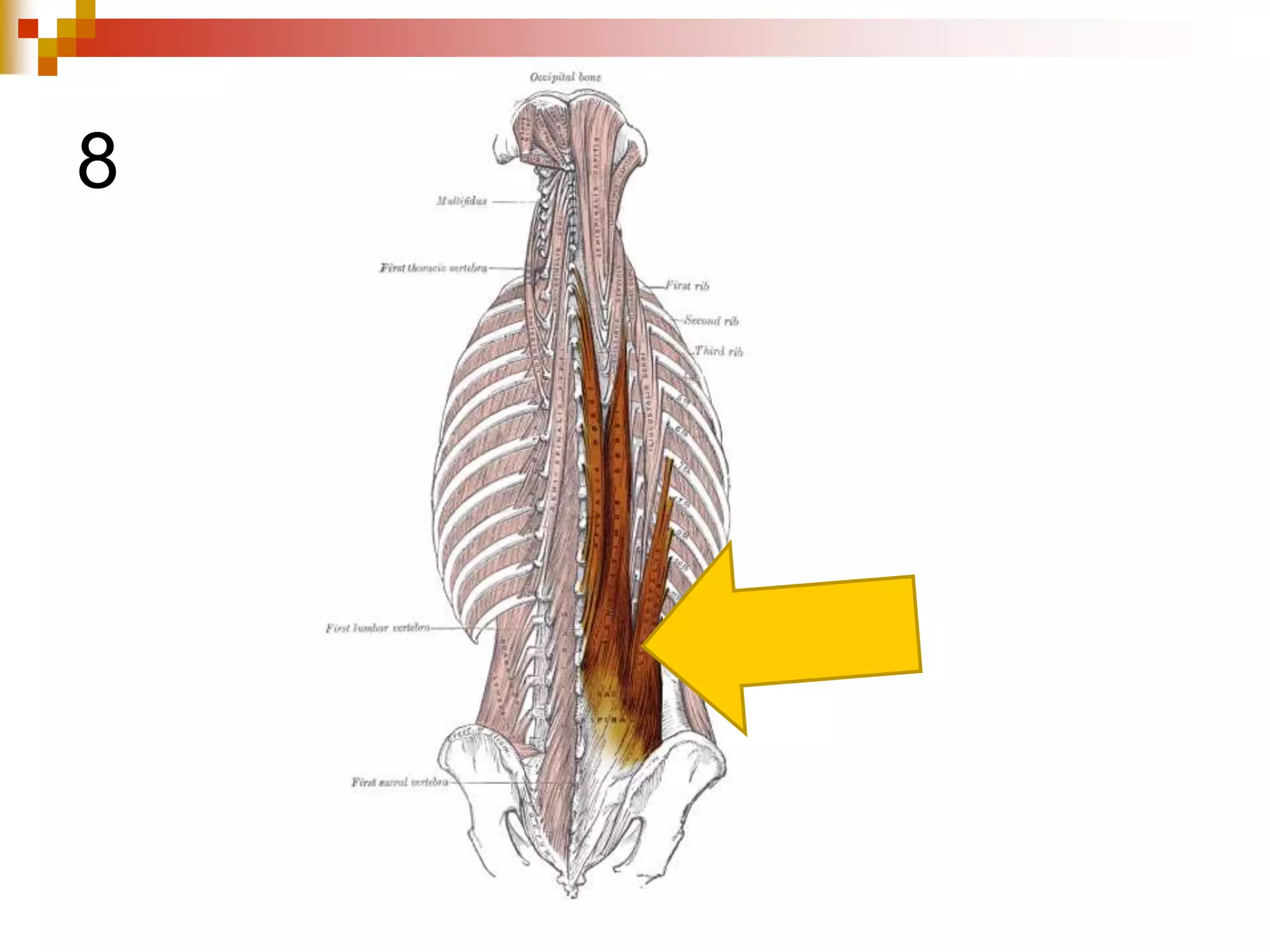
Erector Spinae
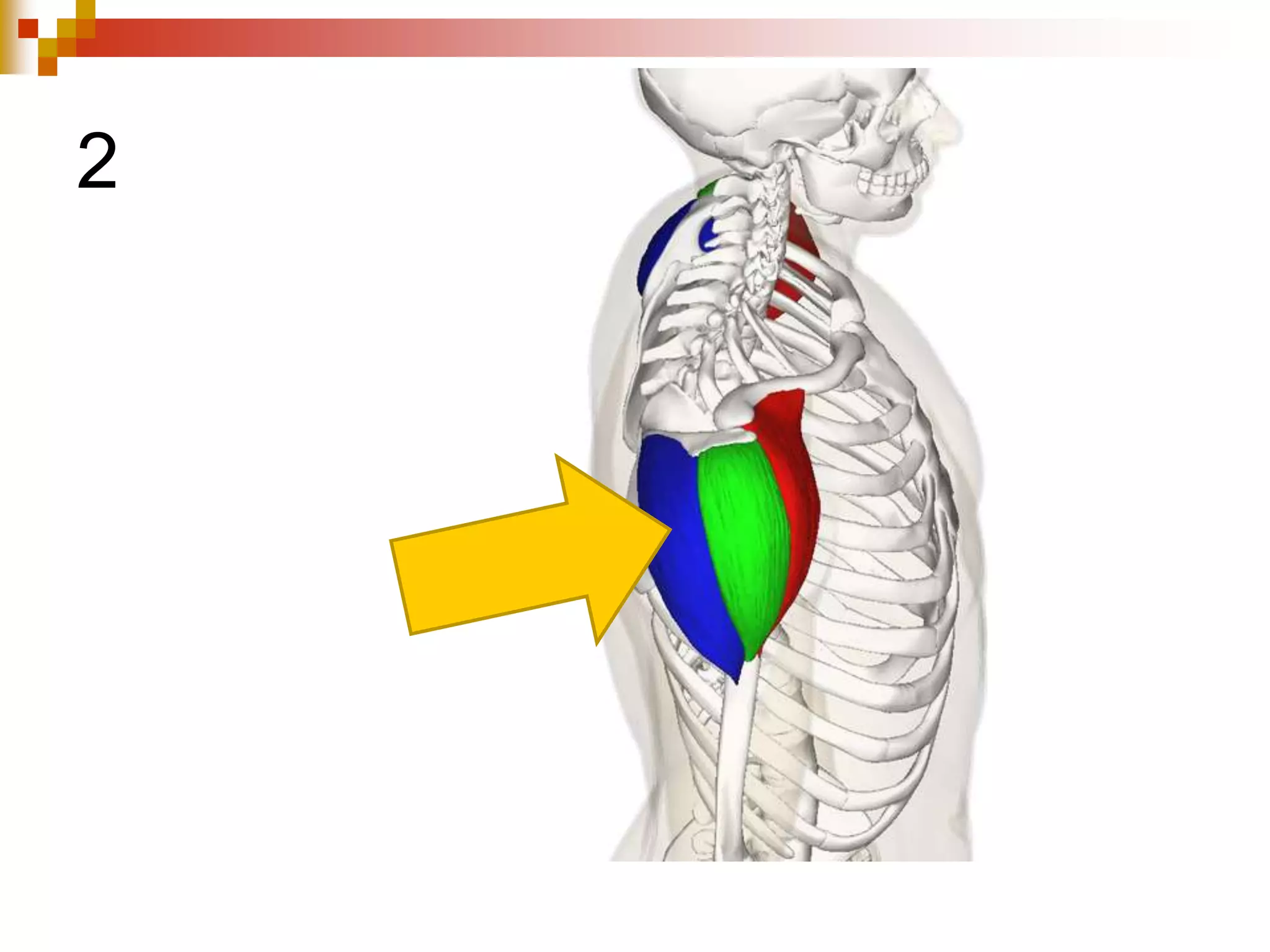
UPPER BODY
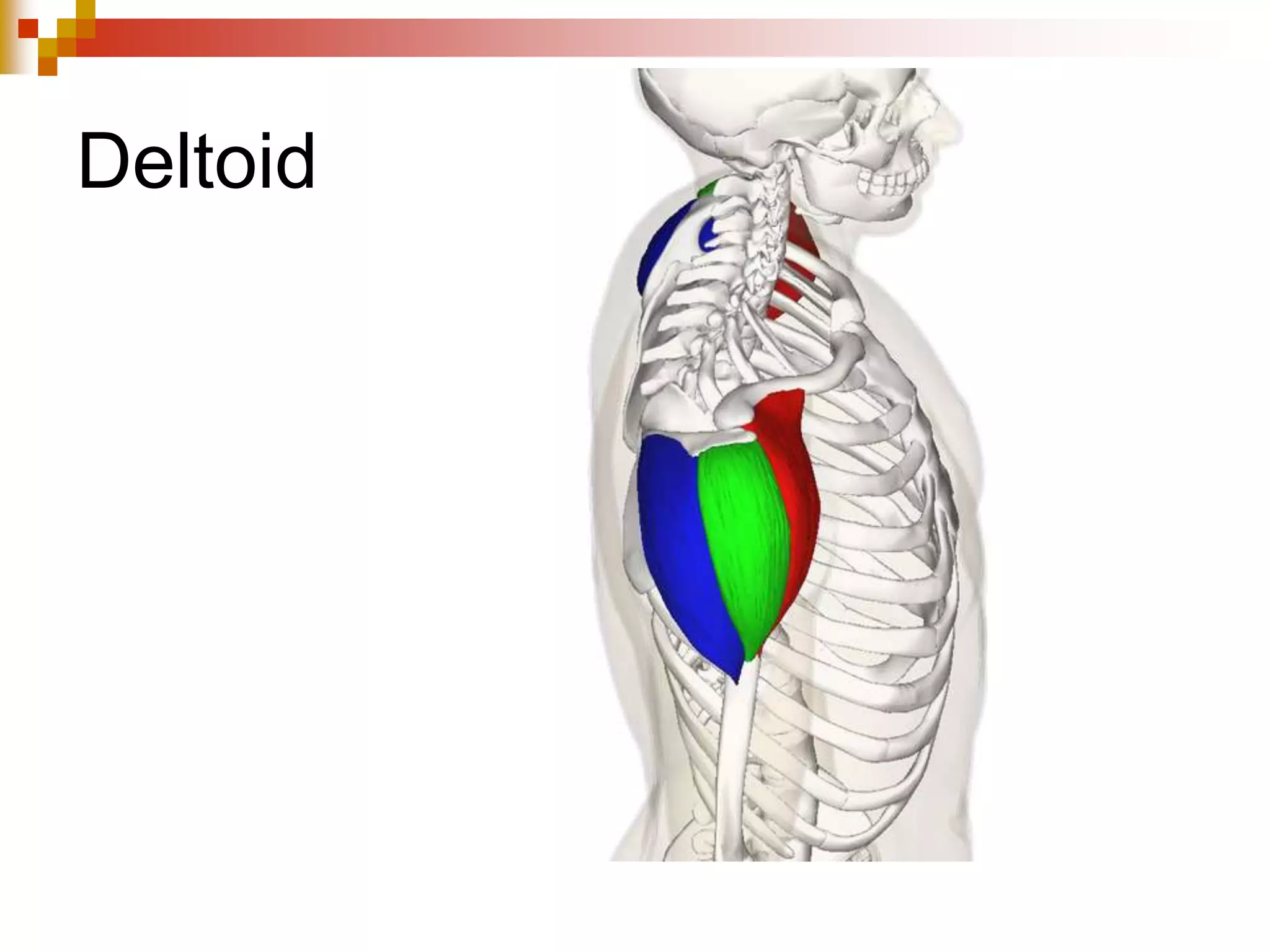
Deltoid
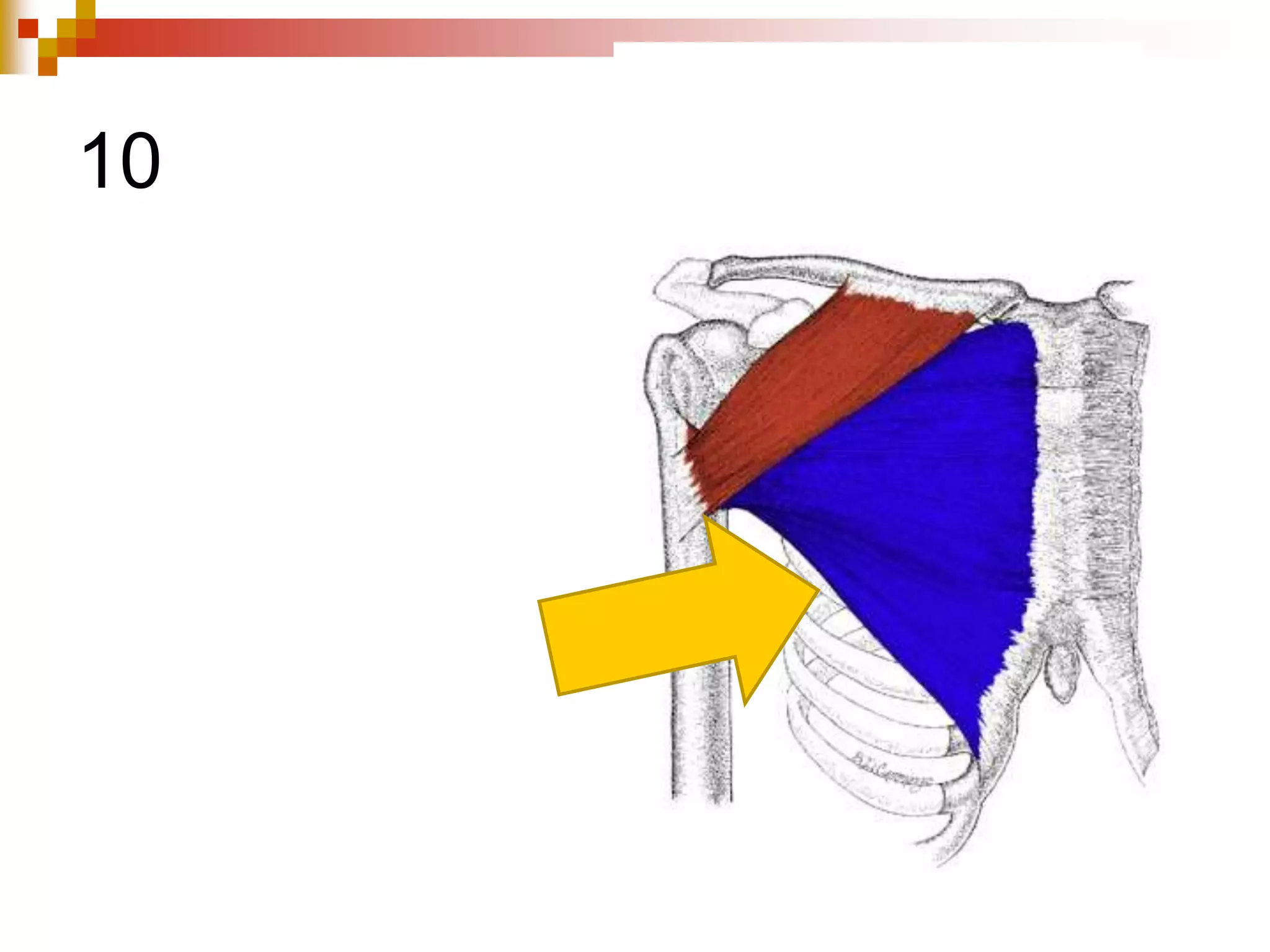
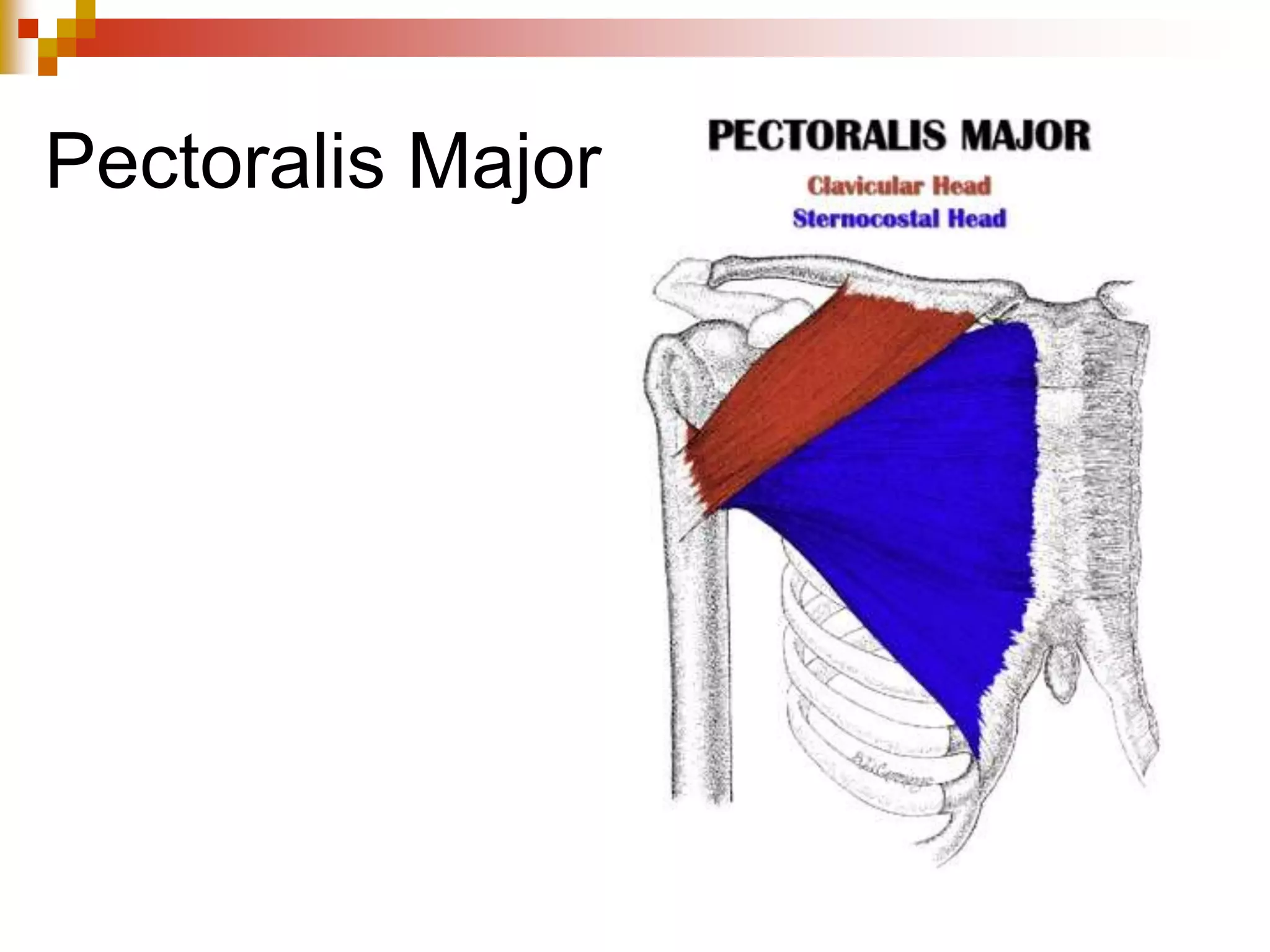
Pectoralis Major
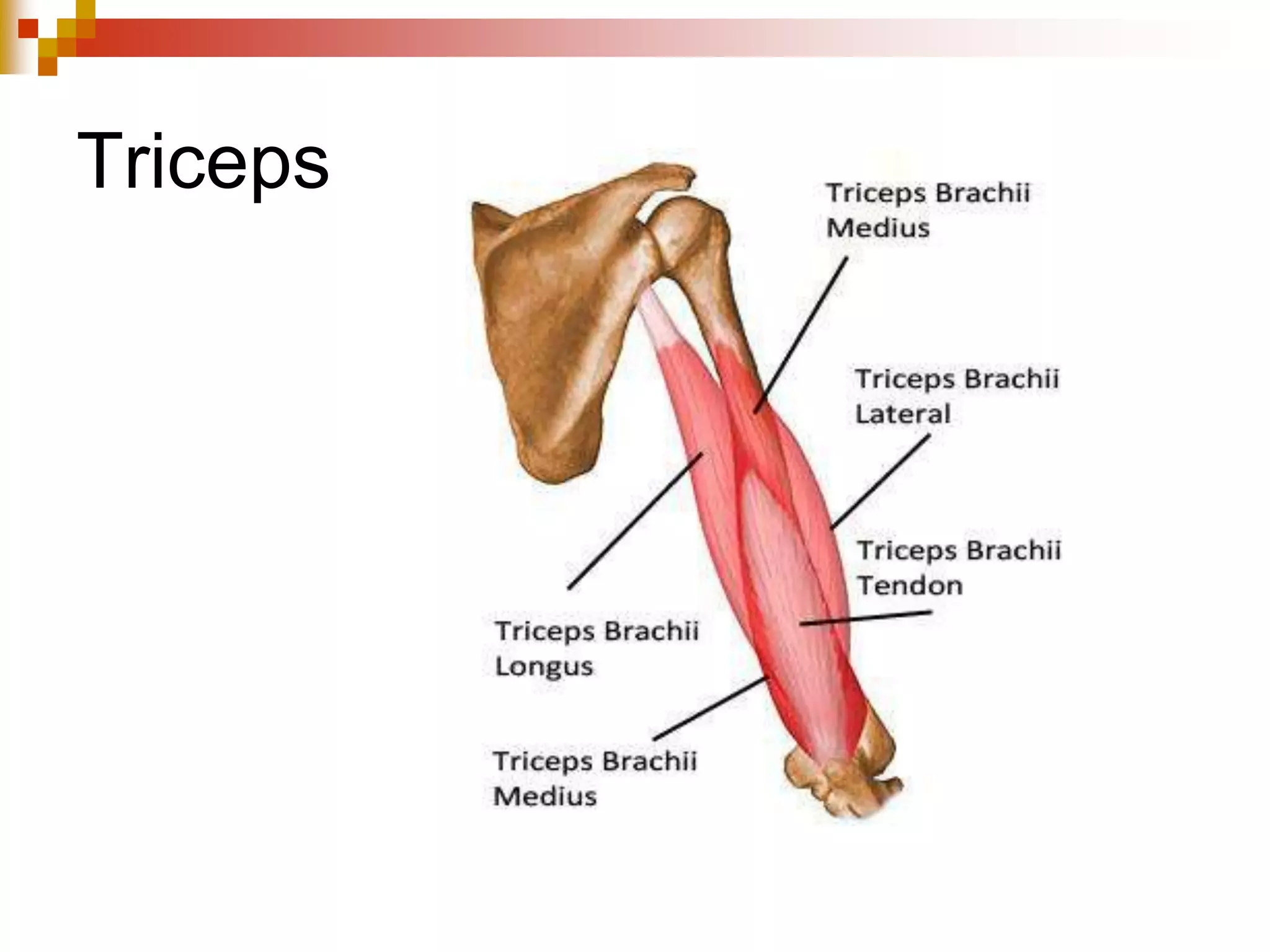
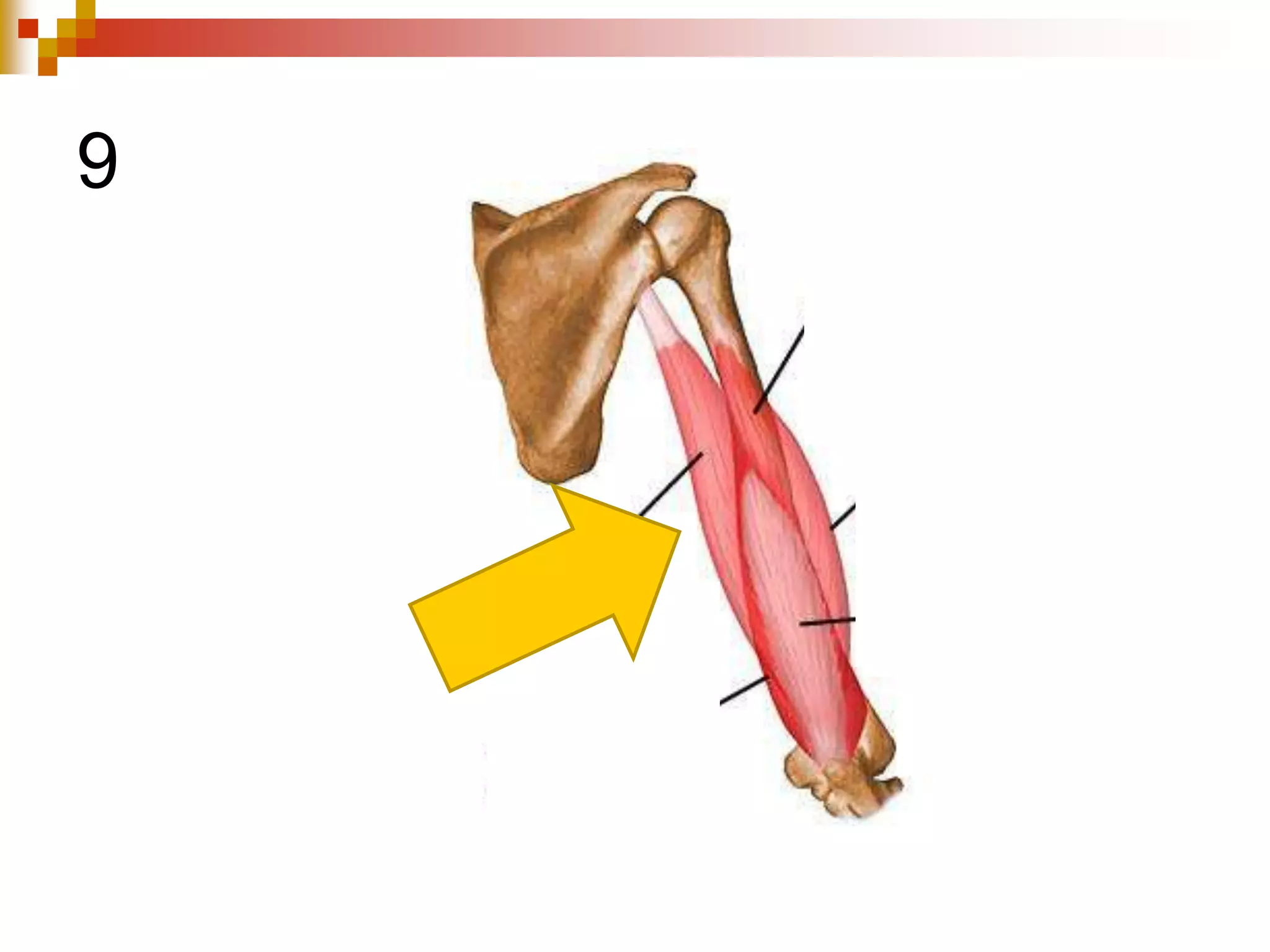
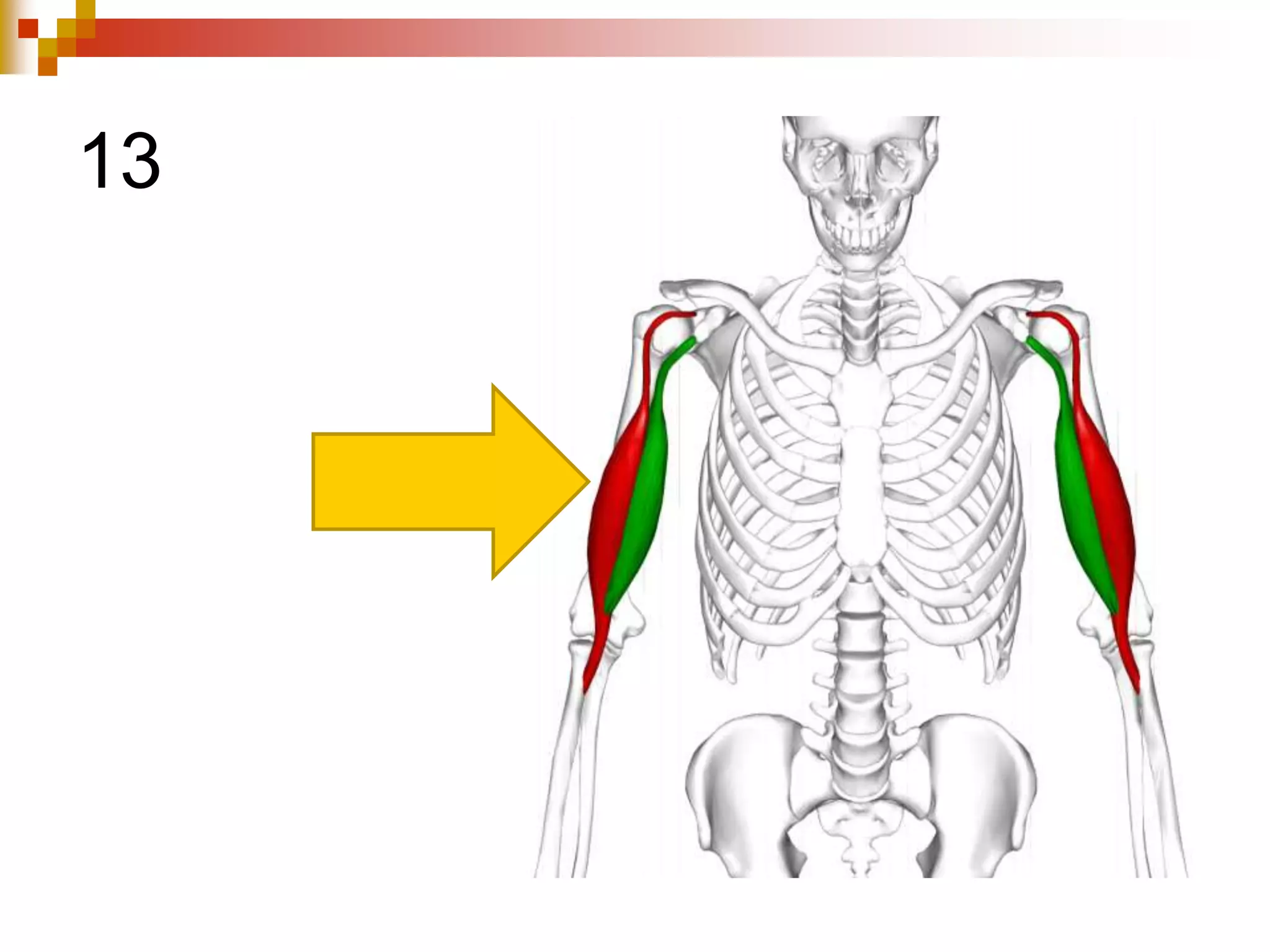
Biceps Brachii
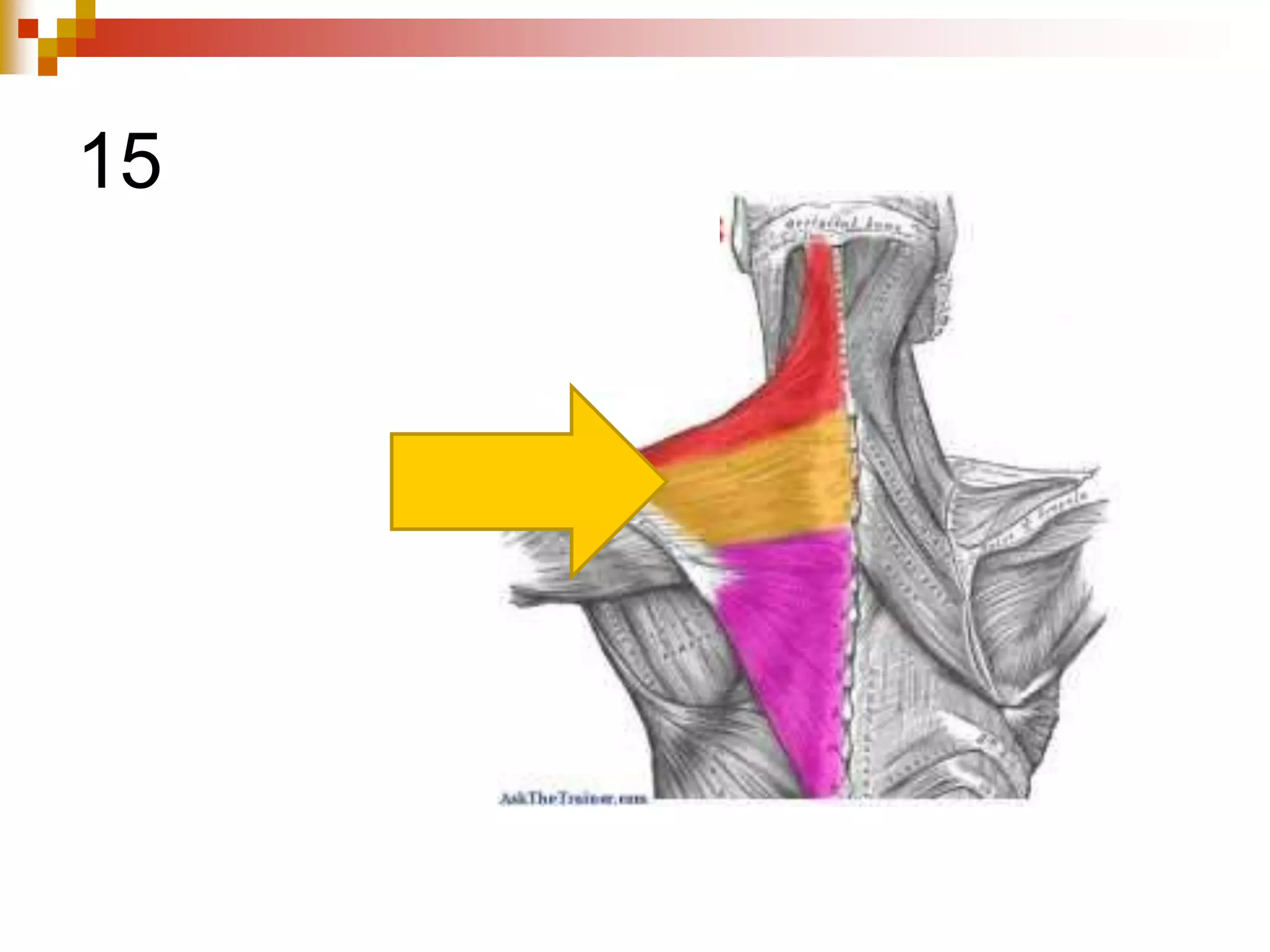
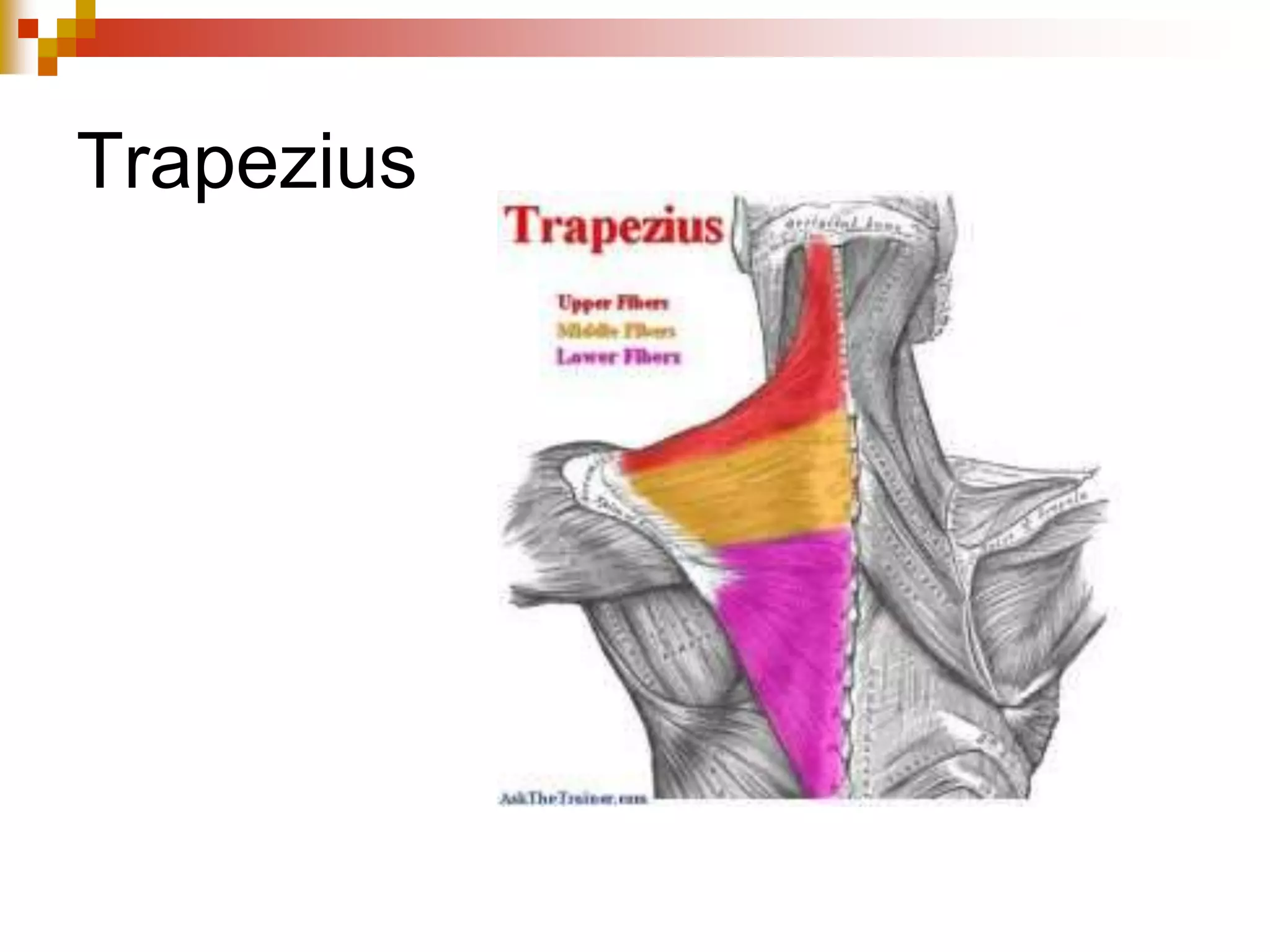
Trapezius
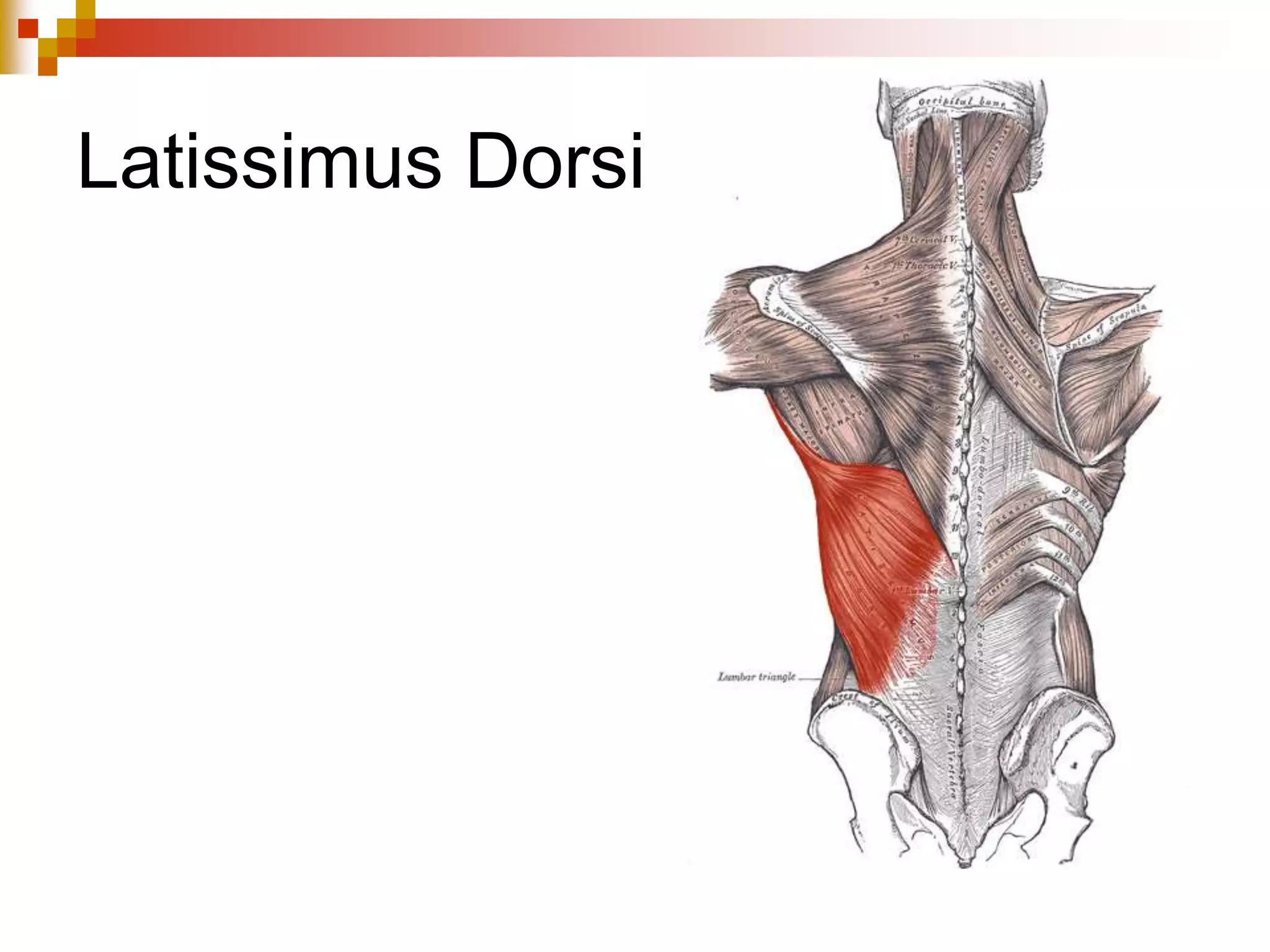
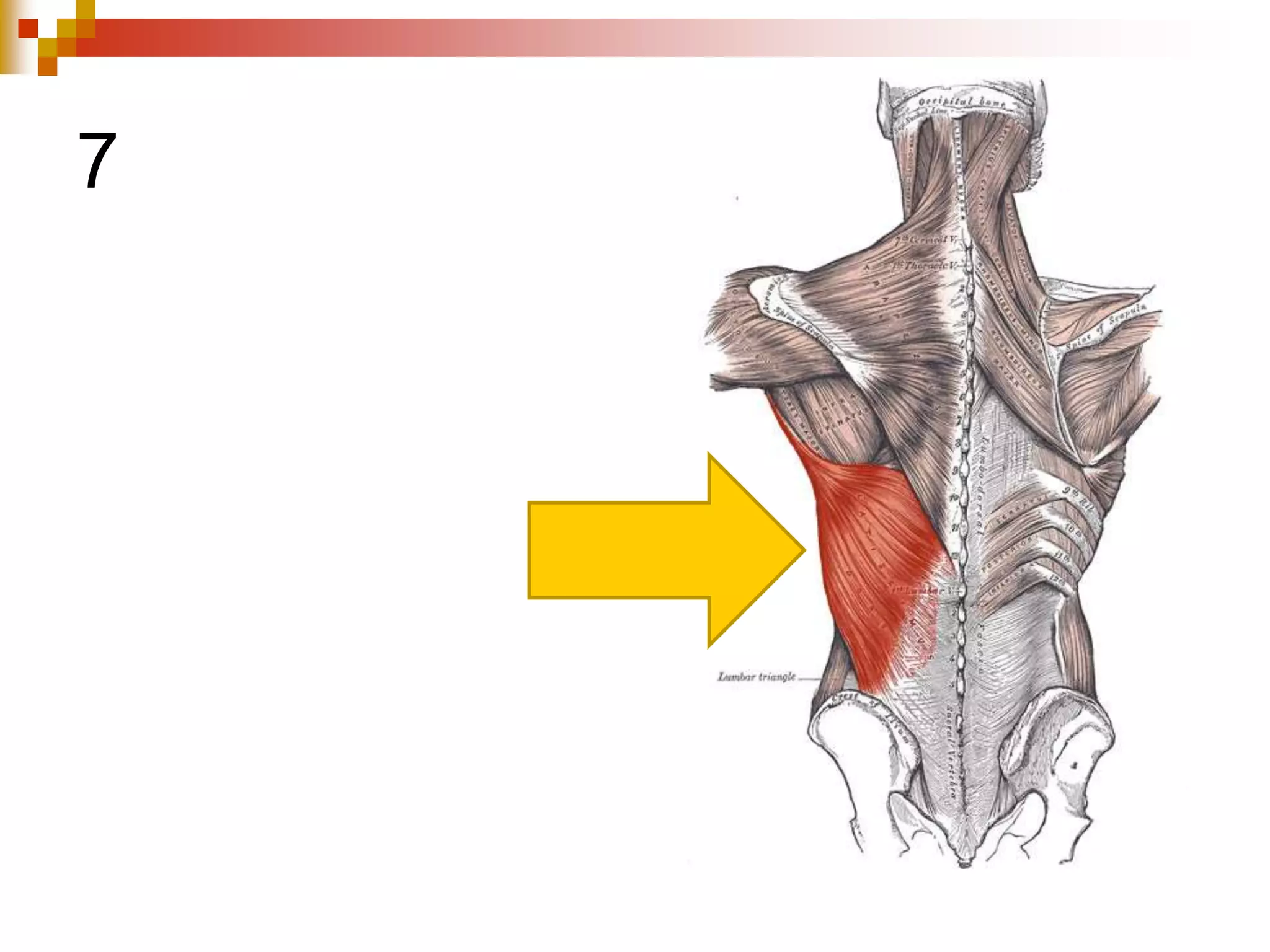
Latissimus Dorsi
Triceps
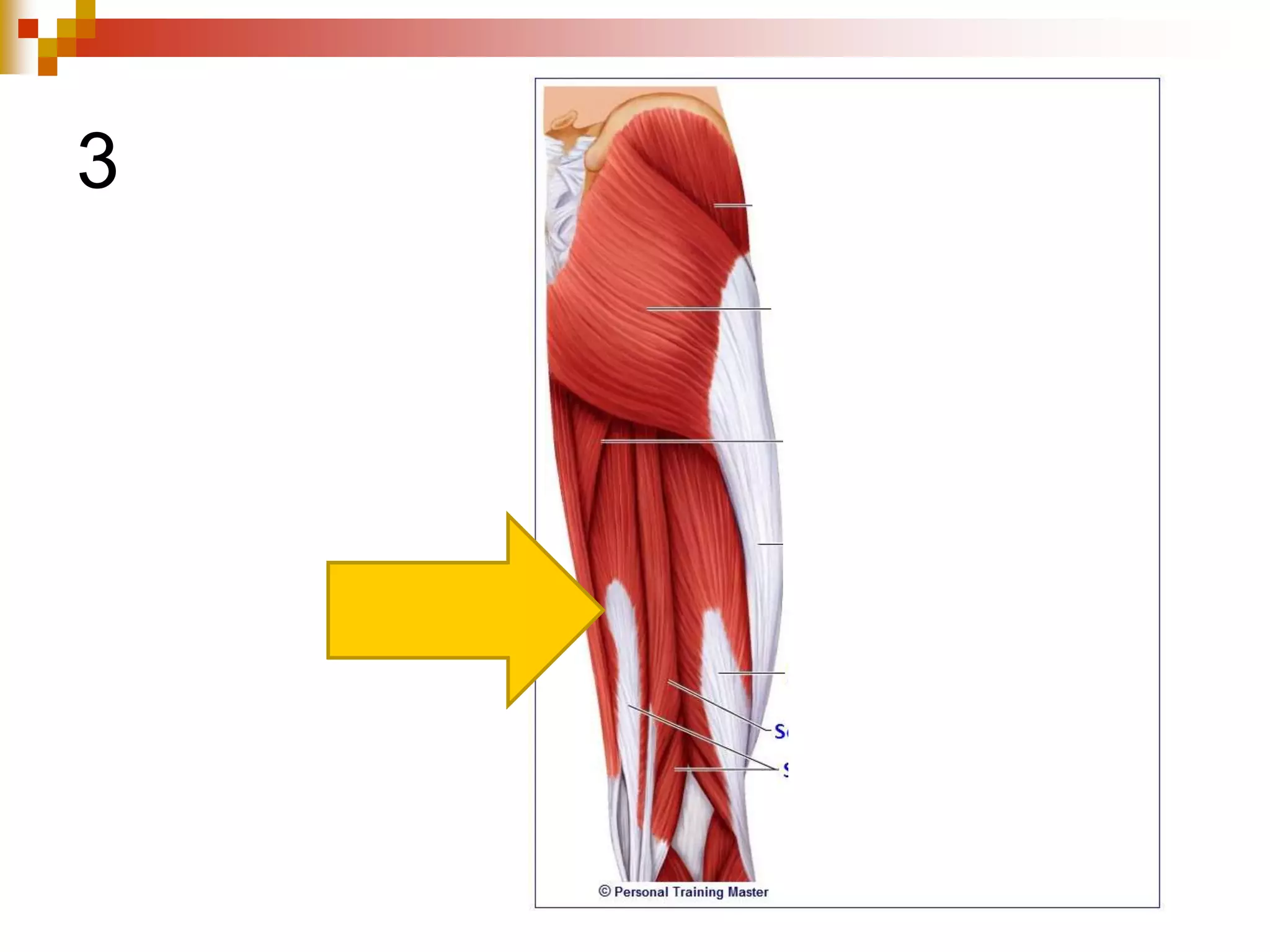
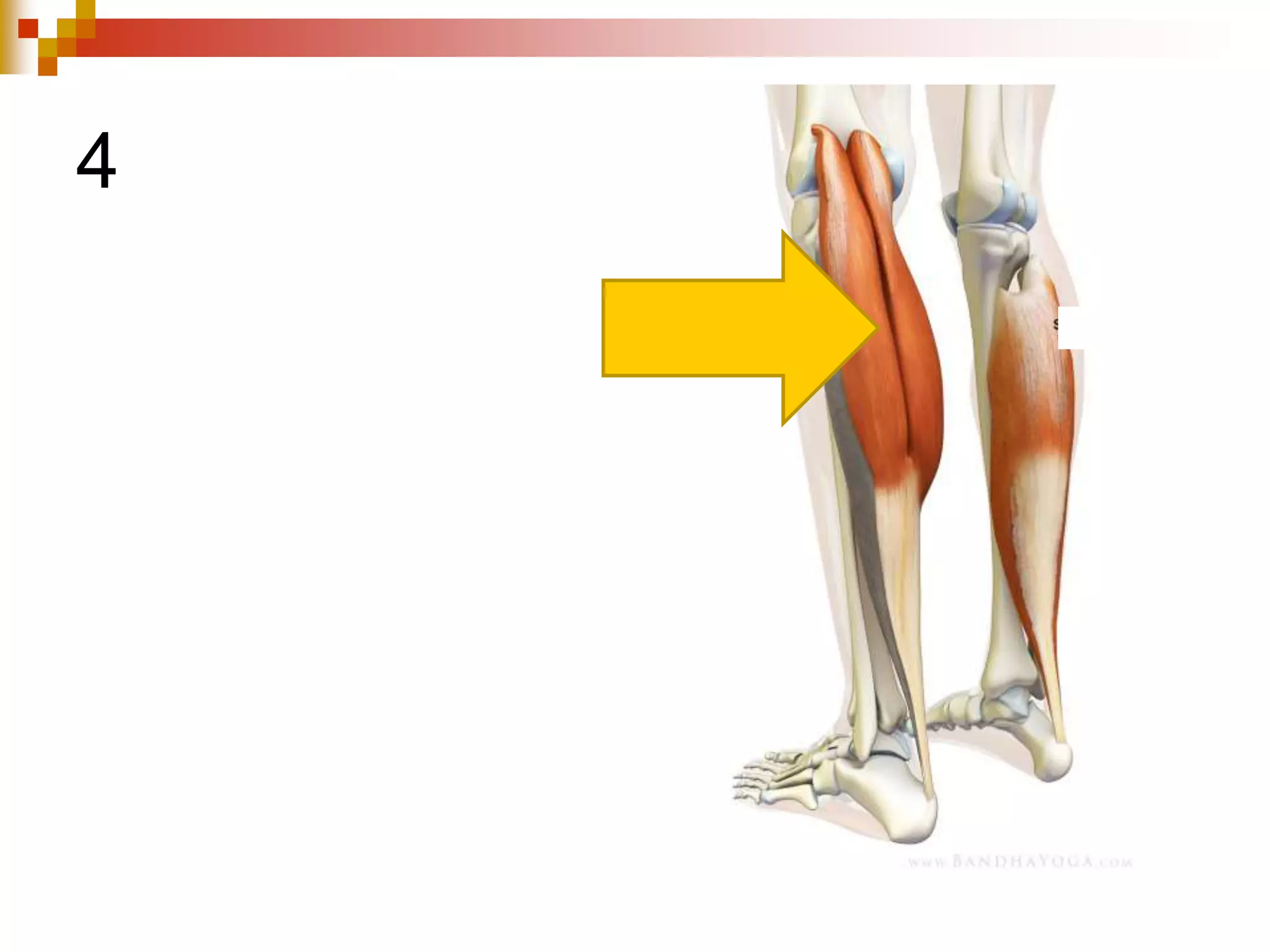
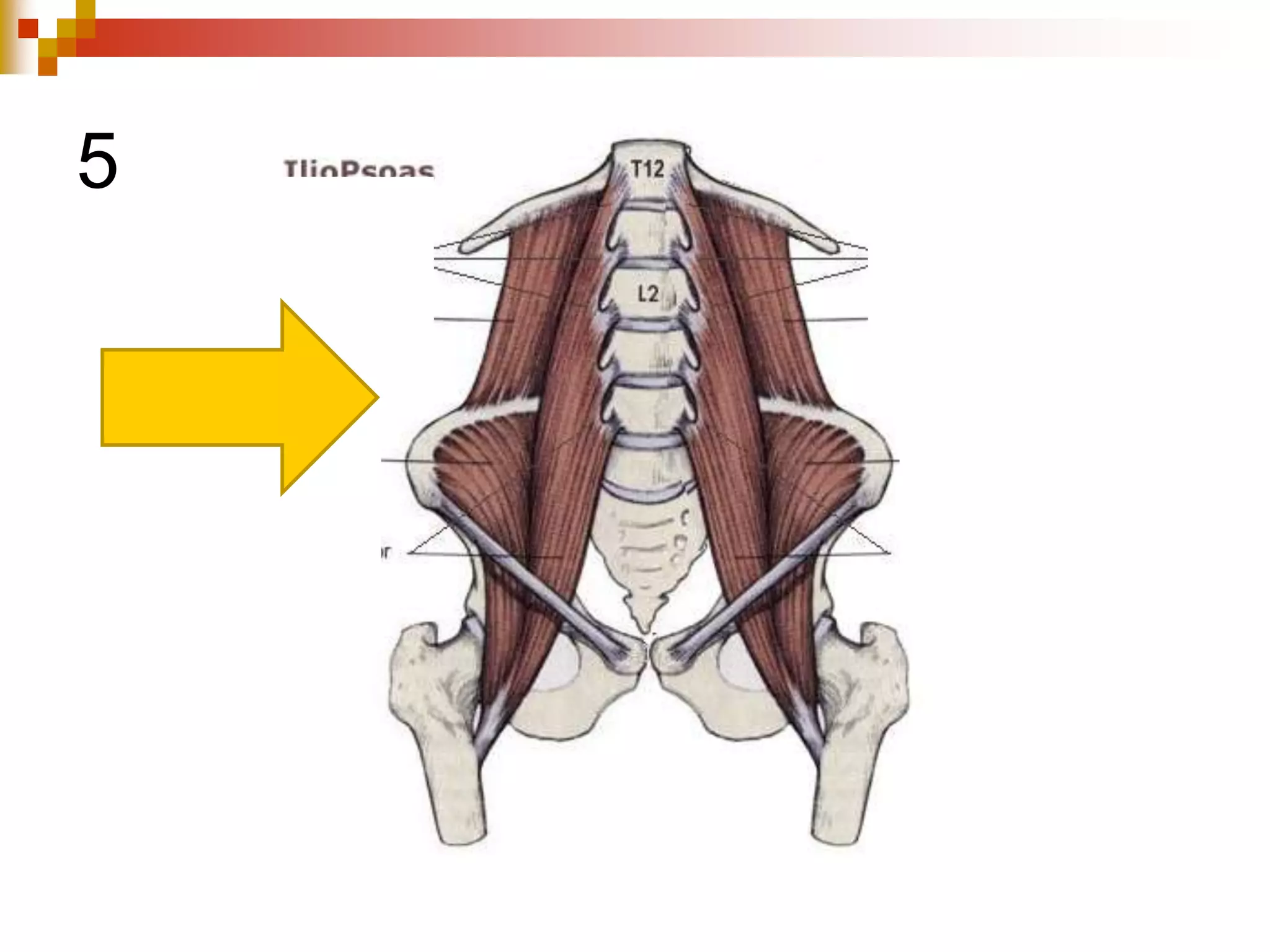
LOWER BODY
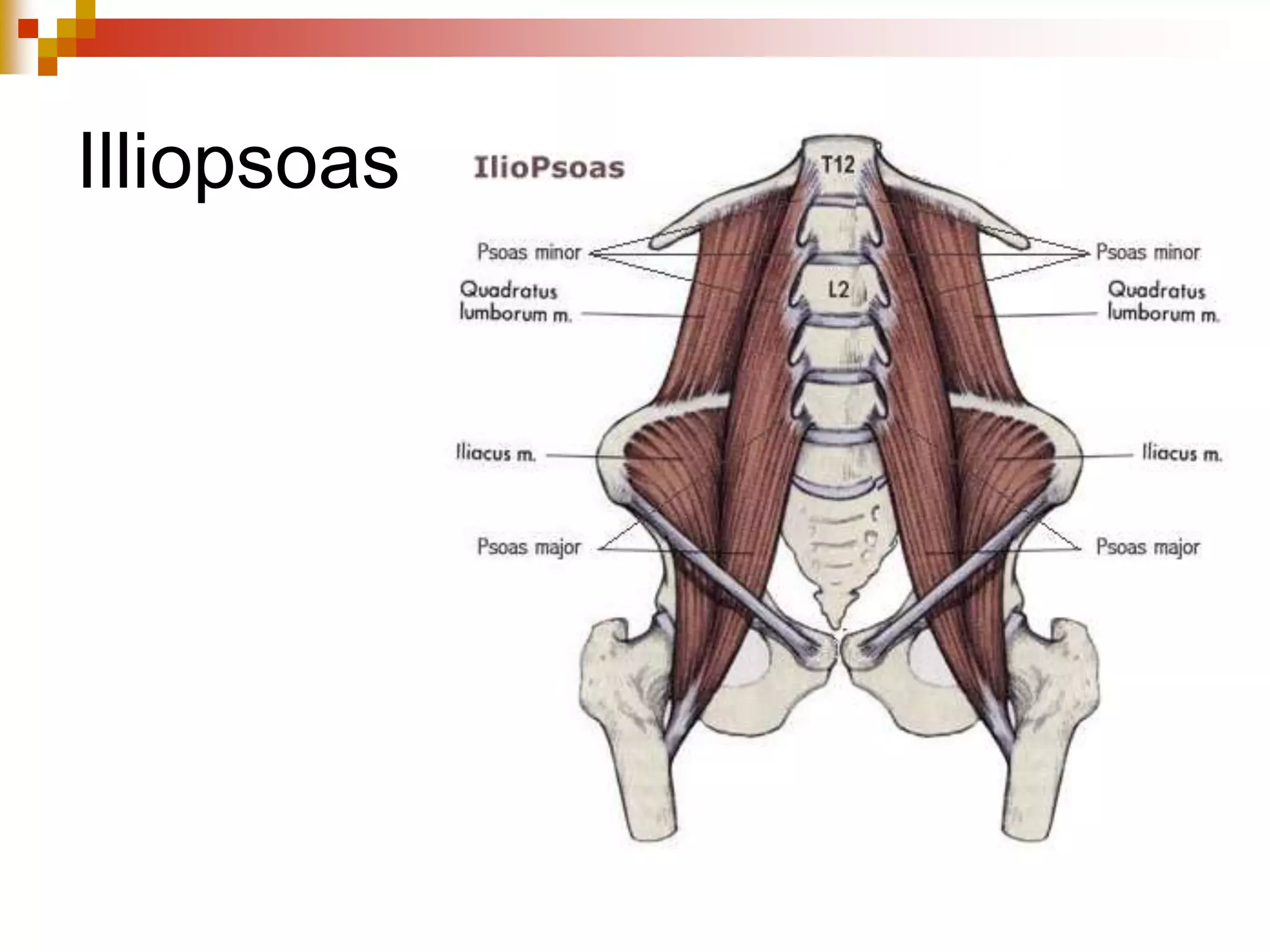
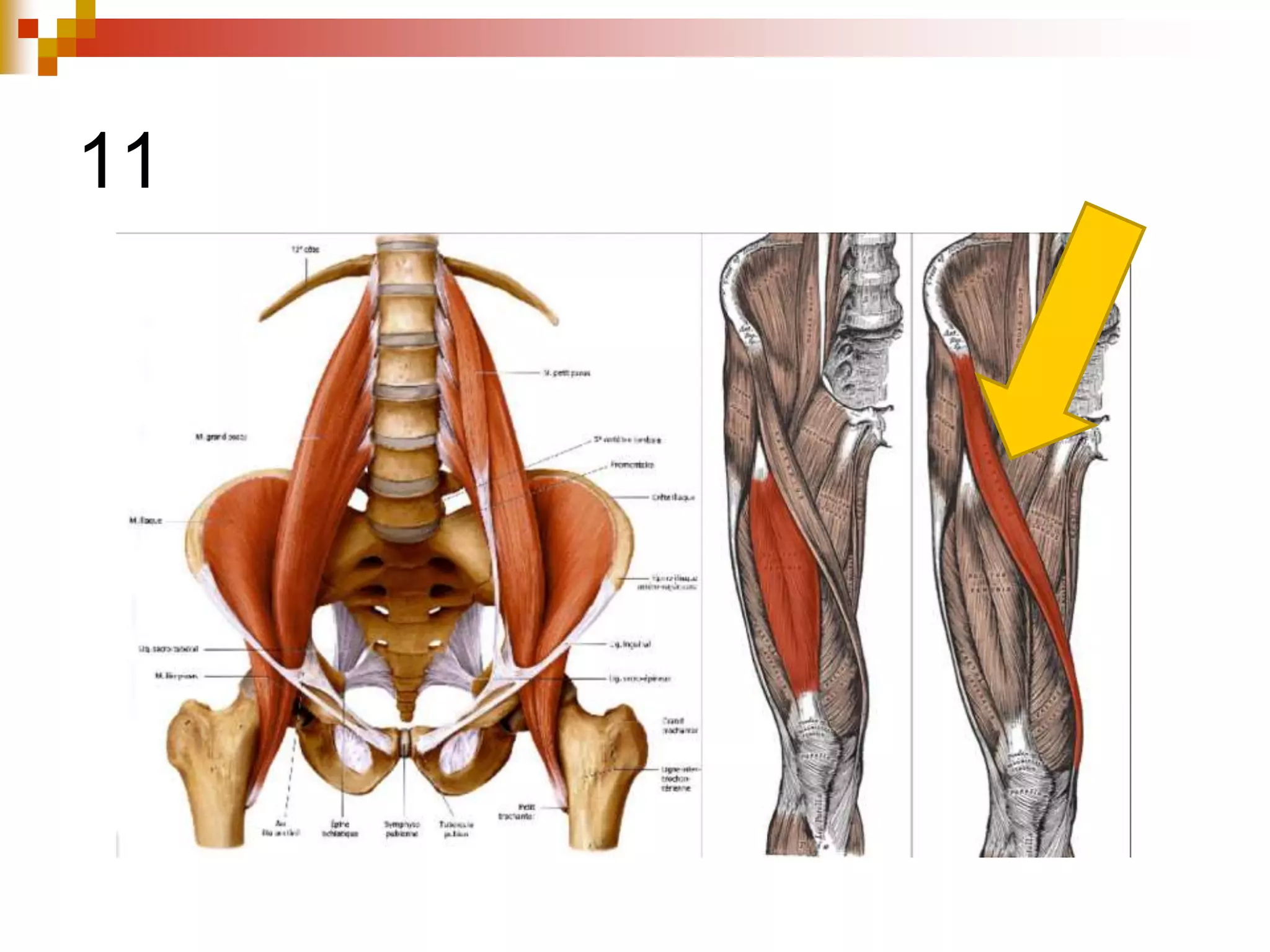
Illiopsoas
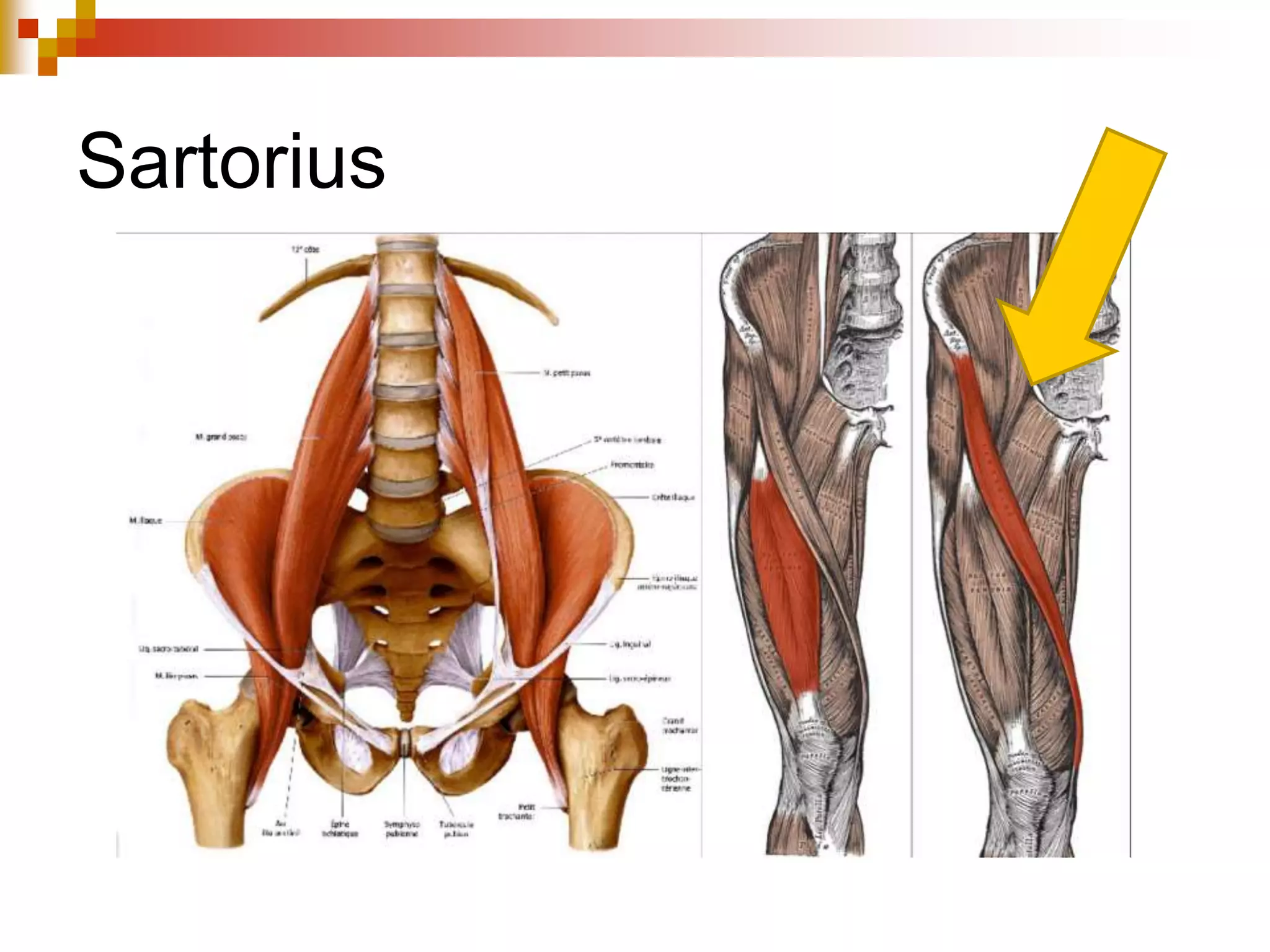
Sartorius
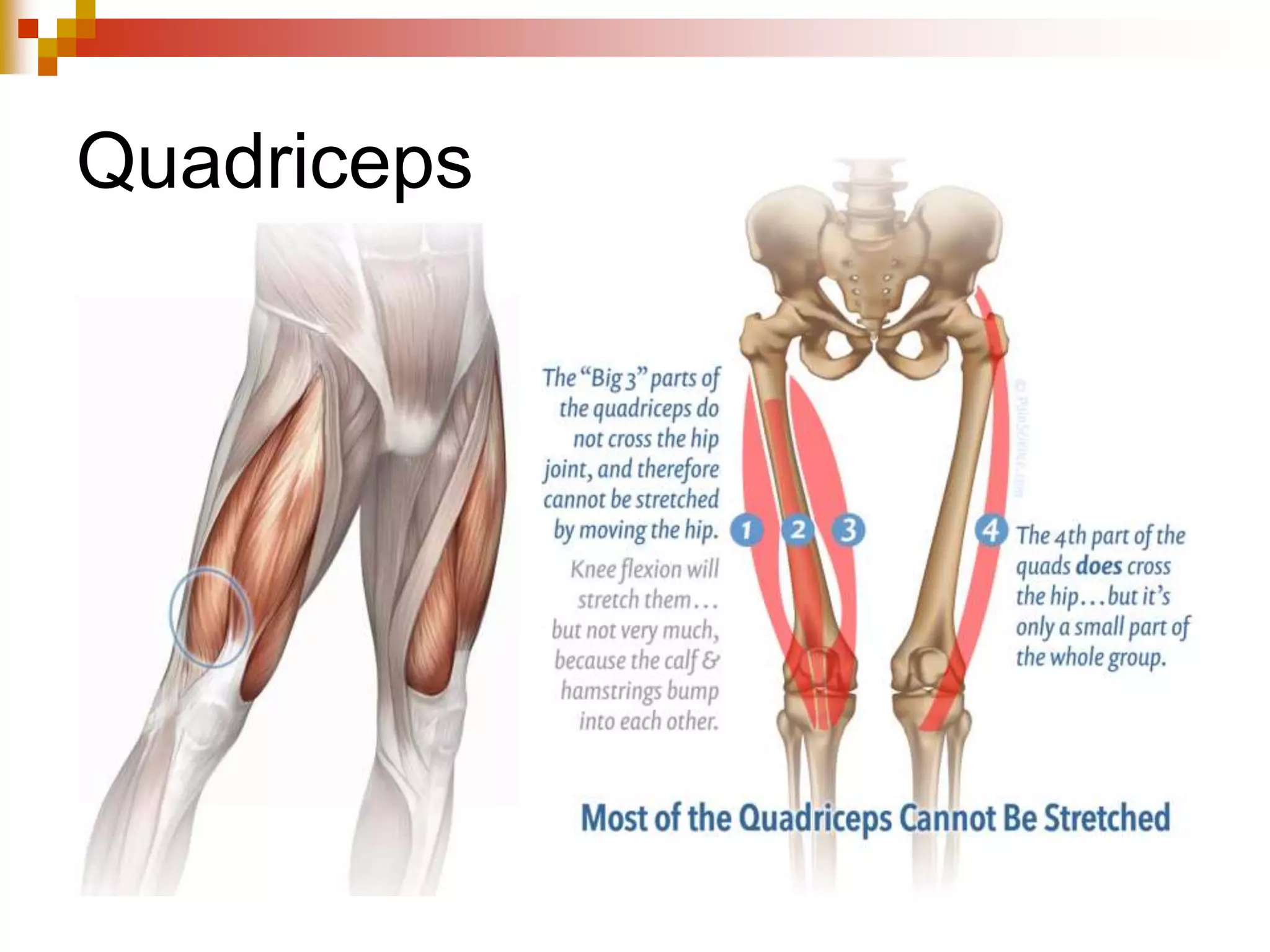
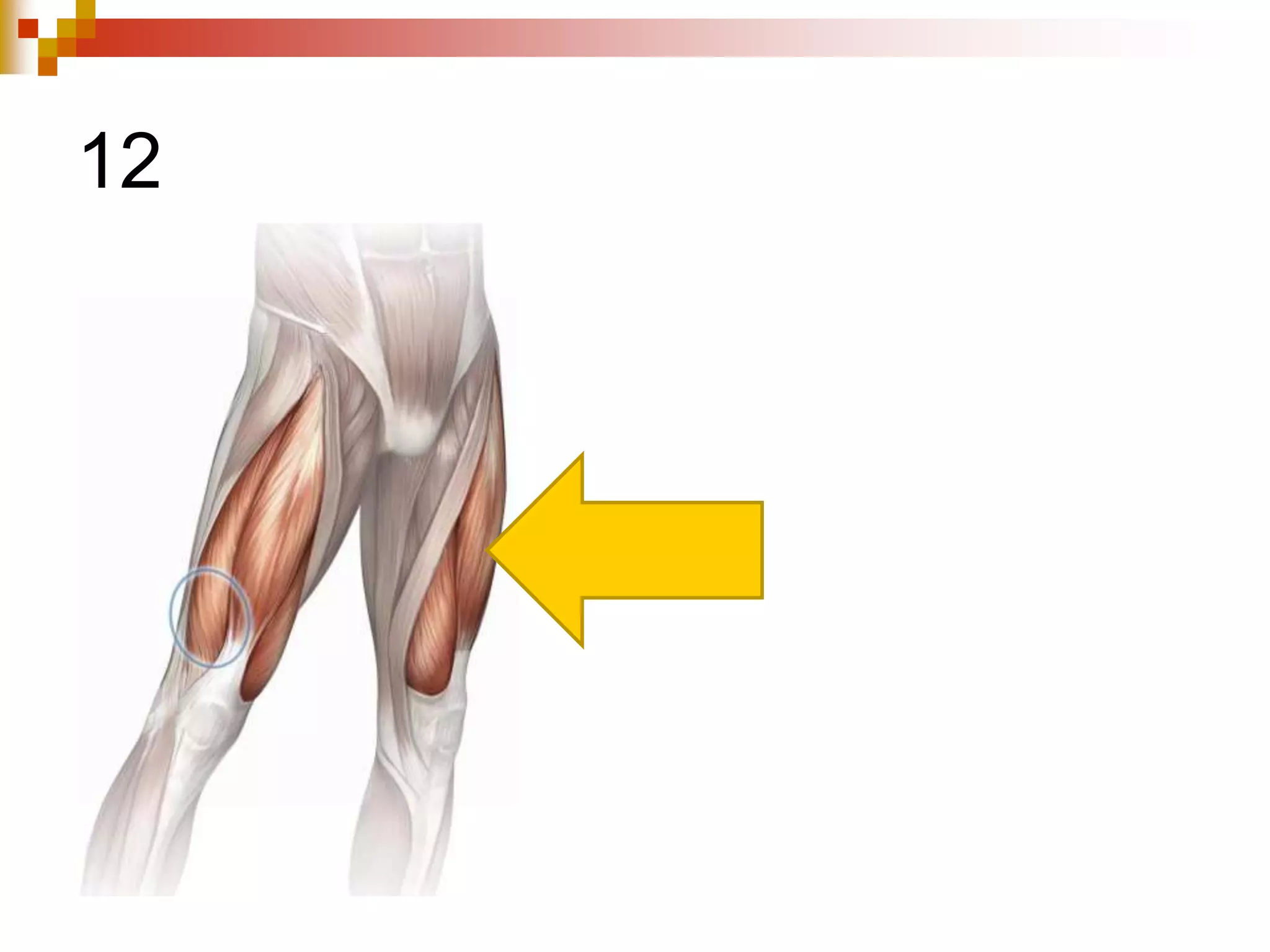
Quadriceps
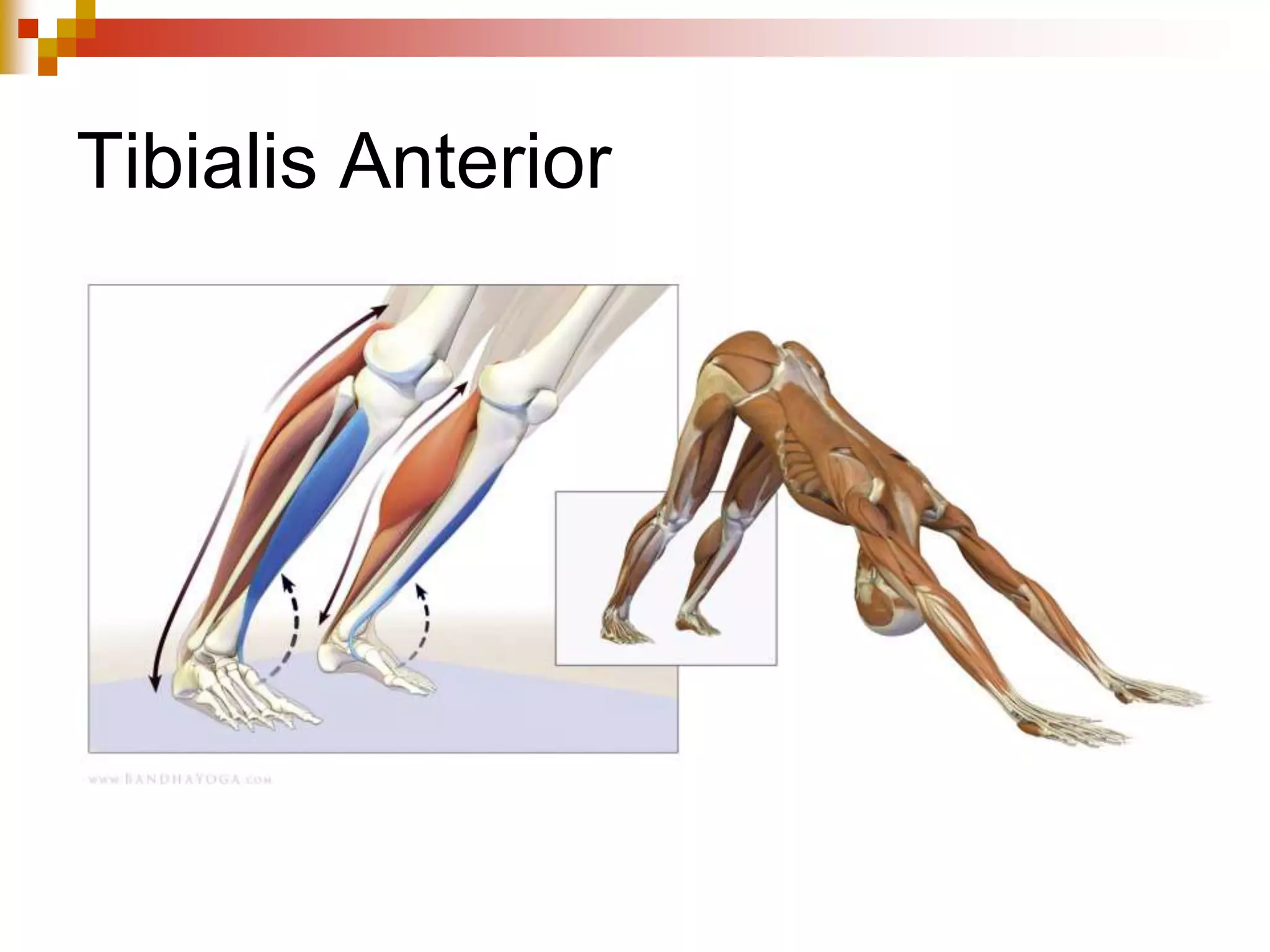
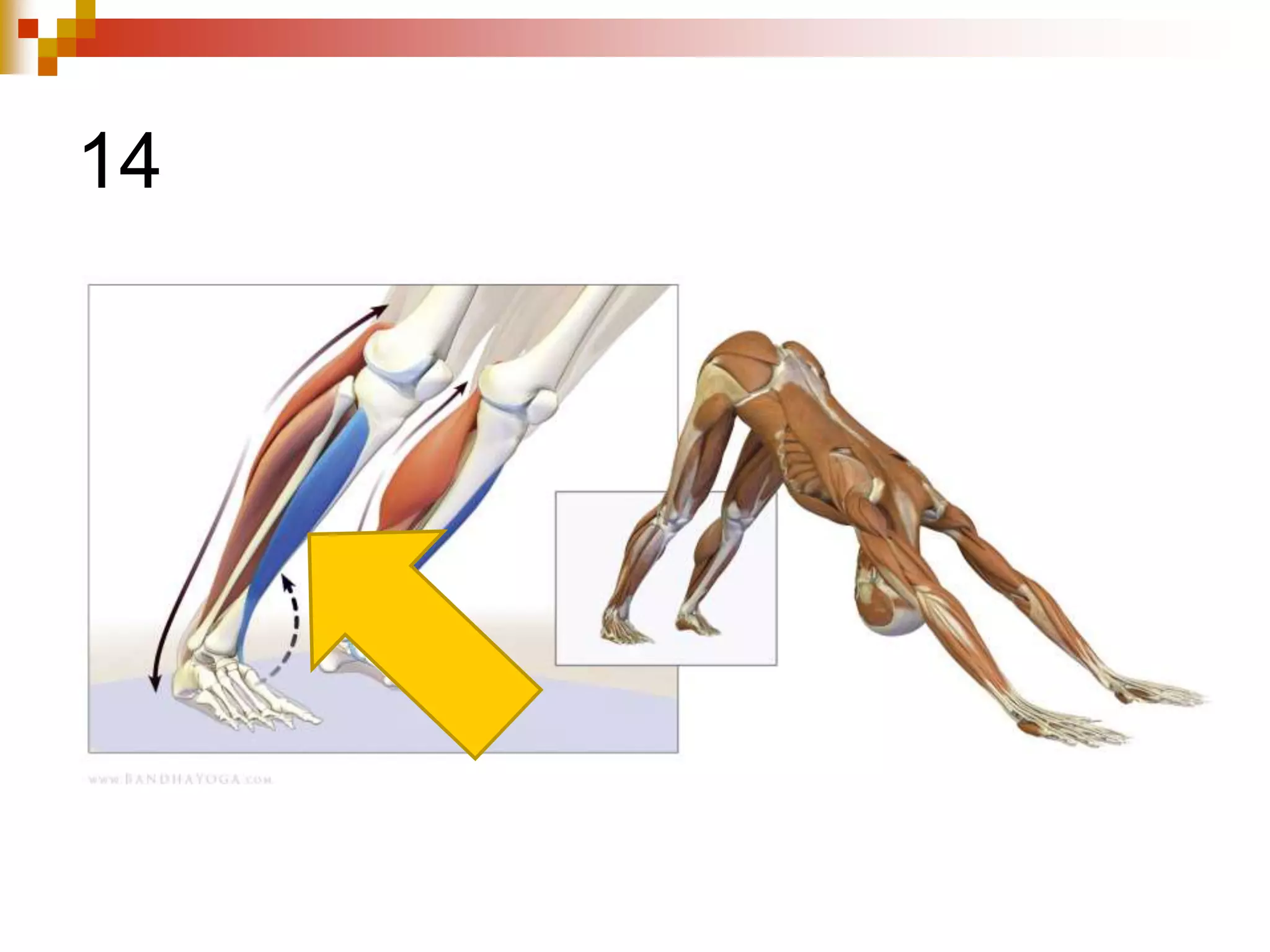
Tibialis Anterior
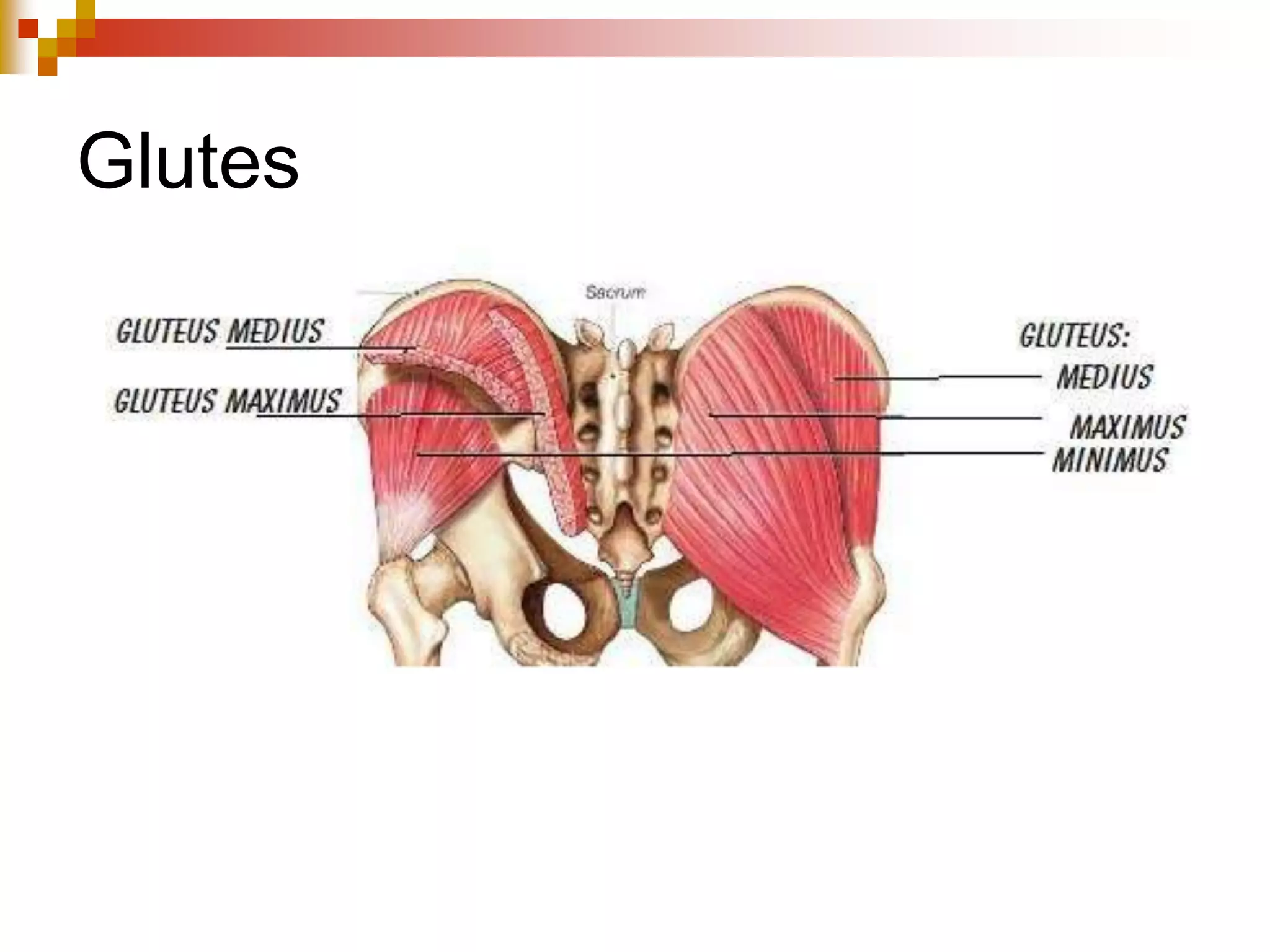
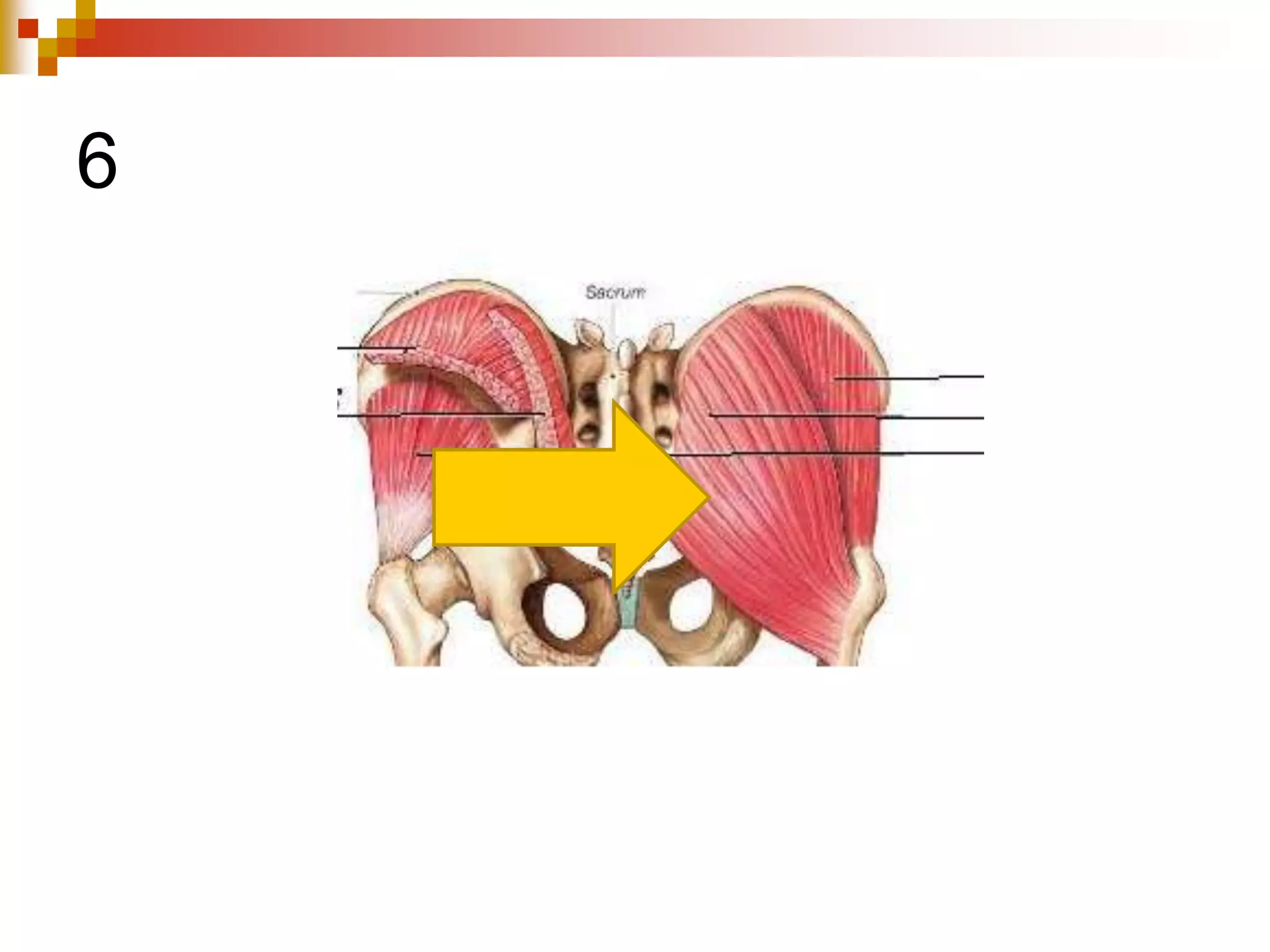
Glutes
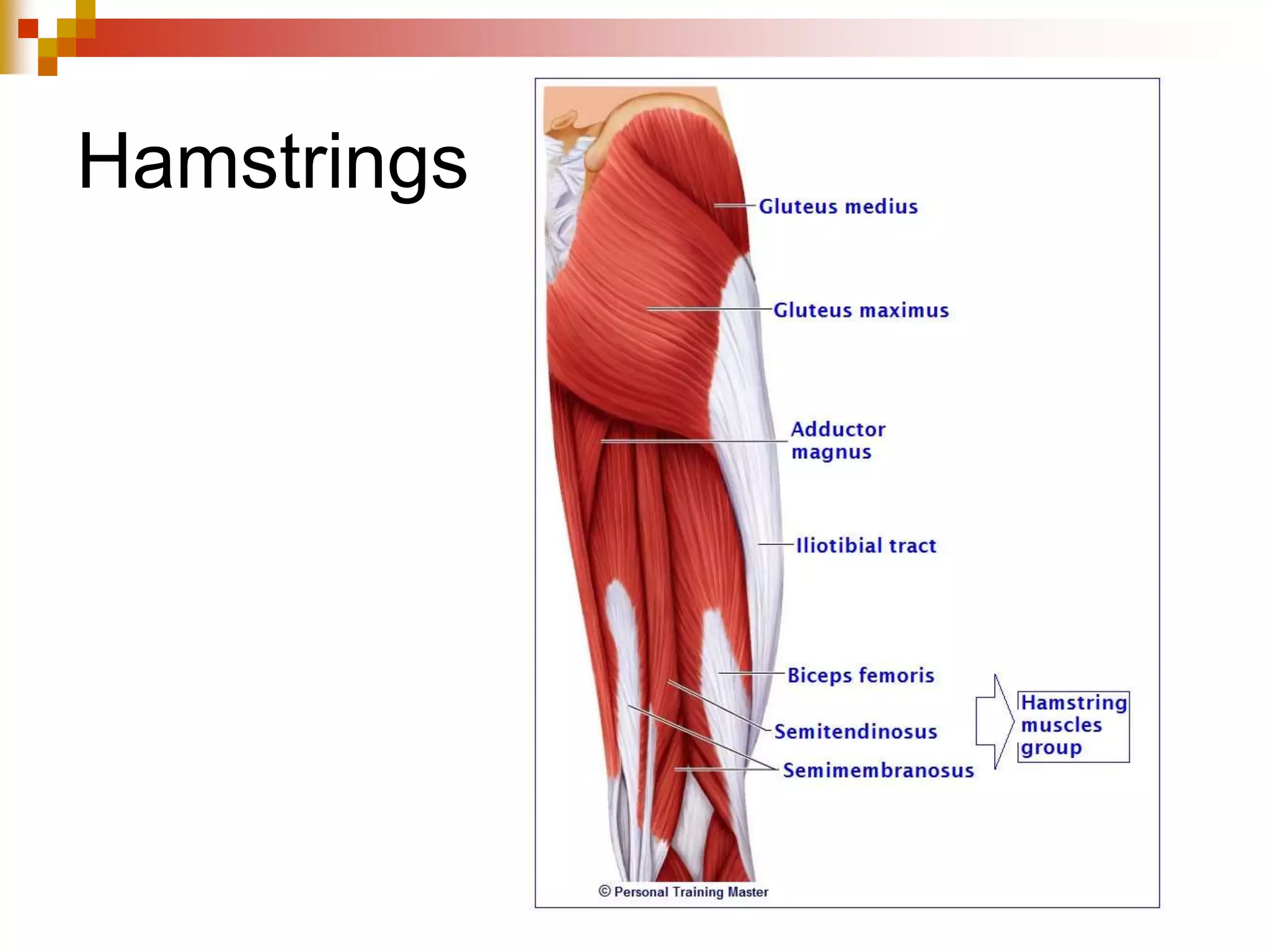
Hamstrings
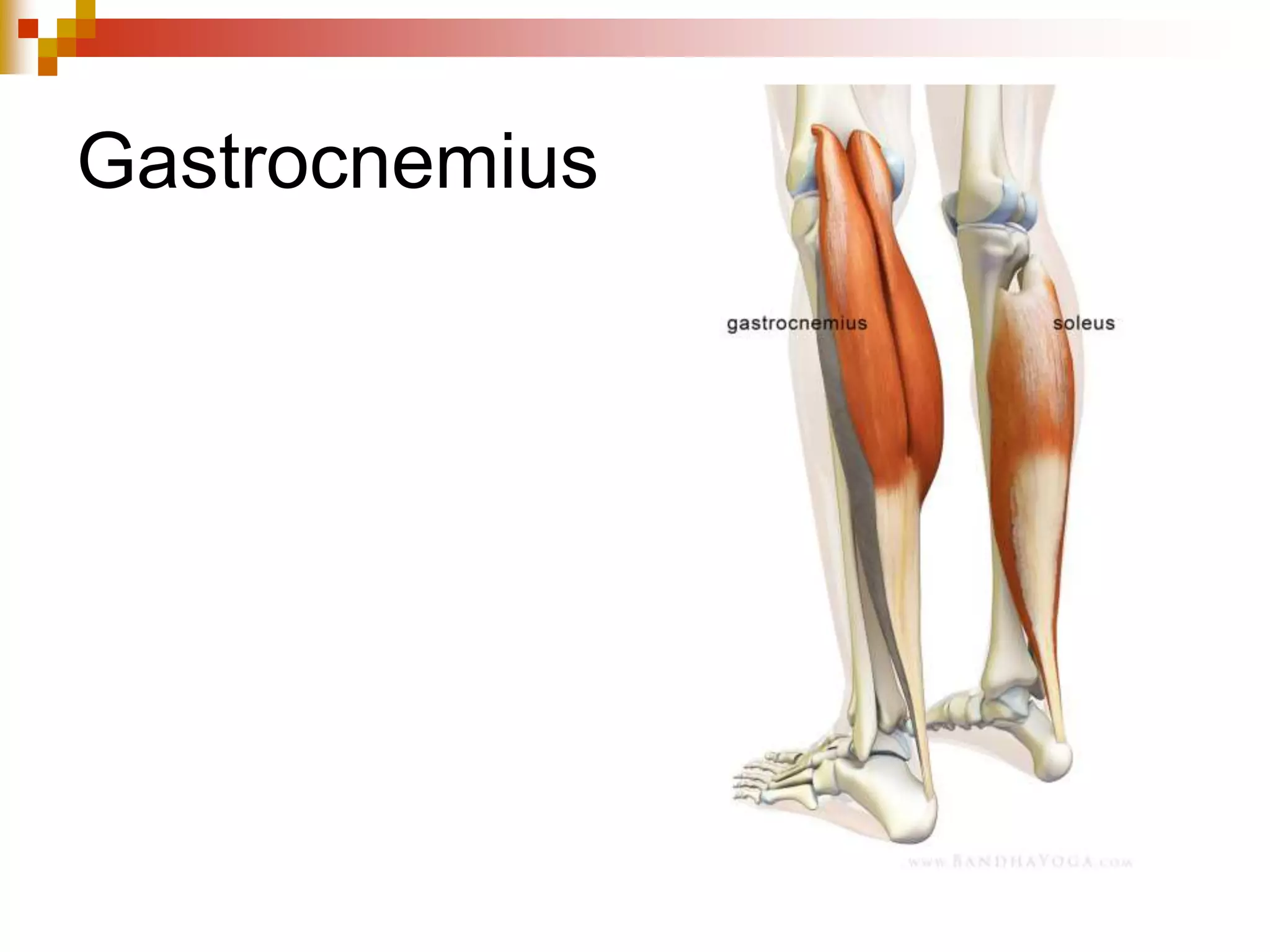
Gastrocnemius
TEST YOURSELF
1
2
3
4
5
6
7
8
9
10
11
12
13
14
15
Topic 1.2   muscular system - whole ppt

Topic 1.2 muscular system - whole ppt

  • 1.
  • 2.
    IB Sports, exercise and health scienceAnatomy Starter-Group Activity Decide whether the following statements are true or false Topic 1 Anatomy 1. There are over 1,000 muscles in your body. 2. Skeletal, or voluntary, muscles are the muscles you can control. 3. Ligaments connect muscles to bones. 4. Your heart is a muscle. 5. A muscle gets strained when it is stretched too much. 6. A sprain happens when a tendon is stretched too much. 7. Muscles that are not used can get smaller and weaker. 8. You don’t need more than 30 min. of physical activity every day. 9. If something hurts when playing sports, you should play through the pain and it will go away.
  • 3.
    IB Sports, exercise and health scienceAnatomy Starter-Group Activity Decide whether the following statements are true or false Topic 1 Anatomy STARTER – Group Activity Decide whether the following statements are true or false: 10. A balanced diet: a) Emphasizes fruits, vegetables, whole grains, and fat- free or low-fat dairy products like milk, cheese, and yogurt. b) Includes protein from lean meats, poultry, seafood, beans, eggs, and nuts. c) Is low in solid fats, saturated fats, cholesterol, salt (sodium), added sugars, and refined grains. d) All of the above
  • 4.
  • 5.
    IB Sports, exercise and health scienceAnatomy 1.2.2 Distinguish between the different types of muscle Topic 1 Anatomy  Skeletal  Cardiac  Smooth
  • 6.
    IB Sports, exercise and health scienceAnatomy 1.2.2 Distinguish between the different types of muscle Topic 1 Anatomy Skeletal Muscles (striated and voluntary muscles) Attach to bones and have the main function of contracting to move the body Striated-appearance of light and dark stripes
  • 7.
    IB Sports, exercise and health scienceAnatomy 1.2.2 Distinguish between the different types of muscle Topic 1 Anatomy Cardiac muscle only in the walls of the heart. Similar to: skeletal muscle -striated smooth muscle- involuntarily controlled Now complete the Types of Muscles section in your workbook!
  • 8.
    IB Sports, exercise and health scienceAnatomy 1.2.2 Distinguish between the different types of muscle Topic 1 Anatomy Smooth muscle (Unstriated) Involuntary muscle due to our inability to control its movements. Found in the walls of hollow organs such as the stomach, esophagus, bronchi and in the walls of blood vessels. Now complete the Types of Muscles section in your workbook!
  • 9.
    IB Sports, exercise and health scienceAnatomy REVIEW POINT 1.2.2 Distinguish between the different types of muscle Topic 1 Anatomy  Skeletal  Cardiac  Smooth DET PDHPE Distance Education Programme.
  • 10.
    IB Sports, exercise and health scienceAnatomy Thinking What do we use our muscles for? Talk and make a list – 2 minutes Topic 1 Anatomy
  • 11.
    IB Sports, exercise and health scienceAnatomy Topic 1 Anatomy MOVEMENT • Skeletal muscles contract exerting forces on the tendons • Tendons pull on the bones causing joint movement
  • 12.
    IB Sports, exercise and health scienceAnatomy Topic 1 Anatomy MOVE SUBSTANCES • Cardiac muscle pumps blood • Smooth muscle moves food in the GI tract
  • 13.
    IB Sports, exercise and health scienceAnatomy Topic 1 Anatomy STABALIZE • Postural muscles stabilize and maintain body positions
  • 14.
    IB Sports, exercise and health scienceAnatomy Topic 1 Anatomy GENERATE HEAT • Body wants to be cozy • When temps drop, the body shivers to warm back up!
  • 15.
    IB Sports, exercise and health scienceAnatomy REVIEW POINT Four functions of muscles Topic 1 Anatomy  Movement  Move Substances  Stabilize the body  Generate heat DET PDHPE Distance Education Programme.
  • 16.
  • 17.
    IB Sports, exercise and health scienceAnatomy Thinking What characteristics do ALL muscles have? Talk and decide Topic 1 Anatomy
  • 18.
    IB Sports, exercise and health scienceAnatomy 1.2.1 Outline the general characteristics common to muscle tissue Topic 1 Anatomy • Excitability: ability to receive and respond to stimuli via generation of an electrical pulse • Contractility: ability of the muscle to contract and generate force when stimulated • Extensibility: ability of muscle to lengthen without damage • Elasticity: ability of muscle to return to resting length
  • 19.
    IB Sports, exercise and health scienceAnatomy 1.2.1 Outline the general characteristics common to muscle tissue Topic 1 Anatomy • Atrophy: is the wasting of muscle tissue  Hypertrophy: is the increase in size of muscle tissue.  Controlled by nerve stimuli – A nerve impulse is required for movement to occur  Fed by capillaries – Muscles receive nourishment through the blood supply.
  • 20.
    IB Sports, exercise and health scienceAnatomy REVIEW Can you write a definition for the words below without using your notes? Topic 1 Anatomy
  • 21.
    1.2.3 Annotate the Structureof Skeletal Muscle
  • 22.
    IB Sports, exercise and health scienceAnatomy 1.2.3 Annotate the structure of skeletal muscle Topic 1 Anatomy Fascia is a connective tissue – three main roles - Transmit Force - Provide Support - Protect Tissue
  • 23.
    IB Sports, exercise and health scienceAnatomy 1.2.3 Annotate the structure of skeletal muscle Topic 1 Anatomy
  • 24.
  • 25.
    Three Golden Rulesof Skeletal Muscle Activity Muscles only contract and relax. Muscles only work on joints they cross. Muscles work best in the direction of their fibers. Tip – Muscles in front do one action – in back do the other. Origin is proximal, Insertion is distal. Larger end is often the origin
  • 26.
    Muscle Attachment  Origin-end of muscle attached to immovable (or less moveable) bone  Insertion- end of muscle attached to moveable bone  During contraction, insertion moves toward origin
  • 27.
    Interactions of SkeletalMuscles  Agonist/ Prime movers - are the muscles mostly responsible for the movement  Antagonists - oppose/reverse movement  Synergists - work with prime movers to stabilize the muscle  Fixators - work with prime movers to stabilize bone or origin. These are mostly found around the hip and shoulder joint.
  • 28.
    Flexion (Bending) ofthe Arm • The muscle doing the work (contracting) and creating the movement is called the agonist. • The muscle which is relaxing and letting the movement take place is called the antagonist. Agonist (The biceps contract) Antagonist (The triceps relaxes) • Other muscles support the agonist in creating movement and these are called synergist (neutralizer). • Fixator (stabilizer) muscles that allow the agonist to work, stabilizing the origin Fixators and Stabilizers
  • 29.
    Antagonistic Muscles • Skeletalmuscles work across a joint and are attached to the bones by fascia known as tendons. • They work in pairs, each contracting or relaxing in turn to create movement. Ex.Biceps brachii and triceps brachii work in what is called Antagonistic Muscle Action. As one muscle shortens the other one lengthens.
  • 30.
  • 31.
  • 32.
  • 33.
  • 34.
  • 35.
  • 36.
  • 37.
  • 38.
  • 39.
  • 40.
  • 41.
  • 42.
  • 43.
  • 44.
  • 45.
  • 46.
  • 47.
  • 48.
  • 49.
  • 50.
  • 51.
  • 52.
  • 53.
  • 54.
  • 55.
  • 56.
  • 57.
  • 58.
  • 59.
  • 60.
  • 61.
  • 62.
  • 63.
  • 64.