Chapter 1
DECISION SUPPORT
SYSTEMS AND
BUSINESS
INTELLIGENCE
Learning Objectives
• Understand today’s turbulent business
environment and describe how organizations
survive and even excel in such an environment
• Understand the need for computerized support
of managerial decision making
• Understand an early framework for managerial
decision making
• Learn the conceptual foundations of the
decision support systems (DSS) methodology
Learning Objectives
• Describe the business intelligence (BI)
methodology and concepts and relate them to
DSS
• Describe the concept of work systems and its
relationship to decision support
• List the major tools of computerized decision
support
• Understand the major issues in implementing
computerized support systems
Changing Business
Environments and Computerized
Decision Support
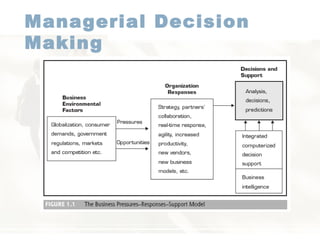
• The business pressures-responses-
support model
– The business environment
– Organizational responses: be reactive,
anticipative, adaptive, and proactive
– Computerized support
Managerial Decision
Making
• The nature of managers’ work
– Interpersonal
– Informational
– Decisional
Managerial Decision
Making
Managerial Decision
Making
• The process of decision making
1. Defining the problem (a decision situation that may
deal with some difficulty or with an opportunity)
2. Constructing a model that describes the real-world
problem
3. Identifying possible solutions to the modeled
problem and evaluating the solutions
4. Comparing, choosing, and recommending a
potential solution to the problem
Managerial Decision
Making
• Decision support systems (DSS)
A conceptual framework for a process of
supporting managerial decision- making,
usually by modeling problems and
employing quantitative models for
solution analysis
Computerized Support
for Decision Making
• Why use computerized decision support
systems
– Speedy computations
– Improved communication and collaboration
– Increased productivity of group members
– Improved data management
– Managing giant data warehouses
Computerized Support
for Decision Making
• Why use computerized decision support
systems
– Quality support
– Agility support
– Overcoming cognitive limits in processing
and storing information
– Using the Web
– Anywhere, anytime support
Computerized Support
for Decision Making
• Cognitive limits
The limitations of the human mind related
to processing information
An Early Framework for
Computerized Decision
Support
An Early Framework for
Computerized Decision
Support
– Degree of structuredness
• Four-phase decision making process
– Intelligence
– Design
– Choice
– Implementation
An Early Framework for
Computerized Decision
Support
An Early Framework for
Computerized Decision
Support
– Types of control in all managerial activities
• Strategic planning
• Management control
• Operational control
– The decision support matrix
• For semi structured decisions and unstructured
decisions, conventional MIS and MS tools are
insufficient
• Decision support systems (DSS) are used
An Early Framework for
Computerized Decision
Support
• Computer support for structured
decisions
– Management science (MS) or operations
research (OR)
The application of a scientific approach and
mathematical models to the analysis and
solution of managerial decision situations
(e.g., problems, opportunities)
An Early Framework for
Computerized Decision
Support
• Computer support for structured
decisions
– Automated decision systems (ADS)
A business rules-based system that uses
intelligence to recommend solutions to
repetitive decisions (such as pricing)
An Early Framework for
Computerized Decision
Support
An Early Framework for
Computerized Decision
Support
• Computer support for unstructured
decisions
– Customized solutions
– intuition and judgment
– Computerized communication and
collaboration technologies
– Knowledge management
An Early Framework for
Computerized Decision
Support
• Computer support for semistructured problems
– A combination of both standard solution procedures
and human judgment
– Management Science can provide models for the
structured portion
– For the unstructured portion, a DSS can improve the
quality of the information on which the decision is
based by providing a range of alternative solutions
along with their potential impacts
An Early Framework for
Computerized Decision
Support
• The benefits of computerized decision support
– Companies work in an unstable or rapidly changing
economy.
– There are difficulties in tracking the numerous
business operations.
– Competition has increased especially global
competition.
– Electronic commerce is changing the ways business
is done.
– Existing information systems do not fully support
decision making.
An Early Framework for
Computerized Decision
Support
• The benefits of computerized decision support
– The Information systems department is too busy to
address all of management’s inquiries.
– Special analysis of profitability and efficiency is
needed.
– Accurate information is needed.
– Computerized support is viewed as an organizational
winner.
– New information is needed.
An Early Framework for
Computerized Decision
Support
• The benefits of computerized decision support
– Management mandates computerized decision
support.
– Higher decision quality is needed.
– Improved communication.
– Improved customer and employee satisfaction.
– Timely information is provided.
– Cost reduction is achieved.
– Employees’ productivity has been improved.
The Concept of Decision
Support Systems (DSS)
• DSS as an Umbrella term: Describes any
computerized system that supports decision
making in an organization
– DSS as a specific application
– The architecture of DSS
• Data
• Models manipulate data as related to a specific situation
• Knowledge component
• Users
• User interface
The Concept of Decision
Support Systems (DSS)
The Concept of Decision
Support Systems (DSS)
– Types of DSS
• model-oriented DSS: quantitative models used to
generate a recommended solution to a problem
• data-oriented DSS: support ad-hoc reporting and
queries
A Framework for
Business Intelligence
(BI)
• Business intelligence (BI)
An umbrella term that combines
architectures, tools, databases,
applications, and methodologies
• Evolution of BI
A Framework for
Business Intelligence
(BI)
A Framework for
Business Intelligence
(BI)
• BI architecture
– Data warehouse
– Business analytics
– Performance management (BPM)
A Framework for
Business Intelligence
(BI)
A Framework for
Business Intelligence
(BI)
– Data warehouse
• Originally, included historical data that were
organized and summarize, so end users could
easily view or manipulate data and information
• Today, some data warehouses include current
data as well, so they can provide real time
decision support
A Framework for
Business Intelligence
(BI)
• Business analytics
– Reporting and queries
– Advanced analytics
– Data, text and Web mining and other
sophisticated mathematical and statistical tools
A Framework for
Business Intelligence
(BI)
• Data mining
A process of searching for unknown
relationships or information in large
databases or data warehouses, using
intelligent tools such as neural computing,
predictive analytics techniques, or
advanced statistical methods
A Framework for
Business Intelligence
(BI)
• Business performance management (BPM)
An advanced performance measurement and
analysis approach that embraces planning and
strategy
– BPM extends the monitoring, measuring, and
comparing of sales, profit, cost, profitability, and other
performance indicators by introducing the concept of
“management and feedback
– BPM provides a top-down enforcement of corporate-
wide strategy
A Framework for
Business Intelligence
(BI)
• Business performance management
– User interface
– Dashboard
A visual presentation of critical data for
executives to view. It allows executives to see
hot spots in seconds and explore the situation
– Dashboards integrate information from multiple
business areas
• Visualization tools
A Framework for
Business Intelligence
(BI)
– Styles of BI
1. Report Delivery and Alerting
2. Enterprise Reporting (dashboard, scorecard)
3. Cube Analysis (Slice and Dice Analysis)
4. Ad-hoc Query
5. Statistics and Data Mining
A Framework for
Business Intelligence
(BI)
• Benefits of BI
– Faster, more accurate reporting
– Improved decision making
– Improved customer service
– Increased revenue
A Framework for
Business Intelligence
(BI)
• The DSS-BI connection
1. The architecture is very similar since BI
evolved from DSS
2. DSS are constructed to directly support
specific decision making; BI systems are
geared to provide accurate and timely
information (indirect support)
3. BI has an executive and strategy orientation
while DSS has been oriented toward analysts
A Framework for
Business Intelligence
(BI)
• The DSS-BI connection
4. BI systems are constructed with commercially
available tools and components that are fitted
to the needs of organizations; DSS more
programming is used to construct custom
solutions to very unstructured problems
5. DSS were developed mostly in the academic
world; BI were developed mostly by software
companies
6. Many tools used by BI are also considered
DSS tools (e.g., data mining and predictive
analysis )
A Framework for
Business Intelligence
(BI)
• Management support systems (MSS)
A system that applies any type of decision
support tool or technique to managerial
decision-making
A Work System
View of Decision
Support
• Work system
A system in which human participants
and/or machines perform a business
process using information, technology,
and other resources to produce products
and/or services for internal or external
customers
A Work System
View of Decision
Support
• Nine elements of a work system
1. Business process
2. Participants
3. Information
4. Technology
5. Product and services
6. Customers
7. Infrastructure
8. Environment
9. Strategy
The Major Tools and
Techniques
of Managerial Decision
Support
• Data management
• Reporting status
tracking
• Visualization
• Business analytics
• Strategy and
performance
management
• Communication and
collaboration
• Knowledge
management
• Intelligent systems
• Enterprise systems
Computerized Tools for Decision Support
The Major Tools and
Techniques
of Managerial Decision
Support• Tools-Web connection
– All of these tools are available in both web-
based and non web-based formats
• Hybrid (integrated) support systems
A support system that uses several tools
and techniques to assist management in
solving managerial or organizational
problems and assess opportunities and
strategies
Implementing Computer-Based
Managerial Decision Support
Systems
• Developing or acquiring support systems
• Justification and cost-benefit analysis
• Security and protection of privacy
• Integration of systems and applications
• The Web in DSS/BI implementation
– Information portals and MSS

Ch01 A decision support system (DSS)

  • 1.
    Chapter 1 DECISION SUPPORT SYSTEMSAND BUSINESS INTELLIGENCE
  • 2.
    Learning Objectives • Understandtoday’s turbulent business environment and describe how organizations survive and even excel in such an environment • Understand the need for computerized support of managerial decision making • Understand an early framework for managerial decision making • Learn the conceptual foundations of the decision support systems (DSS) methodology
  • 3.
    Learning Objectives • Describethe business intelligence (BI) methodology and concepts and relate them to DSS • Describe the concept of work systems and its relationship to decision support • List the major tools of computerized decision support • Understand the major issues in implementing computerized support systems
  • 4.
    Changing Business Environments andComputerized Decision Support • The business pressures-responses- support model – The business environment – Organizational responses: be reactive, anticipative, adaptive, and proactive – Computerized support
  • 5.
    Managerial Decision Making • Thenature of managers’ work – Interpersonal – Informational – Decisional
  • 6.
  • 7.
    Managerial Decision Making • Theprocess of decision making 1. Defining the problem (a decision situation that may deal with some difficulty or with an opportunity) 2. Constructing a model that describes the real-world problem 3. Identifying possible solutions to the modeled problem and evaluating the solutions 4. Comparing, choosing, and recommending a potential solution to the problem
  • 8.
    Managerial Decision Making • Decisionsupport systems (DSS) A conceptual framework for a process of supporting managerial decision- making, usually by modeling problems and employing quantitative models for solution analysis
  • 9.
    Computerized Support for DecisionMaking • Why use computerized decision support systems – Speedy computations – Improved communication and collaboration – Increased productivity of group members – Improved data management – Managing giant data warehouses
  • 10.
    Computerized Support for DecisionMaking • Why use computerized decision support systems – Quality support – Agility support – Overcoming cognitive limits in processing and storing information – Using the Web – Anywhere, anytime support
  • 11.
    Computerized Support for DecisionMaking • Cognitive limits The limitations of the human mind related to processing information
  • 12.
    An Early Frameworkfor Computerized Decision Support
  • 13.
    An Early Frameworkfor Computerized Decision Support – Degree of structuredness • Four-phase decision making process – Intelligence – Design – Choice – Implementation
  • 14.
    An Early Frameworkfor Computerized Decision Support
  • 15.
    An Early Frameworkfor Computerized Decision Support – Types of control in all managerial activities • Strategic planning • Management control • Operational control – The decision support matrix • For semi structured decisions and unstructured decisions, conventional MIS and MS tools are insufficient • Decision support systems (DSS) are used
  • 16.
    An Early Frameworkfor Computerized Decision Support • Computer support for structured decisions – Management science (MS) or operations research (OR) The application of a scientific approach and mathematical models to the analysis and solution of managerial decision situations (e.g., problems, opportunities)
  • 17.
    An Early Frameworkfor Computerized Decision Support • Computer support for structured decisions – Automated decision systems (ADS) A business rules-based system that uses intelligence to recommend solutions to repetitive decisions (such as pricing)
  • 18.
    An Early Frameworkfor Computerized Decision Support
  • 19.
    An Early Frameworkfor Computerized Decision Support • Computer support for unstructured decisions – Customized solutions – intuition and judgment – Computerized communication and collaboration technologies – Knowledge management
  • 20.
    An Early Frameworkfor Computerized Decision Support • Computer support for semistructured problems – A combination of both standard solution procedures and human judgment – Management Science can provide models for the structured portion – For the unstructured portion, a DSS can improve the quality of the information on which the decision is based by providing a range of alternative solutions along with their potential impacts
  • 21.
    An Early Frameworkfor Computerized Decision Support • The benefits of computerized decision support – Companies work in an unstable or rapidly changing economy. – There are difficulties in tracking the numerous business operations. – Competition has increased especially global competition. – Electronic commerce is changing the ways business is done. – Existing information systems do not fully support decision making.
  • 22.
    An Early Frameworkfor Computerized Decision Support • The benefits of computerized decision support – The Information systems department is too busy to address all of management’s inquiries. – Special analysis of profitability and efficiency is needed. – Accurate information is needed. – Computerized support is viewed as an organizational winner. – New information is needed.
  • 23.
    An Early Frameworkfor Computerized Decision Support • The benefits of computerized decision support – Management mandates computerized decision support. – Higher decision quality is needed. – Improved communication. – Improved customer and employee satisfaction. – Timely information is provided. – Cost reduction is achieved. – Employees’ productivity has been improved.
  • 24.
    The Concept ofDecision Support Systems (DSS) • DSS as an Umbrella term: Describes any computerized system that supports decision making in an organization – DSS as a specific application – The architecture of DSS • Data • Models manipulate data as related to a specific situation • Knowledge component • Users • User interface
  • 25.
    The Concept ofDecision Support Systems (DSS)
  • 26.
    The Concept ofDecision Support Systems (DSS) – Types of DSS • model-oriented DSS: quantitative models used to generate a recommended solution to a problem • data-oriented DSS: support ad-hoc reporting and queries
  • 27.
    A Framework for BusinessIntelligence (BI) • Business intelligence (BI) An umbrella term that combines architectures, tools, databases, applications, and methodologies • Evolution of BI
  • 28.
    A Framework for BusinessIntelligence (BI)
  • 29.
    A Framework for BusinessIntelligence (BI) • BI architecture – Data warehouse – Business analytics – Performance management (BPM)
  • 30.
    A Framework for BusinessIntelligence (BI)
  • 31.
    A Framework for BusinessIntelligence (BI) – Data warehouse • Originally, included historical data that were organized and summarize, so end users could easily view or manipulate data and information • Today, some data warehouses include current data as well, so they can provide real time decision support
  • 32.
    A Framework for BusinessIntelligence (BI) • Business analytics – Reporting and queries – Advanced analytics – Data, text and Web mining and other sophisticated mathematical and statistical tools
  • 33.
    A Framework for BusinessIntelligence (BI) • Data mining A process of searching for unknown relationships or information in large databases or data warehouses, using intelligent tools such as neural computing, predictive analytics techniques, or advanced statistical methods
  • 34.
    A Framework for BusinessIntelligence (BI) • Business performance management (BPM) An advanced performance measurement and analysis approach that embraces planning and strategy – BPM extends the monitoring, measuring, and comparing of sales, profit, cost, profitability, and other performance indicators by introducing the concept of “management and feedback – BPM provides a top-down enforcement of corporate- wide strategy
  • 35.
    A Framework for BusinessIntelligence (BI) • Business performance management – User interface – Dashboard A visual presentation of critical data for executives to view. It allows executives to see hot spots in seconds and explore the situation – Dashboards integrate information from multiple business areas • Visualization tools
  • 36.
    A Framework for BusinessIntelligence (BI) – Styles of BI 1. Report Delivery and Alerting 2. Enterprise Reporting (dashboard, scorecard) 3. Cube Analysis (Slice and Dice Analysis) 4. Ad-hoc Query 5. Statistics and Data Mining
  • 37.
    A Framework for BusinessIntelligence (BI) • Benefits of BI – Faster, more accurate reporting – Improved decision making – Improved customer service – Increased revenue
  • 38.
    A Framework for BusinessIntelligence (BI) • The DSS-BI connection 1. The architecture is very similar since BI evolved from DSS 2. DSS are constructed to directly support specific decision making; BI systems are geared to provide accurate and timely information (indirect support) 3. BI has an executive and strategy orientation while DSS has been oriented toward analysts
  • 39.
    A Framework for BusinessIntelligence (BI) • The DSS-BI connection 4. BI systems are constructed with commercially available tools and components that are fitted to the needs of organizations; DSS more programming is used to construct custom solutions to very unstructured problems 5. DSS were developed mostly in the academic world; BI were developed mostly by software companies 6. Many tools used by BI are also considered DSS tools (e.g., data mining and predictive analysis )
  • 40.
    A Framework for BusinessIntelligence (BI) • Management support systems (MSS) A system that applies any type of decision support tool or technique to managerial decision-making
  • 41.
    A Work System Viewof Decision Support • Work system A system in which human participants and/or machines perform a business process using information, technology, and other resources to produce products and/or services for internal or external customers
  • 42.
    A Work System Viewof Decision Support • Nine elements of a work system 1. Business process 2. Participants 3. Information 4. Technology 5. Product and services 6. Customers 7. Infrastructure 8. Environment 9. Strategy
  • 43.
    The Major Toolsand Techniques of Managerial Decision Support • Data management • Reporting status tracking • Visualization • Business analytics • Strategy and performance management • Communication and collaboration • Knowledge management • Intelligent systems • Enterprise systems Computerized Tools for Decision Support
  • 44.
    The Major Toolsand Techniques of Managerial Decision Support• Tools-Web connection – All of these tools are available in both web- based and non web-based formats • Hybrid (integrated) support systems A support system that uses several tools and techniques to assist management in solving managerial or organizational problems and assess opportunities and strategies
  • 45.
    Implementing Computer-Based Managerial DecisionSupport Systems • Developing or acquiring support systems • Justification and cost-benefit analysis • Security and protection of privacy • Integration of systems and applications • The Web in DSS/BI implementation – Information portals and MSS