DR.SARATH CHANDRA CHERUKURI
   1st year PG in general medicine
        KATURI MEDICAL COLLEGE
   Stroke or CVA is defined as abrupt onset of
    neurologic deficit that is attributable to a
    focal vascular cause.

   Stroke has occured if the neurologic signs
    and symptoms last for >24 hours
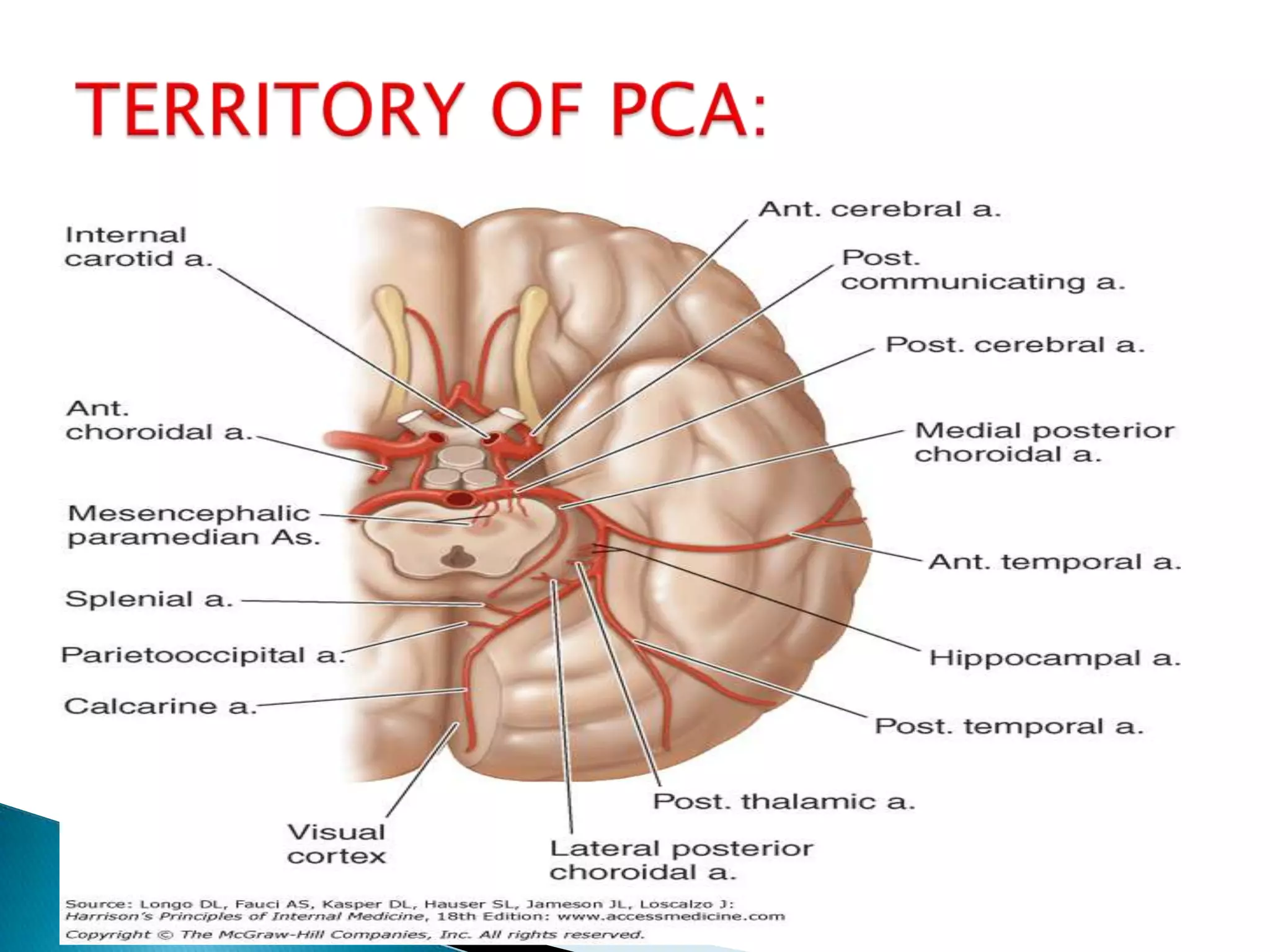
   It is composed of the paired vertebral
    artery,basilar artery&paired PCA’s

   These major arteries give rise to short&long
    circumferential branches that supply the
    cerebellum,medulla,pons,midbrain,thalamus,hipp
    ocampus and medial temporal&occipital lobes

   PCA syndromes usually result from atheroma or
    emboli at the top of basilar artery,fibromuscular
    dysplasia or vertebral artery dissection
   P1 SYNDROME:infarction usually occurs in the
    I/L subthalamus&medial thalamus and in I/L
    cerebral peduncle&midbrain


   P2 SYNDROME:Cortical temporal and occipital
    lobe signs
   The VERTEBRAL artery has 4 segments
    V1,V2,V3&V4
   The fourth segment courses upward to join
    the other vertebral artery to form the basilar
    artery
   Only V4 gives rise to branches that supply the
    brainstem&cerebellum
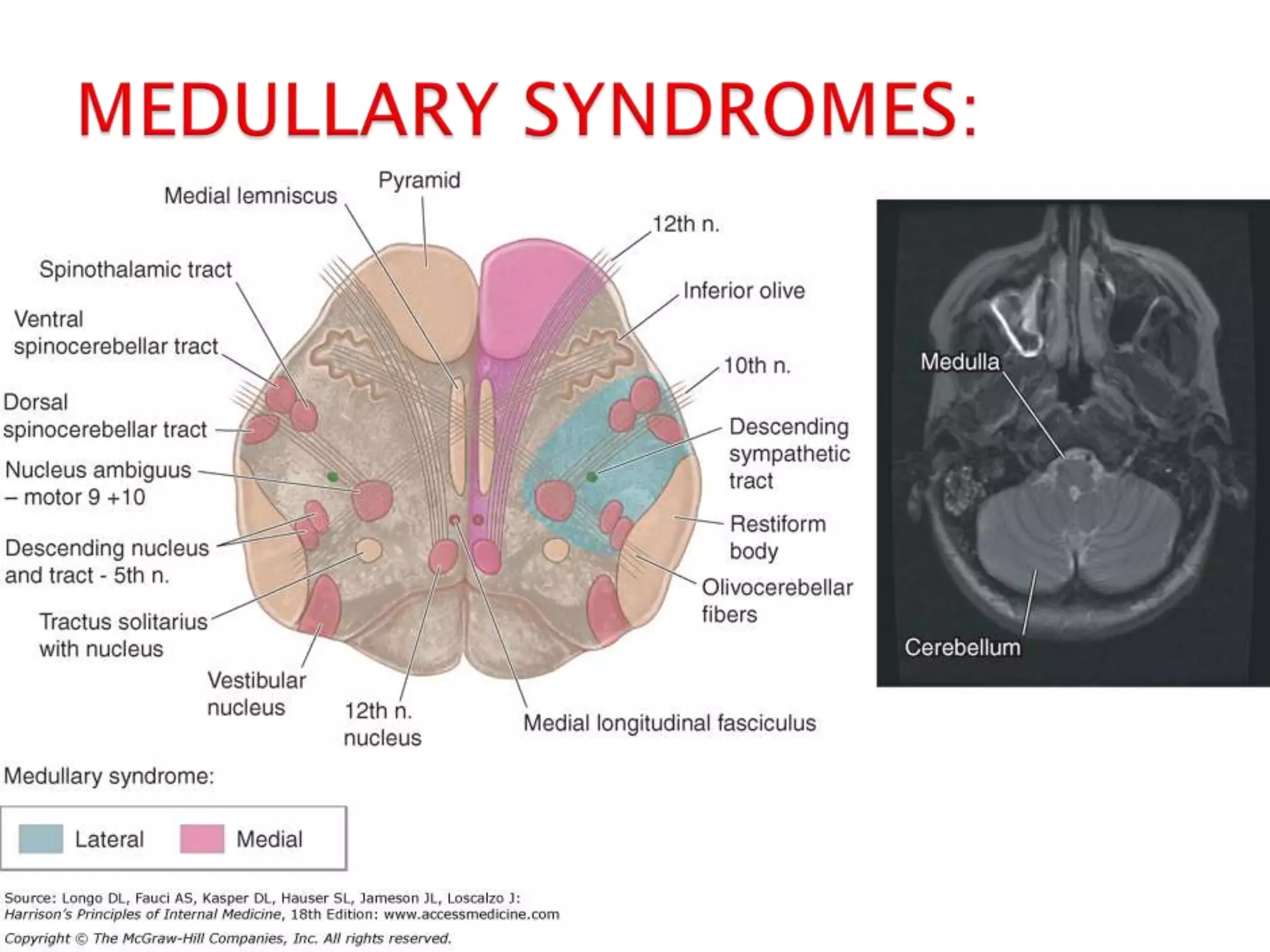
   The PICA,in its proximal segment supplies the
    lateral medulla and in its distal branches the
    inferior surface of cerebellum
 ON SIDE OF LESION:
1) Pain,numbness,impaired sensation over
   one-half of face:5th nerve nucleus
2) Ataxia:restiform body,cerebellar
   hemisphere,spinocerebellar tract
3) Nystagmus,diplopia,vertigo,nausea,vomting
   :vestibular nucleus
4) Horner’s syndrome:descending sympathetic
   tract
5) Dysphagia,paralysis of palate,vocal
   cord,diminished gag reflex:fibres of
   9th&10th nerves
6)Loss   of taste:nucleus&tractus solitarius

7)Numbness    of I/L arm,trunk&leg:
     cuneate&gracile nucleus

8)Weakness    of lower face:UMN fibres to I/L
     facial nucleus

    ON SIDE OPPOSITE LESION:

1)   Impaired pain&thermal sense over half the
     body,sometimes face:Spinothalamic tract
 On the side of lesion:
1) Paralysis with atrophy of half the tongue:
   I/L 12th nerve

    On the side opposite lesion:

1)   Paralysis of arm&leg sparing face;impaired
     tactile&proprioceptive sense over one half
     of the body:C/L pyramidal tract&medial
     leminiscus
    Branches of basilar artery supply the base of
     the pons&superior cerebellum and fall into
     3 groups:
1)   Paramedian,7-10 in number supply a wedge
     of pons on either side of midline
2)   Short circumferential,5-7 that supply lateral
     two-thirds of pons&middle,superior
     cerebellar peduncle
3)   B/L long circumferential(SCA&AICA) course
     around pons to supply the cerebellar
     hemispheres
 MEDIAL INFERIOR PONTINE SYNDROME:
 ON THE SAME SIDE:
1) Paralysis of conjugate gaze to the side of
   lesion
2) Nystagmus:vestibular nucleus
3) Ataxia:middle cerebellar peduncle
4) Diplopia on lateral gaze:abducens nerve


    ON THE OPPOSITE SIDE:
1)   Paralysis of face,arm&leg:CB&CS tracts
2)   Impaired tactile&proproiceptive sense over
     one-half of body:medial leminiscus
 LATERAL INFERIOR PONTINE (AICA)
  SYNDROME:
 ON THE SIDE OF LESION:
1) Horizontal&vertical gaze
   nystagmus,vertigo,nausea,vomting:vestibula
   r nerve or nucleus
2) Facial paralysis:7th nerve
3) Ataxia:middle cerebellar
   peduncle&cerebellar hemisphere
4) Impaired sensation over face:descending
   tract&5th nucleus
 ON THE SIDE OPPOSITE LESION:
1) Impaired pain and thermal sense over one-
   half of body
    ON THE SIDE OF LESION:

1)    Ataxia of limbs and gait-pontine nucleii

     ON THE SIDE OPPOSITE LESION:

1)    Paralysis of face,arm&leg:corticobulbar and
      corticospinal tracts
2)    Variable impaired touch and
      proprioception:medial leminiscus
    ON THE SIDE OF LESION:

1)    Ataxia:middle cerebellar peduncle
     Paralysis of muscles of mastication:motor
      fibres or nucleus of 5th nerve

     ON THE SIDE OPPOSITE LESION:

1)    Impaired pain and thermal sense on limbs
      and trunk:spinothalamic tract
    MEDIAL SUPERIOR PONTINE SYNDROME:

 ON THE SIDE OF LESION:
1) Cerebellar ataxia:superior/middle cerebellar
   peduncle
2) Internuclear ophthalmoplegia:MLF
3) Myoclonic syndrome,palate,pharynx,vocal
   cords-dentate projection,inferior olivary
   nucleus

     ON THE SIDE OPPOSITE LESION:
1)    Paralysis of face,arm&leg:CB&CS tract
2)    Rarely touch,vibration&position:medial
      leminiscus
   LATERAL SUPERIOR PONTINE
    SYNDROME OR SCA OR MILLS’
    SYNDROME:

 ON SIDE OF LESION:
1) Ataxia:middle&superior cerebellar
   peduncles,dentate nucleus
2) Dizziness,nausea,horizontal
   nystagmus:Vestibular nucleus
3) Horner’s syndrome:descending sympathetic
   tract
4) Tremor:red nucleus,superior cerebellar
   peduncle
    ON SIDE OPPOSITE LESION:

1)   Impaired pain&thermal sense on
     face,limbs&trunk:spinothalamic tract
2)   Impaired touch,vibration&position
     sense:medial leminiscus
   MILLARD-GUBLER SYNDROME:I/L LMN type
    facial nerve palsy&C/L hemiparesis due to
    involvement of 7th nerve nucleus&CST

   FOVILLE’S SYNDROME:I/L LMN type facial
    nerve palsy&horizontal gaze palsy with C/L
    hemiparesis due to involvement of horizontal
    gaze centre,7th nerve nucleus&CST

   RAYMOND’S SYNDROME:I/L abducens palsy
    C/L hemiparesis due to involvement of 6th
    cranial nerve&CST
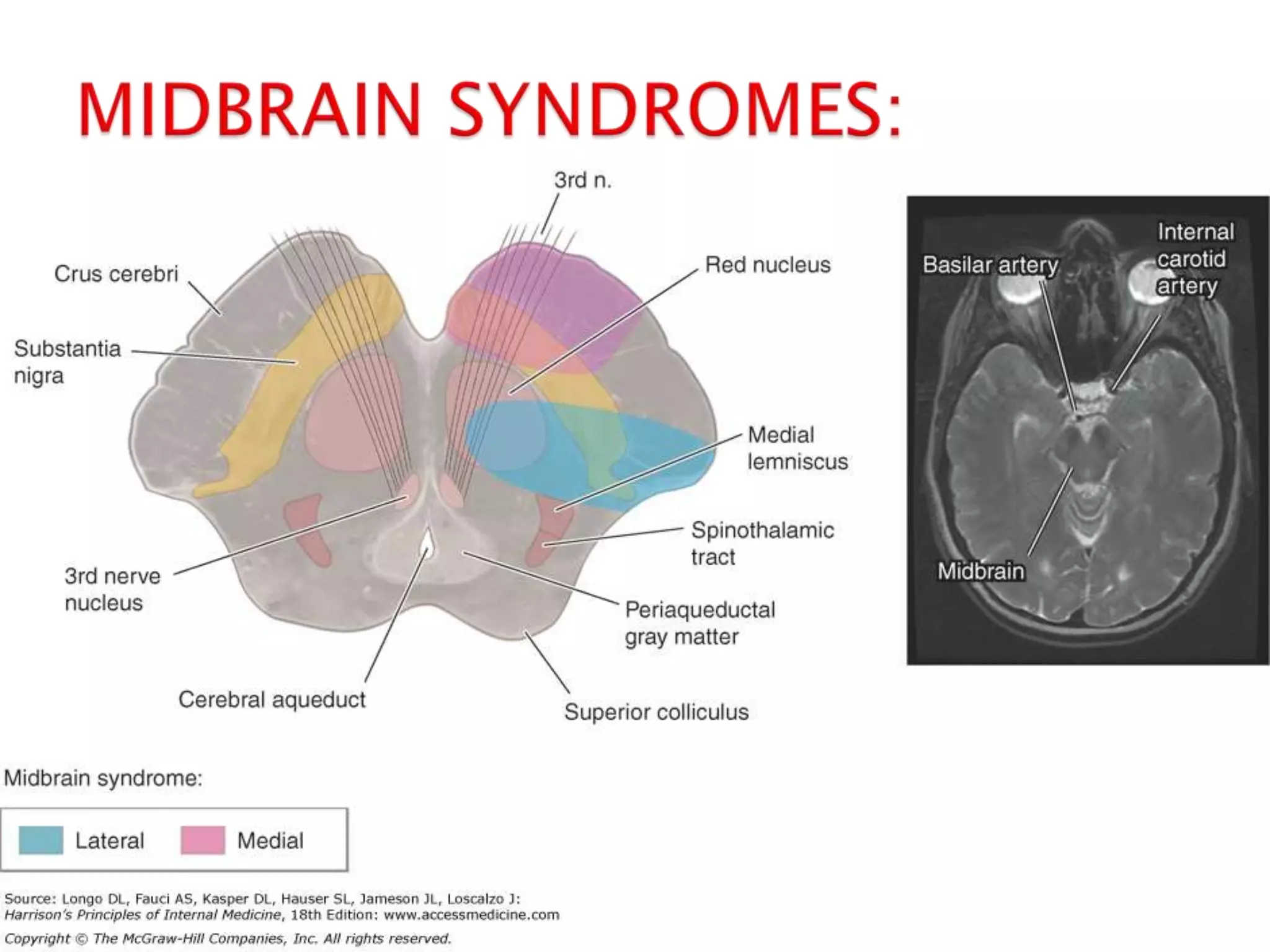
 MEDIAL MIDBRAIN SYNDROME:
1) ON THE SIDE OF LESION:Eye”down&out”
   secondary to unopposed action of 4th&6th
   cranial nerves,with dilated&unresponsive
   pupil(3rd cranial nerve)
2) ON SIDE OPPOSITE LESION:paralysis of
   face,arm,leg(CB&CS tracts in crus cerebri)

    LATERAL MIDBRAIN SYNDROME:
1)   ON THE SIDE OF LESION:eye down&out
2)   ON THE OPP. SIDE:
     hemiataxia,hyperkinesias,tremor:Red
     nucleus,dentatorubrothalamic pathway
   WEBER’S syndrome:third nerve palsy on the
    I/L side due to involvement of occulomotor
    nerve fascicles,Hemiplegia on C/L side due to
    superior cerebral peduncle involvement

   CLAUDE’S syndrome:I/L 3rd nerve palsy,C/L
    ataxia&tremor due superior cerebellar
    peduncle involvement

   BENEDIKT’S syndrome:3rd nerve palsy on I/L
    side&C/L side hemiparesis&ataxia due
    involvement of red nucleus,SCP
   Lesion is dorsal midbrain
   Structures involved are quadrigeminal plate
    region,periaqeuductal gray matter
   Clinical findings: impaired upgaze;
    convergence&retraction nystagmus

   NOTHNAGEL’S SYNDROME:it is more a variant
    of parinaud’s with U/L or B/L 3rd nerve
    palsy.lesion is in midbrain tectum
   C/L homonymous hemianopia with visual sparing
    is the usual manifestation

   ACUTE MEMORY DISTURBANCES:due to medial
    temporal lobe&hippocampus involvement on the
    dominant side

   ALEXIA without agraphia:due to dominant
    hemisphere plus splenium of corpus callosum
    involvement

   PEDUNCULAR HALLUCINOSIS:due to occlusion of
    PCA
   ANTON’S syndrome:B/L infarction in distal
    PCA produces cortical blindness

   If the visual association areas are spared and
    only calcarine cortex is involved,patient may
    be aware of his blindness

   BALINT’S syndrome:disorder of orderly visual
    scanning of the environment due to bilateral
    visual association area lesions,resulting from
    infarctions secondary to low flow in the
    watershed areas between the distal PCA&MCA
    territories
   Pallinopsia&asimultognosia may also be seen
THANK YOU

Posterior circulation stroke

  • 1.
    DR.SARATH CHANDRA CHERUKURI 1st year PG in general medicine KATURI MEDICAL COLLEGE
  • 2.
    Stroke or CVA is defined as abrupt onset of neurologic deficit that is attributable to a focal vascular cause.  Stroke has occured if the neurologic signs and symptoms last for >24 hours
  • 3.
    It is composed of the paired vertebral artery,basilar artery&paired PCA’s  These major arteries give rise to short&long circumferential branches that supply the cerebellum,medulla,pons,midbrain,thalamus,hipp ocampus and medial temporal&occipital lobes  PCA syndromes usually result from atheroma or emboli at the top of basilar artery,fibromuscular dysplasia or vertebral artery dissection
  • 6.
    P1 SYNDROME:infarction usually occurs in the I/L subthalamus&medial thalamus and in I/L cerebral peduncle&midbrain  P2 SYNDROME:Cortical temporal and occipital lobe signs
  • 7.
    The VERTEBRAL artery has 4 segments V1,V2,V3&V4  The fourth segment courses upward to join the other vertebral artery to form the basilar artery  Only V4 gives rise to branches that supply the brainstem&cerebellum  The PICA,in its proximal segment supplies the lateral medulla and in its distal branches the inferior surface of cerebellum
  • 9.
     ON SIDEOF LESION: 1) Pain,numbness,impaired sensation over one-half of face:5th nerve nucleus 2) Ataxia:restiform body,cerebellar hemisphere,spinocerebellar tract 3) Nystagmus,diplopia,vertigo,nausea,vomting :vestibular nucleus 4) Horner’s syndrome:descending sympathetic tract 5) Dysphagia,paralysis of palate,vocal cord,diminished gag reflex:fibres of 9th&10th nerves
  • 10.
    6)Loss of taste:nucleus&tractus solitarius 7)Numbness of I/L arm,trunk&leg: cuneate&gracile nucleus 8)Weakness of lower face:UMN fibres to I/L facial nucleus  ON SIDE OPPOSITE LESION: 1) Impaired pain&thermal sense over half the body,sometimes face:Spinothalamic tract
  • 11.
     On theside of lesion: 1) Paralysis with atrophy of half the tongue: I/L 12th nerve  On the side opposite lesion: 1) Paralysis of arm&leg sparing face;impaired tactile&proprioceptive sense over one half of the body:C/L pyramidal tract&medial leminiscus
  • 12.
    Branches of basilar artery supply the base of the pons&superior cerebellum and fall into 3 groups: 1) Paramedian,7-10 in number supply a wedge of pons on either side of midline 2) Short circumferential,5-7 that supply lateral two-thirds of pons&middle,superior cerebellar peduncle 3) B/L long circumferential(SCA&AICA) course around pons to supply the cerebellar hemispheres
  • 14.
     MEDIAL INFERIORPONTINE SYNDROME:  ON THE SAME SIDE: 1) Paralysis of conjugate gaze to the side of lesion 2) Nystagmus:vestibular nucleus 3) Ataxia:middle cerebellar peduncle 4) Diplopia on lateral gaze:abducens nerve  ON THE OPPOSITE SIDE: 1) Paralysis of face,arm&leg:CB&CS tracts 2) Impaired tactile&proproiceptive sense over one-half of body:medial leminiscus
  • 15.
     LATERAL INFERIORPONTINE (AICA) SYNDROME:  ON THE SIDE OF LESION: 1) Horizontal&vertical gaze nystagmus,vertigo,nausea,vomting:vestibula r nerve or nucleus 2) Facial paralysis:7th nerve 3) Ataxia:middle cerebellar peduncle&cerebellar hemisphere 4) Impaired sensation over face:descending tract&5th nucleus  ON THE SIDE OPPOSITE LESION: 1) Impaired pain and thermal sense over one- half of body
  • 17.
    ON THE SIDE OF LESION: 1) Ataxia of limbs and gait-pontine nucleii  ON THE SIDE OPPOSITE LESION: 1) Paralysis of face,arm&leg:corticobulbar and corticospinal tracts 2) Variable impaired touch and proprioception:medial leminiscus
  • 18.
    ON THE SIDE OF LESION: 1) Ataxia:middle cerebellar peduncle  Paralysis of muscles of mastication:motor fibres or nucleus of 5th nerve  ON THE SIDE OPPOSITE LESION: 1) Impaired pain and thermal sense on limbs and trunk:spinothalamic tract
  • 20.
    MEDIAL SUPERIOR PONTINE SYNDROME:  ON THE SIDE OF LESION: 1) Cerebellar ataxia:superior/middle cerebellar peduncle 2) Internuclear ophthalmoplegia:MLF 3) Myoclonic syndrome,palate,pharynx,vocal cords-dentate projection,inferior olivary nucleus  ON THE SIDE OPPOSITE LESION: 1) Paralysis of face,arm&leg:CB&CS tract 2) Rarely touch,vibration&position:medial leminiscus
  • 21.
    LATERAL SUPERIOR PONTINE SYNDROME OR SCA OR MILLS’ SYNDROME:  ON SIDE OF LESION: 1) Ataxia:middle&superior cerebellar peduncles,dentate nucleus 2) Dizziness,nausea,horizontal nystagmus:Vestibular nucleus 3) Horner’s syndrome:descending sympathetic tract 4) Tremor:red nucleus,superior cerebellar peduncle
  • 22.
    ON SIDE OPPOSITE LESION: 1) Impaired pain&thermal sense on face,limbs&trunk:spinothalamic tract 2) Impaired touch,vibration&position sense:medial leminiscus
  • 23.
    MILLARD-GUBLER SYNDROME:I/L LMN type facial nerve palsy&C/L hemiparesis due to involvement of 7th nerve nucleus&CST  FOVILLE’S SYNDROME:I/L LMN type facial nerve palsy&horizontal gaze palsy with C/L hemiparesis due to involvement of horizontal gaze centre,7th nerve nucleus&CST  RAYMOND’S SYNDROME:I/L abducens palsy C/L hemiparesis due to involvement of 6th cranial nerve&CST
  • 25.
     MEDIAL MIDBRAINSYNDROME: 1) ON THE SIDE OF LESION:Eye”down&out” secondary to unopposed action of 4th&6th cranial nerves,with dilated&unresponsive pupil(3rd cranial nerve) 2) ON SIDE OPPOSITE LESION:paralysis of face,arm,leg(CB&CS tracts in crus cerebri)  LATERAL MIDBRAIN SYNDROME: 1) ON THE SIDE OF LESION:eye down&out 2) ON THE OPP. SIDE: hemiataxia,hyperkinesias,tremor:Red nucleus,dentatorubrothalamic pathway
  • 26.
    WEBER’S syndrome:third nerve palsy on the I/L side due to involvement of occulomotor nerve fascicles,Hemiplegia on C/L side due to superior cerebral peduncle involvement  CLAUDE’S syndrome:I/L 3rd nerve palsy,C/L ataxia&tremor due superior cerebellar peduncle involvement  BENEDIKT’S syndrome:3rd nerve palsy on I/L side&C/L side hemiparesis&ataxia due involvement of red nucleus,SCP
  • 27.
    Lesion is dorsal midbrain  Structures involved are quadrigeminal plate region,periaqeuductal gray matter  Clinical findings: impaired upgaze; convergence&retraction nystagmus  NOTHNAGEL’S SYNDROME:it is more a variant of parinaud’s with U/L or B/L 3rd nerve palsy.lesion is in midbrain tectum
  • 28.
    C/L homonymous hemianopia with visual sparing is the usual manifestation  ACUTE MEMORY DISTURBANCES:due to medial temporal lobe&hippocampus involvement on the dominant side  ALEXIA without agraphia:due to dominant hemisphere plus splenium of corpus callosum involvement  PEDUNCULAR HALLUCINOSIS:due to occlusion of PCA
  • 29.
    ANTON’S syndrome:B/L infarction in distal PCA produces cortical blindness  If the visual association areas are spared and only calcarine cortex is involved,patient may be aware of his blindness  BALINT’S syndrome:disorder of orderly visual scanning of the environment due to bilateral visual association area lesions,resulting from infarctions secondary to low flow in the watershed areas between the distal PCA&MCA territories  Pallinopsia&asimultognosia may also be seen
  • 30.