
Writing your knowledge
mobilization plan
Shawna Reibling, Knowledge Mobilization Officer
Email: sreibling@wlu.ca
Twitter: @MobilizeShawna
@LaurierResearch
What is “kmb”?
•
•
•
•
•
•
•

KM or KMb (SSHRC)
Knowledge translation (CIHR),
Knowledge exchange (CHSRF)
Knowledge transfer partnerships (UK)
Knowledge dissemination (MSFHR)
‘Tech transfer’(S.T.E.M. disciplines)
Extension (agriculture)
What is knowledge mobilization?
• Knowledge mobilization (KMb) is a broad and
encompassing term that includes the products,
processes and relationships among knowledge
creators, users, and mediators (individuals or
intermediary organizations that support knowledge
brokering).
http://www.theresearchshop.ca/sites/default/files/Hawkins%20CSAHS%20CE%20and%20KM%20definitions.pdf
What is knowledge mobilization?
• SSHRC: “moving knowledge into active service for the
broadest possible common good”.
SSHRC (2008b). Knowledge impact in society: A SSHRC transformation program. Social Sciences and Humanities Research
Council. Available: http://www.sshrc.ca/web/apply/program_descriptions/knowledge_impact_e.asp

• “accepting a common set of values, such as respect for
others’ perspective (to encourage wide participation)”,
this is important in “acculturating new participants to
function effectively in knowledge networks”
Dede, C. The role of emerging technologies for knowledge mobilization, dissemination, and use in
education. Paper commissioned by Office of Educational Research and Improvement, US Dept. of
Education. www.virtual.gmu.edu
Types of “kmb”
• “End of Grant” KMb: (curiosity-driven research):
The researcher develops and implements a plan for making
knowledge users aware of the knowledge generated.
• “Integrated” KMb (problem-based research):
The researcher engages potential knowledge users as
partners in the research process. Requires a collaborative
or participatory approach to research that is action oriented
and is solutions and impact focused.
What is “kmb”?
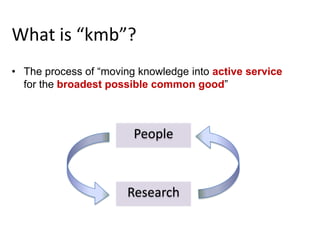
• The process of “moving knowledge into active service
for the broadest possible common good”

People

Research
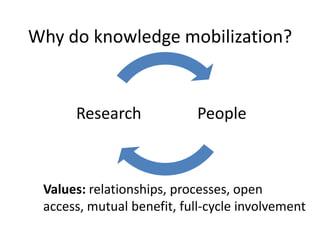
Why do knowledge mobilization?

Research

People

Values: relationships, processes, open
access, mutual benefit, full-cycle involvement
Research outcome
What is your research outcome(s)?
Audience
Who? (Be specific) Why them?
Typical audience outreach tools
• Book?
• Publications in Journals (previous publications,
top-tier, open access)
• Conference presentations (how many people?
Who will be there?)
• Workshops (tailored to audience)
• Website and Social media
• Student training
• Classroom
• Community
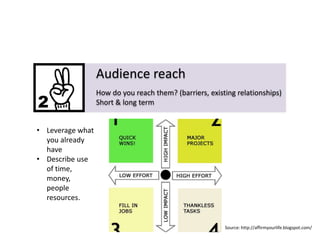
Audience reach
How do you reach them? (barriers, existing relationships)
Short & long term
• Leverage what
you already
have
• Describe use
of time,
money,
people
resources.

Source: http://affirmyourlife.blogspot.com/
Evaluation
Evaluate impact (past & going forward)
Don’t wait till the end to evaluate

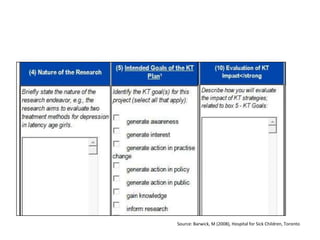
Source: Barwick, M (2008), Hospital for Sick Children, Toronto
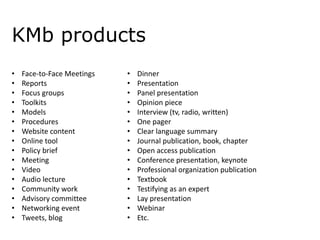
KMb products
•
•
•
•
•
•
•
•
•
•
•
•
•
•
•
•

Face-to-Face Meetings
Reports
Focus groups
Toolkits
Models
Procedures
Website content
Online tool
Policy brief
Meeting
Video
Audio lecture
Community work
Advisory committee
Networking event
Tweets, blog

•
•
•
•
•
•
•
•
•
•
•
•
•
•
•
•

Dinner
Presentation
Panel presentation
Opinion piece
Interview (tv, radio, written)
One pager
Clear language summary
Journal publication, book, chapter
Open access publication
Conference presentation, keynote
Professional organization publication
Textbook
Testifying as an expert
Lay presentation
Webinar
Etc.
Evaluation
Evaluate impact (past & going forward)
Don’t wait till the end to evaluate

Think about how you would report this to your funder.
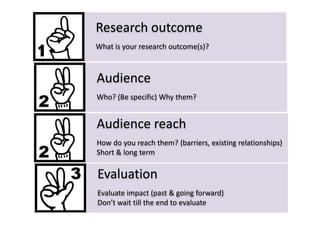
Research outcome
What is your research outcome(s)?

Audience
Who? (Be specific) Why them?

Audience reach
How do you reach them? (barriers, existing relationships)
Short & long term

Evaluation
Evaluate impact (past & going forward)
Don’t wait till the end to evaluate
Services available to your kmb
plans
Laurier services
• Dissemination of faculty research to the broader public,
through materials, events and social media
• Brokering research partnerships between community
members and university researchers
• Clear language assistance
• Social media
• Event training
• More….
Upcoming workshops
•
•
•
•

(Note: All workshops will be held in the library Room 3-314.)
Clear language summary writing workshop Nov 14 2-3pm
Writing your knowledge mobilization plan Oct 3 3:30-4:30pm
How to use Eventbrite/ online registration systems Sept. 26th 1-2pm; 3:304:30pm
• How to create an online presence for your conference Oct 17 1-2pm; Nov 7
3:30-4:30pm; Dec 3 2-3pm
• How to organize your online identity Oct 24 1-2pm; 3:30-4:30pm; Dec 5 23pm
• Knowledge mobilization 101 Nov 21 3:30-4:30pm

Register at http://bit.ly/16X6ow3
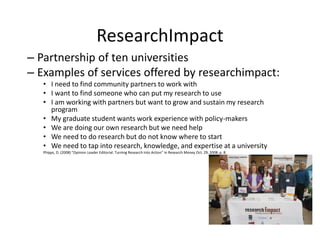
ResearchImpact
– Partnership of ten universities
– Examples of services offered by researchimpact:
• I need to find community partners to work with
• I want to find someone who can put my research to use
• I am working with partners but want to grow and sustain my research
program
• My graduate student wants work experience with policy-makers
• We are doing our own research but we need help
• We need to do research but do not know where to start
• We need to tap into research, knowledge, and expertise at a university
Phipps, D. (2008) “Opinion Leader Editorial: Turning Research into Action” in Research Money Oct. 29, 2008: p. 8.
Open Access
Tri-Council Resources:
• Tri-Council Guiding
Principles
• Research Data Archiving
Policy
• SSHRC: Open Access
• CIHR: Access to
Research Outputs

Tools for faculty:
• Using the SPARC Canadian Author
Addendum to secure your author
rights.
• Greater Reach for Your Research :
Expanding Readership through
Digital Repositories
• What is a journal’s copyright
policy? Here or here
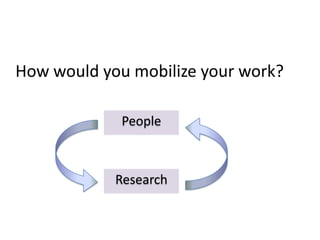
How would you mobilize your work?
People

Research

How to write a knowledge mobilization plan

  • 1.
    Writing your knowledge mobilizationplan Shawna Reibling, Knowledge Mobilization Officer Email: sreibling@wlu.ca Twitter: @MobilizeShawna @LaurierResearch
  • 2.
    What is “kmb”? • • • • • • • KMor KMb (SSHRC) Knowledge translation (CIHR), Knowledge exchange (CHSRF) Knowledge transfer partnerships (UK) Knowledge dissemination (MSFHR) ‘Tech transfer’(S.T.E.M. disciplines) Extension (agriculture)
  • 3.
    What is knowledgemobilization? • Knowledge mobilization (KMb) is a broad and encompassing term that includes the products, processes and relationships among knowledge creators, users, and mediators (individuals or intermediary organizations that support knowledge brokering). http://www.theresearchshop.ca/sites/default/files/Hawkins%20CSAHS%20CE%20and%20KM%20definitions.pdf
  • 4.
    What is knowledgemobilization? • SSHRC: “moving knowledge into active service for the broadest possible common good”. SSHRC (2008b). Knowledge impact in society: A SSHRC transformation program. Social Sciences and Humanities Research Council. Available: http://www.sshrc.ca/web/apply/program_descriptions/knowledge_impact_e.asp • “accepting a common set of values, such as respect for others’ perspective (to encourage wide participation)”, this is important in “acculturating new participants to function effectively in knowledge networks” Dede, C. The role of emerging technologies for knowledge mobilization, dissemination, and use in education. Paper commissioned by Office of Educational Research and Improvement, US Dept. of Education. www.virtual.gmu.edu
  • 5.
    Types of “kmb” •“End of Grant” KMb: (curiosity-driven research): The researcher develops and implements a plan for making knowledge users aware of the knowledge generated. • “Integrated” KMb (problem-based research): The researcher engages potential knowledge users as partners in the research process. Requires a collaborative or participatory approach to research that is action oriented and is solutions and impact focused.
  • 6.
    What is “kmb”? •The process of “moving knowledge into active service for the broadest possible common good” People Research
  • 7.
    Why do knowledgemobilization? Research People Values: relationships, processes, open access, mutual benefit, full-cycle involvement
  • 8.
    Research outcome What isyour research outcome(s)?
  • 9.
  • 10.
    Typical audience outreachtools • Book? • Publications in Journals (previous publications, top-tier, open access) • Conference presentations (how many people? Who will be there?) • Workshops (tailored to audience) • Website and Social media • Student training • Classroom • Community
  • 11.
    Audience reach How doyou reach them? (barriers, existing relationships) Short & long term • Leverage what you already have • Describe use of time, money, people resources. Source: http://affirmyourlife.blogspot.com/
  • 12.
    Evaluation Evaluate impact (past& going forward) Don’t wait till the end to evaluate Source: Barwick, M (2008), Hospital for Sick Children, Toronto
  • 13.
    KMb products • • • • • • • • • • • • • • • • Face-to-Face Meetings Reports Focusgroups Toolkits Models Procedures Website content Online tool Policy brief Meeting Video Audio lecture Community work Advisory committee Networking event Tweets, blog • • • • • • • • • • • • • • • • Dinner Presentation Panel presentation Opinion piece Interview (tv, radio, written) One pager Clear language summary Journal publication, book, chapter Open access publication Conference presentation, keynote Professional organization publication Textbook Testifying as an expert Lay presentation Webinar Etc.
  • 14.
    Evaluation Evaluate impact (past& going forward) Don’t wait till the end to evaluate Think about how you would report this to your funder.
  • 15.
    Research outcome What isyour research outcome(s)? Audience Who? (Be specific) Why them? Audience reach How do you reach them? (barriers, existing relationships) Short & long term Evaluation Evaluate impact (past & going forward) Don’t wait till the end to evaluate
  • 16.
    Services available toyour kmb plans
  • 17.
    Laurier services • Disseminationof faculty research to the broader public, through materials, events and social media • Brokering research partnerships between community members and university researchers • Clear language assistance • Social media • Event training • More….
  • 18.
    Upcoming workshops • • • • (Note: Allworkshops will be held in the library Room 3-314.) Clear language summary writing workshop Nov 14 2-3pm Writing your knowledge mobilization plan Oct 3 3:30-4:30pm How to use Eventbrite/ online registration systems Sept. 26th 1-2pm; 3:304:30pm • How to create an online presence for your conference Oct 17 1-2pm; Nov 7 3:30-4:30pm; Dec 3 2-3pm • How to organize your online identity Oct 24 1-2pm; 3:30-4:30pm; Dec 5 23pm • Knowledge mobilization 101 Nov 21 3:30-4:30pm Register at http://bit.ly/16X6ow3
  • 19.
    ResearchImpact – Partnership often universities – Examples of services offered by researchimpact: • I need to find community partners to work with • I want to find someone who can put my research to use • I am working with partners but want to grow and sustain my research program • My graduate student wants work experience with policy-makers • We are doing our own research but we need help • We need to do research but do not know where to start • We need to tap into research, knowledge, and expertise at a university Phipps, D. (2008) “Opinion Leader Editorial: Turning Research into Action” in Research Money Oct. 29, 2008: p. 8.
  • 20.
    Open Access Tri-Council Resources: •Tri-Council Guiding Principles • Research Data Archiving Policy • SSHRC: Open Access • CIHR: Access to Research Outputs Tools for faculty: • Using the SPARC Canadian Author Addendum to secure your author rights. • Greater Reach for Your Research : Expanding Readership through Digital Repositories • What is a journal’s copyright policy? Here or here
  • 21.
    How would youmobilize your work? People Research

Editor's Notes

  • #15 Roth: higher public and academic ‘visibility’ of each academic prior to the prize
  • #16 Roth: higher public and academic ‘visibility’ of each academic prior to the prize
  • #20 Uvic, Kwantlan, Usask, UQAM, UMontreal, YorkU, Laurier, UGuelph, CarletonU, Memorial