Physics Syllabus
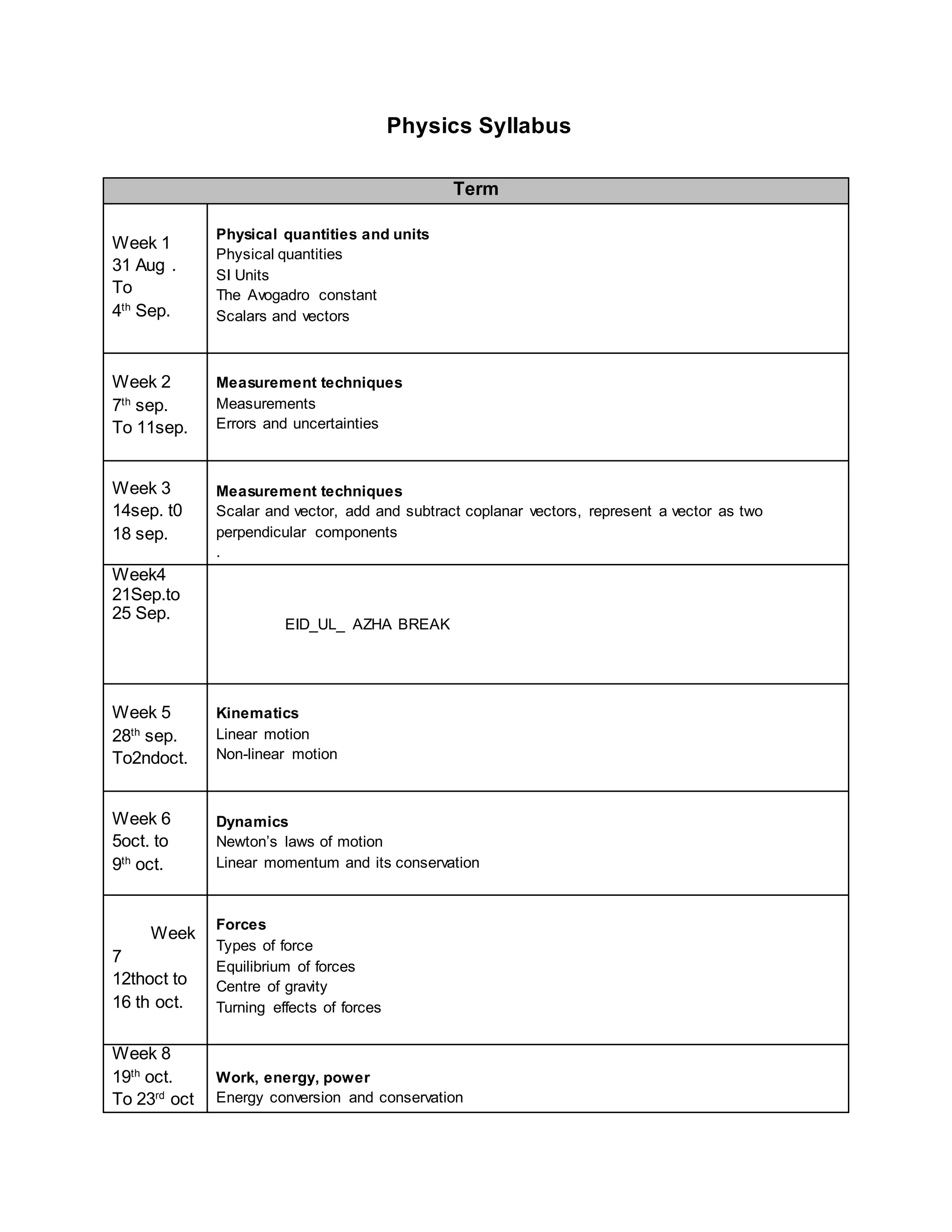
Term
Week 1
31 Aug .
To
4th
Sep.
Physical quantities and units
Physical quantities
SI Units
The Avogadro constant
Scalars and vectors
Week 2
7th
sep.
To 11sep.
Measurement techniques
Measurements
Errors and uncertainties
Week 3
14sep. t0
18 sep.
Measurement techniques
Scalar and vector, add and subtract coplanar vectors, represent a vector as two
perpendicular components
.
Week4
21Sep.to
25 Sep.
EID_UL_ AZHA BREAK
Week 5
28th
sep.
To2ndoct.
Kinematics
Linear motion
Non-linear motion
Week 6
5oct. to
9th
oct.
Dynamics
Newton’s laws of motion
Linear momentum and its conservation
Week
7
12thoct to
16 th oct.
Forces
Types of force
Equilibrium of forces
Centre of gravity
Turning effects of forces
Week 8
19th
oct.
To 23rd
oct
Work, energy, power
Energy conversion and conservation
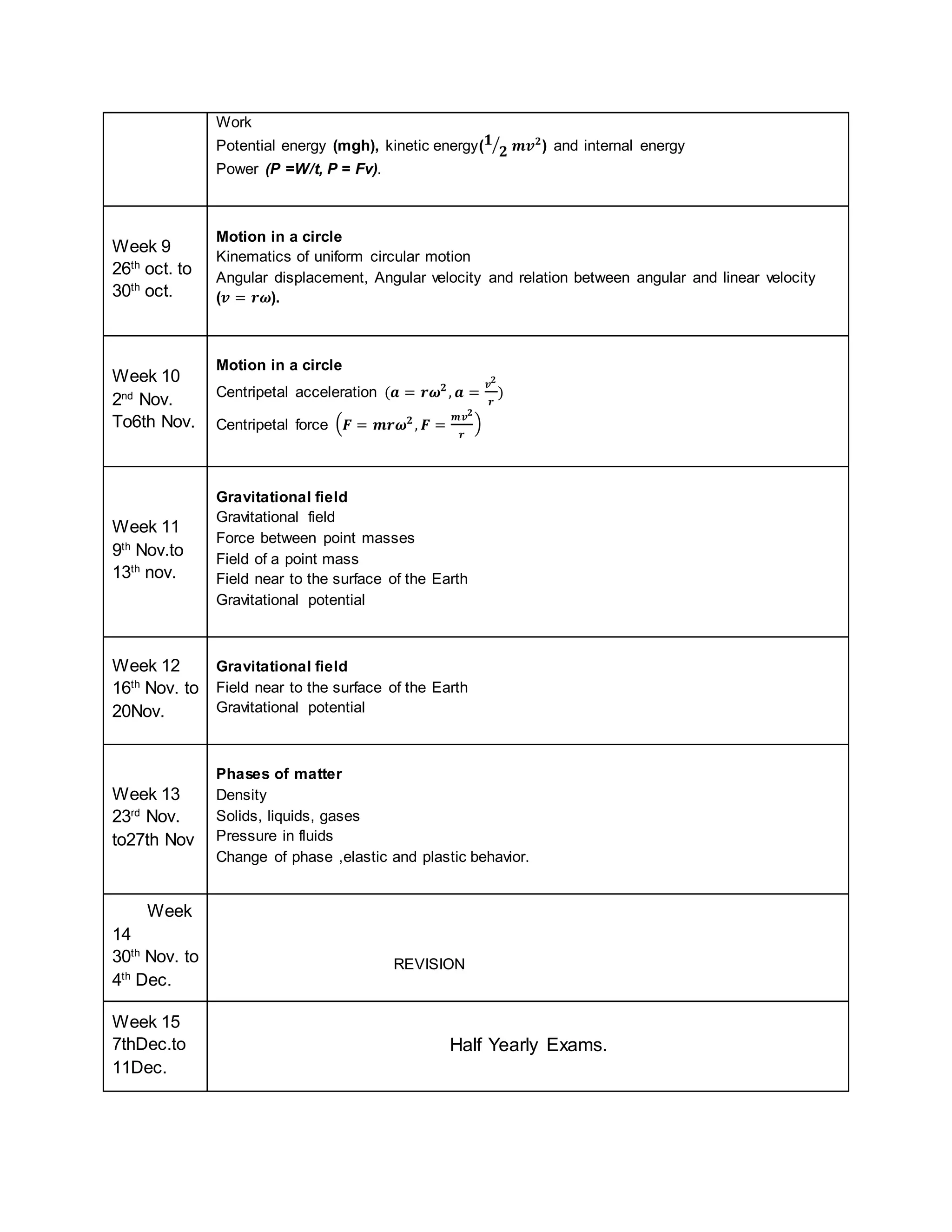
Work
Potential energy (mgh), kinetic energy( 𝟏
𝟐⁄ 𝒎𝒗 𝟐
) and internal energy
Power (P =W/t, P = Fv).
Week 9
26th
oct. to
30th
oct.
Motion in a circle
Kinematics of uniform circular motion
Angular displacement, Angular velocity and relation between angular and linear velocity
(𝒗 = 𝒓𝝎).
Week 10
2nd
Nov.
To6th Nov.
Motion in a circle
Centripetal acceleration (𝒂 = 𝒓𝝎 𝟐
, 𝒂 =
𝒗 𝟐
𝒓
)
Centripetal force ( 𝑭 = 𝒎𝒓𝝎 𝟐
, 𝑭 =
𝒎𝒗 𝟐
𝒓
)
Week 11
9th
Nov.to
13th
nov.
Gravitational field
Gravitational field
Force between point masses
Field of a point mass
Field near to the surface of the Earth
Gravitational potential
Week 12
16th
Nov. to
20Nov.
Gravitational field
Field near to the surface of the Earth
Gravitational potential
Week 13
23rd
Nov.
to27th Nov
Phases of matter
Density
Solids, liquids, gases
Pressure in fluids
Change of phase ,elastic and plastic behavior.
Week
14
30th
Nov. to
4th
Dec.
REVISION
Week 15
7thDec.to
11Dec.
Half Yearly Exams.
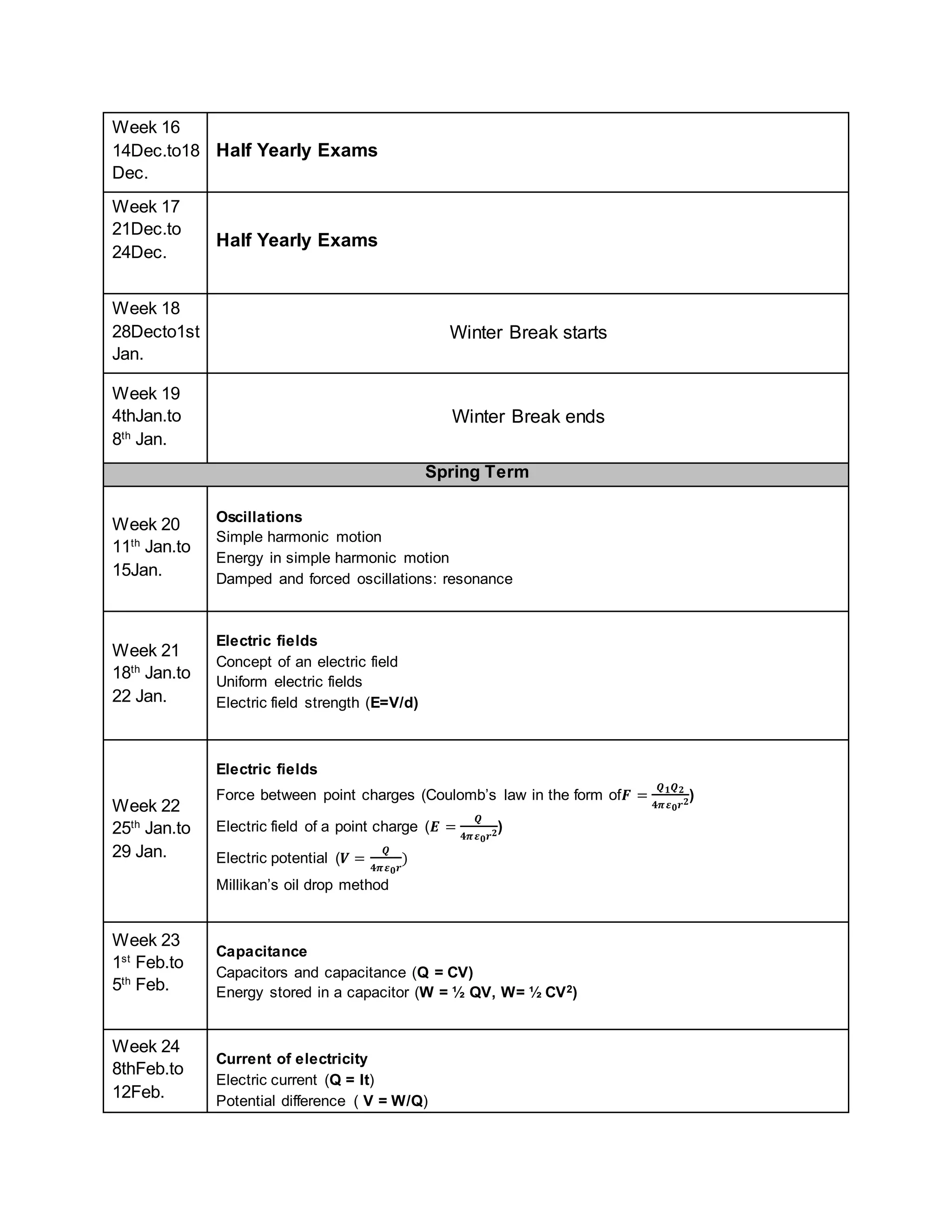
Week 16
14Dec.to18
Dec.
Half Yearly Exams
Week 17
21Dec.to
24Dec.
Half Yearly Exams
Week 18
28Decto1st
Jan.
Winter Break starts
Week 19
4thJan.to
8th
Jan.
Winter Break ends
Spring Term
Week 20
11th
Jan.to
15Jan.
Oscillations
Simple harmonic motion
Energy in simple harmonic motion
Damped and forced oscillations: resonance
Week 21
18th
Jan.to
22 Jan.
Electric fields
Concept of an electric field
Uniform electric fields
Electric field strength (E=V/d)
Week 22
25th
Jan.to
29 Jan.
Electric fields
Force between point charges (Coulomb’s law in the form of𝑭 =
𝑸 𝟏 𝑸 𝟐
𝟒𝝅𝜺 𝟎 𝒓 𝟐)
Electric field of a point charge (𝑬 =
𝑸
𝟒𝝅𝜺 𝟎 𝒓 𝟐
)
Electric potential (𝑽 =
𝑸
𝟒𝝅𝜺 𝟎 𝒓
)
Millikan’s oil drop method
Week 23
1st
Feb.to
5th
Feb.
Capacitance
Capacitors and capacitance (Q = CV)
Energy stored in a capacitor (W = ½ QV, W= ½ CV2)
Week 24
8thFeb.to
12Feb.
Current of electricity
Electric current (Q = It)
Potential difference ( V = W/Q)
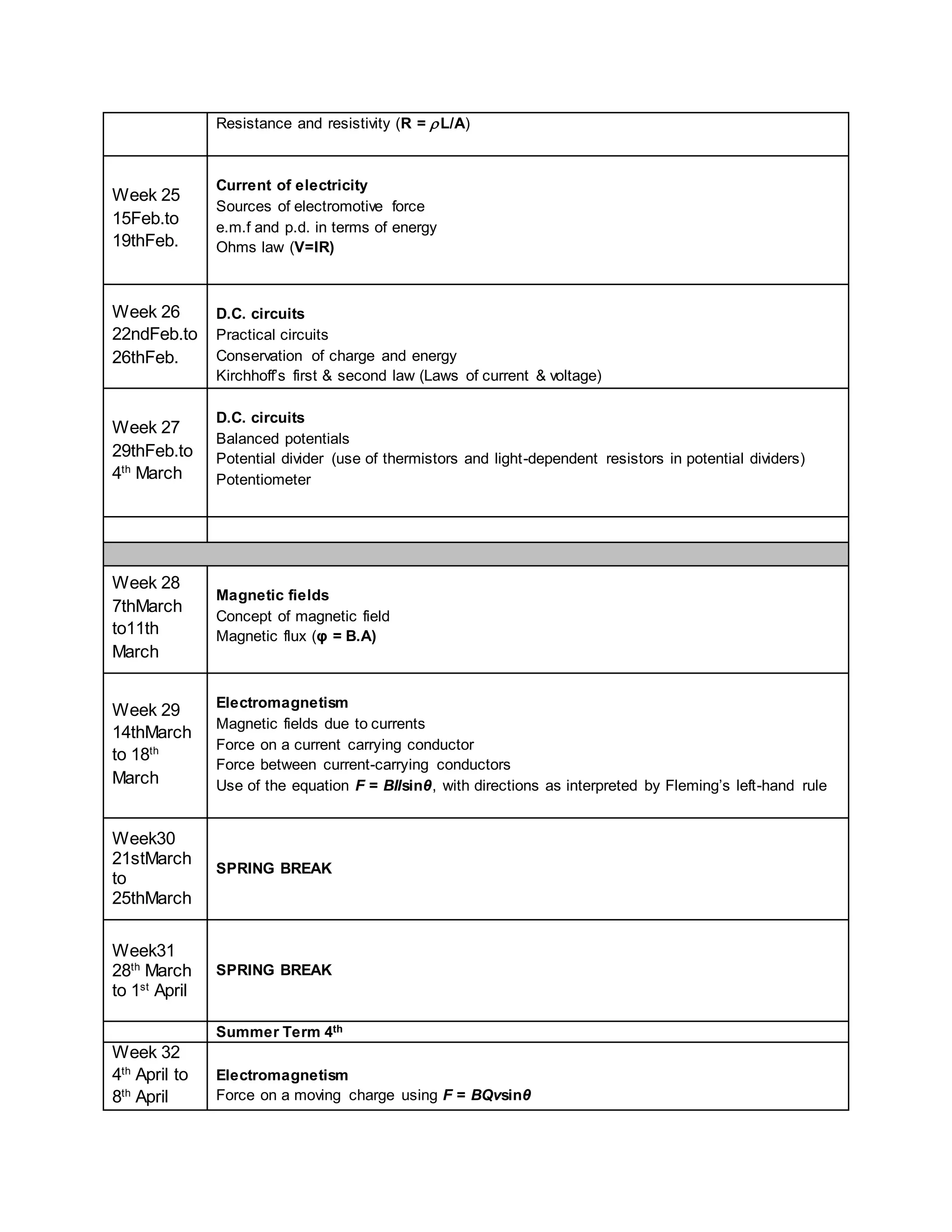
Resistance and resistivity (R = L/A)
Week 25
15Feb.to
19thFeb.
Current of electricity
Sources of electromotive force
e.m.f and p.d. in terms of energy
Ohms law (V=IR)
Week 26
22ndFeb.to
26thFeb.
D.C. circuits
Practical circuits
Conservation of charge and energy
Kirchhoff’s first & second law (Laws of current & voltage)
Week 27
29thFeb.to
4th
March
D.C. circuits
Balanced potentials
Potential divider (use of thermistors and light-dependent resistors in potential dividers)
Potentiometer
Week 28
7thMarch
to11th
March
Magnetic fields
Concept of magnetic field
Magnetic flux (φ = B.A)
Week 29
14thMarch
to 18th
March
Electromagnetism
Magnetic fields due to currents
Force on a current carrying conductor
Force between current-carrying conductors
Use of the equation F = BIlsinθ, with directions as interpreted by Fleming’s left-hand rule
Week30
21stMarch
to
25thMarch
SPRING BREAK
Week31
28th
March
to 1st
April
SPRING BREAK
Summer Term 4th
Week 32
4th
April to
8th
April
Electromagnetism
Force on a moving charge using F = BQvsinθ
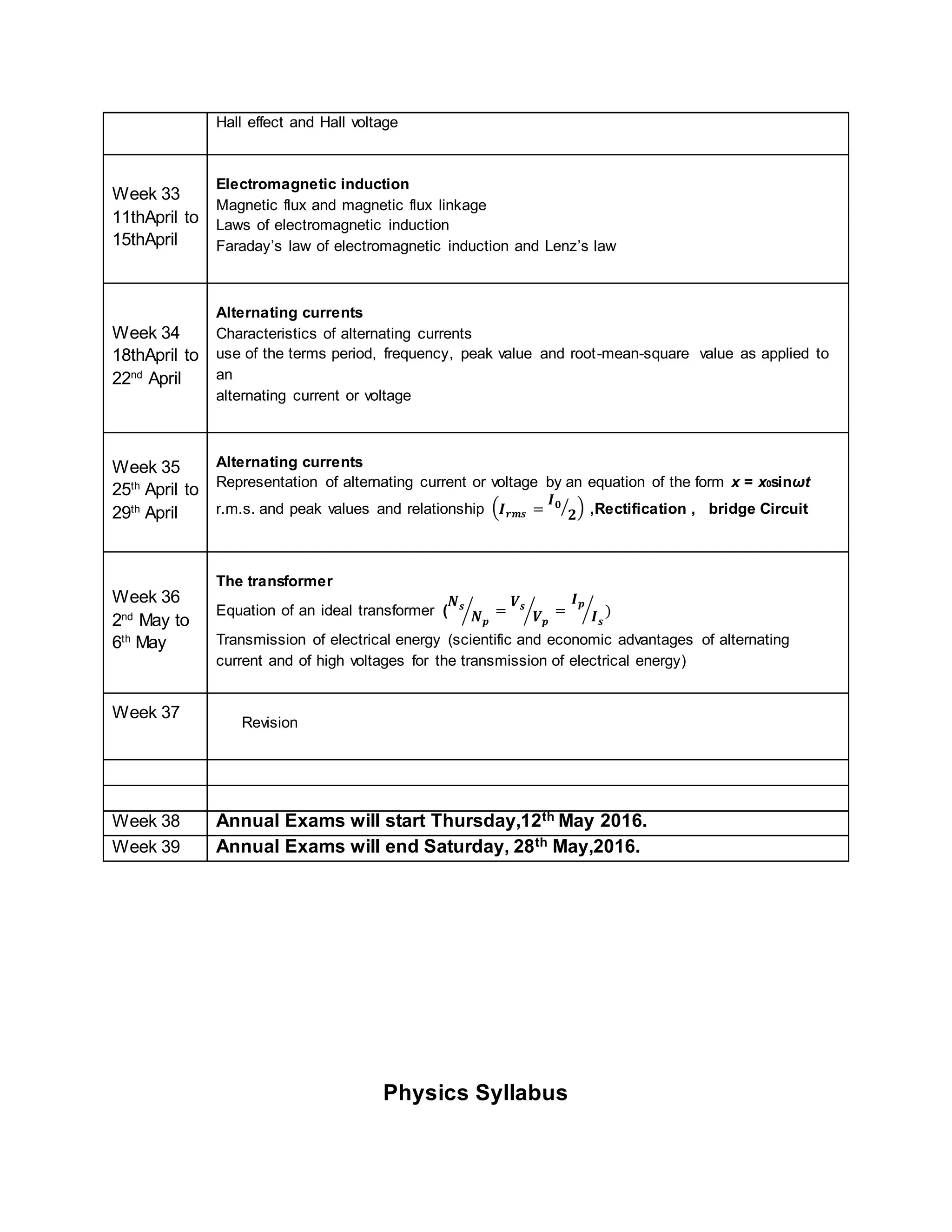
Hall effect and Hall voltage
Week 33
11thApril to
15thApril
Electromagnetic induction
Magnetic flux and magnetic flux linkage
Laws of electromagnetic induction
Faraday’s law of electromagnetic induction and Lenz’s law
Week 34
18thApril to
22nd
April
Alternating currents
Characteristics of alternating currents
use of the terms period, frequency, peak value and root-mean-square value as applied to
an
alternating current or voltage
Week 35
25th
April to
29th
April
Alternating currents
Representation of alternating current or voltage by an equation of the form x = x0sinωt
r.m.s. and peak values and relationship ( 𝑰 𝒓𝒎𝒔 =
𝑰 𝟎
𝟐
⁄ ) ,Rectification , bridge Circuit
Week 36
2nd
May to
6th
May
The transformer
Equation of an ideal transformer (
𝑵 𝒔
𝑵 𝒑
⁄ =
𝑽𝒔
𝑽 𝒑
⁄ =
𝑰 𝒑
𝑰 𝒔
⁄ )
Transmission of electrical energy (scientific and economic advantages of alternating
current and of high voltages for the transmission of electrical energy)
Week 37
Revision
Week 38 Annual Exams will start Thursday,12th May 2016.
Week 39 Annual Exams will end Saturday, 28th May,2016.
Physics Syllabus
Term
Week 1
31st
Aug. to 4th
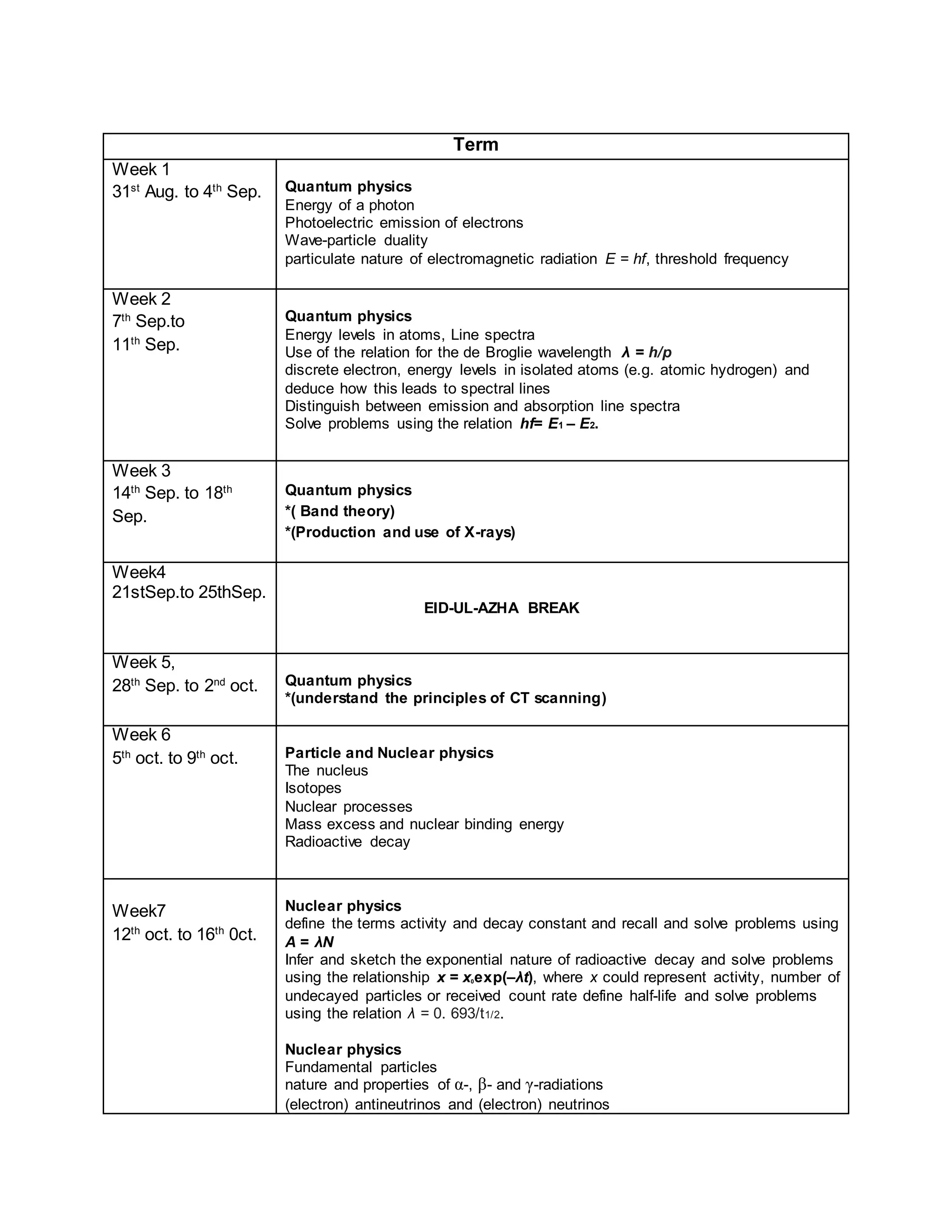
Sep. Quantum physics
Energy of a photon
Photoelectric emission of electrons
Wave-particle duality
particulate nature of electromagnetic radiation E = hf, threshold frequency
Week 2
7th
Sep.to
11th
Sep.
Quantum physics
Energy levels in atoms, Line spectra
Use of the relation for the de Broglie wavelength λ = h/p
discrete electron, energy levels in isolated atoms (e.g. atomic hydrogen) and
deduce how this leads to spectral lines
Distinguish between emission and absorption line spectra
Solve problems using the relation hf= E1 – E2.
Week 3
14th
Sep. to 18th
Sep.
Quantum physics
*( Band theory)
*(Production and use of X-rays)
Week4
21stSep.to 25thSep.
EID-UL-AZHA BREAK
Week 5,
28th
Sep. to 2nd
oct. Quantum physics
*(understand the principles of CT scanning)
Week 6
5th
oct. to 9th
oct. Particle and Nuclear physics
The nucleus
Isotopes
Nuclear processes
Mass excess and nuclear binding energy
Radioactive decay
Week7
12th
oct. to 16th
0ct.
Nuclear physics
define the terms activity and decay constant and recall and solve problems using
A = λN
Infer and sketch the exponential nature of radioactive decay and solve problems
using the relationship x = x0exp(–λt), where x could represent activity, number of
undecayed particles or received count rate define half-life and solve problems
using the relation λ = 0. 693/t1/2.
Nuclear physics
Fundamental particles
nature and properties of α-, β- and γ-radiations
(electron) antineutrinos and (electron) neutrinos
Quark model, leptons
Week 8
19th
Oct. to 23rd
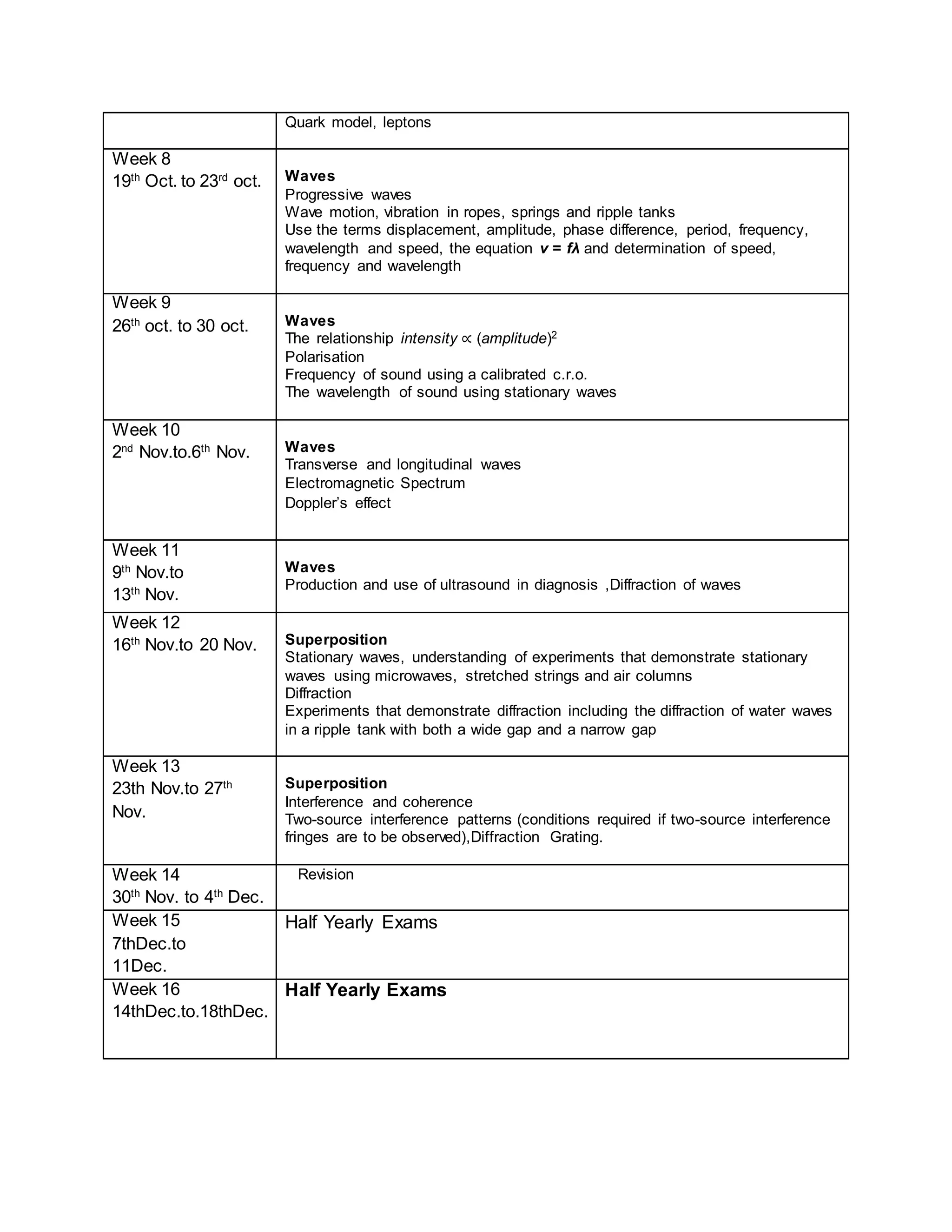
oct. Waves
Progressive waves
Wave motion, vibration in ropes, springs and ripple tanks
Use the terms displacement, amplitude, phase difference, period, frequency,
wavelength and speed, the equation v = fλ and determination of speed,
frequency and wavelength
Week 9
26th
oct. to 30 oct. Waves
The relationship intensity ∝ (amplitude)2
Polarisation
Frequency of sound using a calibrated c.r.o.
The wavelength of sound using stationary waves
Week 10
2nd
Nov.to.6th
Nov. Waves
Transverse and longitudinal waves
Electromagnetic Spectrum
Doppler’s effect
Week 11
9th
Nov.to
13th
Nov.
Waves
Production and use of ultrasound in diagnosis ,Diffraction of waves
Week 12
16th
Nov.to 20 Nov. Superposition
Stationary waves, understanding of experiments that demonstrate stationary
waves using microwaves, stretched strings and air columns
Diffraction
Experiments that demonstrate diffraction including the diffraction of water waves
in a ripple tank with both a wide gap and a narrow gap
Week 13
23th Nov.to 27th
Nov.
Superposition
Interference and coherence
Two-source interference patterns (conditions required if two-source interference
fringes are to be observed),Diffraction Grating.
Week 14
30th
Nov. to 4th
Dec.
Revision
Week 15
7thDec.to
11Dec.
Half Yearly Exams
Week 16
14thDec.to.18thDec.
Half Yearly Exams
Week 17
21stDec.to 24th
Dec.
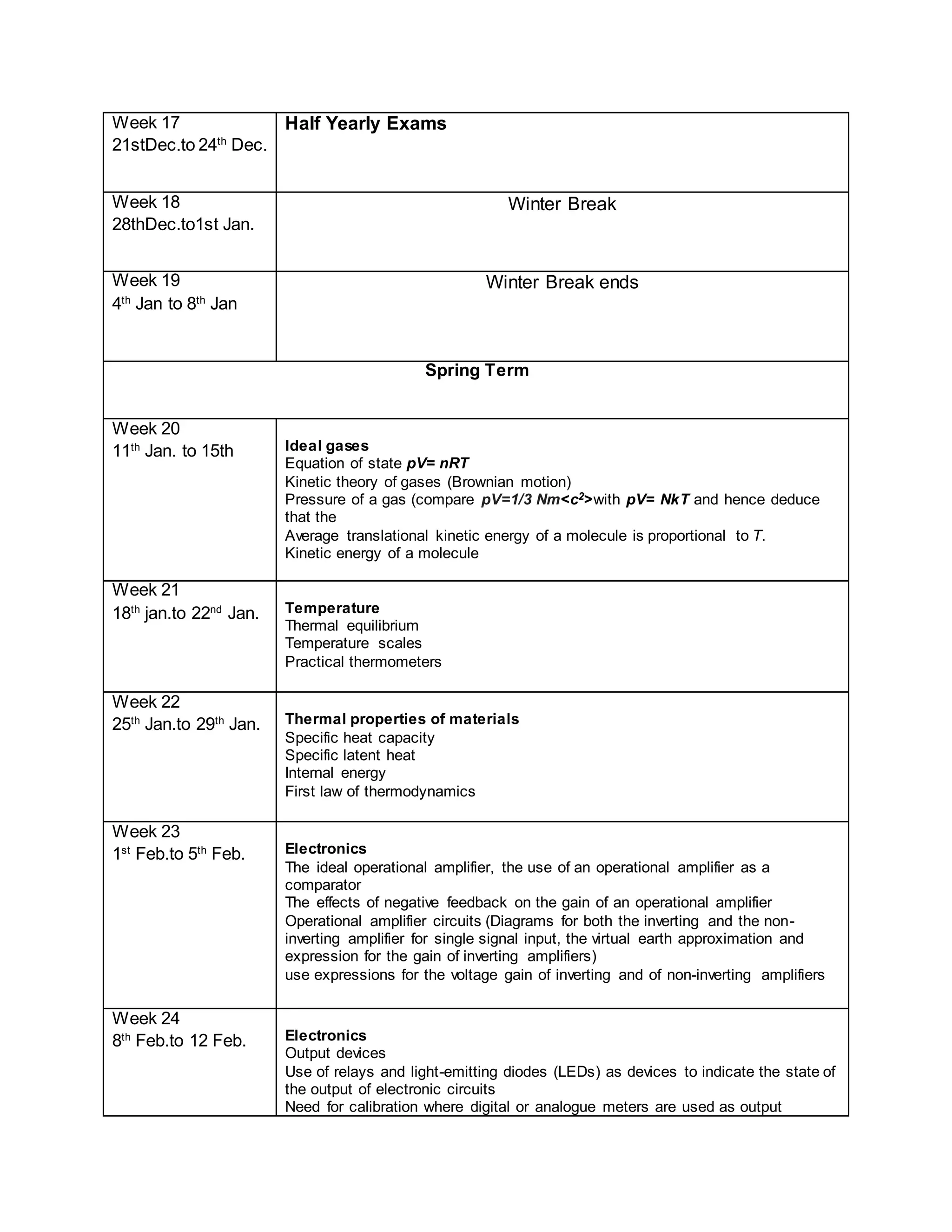
Half Yearly Exams
Week 18
28thDec.to1st Jan.
Winter Break
Week 19
4th
Jan to 8th
Jan
Winter Break ends
Spring Term
Week 20
11th
Jan. to 15th Ideal gases
Equation of state pV= nRT
Kinetic theory of gases (Brownian motion)
Pressure of a gas (compare pV=1/3 Nm<c2>with pV= NkT and hence deduce
that the
Average translational kinetic energy of a molecule is proportional to T.
Kinetic energy of a molecule
Week 21
18th
jan.to 22nd
Jan. Temperature
Thermal equilibrium
Temperature scales
Practical thermometers
Week 22
25th
Jan.to 29th
Jan. Thermal properties of materials
Specific heat capacity
Specific latent heat
Internal energy
First law of thermodynamics
Week 23
1st
Feb.to 5th
Feb. Electronics
The ideal operational amplifier, the use of an operational amplifier as a
comparator
The effects of negative feedback on the gain of an operational amplifier
Operational amplifier circuits (Diagrams for both the inverting and the non-
inverting amplifier for single signal input, the virtual earth approximation and
expression for the gain of inverting amplifiers)
use expressions for the voltage gain of inverting and of non-inverting amplifiers
Week 24
8th
Feb.to 12 Feb. Electronics
Output devices
Use of relays and light-emitting diodes (LEDs) as devices to indicate the state of
the output of electronic circuits
Need for calibration where digital or analogue meters are used as output
devices.
Week 25
15thFeb.to 19th
Feb. Communication
Communication channels
Modulation
Digital communication
Week 26
22Feb to 26th
Feb. Communication
Relative merits of channels of communication
Attenuation
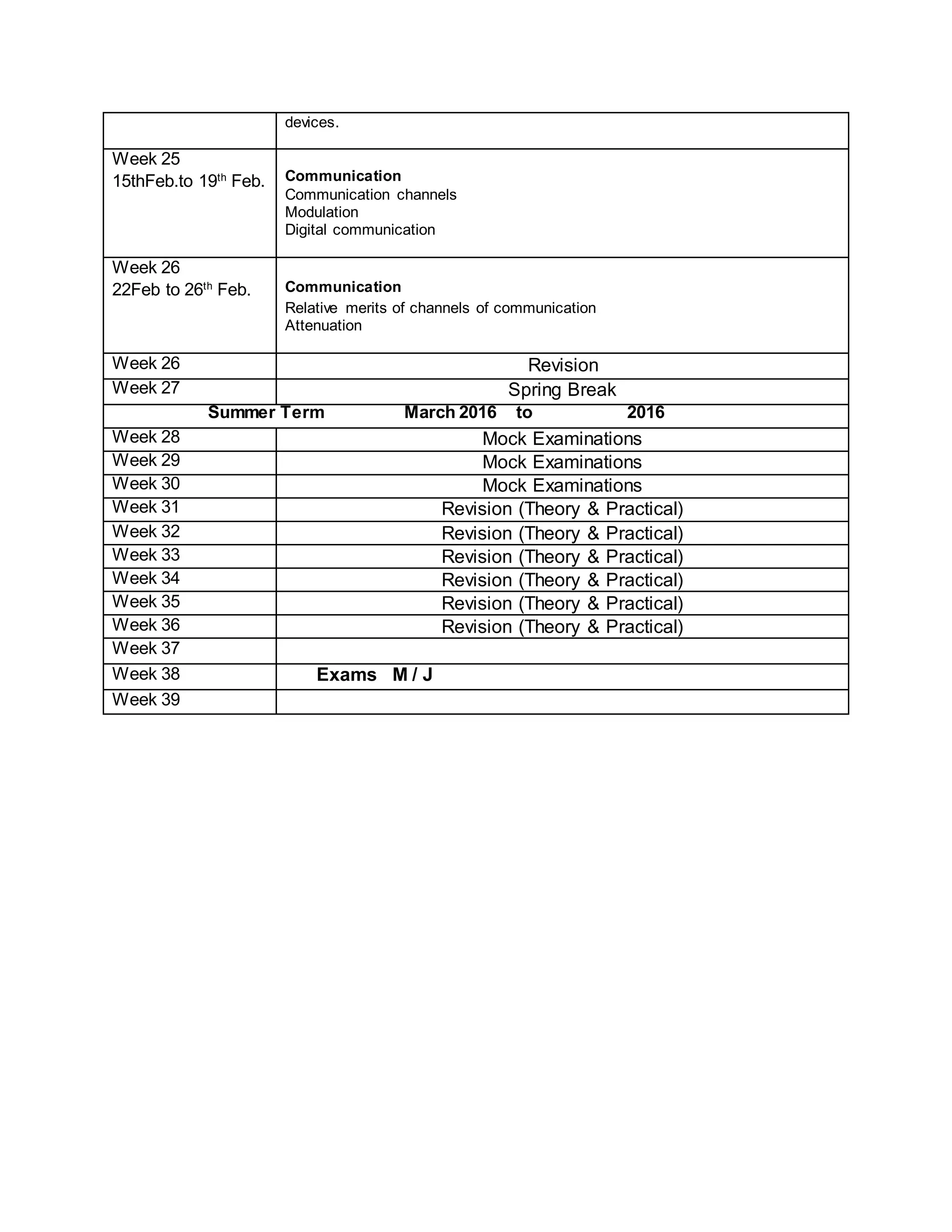
Week 26 Revision
Week 27 Spring Break
Summer Term March 2016 to 2016
Week 28 Mock Examinations
Week 29 Mock Examinations
Week 30 Mock Examinations
Week 31 Revision (Theory & Practical)
Week 32 Revision (Theory & Practical)
Week 33 Revision (Theory & Practical)
Week 34 Revision (Theory & Practical)
Week 35 Revision (Theory & Practical)
Week 36 Revision (Theory & Practical)
Week 37
Week 38 Exams M / J
Week 39
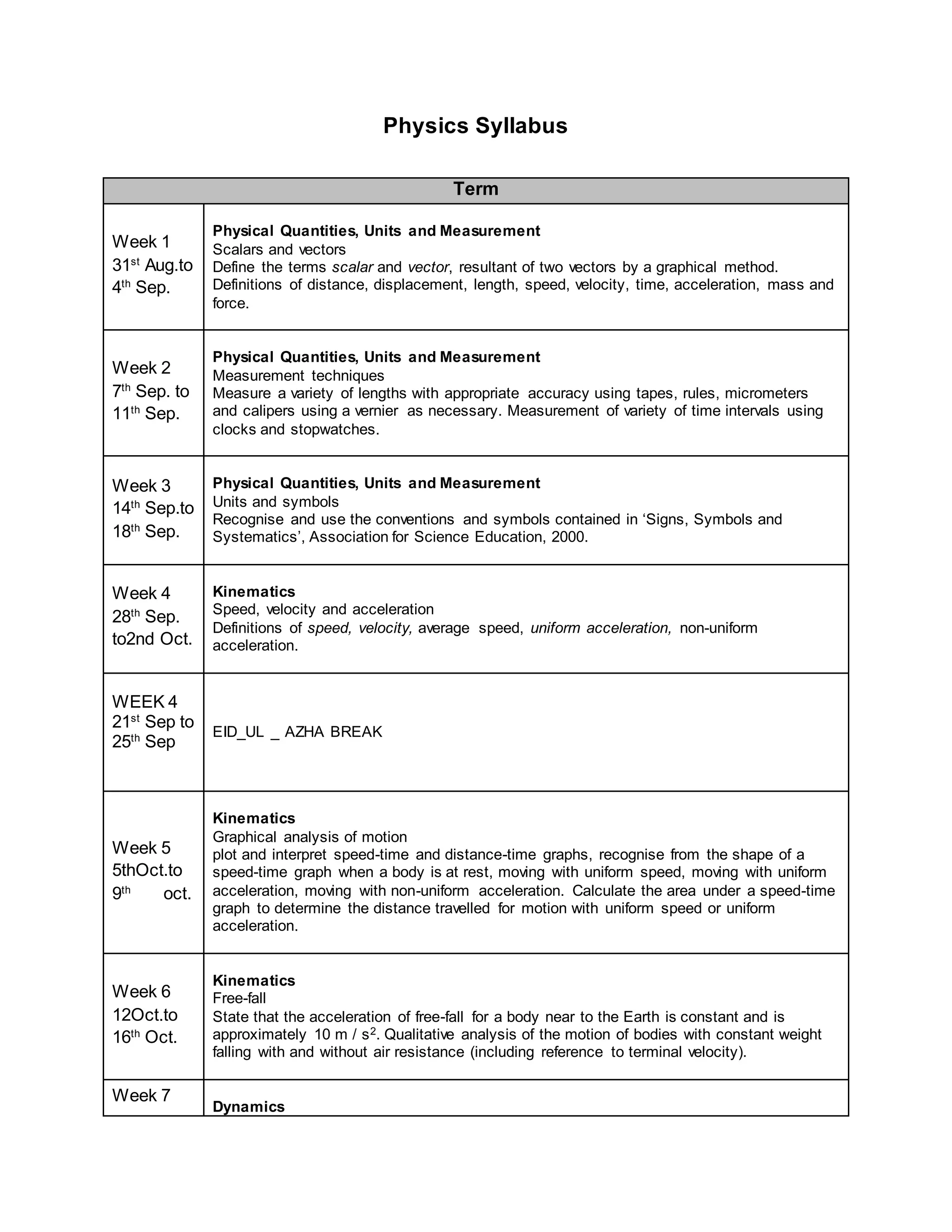
Physics Syllabus
Term
Week 1
31st
Aug.to
4th
Sep.
Physical Quantities, Units and Measurement
Scalars and vectors
Define the terms scalar and vector, resultant of two vectors by a graphical method.
Definitions of distance, displacement, length, speed, velocity, time, acceleration, mass and
force.
Week 2
7th
Sep. to
11th
Sep.
Physical Quantities, Units and Measurement
Measurement techniques
Measure a variety of lengths with appropriate accuracy using tapes, rules, micrometers
and calipers using a vernier as necessary. Measurement of variety of time intervals using
clocks and stopwatches.
Week 3
14th
Sep.to
18th
Sep.
Physical Quantities, Units and Measurement
Units and symbols
Recognise and use the conventions and symbols contained in ‘Signs, Symbols and
Systematics’, Association for Science Education, 2000.
Week 4
28th
Sep.
to2nd Oct.
Kinematics
Speed, velocity and acceleration
Definitions of speed, velocity, average speed, uniform acceleration, non-uniform
acceleration.
WEEK 4
21st
Sep to
25th
Sep
EID_UL _ AZHA BREAK
Week 5
5thOct.to
9th
oct.
Kinematics
Graphical analysis of motion
plot and interpret speed-time and distance-time graphs, recognise from the shape of a
speed-time graph when a body is at rest, moving with uniform speed, moving with uniform
acceleration, moving with non-uniform acceleration. Calculate the area under a speed-time
graph to determine the distance travelled for motion with uniform speed or uniform
acceleration.
Week 6
12Oct.to
16th
Oct.
Kinematics
Free-fall
State that the acceleration of free-fall for a body near to the Earth is constant and is
approximately 10 m / s2. Qualitative analysis of the motion of bodies with constant weight
falling with and without air resistance (including reference to terminal velocity).
Week 7
Dynamics
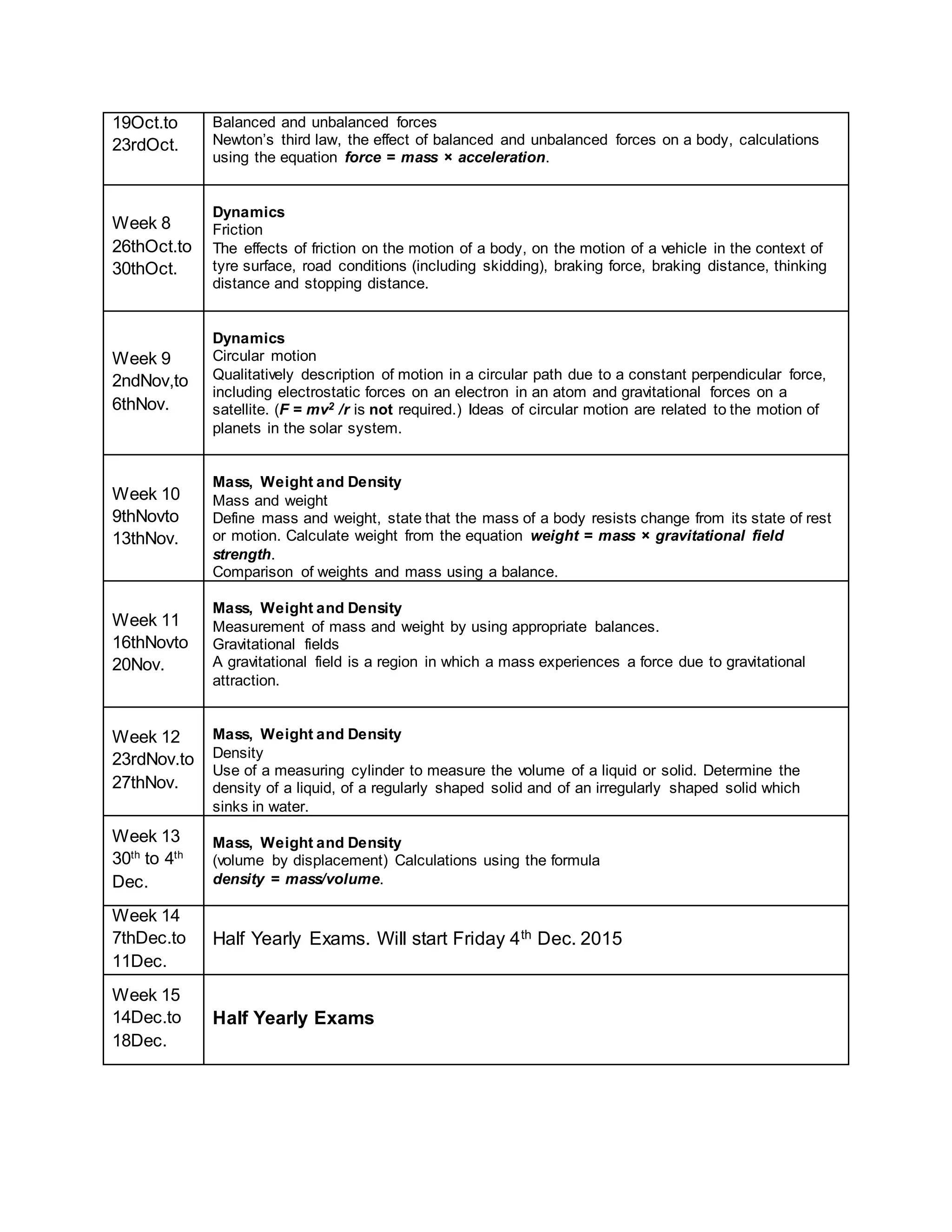
19Oct.to
23rdOct.
Balanced and unbalanced forces
Newton’s third law, the effect of balanced and unbalanced forces on a body, calculations
using the equation force = mass × acceleration.
Week 8
26thOct.to
30thOct.
Dynamics
Friction
The effects of friction on the motion of a body, on the motion of a vehicle in the context of
tyre surface, road conditions (including skidding), braking force, braking distance, thinking
distance and stopping distance.
Week 9
2ndNov,to
6thNov.
Dynamics
Circular motion
Qualitatively description of motion in a circular path due to a constant perpendicular force,
including electrostatic forces on an electron in an atom and gravitational forces on a
satellite. (F = mv2 /r is not required.) Ideas of circular motion are related to the motion of
planets in the solar system.
Week 10
9thNovto
13thNov.
Mass, Weight and Density
Mass and weight
Define mass and weight, state that the mass of a body resists change from its state of rest
or motion. Calculate weight from the equation weight = mass × gravitational field
strength.
Comparison of weights and mass using a balance.
Week 11
16thNovto
20Nov.
Mass, Weight and Density
Measurement of mass and weight by using appropriate balances.
Gravitational fields
A gravitational field is a region in which a mass experiences a force due to gravitational
attraction.
Week 12
23rdNov.to
27thNov.
Mass, Weight and Density
Density
Use of a measuring cylinder to measure the volume of a liquid or solid. Determine the
density of a liquid, of a regularly shaped solid and of an irregularly shaped solid which
sinks in water.
Week 13
30th
to 4th
Dec.
Mass, Weight and Density
(volume by displacement) Calculations using the formula
density = mass/volume.
Week 14
7thDec.to
11Dec.
Half Yearly Exams. Will start Friday 4th Dec. 2015
Week 15
14Dec.to
18Dec.
Half Yearly Exams
Week 16
21st
Dec.
to 24 Dec.
Half Yearly Exams
Week 17
28th
Dec.to
1st
Jan.
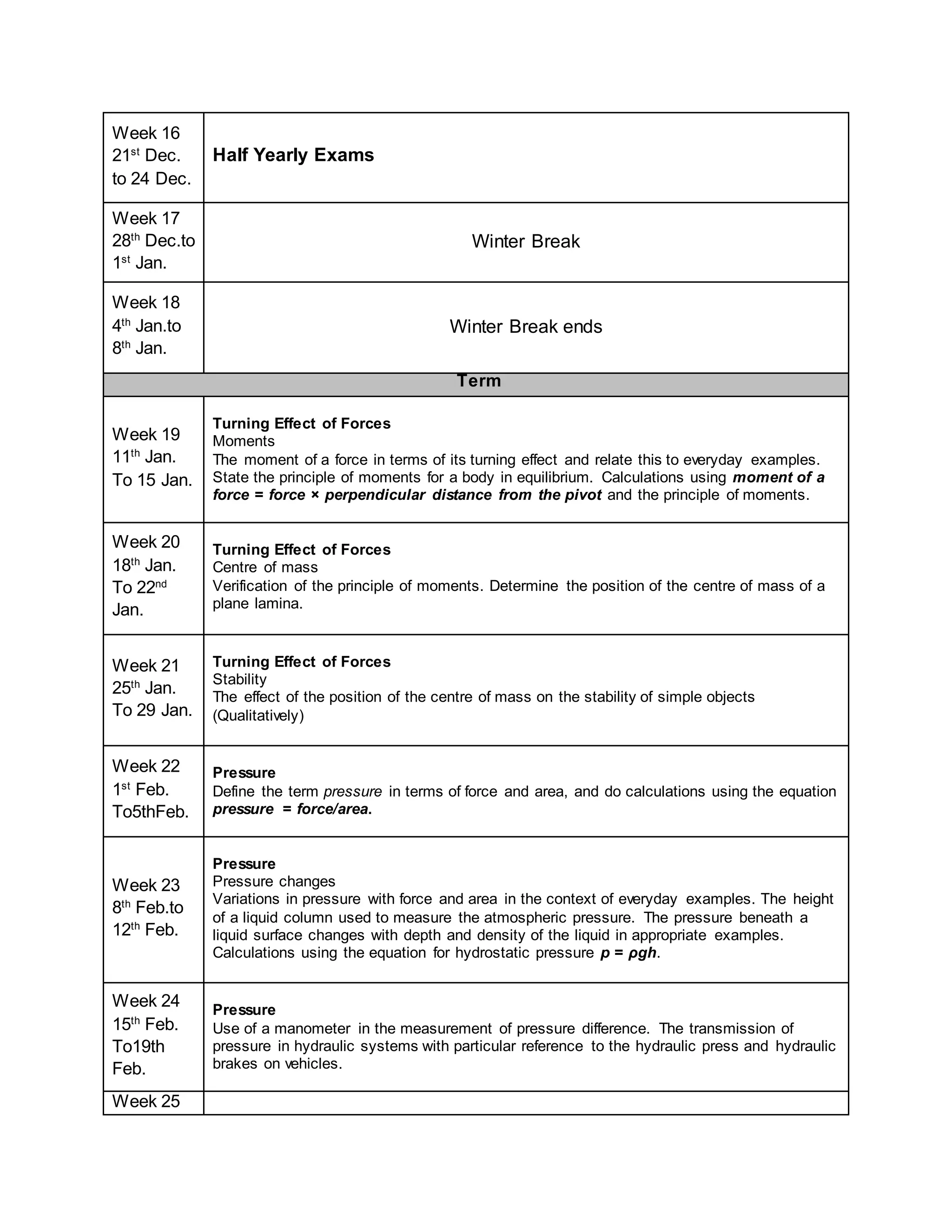
Winter Break
Week 18
4th
Jan.to
8th
Jan.
Winter Break ends
Term
Week 19
11th
Jan.
To 15 Jan.
Turning Effect of Forces
Moments
The moment of a force in terms of its turning effect and relate this to everyday examples.
State the principle of moments for a body in equilibrium. Calculations using moment of a
force = force × perpendicular distance from the pivot and the principle of moments.
Week 20
18th
Jan.
To 22nd
Jan.
Turning Effect of Forces
Centre of mass
Verification of the principle of moments. Determine the position of the centre of mass of a
plane lamina.
Week 21
25th
Jan.
To 29 Jan.
Turning Effect of Forces
Stability
The effect of the position of the centre of mass on the stability of simple objects
(Qualitatively)
Week 22
1st
Feb.
To5thFeb.
Pressure
Define the term pressure in terms of force and area, and do calculations using the equation
pressure = force/area.
Week 23
8th
Feb.to
12th
Feb.
Pressure
Pressure changes
Variations in pressure with force and area in the context of everyday examples. The height
of a liquid column used to measure the atmospheric pressure. The pressure beneath a
liquid surface changes with depth and density of the liquid in appropriate examples.
Calculations using the equation for hydrostatic pressure p = ρgh.
Week 24
15th
Feb.
To19th
Feb.
Pressure
Use of a manometer in the measurement of pressure difference. The transmission of
pressure in hydraulic systems with particular reference to the hydraulic press and hydraulic
brakes on vehicles.
Week 25
22nd
Feb.
To26th
Feb.
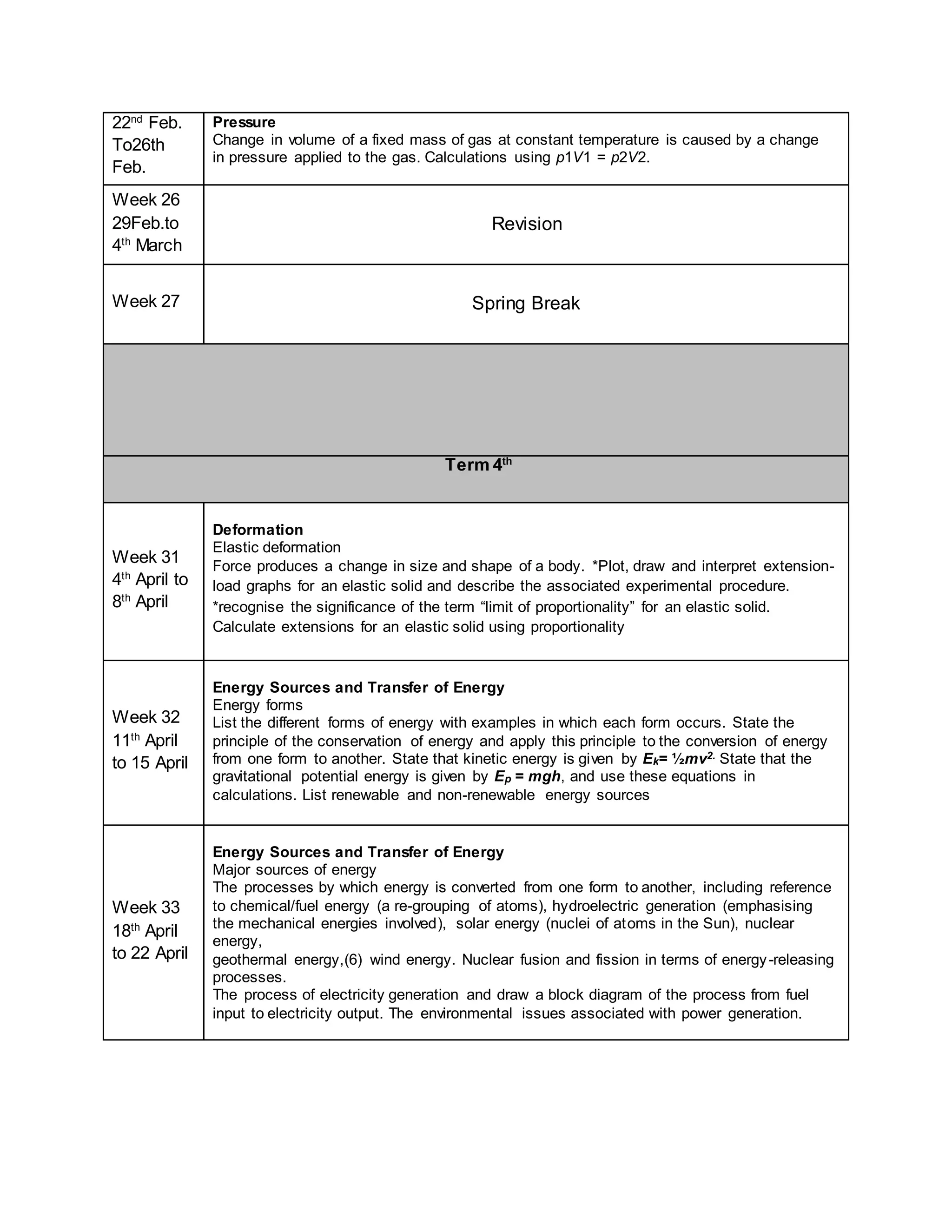
Pressure
Change in volume of a fixed mass of gas at constant temperature is caused by a change
in pressure applied to the gas. Calculations using p1V1 = p2V2.
Week 26
29Feb.to
4th
March
Revision
Week 27 Spring Break
Term 4th
Week 31
4th
April to
8th
April
Deformation
Elastic deformation
Force produces a change in size and shape of a body. *Plot, draw and interpret extension-
load graphs for an elastic solid and describe the associated experimental procedure.
*recognise the significance of the term “limit of proportionality” for an elastic solid.
Calculate extensions for an elastic solid using proportionality
Week 32
11th
April
to 15 April
Energy Sources and Transfer of Energy
Energy forms
List the different forms of energy with examples in which each form occurs. State the
principle of the conservation of energy and apply this principle to the conversion of energy
from one form to another. State that kinetic energy is given by Ek= ½mv2. State that the
gravitational potential energy is given by Ep = mgh, and use these equations in
calculations. List renewable and non-renewable energy sources
Week 33
18th
April
to 22 April
Energy Sources and Transfer of Energy
Major sources of energy
The processes by which energy is converted from one form to another, including reference
to chemical/fuel energy (a re-grouping of atoms), hydroelectric generation (emphasising
the mechanical energies involved), solar energy (nuclei of atoms in the Sun), nuclear
energy,
geothermal energy,(6) wind energy. Nuclear fusion and fission in terms of energy-releasing
processes.
The process of electricity generation and draw a block diagram of the process from fuel
input to electricity output. The environmental issues associated with power generation.
Week 34
25th
April
To29th
April
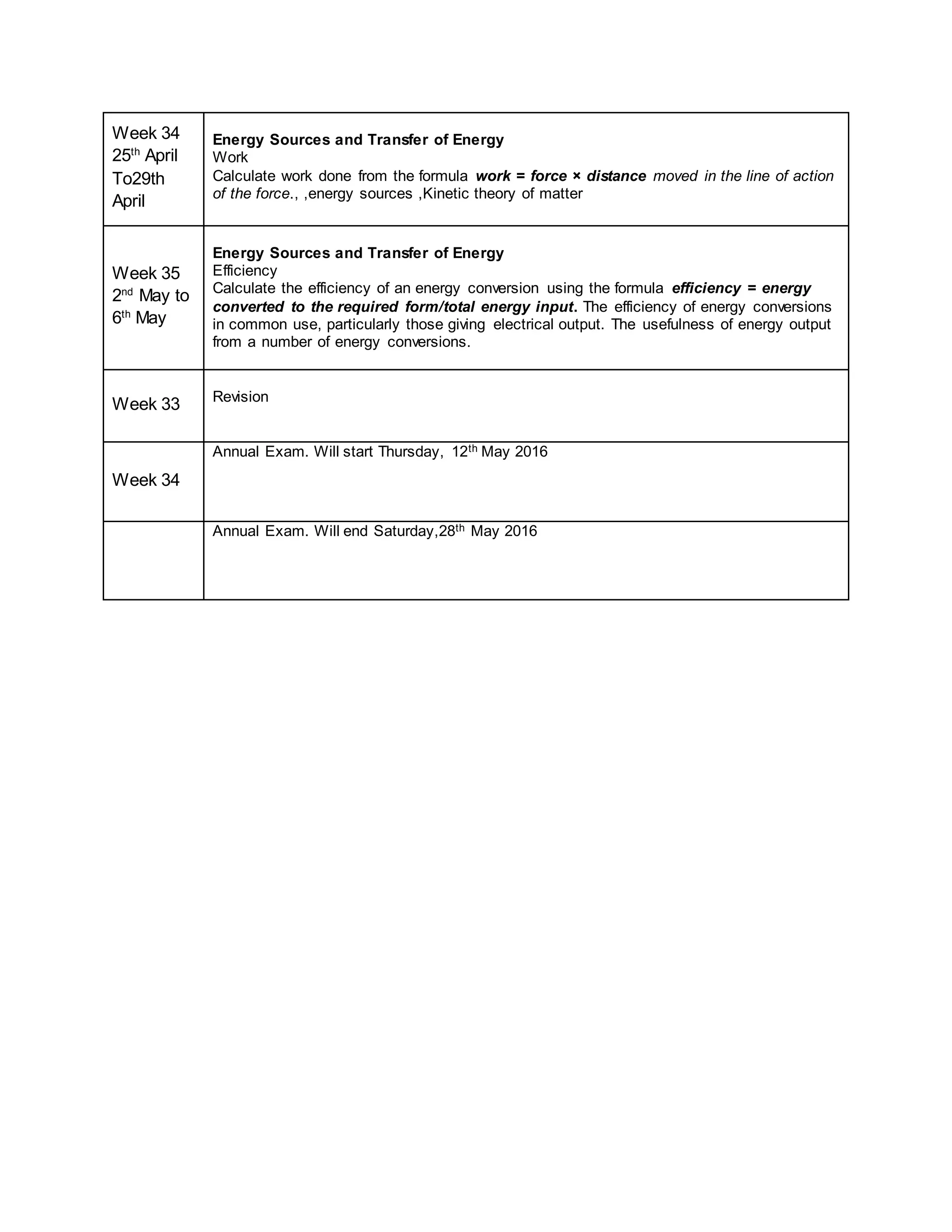
Energy Sources and Transfer of Energy
Work
Calculate work done from the formula work = force × distance moved in the line of action
of the force., ,energy sources ,Kinetic theory of matter
Week 35
2nd
May to
6th
May
Energy Sources and Transfer of Energy
Efficiency
Calculate the efficiency of an energy conversion using the formula efficiency = energy
converted to the required form/total energy input. The efficiency of energy conversions
in common use, particularly those giving electrical output. The usefulness of energy output
from a number of energy conversions.
Week 33 Revision
Week 34
Annual Exam. Will start Thursday, 12th May 2016
Annual Exam. Will end Saturday,28th May 2016
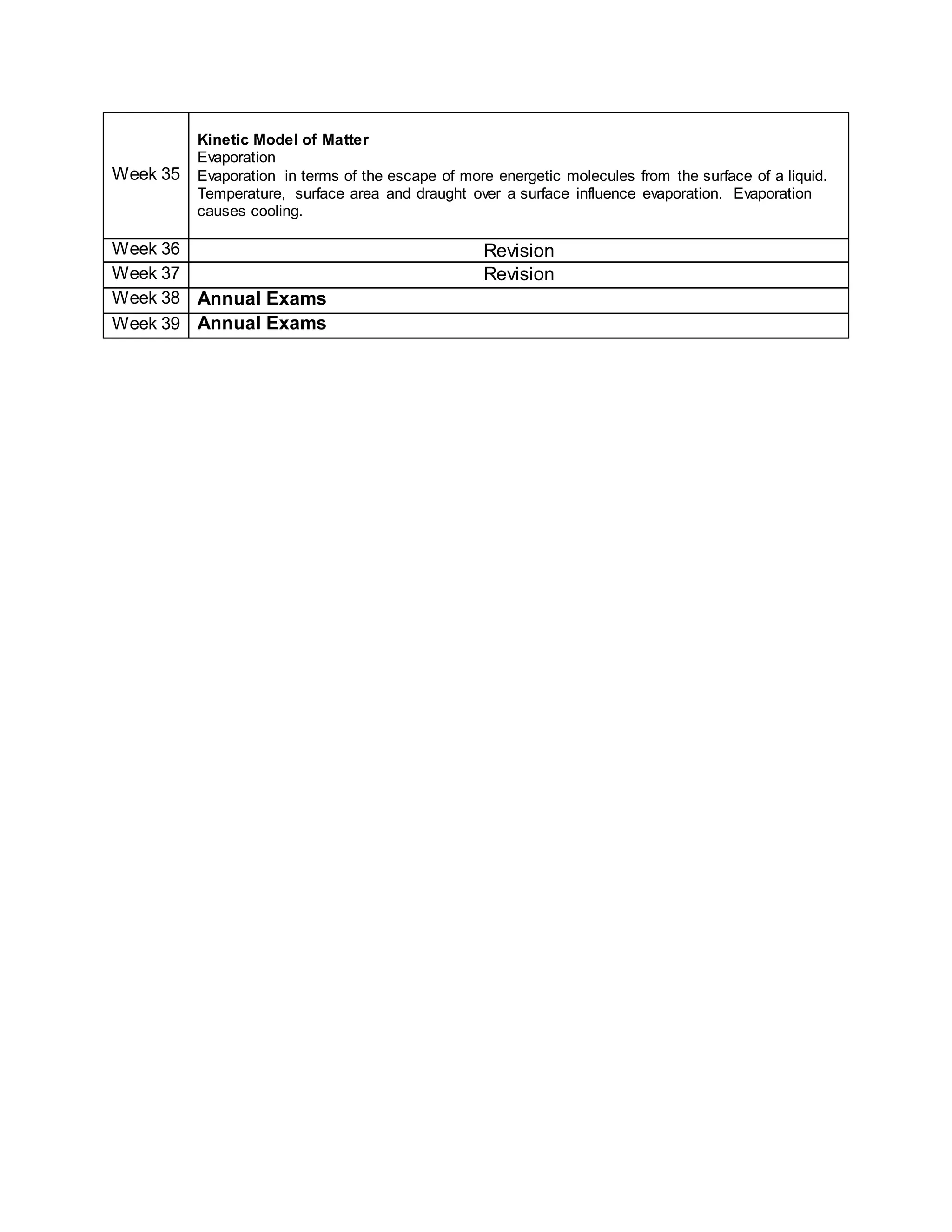
Week 35
Kinetic Model of Matter
Evaporation
Evaporation in terms of the escape of more energetic molecules from the surface of a liquid.
Temperature, surface area and draught over a surface influence evaporation. Evaporation
causes cooling.
Week 36 Revision
Week 37 Revision
Week 38 Annual Exams
Week 39 Annual Exams
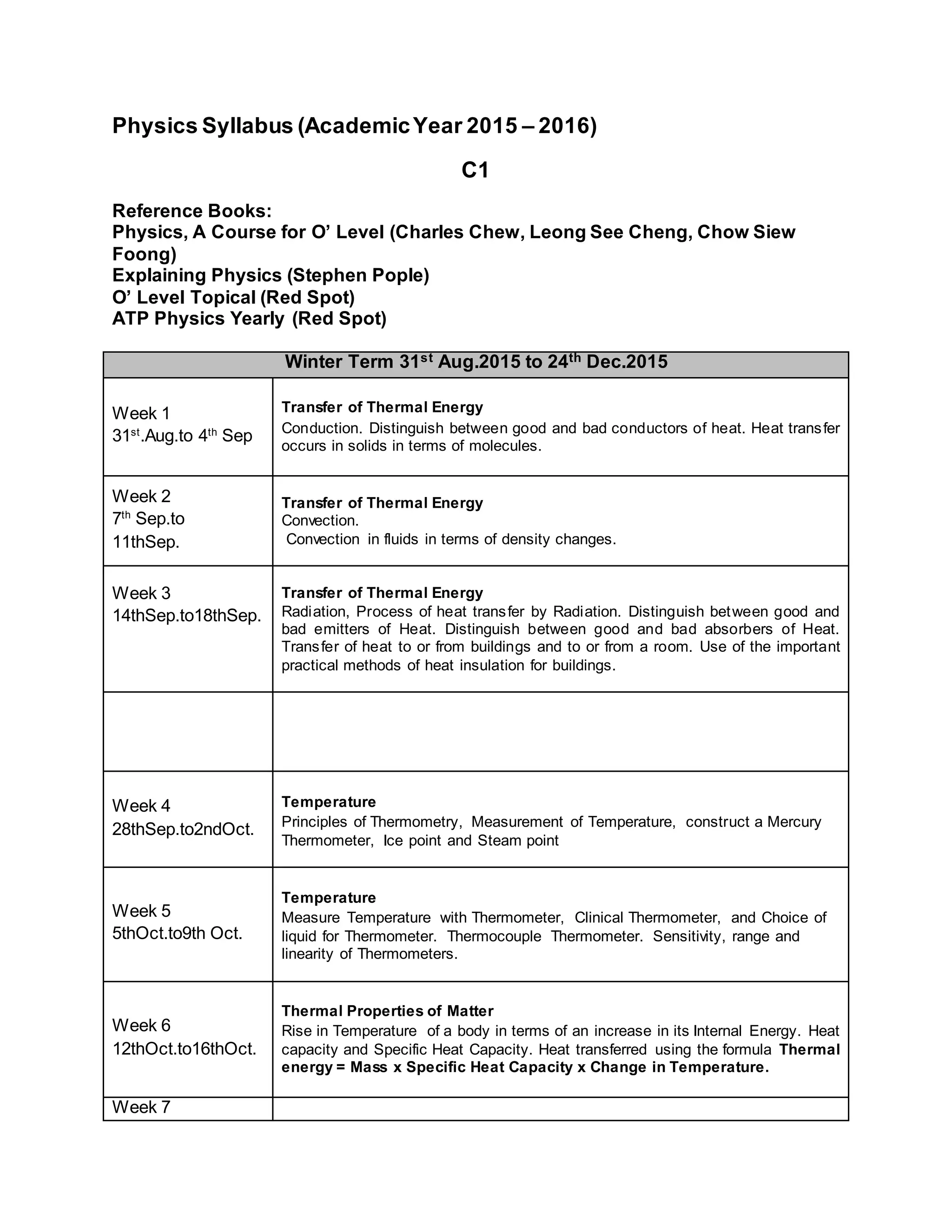
Physics Syllabus (AcademicYear 2015 – 2016)
C1
Reference Books:
Physics, A Course for O’ Level (Charles Chew, Leong See Cheng, Chow Siew
Foong)
Explaining Physics (Stephen Pople)
O’ Level Topical (Red Spot)
ATP Physics Yearly (Red Spot)
Winter Term 31st Aug.2015 to 24th Dec.2015
Week 1
31st
.Aug.to 4th
Sep
Transfer of Thermal Energy
Conduction. Distinguish between good and bad conductors of heat. Heat transfer
occurs in solids in terms of molecules.
Week 2
7th
Sep.to
11thSep.
Transfer of Thermal Energy
Convection.
Convection in fluids in terms of density changes.
Week 3
14thSep.to18thSep.
Transfer of Thermal Energy
Radiation, Process of heat transfer by Radiation. Distinguish between good and
bad emitters of Heat. Distinguish between good and bad absorbers of Heat.
Transfer of heat to or from buildings and to or from a room. Use of the important
practical methods of heat insulation for buildings.
Week 4
28thSep.to2ndOct.
Temperature
Principles of Thermometry, Measurement of Temperature, construct a Mercury
Thermometer, Ice point and Steam point
Week 5
5thOct.to9th Oct.
Temperature
Measure Temperature with Thermometer, Clinical Thermometer, and Choice of
liquid for Thermometer. Thermocouple Thermometer. Sensitivity, range and
linearity of Thermometers.
Week 6
12thOct.to16thOct.
Thermal Properties of Matter
Rise in Temperature of a body in terms of an increase in its Internal Energy. Heat
capacity and Specific Heat Capacity. Heat transferred using the formula Thermal
energy = Mass x Specific Heat Capacity x Change in Temperature.
Week 7
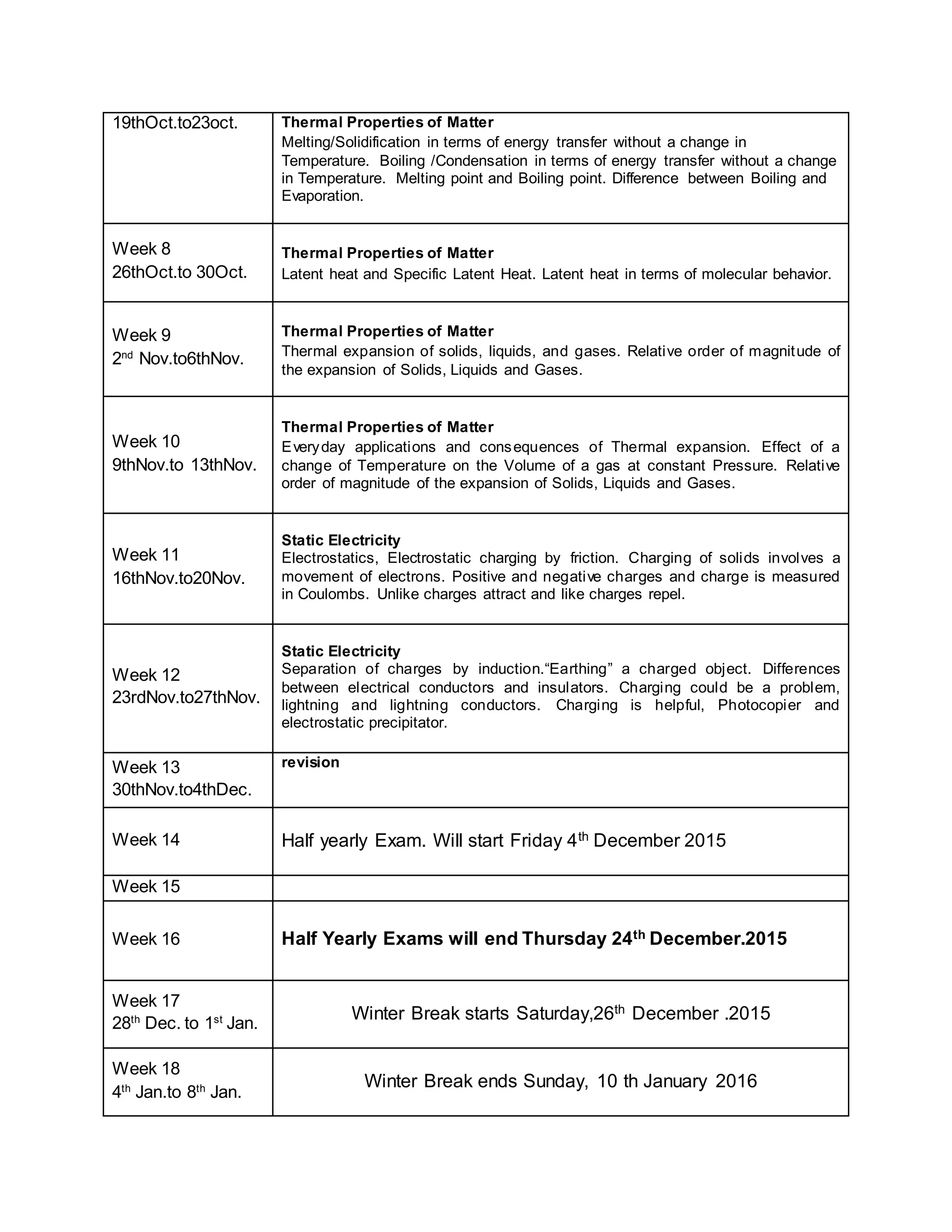
19thOct.to23oct. Thermal Properties of Matter
Melting/Solidification in terms of energy transfer without a change in
Temperature. Boiling /Condensation in terms of energy transfer without a change
in Temperature. Melting point and Boiling point. Difference between Boiling and
Evaporation.
Week 8
26thOct.to 30Oct.
Thermal Properties of Matter
Latent heat and Specific Latent Heat. Latent heat in terms of molecular behavior.
Week 9
2nd
Nov.to6thNov.
Thermal Properties of Matter
Thermal expansion of solids, liquids, and gases. Relative order of magnitude of
the expansion of Solids, Liquids and Gases.
Week 10
9thNov.to 13thNov.
Thermal Properties of Matter
Everyday applications and consequences of Thermal expansion. Effect of a
change of Temperature on the Volume of a gas at constant Pressure. Relative
order of magnitude of the expansion of Solids, Liquids and Gases.
Week 11
16thNov.to20Nov.
Static Electricity
Electrostatics, Electrostatic charging by friction. Charging of solids involves a
movement of electrons. Positive and negative charges and charge is measured
in Coulombs. Unlike charges attract and like charges repel.
Week 12
23rdNov.to27thNov.
Static Electricity
Separation of charges by induction.“Earthing” a charged object. Differences
between electrical conductors and insulators. Charging could be a problem,
lightning and lightning conductors. Charging is helpful, Photocopier and
electrostatic precipitator.
Week 13
30thNov.to4thDec.
revision
Week 14 Half yearly Exam. Will start Friday 4th December 2015
Week 15
Week 16 Half Yearly Exams will end Thursday 24th December.2015
Week 17
28th
Dec. to 1st
Jan.
Winter Break starts Saturday,26th December .2015
Week 18
4th
Jan.to 8th
Jan.
Winter Break ends Sunday, 10 th January 2016
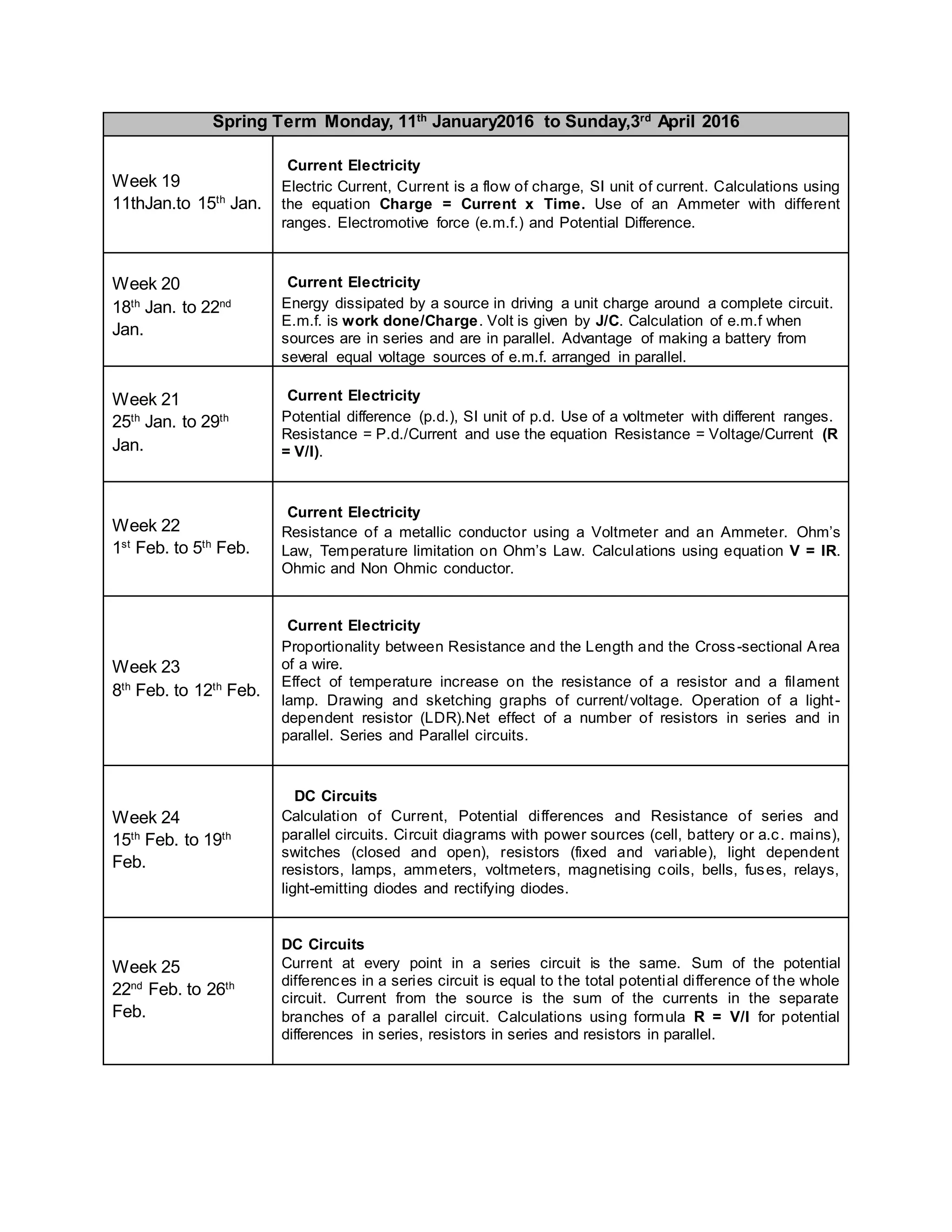
Spring Term Monday, 11th
January2016 to Sunday,3rd
April 2016
Week 19
11thJan.to 15th
Jan.
Current Electricity
Electric Current, Current is a flow of charge, SI unit of current. Calculations using
the equation Charge = Current x Time. Use of an Ammeter with different
ranges. Electromotive force (e.m.f.) and Potential Difference.
Week 20
18th
Jan. to 22nd
Jan.
Current Electricity
Energy dissipated by a source in driving a unit charge around a complete circuit.
E.m.f. is work done/Charge. Volt is given by J/C. Calculation of e.m.f when
sources are in series and are in parallel. Advantage of making a battery from
several equal voltage sources of e.m.f. arranged in parallel.
Week 21
25th
Jan. to 29th
Jan.
Current Electricity
Potential difference (p.d.), SI unit of p.d. Use of a voltmeter with different ranges.
Resistance = P.d./Current and use the equation Resistance = Voltage/Current (R
= V/I).
Week 22
1st
Feb. to 5th
Feb.
Current Electricity
Resistance of a metallic conductor using a Voltmeter and an Ammeter. Ohm’s
Law, Temperature limitation on Ohm’s Law. Calculations using equation V = IR.
Ohmic and Non Ohmic conductor.
Week 23
8th
Feb. to 12th
Feb.
Current Electricity
Proportionality between Resistance and the Length and the Cross-sectional Area
of a wire.
Effect of temperature increase on the resistance of a resistor and a filament
lamp. Drawing and sketching graphs of current/voltage. Operation of a light-
dependent resistor (LDR).Net effect of a number of resistors in series and in
parallel. Series and Parallel circuits.
Week 24
15th
Feb. to 19th
Feb.
DC Circuits
Calculation of Current, Potential differences and Resistance of series and
parallel circuits. Circuit diagrams with power sources (cell, battery or a.c. mains),
switches (closed and open), resistors (fixed and variable), light dependent
resistors, lamps, ammeters, voltmeters, magnetising coils, bells, fuses, relays,
light-emitting diodes and rectifying diodes.
Week 25
22nd
Feb. to 26th
Feb.
DC Circuits
Current at every point in a series circuit is the same. Sum of the potential
differences in a series circuit is equal to the total potential difference of the whole
circuit. Current from the source is the sum of the currents in the separate
branches of a parallel circuit. Calculations using formula R = V/I for potential
differences in series, resistors in series and resistors in parallel.
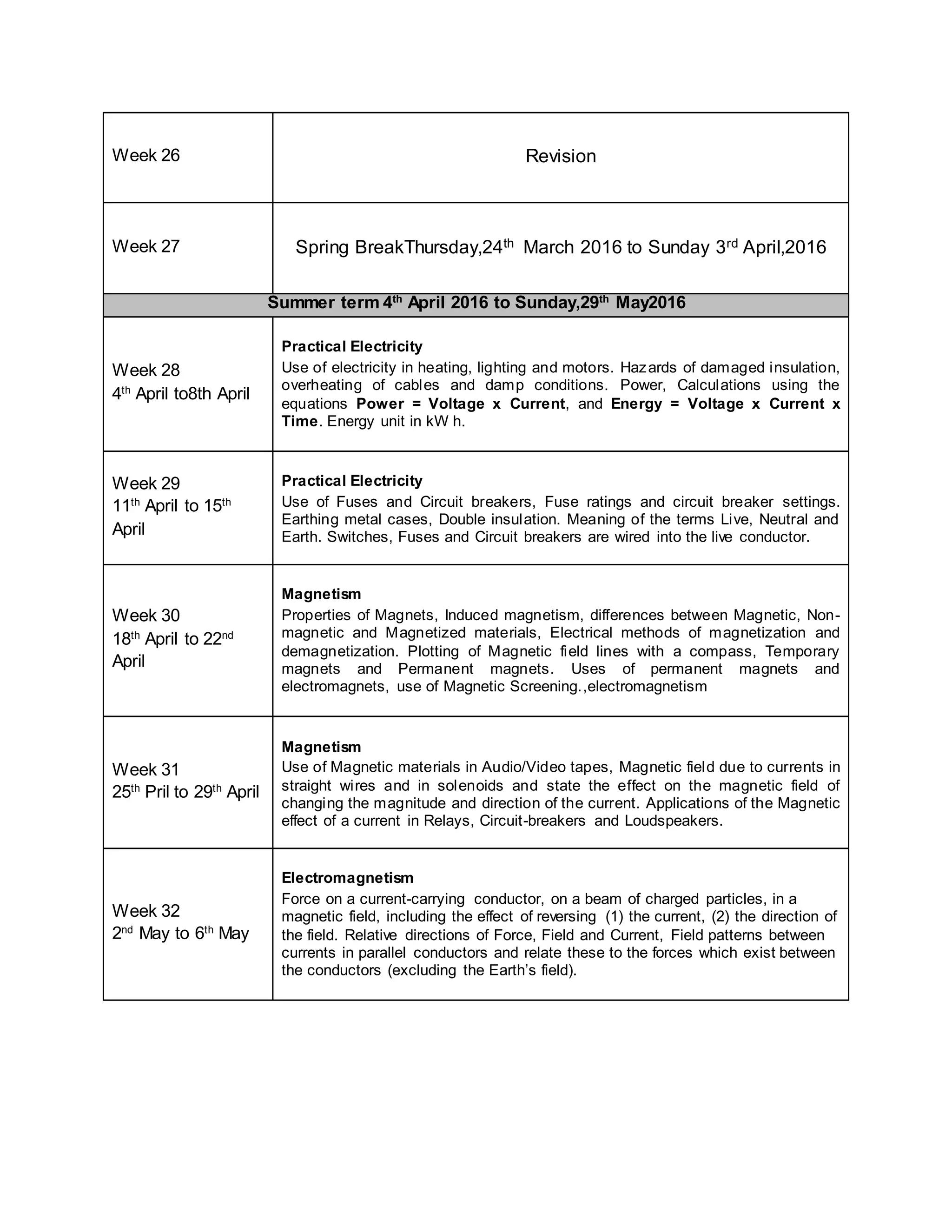
Week 26 Revision
Week 27 Spring BreakThursday,24th March 2016 to Sunday 3rd April,2016
Summer term 4th
April 2016 to Sunday,29th
May2016
Week 28
4th
April to8th April
Practical Electricity
Use of electricity in heating, lighting and motors. Hazards of damaged insulation,
overheating of cables and damp conditions. Power, Calculations using the
equations Power = Voltage x Current, and Energy = Voltage x Current x
Time. Energy unit in kW h.
Week 29
11th
April to 15th
April
Practical Electricity
Use of Fuses and Circuit breakers, Fuse ratings and circuit breaker settings.
Earthing metal cases, Double insulation. Meaning of the terms Live, Neutral and
Earth. Switches, Fuses and Circuit breakers are wired into the live conductor.
Week 30
18th
April to 22nd
April
Magnetism
Properties of Magnets, Induced magnetism, differences between Magnetic, Non-
magnetic and Magnetized materials, Electrical methods of magnetization and
demagnetization. Plotting of Magnetic field lines with a compass, Temporary
magnets and Permanent magnets. Uses of permanent magnets and
electromagnets, use of Magnetic Screening.,electromagnetism
Week 31
25th
Pril to 29th
April
Magnetism
Use of Magnetic materials in Audio/Video tapes, Magnetic field due to currents in
straight wires and in solenoids and state the effect on the magnetic field of
changing the magnitude and direction of the current. Applications of the Magnetic
effect of a current in Relays, Circuit-breakers and Loudspeakers.
Week 32
2nd
May to 6th
May
Electromagnetism
Force on a current-carrying conductor, on a beam of charged particles, in a
magnetic field, including the effect of reversing (1) the current, (2) the direction of
the field. Relative directions of Force, Field and Current, Field patterns between
currents in parallel conductors and relate these to the forces which exist between
the conductors (excluding the Earth’s field).
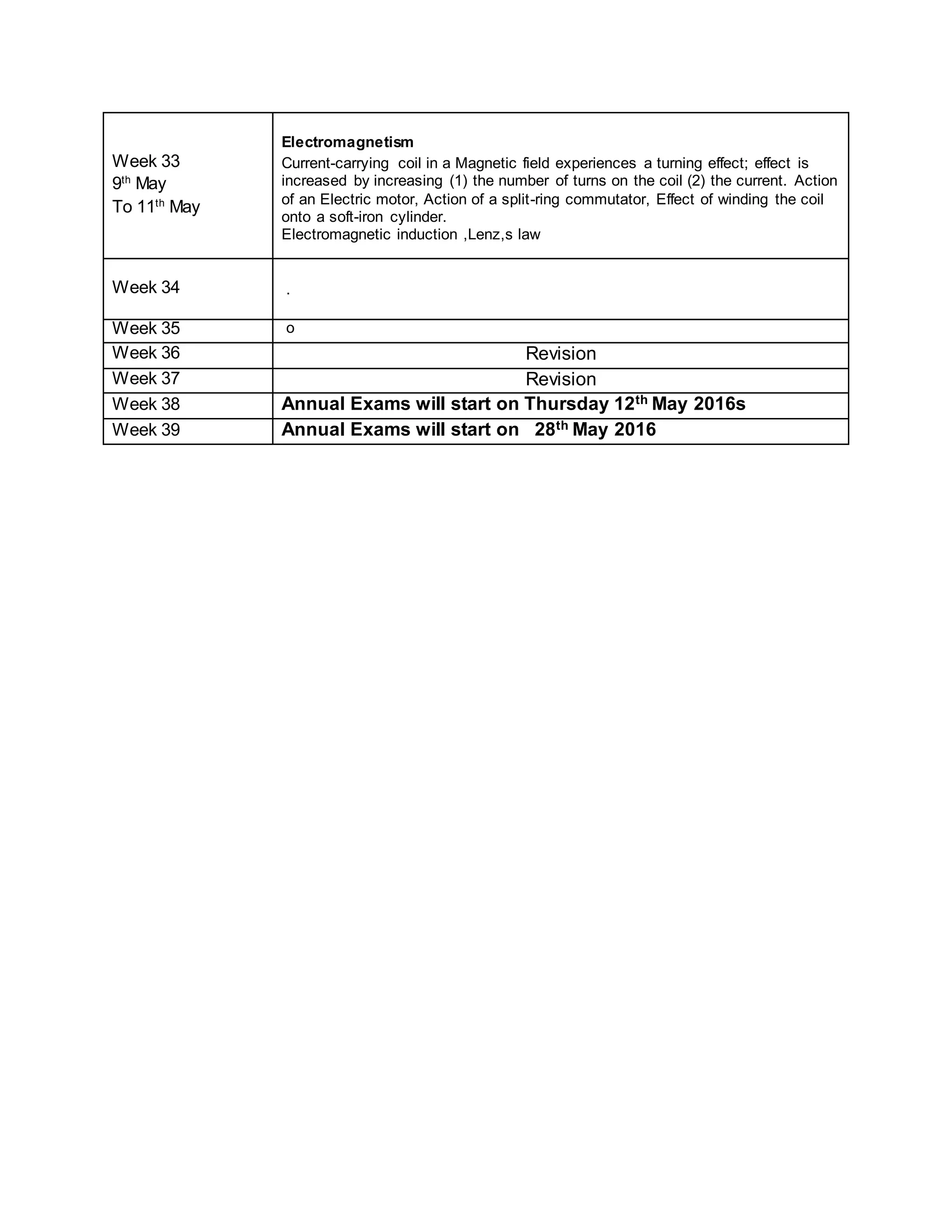
Week 33
9th
May
To 11th
May
Electromagnetism
Current-carrying coil in a Magnetic field experiences a turning effect; effect is
increased by increasing (1) the number of turns on the coil (2) the current. Action
of an Electric motor, Action of a split-ring commutator, Effect of winding the coil
onto a soft-iron cylinder.
Electromagnetic induction ,Lenz,s law
Week 34 .
Week 35 o
Week 36 Revision
Week 37 Revision
Week 38 Annual Exams will start on Thursday 12th May 2016s
Week 39 Annual Exams will start on 28th May 2016
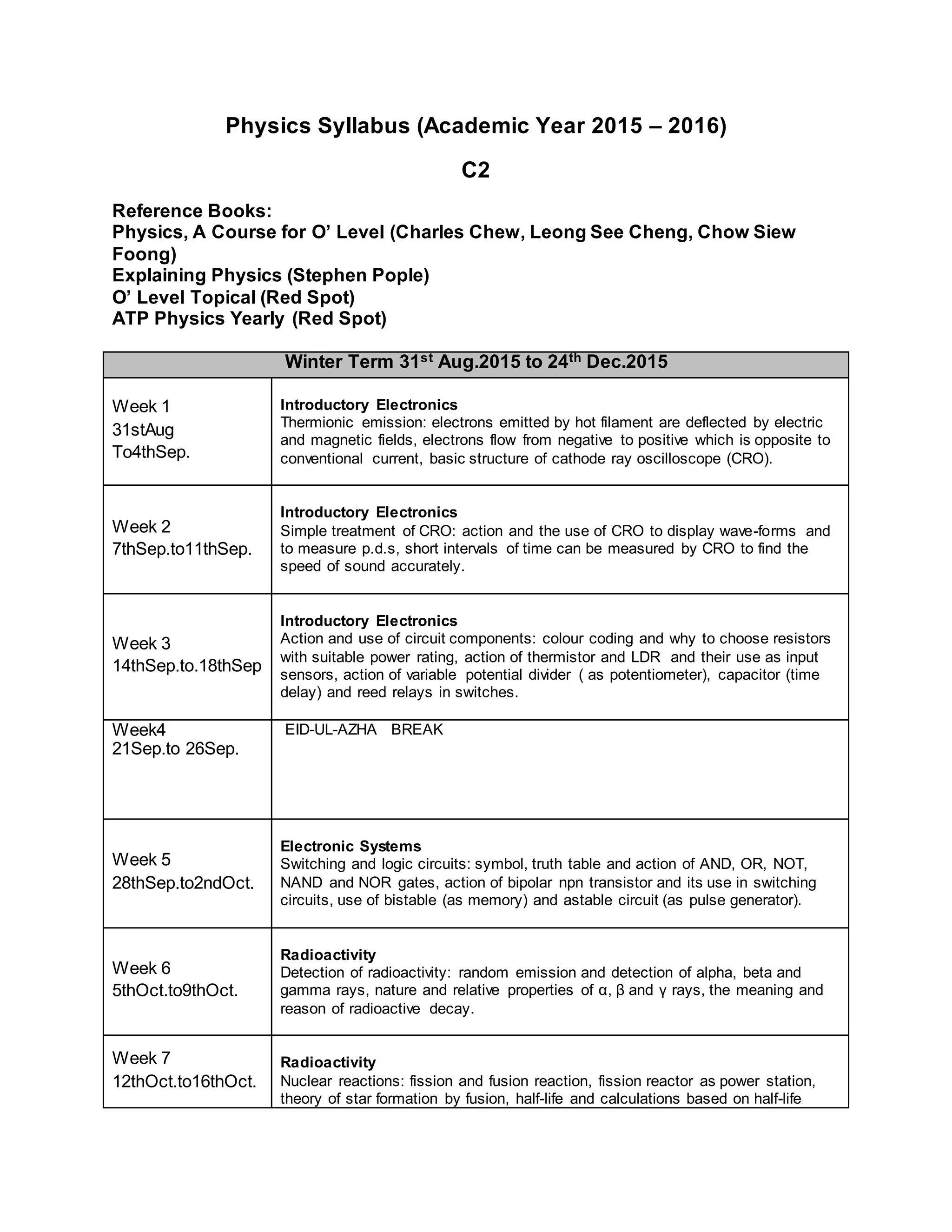
Physics Syllabus (Academic Year 2015 – 2016)
C2
Reference Books:
Physics, A Course for O’ Level (Charles Chew, Leong See Cheng, Chow Siew
Foong)
Explaining Physics (Stephen Pople)
O’ Level Topical (Red Spot)
ATP Physics Yearly (Red Spot)
Winter Term 31st Aug.2015 to 24th Dec.2015
Week 1
31stAug
To4thSep.
Introductory Electronics
Thermionic emission: electrons emitted by hot filament are deflected by electric
and magnetic fields, electrons flow from negative to positive which is opposite to
conventional current, basic structure of cathode ray oscilloscope (CRO).
Week 2
7thSep.to11thSep.
Introductory Electronics
Simple treatment of CRO: action and the use of CRO to display wave-forms and
to measure p.d.s, short intervals of time can be measured by CRO to find the
speed of sound accurately.
Week 3
14thSep.to.18thSep
Introductory Electronics
Action and use of circuit components: colour coding and why to choose resistors
with suitable power rating, action of thermistor and LDR and their use as input
sensors, action of variable potential divider ( as potentiometer), capacitor (time
delay) and reed relays in switches.
Week4
21Sep.to 26Sep.
EID-UL-AZHA BREAK
Week 5
28thSep.to2ndOct.
Electronic Systems
Switching and logic circuits: symbol, truth table and action of AND, OR, NOT,
NAND and NOR gates, action of bipolar npn transistor and its use in switching
circuits, use of bistable (as memory) and astable circuit (as pulse generator).
Week 6
5thOct.to9thOct.
Radioactivity
Detection of radioactivity: random emission and detection of alpha, beta and
gamma rays, nature and relative properties of α, β and γ rays, the meaning and
reason of radioactive decay.
Week 7
12thOct.to16thOct.
Radioactivity
Nuclear reactions: fission and fusion reaction, fission reactor as power station,
theory of star formation by fusion, half-life and calculations based on half-life
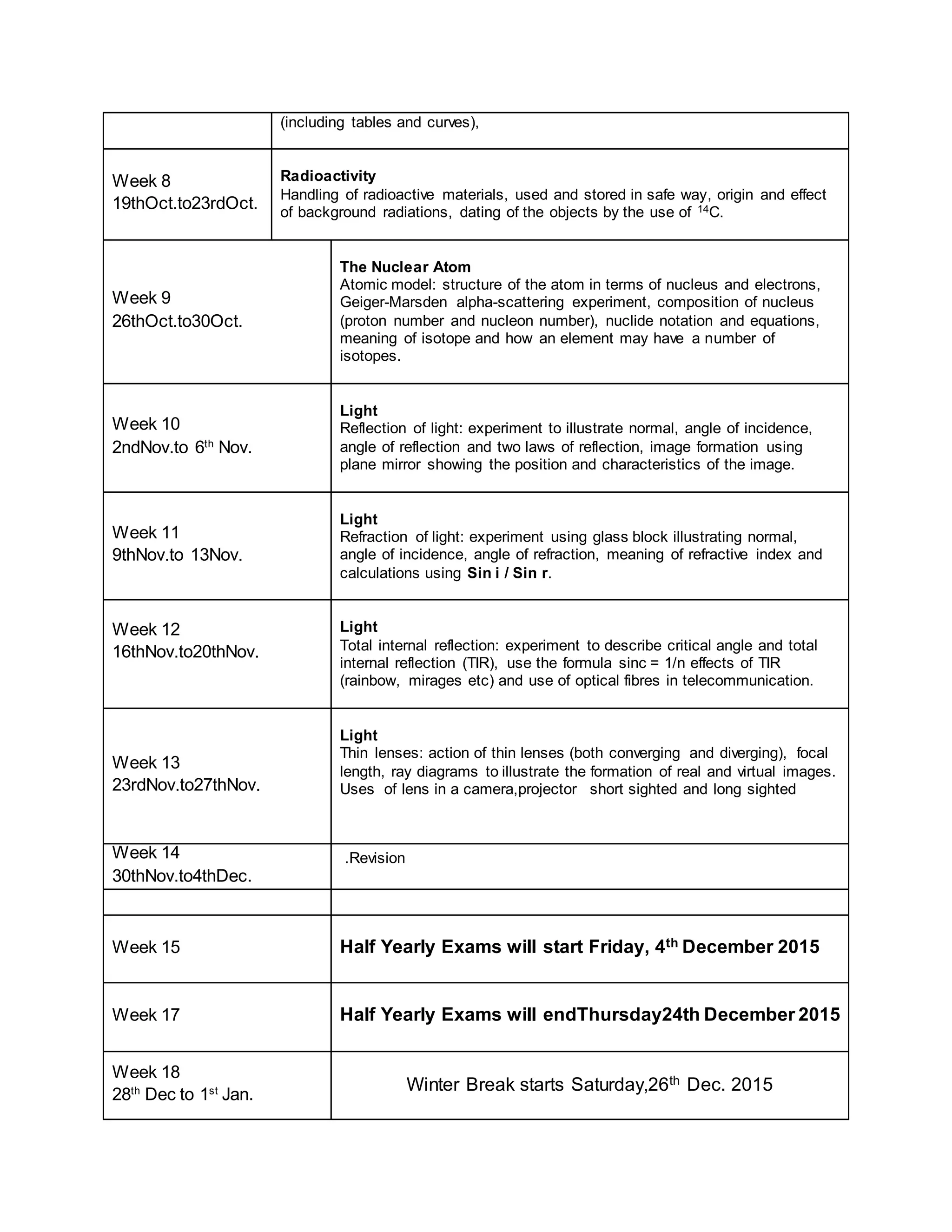
(including tables and curves),
Week 8
19thOct.to23rdOct.
Radioactivity
Handling of radioactive materials, used and stored in safe way, origin and effect
of background radiations, dating of the objects by the use of 14C.
Week 9
26thOct.to30Oct.
The Nuclear Atom
Atomic model: structure of the atom in terms of nucleus and electrons,
Geiger-Marsden alpha-scattering experiment, composition of nucleus
(proton number and nucleon number), nuclide notation and equations,
meaning of isotope and how an element may have a number of
isotopes.
Week 10
2ndNov.to 6th
Nov.
Light
Reflection of light: experiment to illustrate normal, angle of incidence,
angle of reflection and two laws of reflection, image formation using
plane mirror showing the position and characteristics of the image.
Week 11
9thNov.to 13Nov.
Light
Refraction of light: experiment using glass block illustrating normal,
angle of incidence, angle of refraction, meaning of refractive index and
calculations using Sin i / Sin r.
Week 12
16thNov.to20thNov.
Light
Total internal reflection: experiment to describe critical angle and total
internal reflection (TIR), use the formula sinc = 1/n effects of TIR
(rainbow, mirages etc) and use of optical fibres in telecommunication.
Week 13
23rdNov.to27thNov.
Light
Thin lenses: action of thin lenses (both converging and diverging), focal
length, ray diagrams to illustrate the formation of real and virtual images.
Uses of lens in a camera,projector short sighted and long sighted
Week 14
30thNov.to4thDec.
.Revision
Week 15 Half Yearly Exams will start Friday, 4th December 2015
Week 17 Half Yearly Exams will endThursday24th December 2015
Week 18
28th
Dec to 1st
Jan.
Winter Break starts Saturday,26th Dec. 2015
Week 19
4th
Jan to 8th
Jan.
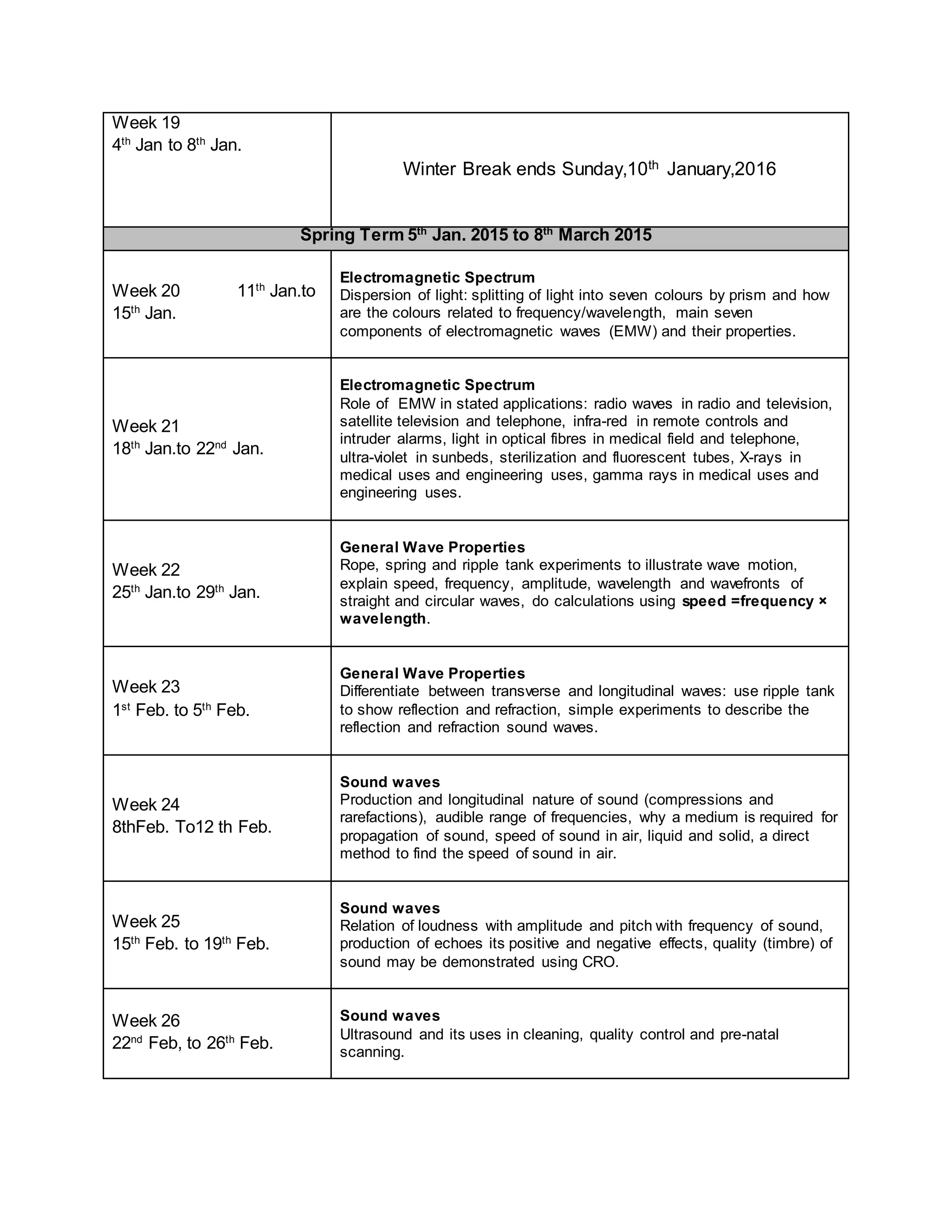
Winter Break ends Sunday,10th January,2016
Spring Term 5th
Jan. 2015 to 8th
March 2015
Week 20 11th
Jan.to
15th
Jan.
Electromagnetic Spectrum
Dispersion of light: splitting of light into seven colours by prism and how
are the colours related to frequency/wavelength, main seven
components of electromagnetic waves (EMW) and their properties.
Week 21
18th
Jan.to 22nd
Jan.
Electromagnetic Spectrum
Role of EMW in stated applications: radio waves in radio and television,
satellite television and telephone, infra-red in remote controls and
intruder alarms, light in optical fibres in medical field and telephone,
ultra-violet in sunbeds, sterilization and fluorescent tubes, X-rays in
medical uses and engineering uses, gamma rays in medical uses and
engineering uses.
Week 22
25th
Jan.to 29th
Jan.
General Wave Properties
Rope, spring and ripple tank experiments to illustrate wave motion,
explain speed, frequency, amplitude, wavelength and wavefronts of
straight and circular waves, do calculations using speed =frequency ×
wavelength.
Week 23
1st
Feb. to 5th
Feb.
General Wave Properties
Differentiate between transverse and longitudinal waves: use ripple tank
to show reflection and refraction, simple experiments to describe the
reflection and refraction sound waves.
Week 24
8thFeb. To12 th Feb.
Sound waves
Production and longitudinal nature of sound (compressions and
rarefactions), audible range of frequencies, why a medium is required for
propagation of sound, speed of sound in air, liquid and solid, a direct
method to find the speed of sound in air.
Week 25
15th
Feb. to 19th
Feb.
Sound waves
Relation of loudness with amplitude and pitch with frequency of sound,
production of echoes its positive and negative effects, quality (timbre) of
sound may be demonstrated using CRO.
Week 26
22nd
Feb, to 26th
Feb.
Sound waves
Ultrasound and its uses in cleaning, quality control and pre-natal
scanning.
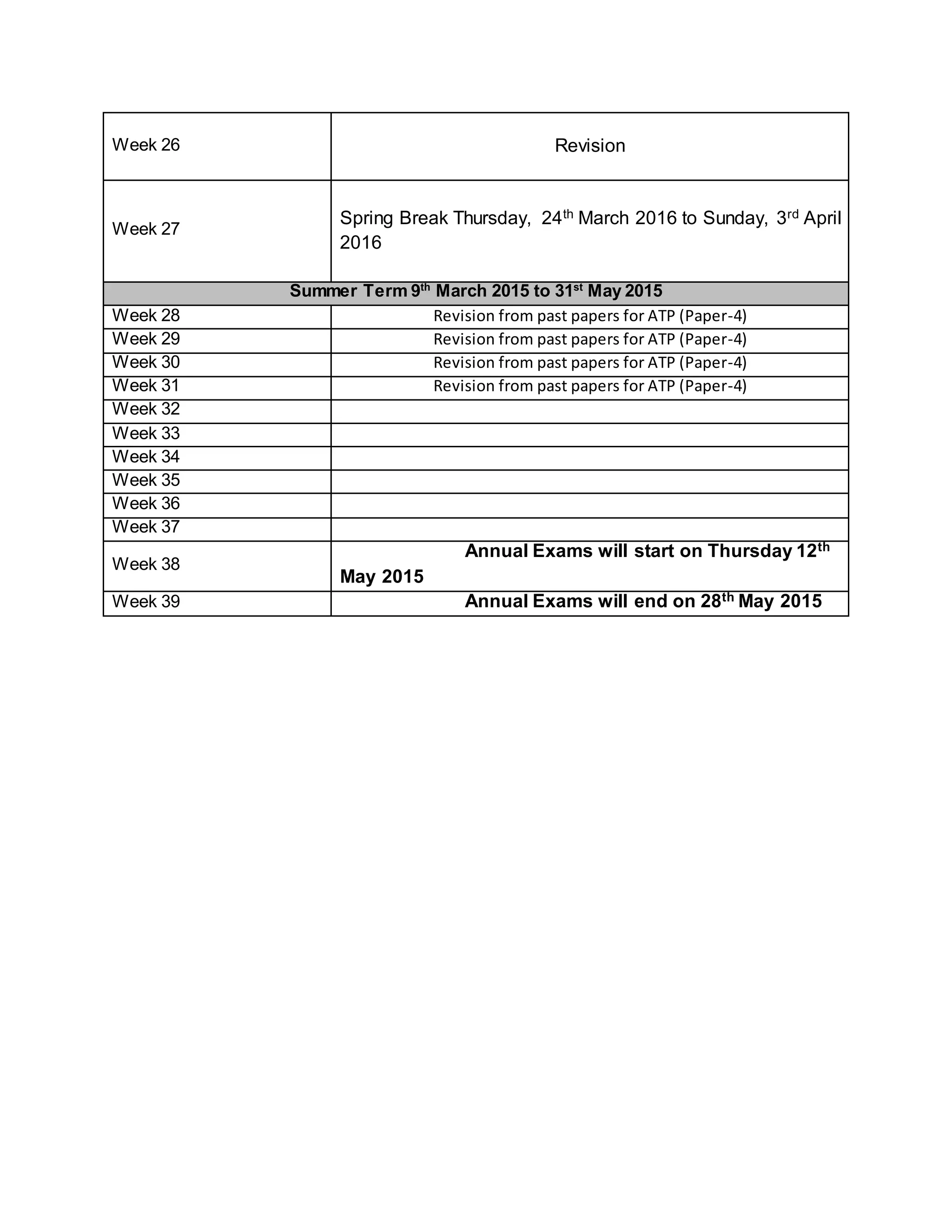
Week 26 Revision
Week 27
Spring Break Thursday, 24th March 2016 to Sunday, 3rd April
2016
Summer Term 9th
March 2015 to 31st
May 2015
Week 28 Revision from past papers for ATP (Paper-4)
Week 29 Revision from past papers for ATP (Paper-4)
Week 30 Revision from past papers for ATP (Paper-4)
Week 31 Revision from past papers for ATP (Paper-4)
Week 32
Week 33
Week 34
Week 35
Week 36
Week 37
Week 38
Annual Exams will start on Thursday 12th
May 2015
Week 39 Annual Exams will end on 28th May 2015

Physics syllabus

  • 1.
    Physics Syllabus Term Week 1 31Aug . To 4th Sep. Physical quantities and units Physical quantities SI Units The Avogadro constant Scalars and vectors Week 2 7th sep. To 11sep. Measurement techniques Measurements Errors and uncertainties Week 3 14sep. t0 18 sep. Measurement techniques Scalar and vector, add and subtract coplanar vectors, represent a vector as two perpendicular components . Week4 21Sep.to 25 Sep. EID_UL_ AZHA BREAK Week 5 28th sep. To2ndoct. Kinematics Linear motion Non-linear motion Week 6 5oct. to 9th oct. Dynamics Newton’s laws of motion Linear momentum and its conservation Week 7 12thoct to 16 th oct. Forces Types of force Equilibrium of forces Centre of gravity Turning effects of forces Week 8 19th oct. To 23rd oct Work, energy, power Energy conversion and conservation
  • 2.
    Work Potential energy (mgh),kinetic energy( 𝟏 𝟐⁄ 𝒎𝒗 𝟐 ) and internal energy Power (P =W/t, P = Fv). Week 9 26th oct. to 30th oct. Motion in a circle Kinematics of uniform circular motion Angular displacement, Angular velocity and relation between angular and linear velocity (𝒗 = 𝒓𝝎). Week 10 2nd Nov. To6th Nov. Motion in a circle Centripetal acceleration (𝒂 = 𝒓𝝎 𝟐 , 𝒂 = 𝒗 𝟐 𝒓 ) Centripetal force ( 𝑭 = 𝒎𝒓𝝎 𝟐 , 𝑭 = 𝒎𝒗 𝟐 𝒓 ) Week 11 9th Nov.to 13th nov. Gravitational field Gravitational field Force between point masses Field of a point mass Field near to the surface of the Earth Gravitational potential Week 12 16th Nov. to 20Nov. Gravitational field Field near to the surface of the Earth Gravitational potential Week 13 23rd Nov. to27th Nov Phases of matter Density Solids, liquids, gases Pressure in fluids Change of phase ,elastic and plastic behavior. Week 14 30th Nov. to 4th Dec. REVISION Week 15 7thDec.to 11Dec. Half Yearly Exams.
  • 3.
    Week 16 14Dec.to18 Dec. Half YearlyExams Week 17 21Dec.to 24Dec. Half Yearly Exams Week 18 28Decto1st Jan. Winter Break starts Week 19 4thJan.to 8th Jan. Winter Break ends Spring Term Week 20 11th Jan.to 15Jan. Oscillations Simple harmonic motion Energy in simple harmonic motion Damped and forced oscillations: resonance Week 21 18th Jan.to 22 Jan. Electric fields Concept of an electric field Uniform electric fields Electric field strength (E=V/d) Week 22 25th Jan.to 29 Jan. Electric fields Force between point charges (Coulomb’s law in the form of𝑭 = 𝑸 𝟏 𝑸 𝟐 𝟒𝝅𝜺 𝟎 𝒓 𝟐) Electric field of a point charge (𝑬 = 𝑸 𝟒𝝅𝜺 𝟎 𝒓 𝟐 ) Electric potential (𝑽 = 𝑸 𝟒𝝅𝜺 𝟎 𝒓 ) Millikan’s oil drop method Week 23 1st Feb.to 5th Feb. Capacitance Capacitors and capacitance (Q = CV) Energy stored in a capacitor (W = ½ QV, W= ½ CV2) Week 24 8thFeb.to 12Feb. Current of electricity Electric current (Q = It) Potential difference ( V = W/Q)
  • 4.
    Resistance and resistivity(R = L/A) Week 25 15Feb.to 19thFeb. Current of electricity Sources of electromotive force e.m.f and p.d. in terms of energy Ohms law (V=IR) Week 26 22ndFeb.to 26thFeb. D.C. circuits Practical circuits Conservation of charge and energy Kirchhoff’s first & second law (Laws of current & voltage) Week 27 29thFeb.to 4th March D.C. circuits Balanced potentials Potential divider (use of thermistors and light-dependent resistors in potential dividers) Potentiometer Week 28 7thMarch to11th March Magnetic fields Concept of magnetic field Magnetic flux (φ = B.A) Week 29 14thMarch to 18th March Electromagnetism Magnetic fields due to currents Force on a current carrying conductor Force between current-carrying conductors Use of the equation F = BIlsinθ, with directions as interpreted by Fleming’s left-hand rule Week30 21stMarch to 25thMarch SPRING BREAK Week31 28th March to 1st April SPRING BREAK Summer Term 4th Week 32 4th April to 8th April Electromagnetism Force on a moving charge using F = BQvsinθ
  • 5.
    Hall effect andHall voltage Week 33 11thApril to 15thApril Electromagnetic induction Magnetic flux and magnetic flux linkage Laws of electromagnetic induction Faraday’s law of electromagnetic induction and Lenz’s law Week 34 18thApril to 22nd April Alternating currents Characteristics of alternating currents use of the terms period, frequency, peak value and root-mean-square value as applied to an alternating current or voltage Week 35 25th April to 29th April Alternating currents Representation of alternating current or voltage by an equation of the form x = x0sinωt r.m.s. and peak values and relationship ( 𝑰 𝒓𝒎𝒔 = 𝑰 𝟎 𝟐 ⁄ ) ,Rectification , bridge Circuit Week 36 2nd May to 6th May The transformer Equation of an ideal transformer ( 𝑵 𝒔 𝑵 𝒑 ⁄ = 𝑽𝒔 𝑽 𝒑 ⁄ = 𝑰 𝒑 𝑰 𝒔 ⁄ ) Transmission of electrical energy (scientific and economic advantages of alternating current and of high voltages for the transmission of electrical energy) Week 37 Revision Week 38 Annual Exams will start Thursday,12th May 2016. Week 39 Annual Exams will end Saturday, 28th May,2016. Physics Syllabus
  • 6.
    Term Week 1 31st Aug. to4th Sep. Quantum physics Energy of a photon Photoelectric emission of electrons Wave-particle duality particulate nature of electromagnetic radiation E = hf, threshold frequency Week 2 7th Sep.to 11th Sep. Quantum physics Energy levels in atoms, Line spectra Use of the relation for the de Broglie wavelength λ = h/p discrete electron, energy levels in isolated atoms (e.g. atomic hydrogen) and deduce how this leads to spectral lines Distinguish between emission and absorption line spectra Solve problems using the relation hf= E1 – E2. Week 3 14th Sep. to 18th Sep. Quantum physics *( Band theory) *(Production and use of X-rays) Week4 21stSep.to 25thSep. EID-UL-AZHA BREAK Week 5, 28th Sep. to 2nd oct. Quantum physics *(understand the principles of CT scanning) Week 6 5th oct. to 9th oct. Particle and Nuclear physics The nucleus Isotopes Nuclear processes Mass excess and nuclear binding energy Radioactive decay Week7 12th oct. to 16th 0ct. Nuclear physics define the terms activity and decay constant and recall and solve problems using A = λN Infer and sketch the exponential nature of radioactive decay and solve problems using the relationship x = x0exp(–λt), where x could represent activity, number of undecayed particles or received count rate define half-life and solve problems using the relation λ = 0. 693/t1/2. Nuclear physics Fundamental particles nature and properties of α-, β- and γ-radiations (electron) antineutrinos and (electron) neutrinos
  • 7.
    Quark model, leptons Week8 19th Oct. to 23rd oct. Waves Progressive waves Wave motion, vibration in ropes, springs and ripple tanks Use the terms displacement, amplitude, phase difference, period, frequency, wavelength and speed, the equation v = fλ and determination of speed, frequency and wavelength Week 9 26th oct. to 30 oct. Waves The relationship intensity ∝ (amplitude)2 Polarisation Frequency of sound using a calibrated c.r.o. The wavelength of sound using stationary waves Week 10 2nd Nov.to.6th Nov. Waves Transverse and longitudinal waves Electromagnetic Spectrum Doppler’s effect Week 11 9th Nov.to 13th Nov. Waves Production and use of ultrasound in diagnosis ,Diffraction of waves Week 12 16th Nov.to 20 Nov. Superposition Stationary waves, understanding of experiments that demonstrate stationary waves using microwaves, stretched strings and air columns Diffraction Experiments that demonstrate diffraction including the diffraction of water waves in a ripple tank with both a wide gap and a narrow gap Week 13 23th Nov.to 27th Nov. Superposition Interference and coherence Two-source interference patterns (conditions required if two-source interference fringes are to be observed),Diffraction Grating. Week 14 30th Nov. to 4th Dec. Revision Week 15 7thDec.to 11Dec. Half Yearly Exams Week 16 14thDec.to.18thDec. Half Yearly Exams
  • 8.
    Week 17 21stDec.to 24th Dec. HalfYearly Exams Week 18 28thDec.to1st Jan. Winter Break Week 19 4th Jan to 8th Jan Winter Break ends Spring Term Week 20 11th Jan. to 15th Ideal gases Equation of state pV= nRT Kinetic theory of gases (Brownian motion) Pressure of a gas (compare pV=1/3 Nm<c2>with pV= NkT and hence deduce that the Average translational kinetic energy of a molecule is proportional to T. Kinetic energy of a molecule Week 21 18th jan.to 22nd Jan. Temperature Thermal equilibrium Temperature scales Practical thermometers Week 22 25th Jan.to 29th Jan. Thermal properties of materials Specific heat capacity Specific latent heat Internal energy First law of thermodynamics Week 23 1st Feb.to 5th Feb. Electronics The ideal operational amplifier, the use of an operational amplifier as a comparator The effects of negative feedback on the gain of an operational amplifier Operational amplifier circuits (Diagrams for both the inverting and the non- inverting amplifier for single signal input, the virtual earth approximation and expression for the gain of inverting amplifiers) use expressions for the voltage gain of inverting and of non-inverting amplifiers Week 24 8th Feb.to 12 Feb. Electronics Output devices Use of relays and light-emitting diodes (LEDs) as devices to indicate the state of the output of electronic circuits Need for calibration where digital or analogue meters are used as output
  • 9.
    devices. Week 25 15thFeb.to 19th Feb.Communication Communication channels Modulation Digital communication Week 26 22Feb to 26th Feb. Communication Relative merits of channels of communication Attenuation Week 26 Revision Week 27 Spring Break Summer Term March 2016 to 2016 Week 28 Mock Examinations Week 29 Mock Examinations Week 30 Mock Examinations Week 31 Revision (Theory & Practical) Week 32 Revision (Theory & Practical) Week 33 Revision (Theory & Practical) Week 34 Revision (Theory & Practical) Week 35 Revision (Theory & Practical) Week 36 Revision (Theory & Practical) Week 37 Week 38 Exams M / J Week 39
  • 10.
    Physics Syllabus Term Week 1 31st Aug.to 4th Sep. PhysicalQuantities, Units and Measurement Scalars and vectors Define the terms scalar and vector, resultant of two vectors by a graphical method. Definitions of distance, displacement, length, speed, velocity, time, acceleration, mass and force. Week 2 7th Sep. to 11th Sep. Physical Quantities, Units and Measurement Measurement techniques Measure a variety of lengths with appropriate accuracy using tapes, rules, micrometers and calipers using a vernier as necessary. Measurement of variety of time intervals using clocks and stopwatches. Week 3 14th Sep.to 18th Sep. Physical Quantities, Units and Measurement Units and symbols Recognise and use the conventions and symbols contained in ‘Signs, Symbols and Systematics’, Association for Science Education, 2000. Week 4 28th Sep. to2nd Oct. Kinematics Speed, velocity and acceleration Definitions of speed, velocity, average speed, uniform acceleration, non-uniform acceleration. WEEK 4 21st Sep to 25th Sep EID_UL _ AZHA BREAK Week 5 5thOct.to 9th oct. Kinematics Graphical analysis of motion plot and interpret speed-time and distance-time graphs, recognise from the shape of a speed-time graph when a body is at rest, moving with uniform speed, moving with uniform acceleration, moving with non-uniform acceleration. Calculate the area under a speed-time graph to determine the distance travelled for motion with uniform speed or uniform acceleration. Week 6 12Oct.to 16th Oct. Kinematics Free-fall State that the acceleration of free-fall for a body near to the Earth is constant and is approximately 10 m / s2. Qualitative analysis of the motion of bodies with constant weight falling with and without air resistance (including reference to terminal velocity). Week 7 Dynamics
  • 11.
    19Oct.to 23rdOct. Balanced and unbalancedforces Newton’s third law, the effect of balanced and unbalanced forces on a body, calculations using the equation force = mass × acceleration. Week 8 26thOct.to 30thOct. Dynamics Friction The effects of friction on the motion of a body, on the motion of a vehicle in the context of tyre surface, road conditions (including skidding), braking force, braking distance, thinking distance and stopping distance. Week 9 2ndNov,to 6thNov. Dynamics Circular motion Qualitatively description of motion in a circular path due to a constant perpendicular force, including electrostatic forces on an electron in an atom and gravitational forces on a satellite. (F = mv2 /r is not required.) Ideas of circular motion are related to the motion of planets in the solar system. Week 10 9thNovto 13thNov. Mass, Weight and Density Mass and weight Define mass and weight, state that the mass of a body resists change from its state of rest or motion. Calculate weight from the equation weight = mass × gravitational field strength. Comparison of weights and mass using a balance. Week 11 16thNovto 20Nov. Mass, Weight and Density Measurement of mass and weight by using appropriate balances. Gravitational fields A gravitational field is a region in which a mass experiences a force due to gravitational attraction. Week 12 23rdNov.to 27thNov. Mass, Weight and Density Density Use of a measuring cylinder to measure the volume of a liquid or solid. Determine the density of a liquid, of a regularly shaped solid and of an irregularly shaped solid which sinks in water. Week 13 30th to 4th Dec. Mass, Weight and Density (volume by displacement) Calculations using the formula density = mass/volume. Week 14 7thDec.to 11Dec. Half Yearly Exams. Will start Friday 4th Dec. 2015 Week 15 14Dec.to 18Dec. Half Yearly Exams
  • 12.
    Week 16 21st Dec. to 24Dec. Half Yearly Exams Week 17 28th Dec.to 1st Jan. Winter Break Week 18 4th Jan.to 8th Jan. Winter Break ends Term Week 19 11th Jan. To 15 Jan. Turning Effect of Forces Moments The moment of a force in terms of its turning effect and relate this to everyday examples. State the principle of moments for a body in equilibrium. Calculations using moment of a force = force × perpendicular distance from the pivot and the principle of moments. Week 20 18th Jan. To 22nd Jan. Turning Effect of Forces Centre of mass Verification of the principle of moments. Determine the position of the centre of mass of a plane lamina. Week 21 25th Jan. To 29 Jan. Turning Effect of Forces Stability The effect of the position of the centre of mass on the stability of simple objects (Qualitatively) Week 22 1st Feb. To5thFeb. Pressure Define the term pressure in terms of force and area, and do calculations using the equation pressure = force/area. Week 23 8th Feb.to 12th Feb. Pressure Pressure changes Variations in pressure with force and area in the context of everyday examples. The height of a liquid column used to measure the atmospheric pressure. The pressure beneath a liquid surface changes with depth and density of the liquid in appropriate examples. Calculations using the equation for hydrostatic pressure p = ρgh. Week 24 15th Feb. To19th Feb. Pressure Use of a manometer in the measurement of pressure difference. The transmission of pressure in hydraulic systems with particular reference to the hydraulic press and hydraulic brakes on vehicles. Week 25
  • 13.
    22nd Feb. To26th Feb. Pressure Change in volumeof a fixed mass of gas at constant temperature is caused by a change in pressure applied to the gas. Calculations using p1V1 = p2V2. Week 26 29Feb.to 4th March Revision Week 27 Spring Break Term 4th Week 31 4th April to 8th April Deformation Elastic deformation Force produces a change in size and shape of a body. *Plot, draw and interpret extension- load graphs for an elastic solid and describe the associated experimental procedure. *recognise the significance of the term “limit of proportionality” for an elastic solid. Calculate extensions for an elastic solid using proportionality Week 32 11th April to 15 April Energy Sources and Transfer of Energy Energy forms List the different forms of energy with examples in which each form occurs. State the principle of the conservation of energy and apply this principle to the conversion of energy from one form to another. State that kinetic energy is given by Ek= ½mv2. State that the gravitational potential energy is given by Ep = mgh, and use these equations in calculations. List renewable and non-renewable energy sources Week 33 18th April to 22 April Energy Sources and Transfer of Energy Major sources of energy The processes by which energy is converted from one form to another, including reference to chemical/fuel energy (a re-grouping of atoms), hydroelectric generation (emphasising the mechanical energies involved), solar energy (nuclei of atoms in the Sun), nuclear energy, geothermal energy,(6) wind energy. Nuclear fusion and fission in terms of energy-releasing processes. The process of electricity generation and draw a block diagram of the process from fuel input to electricity output. The environmental issues associated with power generation.
  • 14.
    Week 34 25th April To29th April Energy Sourcesand Transfer of Energy Work Calculate work done from the formula work = force × distance moved in the line of action of the force., ,energy sources ,Kinetic theory of matter Week 35 2nd May to 6th May Energy Sources and Transfer of Energy Efficiency Calculate the efficiency of an energy conversion using the formula efficiency = energy converted to the required form/total energy input. The efficiency of energy conversions in common use, particularly those giving electrical output. The usefulness of energy output from a number of energy conversions. Week 33 Revision Week 34 Annual Exam. Will start Thursday, 12th May 2016 Annual Exam. Will end Saturday,28th May 2016
  • 15.
    Week 35 Kinetic Modelof Matter Evaporation Evaporation in terms of the escape of more energetic molecules from the surface of a liquid. Temperature, surface area and draught over a surface influence evaporation. Evaporation causes cooling. Week 36 Revision Week 37 Revision Week 38 Annual Exams Week 39 Annual Exams
  • 16.
    Physics Syllabus (AcademicYear2015 – 2016) C1 Reference Books: Physics, A Course for O’ Level (Charles Chew, Leong See Cheng, Chow Siew Foong) Explaining Physics (Stephen Pople) O’ Level Topical (Red Spot) ATP Physics Yearly (Red Spot) Winter Term 31st Aug.2015 to 24th Dec.2015 Week 1 31st .Aug.to 4th Sep Transfer of Thermal Energy Conduction. Distinguish between good and bad conductors of heat. Heat transfer occurs in solids in terms of molecules. Week 2 7th Sep.to 11thSep. Transfer of Thermal Energy Convection. Convection in fluids in terms of density changes. Week 3 14thSep.to18thSep. Transfer of Thermal Energy Radiation, Process of heat transfer by Radiation. Distinguish between good and bad emitters of Heat. Distinguish between good and bad absorbers of Heat. Transfer of heat to or from buildings and to or from a room. Use of the important practical methods of heat insulation for buildings. Week 4 28thSep.to2ndOct. Temperature Principles of Thermometry, Measurement of Temperature, construct a Mercury Thermometer, Ice point and Steam point Week 5 5thOct.to9th Oct. Temperature Measure Temperature with Thermometer, Clinical Thermometer, and Choice of liquid for Thermometer. Thermocouple Thermometer. Sensitivity, range and linearity of Thermometers. Week 6 12thOct.to16thOct. Thermal Properties of Matter Rise in Temperature of a body in terms of an increase in its Internal Energy. Heat capacity and Specific Heat Capacity. Heat transferred using the formula Thermal energy = Mass x Specific Heat Capacity x Change in Temperature. Week 7
  • 17.
    19thOct.to23oct. Thermal Propertiesof Matter Melting/Solidification in terms of energy transfer without a change in Temperature. Boiling /Condensation in terms of energy transfer without a change in Temperature. Melting point and Boiling point. Difference between Boiling and Evaporation. Week 8 26thOct.to 30Oct. Thermal Properties of Matter Latent heat and Specific Latent Heat. Latent heat in terms of molecular behavior. Week 9 2nd Nov.to6thNov. Thermal Properties of Matter Thermal expansion of solids, liquids, and gases. Relative order of magnitude of the expansion of Solids, Liquids and Gases. Week 10 9thNov.to 13thNov. Thermal Properties of Matter Everyday applications and consequences of Thermal expansion. Effect of a change of Temperature on the Volume of a gas at constant Pressure. Relative order of magnitude of the expansion of Solids, Liquids and Gases. Week 11 16thNov.to20Nov. Static Electricity Electrostatics, Electrostatic charging by friction. Charging of solids involves a movement of electrons. Positive and negative charges and charge is measured in Coulombs. Unlike charges attract and like charges repel. Week 12 23rdNov.to27thNov. Static Electricity Separation of charges by induction.“Earthing” a charged object. Differences between electrical conductors and insulators. Charging could be a problem, lightning and lightning conductors. Charging is helpful, Photocopier and electrostatic precipitator. Week 13 30thNov.to4thDec. revision Week 14 Half yearly Exam. Will start Friday 4th December 2015 Week 15 Week 16 Half Yearly Exams will end Thursday 24th December.2015 Week 17 28th Dec. to 1st Jan. Winter Break starts Saturday,26th December .2015 Week 18 4th Jan.to 8th Jan. Winter Break ends Sunday, 10 th January 2016
  • 18.
    Spring Term Monday,11th January2016 to Sunday,3rd April 2016 Week 19 11thJan.to 15th Jan. Current Electricity Electric Current, Current is a flow of charge, SI unit of current. Calculations using the equation Charge = Current x Time. Use of an Ammeter with different ranges. Electromotive force (e.m.f.) and Potential Difference. Week 20 18th Jan. to 22nd Jan. Current Electricity Energy dissipated by a source in driving a unit charge around a complete circuit. E.m.f. is work done/Charge. Volt is given by J/C. Calculation of e.m.f when sources are in series and are in parallel. Advantage of making a battery from several equal voltage sources of e.m.f. arranged in parallel. Week 21 25th Jan. to 29th Jan. Current Electricity Potential difference (p.d.), SI unit of p.d. Use of a voltmeter with different ranges. Resistance = P.d./Current and use the equation Resistance = Voltage/Current (R = V/I). Week 22 1st Feb. to 5th Feb. Current Electricity Resistance of a metallic conductor using a Voltmeter and an Ammeter. Ohm’s Law, Temperature limitation on Ohm’s Law. Calculations using equation V = IR. Ohmic and Non Ohmic conductor. Week 23 8th Feb. to 12th Feb. Current Electricity Proportionality between Resistance and the Length and the Cross-sectional Area of a wire. Effect of temperature increase on the resistance of a resistor and a filament lamp. Drawing and sketching graphs of current/voltage. Operation of a light- dependent resistor (LDR).Net effect of a number of resistors in series and in parallel. Series and Parallel circuits. Week 24 15th Feb. to 19th Feb. DC Circuits Calculation of Current, Potential differences and Resistance of series and parallel circuits. Circuit diagrams with power sources (cell, battery or a.c. mains), switches (closed and open), resistors (fixed and variable), light dependent resistors, lamps, ammeters, voltmeters, magnetising coils, bells, fuses, relays, light-emitting diodes and rectifying diodes. Week 25 22nd Feb. to 26th Feb. DC Circuits Current at every point in a series circuit is the same. Sum of the potential differences in a series circuit is equal to the total potential difference of the whole circuit. Current from the source is the sum of the currents in the separate branches of a parallel circuit. Calculations using formula R = V/I for potential differences in series, resistors in series and resistors in parallel.
  • 19.
    Week 26 Revision Week27 Spring BreakThursday,24th March 2016 to Sunday 3rd April,2016 Summer term 4th April 2016 to Sunday,29th May2016 Week 28 4th April to8th April Practical Electricity Use of electricity in heating, lighting and motors. Hazards of damaged insulation, overheating of cables and damp conditions. Power, Calculations using the equations Power = Voltage x Current, and Energy = Voltage x Current x Time. Energy unit in kW h. Week 29 11th April to 15th April Practical Electricity Use of Fuses and Circuit breakers, Fuse ratings and circuit breaker settings. Earthing metal cases, Double insulation. Meaning of the terms Live, Neutral and Earth. Switches, Fuses and Circuit breakers are wired into the live conductor. Week 30 18th April to 22nd April Magnetism Properties of Magnets, Induced magnetism, differences between Magnetic, Non- magnetic and Magnetized materials, Electrical methods of magnetization and demagnetization. Plotting of Magnetic field lines with a compass, Temporary magnets and Permanent magnets. Uses of permanent magnets and electromagnets, use of Magnetic Screening.,electromagnetism Week 31 25th Pril to 29th April Magnetism Use of Magnetic materials in Audio/Video tapes, Magnetic field due to currents in straight wires and in solenoids and state the effect on the magnetic field of changing the magnitude and direction of the current. Applications of the Magnetic effect of a current in Relays, Circuit-breakers and Loudspeakers. Week 32 2nd May to 6th May Electromagnetism Force on a current-carrying conductor, on a beam of charged particles, in a magnetic field, including the effect of reversing (1) the current, (2) the direction of the field. Relative directions of Force, Field and Current, Field patterns between currents in parallel conductors and relate these to the forces which exist between the conductors (excluding the Earth’s field).
  • 20.
    Week 33 9th May To 11th May Electromagnetism Current-carryingcoil in a Magnetic field experiences a turning effect; effect is increased by increasing (1) the number of turns on the coil (2) the current. Action of an Electric motor, Action of a split-ring commutator, Effect of winding the coil onto a soft-iron cylinder. Electromagnetic induction ,Lenz,s law Week 34 . Week 35 o Week 36 Revision Week 37 Revision Week 38 Annual Exams will start on Thursday 12th May 2016s Week 39 Annual Exams will start on 28th May 2016
  • 21.
    Physics Syllabus (AcademicYear 2015 – 2016) C2 Reference Books: Physics, A Course for O’ Level (Charles Chew, Leong See Cheng, Chow Siew Foong) Explaining Physics (Stephen Pople) O’ Level Topical (Red Spot) ATP Physics Yearly (Red Spot) Winter Term 31st Aug.2015 to 24th Dec.2015 Week 1 31stAug To4thSep. Introductory Electronics Thermionic emission: electrons emitted by hot filament are deflected by electric and magnetic fields, electrons flow from negative to positive which is opposite to conventional current, basic structure of cathode ray oscilloscope (CRO). Week 2 7thSep.to11thSep. Introductory Electronics Simple treatment of CRO: action and the use of CRO to display wave-forms and to measure p.d.s, short intervals of time can be measured by CRO to find the speed of sound accurately. Week 3 14thSep.to.18thSep Introductory Electronics Action and use of circuit components: colour coding and why to choose resistors with suitable power rating, action of thermistor and LDR and their use as input sensors, action of variable potential divider ( as potentiometer), capacitor (time delay) and reed relays in switches. Week4 21Sep.to 26Sep. EID-UL-AZHA BREAK Week 5 28thSep.to2ndOct. Electronic Systems Switching and logic circuits: symbol, truth table and action of AND, OR, NOT, NAND and NOR gates, action of bipolar npn transistor and its use in switching circuits, use of bistable (as memory) and astable circuit (as pulse generator). Week 6 5thOct.to9thOct. Radioactivity Detection of radioactivity: random emission and detection of alpha, beta and gamma rays, nature and relative properties of α, β and γ rays, the meaning and reason of radioactive decay. Week 7 12thOct.to16thOct. Radioactivity Nuclear reactions: fission and fusion reaction, fission reactor as power station, theory of star formation by fusion, half-life and calculations based on half-life
  • 22.
    (including tables andcurves), Week 8 19thOct.to23rdOct. Radioactivity Handling of radioactive materials, used and stored in safe way, origin and effect of background radiations, dating of the objects by the use of 14C. Week 9 26thOct.to30Oct. The Nuclear Atom Atomic model: structure of the atom in terms of nucleus and electrons, Geiger-Marsden alpha-scattering experiment, composition of nucleus (proton number and nucleon number), nuclide notation and equations, meaning of isotope and how an element may have a number of isotopes. Week 10 2ndNov.to 6th Nov. Light Reflection of light: experiment to illustrate normal, angle of incidence, angle of reflection and two laws of reflection, image formation using plane mirror showing the position and characteristics of the image. Week 11 9thNov.to 13Nov. Light Refraction of light: experiment using glass block illustrating normal, angle of incidence, angle of refraction, meaning of refractive index and calculations using Sin i / Sin r. Week 12 16thNov.to20thNov. Light Total internal reflection: experiment to describe critical angle and total internal reflection (TIR), use the formula sinc = 1/n effects of TIR (rainbow, mirages etc) and use of optical fibres in telecommunication. Week 13 23rdNov.to27thNov. Light Thin lenses: action of thin lenses (both converging and diverging), focal length, ray diagrams to illustrate the formation of real and virtual images. Uses of lens in a camera,projector short sighted and long sighted Week 14 30thNov.to4thDec. .Revision Week 15 Half Yearly Exams will start Friday, 4th December 2015 Week 17 Half Yearly Exams will endThursday24th December 2015 Week 18 28th Dec to 1st Jan. Winter Break starts Saturday,26th Dec. 2015
  • 23.
    Week 19 4th Jan to8th Jan. Winter Break ends Sunday,10th January,2016 Spring Term 5th Jan. 2015 to 8th March 2015 Week 20 11th Jan.to 15th Jan. Electromagnetic Spectrum Dispersion of light: splitting of light into seven colours by prism and how are the colours related to frequency/wavelength, main seven components of electromagnetic waves (EMW) and their properties. Week 21 18th Jan.to 22nd Jan. Electromagnetic Spectrum Role of EMW in stated applications: radio waves in radio and television, satellite television and telephone, infra-red in remote controls and intruder alarms, light in optical fibres in medical field and telephone, ultra-violet in sunbeds, sterilization and fluorescent tubes, X-rays in medical uses and engineering uses, gamma rays in medical uses and engineering uses. Week 22 25th Jan.to 29th Jan. General Wave Properties Rope, spring and ripple tank experiments to illustrate wave motion, explain speed, frequency, amplitude, wavelength and wavefronts of straight and circular waves, do calculations using speed =frequency × wavelength. Week 23 1st Feb. to 5th Feb. General Wave Properties Differentiate between transverse and longitudinal waves: use ripple tank to show reflection and refraction, simple experiments to describe the reflection and refraction sound waves. Week 24 8thFeb. To12 th Feb. Sound waves Production and longitudinal nature of sound (compressions and rarefactions), audible range of frequencies, why a medium is required for propagation of sound, speed of sound in air, liquid and solid, a direct method to find the speed of sound in air. Week 25 15th Feb. to 19th Feb. Sound waves Relation of loudness with amplitude and pitch with frequency of sound, production of echoes its positive and negative effects, quality (timbre) of sound may be demonstrated using CRO. Week 26 22nd Feb, to 26th Feb. Sound waves Ultrasound and its uses in cleaning, quality control and pre-natal scanning.
  • 24.
    Week 26 Revision Week27 Spring Break Thursday, 24th March 2016 to Sunday, 3rd April 2016 Summer Term 9th March 2015 to 31st May 2015 Week 28 Revision from past papers for ATP (Paper-4) Week 29 Revision from past papers for ATP (Paper-4) Week 30 Revision from past papers for ATP (Paper-4) Week 31 Revision from past papers for ATP (Paper-4) Week 32 Week 33 Week 34 Week 35 Week 36 Week 37 Week 38 Annual Exams will start on Thursday 12th May 2015 Week 39 Annual Exams will end on 28th May 2015