Applied Physics
PHM181
Dr. Zeeshan
( Lecturer )
Department of Physics and Computer Science
DAYALBAGH EDUCATIONAL INSTITUTE
“ When you can measure
what you are speaking about,
and express it in numbers,
you know something about
it.” Lord Kelvin
Physical quantities
Control
Fundamental Physical Quantities
1. Length (m) 🗸
Fundamental Physical Quantities
1. Length (m) 🗸
2. Mass (kg) 🗸
Fundamental Physical Quantities
1. Length (m) 🗸
2. Mass (kg) 🗸
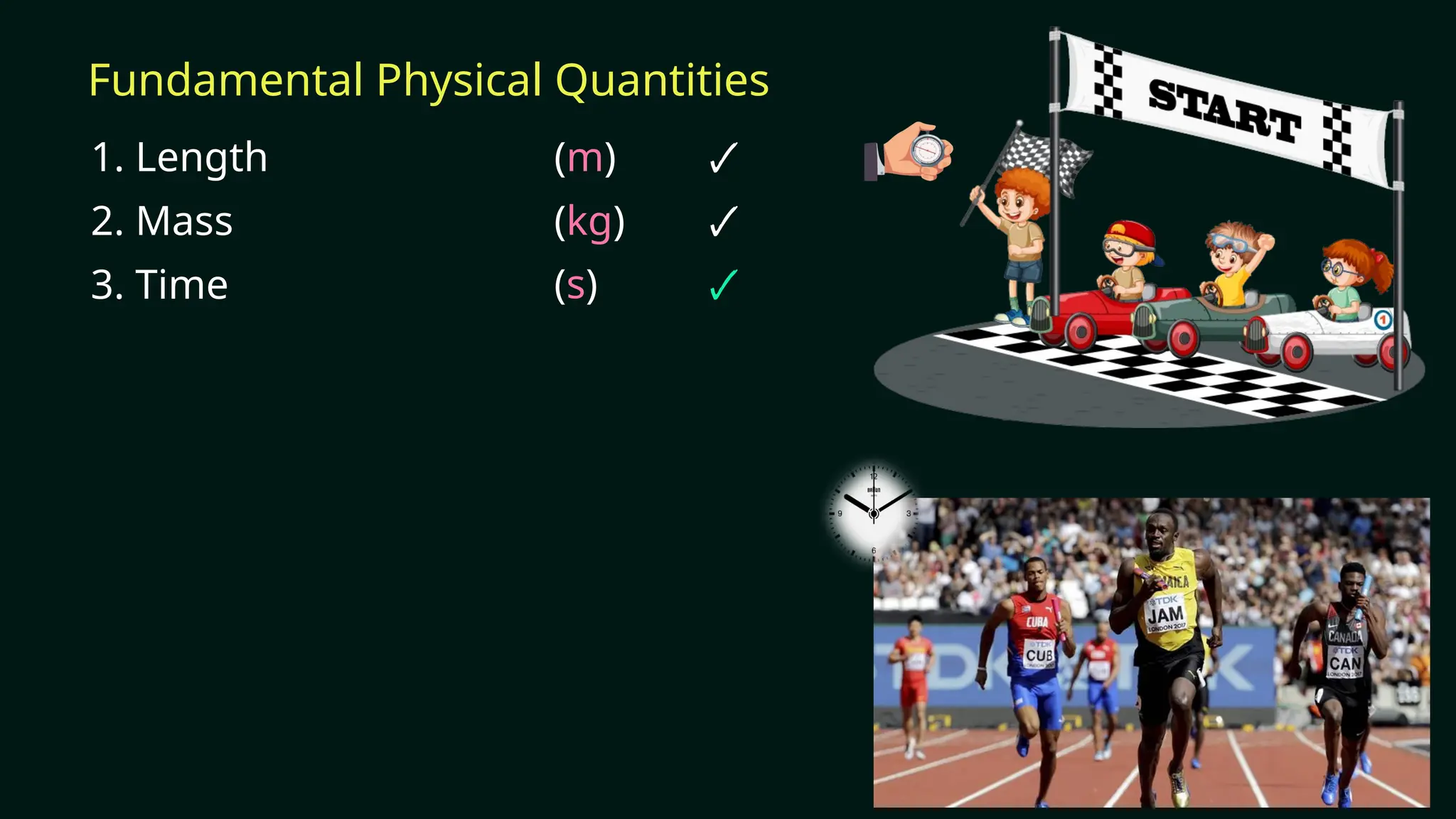
3. Time (s) 🗸
Fundamental Physical Quantities
1. Length (m) 🗸
2. Mass (kg) 🗸
3. Time (s) 🗸
Fundamental Physical Quantities
1. Length (m) 🗸
2. Mass (kg) 🗸
3. Time (s) 🗸
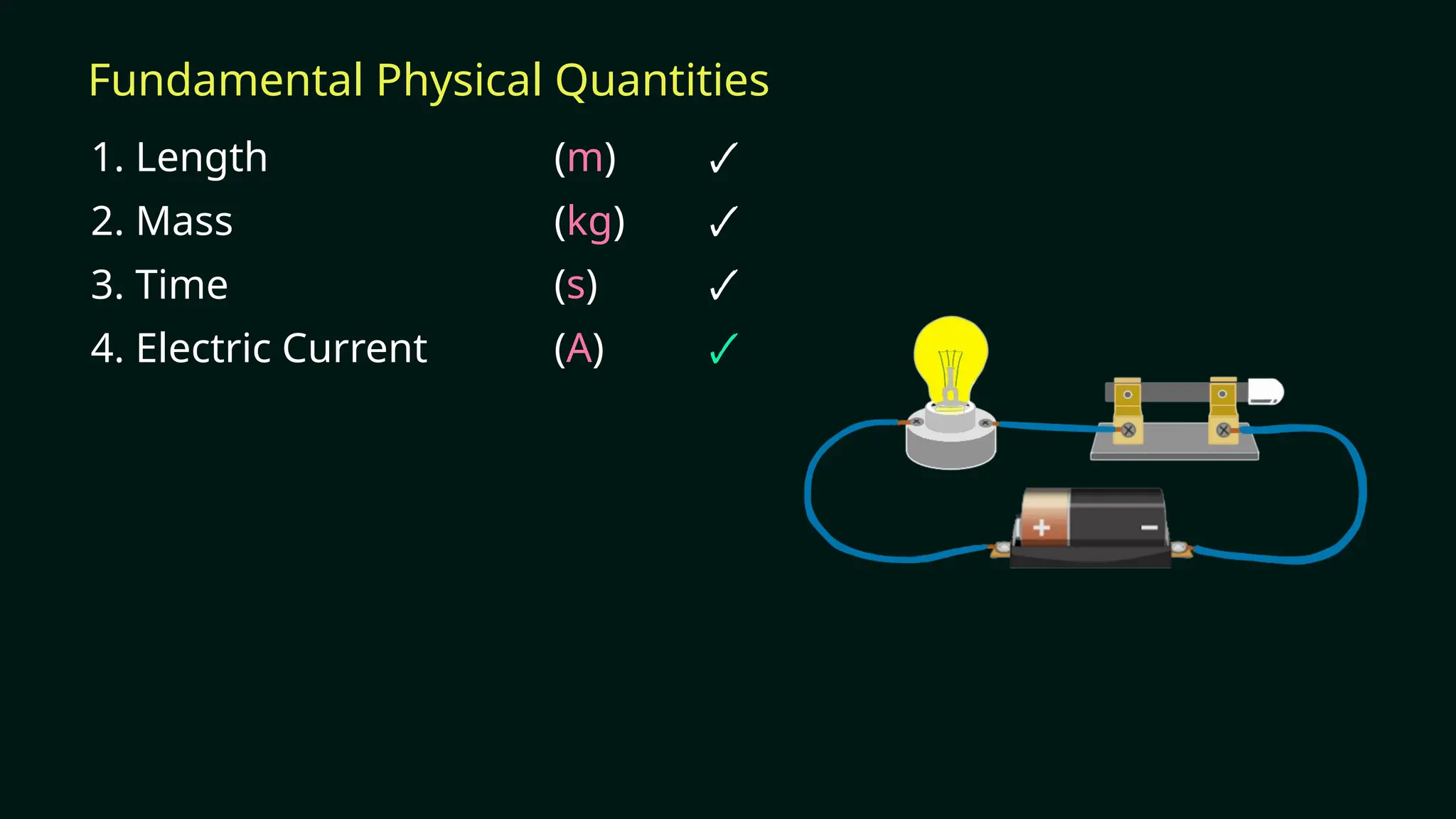
4. Electric Current (A) 🗸
Fundamental Physical Quantities
1. Length (m) 🗸
2. Mass (kg) 🗸
3. Time (s) 🗸
4. Electric Current (A) 🗸
5. Temperature (K) 🗸
Fundamental Physical Quantities
1. Length (m) 🗸
2. Mass (kg) 🗸
3. Time (s) 🗸
4. Electric Current (A) 🗸
5. Temperature (K) 🗸
6. Luminous Intensity (Cd) 🗸
Fundamental Physical Quantities
1. Length (m) 🗸
2. Mass (kg) 🗸
3. Time (s) 🗸
4. Electric Current (A) 🗸
5. Temperature (K) 🗸
6. Luminous Intensity (Cd) 🗸
7. Amount of Substance (Mole) 🗸
🗸
12.0
g
24.3
g
63.5
g
Carbo
n
Magnes
ium
Copp
er
No. of Particles 6.02 ✕ 1023
Communicat
ion
Technology
Space and
Astrophysics
Clinical and
Medical
Material
Science
Application Areas
Syllabus
5 Electromagnetic Theory
6 Lasers & Fiber Optics
1 Wave Motion
4 Polarisation
2 Interference
3 Diffraction
Prerequisite
Target Audience
Physics at 10+2 Level.
Undergraduate students of Science and Engineering stream.
Diploma and Polytechnic students.
Students preparing for NET/GATE exams.
Physics admirers who wish to brush up the concepts.
UNIT 1: WAVE MOTION
One dimensional waves, harmonic waves, phase and phase velocity, the superposition
principle, the complex representation, phasors and the addition of waves, plane waves, the
addition of waves of the same frequency, the addition of waves of different frequency.
Acoustics: sound waves, intensity of sound waves, decibels and Weber-Fechner law;
characteristics of a musical sound versus noise.
UNIT 2: ELECTROMAGNETIC THEORY
Basic laws of electromagnetic theory – Maxwell’s equations, electromagnetic
waves, energy and momentum in electromagnetic waves, the electromagnetic-
photon spectrum, Rayleigh scattering, reflection, refraction, Fermat's principle,
total internal reflection
UNIT 3: INTERFERENCE AND DIFFRACTION
Conditions for interference, Wavefront-splitting interferometers, amplitude-splitting
interferometers, types and localization of interference fringes, Fraunhofer diffraction,
Fresnel diffraction.
UNIT 4: POLARIZATION
The nature of polarized light, polarizers, dichroism, birefringence, scattering and
polarization, polarization by reflection, retarders, circular polarizers, polarizations of
polychromatic light, optical activity.
UNIT 5: LASER AND FIBER OPTICS
Radiant energy and matter in equilibrium, Stefan-Boltzmann law, Wien displacement law,
Planck’s radiation law, the Einstein A and B coefficients, Ruby laser, Helium-neon laser,
semiconductor laser, fiber optics, numerical aperture, types of fiber, fiber optic
communication.
Suggested Reading
What is light?
“Is light a wave phenomenon or a particle
phenomenon?”
Particle
● The essential feature of a particle is its localization;
● It exists in a well-defined, “small” region of space.
● Practically, we tend to take something familiar like a ball or a pebble and shrink it down
in imagination until it becomes vanishingly small.
Wave
 The essential feature of a wave is its non-localization.
 A classical traveling wave is a self-sustaining disturbance of a medium, which moves through
space transporting energy and momentum.
Traveling Waves
● Traveling wave is a self-sustaining disturbance of the medium through which it propagates
● The most familiar waves, and the easiest to visualize are the mechanical waves. For
example, waves on strings, surface waves on liquids, sound waves in the air, and
compression waves in both solids and fluids.
Longitudinal and Transverse Waves
Sound waves are longitudinal—the medium is displaced in the direction of
motion of the wave.
Waves on a string (and electromagnetic waves) are transverse—the medium
is displaced in a direction perpendicular to that of the motion of the wave.
………
NOTE:
In all cases, although the energy-carrying disturbance advances through the
medium, the individual participating atoms remain in the vicinity of their
equilibrium positions: the disturbance advances, not the material medium.
Some Questions
What about water waves and Earthquakes?
Transverse / Longitudinal?????
https://www.acs.psu.edu/drussell/Demos/waves/wavemotion.html
What about water waves and Earthquakes?
Transverse / Longitudinal?????
https://www.acs.psu.edu/drussell/Demos/waves/wavemotion.html
Ph.D. in Physics from DEI, Agra and Michigan State University, USA
Masters of Physics (Director's Medal) with specialization in Electronics &
B.Sc. Physics Honors (Director's Medal) from Dayalbagh Educational Institute,
Agra
Research interests : Electronics, Bio-sensing, Plasma and Microwave physics.
Research Publications: 6 Journals, 12 Conferences, 2 Patents
Professional Achievements:
 UGC-NET (Electronic Science)-2017, 2018, 2019, 2020,
2021
 UGC-NET (JRF)-2020, 2021
 GATE-(Electronics and Communication Engineering)-2019
 Fellowships Selected for- JRF in DST-INSPIRE, DRDO and
UGC. E-Mail:
Teaching Assignments
Even Semester:
• Applied Physics-II
• Electronics-II
• Electronics Lab
Odd Semester:
• Applied Physics-I
• Network Theory
• Microcontrollers
Know Your Instructor…….
Dr. Zeeshan, Lecturer
Dept. Of Physics & Comp Sci.
Faculty of Science
Thank you!

Applied physics engineering Lec 1.1.pptx

  • 1.
    Applied Physics PHM181 Dr. Zeeshan (Lecturer ) Department of Physics and Computer Science DAYALBAGH EDUCATIONAL INSTITUTE
  • 2.
    “ When youcan measure what you are speaking about, and express it in numbers, you know something about it.” Lord Kelvin Physical quantities Control
  • 3.
  • 4.
    Fundamental Physical Quantities 1.Length (m) 🗸 2. Mass (kg) 🗸
  • 5.
    Fundamental Physical Quantities 1.Length (m) 🗸 2. Mass (kg) 🗸 3. Time (s) 🗸
  • 6.
    Fundamental Physical Quantities 1.Length (m) 🗸 2. Mass (kg) 🗸 3. Time (s) 🗸
  • 7.
    Fundamental Physical Quantities 1.Length (m) 🗸 2. Mass (kg) 🗸 3. Time (s) 🗸 4. Electric Current (A) 🗸
  • 8.
    Fundamental Physical Quantities 1.Length (m) 🗸 2. Mass (kg) 🗸 3. Time (s) 🗸 4. Electric Current (A) 🗸 5. Temperature (K) 🗸
  • 9.
    Fundamental Physical Quantities 1.Length (m) 🗸 2. Mass (kg) 🗸 3. Time (s) 🗸 4. Electric Current (A) 🗸 5. Temperature (K) 🗸 6. Luminous Intensity (Cd) 🗸
  • 10.
    Fundamental Physical Quantities 1.Length (m) 🗸 2. Mass (kg) 🗸 3. Time (s) 🗸 4. Electric Current (A) 🗸 5. Temperature (K) 🗸 6. Luminous Intensity (Cd) 🗸 7. Amount of Substance (Mole) 🗸 🗸 12.0 g 24.3 g 63.5 g Carbo n Magnes ium Copp er No. of Particles 6.02 ✕ 1023
  • 11.
  • 12.
    Syllabus 5 Electromagnetic Theory 6Lasers & Fiber Optics 1 Wave Motion 4 Polarisation 2 Interference 3 Diffraction
  • 13.
    Prerequisite Target Audience Physics at10+2 Level. Undergraduate students of Science and Engineering stream. Diploma and Polytechnic students. Students preparing for NET/GATE exams. Physics admirers who wish to brush up the concepts.
  • 14.
    UNIT 1: WAVEMOTION One dimensional waves, harmonic waves, phase and phase velocity, the superposition principle, the complex representation, phasors and the addition of waves, plane waves, the addition of waves of the same frequency, the addition of waves of different frequency. Acoustics: sound waves, intensity of sound waves, decibels and Weber-Fechner law; characteristics of a musical sound versus noise.
  • 15.
    UNIT 2: ELECTROMAGNETICTHEORY Basic laws of electromagnetic theory – Maxwell’s equations, electromagnetic waves, energy and momentum in electromagnetic waves, the electromagnetic- photon spectrum, Rayleigh scattering, reflection, refraction, Fermat's principle, total internal reflection
  • 16.
    UNIT 3: INTERFERENCEAND DIFFRACTION Conditions for interference, Wavefront-splitting interferometers, amplitude-splitting interferometers, types and localization of interference fringes, Fraunhofer diffraction, Fresnel diffraction.
  • 17.
    UNIT 4: POLARIZATION Thenature of polarized light, polarizers, dichroism, birefringence, scattering and polarization, polarization by reflection, retarders, circular polarizers, polarizations of polychromatic light, optical activity.
  • 18.
    UNIT 5: LASERAND FIBER OPTICS Radiant energy and matter in equilibrium, Stefan-Boltzmann law, Wien displacement law, Planck’s radiation law, the Einstein A and B coefficients, Ruby laser, Helium-neon laser, semiconductor laser, fiber optics, numerical aperture, types of fiber, fiber optic communication.
  • 19.
  • 20.
    What is light? “Islight a wave phenomenon or a particle phenomenon?”
  • 21.
    Particle ● The essentialfeature of a particle is its localization; ● It exists in a well-defined, “small” region of space. ● Practically, we tend to take something familiar like a ball or a pebble and shrink it down in imagination until it becomes vanishingly small. Wave  The essential feature of a wave is its non-localization.  A classical traveling wave is a self-sustaining disturbance of a medium, which moves through space transporting energy and momentum.
  • 22.
    Traveling Waves ● Travelingwave is a self-sustaining disturbance of the medium through which it propagates ● The most familiar waves, and the easiest to visualize are the mechanical waves. For example, waves on strings, surface waves on liquids, sound waves in the air, and compression waves in both solids and fluids.
  • 23.
    Longitudinal and TransverseWaves Sound waves are longitudinal—the medium is displaced in the direction of motion of the wave. Waves on a string (and electromagnetic waves) are transverse—the medium is displaced in a direction perpendicular to that of the motion of the wave. ……… NOTE: In all cases, although the energy-carrying disturbance advances through the medium, the individual participating atoms remain in the vicinity of their equilibrium positions: the disturbance advances, not the material medium.
  • 24.
  • 25.
    What about waterwaves and Earthquakes? Transverse / Longitudinal????? https://www.acs.psu.edu/drussell/Demos/waves/wavemotion.html
  • 26.
    What about waterwaves and Earthquakes? Transverse / Longitudinal????? https://www.acs.psu.edu/drussell/Demos/waves/wavemotion.html
  • 27.
  • 28.
  • 29.
  • 30.
    Ph.D. in Physicsfrom DEI, Agra and Michigan State University, USA Masters of Physics (Director's Medal) with specialization in Electronics & B.Sc. Physics Honors (Director's Medal) from Dayalbagh Educational Institute, Agra Research interests : Electronics, Bio-sensing, Plasma and Microwave physics. Research Publications: 6 Journals, 12 Conferences, 2 Patents Professional Achievements:  UGC-NET (Electronic Science)-2017, 2018, 2019, 2020, 2021  UGC-NET (JRF)-2020, 2021  GATE-(Electronics and Communication Engineering)-2019  Fellowships Selected for- JRF in DST-INSPIRE, DRDO and UGC. E-Mail: Teaching Assignments Even Semester: • Applied Physics-II • Electronics-II • Electronics Lab Odd Semester: • Applied Physics-I • Network Theory • Microcontrollers Know Your Instructor……. Dr. Zeeshan, Lecturer Dept. Of Physics & Comp Sci. Faculty of Science
  • 33.