POSITIVE SPECIES
INTERACTION
Presented by,
Sonia John
II M.Sc.Zoology
INTRODUCTION
 No organisms under natural conditions is divorced from
all other living things
 Species interact with each other in one way or the
other:
1. Intraspecific Interactions- associations,aggregations
2. Interspecific Interactions:-
(a)Positive interactions
(b) Negative Interactions
POSITIVE INTERACTIONS
 When the interactions result in a benefit for one or both
of the species and harm to neither.
 Result in better growth, reproduction and survival
 Not static and they vary in their strength and symmetry
depending upon the context under which they occur.
 Types: Commensalism
Proto Co-operation
Mutualism
Commensalism
 Association of two or more species;associated for
activities such as food;
 one species at least derives benefit from the
association while the other species are neither
benefitted nor harmed.
 Commensal- species that benefits from the association;
May obtain nutrients,shelter,support etc from the host
species which is substantially unaffected
 Often between a large host and a smaller commensal
 Ecto Commensal- Epizoite animals; Associated
with other animal for the purpose of anchorage and
protection
 Eg: Whale and Barnacles
 Endo Commensal- When the commensalism is
internal
 Eg:Harmless protozoans in the intestinal tract of
humans
EXAMPLES
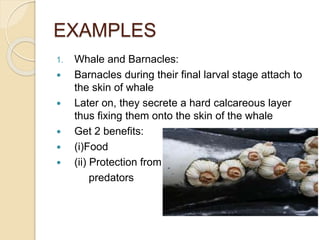
1. Whale and Barnacles:
 Barnacles during their final larval stage attach to
the skin of whale
 Later on, they secrete a hard calcareous layer
thus fixing them onto the skin of the whale
 Get 2 benefits:
 (i)Food
 (ii) Protection from
predators
2.Remora Fish and Shark
 Remora fish attach to the bellies of shark by means of a
dorsal fin highly modified to form a sucker
 Gets a free ride when the host moves about
 Food scrapes of the shark are swept up by the
Remoraa
3.PseudoScorpions and Insects
Some species of Pseudoscorpions hide themselves under the
wing covers of large insects like beetles.
This gives them protection from their predators, and also
provides them a means of transportation over a larger area.
Because of its small size and lack of sting, it does not harm
the beetle in any way.
 4.Hermit Crab Living in the Gastropod Shell
TYPES OF
COMMENSALISM
1. Chemical commensalism: Often b/w 2 species of
bacteria
2. Inquilism: One species using the body or body cavity
of another organism. Eg: Whale and barnacle
3. Metabiosis: One species unintentionally creates a
home for another species through one of its normal
life activities. Eg:hermit crab in gastropod shells
4. Phoresy: When one organism attaches to the other for
gaining transportations. Eg: mites on insects
PROTO CO-OPERATION
 Interaction clearly beneficial to both species; However
not obligatory for either species.
 Growth and survival is possible in the absence of
the interaction
 Examples:
1. Ants and aphids
2. Red Billed Oxpecker and Impala
3. Water moccasin and large birds
1.Red Billed Oxpecker
and Impala
This bird eats mainly ticks
but may also eat blood-sucking flies, fleas, and lice off the
Impala
Both organisms benefit from this because the Impala is
getting rid of the parasites that could harm it. The
oxpecker benefits from it because it is getting food.
But this association is not obligatory for both
2.Ants and Aphids
 Ants searches for the food on trees an shrubs which are
hosts to the honey-dew secreting Aphids
 Some species of ants farm the aphids,stimulate them to
secrete honeydew and also protect them
 The honey dew secreted by the aphids are used as
food by the ants
3.Water moccasin and large birds(Heron)
 These birds nest in the lower branches of trees while
the water moccasin congregate around the bases
 This protects the bird from tree climbing predators such
as raccoons
 The snake feed,in turn,is dropped by the birds
MUTUALISM
 Obligatory interaction that is strongly beneficial to
both species.
 2 organisms of diff species associates and each
individual benefits from the other.
 Term introduced by Pierre Joseph van Beneden in
1876
 Examples
1. The lichen is a mutualistic association between a
species of algae and a species of fungus
2. Mycorrhizal association
3. Bacteria in the intestine of herbivorous birds and
mammals
4. Mutualism in Trichonympha in the gut of termites
5. Spider crab and algae
1.Lichen
 Mutualistic association between a species of
algae/cyanobacteria and a species of fungus
 The fungus benefits :because algae or cyanobacteria
produce food by photosynthesis
 The algae or cyanobacteria benefit :by being protected
from the environment by the filaments of the fungus,
which also gather moisture and nutrients from the
environment, and (usually) provide an anchor to it.
2.Trichonympha in the gut of termites
 Although termites are insects that eat wood, termites
are not capable of digesting wood on their own.
 Trichonympha have the enzymes needed to convert
cellulose in wood into starches and sugars that the
termite can use as nutrients.
 In exchange, these organisms benefit from a
continuous supply of energy-rich cellulose and a
suitable environment in which to live.
3.The spider crab and the algae.
 Spider crabs live in shallow areas of the ocean floor,
and greenish-brown algae lives on the crabs' backs,
making the crabs blend in with their environment, and
unnoticeable to predators.
 The algae gets a good place to live, and the crab gets
camouflage.
REFERENCES
 Agarwal.V.K and P.S.Verma.Principles of
Ecology.S.Chand Publications
 Arora.M.P. Ecology. Himalaya Publishing
House.
 http://en.wikipedia.org
 www.tutorvisita.com
 www.buzzle.com
Positive species interaction

Positive species interaction

  • 1.
  • 2.
    INTRODUCTION  No organismsunder natural conditions is divorced from all other living things  Species interact with each other in one way or the other: 1. Intraspecific Interactions- associations,aggregations 2. Interspecific Interactions:- (a)Positive interactions (b) Negative Interactions
  • 3.
    POSITIVE INTERACTIONS  Whenthe interactions result in a benefit for one or both of the species and harm to neither.  Result in better growth, reproduction and survival  Not static and they vary in their strength and symmetry depending upon the context under which they occur.  Types: Commensalism Proto Co-operation Mutualism
  • 4.
    Commensalism  Association oftwo or more species;associated for activities such as food;  one species at least derives benefit from the association while the other species are neither benefitted nor harmed.  Commensal- species that benefits from the association; May obtain nutrients,shelter,support etc from the host species which is substantially unaffected  Often between a large host and a smaller commensal
  • 5.
     Ecto Commensal-Epizoite animals; Associated with other animal for the purpose of anchorage and protection  Eg: Whale and Barnacles  Endo Commensal- When the commensalism is internal  Eg:Harmless protozoans in the intestinal tract of humans
  • 6.
    EXAMPLES 1. Whale andBarnacles:  Barnacles during their final larval stage attach to the skin of whale  Later on, they secrete a hard calcareous layer thus fixing them onto the skin of the whale  Get 2 benefits:  (i)Food  (ii) Protection from predators
  • 7.
    2.Remora Fish andShark  Remora fish attach to the bellies of shark by means of a dorsal fin highly modified to form a sucker  Gets a free ride when the host moves about  Food scrapes of the shark are swept up by the Remoraa
  • 8.
    3.PseudoScorpions and Insects Somespecies of Pseudoscorpions hide themselves under the wing covers of large insects like beetles. This gives them protection from their predators, and also provides them a means of transportation over a larger area. Because of its small size and lack of sting, it does not harm the beetle in any way.
  • 9.
     4.Hermit CrabLiving in the Gastropod Shell
  • 10.
    TYPES OF COMMENSALISM 1. Chemicalcommensalism: Often b/w 2 species of bacteria 2. Inquilism: One species using the body or body cavity of another organism. Eg: Whale and barnacle 3. Metabiosis: One species unintentionally creates a home for another species through one of its normal life activities. Eg:hermit crab in gastropod shells 4. Phoresy: When one organism attaches to the other for gaining transportations. Eg: mites on insects
  • 11.
    PROTO CO-OPERATION  Interactionclearly beneficial to both species; However not obligatory for either species.  Growth and survival is possible in the absence of the interaction  Examples: 1. Ants and aphids 2. Red Billed Oxpecker and Impala 3. Water moccasin and large birds
  • 12.
    1.Red Billed Oxpecker andImpala This bird eats mainly ticks but may also eat blood-sucking flies, fleas, and lice off the Impala Both organisms benefit from this because the Impala is getting rid of the parasites that could harm it. The oxpecker benefits from it because it is getting food. But this association is not obligatory for both
  • 13.
    2.Ants and Aphids Ants searches for the food on trees an shrubs which are hosts to the honey-dew secreting Aphids  Some species of ants farm the aphids,stimulate them to secrete honeydew and also protect them  The honey dew secreted by the aphids are used as food by the ants
  • 14.
    3.Water moccasin andlarge birds(Heron)  These birds nest in the lower branches of trees while the water moccasin congregate around the bases  This protects the bird from tree climbing predators such as raccoons  The snake feed,in turn,is dropped by the birds
  • 15.
    MUTUALISM  Obligatory interactionthat is strongly beneficial to both species.  2 organisms of diff species associates and each individual benefits from the other.  Term introduced by Pierre Joseph van Beneden in 1876
  • 16.
     Examples 1. Thelichen is a mutualistic association between a species of algae and a species of fungus 2. Mycorrhizal association 3. Bacteria in the intestine of herbivorous birds and mammals 4. Mutualism in Trichonympha in the gut of termites 5. Spider crab and algae
  • 17.
    1.Lichen  Mutualistic associationbetween a species of algae/cyanobacteria and a species of fungus  The fungus benefits :because algae or cyanobacteria produce food by photosynthesis  The algae or cyanobacteria benefit :by being protected from the environment by the filaments of the fungus, which also gather moisture and nutrients from the environment, and (usually) provide an anchor to it.
  • 18.
    2.Trichonympha in thegut of termites  Although termites are insects that eat wood, termites are not capable of digesting wood on their own.  Trichonympha have the enzymes needed to convert cellulose in wood into starches and sugars that the termite can use as nutrients.  In exchange, these organisms benefit from a continuous supply of energy-rich cellulose and a suitable environment in which to live.
  • 20.
    3.The spider craband the algae.  Spider crabs live in shallow areas of the ocean floor, and greenish-brown algae lives on the crabs' backs, making the crabs blend in with their environment, and unnoticeable to predators.  The algae gets a good place to live, and the crab gets camouflage.
  • 22.
    REFERENCES  Agarwal.V.K andP.S.Verma.Principles of Ecology.S.Chand Publications  Arora.M.P. Ecology. Himalaya Publishing House.  http://en.wikipedia.org  www.tutorvisita.com  www.buzzle.com