A Mobile Application for School
Children controlled by External
Bluetooth Devices
Valdrin Maloku
Supervisor: Priv.-Doz. Dipl.-Ing.Dr.techn. Martin Ebner
June, 2018
MASTERS THESIS DEFENSE
Outline
● Introduction
● Digital Game-Based Learning
● Mobile-Based Learning
● Innovative Technologies for Education and Learning
● Prototype – 1x1 Trainer Flic
● Evaluation and Results
Introduction
● Learning dimensions of computer games
● Main research questions:
 How can seamless learning be effective using innovative devices for
learning mathematics?
 What can be concluded from the evaluation of the learning activity
in a third school class?
Digital Game-Based Learning
● Why use games for learning:
 Why game design and adoption is needed as vehicles for learning "serious"
content and subject matter?
 Our learners have changed radically (different minds from their parents)
 These learners need to be motivated in new ways (motivation & engagement)
Digital Game-Based Learning
● How learners have changed:
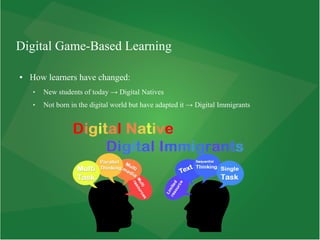
 New students of today → Digital Natives
 Not born in the digital world but have adapted it → Digital Immigrants
Digital Game-Based Learning
 Ten ways digital natives are different:
 Twitch speed vs. Conventional Speed
 Parallel processing vs. Linear Processing
 Random Access vs. Linear Thinking
 Graphics First vs. Text First
 Connected vs. Stand-Alone
 Active vs. Passive
 Payoff vs. Patience
 Fantasy vs. Reality
 Play vs. Work
 Technology as Friend vs. Technology as Foe
Digital Game-Based Learning
● Why it works:
 Engaging process → main reason children play
 Motivating elements → fun, play, rules, goals, interactivity, adaptivity,
conflict/competition/challenge/opposition, characters and story, ...
 Engaging power of computer games vs. Set of interactive learning processes → learning
package
 Content vs. Player → well-matched
Digital Game-Based Learning
● Effectiveness:
 How effective is digital game-based learning?
 The measure of effectiveness (“true learning”) → behaviour change
 Digital game-based learning method vs. Other methods → head to head comparison
 Practice → key success of mastering the game
Digital Game-Based Learning
● Designing Games as Learning Tools:
 Why it is hard?
 Fun of a real game & Educational content → not an easy task
 Designer:
 Entertainment game
 Educational game
Digital Game-Based Learning
● Known Risks of digital game-based learning:
 Long time standing in front of video games
 Players try more to win than to learn
 Employees do not focus on collaboration
 Aggressive Content & Graphic violence
 Affection on behaviour, thoughts, problem-solving styles and social skills of
children
 Affection on player's emotional state → hostility and anxiety
 Monetary issues
 Pupils spend their school money
 Pupils steal money from their parents
Mobile-Based Learning
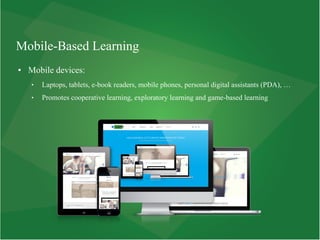
● Mobile devices:
 Laptops, tablets, e-book readers, mobile phones, personal digital assistants (PDA), …
 Promotes cooperative learning, exploratory learning and game-based learning
Mobile-Based Learning
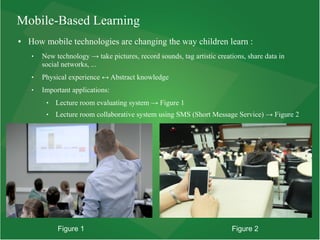
● How mobile technologies are changing the way children learn :
 New technology → take pictures, record sounds, tag artistic creations, share data in
social networks, ...
 Physical experience ↔ Abstract knowledge
 Important applications:
 Lecture room evaluating system → Figure 1
 Lecture room collaborative system using SMS (Short Message Service) → Figure 2
Figure 1 Figure 2
Mobile-Based Learning
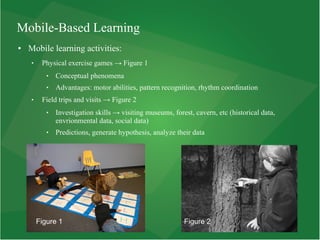
● Mobile learning activities:
 Physical exercise games → Figure 1
 Conceptual phenomena
 Advantages: motor abilities, pattern recognition, rhythm coordination
 Field trips and visits → Figure 2
 Investigation skills → visiting museums, forest, cavern, etc (historical data,
envrionmental data, social data)
 Predictions, generate hypothesis, analyze their data
Figure 1 Figure 2
Mobile-Based Learning
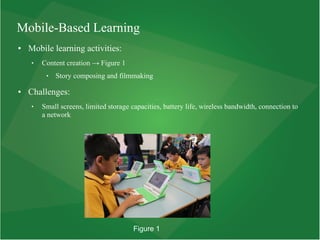
● Mobile learning activities:
 Content creation → Figure 1
 Story composing and filmmaking
Figure 1
● Challenges:
 Small screens, limited storage capacities, battery life, wireless bandwidth, connection to
a network
Innovative Technologies for Education and Learning
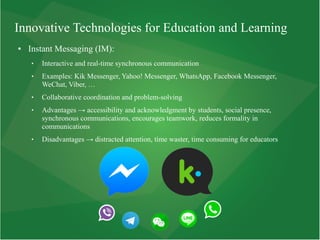
● Instant Messaging (IM):
 Interactive and real-time synchronous communication
 Examples: Kik Messenger, Yahoo! Messenger, WhatsApp, Facebook Messenger,
WeChat, Viber, …
 Collaborative coordination and problem-solving
 Advantages → accessibility and acknowledgment by students, social presence,
synchronous communications, encourages teamwork, reduces formality in
communications
 Disadvantages → distracted attention, time waster, time consuming for educators
Innovative Technologies for Education and Learning
● Blogs (Weblogs):
 Documentation of learning, Critical reflection, Self-investigation
 Different forms:
 The personal journal/diary
 Knowledge-based logs
 Filter blogs
 Benefits of Weblogs → use learning approaches and conceptions of:
 Guided discovery
 Directive learning
 Receptive learning
 Advantages → reflection and critical thinking are encouraged, social presence,
development of learning community, active learning
 Disadvantages → controlled primarily by blog author, editing/modifications not open as
in wiki
Prototype – 1x1 Trainer Flic
● Overview
● Main Concept
● Focus
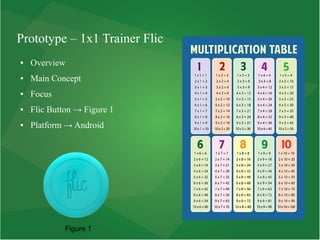
● Flic Button → Figure 1
● Platform → Android
Figure 1
Prototype – 1x1 Trainer Flic
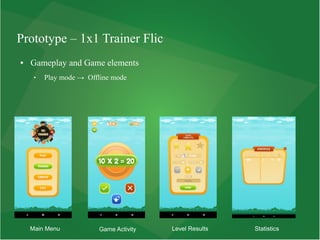
● Gameplay and Game elements
 Play mode → Offline mode
Main Menu Game Activity Level Results Statistics
Prototype – 1x1 Trainer Flic
● Gameplay and Game elements
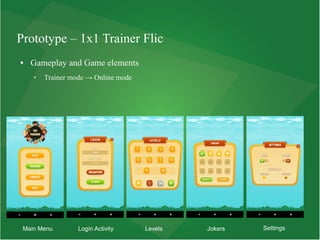
 Trainer mode → Online mode
Main Menu Login Activity Levels Jokers Settings
Prototype – 1x1 Trainer Flic
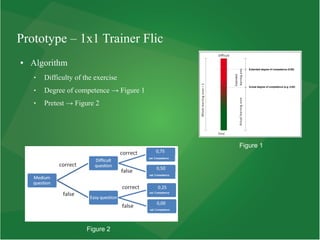
● Algorithm
 Difficulty of the exercise
 Degree of competence → Figure 1
 Pretest → Figure 2
Figure 1
Figure 2
Prototype – 1x1 Trainer Flic
● Algorithm
 Classification of answers
 0 → wrong answer
 1 → the user knew the right answer once
 2 → the user gave two correct answers in sequence (well-known)
 Selection of questions
 Three categories from which the questions are generated:
 Extended and Actual Learning Area (questions written with 0)
 Actual Learning Area (questions written with 1)
 Actual Learning Area (questions written with 2)
 A random number out of 0 and 1 is chosen to decide which category is initiated. There are three
conditions:
 Condition 1 – if the random number x <= 0,05 a well-known question (2) is selected
 Condition 2 – if the random number is 0,05 > x >= 0,15 a known question (1) is selected
 Condition 3 – if the random number is x > 0,15 an unknown question not in extended and actual learning
area is selected
Prototype – 1x1 Trainer Flic
● Evaluation
 Evaluation arrangement
 Game presentation
 Game activity
 Evaluation
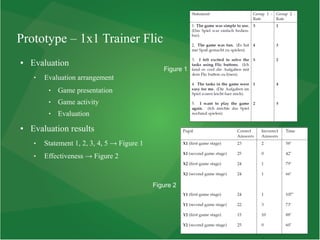
● Evaluation results
 Statement 1, 2, 3, 4, 5 → Figure 1
 Effectiveness → Figure 2
Figure 1
Figure 2
Thank You!

A Mobile Application for School Children controlled by External Bluetooth Devices

  • 1.
    A Mobile Applicationfor School Children controlled by External Bluetooth Devices Valdrin Maloku Supervisor: Priv.-Doz. Dipl.-Ing.Dr.techn. Martin Ebner June, 2018 MASTERS THESIS DEFENSE
  • 2.
    Outline ● Introduction ● DigitalGame-Based Learning ● Mobile-Based Learning ● Innovative Technologies for Education and Learning ● Prototype – 1x1 Trainer Flic ● Evaluation and Results
  • 3.
    Introduction ● Learning dimensionsof computer games ● Main research questions:  How can seamless learning be effective using innovative devices for learning mathematics?  What can be concluded from the evaluation of the learning activity in a third school class?
  • 4.
    Digital Game-Based Learning ●Why use games for learning:  Why game design and adoption is needed as vehicles for learning "serious" content and subject matter?  Our learners have changed radically (different minds from their parents)  These learners need to be motivated in new ways (motivation & engagement)
  • 5.
    Digital Game-Based Learning ●How learners have changed:  New students of today → Digital Natives  Not born in the digital world but have adapted it → Digital Immigrants
  • 6.
    Digital Game-Based Learning Ten ways digital natives are different:  Twitch speed vs. Conventional Speed  Parallel processing vs. Linear Processing  Random Access vs. Linear Thinking  Graphics First vs. Text First  Connected vs. Stand-Alone  Active vs. Passive  Payoff vs. Patience  Fantasy vs. Reality  Play vs. Work  Technology as Friend vs. Technology as Foe
  • 7.
    Digital Game-Based Learning ●Why it works:  Engaging process → main reason children play  Motivating elements → fun, play, rules, goals, interactivity, adaptivity, conflict/competition/challenge/opposition, characters and story, ...  Engaging power of computer games vs. Set of interactive learning processes → learning package  Content vs. Player → well-matched
  • 8.
    Digital Game-Based Learning ●Effectiveness:  How effective is digital game-based learning?  The measure of effectiveness (“true learning”) → behaviour change  Digital game-based learning method vs. Other methods → head to head comparison  Practice → key success of mastering the game
  • 9.
    Digital Game-Based Learning ●Designing Games as Learning Tools:  Why it is hard?  Fun of a real game & Educational content → not an easy task  Designer:  Entertainment game  Educational game
  • 10.
    Digital Game-Based Learning ●Known Risks of digital game-based learning:  Long time standing in front of video games  Players try more to win than to learn  Employees do not focus on collaboration  Aggressive Content & Graphic violence  Affection on behaviour, thoughts, problem-solving styles and social skills of children  Affection on player's emotional state → hostility and anxiety  Monetary issues  Pupils spend their school money  Pupils steal money from their parents
  • 11.
    Mobile-Based Learning ● Mobiledevices:  Laptops, tablets, e-book readers, mobile phones, personal digital assistants (PDA), …  Promotes cooperative learning, exploratory learning and game-based learning
  • 12.
    Mobile-Based Learning ● Howmobile technologies are changing the way children learn :  New technology → take pictures, record sounds, tag artistic creations, share data in social networks, ...  Physical experience ↔ Abstract knowledge  Important applications:  Lecture room evaluating system → Figure 1  Lecture room collaborative system using SMS (Short Message Service) → Figure 2 Figure 1 Figure 2
  • 13.
    Mobile-Based Learning ● Mobilelearning activities:  Physical exercise games → Figure 1  Conceptual phenomena  Advantages: motor abilities, pattern recognition, rhythm coordination  Field trips and visits → Figure 2  Investigation skills → visiting museums, forest, cavern, etc (historical data, envrionmental data, social data)  Predictions, generate hypothesis, analyze their data Figure 1 Figure 2
  • 14.
    Mobile-Based Learning ● Mobilelearning activities:  Content creation → Figure 1  Story composing and filmmaking Figure 1 ● Challenges:  Small screens, limited storage capacities, battery life, wireless bandwidth, connection to a network
  • 15.
    Innovative Technologies forEducation and Learning ● Instant Messaging (IM):  Interactive and real-time synchronous communication  Examples: Kik Messenger, Yahoo! Messenger, WhatsApp, Facebook Messenger, WeChat, Viber, …  Collaborative coordination and problem-solving  Advantages → accessibility and acknowledgment by students, social presence, synchronous communications, encourages teamwork, reduces formality in communications  Disadvantages → distracted attention, time waster, time consuming for educators
  • 16.
    Innovative Technologies forEducation and Learning ● Blogs (Weblogs):  Documentation of learning, Critical reflection, Self-investigation  Different forms:  The personal journal/diary  Knowledge-based logs  Filter blogs  Benefits of Weblogs → use learning approaches and conceptions of:  Guided discovery  Directive learning  Receptive learning  Advantages → reflection and critical thinking are encouraged, social presence, development of learning community, active learning  Disadvantages → controlled primarily by blog author, editing/modifications not open as in wiki
  • 17.
    Prototype – 1x1Trainer Flic ● Overview ● Main Concept ● Focus ● Flic Button → Figure 1 ● Platform → Android Figure 1
  • 18.
    Prototype – 1x1Trainer Flic ● Gameplay and Game elements  Play mode → Offline mode Main Menu Game Activity Level Results Statistics
  • 19.
    Prototype – 1x1Trainer Flic ● Gameplay and Game elements  Trainer mode → Online mode Main Menu Login Activity Levels Jokers Settings
  • 20.
    Prototype – 1x1Trainer Flic ● Algorithm  Difficulty of the exercise  Degree of competence → Figure 1  Pretest → Figure 2 Figure 1 Figure 2
  • 21.
    Prototype – 1x1Trainer Flic ● Algorithm  Classification of answers  0 → wrong answer  1 → the user knew the right answer once  2 → the user gave two correct answers in sequence (well-known)  Selection of questions  Three categories from which the questions are generated:  Extended and Actual Learning Area (questions written with 0)  Actual Learning Area (questions written with 1)  Actual Learning Area (questions written with 2)  A random number out of 0 and 1 is chosen to decide which category is initiated. There are three conditions:  Condition 1 – if the random number x <= 0,05 a well-known question (2) is selected  Condition 2 – if the random number is 0,05 > x >= 0,15 a known question (1) is selected  Condition 3 – if the random number is x > 0,15 an unknown question not in extended and actual learning area is selected
  • 22.
    Prototype – 1x1Trainer Flic ● Evaluation  Evaluation arrangement  Game presentation  Game activity  Evaluation ● Evaluation results  Statement 1, 2, 3, 4, 5 → Figure 1  Effectiveness → Figure 2 Figure 1 Figure 2
  • 23.