1
S C I E N C E ◼ P A S S I O N ◼ T E C H N O L O G Y
u www.tugraz.at
Learning Analytics and Spelling
Acquisition in German –
the Path to Individualization in Learning
Markus Ebner, Konstanze Edtstadler and Martin Ebner
22
Outline
• Introduction to IDeRBlog
• Background
• Goals of the project
• Individualization in Learning
• Extension of the Intelligent Dictionary
• A new Training Format
• Example: incorrect spelled words
• Walkthrough
• Outlook
33
IDeRBlog & IDeRBlog ii
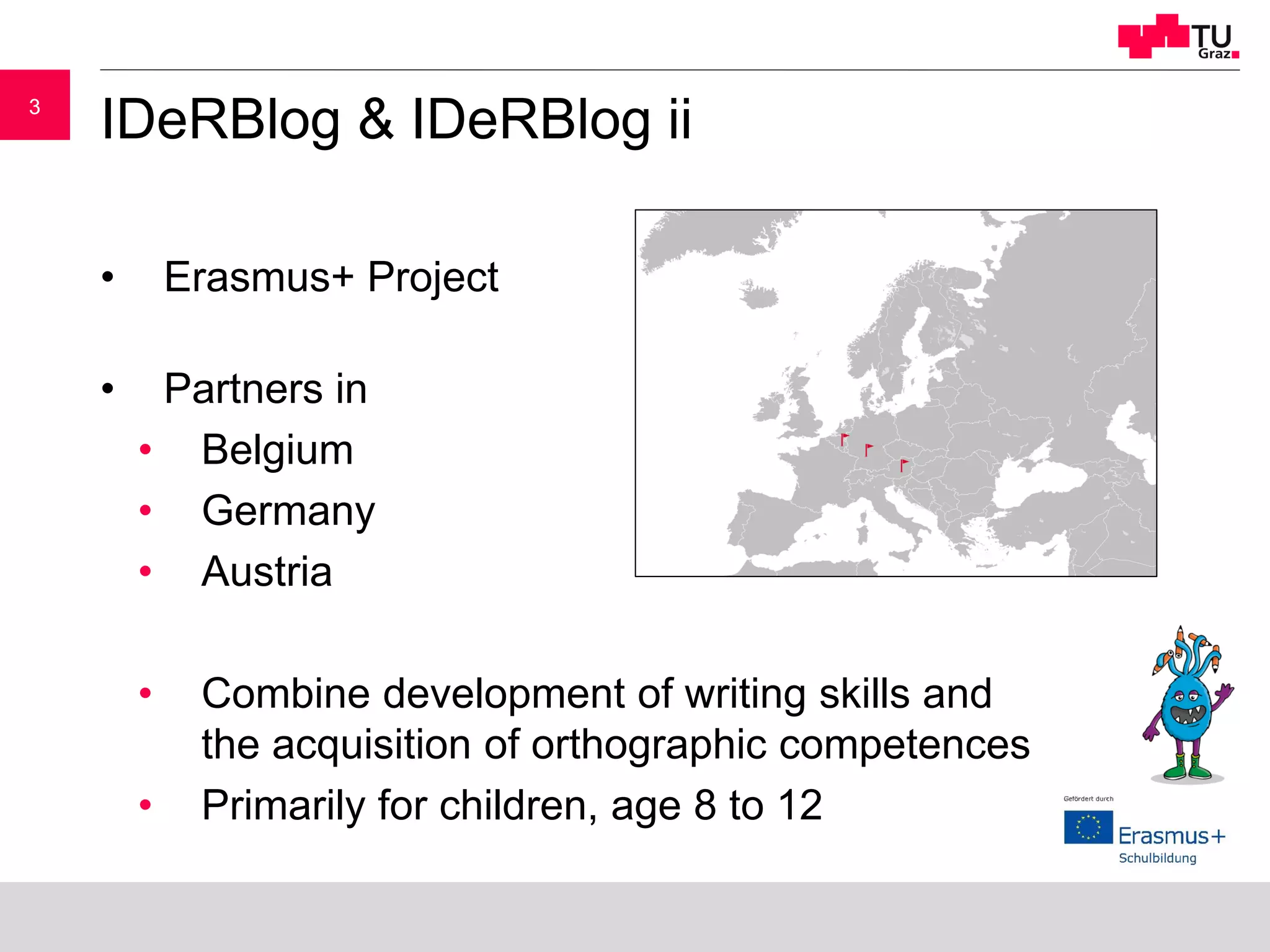
• Erasmus+ Project
• Partners in
• Belgium
• Germany
• Austria
• Combine development of writing skills and
the acquisition of orthographic competences
• Primarily for children, age 8 to 12
44
Ideas and main points
• User friendly web-based platform
• Writing a text and get automatic feedback for
autonomous correction
• German orthography is known to be difficult to master.
• Help pupils who struggle with the acquisition of
German orthography
• Help them improve writing and spelling
• Provide qualitative analysis of orthographic
problems for teachers
• Provide exercises for training
55
Goals of IDeRBlog ii
• further implementation in schools in order that more
students can benefit from the platform
• further individualization of the training material to
foster the orthographic competence
• extension of the number of words, which give a
specific feedback for correcting the mistakes
66
Individualization –
Extension of the Intelligent Dictionary
Two strategies:
• (1) Analysing the texts between October 2016 and
October 2019
• Select most frequent correct and incorrect spelled
words
• Implementation into the intelligent dictionary by
deriving all their word forms and the mistakes
corresponding to the categories
77
Individualization –
Extension of the Intelligent Dictionary
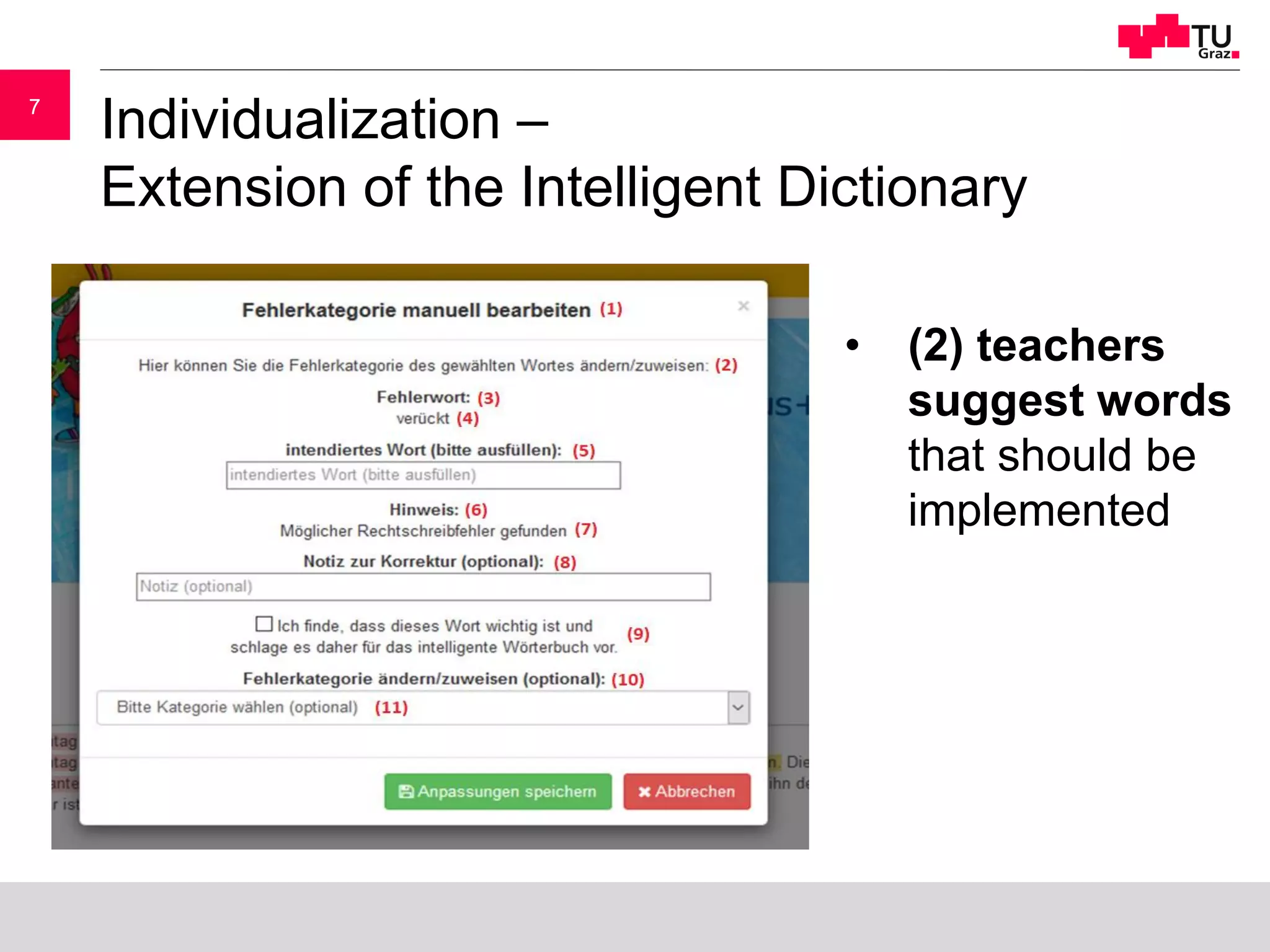
• (2) teachers
suggest words
that should be
implemented
88
Individualization –
A new Training Format
Two approaches:
1. focus on problematic orthographic areas based
on the qualitative analysis of mistakes
2. train the specific words that are spelled
incorrectly
99
Example: incorrect spelled words
• to train incorrectly spelled words, a specific didactic
approach is necessary
• it is not enough to just read the words or write them
several times.
• the words should be trained by applying the strategy
of conscious copying
• taking into account specific problematic positions in
a word
• Advantage of digital format: words that need to be
trained are chosen automatically by the system
1010
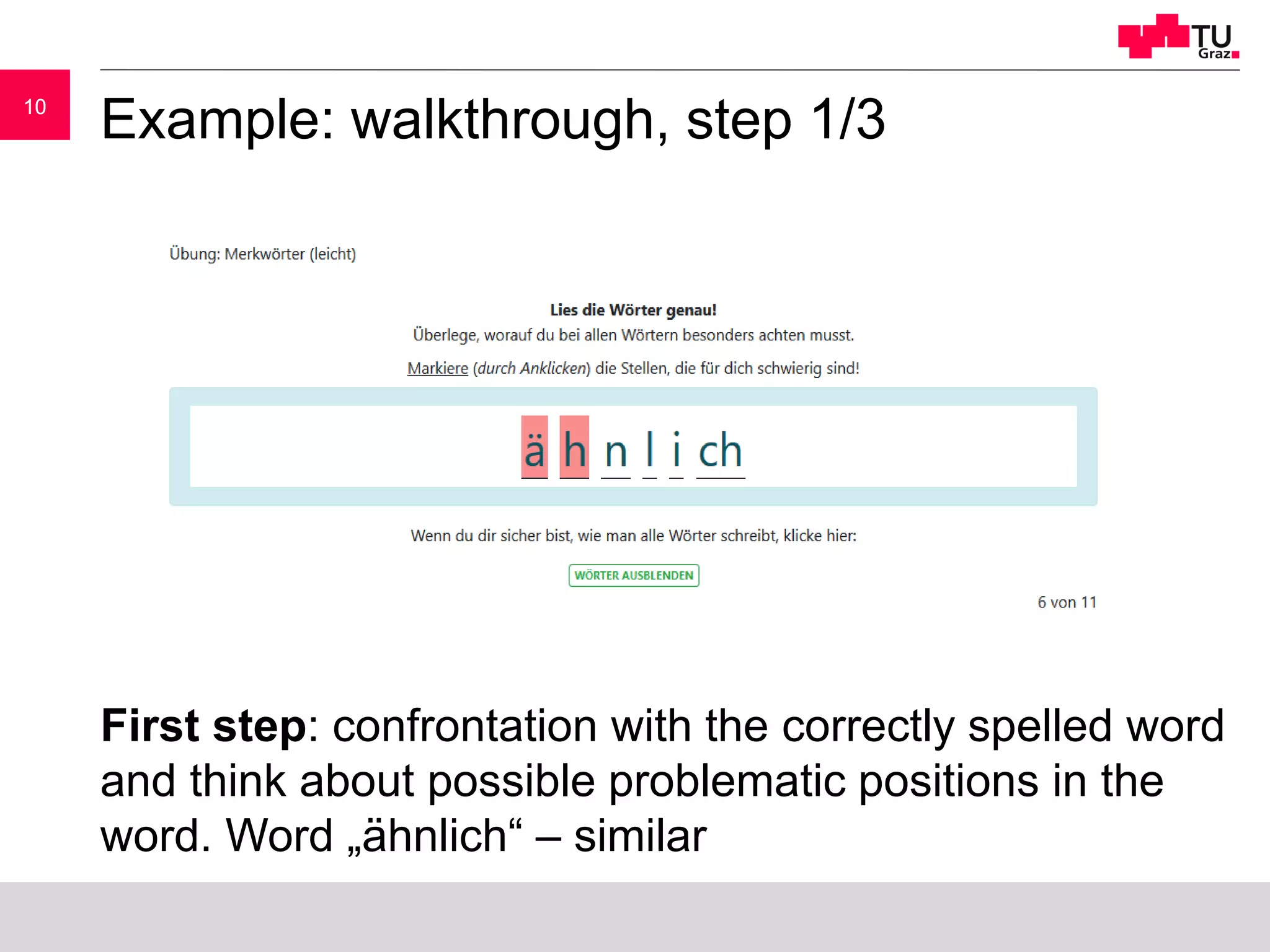
Example: walkthrough, step 1/3
First step: confrontation with the correctly spelled word
and think about possible problematic positions in the
word. Word „ähnlich“ – similar
1111
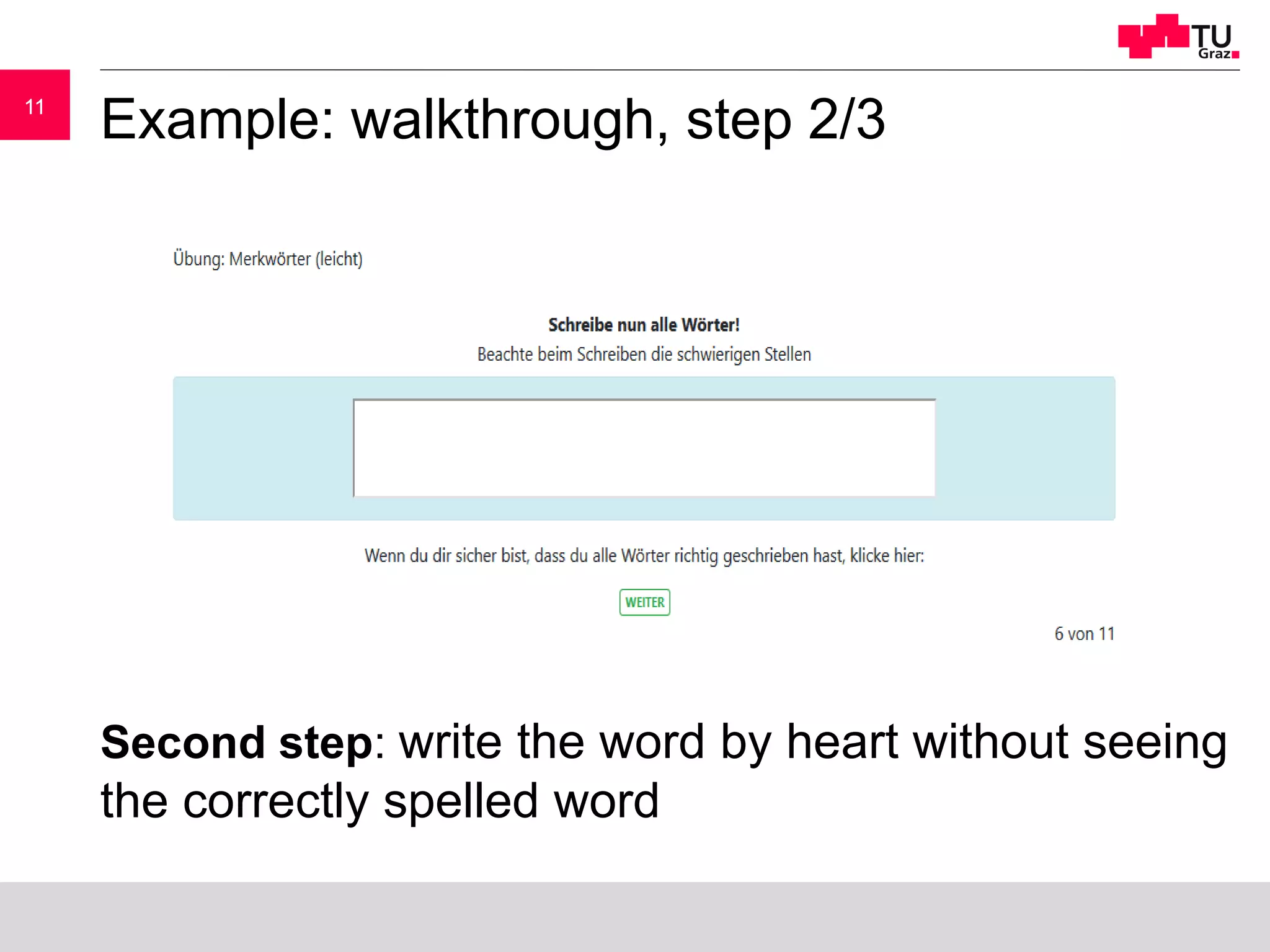
Example: walkthrough, step 2/3
Second step: write the word by heart without seeing
the correctly spelled word
1212
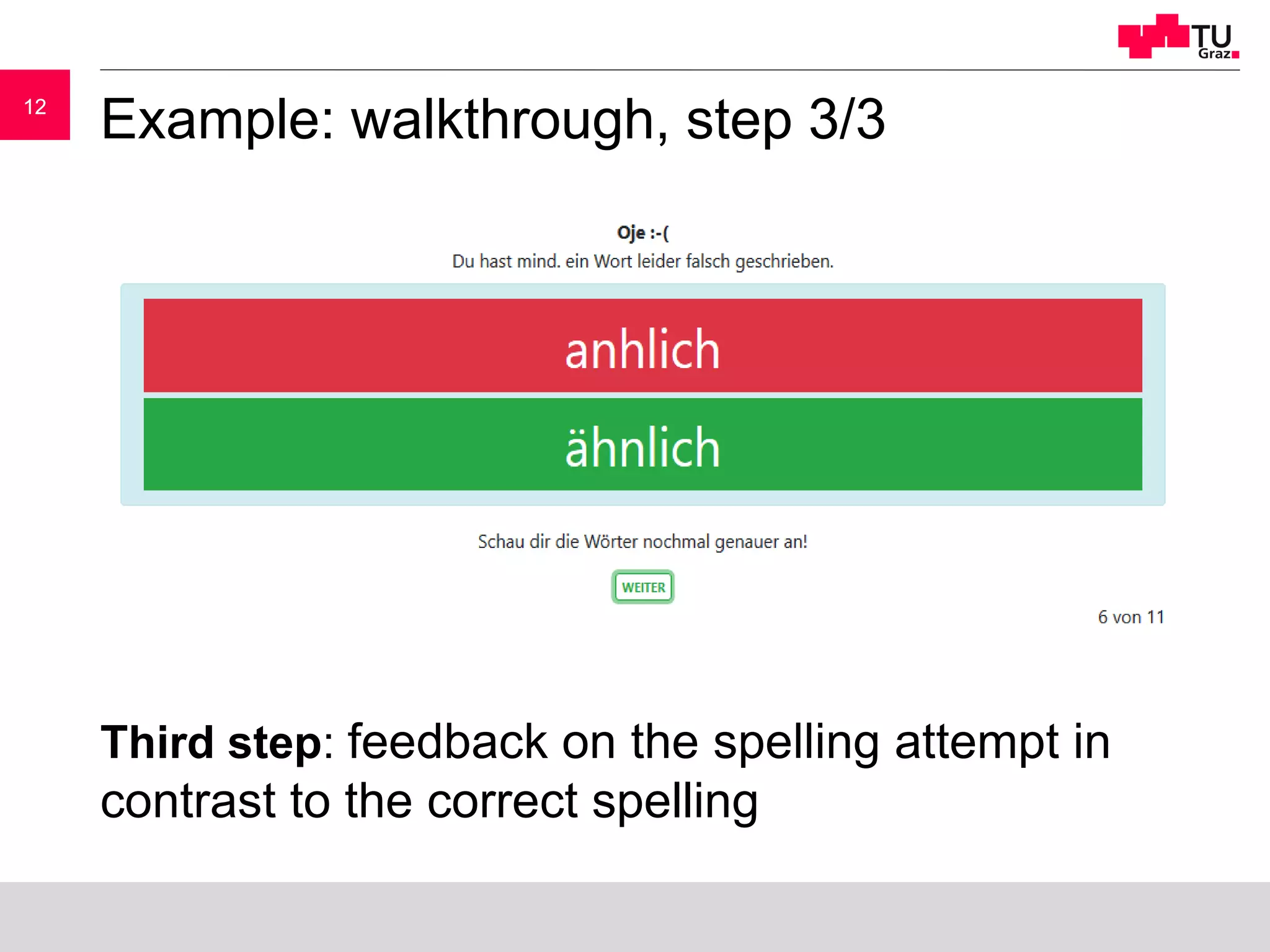
Example: walkthrough, step 3/3
Third step: feedback on the spelling attempt in
contrast to the correct spelling
1313
Possible modifications
• Number of presented words
• Up to five words can be presented at the same
time in the first step.
• Marking of problematic positions
• Can be deactivated
• Time limit
• Optionally definable
• Presentation of misspelled words
• Only show the correctly spelled word
1414
Outlook
• Currently we work on developing additional
training formats and on extending the intelligent
dictionary
• we are working on the extension of the intelligent
dictionary by analyzing the texts written so far
• Interesting topic: Corona crisis and IDeRBlog
1515
Educational Technology
• Slides available at:
• http://elearningblog.tugraz.at
• For further information about the project and
partners please visit:
• http://iderblog.eu
• http://elearning.tugraz.at
• https://www.tugraz.at/en/
oe/lehr-und-lerntechnologien/home/
1616
Acknowledgements
The IDeRBlog-project and the IDeRBlog-ii project are funded by the European
Commission in the framework of Erasmus+ (IDeRBlog: VG-SPS-SL-14-001616-
3, 2014-2017; IDeRBlog-ii: VG-IN-SL-18-36-047317, 2018-2021).
Project-team of IDeRBlog ii:
Germany: LPM Saarland (M. Gros = coordinator, N. Steinhauer); Gebundene
Ganztagsschule Dellengarten (S. Pfeifer, J. Gregori);
Austria: PH Steiermark (K. Edtstadler, E. Herunter); TU Graz (M. Ebner, M.
Ebner);
Belgium: Gemeindeschule Raeren (A. Huppertz, V. Kistemann);

Learning Analytics and Spelling Acquisition in German - the Path to Indivdualization in Learning

  • 1.
    1 S C IE N C E ◼ P A S S I O N ◼ T E C H N O L O G Y u www.tugraz.at Learning Analytics and Spelling Acquisition in German – the Path to Individualization in Learning Markus Ebner, Konstanze Edtstadler and Martin Ebner
  • 2.
    22 Outline • Introduction toIDeRBlog • Background • Goals of the project • Individualization in Learning • Extension of the Intelligent Dictionary • A new Training Format • Example: incorrect spelled words • Walkthrough • Outlook
  • 3.
    33 IDeRBlog & IDeRBlogii • Erasmus+ Project • Partners in • Belgium • Germany • Austria • Combine development of writing skills and the acquisition of orthographic competences • Primarily for children, age 8 to 12
  • 4.
    44 Ideas and mainpoints • User friendly web-based platform • Writing a text and get automatic feedback for autonomous correction • German orthography is known to be difficult to master. • Help pupils who struggle with the acquisition of German orthography • Help them improve writing and spelling • Provide qualitative analysis of orthographic problems for teachers • Provide exercises for training
  • 5.
    55 Goals of IDeRBlogii • further implementation in schools in order that more students can benefit from the platform • further individualization of the training material to foster the orthographic competence • extension of the number of words, which give a specific feedback for correcting the mistakes
  • 6.
    66 Individualization – Extension ofthe Intelligent Dictionary Two strategies: • (1) Analysing the texts between October 2016 and October 2019 • Select most frequent correct and incorrect spelled words • Implementation into the intelligent dictionary by deriving all their word forms and the mistakes corresponding to the categories
  • 7.
    77 Individualization – Extension ofthe Intelligent Dictionary • (2) teachers suggest words that should be implemented
  • 8.
    88 Individualization – A newTraining Format Two approaches: 1. focus on problematic orthographic areas based on the qualitative analysis of mistakes 2. train the specific words that are spelled incorrectly
  • 9.
    99 Example: incorrect spelledwords • to train incorrectly spelled words, a specific didactic approach is necessary • it is not enough to just read the words or write them several times. • the words should be trained by applying the strategy of conscious copying • taking into account specific problematic positions in a word • Advantage of digital format: words that need to be trained are chosen automatically by the system
  • 10.
    1010 Example: walkthrough, step1/3 First step: confrontation with the correctly spelled word and think about possible problematic positions in the word. Word „ähnlich“ – similar
  • 11.
    1111 Example: walkthrough, step2/3 Second step: write the word by heart without seeing the correctly spelled word
  • 12.
    1212 Example: walkthrough, step3/3 Third step: feedback on the spelling attempt in contrast to the correct spelling
  • 13.
    1313 Possible modifications • Numberof presented words • Up to five words can be presented at the same time in the first step. • Marking of problematic positions • Can be deactivated • Time limit • Optionally definable • Presentation of misspelled words • Only show the correctly spelled word
  • 14.
    1414 Outlook • Currently wework on developing additional training formats and on extending the intelligent dictionary • we are working on the extension of the intelligent dictionary by analyzing the texts written so far • Interesting topic: Corona crisis and IDeRBlog
  • 15.
    1515 Educational Technology • Slidesavailable at: • http://elearningblog.tugraz.at • For further information about the project and partners please visit: • http://iderblog.eu • http://elearning.tugraz.at • https://www.tugraz.at/en/ oe/lehr-und-lerntechnologien/home/
  • 16.
    1616 Acknowledgements The IDeRBlog-project andthe IDeRBlog-ii project are funded by the European Commission in the framework of Erasmus+ (IDeRBlog: VG-SPS-SL-14-001616- 3, 2014-2017; IDeRBlog-ii: VG-IN-SL-18-36-047317, 2018-2021). Project-team of IDeRBlog ii: Germany: LPM Saarland (M. Gros = coordinator, N. Steinhauer); Gebundene Ganztagsschule Dellengarten (S. Pfeifer, J. Gregori); Austria: PH Steiermark (K. Edtstadler, E. Herunter); TU Graz (M. Ebner, M. Ebner); Belgium: Gemeindeschule Raeren (A. Huppertz, V. Kistemann);