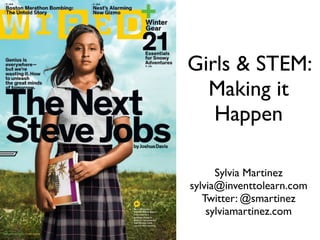
Girls & STEM:
Making it
Happen
Sylvia Martinez
sylvia@inventtolearn.com
Twitter: @smartinez
sylviamartinez.com
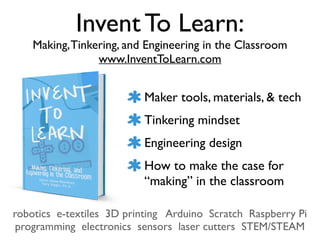
Invent To Learn:
Making,Tinkering, and Engineering in the Classroom
www.InventToLearn.com
Maker tools, materials, & tech
Tinkering mindset
Engineering design
How to make the case for
“making” in the classroom
robotics e-textiles 3D printing Arduino Scratch Raspberry Pi
programming electronics sensors laser cutters STEM/STEAM
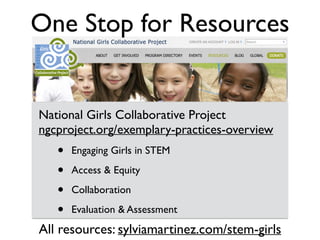
National Girls Collaborative Project

ngcproject.org/exemplary-practices-overview
• Engaging Girls in STEM
• Access & Equity
• Collaboration
• Evaluation & Assessment
One Stop for Resources
All resources: sylviamartinez.com/stem-girls
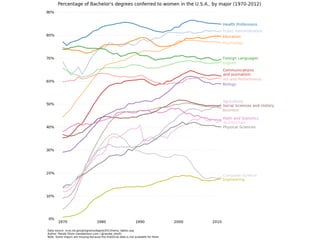
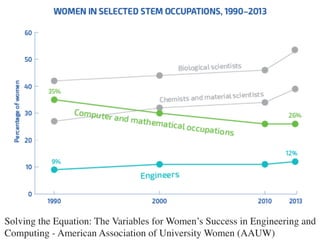
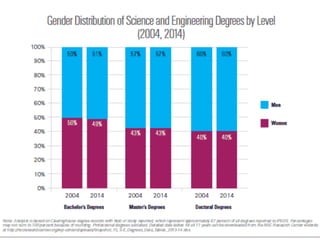
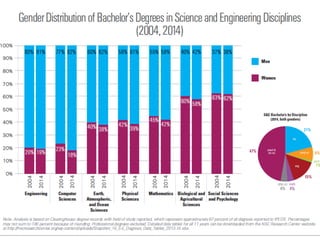
Sobering Statistics about
Women and STEM Jobs
• "Women have seen no employment growth in
STEM jobs since 2000" - Forbes.
• Women leave STEM jobs at a significantly higher
rate then men - often citing gender issues
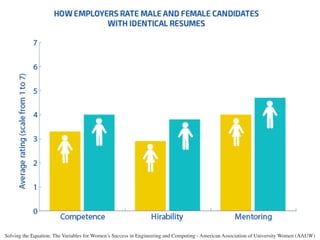
Solving the Equation: The Variables for Women’s Success in Engineering and
Computing - American Association of University Women (AAUW)
Securing Australia’s Future STEM: Country Comparisons - Australian Council of Learned Academies
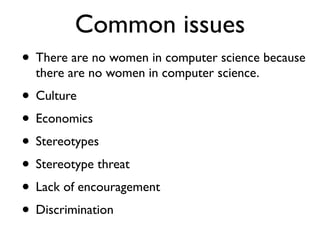
Common issues
• There are no women in computer science because
there are no women in computer science.
• Culture
• Economics
• Stereotypes
• Stereotype threat
• Lack of encouragement
• Discrimination
Solving the Equation: The Variables for Women’s Success in Engineering and Computing - American Association of University Women (AAUW)
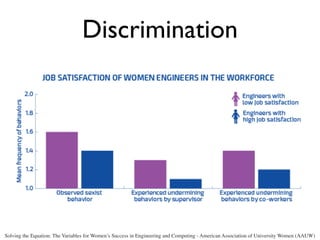
Discrimination
Solving the Equation: The Variables for Women’s Success in Engineering and Computing - American Association of University Women (AAUW)
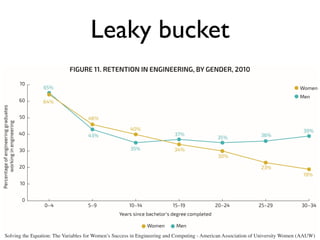
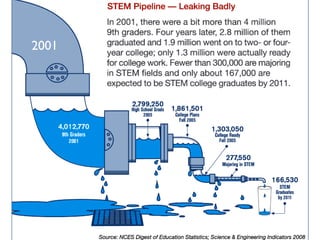
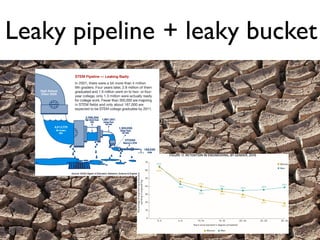
Leaky bucket
Solving the Equation: The Variables for Women’s Success in Engineering and Computing - American Association of University Women (AAUW)
2001
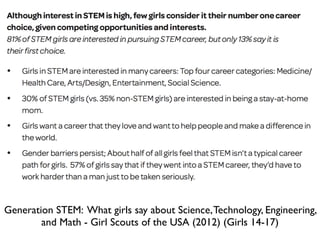
Generation STEM: What girls say about Science,Technology, Engineering,
and Math - Girl Scouts of the USA (2012) (Girls 14-17)
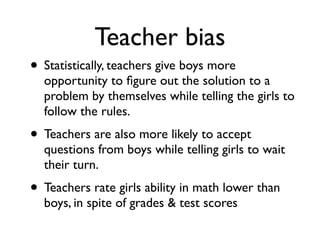
Teacher bias
• Statistically, teachers give boys more
opportunity to figure out the solution to a
problem by themselves while telling the girls to
follow the rules.
• Teachers are also more likely to accept
questions from boys while telling girls to wait
their turn.
• Teachers rate girls ability in math lower than
boys, in spite of grades & test scores
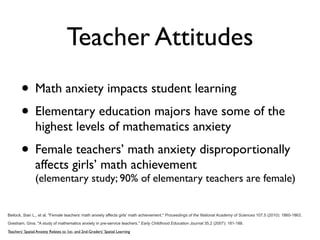
Teacher Attitudes
• Math anxiety impacts student learning
• Elementary education majors have some of the
highest levels of mathematics anxiety
• Female teachers’ math anxiety disproportionally
affects girls’ math achievement 

(elementary study; 90% of elementary teachers are female)
Beilock, Sian L., et al. "Female teachers’ math anxiety affects girls’ math achievement." Proceedings of the National Academy of Sciences 107.5 (2010): 1860-1863.
Gresham, Gina. "A study of mathematics anxiety in pre-service teachers." Early Childhood Education Journal 35.2 (2007): 181-188.
Teachers’ Spatial Anxiety Relates to 1st- and 2nd-Graders’ Spatial Learning
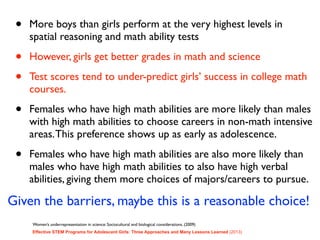
• More boys than girls perform at the very highest levels in
spatial reasoning and math ability tests
• However, girls get better grades in math and science
• Test scores tend to under-predict girls’ success in college math
courses.
• Females who have high math abilities are more likely than males
with high math abilities to choose careers in non-math intensive
areas.This preference shows up as early as adolescence.
• Females who have high math abilities are also more likely than
males who have high math abilities to also have high verbal
abilities, giving them more choices of majors/careers to pursue.
Given the barriers, maybe this is a reasonable choice!
Women’s underrepresentation in science: Sociocultural and biological considerations. (2009)
Effective STEM Programs for Adolescent Girls: Three Approaches and Many Lessons Learned (2013)
Leaky pipeline + leaky bucket
What can we do?
Girls more likely to:
• Girls are more likely to look to the teacher for
clues on how to behave or what to choose
• Collaborate & strive for consensus
• Let others take credit
• Take the blame
• Decline to compete for scarce materials
• Take on organizational roles
• Be compliant and adapt
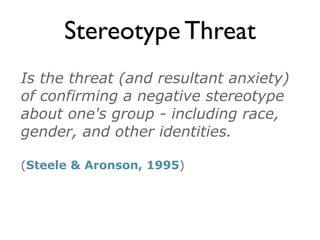
Stereotype Threat
Is the threat (and resultant anxiety)
of confirming a negative stereotype
about one's group - including race,
gender, and other identities.
(Steele & Aronson, 1995)
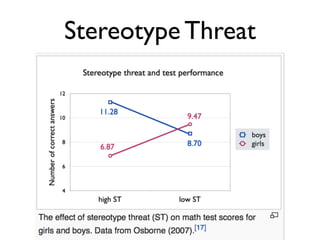
Stereotype Threat
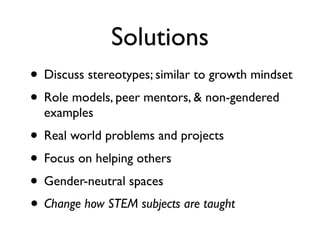
Solutions
• Discuss stereotypes; similar to growth mindset
• Role models, peer mentors, & non-gendered
examples
• Real world problems and projects
• Focus on helping others
• Gender-neutral spaces
• Change how STEM subjects are taught
Problem Solving
• Dr. Seymour Papert defined two
styles of problem solving:
analytical and bricolage
• Bricolage - French for tinkering,
using found objects, playfulness
in creation
• Higher grades = more analytical
• Real world is both
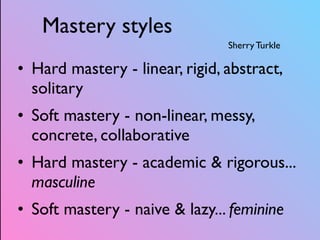
Mastery styles
Sherry Turkle
• Hard mastery - linear, rigid, abstract,
solitary
• Soft mastery - non-linear, messy,
concrete, collaborative
• Hard mastery - academic & rigorous...
masculine
• Soft mastery - naive & lazy... feminine
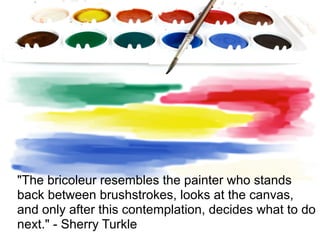
"The bricoleur resembles the painter who stands
back between brushstrokes, looks at the canvas,
and only after this contemplation, decides what to do
next." - Sherry Turkle
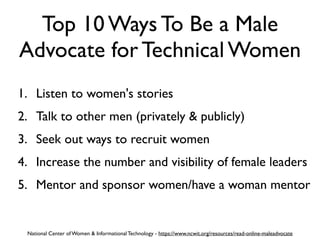
Top 10 Ways To Be a Male
Advocate for Technical Women
1. Listen to women's stories
2. Talk to other men (privately & publicly)
3. Seek out ways to recruit women
4. Increase the number and visibility of female leaders
5. Mentor and sponsor women/have a woman mentor
National Center of Women & Informational Technology - https://www.ncwit.org/resources/read-online-maleadvocate
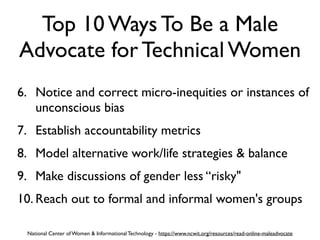
Top 10 Ways To Be a Male
Advocate for Technical Women
6. Notice and correct micro-inequities or instances of
unconscious bias
7. Establish accountability metrics
8. Model alternative work/life strategies & balance
9. Make discussions of gender less “risky"
10. Reach out to formal and informal women's groups
National Center of Women & Informational Technology - https://www.ncwit.org/resources/read-online-maleadvocate
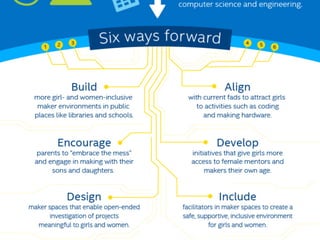
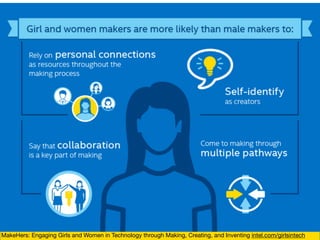
MakeHers: Engaging Girls and Women in Technology through Making, Creating, and Inventing intel.com/girlsintech
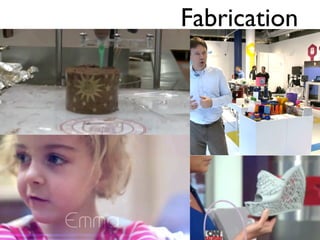
Fabrication
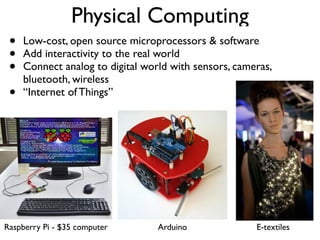
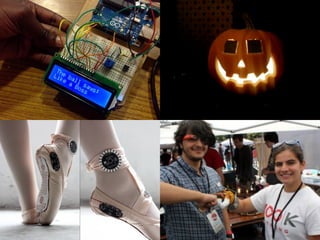
Physical Computing
• Low-cost, open source microprocessors & software
• Add interactivity to the real world
• Connect analog to digital world with sensors, cameras,
bluetooth, wireless
• “Internet of Things”
Raspberry Pi - $35 computer Arduino E-textiles
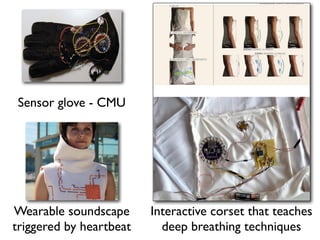
Sensor glove - CMU
Interactive corset that teaches
deep breathing techniques
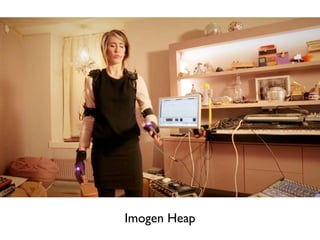
Wearable soundscape
triggered by heartbeat
Imogen Heap
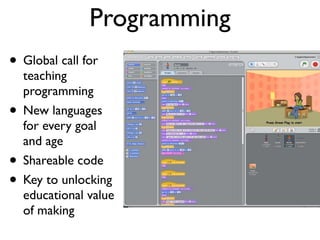
Programming
• Global call for
teaching
programming
• New languages
for every goal
and age
• Shareable code
• Key to unlocking
educational value
of making
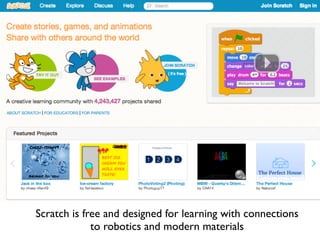
Scratch is free and designed for learning with connections
to robotics and modern materials
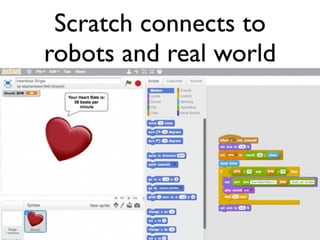
Scratch connects to
robots and real world
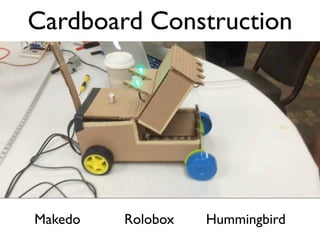
Cardboard Construction
Makedo Rolobox Hummingbird
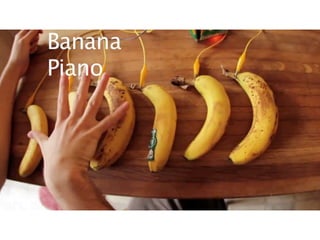
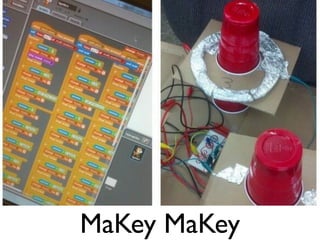
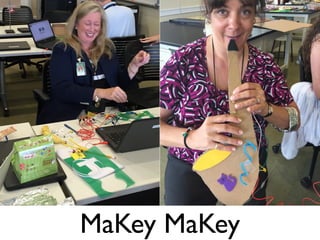
MaKey MaKey
MaKey MaKey
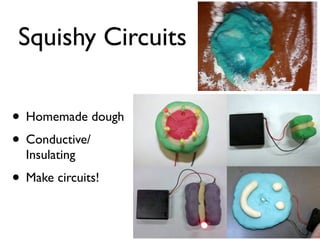
Squishy Circuits
• Homemade dough
• Conductive/
Insulating
• Make circuits!
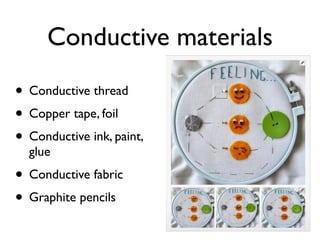
Conductive materials
• Conductive thread
• Copper tape, foil
• Conductive ink, paint,
glue
• Conductive fabric
• Graphite pencils
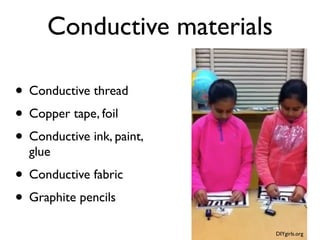
Conductive materials
• Conductive thread
• Copper tape, foil
• Conductive ink, paint,
glue
• Conductive fabric
• Graphite pencils
DIYgirls.org
If	
  technical	
  tinkering,	
  STEM,	
  and	
  digital	
  fabrication	
  are	
  the	
  
economic	
  forces	
  that	
  will	
  empower	
  Makers,	
  and	
  women	
  and	
  
people	
  of	
  color	
  are	
  not	
  participating	
  in	
  these	
  activities	
  in	
  a	
  visible	
  
way,	
  that	
  power	
  will	
  remain	
  unequally	
  distributed.	
  When	
  gender	
  is	
  
discussed	
  in	
  relation	
  to	
  the	
  maker	
  movement,	
  the	
  conversation	
  
starts	
  with	
  the	
  notion	
  that	
  Making	
  creates	
  a	
  unique	
  opportunity	
  
for	
  inclusive	
  participation,	
  and	
  is	
  quickly	
  followed	
  by	
  the	
  question	
  
‘how	
  can	
  we	
  get	
  more	
  women	
  to	
  participate?’	
  Generally,	
  the	
  
responses	
  focus	
  on	
  transforming	
  women,	
  on	
  areas	
  that	
  need	
  to	
  be	
  
corrected,	
  such	
  as	
  raising	
  confidence,	
  creating	
  more	
  woman/girl	
  
friendly	
  learning	
  environments,	
  increasing	
  ability	
  in	
  math	
  and	
  
science,	
  and	
  so	
  on.	
  The	
  women	
  themselves	
  cause	
  the	
  problem;	
  
they	
  lack	
  confidence,	
  they	
  are	
  unable	
  to	
  learn	
  in	
  the	
  ‘normal’	
  STEM	
  
environment,	
  they	
  do	
  not	
  embrace	
  their	
  full	
  capability	
  in	
  math	
  and	
  
science.	
  It	
  is	
  the	
  women	
  who	
  are	
  deficient.
Power,	
  Access,	
  Status:	
  The	
  Discourse	
  of	
  Race,	
  Gender,	
  and	
  Class	
  in	
  the	
  Maker	
  Movement	
  -­‐	
  Lauren	
  Britton	
  
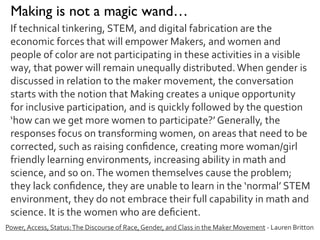
Making is not a magic wand…
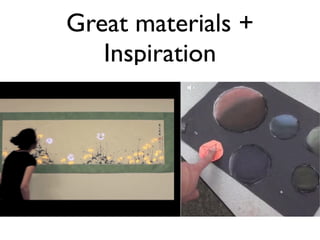
Great materials +
Inspiration
Next Generation
Science Standards
• Significant increase in integration of engineering and
technology from previous science standards
• Elevates engineering design to same level of
importance as scientific inquiry
• Two reasons given:
• Aspirational: Scientific challenges are motivating and
young people want to make the world a better place
• Practical:The process of design is not the same as
the scientific method.
Scantron mathface http://www.flickr.com/photos/schestok/414196453/
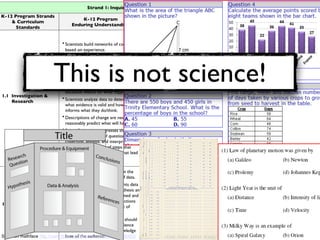
This is not science!
To raise new questions, new possibilities, to regard
old problems from a new angle, requires creative
imagination and marks real advance in science.

Albert Einstein
Girls & STEM
• Embrace all learning styles
• Address stereotypes honestly and give all
students tools to overcome them
• Real world projects
• Address teacher anxiety and biases
• Change how STEM subjects are taught
STEM For All
• Embrace all learning styles
• Address stereotypes honestly and give all
students tools to overcome them
• Real world projects
• Address teacher anxiety and biases
• Change how STEM subjects are taught
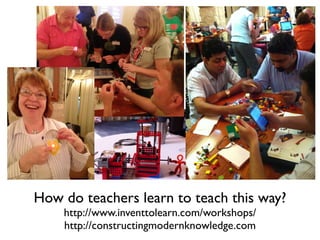
How do teachers learn to teach this way?
http://www.inventtolearn.com/workshops/
http://constructingmodernknowledge.com
Events
Resources
Free stuff
Project ideas
New books
Email newsletter
friend@inventtolearn.com
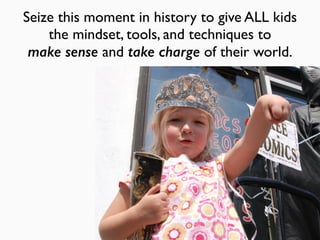
Seize this moment in history to give ALL kids
the mindset, tools, and techniques to
make sense and take charge of their world.
Let’s make it
happen!
www.inventtolearn.com
Sylvia Martinez
sylvia@inventtolearn.com
Twitter: @smartinez
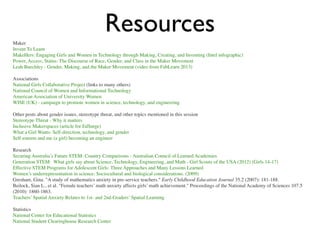
Resources
Maker
Invent To Learn
MakeHers: Engaging Girls and Women in Technology through Making, Creating, and Inventing (Intel infographic)
Power, Access, Status: The Discourse of Race, Gender, and Class in the Maker Movement
Leah Buechley - Gender, Making, and the Maker Movement (video from FabLearn 2013)
Associations
National Girls Collaborative Project (links to many others)
National Council of Women and Informational Technology
American Association of University Women
WISE (UK) - campaign to promote women in science, technology, and engineering
Other posts about gender issues, stereotype threat, and other topics mentioned in this session
Stereotype Threat - Why it matters
Inclusive Makerspaces (article for EdSurge)
What a Girl Wants: Self-direction, technology, and gender
Self-esteem and me (a girl) becoming an engineer
Research
Securing Australia’s Future STEM: Country Comparisons - Australian Council of Learned Academies
Generation STEM:  What girls say about Science, Technology, Engineering, and Math - Girl Scouts of the USA (2012) (Girls 14-17)
Effective STEM Programs for Adolescent Girls: Three Approaches and Many Lessons Learned
Women’s underrepresentation in science: Sociocultural and biological considerations. (2009)
Gresham, Gina. "A study of mathematics anxiety in pre-service teachers." Early Childhood Education Journal 35.2 (2007): 181-188.
Beilock, Sian L., et al. "Female teachers’ math anxiety affects girls’ math achievement." Proceedings of the National Academy of Sciences 107.5
(2010): 1860-1863.
Teachers’ Spatial Anxiety Relates to 1st- and 2nd-Graders’ Spatial Learning
Statistics
National Center for Educational Statistics
National Student Clearinghouse Research Center

Girls & STEM: Making it Happen

  • 1.
    Girls & STEM: Makingit Happen Sylvia Martinez sylvia@inventtolearn.com Twitter: @smartinez sylviamartinez.com
  • 2.
    Invent To Learn: Making,Tinkering,and Engineering in the Classroom www.InventToLearn.com Maker tools, materials, & tech Tinkering mindset Engineering design How to make the case for “making” in the classroom robotics e-textiles 3D printing Arduino Scratch Raspberry Pi programming electronics sensors laser cutters STEM/STEAM
  • 3.
    National Girls CollaborativeProject
 ngcproject.org/exemplary-practices-overview • Engaging Girls in STEM • Access & Equity • Collaboration • Evaluation & Assessment One Stop for Resources All resources: sylviamartinez.com/stem-girls
  • 4.
    Sobering Statistics about Womenand STEM Jobs • "Women have seen no employment growth in STEM jobs since 2000" - Forbes. • Women leave STEM jobs at a significantly higher rate then men - often citing gender issues
  • 6.
    Solving the Equation:The Variables for Women’s Success in Engineering and Computing - American Association of University Women (AAUW)
  • 9.
    Securing Australia’s FutureSTEM: Country Comparisons - Australian Council of Learned Academies
  • 10.
    Common issues • Thereare no women in computer science because there are no women in computer science. • Culture • Economics • Stereotypes • Stereotype threat • Lack of encouragement • Discrimination
  • 11.
    Solving the Equation:The Variables for Women’s Success in Engineering and Computing - American Association of University Women (AAUW)
  • 12.
    Discrimination Solving the Equation:The Variables for Women’s Success in Engineering and Computing - American Association of University Women (AAUW)
  • 13.
    Leaky bucket Solving theEquation: The Variables for Women’s Success in Engineering and Computing - American Association of University Women (AAUW)
  • 14.
  • 15.
    Generation STEM: Whatgirls say about Science,Technology, Engineering, and Math - Girl Scouts of the USA (2012) (Girls 14-17)
  • 16.
    Teacher bias • Statistically,teachers give boys more opportunity to figure out the solution to a problem by themselves while telling the girls to follow the rules. • Teachers are also more likely to accept questions from boys while telling girls to wait their turn. • Teachers rate girls ability in math lower than boys, in spite of grades & test scores
  • 17.
    Teacher Attitudes • Mathanxiety impacts student learning • Elementary education majors have some of the highest levels of mathematics anxiety • Female teachers’ math anxiety disproportionally affects girls’ math achievement 
 (elementary study; 90% of elementary teachers are female) Beilock, Sian L., et al. "Female teachers’ math anxiety affects girls’ math achievement." Proceedings of the National Academy of Sciences 107.5 (2010): 1860-1863. Gresham, Gina. "A study of mathematics anxiety in pre-service teachers." Early Childhood Education Journal 35.2 (2007): 181-188. Teachers’ Spatial Anxiety Relates to 1st- and 2nd-Graders’ Spatial Learning
  • 18.
    • More boysthan girls perform at the very highest levels in spatial reasoning and math ability tests • However, girls get better grades in math and science • Test scores tend to under-predict girls’ success in college math courses. • Females who have high math abilities are more likely than males with high math abilities to choose careers in non-math intensive areas.This preference shows up as early as adolescence. • Females who have high math abilities are also more likely than males who have high math abilities to also have high verbal abilities, giving them more choices of majors/careers to pursue. Given the barriers, maybe this is a reasonable choice! Women’s underrepresentation in science: Sociocultural and biological considerations. (2009) Effective STEM Programs for Adolescent Girls: Three Approaches and Many Lessons Learned (2013)
  • 19.
    Leaky pipeline +leaky bucket
  • 20.
  • 22.
    Girls more likelyto: • Girls are more likely to look to the teacher for clues on how to behave or what to choose • Collaborate & strive for consensus • Let others take credit • Take the blame • Decline to compete for scarce materials • Take on organizational roles • Be compliant and adapt
  • 23.
    Stereotype Threat Is thethreat (and resultant anxiety) of confirming a negative stereotype about one's group - including race, gender, and other identities. (Steele & Aronson, 1995)
  • 24.
  • 25.
    Solutions • Discuss stereotypes;similar to growth mindset • Role models, peer mentors, & non-gendered examples • Real world problems and projects • Focus on helping others • Gender-neutral spaces • Change how STEM subjects are taught
  • 26.
    Problem Solving • Dr.Seymour Papert defined two styles of problem solving: analytical and bricolage • Bricolage - French for tinkering, using found objects, playfulness in creation • Higher grades = more analytical • Real world is both
  • 27.
    Mastery styles Sherry Turkle •Hard mastery - linear, rigid, abstract, solitary • Soft mastery - non-linear, messy, concrete, collaborative • Hard mastery - academic & rigorous... masculine • Soft mastery - naive & lazy... feminine
  • 28.
    "The bricoleur resemblesthe painter who stands back between brushstrokes, looks at the canvas, and only after this contemplation, decides what to do next." - Sherry Turkle
  • 29.
    Top 10 WaysTo Be a Male Advocate for Technical Women 1. Listen to women's stories 2. Talk to other men (privately & publicly) 3. Seek out ways to recruit women 4. Increase the number and visibility of female leaders 5. Mentor and sponsor women/have a woman mentor National Center of Women & Informational Technology - https://www.ncwit.org/resources/read-online-maleadvocate
  • 30.
    Top 10 WaysTo Be a Male Advocate for Technical Women 6. Notice and correct micro-inequities or instances of unconscious bias 7. Establish accountability metrics 8. Model alternative work/life strategies & balance 9. Make discussions of gender less “risky" 10. Reach out to formal and informal women's groups National Center of Women & Informational Technology - https://www.ncwit.org/resources/read-online-maleadvocate
  • 31.
    MakeHers: Engaging Girlsand Women in Technology through Making, Creating, and Inventing intel.com/girlsintech
  • 34.
    MakeHers: Engaging Girlsand Women in Technology through Making, Creating, and Inventing intel.com/girlsintech
  • 35.
  • 40.
    Physical Computing • Low-cost,open source microprocessors & software • Add interactivity to the real world • Connect analog to digital world with sensors, cameras, bluetooth, wireless • “Internet of Things” Raspberry Pi - $35 computer Arduino E-textiles
  • 42.
    Sensor glove -CMU Interactive corset that teaches deep breathing techniques Wearable soundscape triggered by heartbeat
  • 44.
  • 45.
    Programming • Global callfor teaching programming • New languages for every goal and age • Shareable code • Key to unlocking educational value of making
  • 46.
    Scratch is freeand designed for learning with connections to robotics and modern materials
  • 47.
  • 48.
  • 50.
  • 51.
  • 52.
    Squishy Circuits • Homemadedough • Conductive/ Insulating • Make circuits!
  • 53.
    Conductive materials • Conductivethread • Copper tape, foil • Conductive ink, paint, glue • Conductive fabric • Graphite pencils
  • 54.
    Conductive materials • Conductivethread • Copper tape, foil • Conductive ink, paint, glue • Conductive fabric • Graphite pencils DIYgirls.org
  • 57.
    If  technical  tinkering,  STEM,  and  digital  fabrication  are  the   economic  forces  that  will  empower  Makers,  and  women  and   people  of  color  are  not  participating  in  these  activities  in  a  visible   way,  that  power  will  remain  unequally  distributed.  When  gender  is   discussed  in  relation  to  the  maker  movement,  the  conversation   starts  with  the  notion  that  Making  creates  a  unique  opportunity   for  inclusive  participation,  and  is  quickly  followed  by  the  question   ‘how  can  we  get  more  women  to  participate?’  Generally,  the   responses  focus  on  transforming  women,  on  areas  that  need  to  be   corrected,  such  as  raising  confidence,  creating  more  woman/girl   friendly  learning  environments,  increasing  ability  in  math  and   science,  and  so  on.  The  women  themselves  cause  the  problem;   they  lack  confidence,  they  are  unable  to  learn  in  the  ‘normal’  STEM   environment,  they  do  not  embrace  their  full  capability  in  math  and   science.  It  is  the  women  who  are  deficient. Power,  Access,  Status:  The  Discourse  of  Race,  Gender,  and  Class  in  the  Maker  Movement  -­‐  Lauren  Britton   Making is not a magic wand…
  • 58.
  • 60.
    Next Generation Science Standards •Significant increase in integration of engineering and technology from previous science standards • Elevates engineering design to same level of importance as scientific inquiry • Two reasons given: • Aspirational: Scientific challenges are motivating and young people want to make the world a better place • Practical:The process of design is not the same as the scientific method.
  • 61.
  • 62.
    To raise newquestions, new possibilities, to regard old problems from a new angle, requires creative imagination and marks real advance in science. Albert Einstein
  • 63.
    Girls & STEM •Embrace all learning styles • Address stereotypes honestly and give all students tools to overcome them • Real world projects • Address teacher anxiety and biases • Change how STEM subjects are taught
  • 64.
    STEM For All •Embrace all learning styles • Address stereotypes honestly and give all students tools to overcome them • Real world projects • Address teacher anxiety and biases • Change how STEM subjects are taught
  • 65.
    How do teacherslearn to teach this way? http://www.inventtolearn.com/workshops/ http://constructingmodernknowledge.com
  • 67.
    Events Resources Free stuff Project ideas Newbooks Email newsletter friend@inventtolearn.com
  • 68.
    Seize this momentin history to give ALL kids the mindset, tools, and techniques to make sense and take charge of their world.
  • 69.
    Let’s make it happen! www.inventtolearn.com SylviaMartinez sylvia@inventtolearn.com Twitter: @smartinez
  • 70.
    Resources Maker Invent To Learn MakeHers:Engaging Girls and Women in Technology through Making, Creating, and Inventing (Intel infographic) Power, Access, Status: The Discourse of Race, Gender, and Class in the Maker Movement Leah Buechley - Gender, Making, and the Maker Movement (video from FabLearn 2013) Associations National Girls Collaborative Project (links to many others) National Council of Women and Informational Technology American Association of University Women WISE (UK) - campaign to promote women in science, technology, and engineering Other posts about gender issues, stereotype threat, and other topics mentioned in this session Stereotype Threat - Why it matters Inclusive Makerspaces (article for EdSurge) What a Girl Wants: Self-direction, technology, and gender Self-esteem and me (a girl) becoming an engineer Research Securing Australia’s Future STEM: Country Comparisons - Australian Council of Learned Academies Generation STEM:  What girls say about Science, Technology, Engineering, and Math - Girl Scouts of the USA (2012) (Girls 14-17) Effective STEM Programs for Adolescent Girls: Three Approaches and Many Lessons Learned Women’s underrepresentation in science: Sociocultural and biological considerations. (2009) Gresham, Gina. "A study of mathematics anxiety in pre-service teachers." Early Childhood Education Journal 35.2 (2007): 181-188. Beilock, Sian L., et al. "Female teachers’ math anxiety affects girls’ math achievement." Proceedings of the National Academy of Sciences 107.5 (2010): 1860-1863. Teachers’ Spatial Anxiety Relates to 1st- and 2nd-Graders’ Spatial Learning Statistics National Center for Educational Statistics National Student Clearinghouse Research Center