Prominent Indian Women
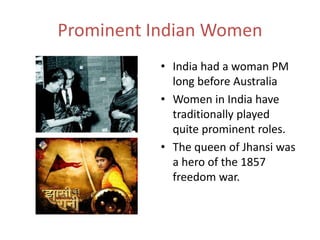
• India had a woman PM
long before Australia
• Women in India have
traditionally played
quite prominent roles.
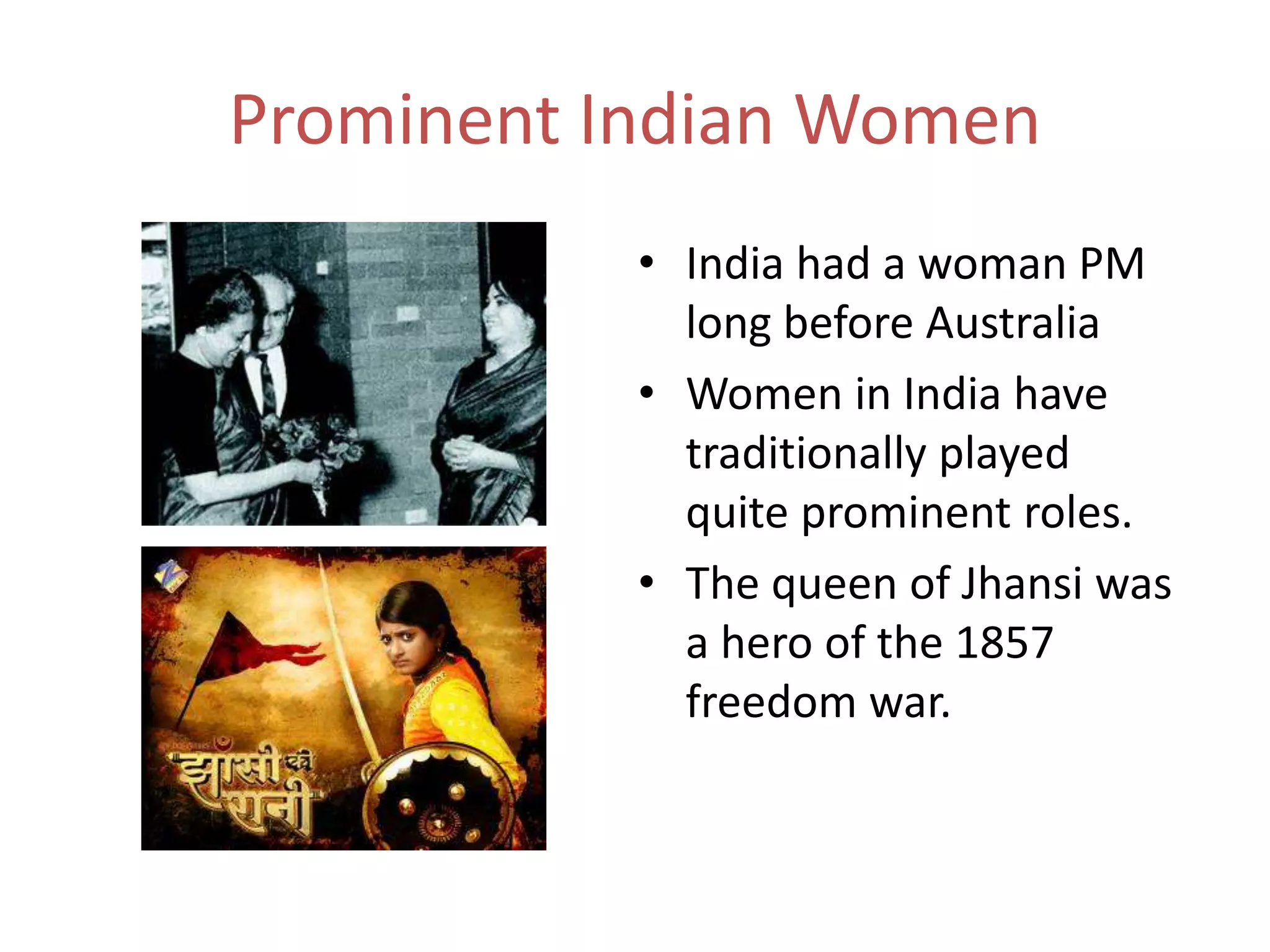
• The queen of Jhansi was
a hero of the 1857
freedom war.
PRESENTED
BY
ARCHANA
CHAUDHARI
GUIDANCE
DR. SAROJ VEERKAR
DID YOU KNOW?
•It is estimated that women perform two-thirds of the world’s
work, yet they only earn one-tenth of the income, and own less
than one percent of the world’s property.
•More than 110 million of the world’s children, two-thirds of
them girls, are not in school.
•Only 17% of the world’s elected government leaders are women.
•More than 80% of the world’s 35 million refugees and displaced
people are women and children.
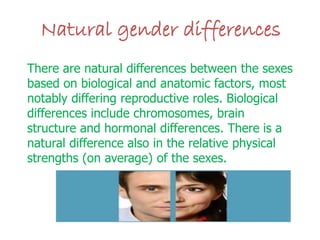
Natural gender differences
There are natural differences between the sexes
based on biological and anatomic factors, most
notably differing reproductive roles. Biological
differences include chromosomes, brain
structure and hormonal differences. There is a
natural difference also in the relative physical
strengths (on average) of the sexes.
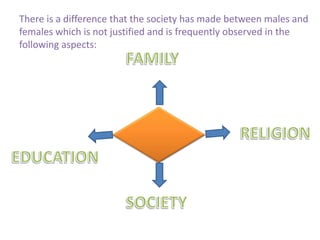
There is a difference that the society has made between males and
females which is not justified and is frequently observed in the
following aspects:
A girl being born is considered inauspicious
whereas the birth of a boy is a cause for
celebration
The nutritious and the better food is given to
the males whereas the women have to eat the
leftovers
The important decisions are taken by the male
and the females have no or little say in it.
The household chores, rearing the child etc.,
are expected to be done by the women.
The society has designed certain norms and
assigned certain roles for both the male and the
female.
The percentage of females to males in Politics is
also less (Though 33% of the seats are reserved for
women, it is only for name sake)
The society doesn't consider it proper for the
parents of a married girl to live with her at her in-
laws house.
The groom’s side always weighs heavier over the
bride’s, and the society accepts the husband showing
his supremacy over the wife.
The women are expected to observe fasts or
‘vrats’.
She cannot fill the position of a religious head.
Religious ceremonies are mostly conducted by
males.
Upanayan vidhi, or performing the last rites of a
deceased are some privileges that have been
granted only to men.
Normally the boys are educated at the best
institutions whereas the girls are educated in
institutions where the fees are less.
The boys are encouraged to opt for Science,
whereas girls are normally pushed towards the
Arts faculty.
Girls aren’t given enough freedom to choose their
careers.
Researches prove that gender bias is also
observed in schools.
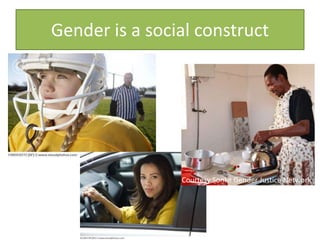
Gender is a social construct
Courtesy Sonke Gender Justice Network
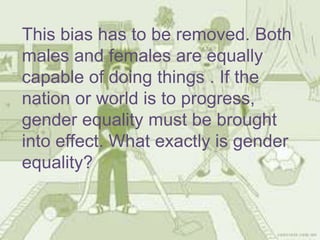
This bias has to be removed. Both
males and females are equally
capable of doing things . If the
nation or world is to progress,
gender equality must be brought
into effect. What exactly is gender
equality?
• Long-term goal
• Absence of discrimination
based on sex
• Equality between men and
women exists when both
sexes are able to share
equally in the distribution
of power and influence
Gender
Equality
• Gender equity is the process
of being fair to women and
men.
• To ensure fairness, strategies
and measures must often be
available to compensate for
women’s historical and social
disadvantages that prevent
women and men from
otherwise operating on a
level playing field.
• Equity leads to equality.
GENDER
EQUITY
Where gender inequality exists, it is generally women who
are excluded or disadvantaged in relation to decision-
making and access to economic and social resources.
Therefore a critical aspect of promoting gender equality is
the empowerment of women, with a focus on identifying
and redressing power imbalances and giving women
more autonomy to manage their own lives.
Our Constitution has laid down certain
laws for women.
According to Article 15 of our
Constitution, you cannot discriminate
people on the basis of religion, caste,
gender or race.
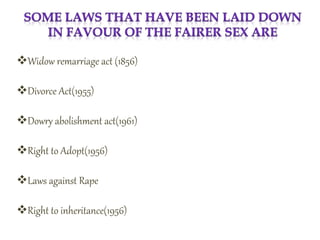
Widow remarriage act (1856)
Divorce Act(1955)
Dowry abolishment act(1961)
Right to Adopt(1956)
Laws against Rape
Right to inheritance(1956)
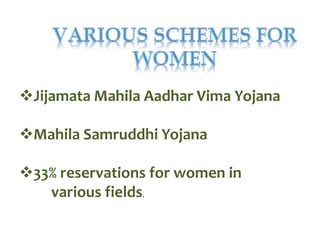
Jijamata Mahila Aadhar Vima Yojana
Mahila Samruddhi Yojana
33% reservations for women in
various fields.
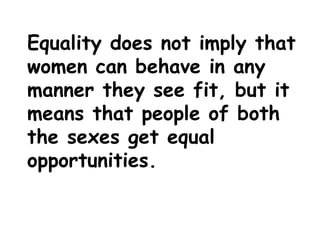
Equality does not imply that
women can behave in any
manner they see fit, but it
means that people of both
the sexes get equal
opportunities.
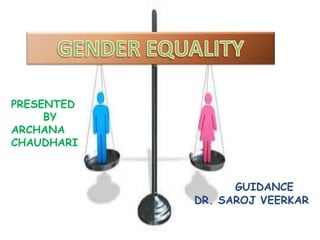
Gender equality
Gender equality

Gender equality

  • 1.
    Prominent Indian Women •India had a woman PM long before Australia • Women in India have traditionally played quite prominent roles. • The queen of Jhansi was a hero of the 1857 freedom war.
  • 2.
  • 3.
    DID YOU KNOW? •Itis estimated that women perform two-thirds of the world’s work, yet they only earn one-tenth of the income, and own less than one percent of the world’s property. •More than 110 million of the world’s children, two-thirds of them girls, are not in school. •Only 17% of the world’s elected government leaders are women. •More than 80% of the world’s 35 million refugees and displaced people are women and children.
  • 4.
    Natural gender differences Thereare natural differences between the sexes based on biological and anatomic factors, most notably differing reproductive roles. Biological differences include chromosomes, brain structure and hormonal differences. There is a natural difference also in the relative physical strengths (on average) of the sexes.
  • 5.
    There is adifference that the society has made between males and females which is not justified and is frequently observed in the following aspects:
  • 6.
    A girl beingborn is considered inauspicious whereas the birth of a boy is a cause for celebration The nutritious and the better food is given to the males whereas the women have to eat the leftovers The important decisions are taken by the male and the females have no or little say in it. The household chores, rearing the child etc., are expected to be done by the women.
  • 7.
    The society hasdesigned certain norms and assigned certain roles for both the male and the female. The percentage of females to males in Politics is also less (Though 33% of the seats are reserved for women, it is only for name sake) The society doesn't consider it proper for the parents of a married girl to live with her at her in- laws house. The groom’s side always weighs heavier over the bride’s, and the society accepts the husband showing his supremacy over the wife.
  • 8.
    The women areexpected to observe fasts or ‘vrats’. She cannot fill the position of a religious head. Religious ceremonies are mostly conducted by males. Upanayan vidhi, or performing the last rites of a deceased are some privileges that have been granted only to men.
  • 9.
    Normally the boysare educated at the best institutions whereas the girls are educated in institutions where the fees are less. The boys are encouraged to opt for Science, whereas girls are normally pushed towards the Arts faculty. Girls aren’t given enough freedom to choose their careers. Researches prove that gender bias is also observed in schools.
  • 10.
    Gender is asocial construct Courtesy Sonke Gender Justice Network
  • 11.
    This bias hasto be removed. Both males and females are equally capable of doing things . If the nation or world is to progress, gender equality must be brought into effect. What exactly is gender equality?
  • 12.
    • Long-term goal •Absence of discrimination based on sex • Equality between men and women exists when both sexes are able to share equally in the distribution of power and influence Gender Equality
  • 13.
    • Gender equityis the process of being fair to women and men. • To ensure fairness, strategies and measures must often be available to compensate for women’s historical and social disadvantages that prevent women and men from otherwise operating on a level playing field. • Equity leads to equality. GENDER EQUITY
  • 14.
    Where gender inequalityexists, it is generally women who are excluded or disadvantaged in relation to decision- making and access to economic and social resources. Therefore a critical aspect of promoting gender equality is the empowerment of women, with a focus on identifying and redressing power imbalances and giving women more autonomy to manage their own lives.
  • 15.
    Our Constitution haslaid down certain laws for women. According to Article 15 of our Constitution, you cannot discriminate people on the basis of religion, caste, gender or race.
  • 16.
    Widow remarriage act(1856) Divorce Act(1955) Dowry abolishment act(1961) Right to Adopt(1956) Laws against Rape Right to inheritance(1956)
  • 17.
    Jijamata Mahila AadharVima Yojana Mahila Samruddhi Yojana 33% reservations for women in various fields.
  • 18.
    Equality does notimply that women can behave in any manner they see fit, but it means that people of both the sexes get equal opportunities.

Editor's Notes

  • #13 e.g. of eye color (It does not mean that women and men have to become the same, but that their rights, responsibilities, and opportunities will not depend on whether they are born male or female. )