1
Simple Keynesian Model
MOOCS
by
Dr. Subir Maitra
Associate Professor of Economics
For B.Com (Honours) Third YearFor B.Com (Honours) Third Year
2
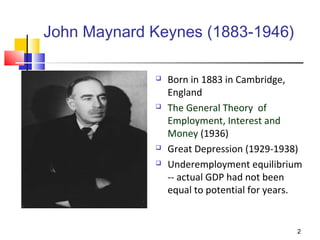
John Maynard Keynes (1883-1946)
 Born in 1883 in Cambridge,
England
 The General Theory of
Employment, Interest and
Money (1936)
 Great Depression (1929-1938)
 Underemployment equilibrium
-- actual GDP had not been
equal to potential for years.
The Great Depression
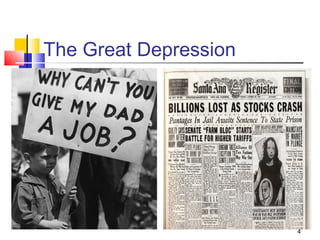
 The Great Depression lasted from 1929 to 1939, and was the
worst economic downturn in the history of the industrialized
world.
 It began after the stock market crash of October 1929, which
sent Wall Street into a panic and wiped out millions of investors.
 Over the next several years, consumer spending and
investment dropped, causing steep declines in industrial output
and employment as failing companies laid off workers.
 By 1933, when the Great Depression reached its lowest point,
some 15 million Americans were unemployed and nearly half
the country’s banks had failed.
3
The Great Depression
4
The Great Depression: Causes
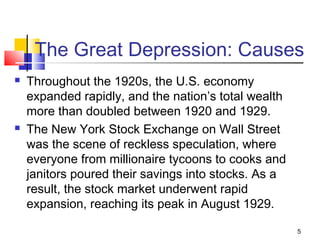
 Throughout the 1920s, the U.S. economy
expanded rapidly, and the nation’s total wealth
more than doubled between 1920 and 1929.
 The New York Stock Exchange on Wall Street
was the scene of reckless speculation, where
everyone from millionaire tycoons to cooks and
janitors poured their savings into stocks. As a
result, the stock market underwent rapid
expansion, reaching its peak in August 1929.
5
The Great Depression: Causes
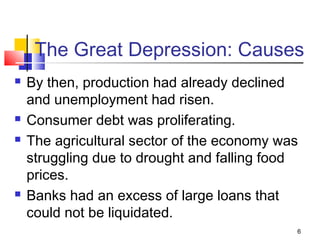
 By then, production had already declined
and unemployment had risen.
 Consumer debt was proliferating.
 The agricultural sector of the economy was
struggling due to drought and falling food
prices.
 Banks had an excess of large loans that
could not be liquidated.
6
The Great Depression: Causes
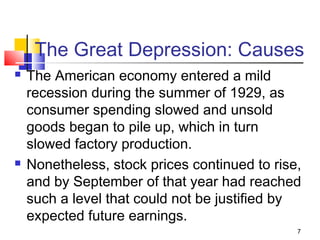
 The American economy entered a mild
recession during the summer of 1929, as
consumer spending slowed and unsold
goods began to pile up, which in turn
slowed factory production.
 Nonetheless, stock prices continued to rise,
and by September of that year had reached
such a level that could not be justified by
expected future earnings.
7
THE STOCK MARKET CRASH OF
1929
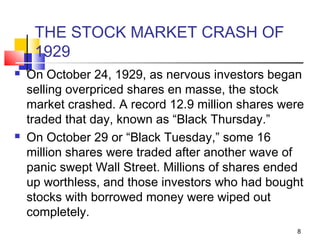
 On October 24, 1929, as nervous investors began
selling overpriced shares en masse, the stock
market crashed. A record 12.9 million shares were
traded that day, known as “Black Thursday.”
 On October 29 or “Black Tuesday,” some 16
million shares were traded after another wave of
panic swept Wall Street. Millions of shares ended
up worthless, and those investors who had bought
stocks with borrowed money were wiped out
completely.
8
THE STOCK MARKET CRASH OF
1929
 As consumer confidence vanished in the
wake of the stock market crash, the
downturn in spending and investment led
factories and other businesses to slow
down production and begin firing their
workers. For those who were lucky enough
to remain employed, wages fell and buying
power decreased. Many Americans fell into
debt.
9
10
Simple Keynesian Model
 The Keynesian model distinguishes:
 Actual GDP -- what GDP happens to be right now
 Potential GDP -- full employment GDP
 Equilibrium GDP -- a level of GDP at which there
are no forces tending to change the level of
GDP.
 This most important assumption of this model is
that prices are constant. In the short run, firms
stand ready to supply whatever output their
customers want at the given prices.
11
Simple Keynesian Model
 Thus demand is the ruling force in this model.
If demand is strong, real GDP exceeds
potential. In recession, when demand is
weak, real GDP drops below potential.
 This Model is a static model of the economy
which helps us to determine equilibrium real
national income based on ‘effective demand’
principle.
12
Assumptions
 One-sector model: The SKM is a one-sector
model which includes only the goods market.
 Absence of monetary sector: There is no
monetary sector in the SKM.
 Static model: The SKM is a static model. The
model solves for static equilibrium level of real
output, which is the value of real output that has
no tendency to change once it has been
established.
13
Assumptions
 Closed economy with or without Government:
The SKM assumes a closed economy (i.e.
without foreign trade) with or without Government.
 Constant prices: In stark contrast to the quantity
theory model, the SKM assumes an exogenously
fixed price level.
 Short-run model: The model is a short-run model
and determines the value of real national output
for a particular period of time, such as a year.
14
Assumptions
 Fixed stock of capital and labour: The model assumes that
both the stock of capital and the labour force, which when
fully utilised determine the maximum level of real output
the economy can produce, are constant.
 Profit maximization: An underlying behavioural assumption
is that firms act as profit maximisers. If demand for their
output exceeds supply, firms increase production,
providing there are spare resources put to work.
Conversely if supply exceeds demand, firms reduce
output.
15
Assumptions
 Effective demand principle: The SKM is based on
Keynesian ‘effective demand principle’. According
to this principle, since commodities are necessarily
produced for a market, the size of the market must
regulate the level of commodity production. Put
differently, effective demand refers to that level of
the value of aggregate output which, if produced
and paid out as income, will be matched by an
equivalent amount of expenditure.
16
Equilibrium Income (AD—AS
Approach)
 Equilibrium in the SKM requires that the supply of real
national output, Y, equals the quantity of national output
which people wish to buy, E. The condition for static
equilibrium in this model is therefore Y = E
 E is the ‘desired’ Aggregate Demand or, alternatively,
‘Planned Expenditure’.
 Y is ‘Aggregate Supply’ or ‘Actual Expenditure’ in the
economy and rewrite the above condition as Actual
Expenditure (Aggregate Supply) = Planned Expenditure
(Aggregate Demand)
17
Variants of Simple Keynesian Model
 Simple Keynesian Model without
Government and Foreign Trade
 Simple Keynesian Model with
Government and without Foreign Trade
 Simple Keynesian Model with
Government and Foreign Trade

Simple keynesian model

  • 1.
    1 Simple Keynesian Model MOOCS by Dr.Subir Maitra Associate Professor of Economics For B.Com (Honours) Third YearFor B.Com (Honours) Third Year
  • 2.
    2 John Maynard Keynes(1883-1946)  Born in 1883 in Cambridge, England  The General Theory of Employment, Interest and Money (1936)  Great Depression (1929-1938)  Underemployment equilibrium -- actual GDP had not been equal to potential for years.
  • 3.
    The Great Depression The Great Depression lasted from 1929 to 1939, and was the worst economic downturn in the history of the industrialized world.  It began after the stock market crash of October 1929, which sent Wall Street into a panic and wiped out millions of investors.  Over the next several years, consumer spending and investment dropped, causing steep declines in industrial output and employment as failing companies laid off workers.  By 1933, when the Great Depression reached its lowest point, some 15 million Americans were unemployed and nearly half the country’s banks had failed. 3
  • 4.
  • 5.
    The Great Depression:Causes  Throughout the 1920s, the U.S. economy expanded rapidly, and the nation’s total wealth more than doubled between 1920 and 1929.  The New York Stock Exchange on Wall Street was the scene of reckless speculation, where everyone from millionaire tycoons to cooks and janitors poured their savings into stocks. As a result, the stock market underwent rapid expansion, reaching its peak in August 1929. 5
  • 6.
    The Great Depression:Causes  By then, production had already declined and unemployment had risen.  Consumer debt was proliferating.  The agricultural sector of the economy was struggling due to drought and falling food prices.  Banks had an excess of large loans that could not be liquidated. 6
  • 7.
    The Great Depression:Causes  The American economy entered a mild recession during the summer of 1929, as consumer spending slowed and unsold goods began to pile up, which in turn slowed factory production.  Nonetheless, stock prices continued to rise, and by September of that year had reached such a level that could not be justified by expected future earnings. 7
  • 8.
    THE STOCK MARKETCRASH OF 1929  On October 24, 1929, as nervous investors began selling overpriced shares en masse, the stock market crashed. A record 12.9 million shares were traded that day, known as “Black Thursday.”  On October 29 or “Black Tuesday,” some 16 million shares were traded after another wave of panic swept Wall Street. Millions of shares ended up worthless, and those investors who had bought stocks with borrowed money were wiped out completely. 8
  • 9.
    THE STOCK MARKETCRASH OF 1929  As consumer confidence vanished in the wake of the stock market crash, the downturn in spending and investment led factories and other businesses to slow down production and begin firing their workers. For those who were lucky enough to remain employed, wages fell and buying power decreased. Many Americans fell into debt. 9
  • 10.
    10 Simple Keynesian Model The Keynesian model distinguishes:  Actual GDP -- what GDP happens to be right now  Potential GDP -- full employment GDP  Equilibrium GDP -- a level of GDP at which there are no forces tending to change the level of GDP.  This most important assumption of this model is that prices are constant. In the short run, firms stand ready to supply whatever output their customers want at the given prices.
  • 11.
    11 Simple Keynesian Model Thus demand is the ruling force in this model. If demand is strong, real GDP exceeds potential. In recession, when demand is weak, real GDP drops below potential.  This Model is a static model of the economy which helps us to determine equilibrium real national income based on ‘effective demand’ principle.
  • 12.
    12 Assumptions  One-sector model:The SKM is a one-sector model which includes only the goods market.  Absence of monetary sector: There is no monetary sector in the SKM.  Static model: The SKM is a static model. The model solves for static equilibrium level of real output, which is the value of real output that has no tendency to change once it has been established.
  • 13.
    13 Assumptions  Closed economywith or without Government: The SKM assumes a closed economy (i.e. without foreign trade) with or without Government.  Constant prices: In stark contrast to the quantity theory model, the SKM assumes an exogenously fixed price level.  Short-run model: The model is a short-run model and determines the value of real national output for a particular period of time, such as a year.
  • 14.
    14 Assumptions  Fixed stockof capital and labour: The model assumes that both the stock of capital and the labour force, which when fully utilised determine the maximum level of real output the economy can produce, are constant.  Profit maximization: An underlying behavioural assumption is that firms act as profit maximisers. If demand for their output exceeds supply, firms increase production, providing there are spare resources put to work. Conversely if supply exceeds demand, firms reduce output.
  • 15.
    15 Assumptions  Effective demandprinciple: The SKM is based on Keynesian ‘effective demand principle’. According to this principle, since commodities are necessarily produced for a market, the size of the market must regulate the level of commodity production. Put differently, effective demand refers to that level of the value of aggregate output which, if produced and paid out as income, will be matched by an equivalent amount of expenditure.
  • 16.
    16 Equilibrium Income (AD—AS Approach) Equilibrium in the SKM requires that the supply of real national output, Y, equals the quantity of national output which people wish to buy, E. The condition for static equilibrium in this model is therefore Y = E  E is the ‘desired’ Aggregate Demand or, alternatively, ‘Planned Expenditure’.  Y is ‘Aggregate Supply’ or ‘Actual Expenditure’ in the economy and rewrite the above condition as Actual Expenditure (Aggregate Supply) = Planned Expenditure (Aggregate Demand)
  • 17.
    17 Variants of SimpleKeynesian Model  Simple Keynesian Model without Government and Foreign Trade  Simple Keynesian Model with Government and without Foreign Trade  Simple Keynesian Model with Government and Foreign Trade